TYPES OF RADIATION/INTERACTION
       WITH MATTER/RADIATION
              DETECTORS

Girish kumar Palvai
Website: www.conceptualphysicstoday.com
Email: palvaigirish@physicsdownloads.com
Topics under Discussion

 What is Radiation?
   Types of Radiation?
   Interaction of radiation with matter.
   Why Radiation Detection?
   Types of Radiation detectors
   Radiation Detectors in ECIL
   Radiation --- harmful to mankind?
Radiation could be referred to as flux of energetic
particles emanating from Nuclei /atomic events.


The word radiation in the present world covers both high
energy photons and energetic subatomic particles such
as electrons, protons, -particles, fission products etc.
Process of emission of energetic
subatomic/Nuclei particles due to change
in state of certain atoms/nuclei. Such nuclei
are called unstable nuclides.

This phenomenon is called Radioactivity.
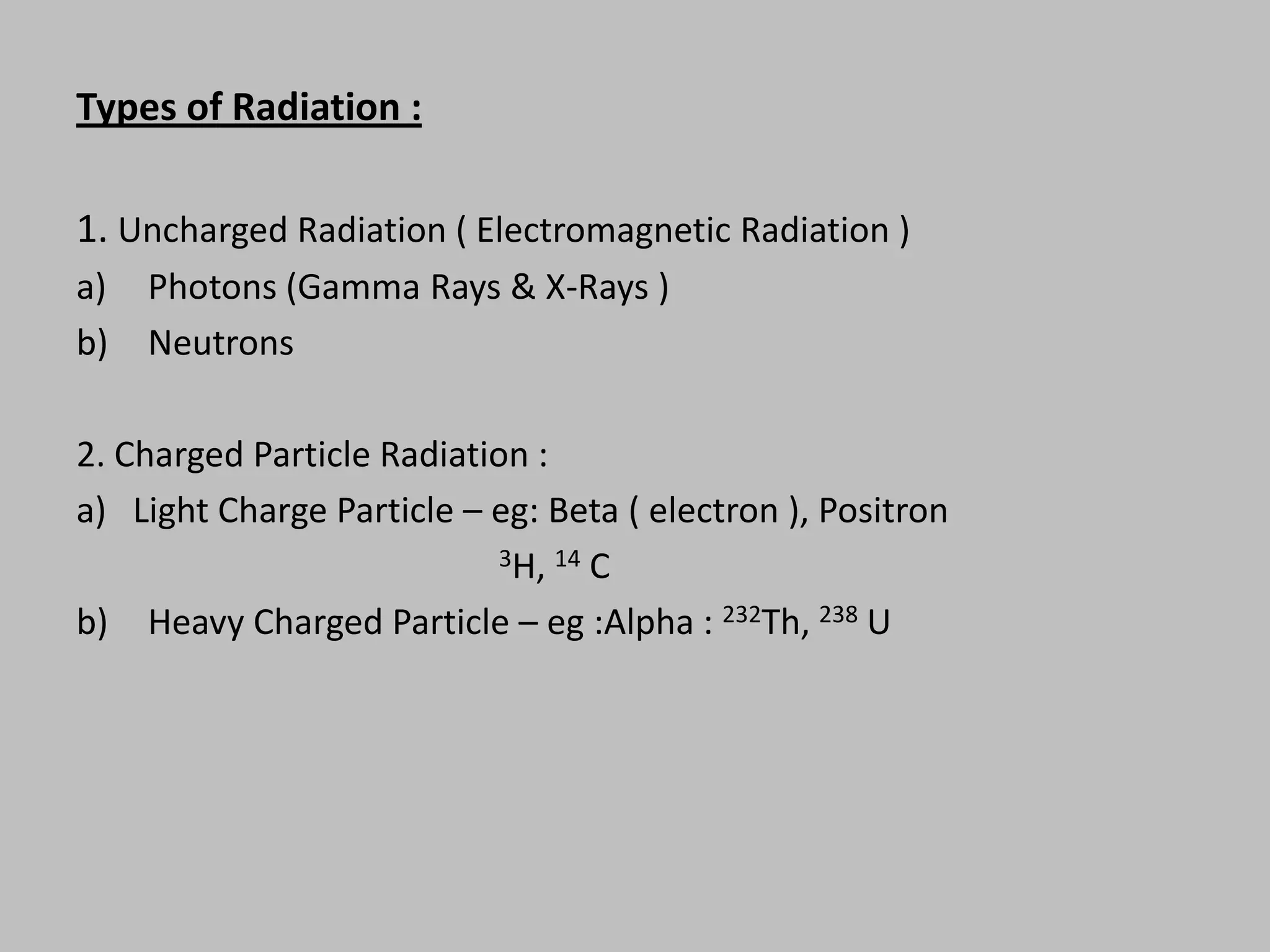
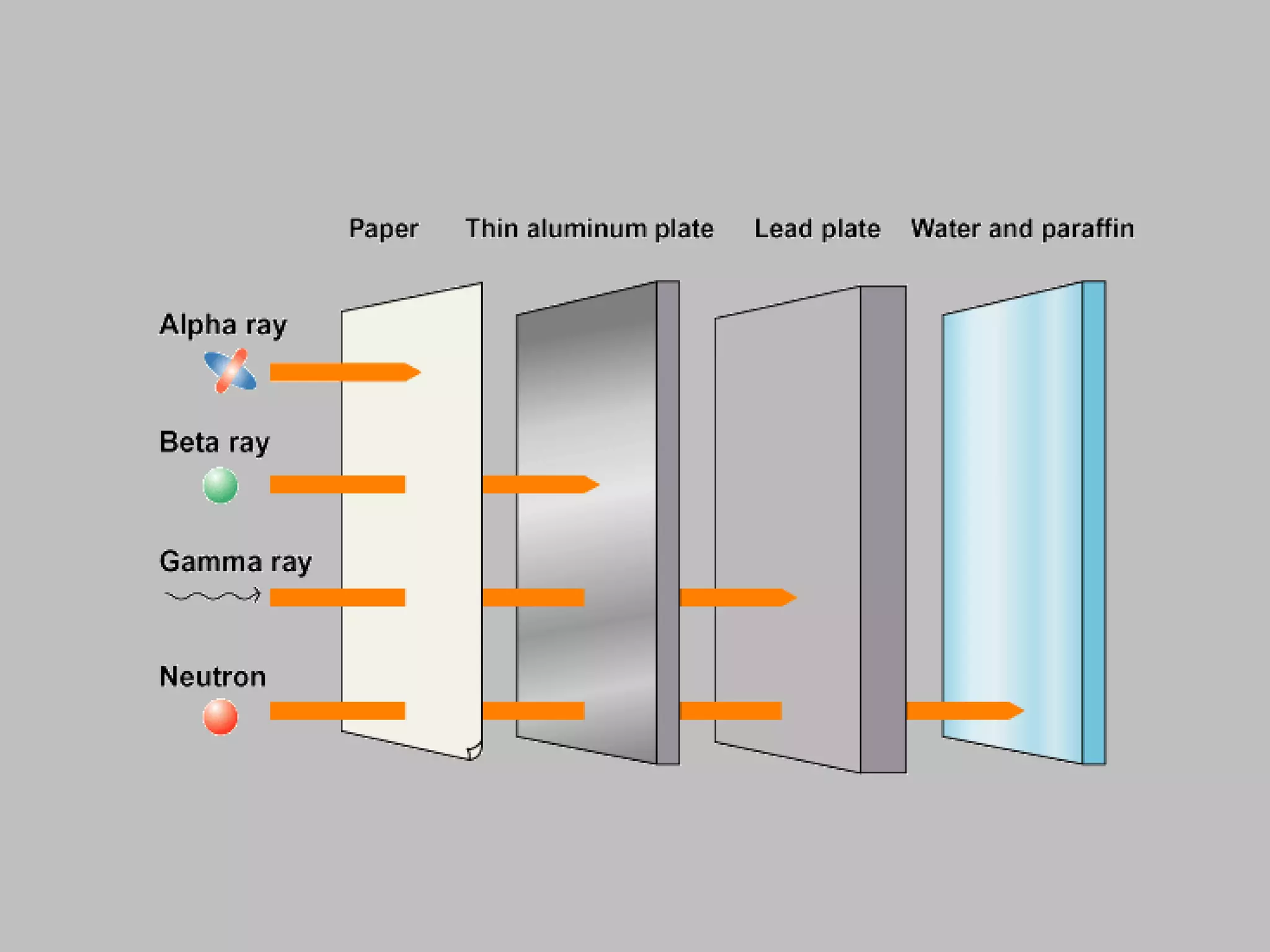
Types of Radiation :

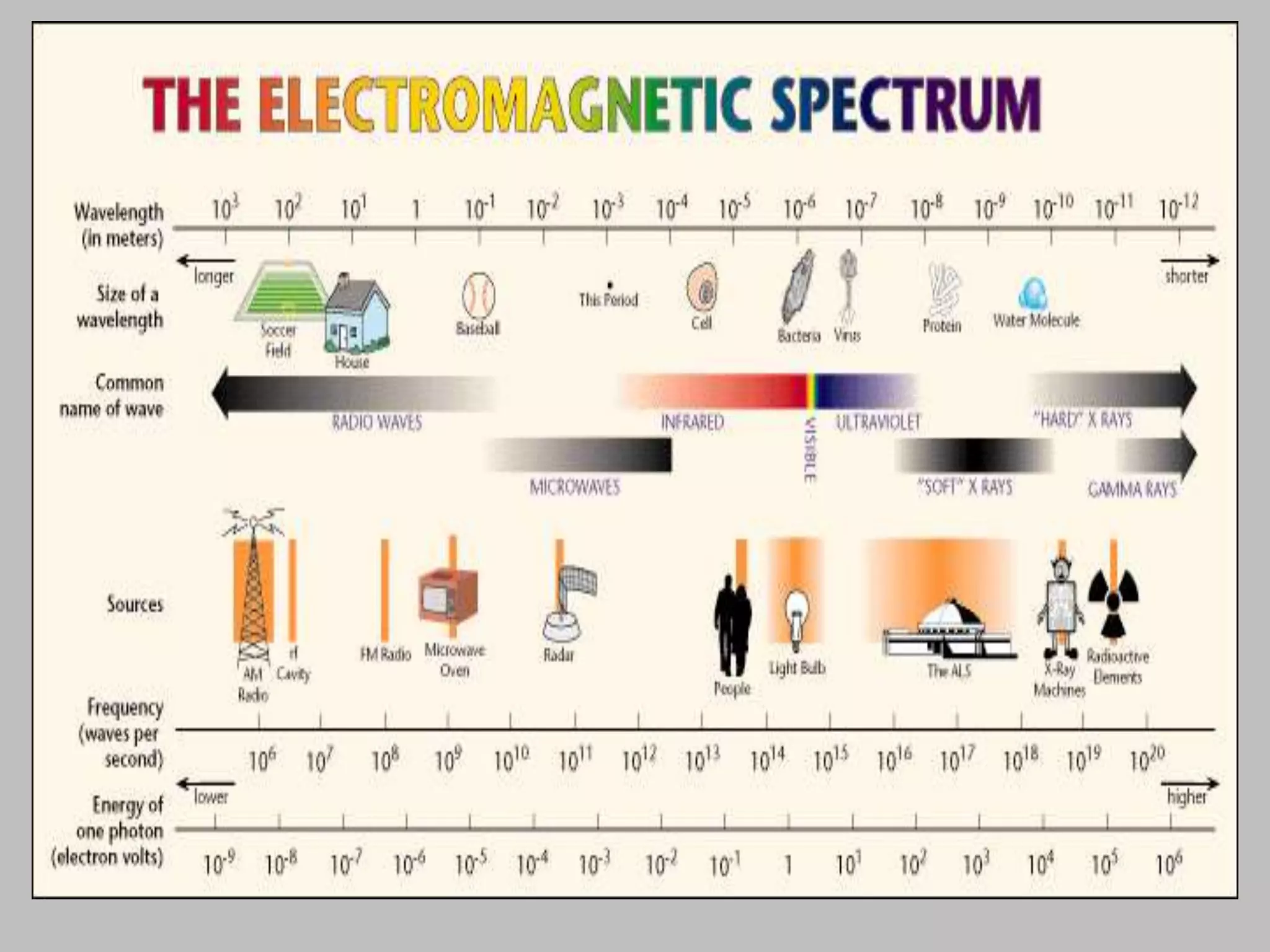
1. Uncharged Radiation ( Electromagnetic Radiation )
a)   Photons (Gamma Rays & X-Rays )
b)   Neutrons

2. Charged Particle Radiation :
a) Light Charge Particle – eg: Beta ( electron ), Positron
                            3H, 14 C

b) Heavy Charged Particle – eg :Alpha : 232Th, 238 U
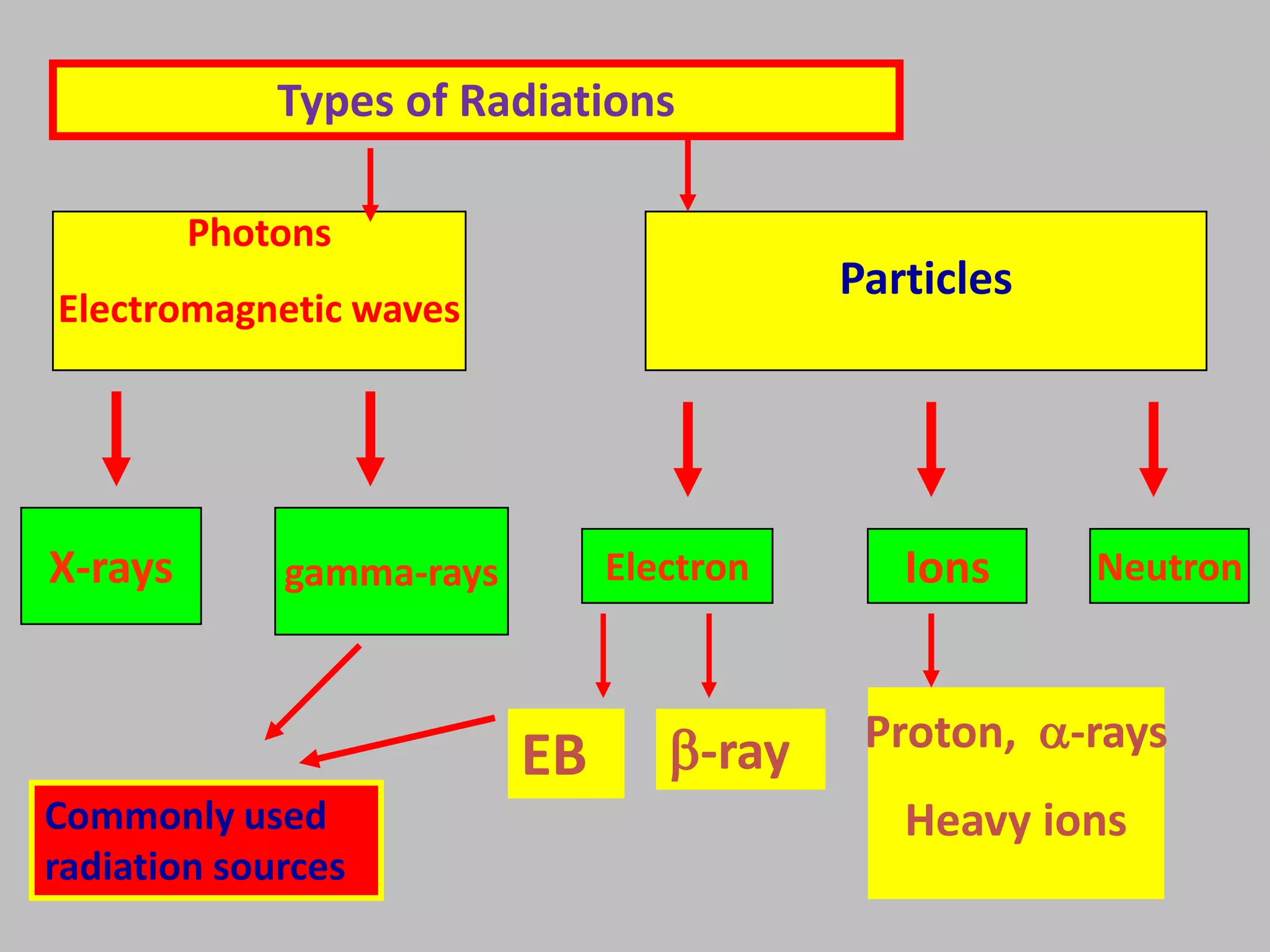
Types of Radiations

         Photons
                                          Particles
Electromagnetic waves


X-rays       gamma-rays        Electron      Ions     Neutron


                                  -ray    Proton, -rays
                          EB
Commonly used                                Heavy ions
radiation sources
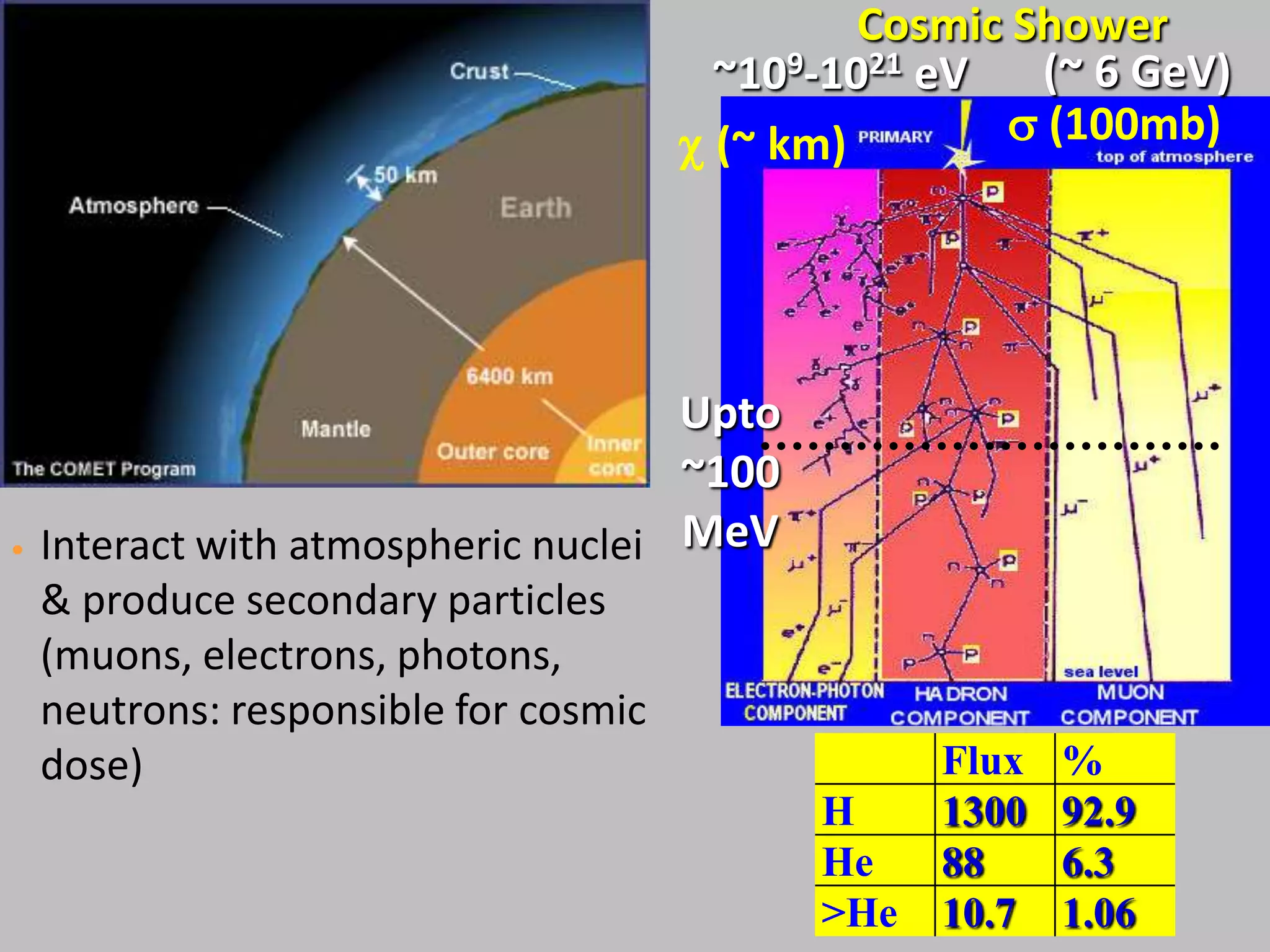
Cosmic Shower
                                         ~109-1021 eV   (~ 6 GeV)
                                        (~ km)         (100mb)
    2 x 10¹⁸ particles (mainly
      protons) / s enter the
          atmosphere
          (ISOTROPIC)
                                     Upto
                                     ~100
•   Interact with atmospheric nuclei MeV
    & produce secondary particles
    (muons, electrons, photons,
    neutrons: responsible for cosmic
    dose)                                          Flux   %
                                             H     1300   92.9
                                             He    88     6.3
                                             >He   10.7   1.06
S
o
u
r


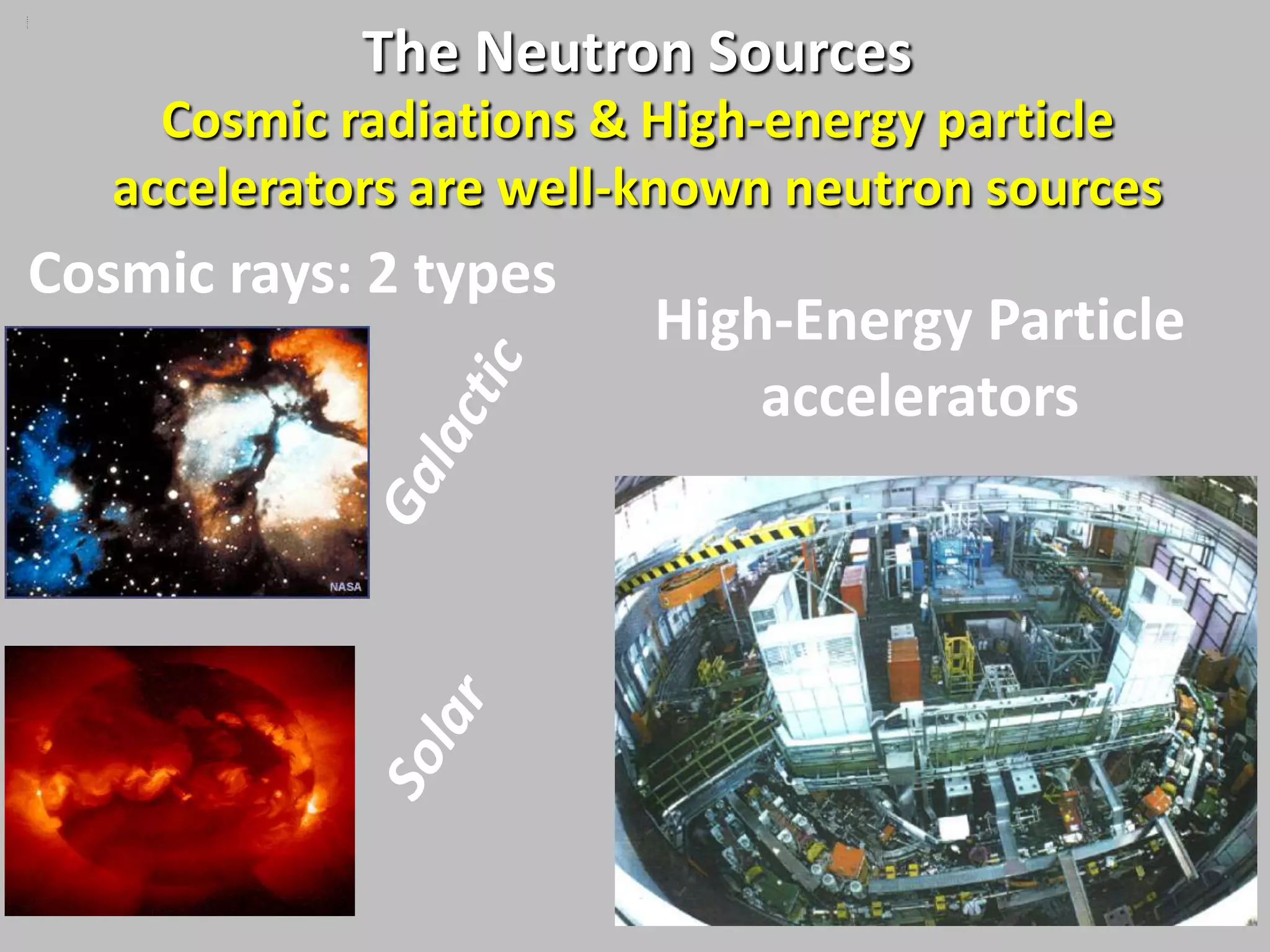
              The Neutron Sources
c
e


      Cosmic radiations & High-energy particle
    accelerators are well-known neutron sources
Cosmic rays: 2 types
                          High-Energy Particle
                              accelerators
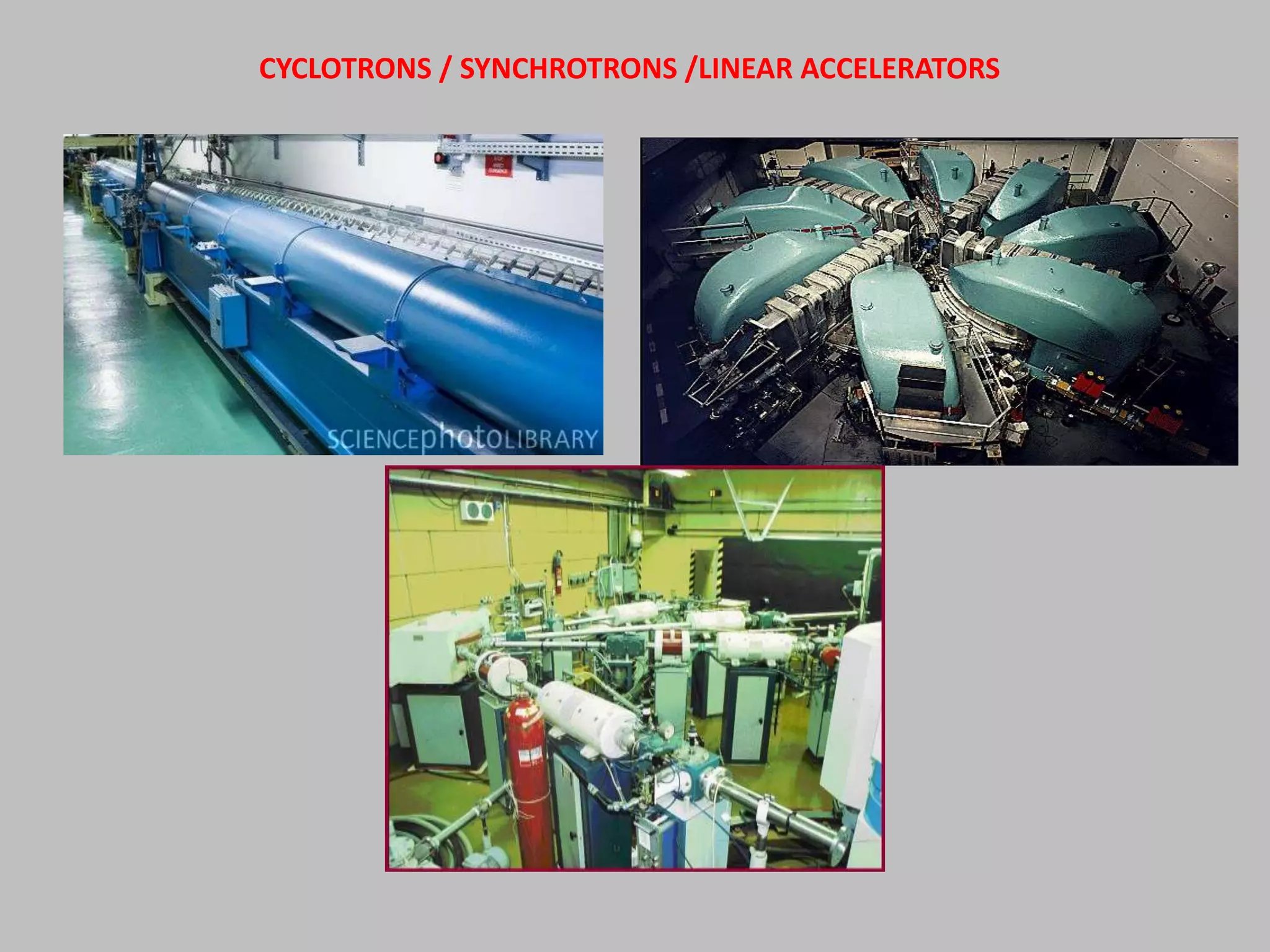
CYCLOTRONS / SYNCHROTRONS /LINEAR ACCELERATORS
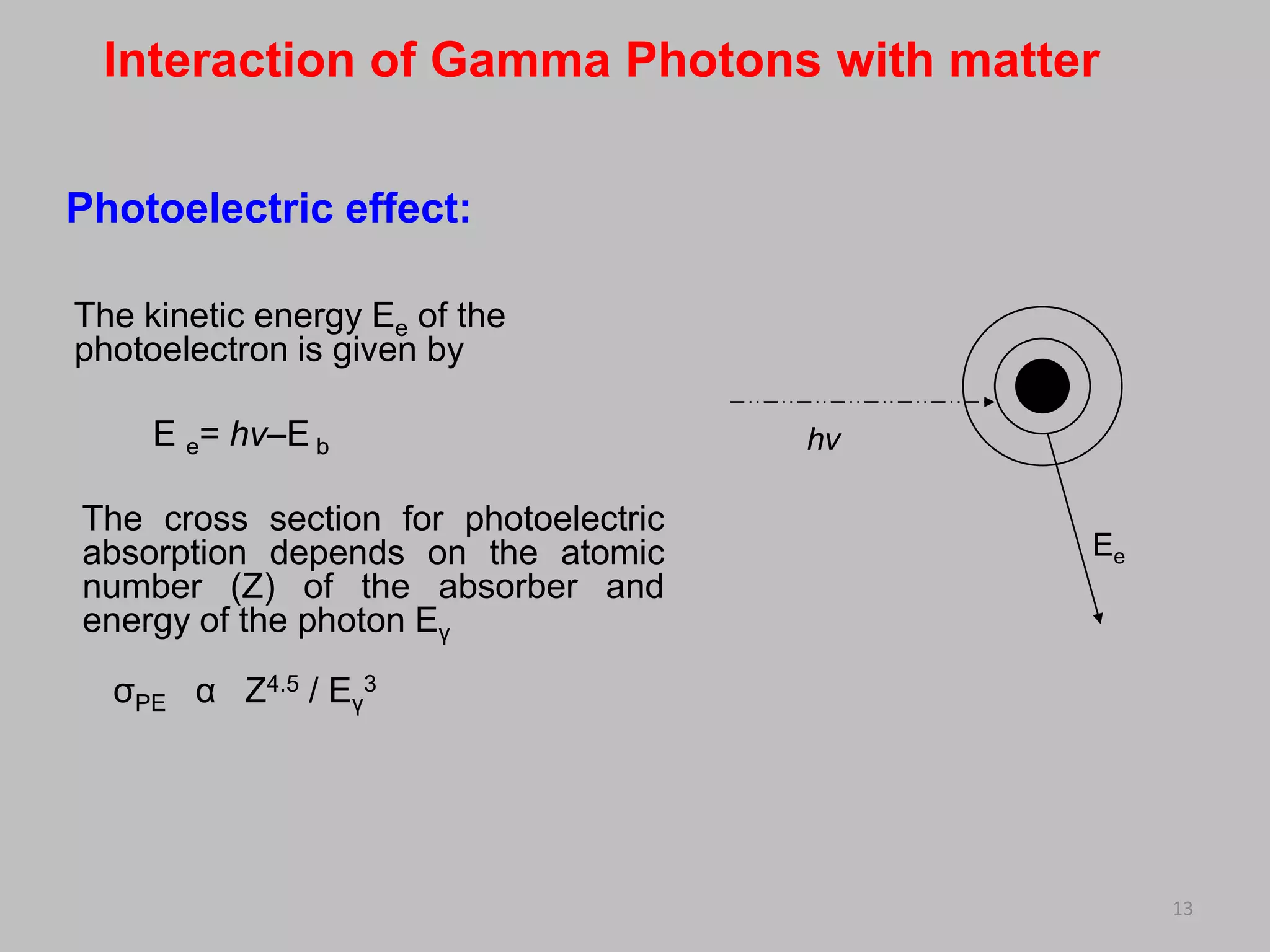
Interaction of Gamma Photons with matter

Photoelectric effect:

The kinetic energy Ee of the
photoelectron is given by

     E e= hν–E b                      hν

The cross section for photoelectric
absorption depends on the atomic           Ee
number (Z) of the absorber and
energy of the photon Eγ
  σPE α Z4.5 / Eγ3


                                                13
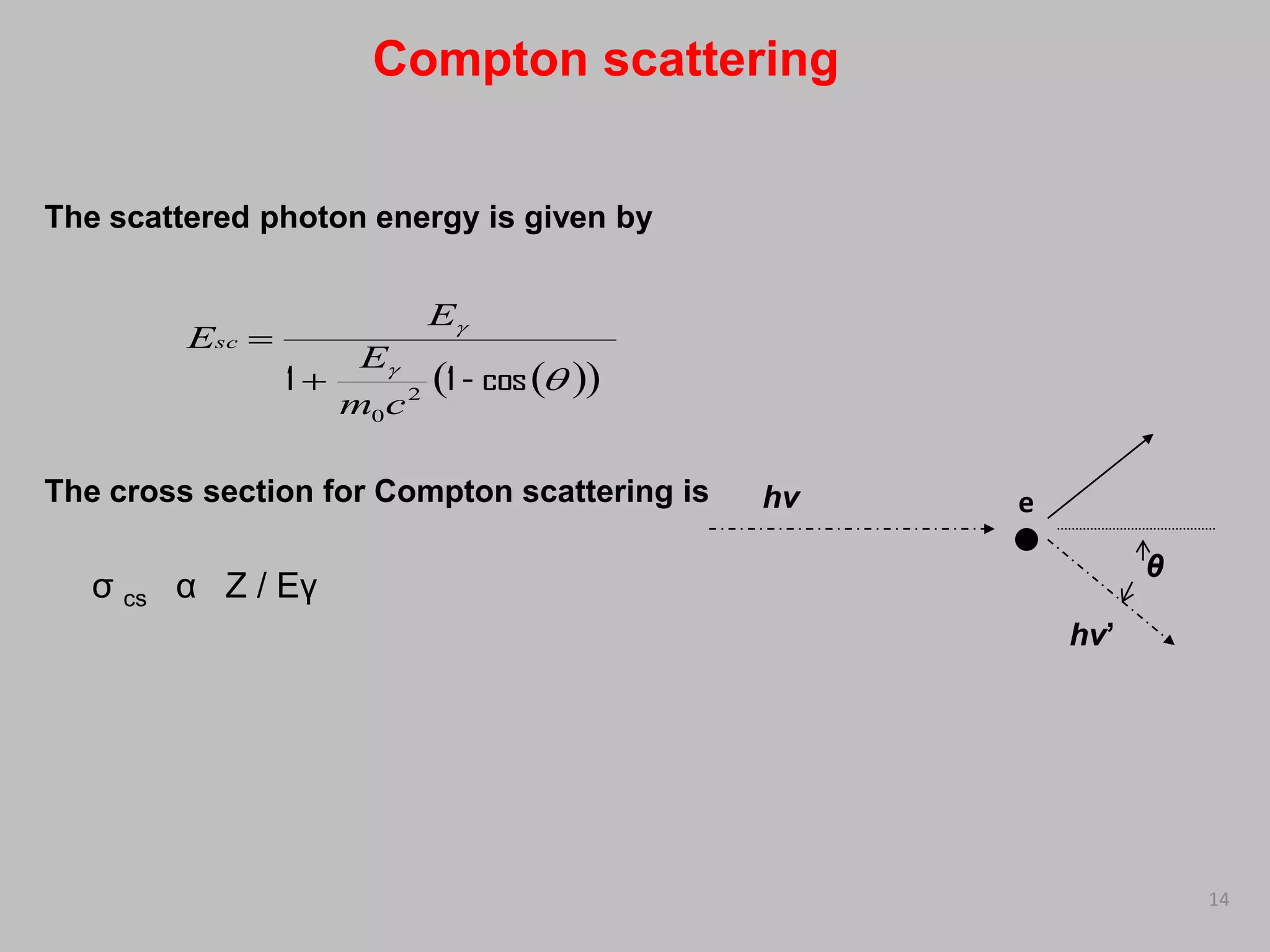
Compton scattering


The scattered photon energy is given by


                             E
         Esc 
                       E
                 1          1 - cos  
                      m0 c 2

The cross section for Compton scattering is   hν   e

                                                             θ
   σ cs α Z / Eγ
                                                       hν’


                                                                 14
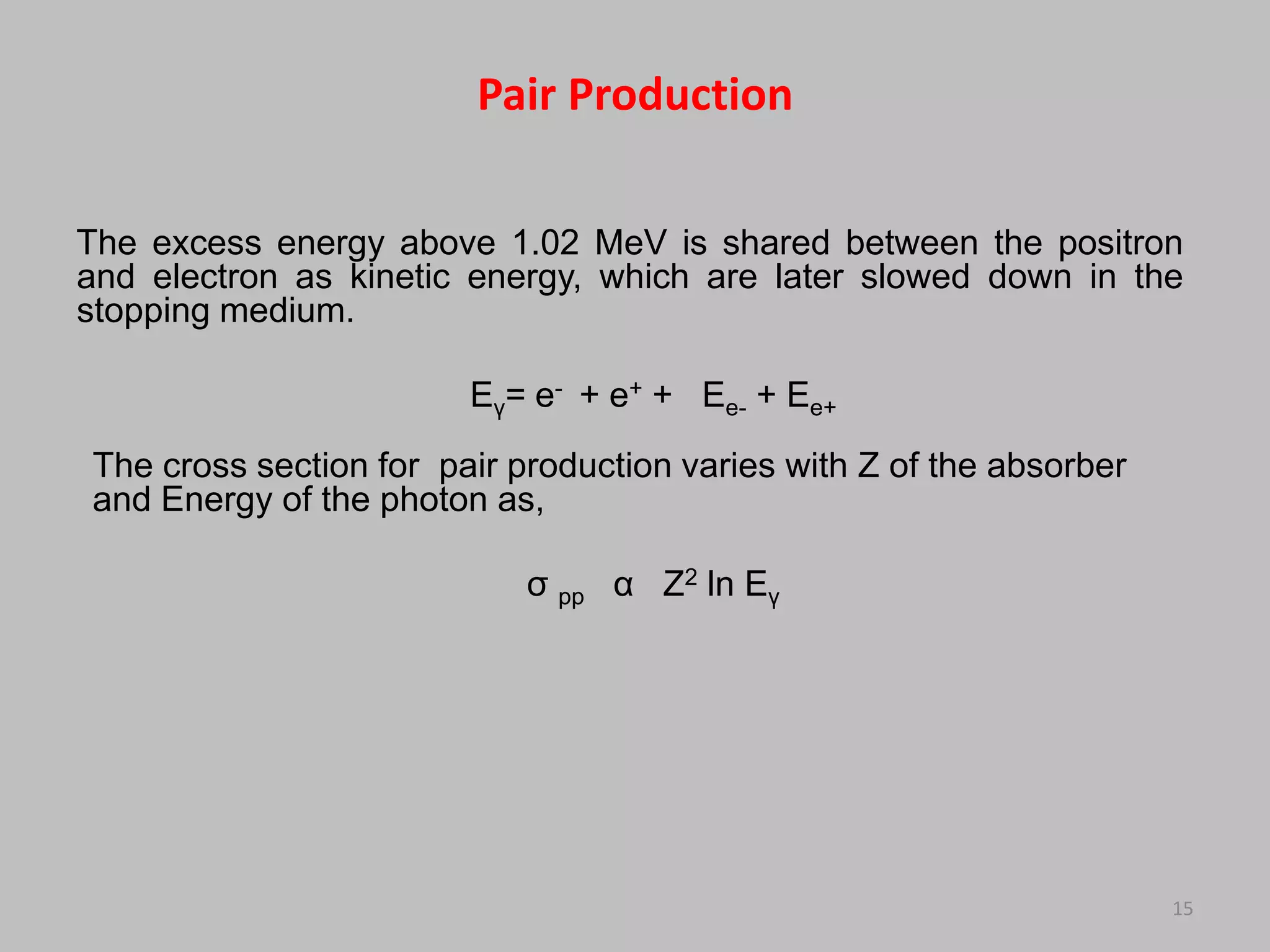
Pair Production

The excess energy above 1.02 MeV is shared between the positron
and electron as kinetic energy, which are later slowed down in the
stopping medium.

                        Eγ= e- + e+ + Ee- + Ee+
The cross section for pair production varies with Z of the absorber
and Energy of the photon as,

                            σ pp α Z2 ln Eγ


                                                                      15
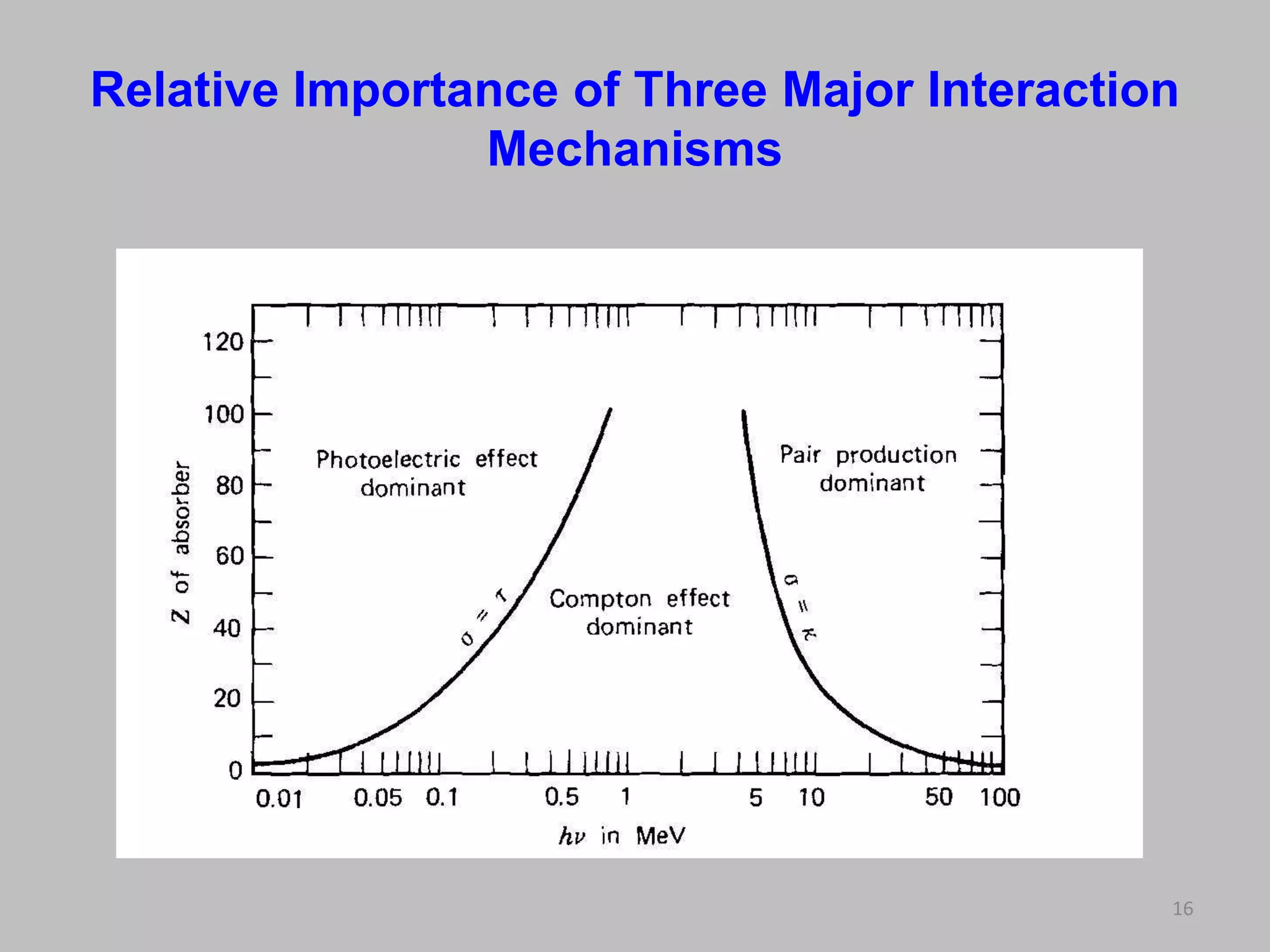
Relative Importance of Three Major Interaction
                Mechanisms


                                             16
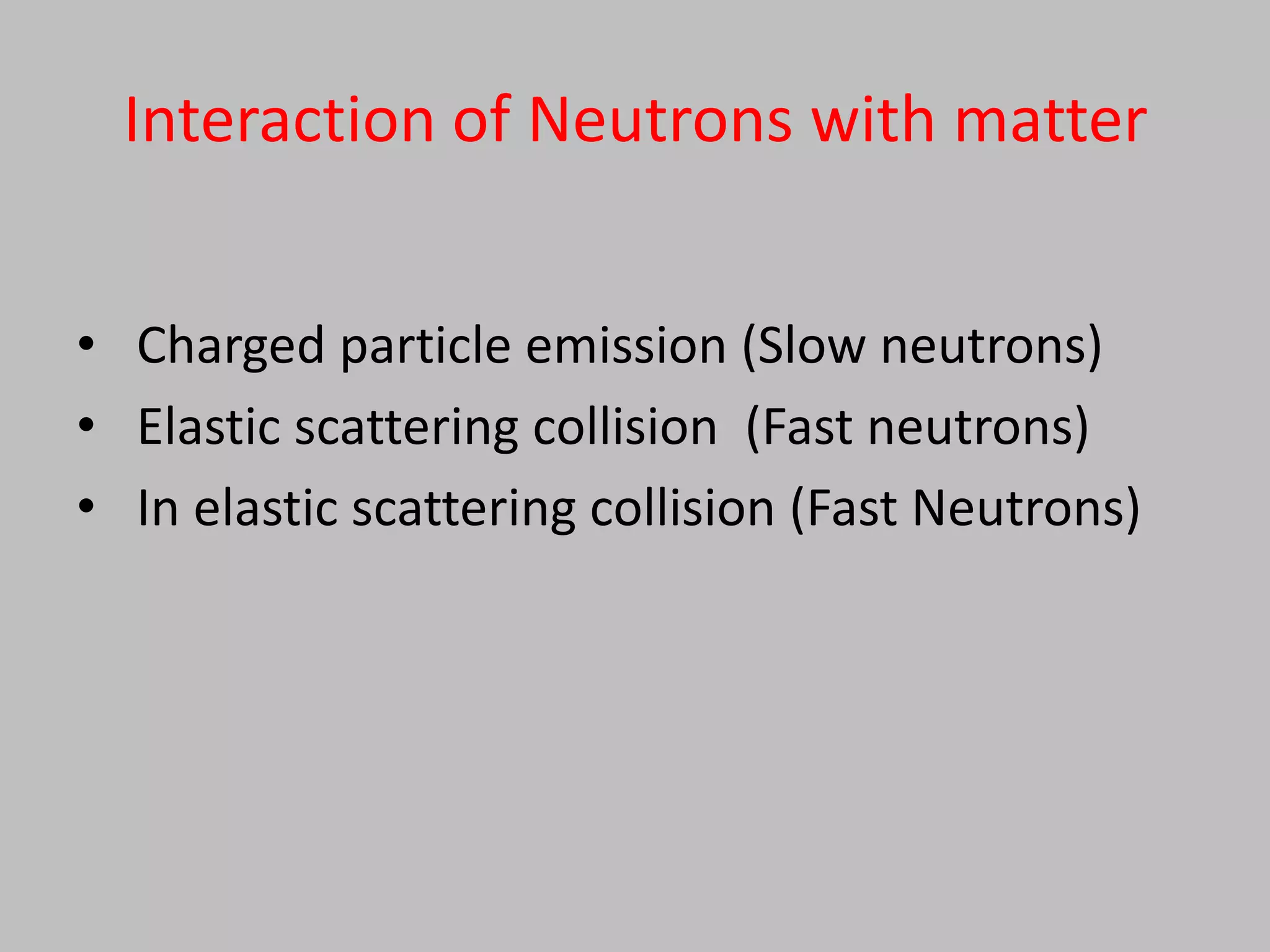
Interaction of Neutrons with matter


• Charged particle emission (Slow neutrons)
• Elastic scattering collision (Fast neutrons)
• In elastic scattering collision (Fast Neutrons)
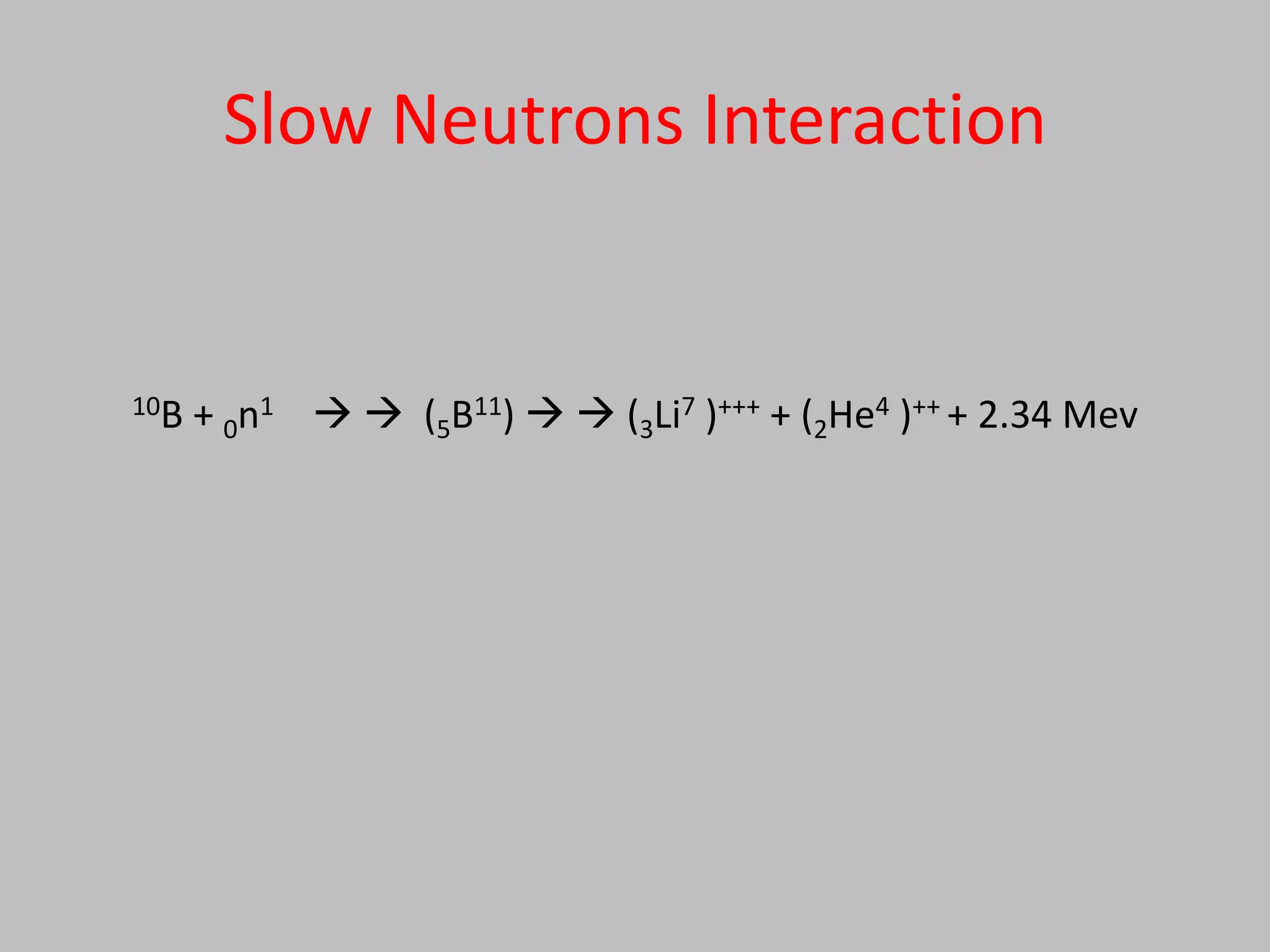
Slow Neutrons Interaction


10B   + 0n1   (5B11)   (3Li7 )+++ + (2He4 )++ + 2.34 Mev
Fast Neutron Interaction
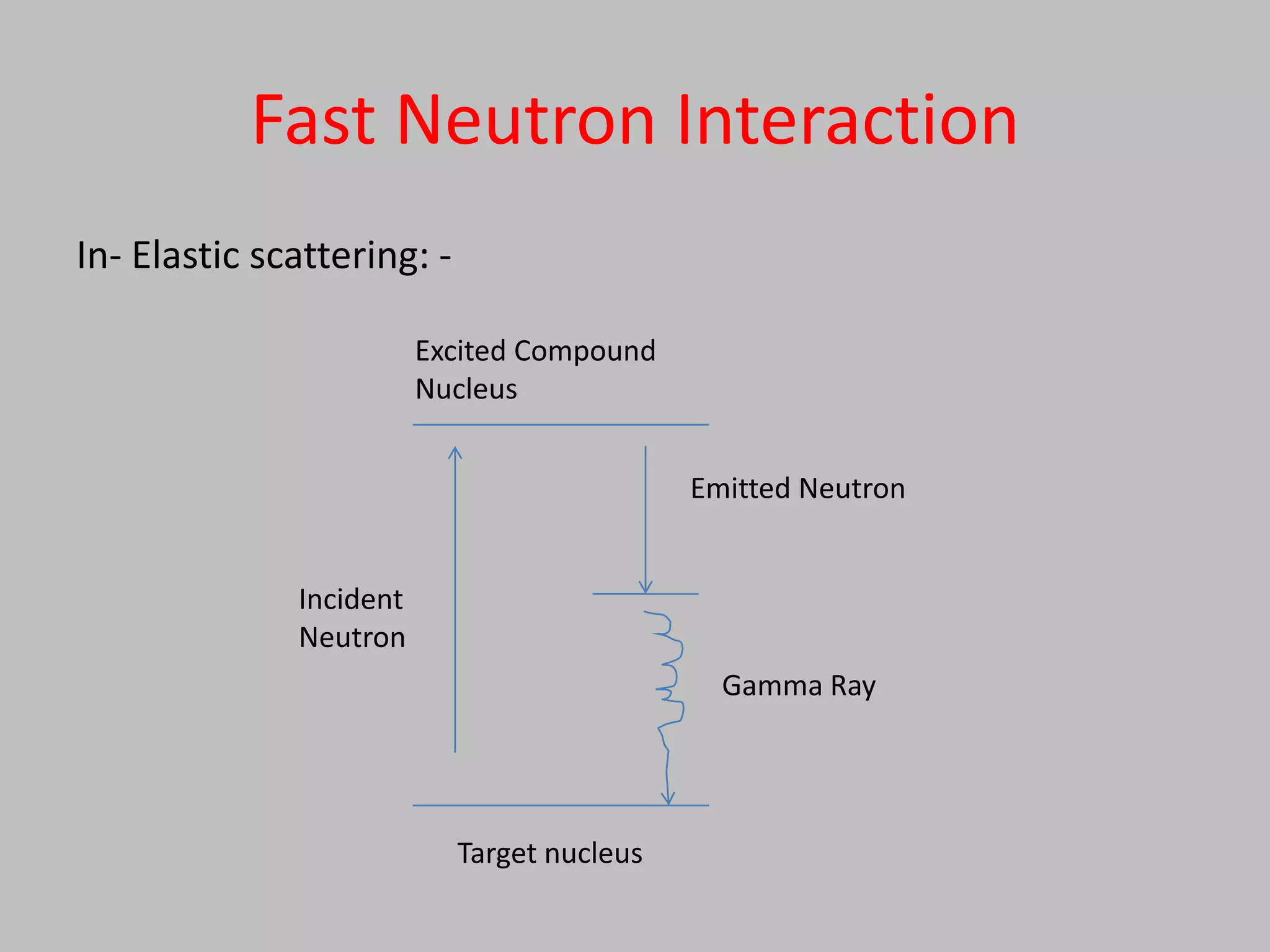
In- Elastic scattering: -

                         Excited Compound
                         Nucleus


                                             Emitted Neutron


              Incident
              Neutron
                                               Gamma Ray


                            Target nucleus
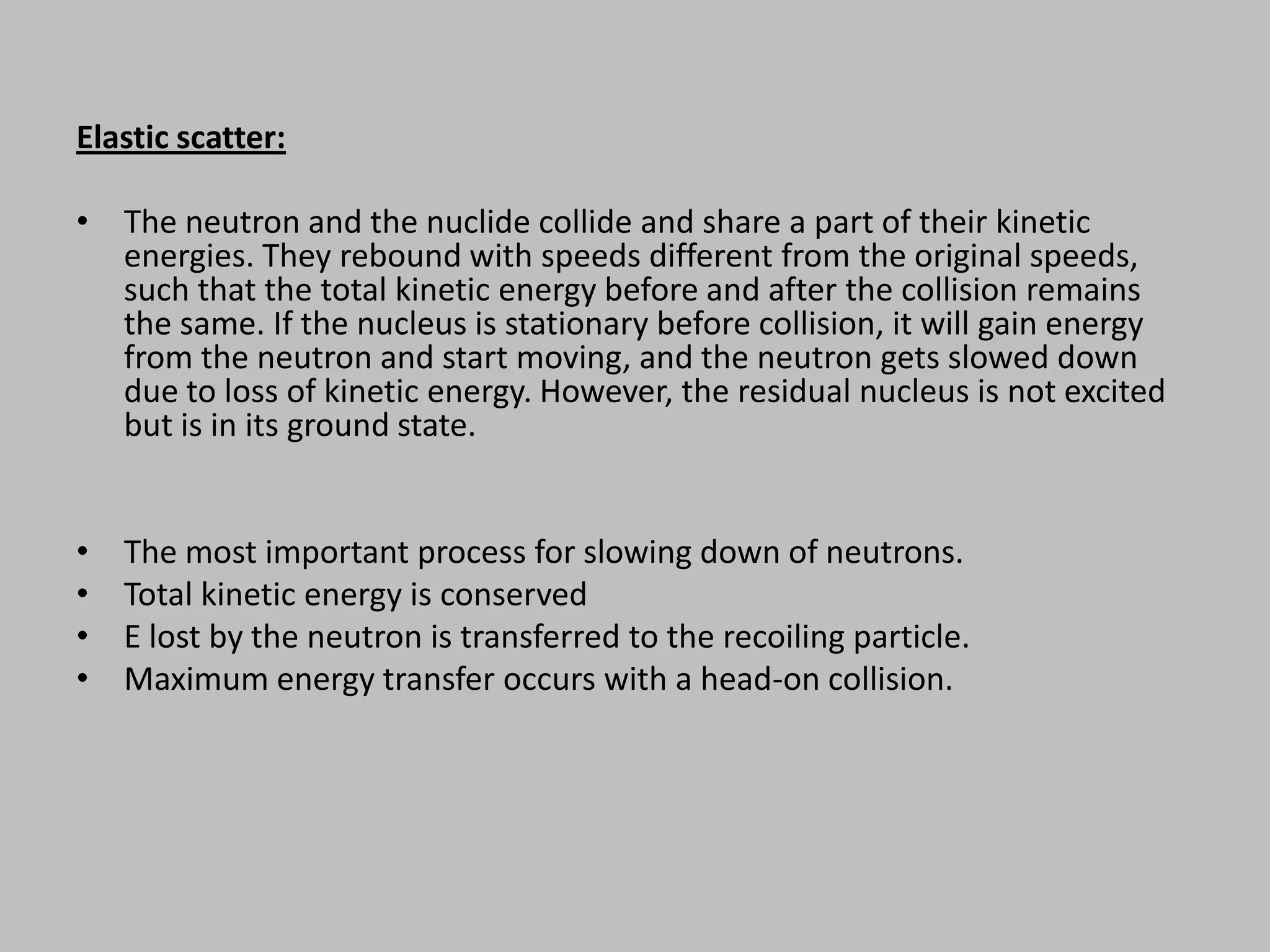
Elastic scatter:

• The neutron and the nuclide collide and share a part of their kinetic
  energies. They rebound with speeds different from the original speeds,
  such that the total kinetic energy before and after the collision remains
  the same. If the nucleus is stationary before collision, it will gain energy
  from the neutron and start moving, and the neutron gets slowed down
  due to loss of kinetic energy. However, the residual nucleus is not excited
  but is in its ground state.


•   The most important process for slowing down of neutrons.
•   Total kinetic energy is conserved
•   E lost by the neutron is transferred to the recoiling particle.
•   Maximum energy transfer occurs with a head-on collision.
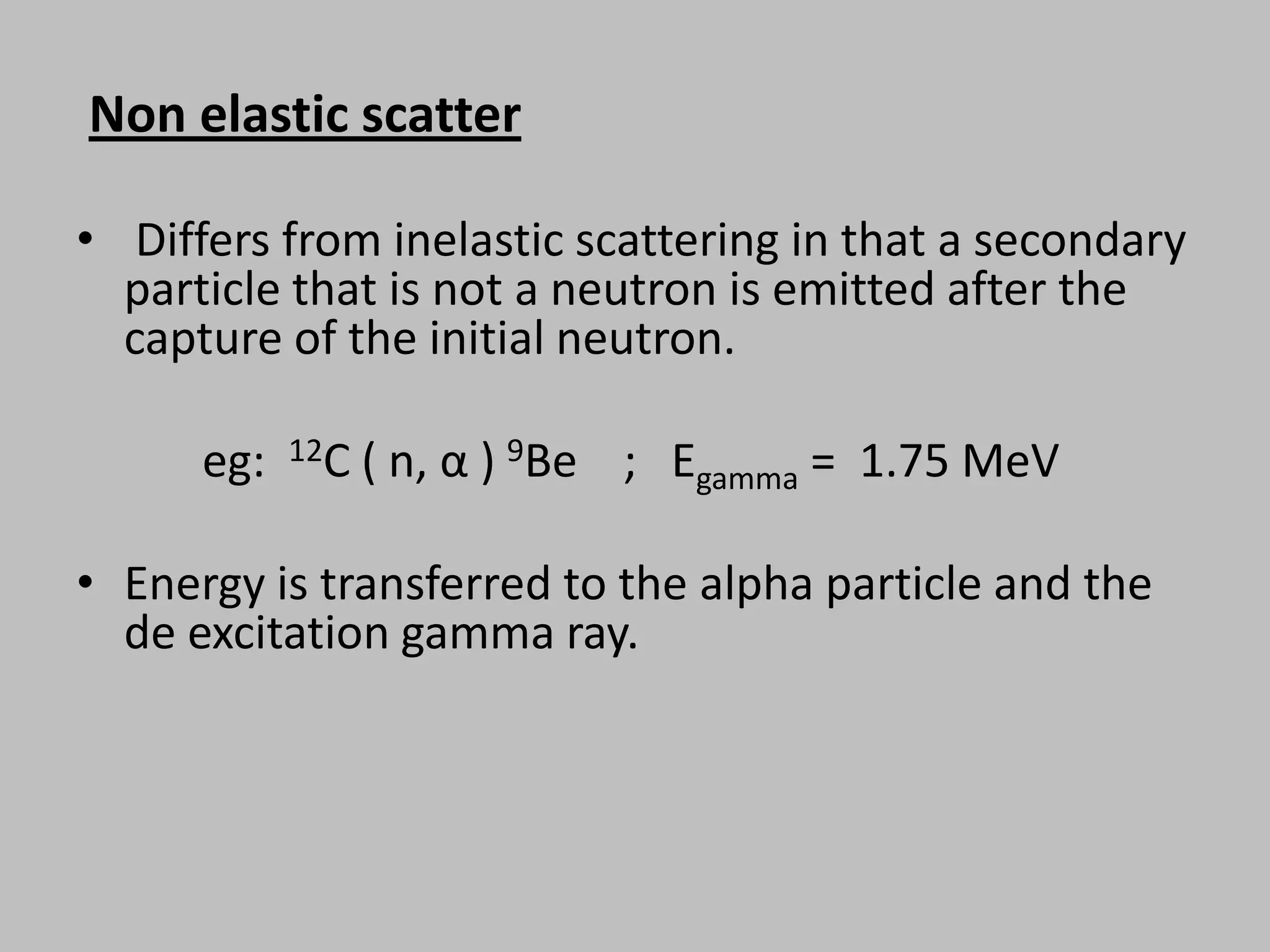
Non elastic scatter

• Differs from inelastic scattering in that a secondary
  particle that is not a neutron is emitted after the
  capture of the initial neutron.

      eg:   12C   ( n, α ) 9Be ; Egamma = 1.75 MeV

• Energy is transferred to the alpha particle and the
  de excitation gamma ray.
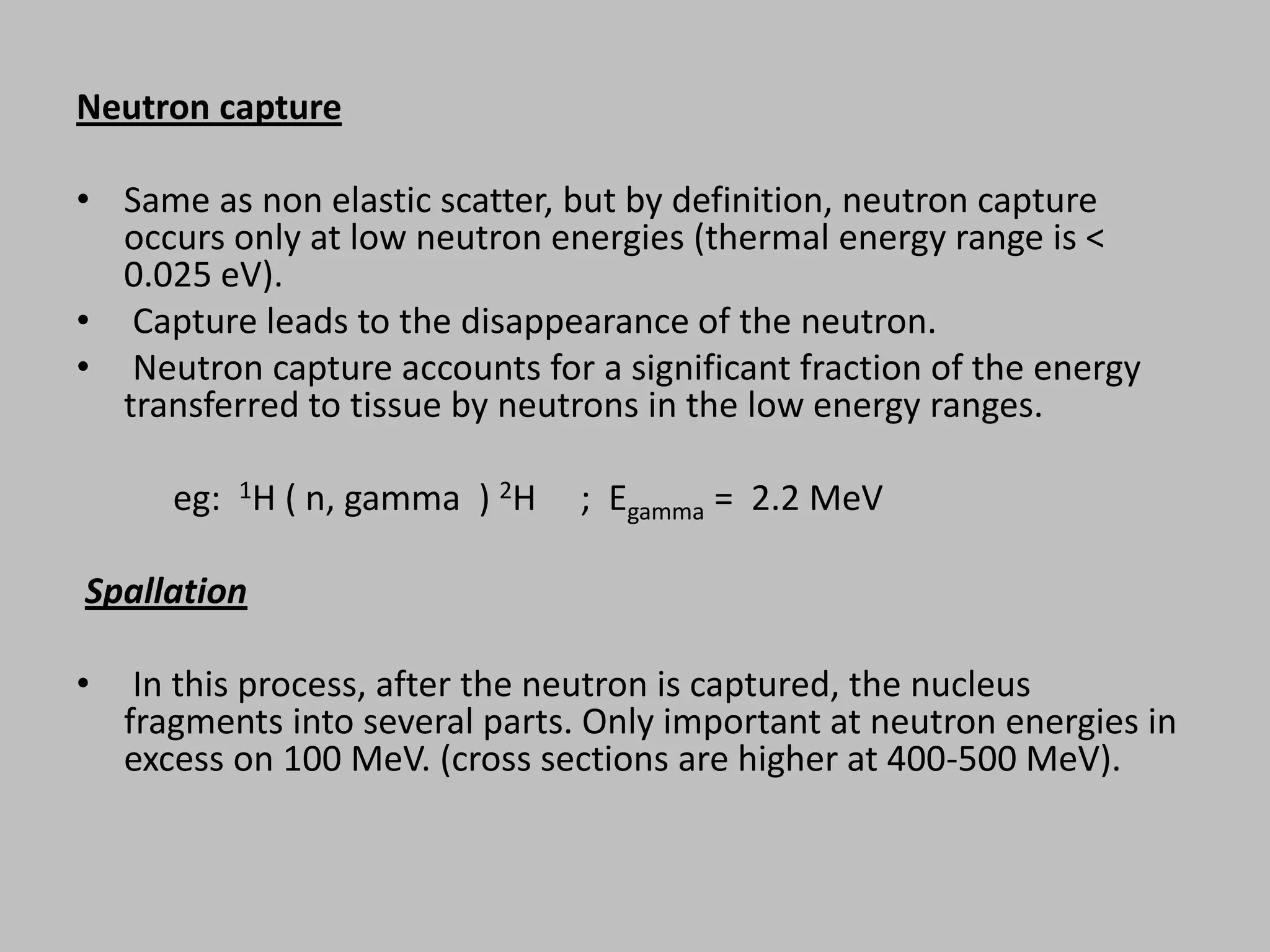
Neutron capture

• Same as non elastic scatter, but by definition, neutron capture
  occurs only at low neutron energies (thermal energy range is <
  0.025 eV).
• Capture leads to the disappearance of the neutron.
• Neutron capture accounts for a significant fraction of the energy
  transferred to tissue by neutrons in the low energy ranges.

       eg: 1H ( n, gamma ) 2H    ; Egamma = 2.2 MeV

Spallation

•    In this process, after the neutron is captured, the nucleus
    fragments into several parts. Only important at neutron energies in
    excess on 100 MeV. (cross sections are higher at 400-500 MeV).
Why to detect Radiation?
           &
How to detect Radiation
Why to detect Radiation?
•   Environmental safety
•   Personal protection of occupational workers
•   Calibration of radioactive isotopes
•   Power regulation in nuclear reactors
•   Research applications
•   Estimation of radiation dose in treatment of
    patients and more…………….
How to detect Radiation?
Choose a radiation detector working on a particular
principle of interaction (ionization/scintillation/etc)
with known sensitivity to estimate the radiation under
detection.
Some Characteristics of Radiation Detectors

• Sensitivity
• Operating voltage
• Operating voltage region
• Radiation detection range
• Resolution (for pulse based)
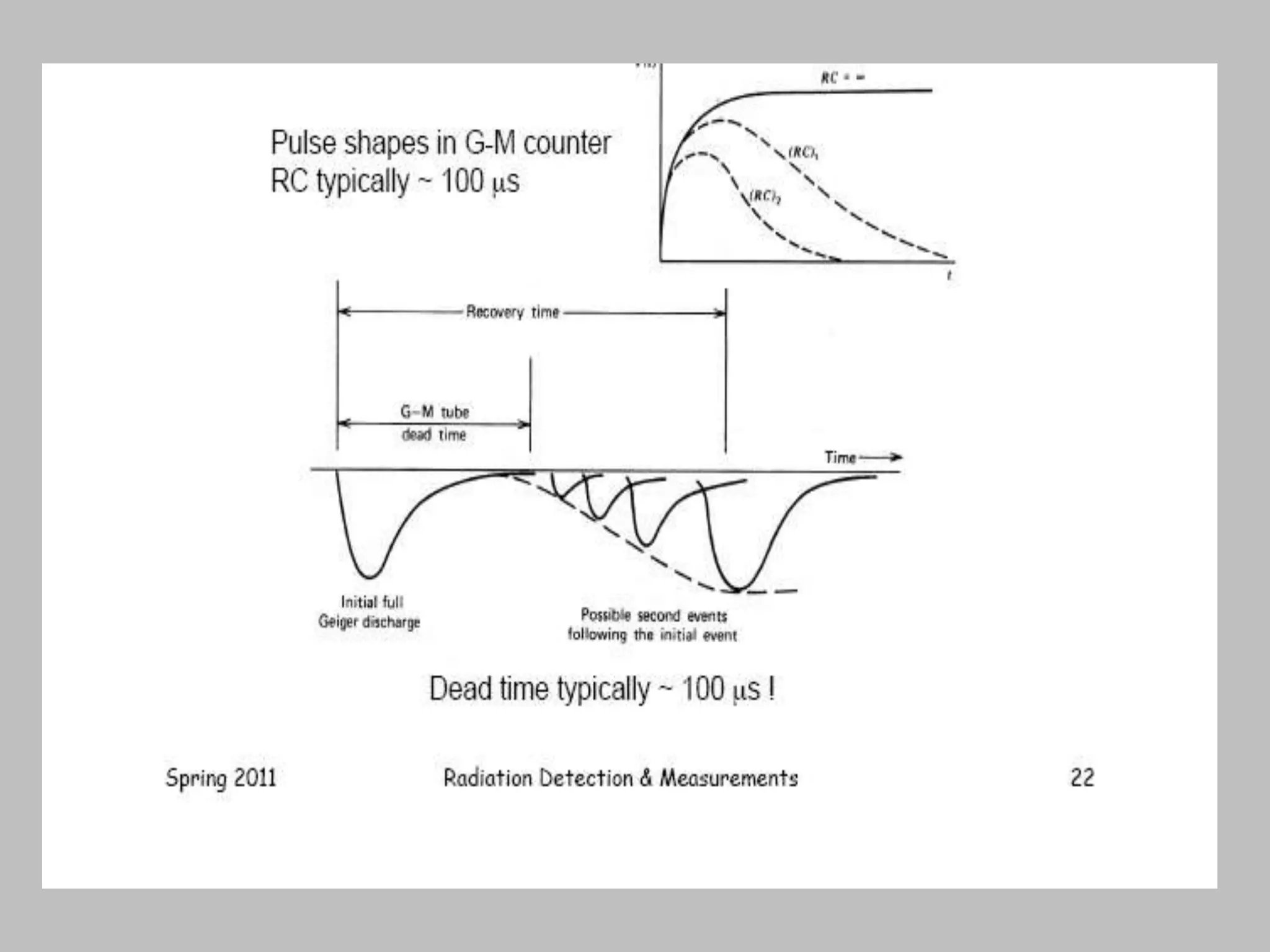
• Less dead time
• Life time
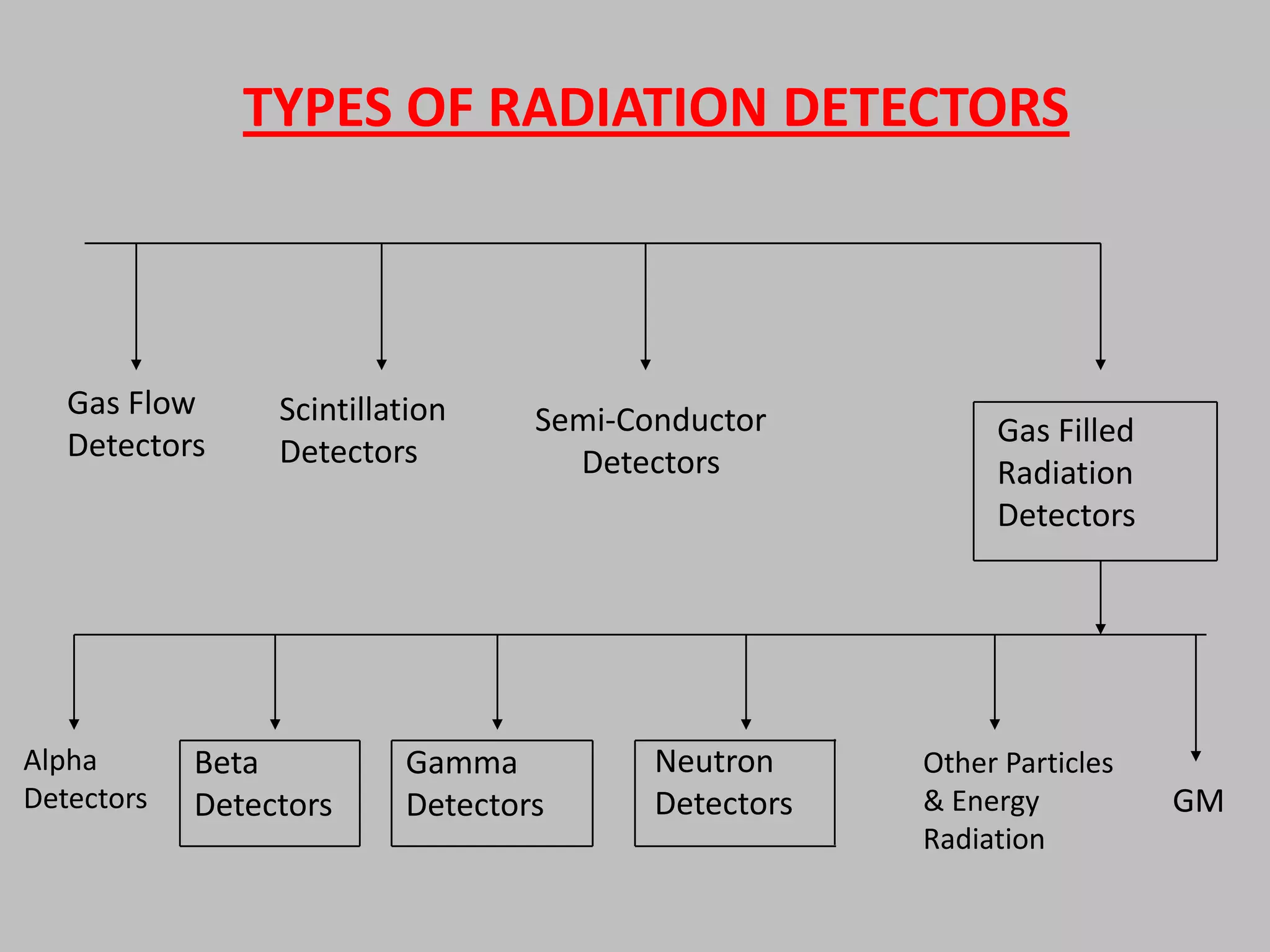
TYPES OF RADIATION DETECTORS


   Gas Flow      Scintillation    Semi-Conductor
   Detectors                                              Gas Filled
                 Detectors          Detectors             Radiation
                                                          Detectors


Alpha       Beta          Gamma          Neutron     Other Particles
Detectors   Detectors     Detectors      Detectors   & Energy          GM
                                                     Radiation
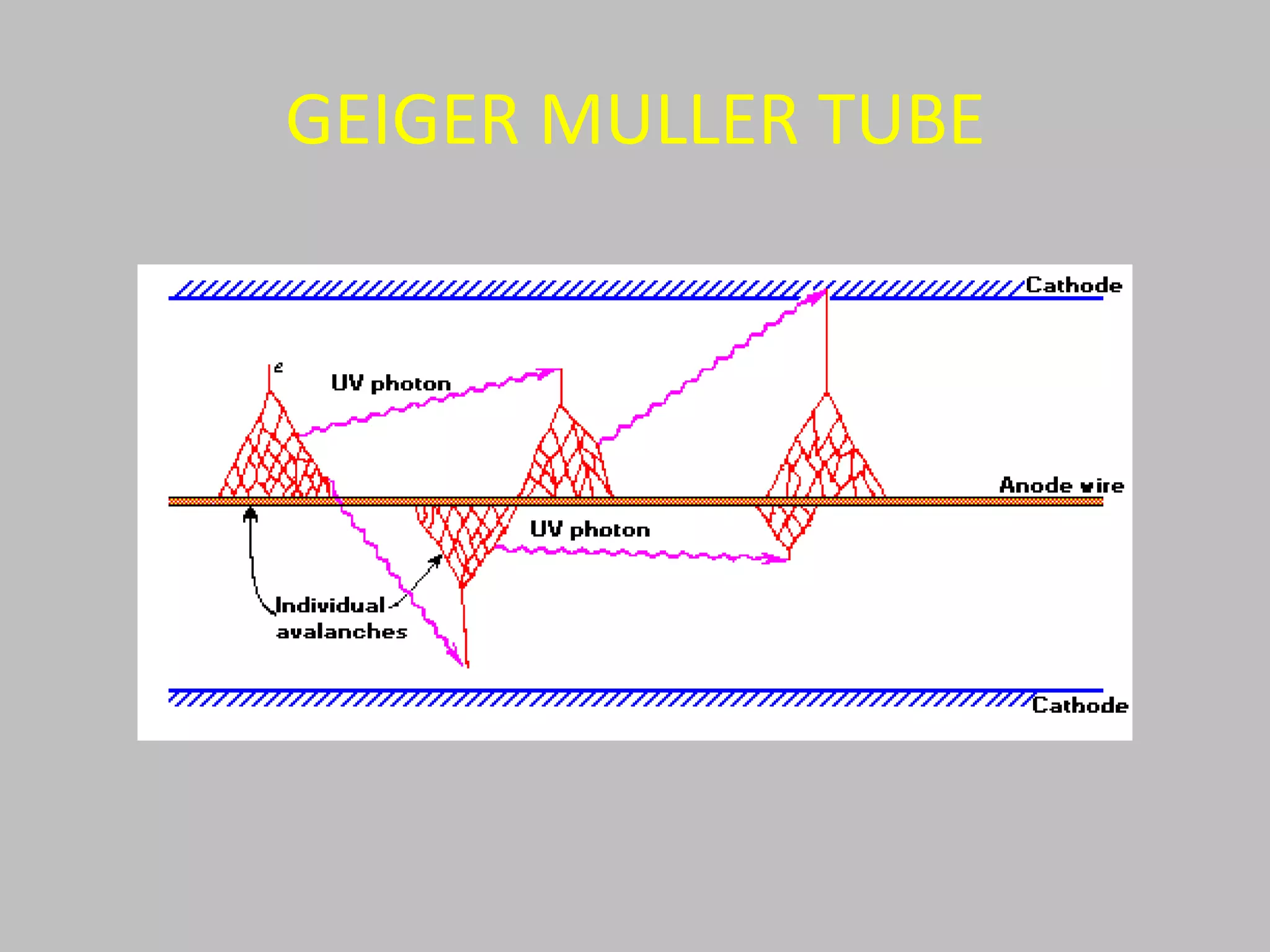
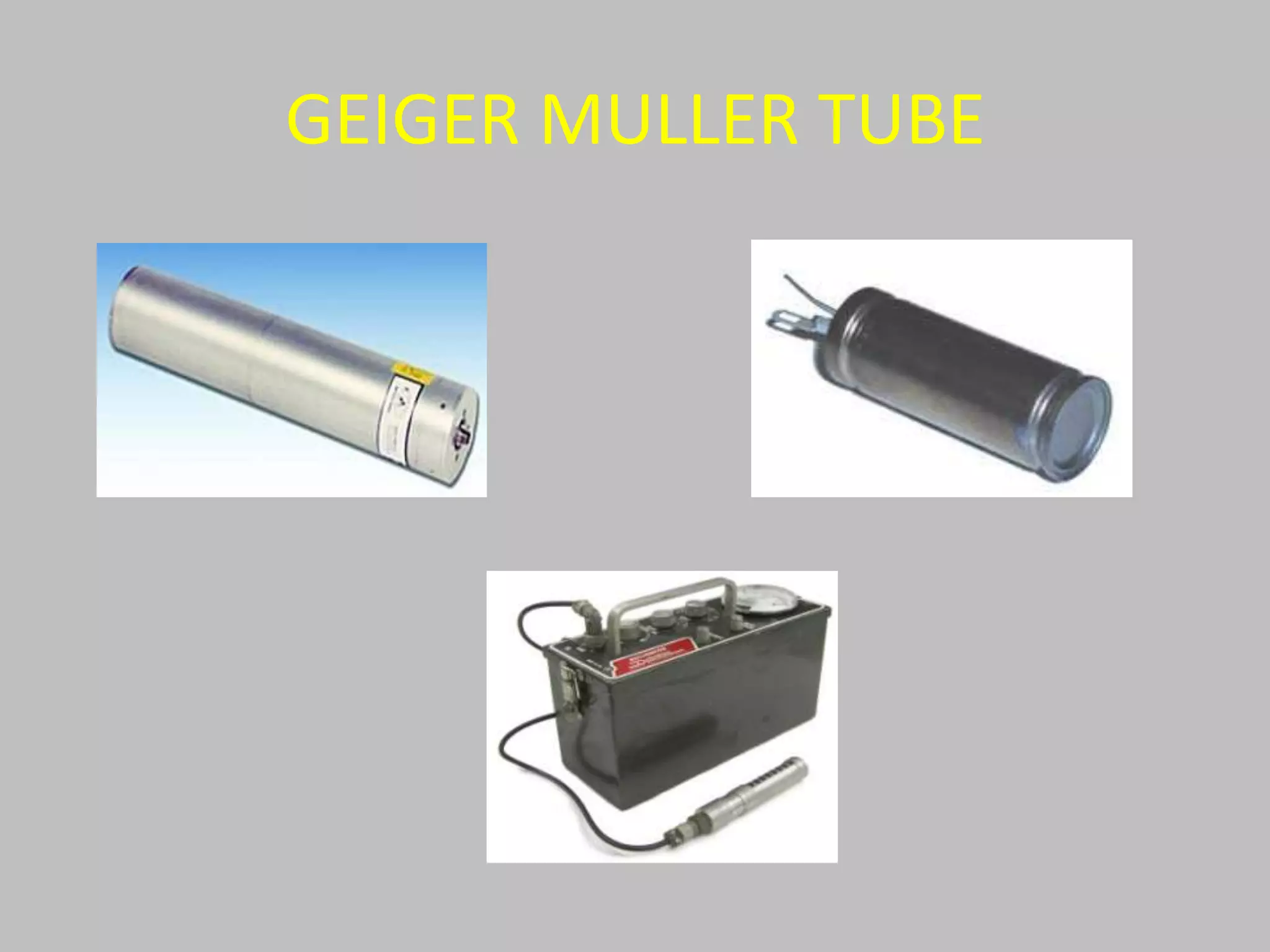
GEIGER MULLER TUBE
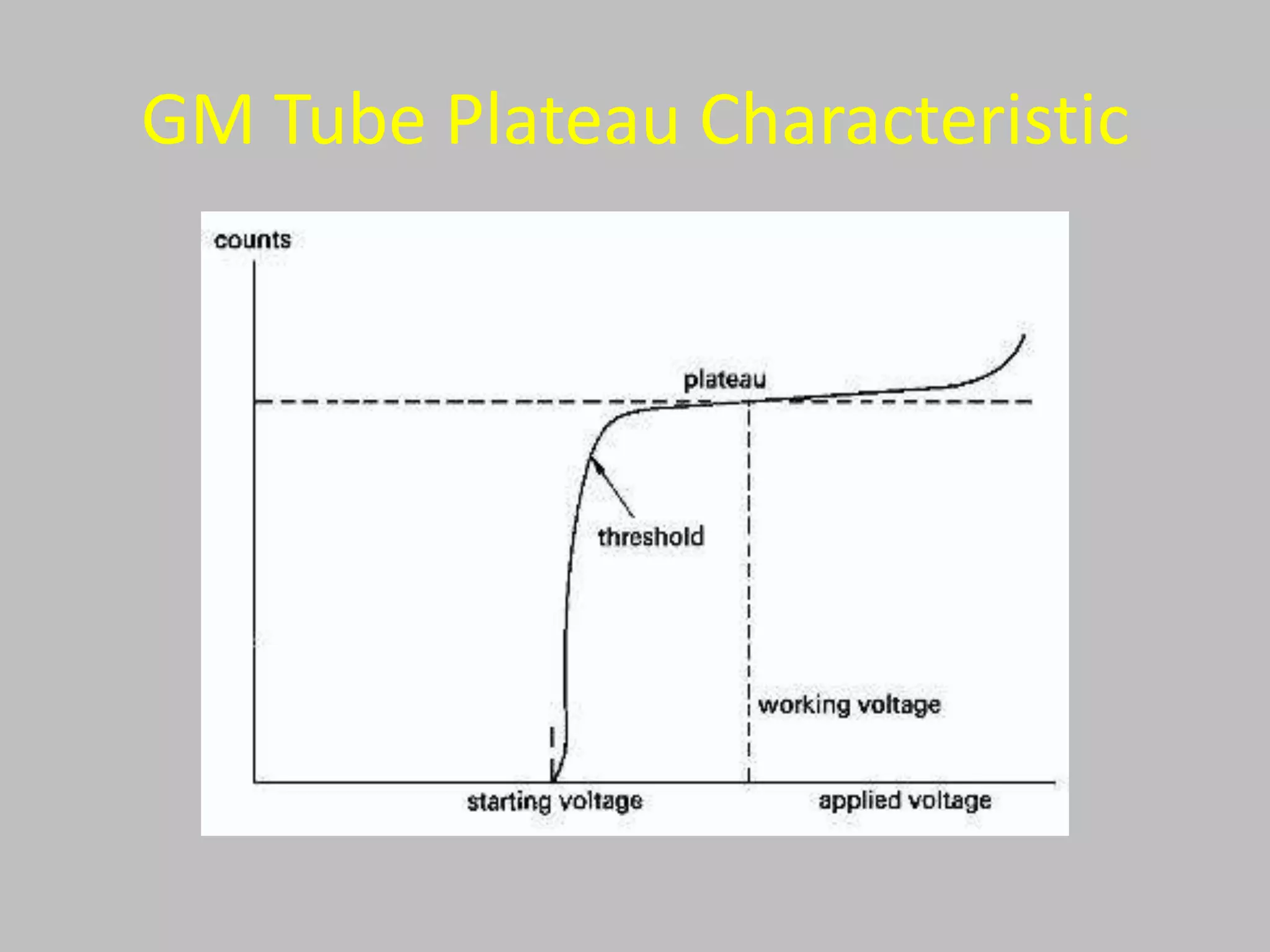
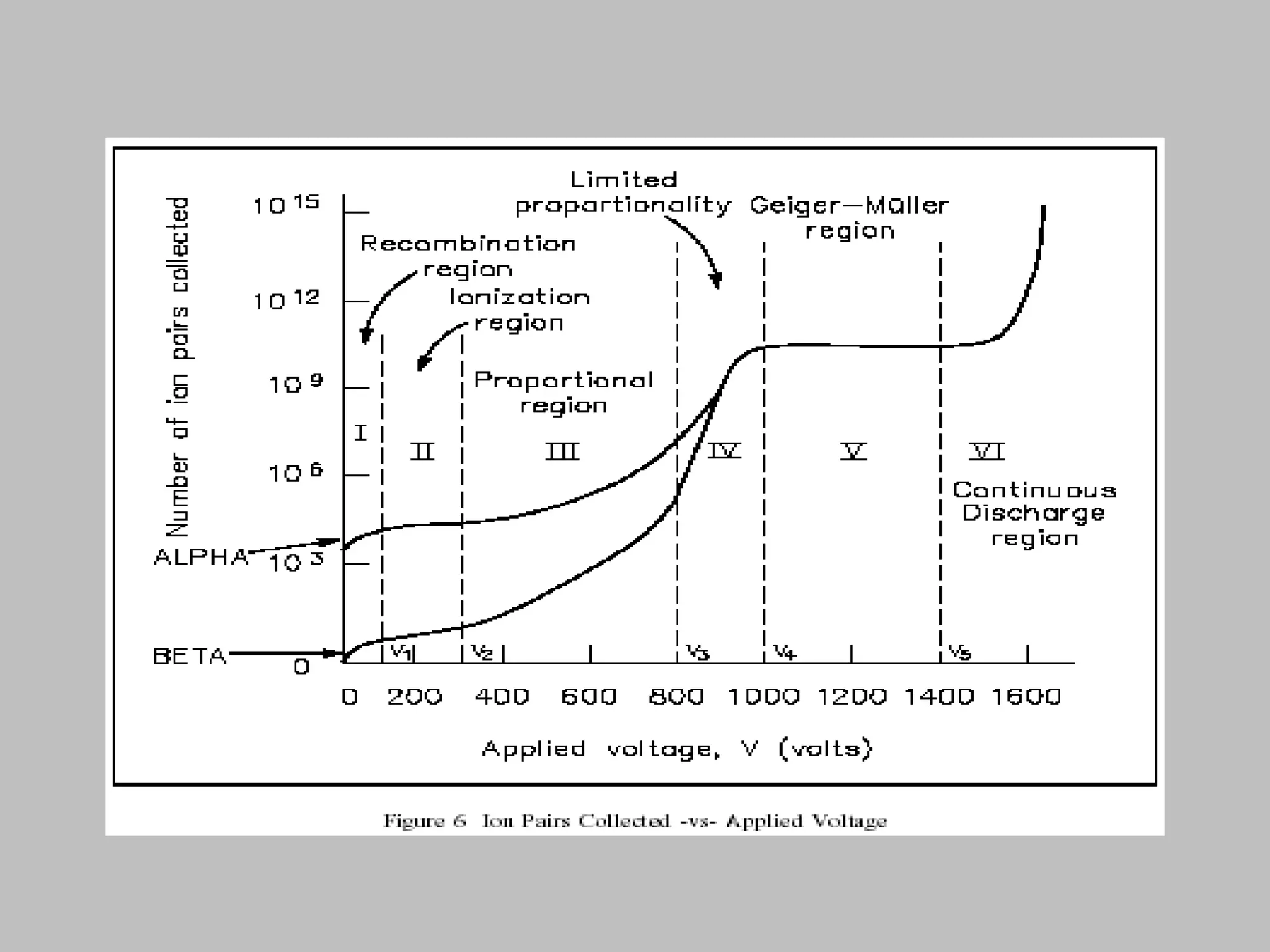
GM Tube Plateau Characteristic
GEIGER MULLER TUBE
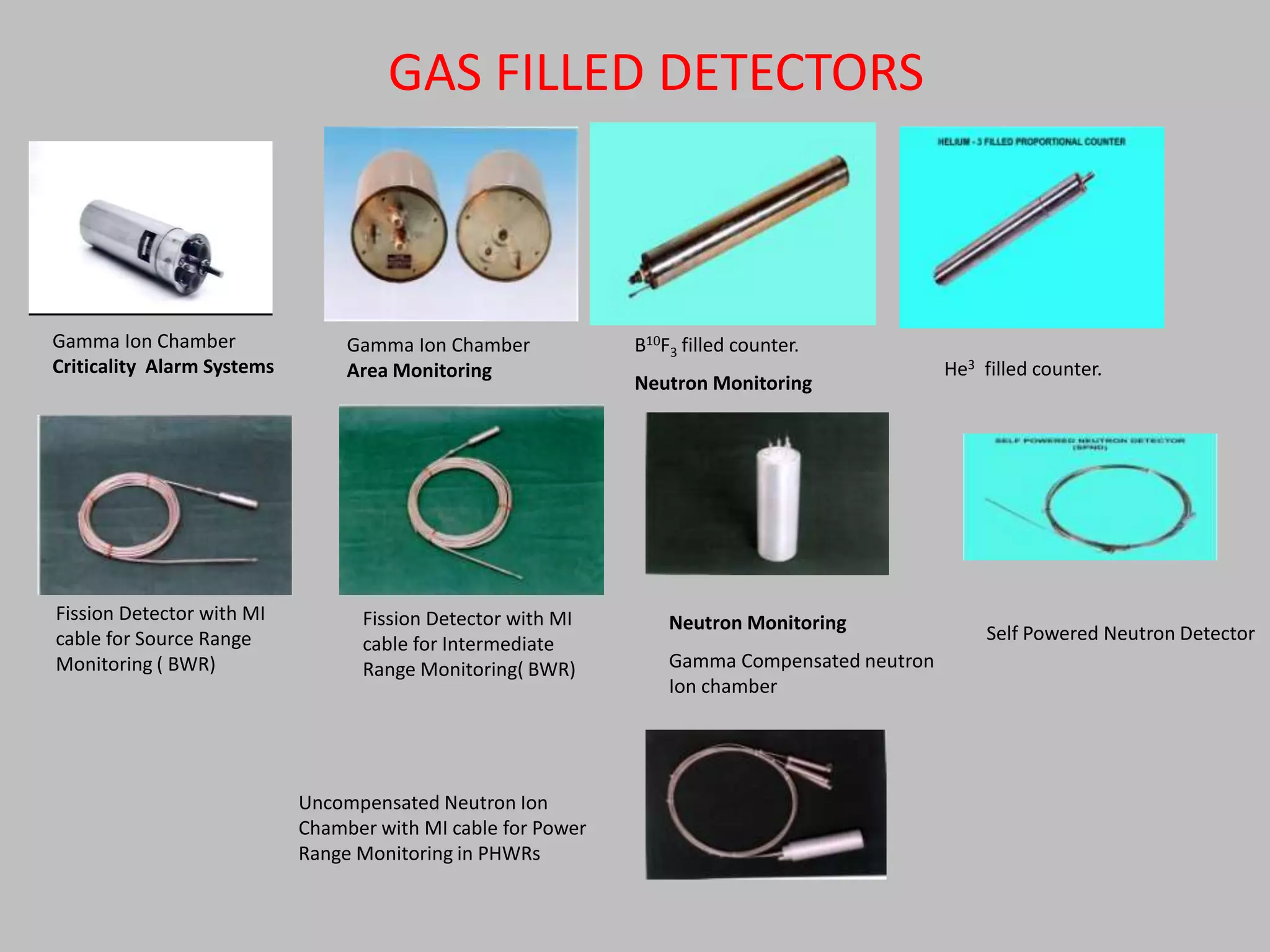
GAS FILLED DETECTORS


Gamma Ion Chamber                Gamma Ion Chamber            B10F3 filled counter.
Criticality Alarm Systems        Area Monitoring                                              He3 filled counter.
                                                              Neutron Monitoring


Fission Detector with MI          Fission Detector with MI        Neutron Monitoring
cable for Source Range                                                                             Self Powered Neutron Detector
                                  cable for Intermediate
Monitoring ( BWR)                 Range Monitoring( BWR)          Gamma Compensated neutron
                                                                  Ion chamber


                            Uncompensated Neutron Ion
                            Chamber with MI cable for Power
                            Range Monitoring in PHWRs
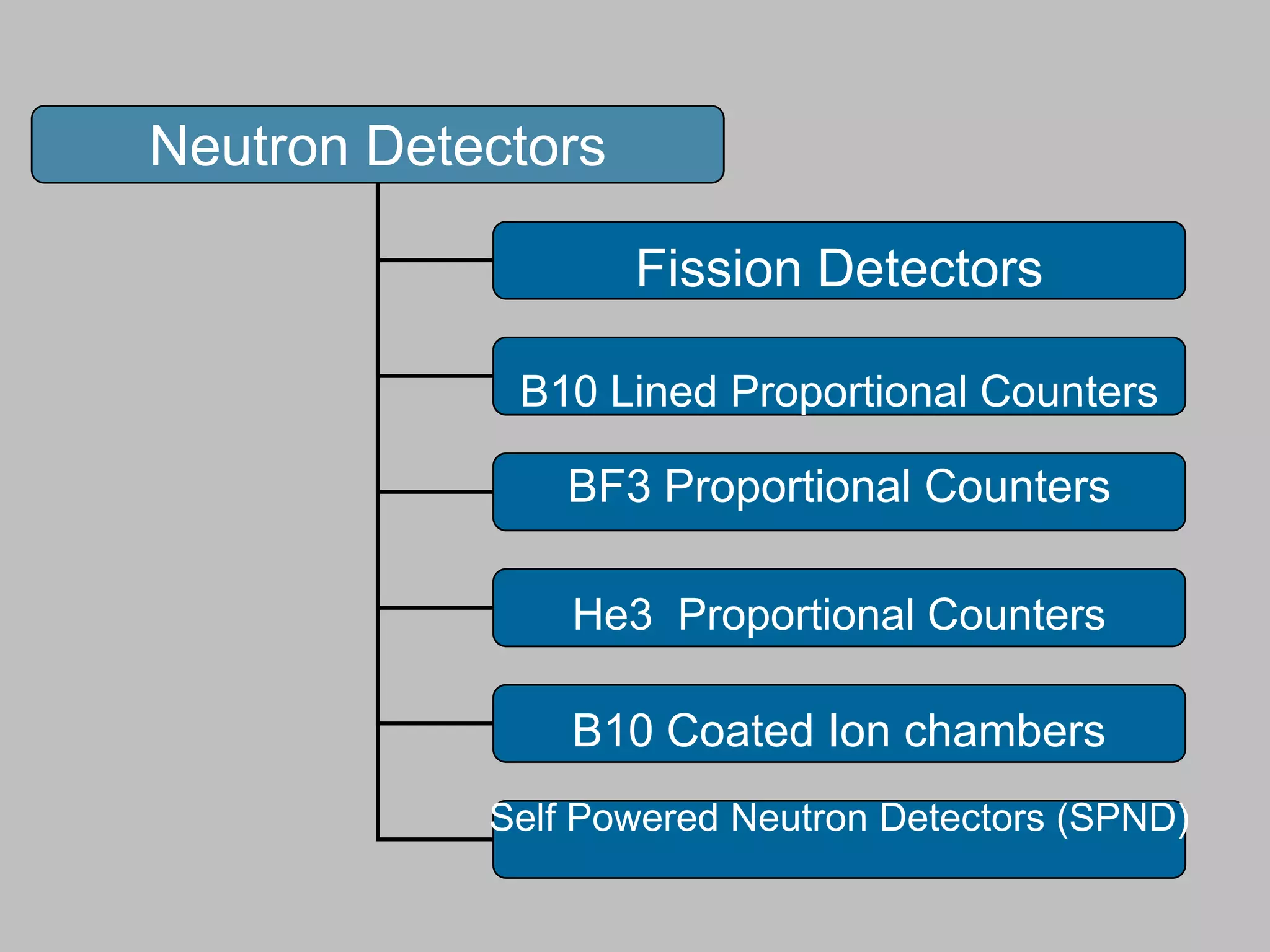
Neutron Detectors

                    Fission Detectors

             B10 Lined Proportional Counters

                BF3 Proportional Counters

                He3 Proportional Counters

                B10 Coated Ion chambers
            Self Powered Neutron Detectors (SPND)
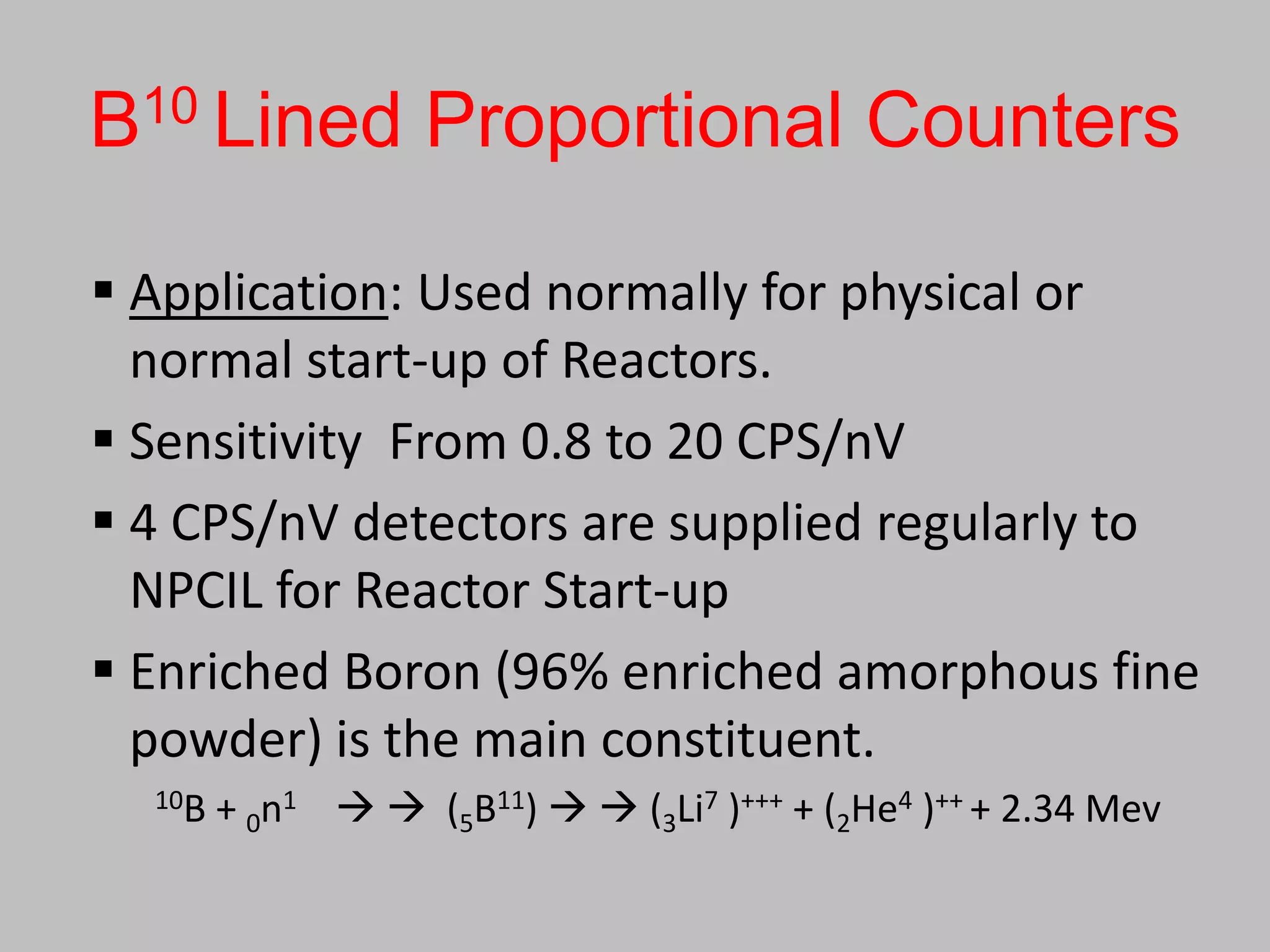
B10 Lined Proportional Counters

 Application: Used normally for physical or
  normal start-up of Reactors.
 Sensitivity From 0.8 to 20 CPS/nV
 4 CPS/nV detectors are supplied regularly to
  NPCIL for Reactor Start-up
 Enriched Boron (96% enriched amorphous fine
  powder) is the main constituent.
  10B   + 0n1   (5B11)   (3Li7 )+++ + (2He4 )++ + 2.34 Mev
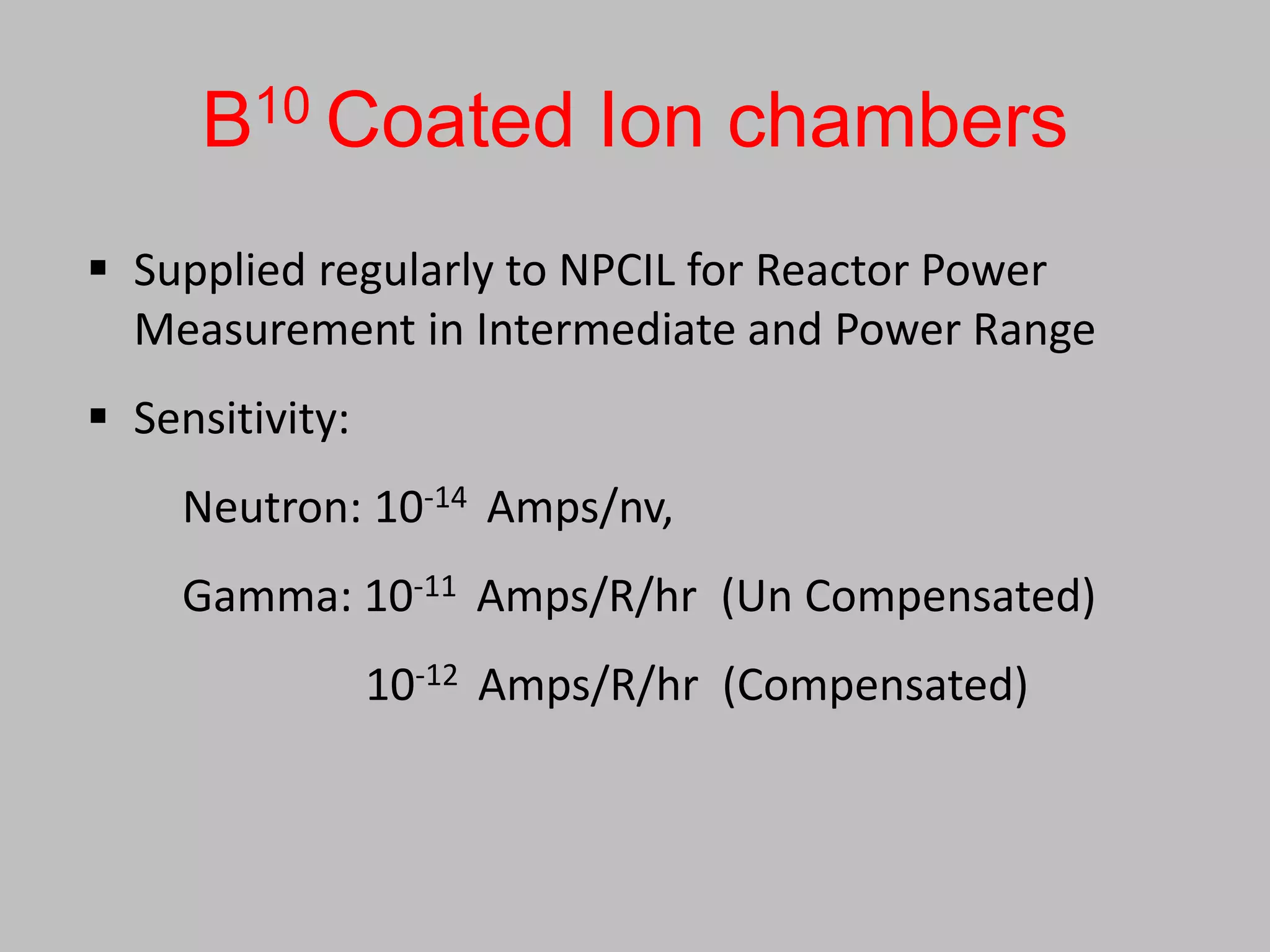
B10 Coated Ion chambers
 Supplied regularly to NPCIL for Reactor Power
  Measurement in Intermediate and Power Range
 Sensitivity:
     Neutron: 10-14 Amps/nv,
     Gamma: 10-11 Amps/R/hr (Un Compensated)
                 10-12 Amps/R/hr (Compensated)
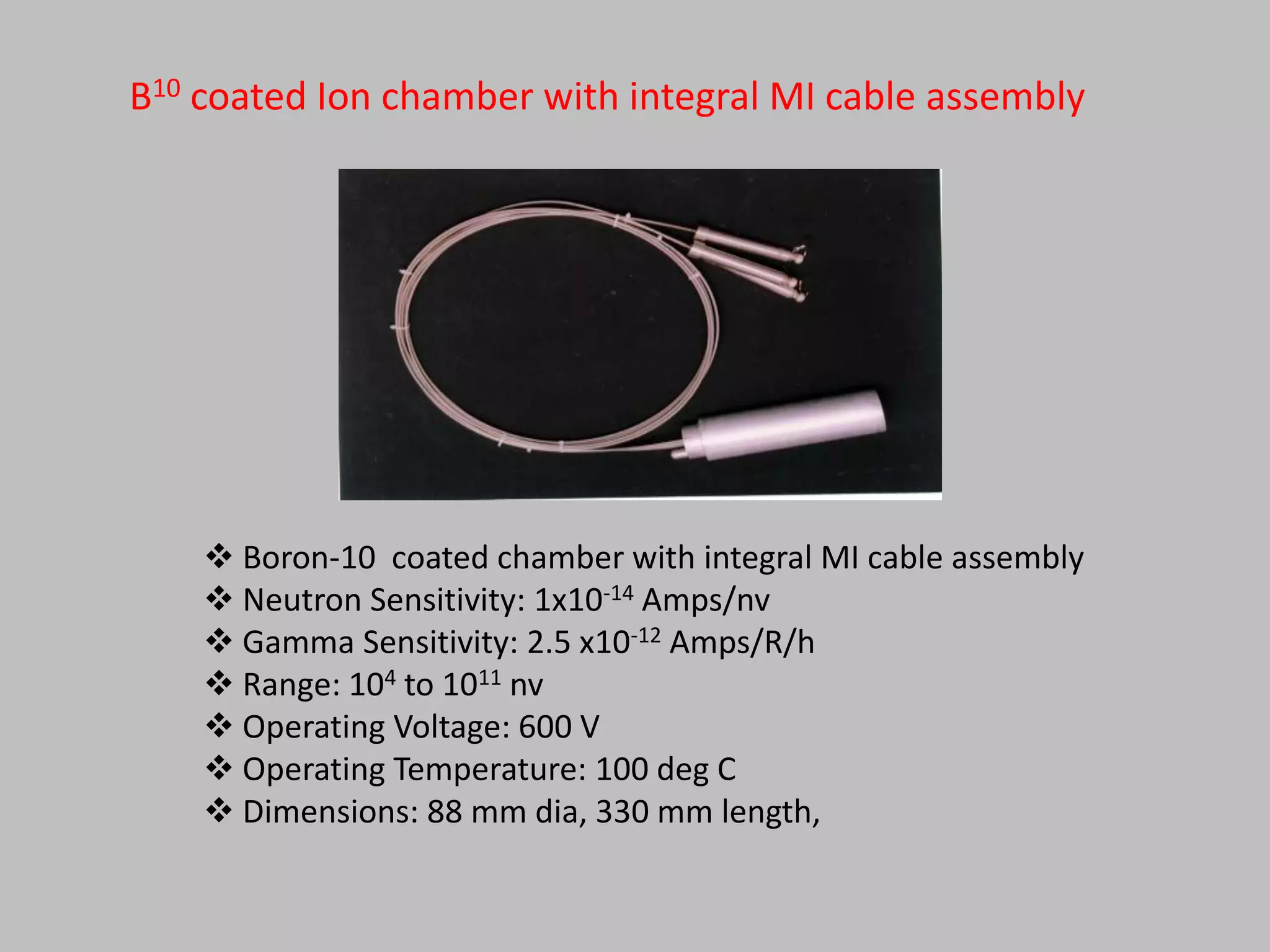
B10 coated Ion chamber with integral MI cable assembly


     Boron-10 coated chamber with integral MI cable assembly
     Neutron Sensitivity: 1x10-14 Amps/nv
     Gamma Sensitivity: 2.5 x10⁻¹² Amps/R/h
     Range: 104 to 1011 nv
     Operating Voltage: 600 V
     Operating Temperature: 100 deg C
     Dimensions: 88 mm dia, 330 mm length,
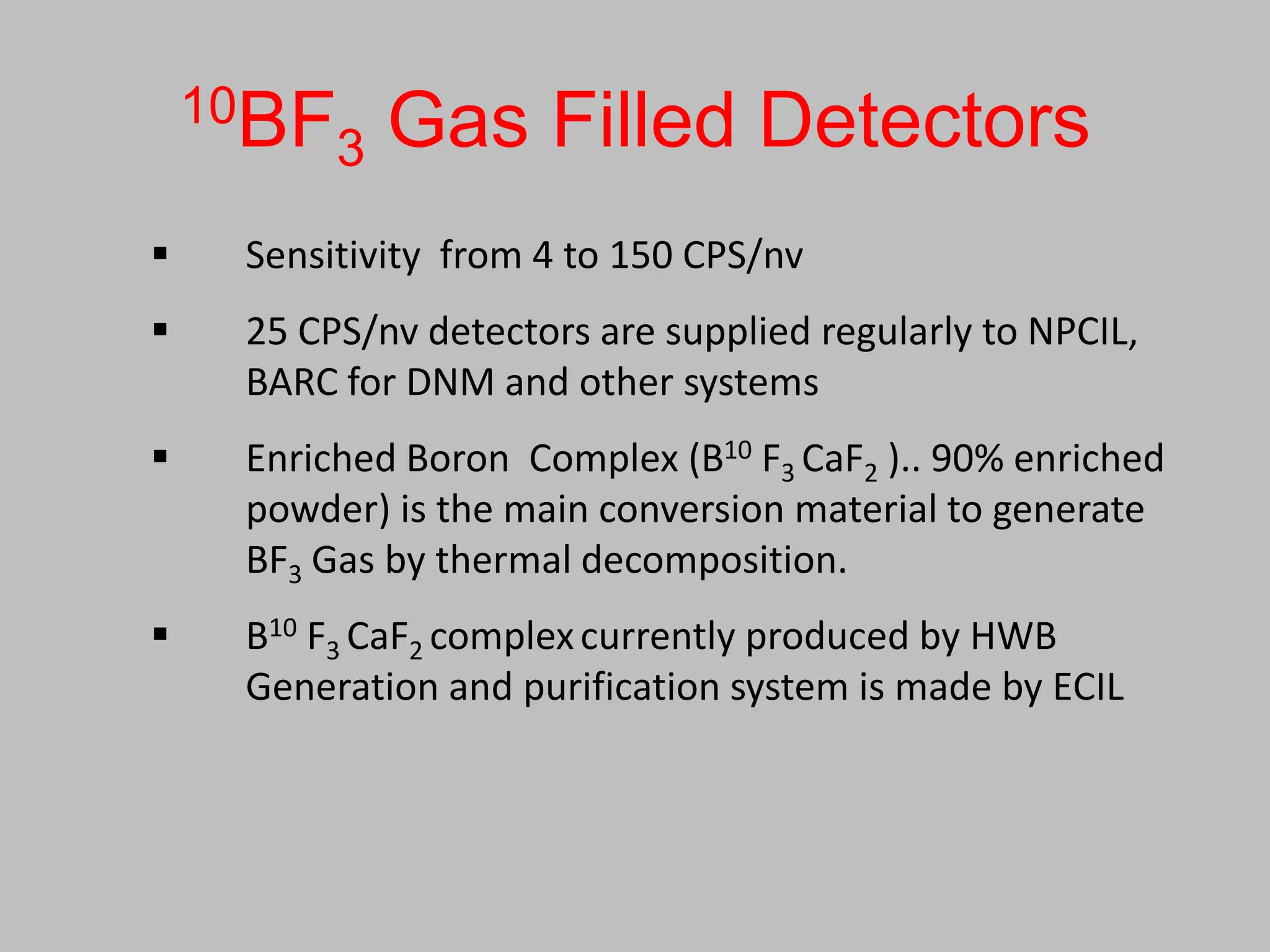
10BF     Gas Filled Detectors
        3
    Sensitivity from 4 to 150 CPS/nv
    25 CPS/nv detectors are supplied regularly to NPCIL,
     BARC for DNM and other systems
    Enriched Boron Complex (B10 F3 CaF2 ).. 90% enriched
     powder) is the main conversion material to generate
     BF3 Gas by thermal decomposition.
    B10 F3 CaF2 complex currently produced by HWB
     Generation and purification system is made by ECIL
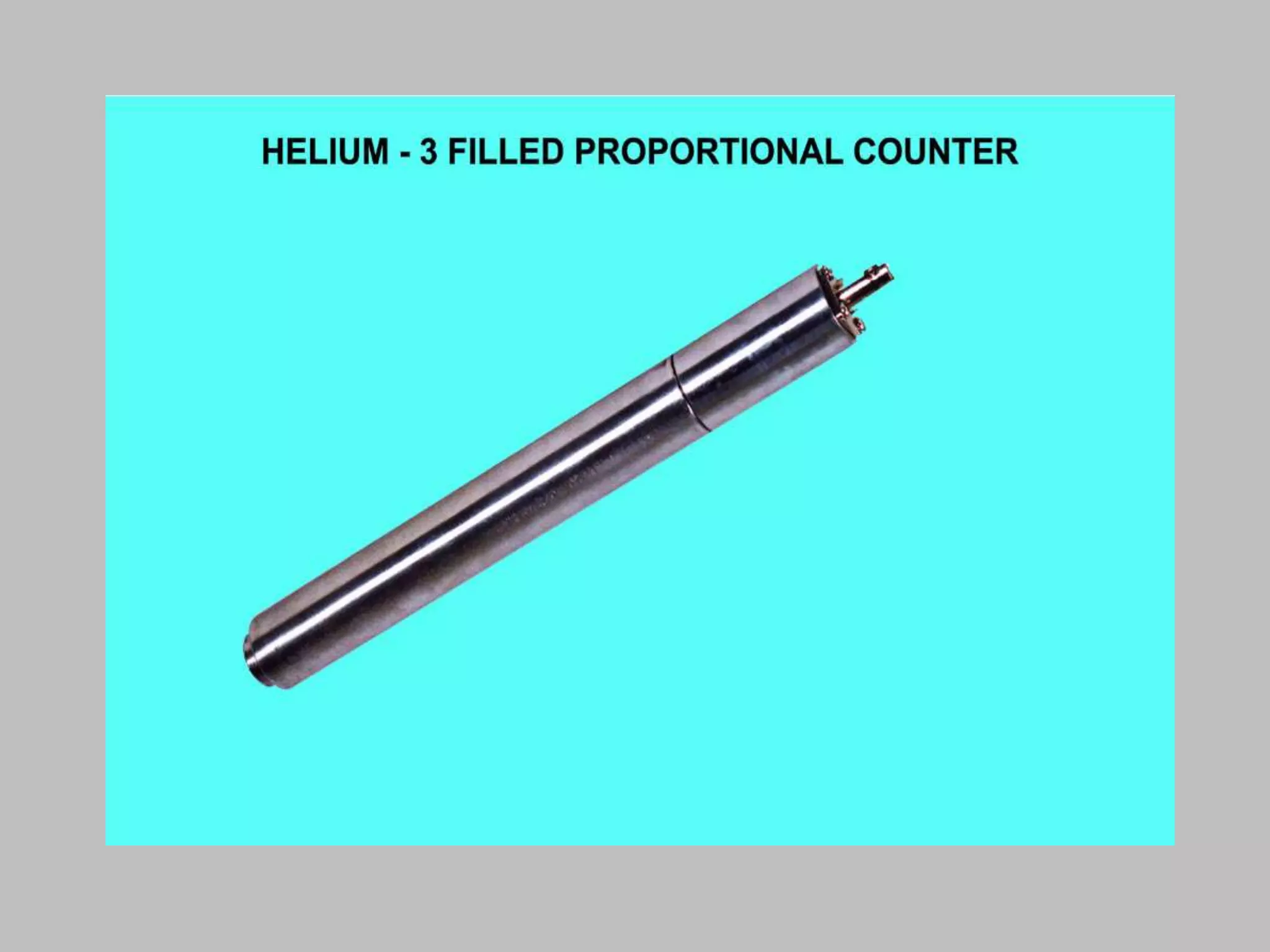
He3 Detectors
   Sensitivity from 10 to 250 CPS/nv
    Applications: SNM detection
    systems, research applications etc.
   Supplied to IGCAR, BARC for Neutron well
    counters and other applications
Fission Detectors
• HEU based
      SRM, IRM, LPRM, Wide Range
      Sensitivity From 10-3 to 1 CPS/nv, With & Without
       integral MI Cable
      Supplied to BWR, FBTR
• LEU (<20% Enrichment) based
      Sensitivity From 10-3 to 0.18 CPS/nv, With & Without
       integral MI Cable
      Supplied to BARC, PHWR
      High Temperature (650o C) Fission Counter for PFBR
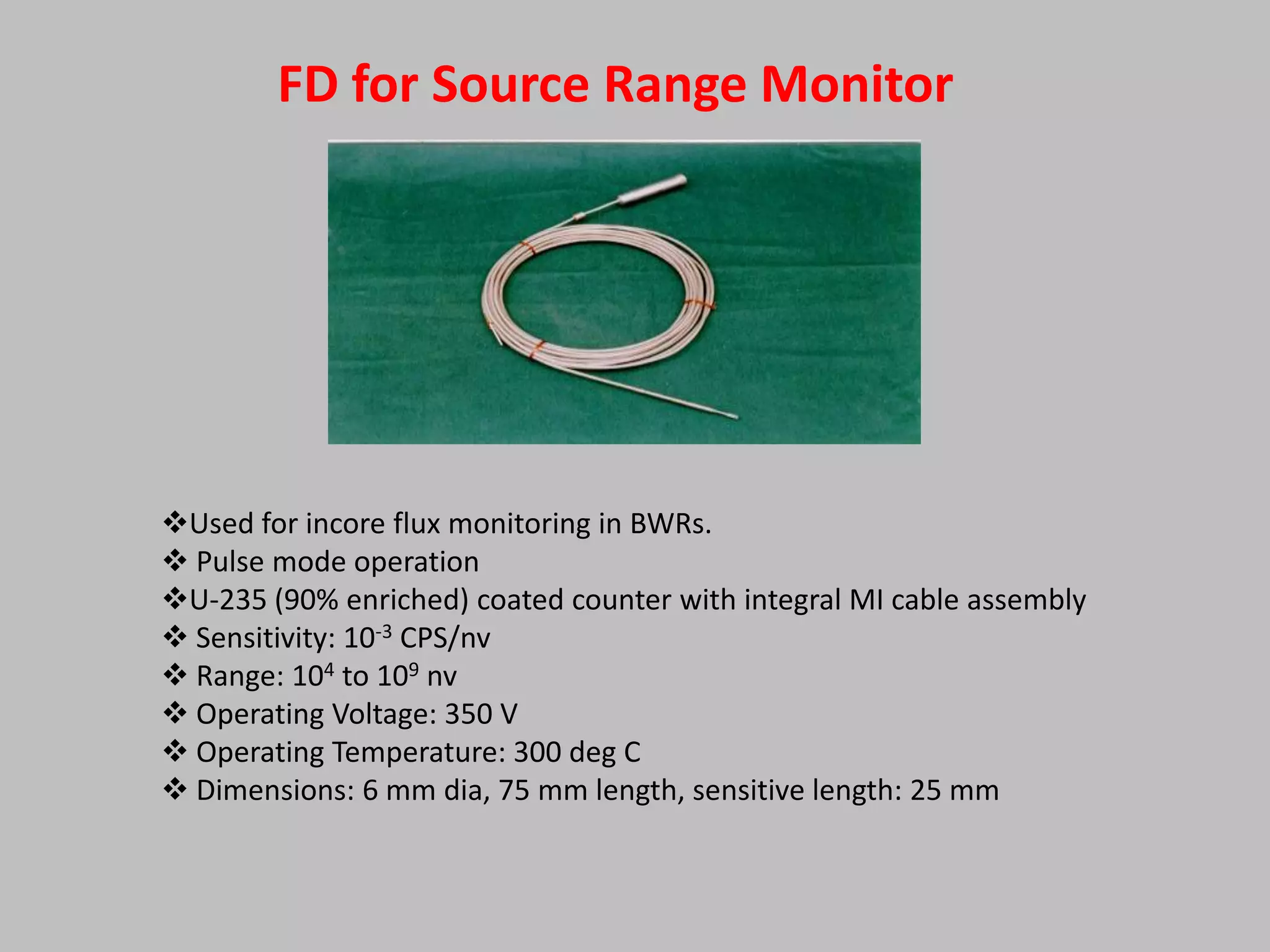
FD for Source Range Monitor


Used for incore flux monitoring in BWRs.
 Pulse mode operation
U-235 (90% enriched) coated counter with integral MI cable assembly
 Sensitivity: 10-3 CPS/nv
 Range: 104 to 109 nv
 Operating Voltage: 350 V
 Operating Temperature: 300 deg C
 Dimensions: 6 mm dia, 75 mm length, sensitive length: 25 mm
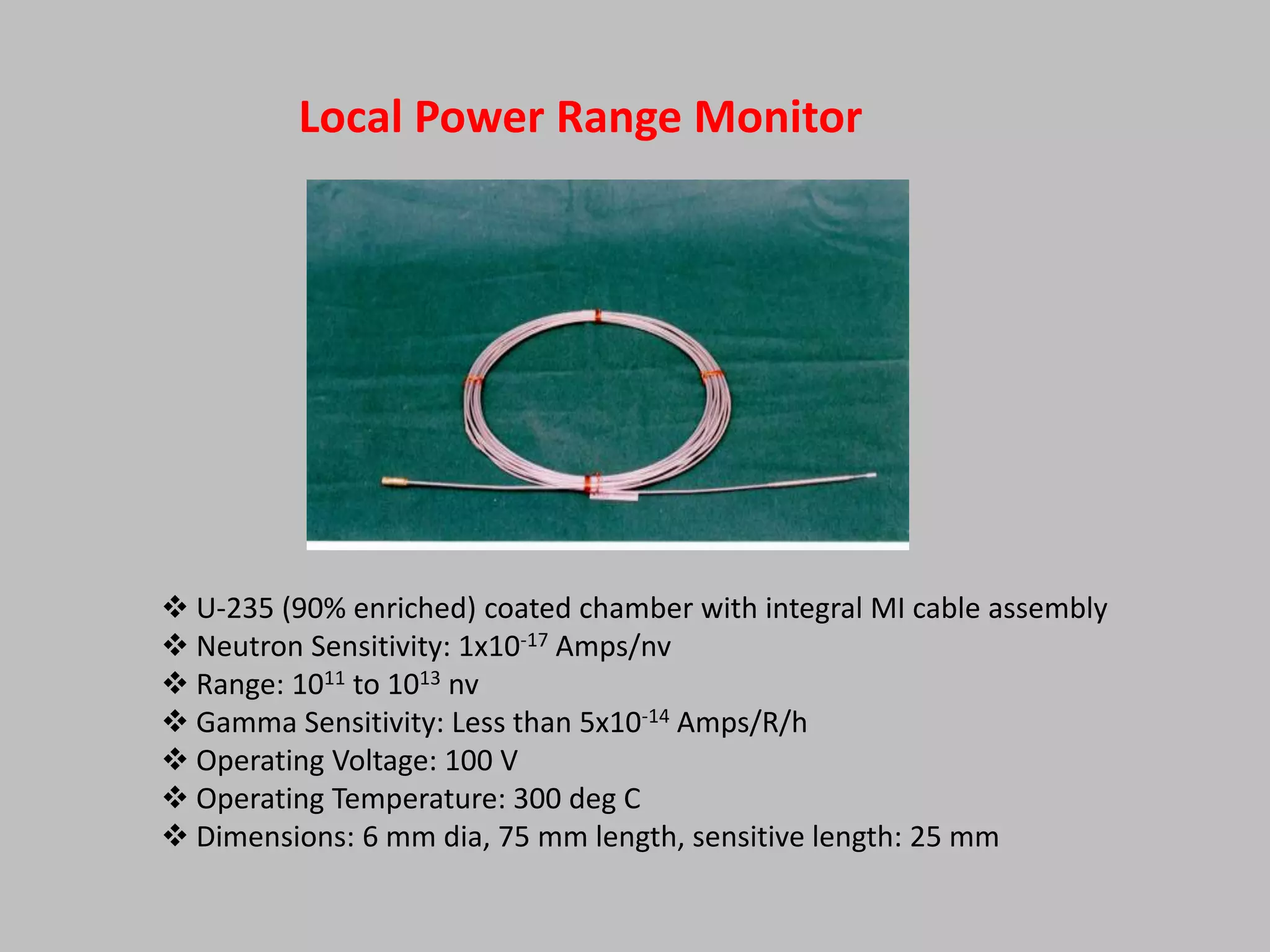
Local Power Range Monitor


 U-235 (90% enriched) coated chamber with integral MI cable assembly
 Neutron Sensitivity: 1x10-17 Amps/nv
 Range: 1011 to 1013 nv
 Gamma Sensitivity: Less than 5x10-14 Amps/R/h
 Operating Voltage: 100 V
 Operating Temperature: 300 deg C
 Dimensions: 6 mm dia, 75 mm length, sensitive length: 25 mm
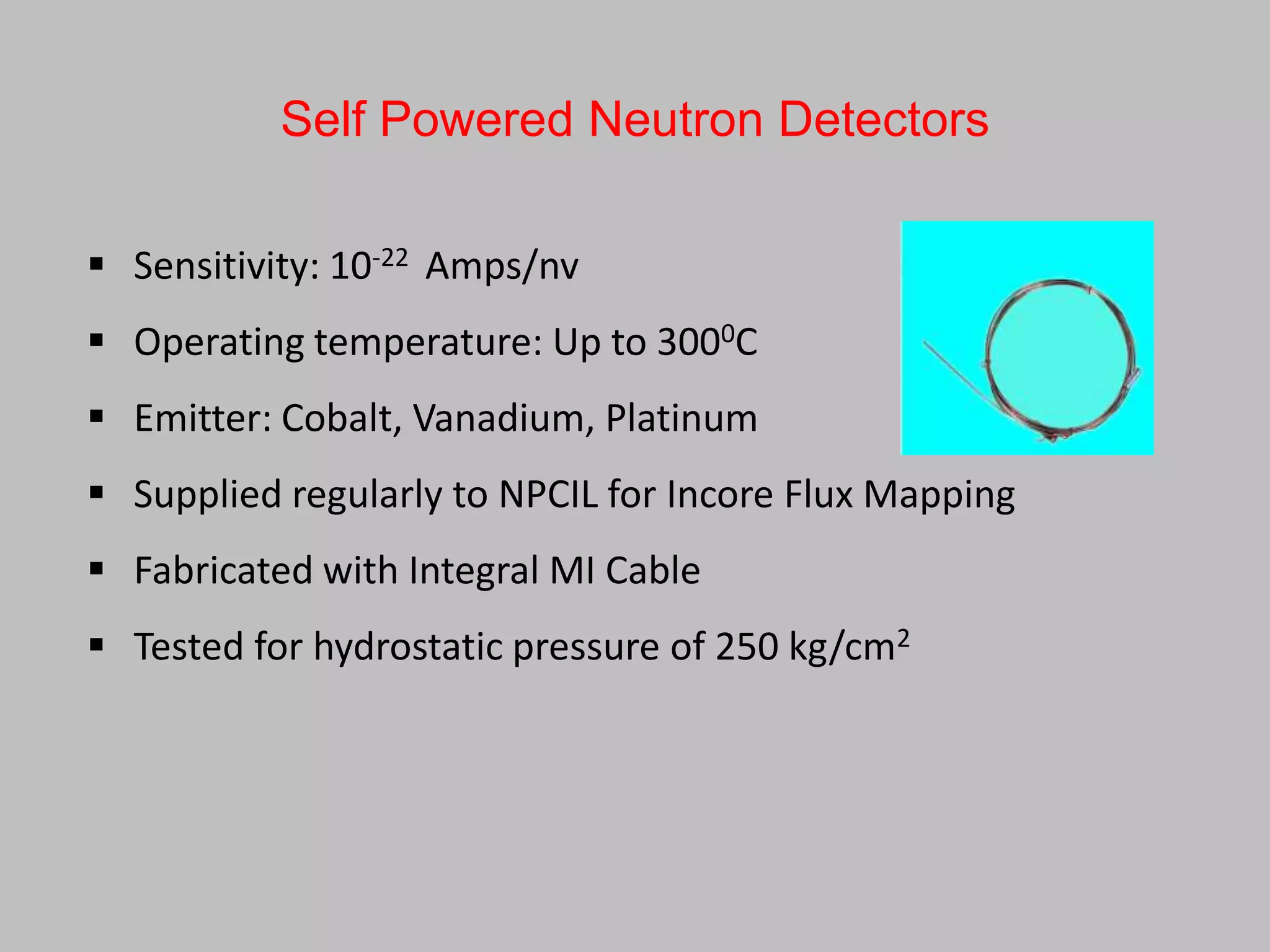
Self Powered Neutron Detectors

 Sensitivity: 10-22 Amps/nv
 Operating temperature: Up to 3000C
 Emitter: Cobalt, Vanadium, Platinum
 Supplied regularly to NPCIL for Incore Flux Mapping
 Fabricated with Integral MI Cable
 Tested for hydrostatic pressure of 250 kg/cm2
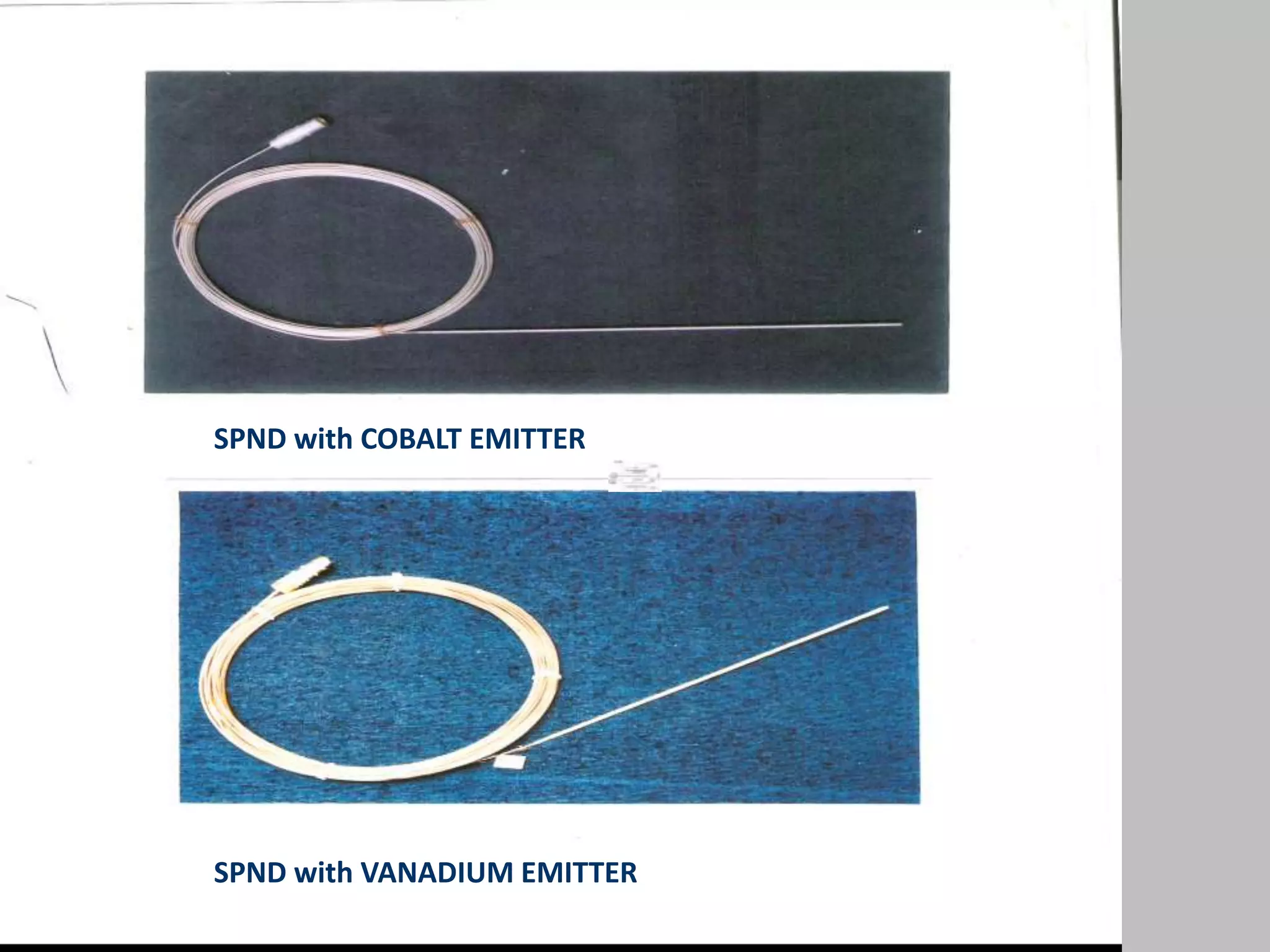
SPND with COBALT EMITTER


SPND with VANADIUM EMITTER
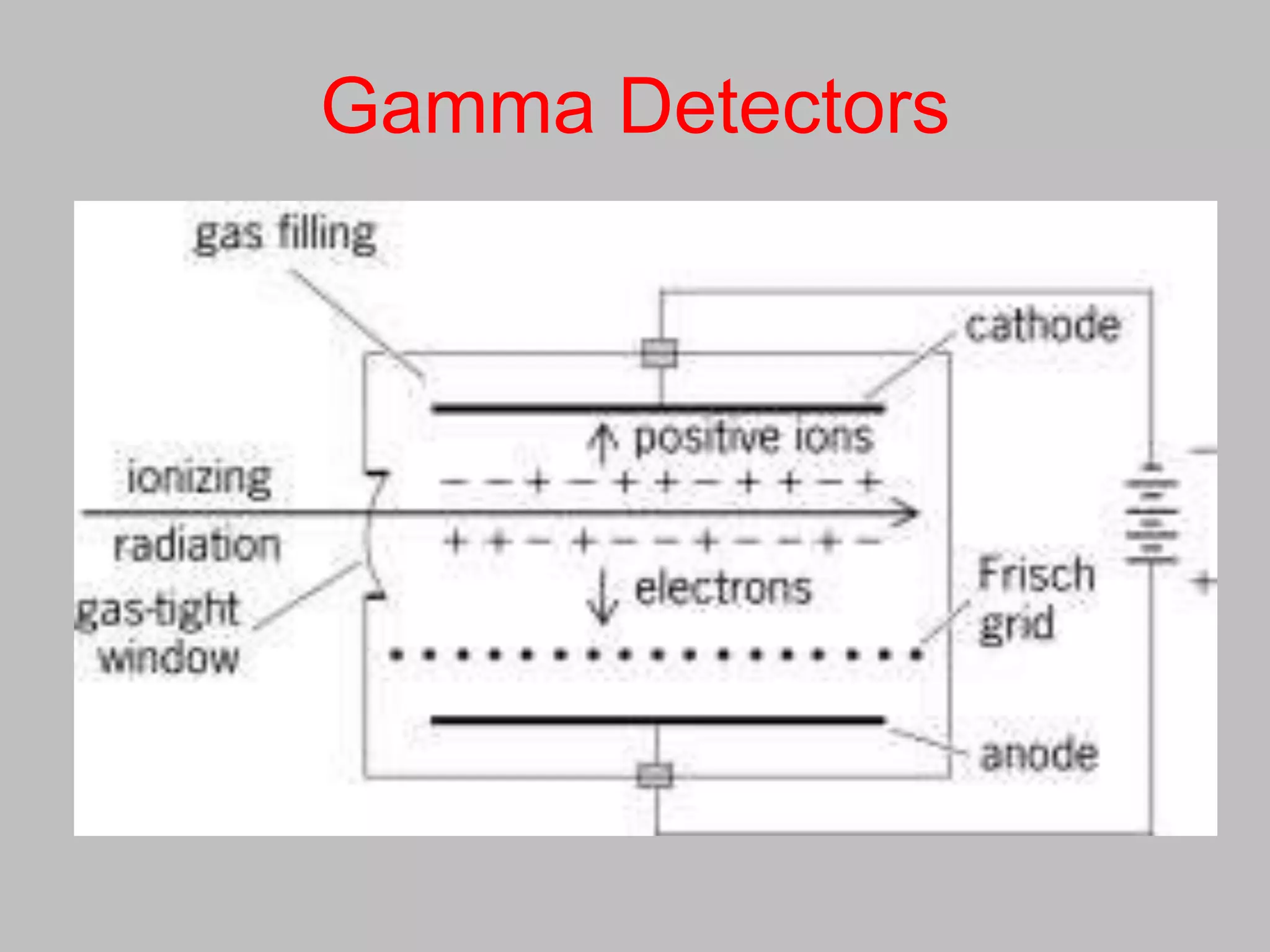
Gamma Detectors
Gamma Detectors
Gamma Ion Chambers
• CRITICALITY-CAS-G11;
• AREA MONITORING-G12, 12A;
• ISOTOPE CALIBRATION- well type-G13;
• ENVIRONMENTAL RADIATION MONITORING-G15,
  G17
• FUEL FAILURE DETECTION, DHRUVA , BARC-G20,
  G21
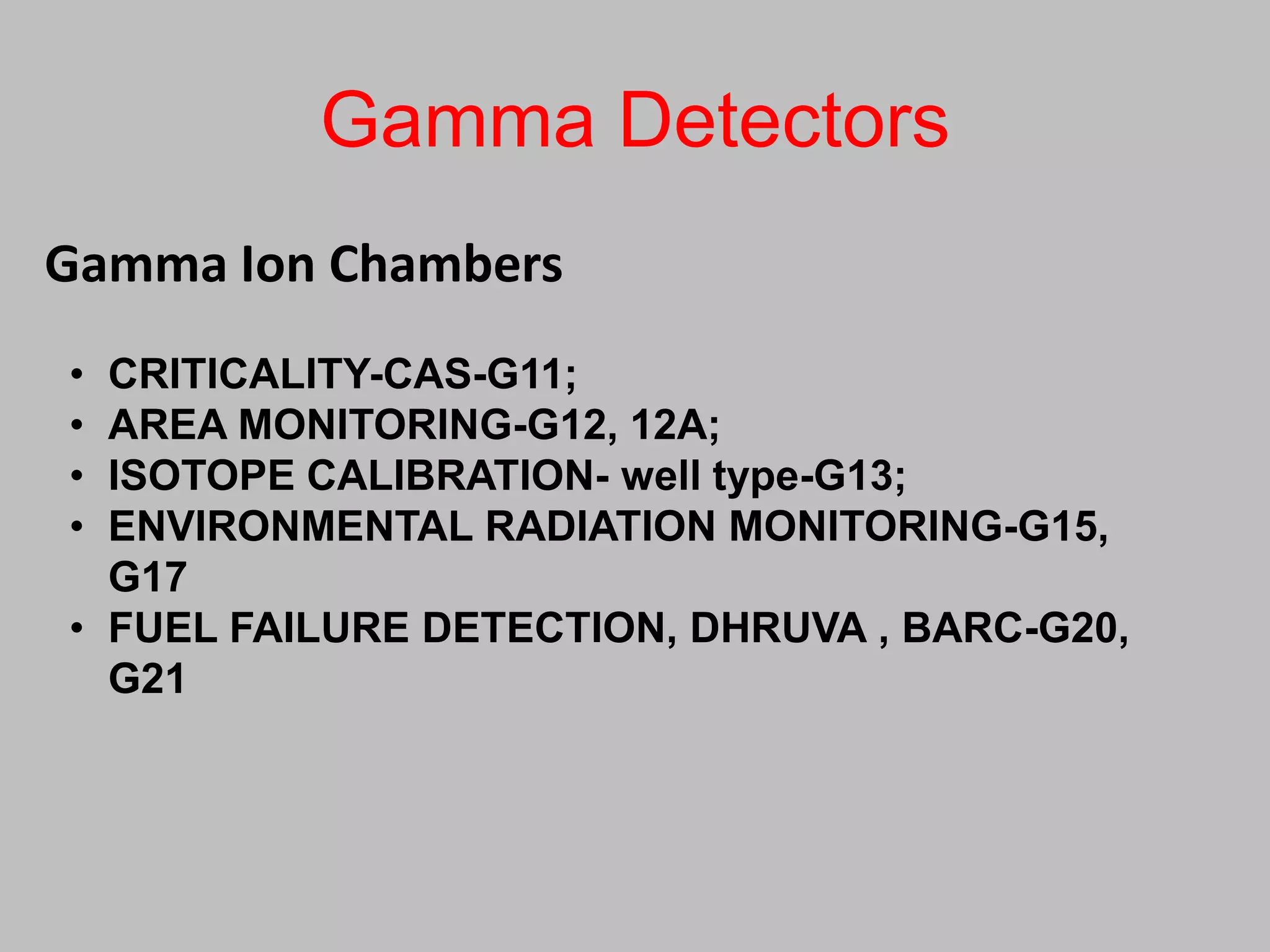
•   Application: Criticality Alarm System
•   Gamma Field range: 1mR/hr to 1000R/hr
•   Sensitivity : 3 x 10⁻¹⁰ A/R/Hr
•   Fill gas: Nitrogen + Argon
•   Seismic qualified
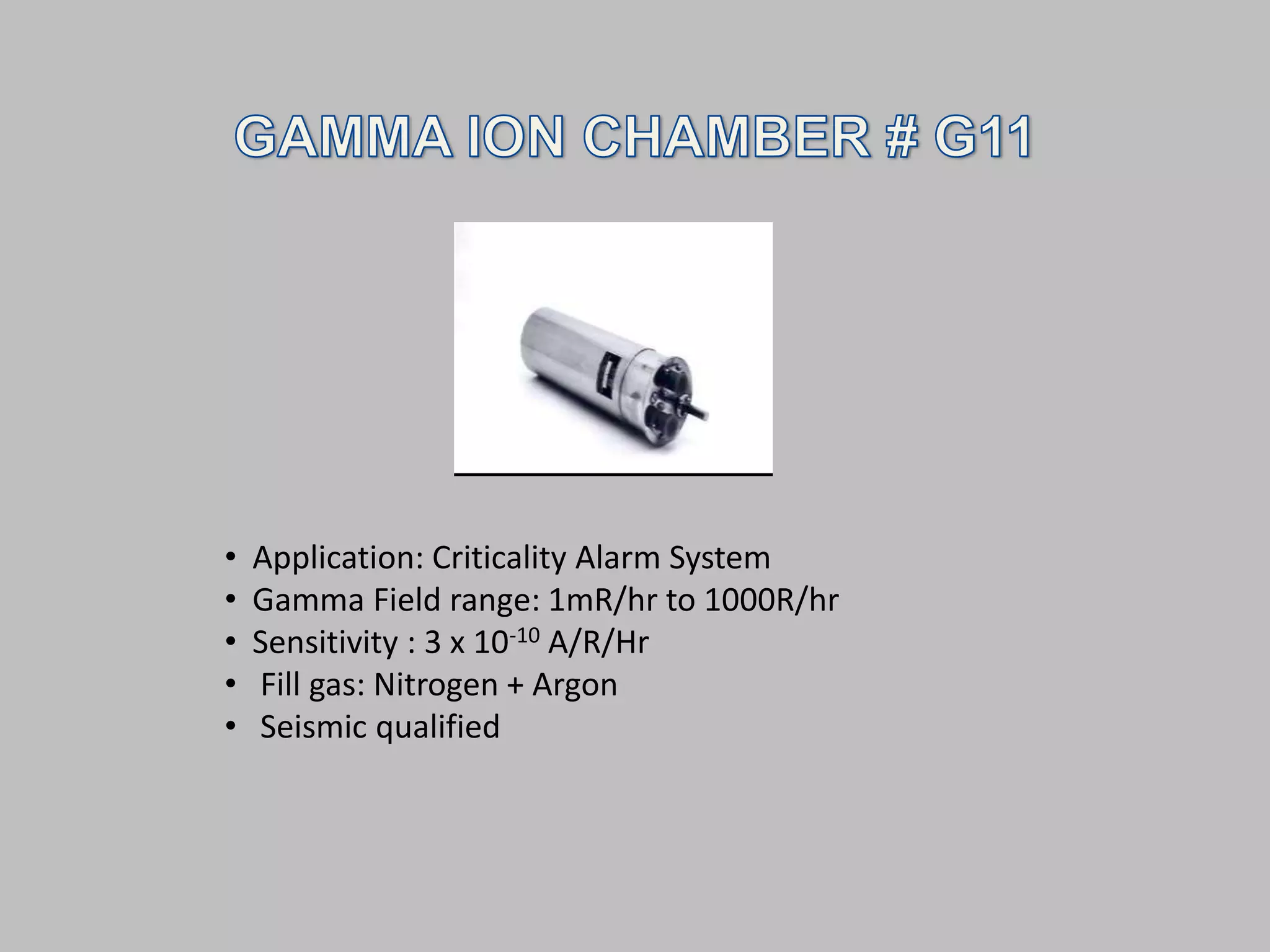
•   Application: Shut Down Area Range Monitor
•   Gamma Field range: 1mR/hr to 1000R/hr
•   Sensitivity : 4.5 x 10⁻⁹ A/R/Hr
•   Fill gas: Nitrogen + Argon
•   Seismic qualified
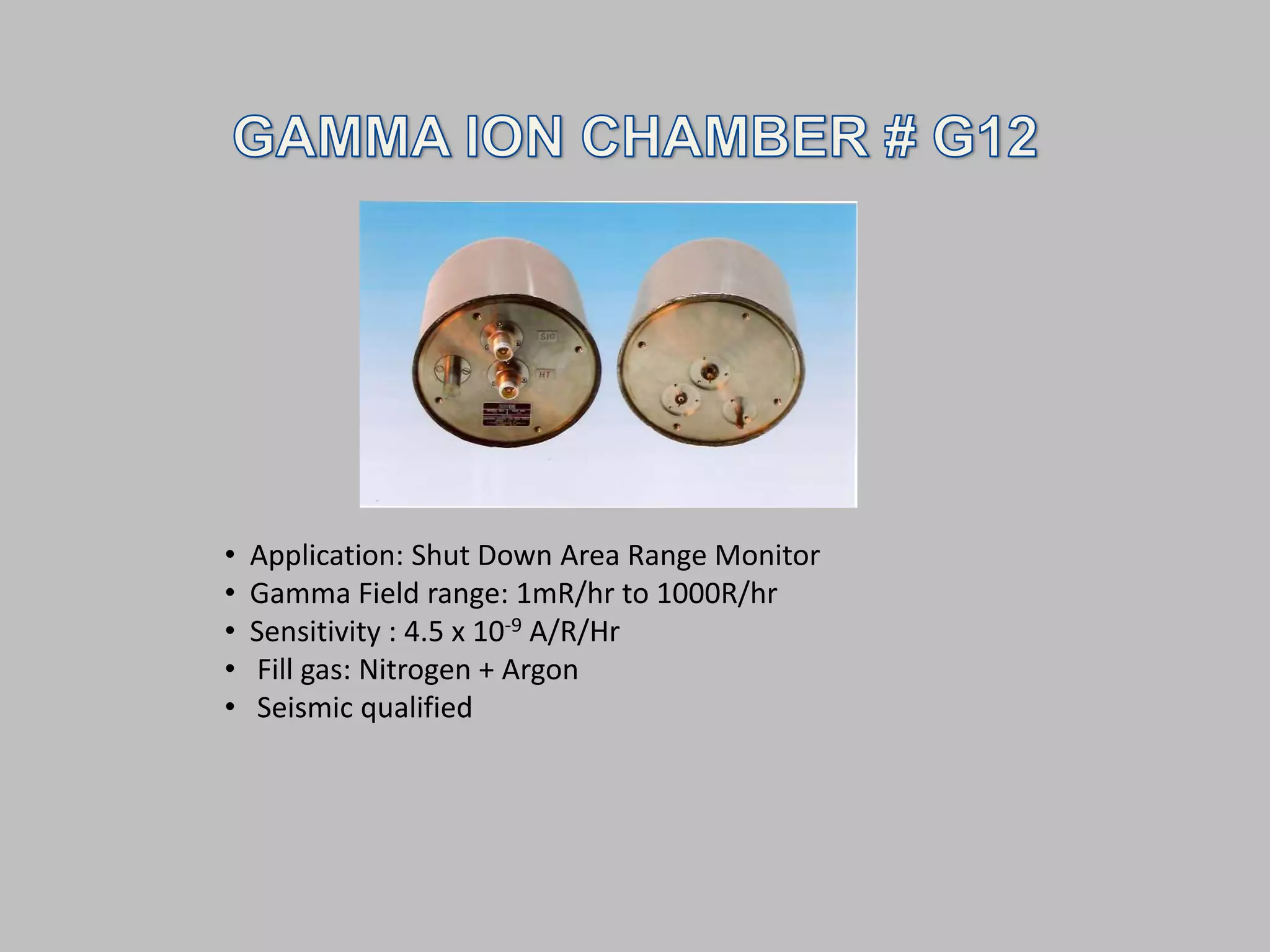
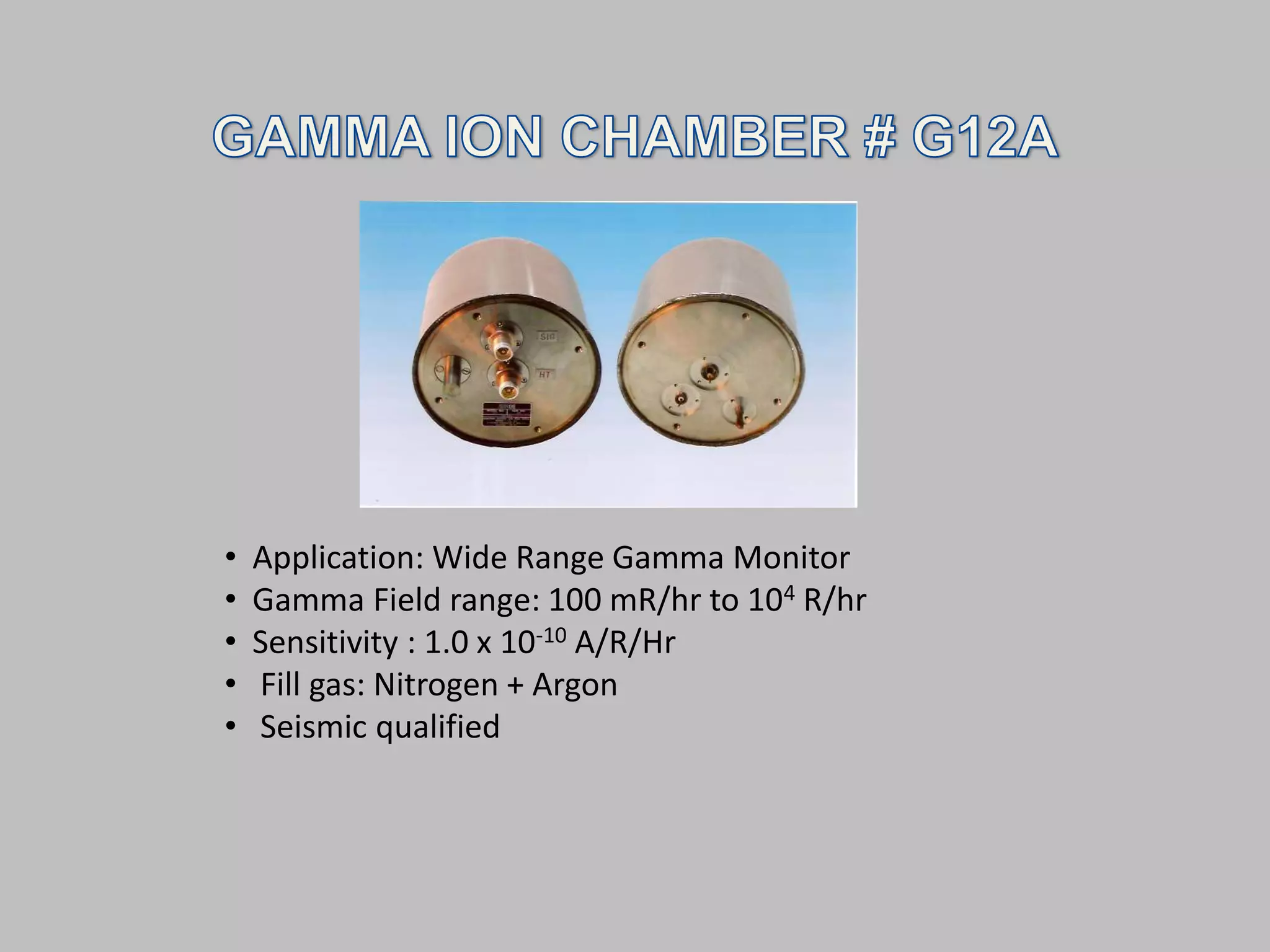
•   Application: Wide Range Gamma Monitor
•   Gamma Field range: 100 mR/hr to 104 R/hr
•   Sensitivity : 1.0 x 10⁻¹⁰ A/R/Hr
•   Fill gas: Nitrogen + Argon
•   Seismic qualified
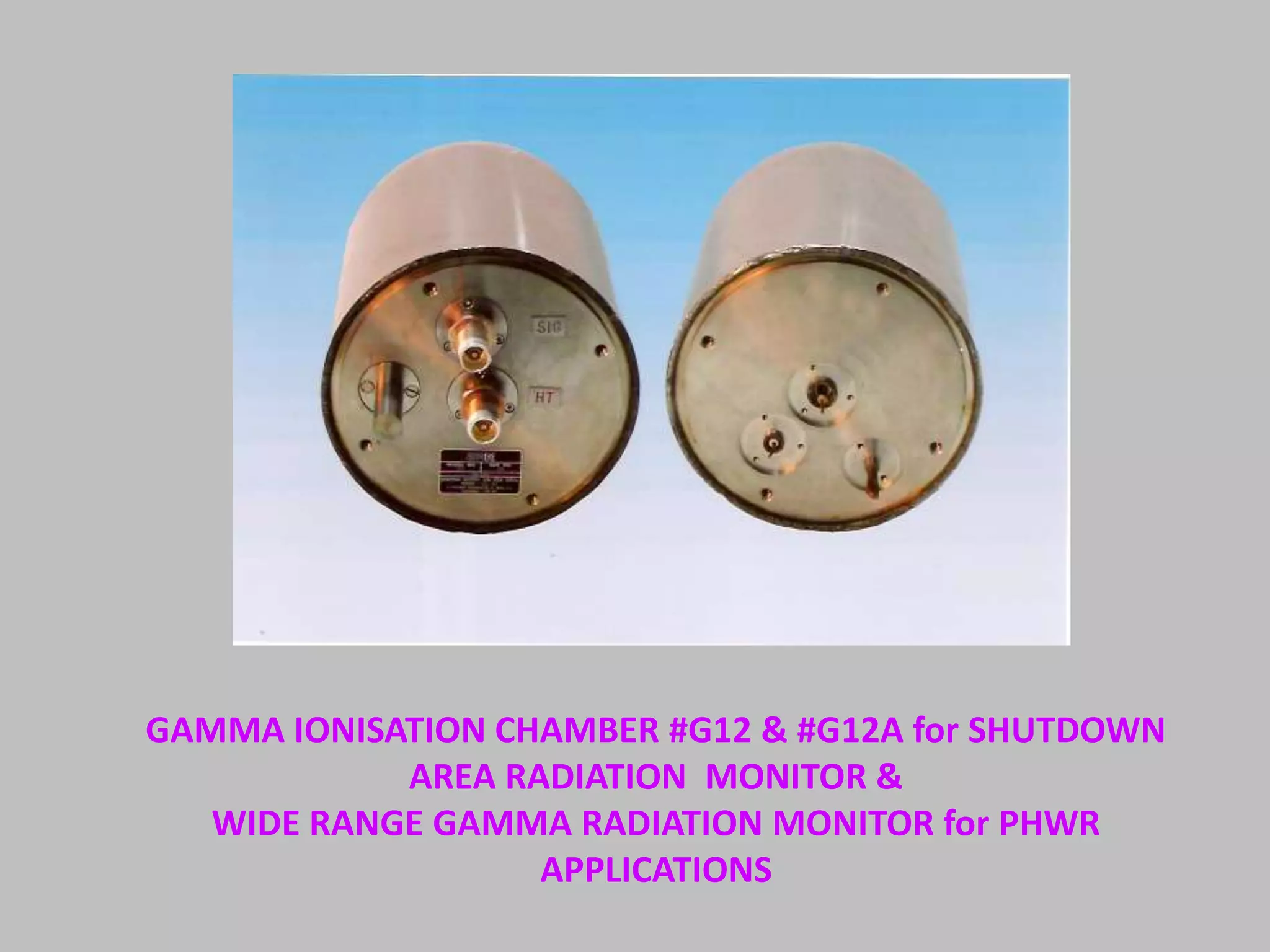
GAMMA IONISATION CHAMBER #G12 & #G12A for SHUTDOWN
            AREA RADIATION MONITOR &
   WIDE RANGE GAMMA RADIATION MONITOR for PHWR
                   APPLICATIONS
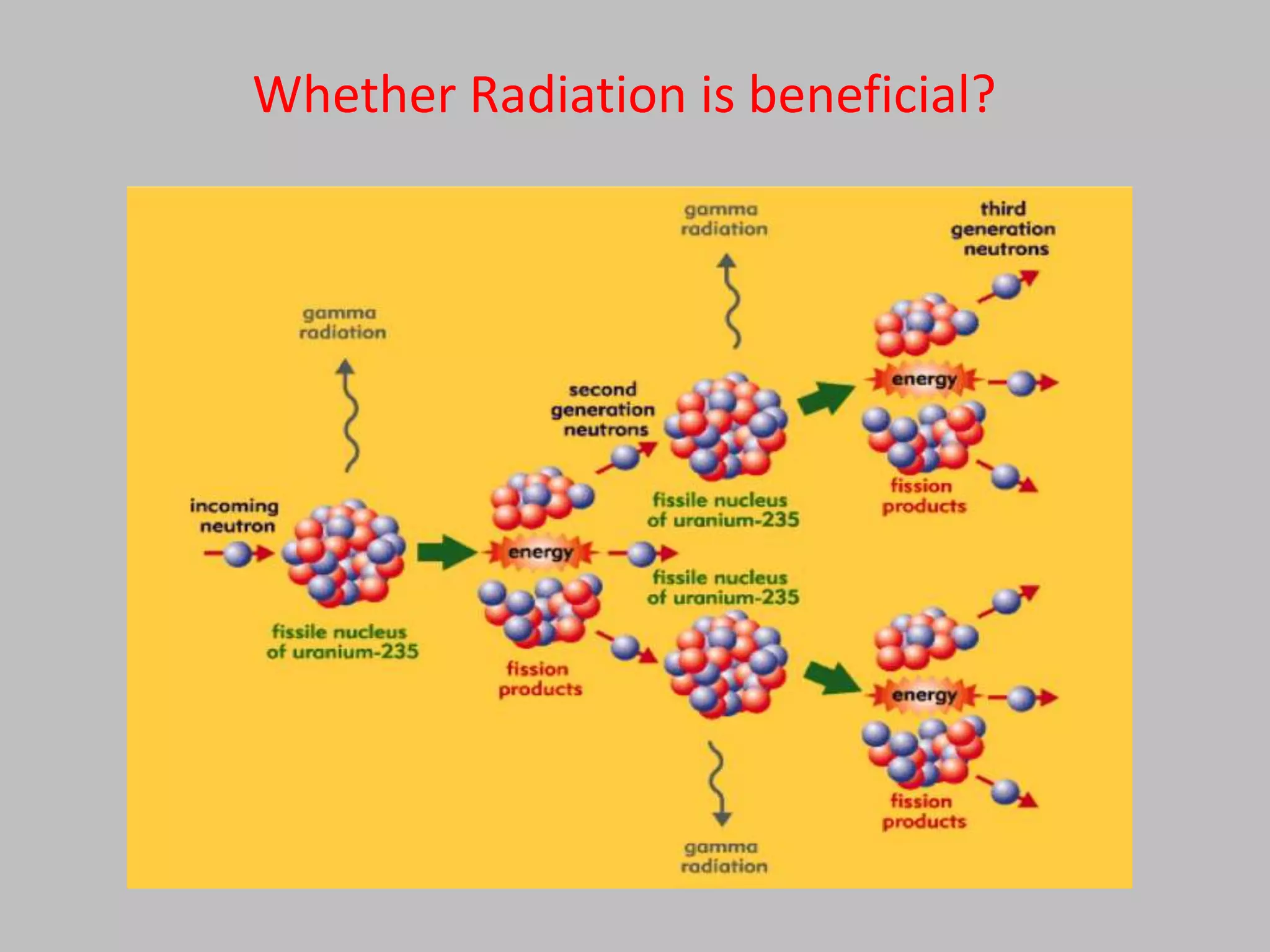
Whether Radiation is beneficial?
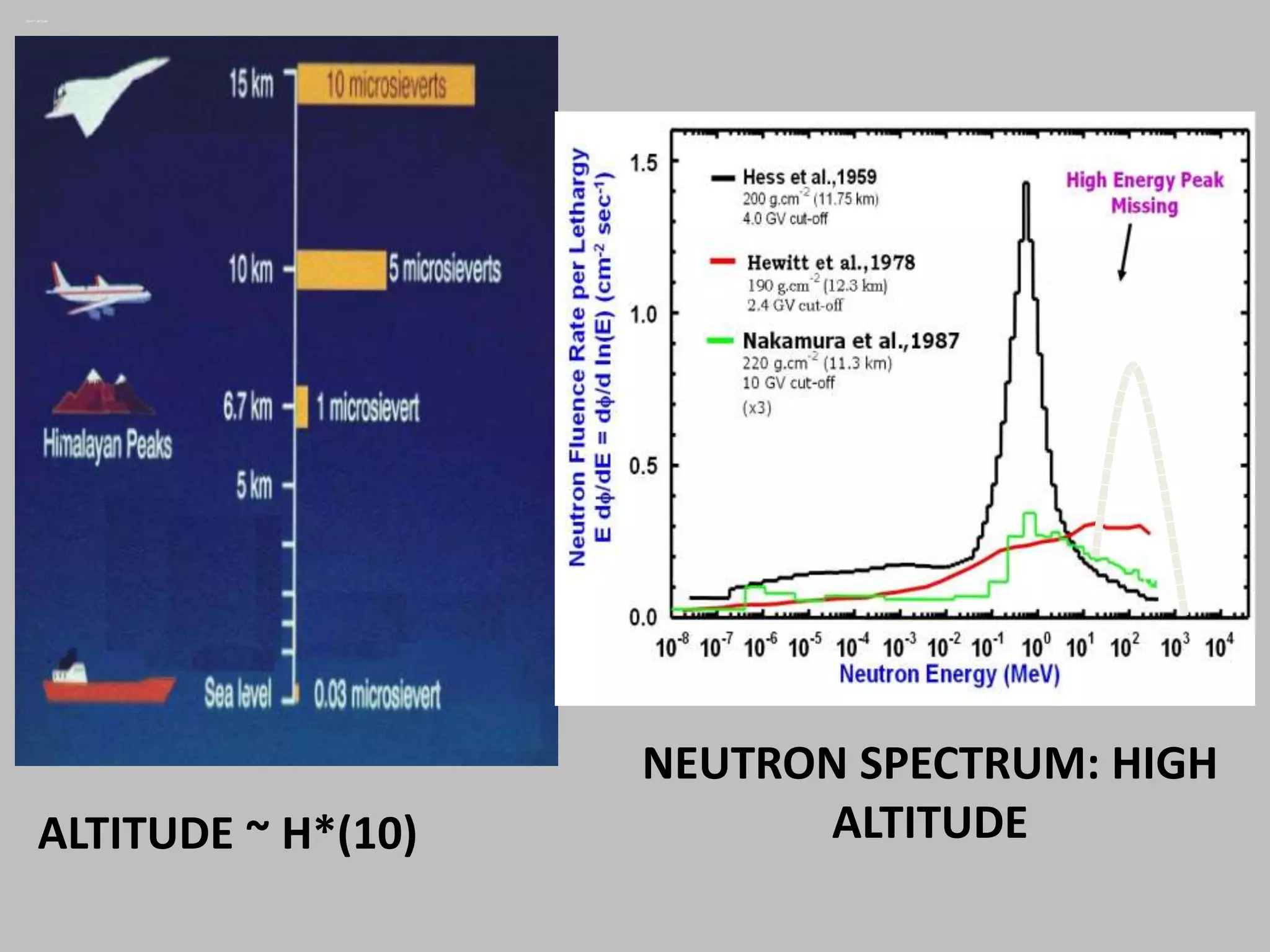
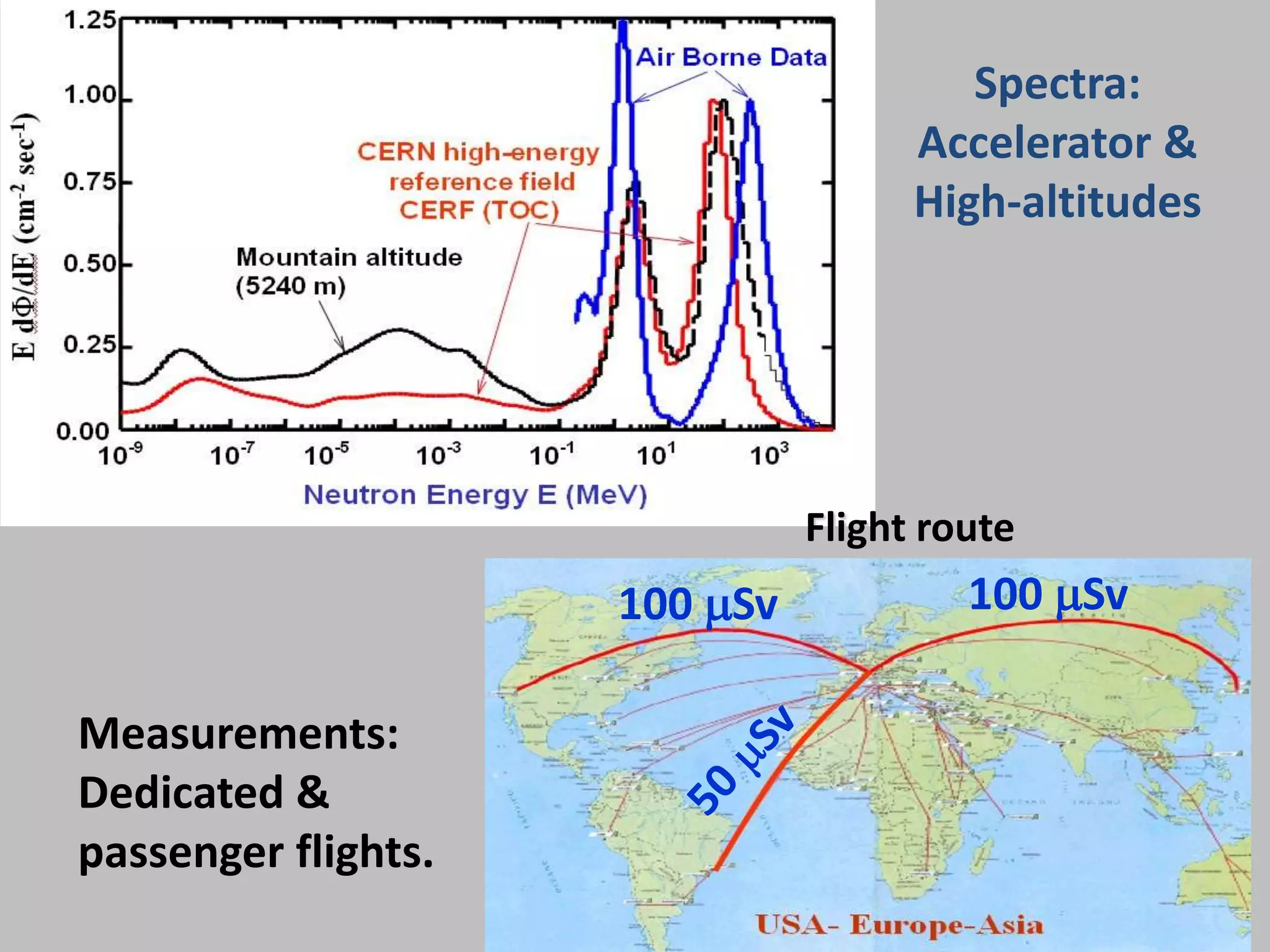
Dose ~ altitude


                  Cosmic ray Dose
                   versus altitude


                                     NEUTRON SPECTRUM: HIGH
       ALTITUDE ~ H*(10)                   ALTITUDE
Spectra:
                                     Accelerator &
                                     High-altitudes


                               Flight route
                     100 mSv            100 mSv

Measurements:
Dedicated &
passenger flights.
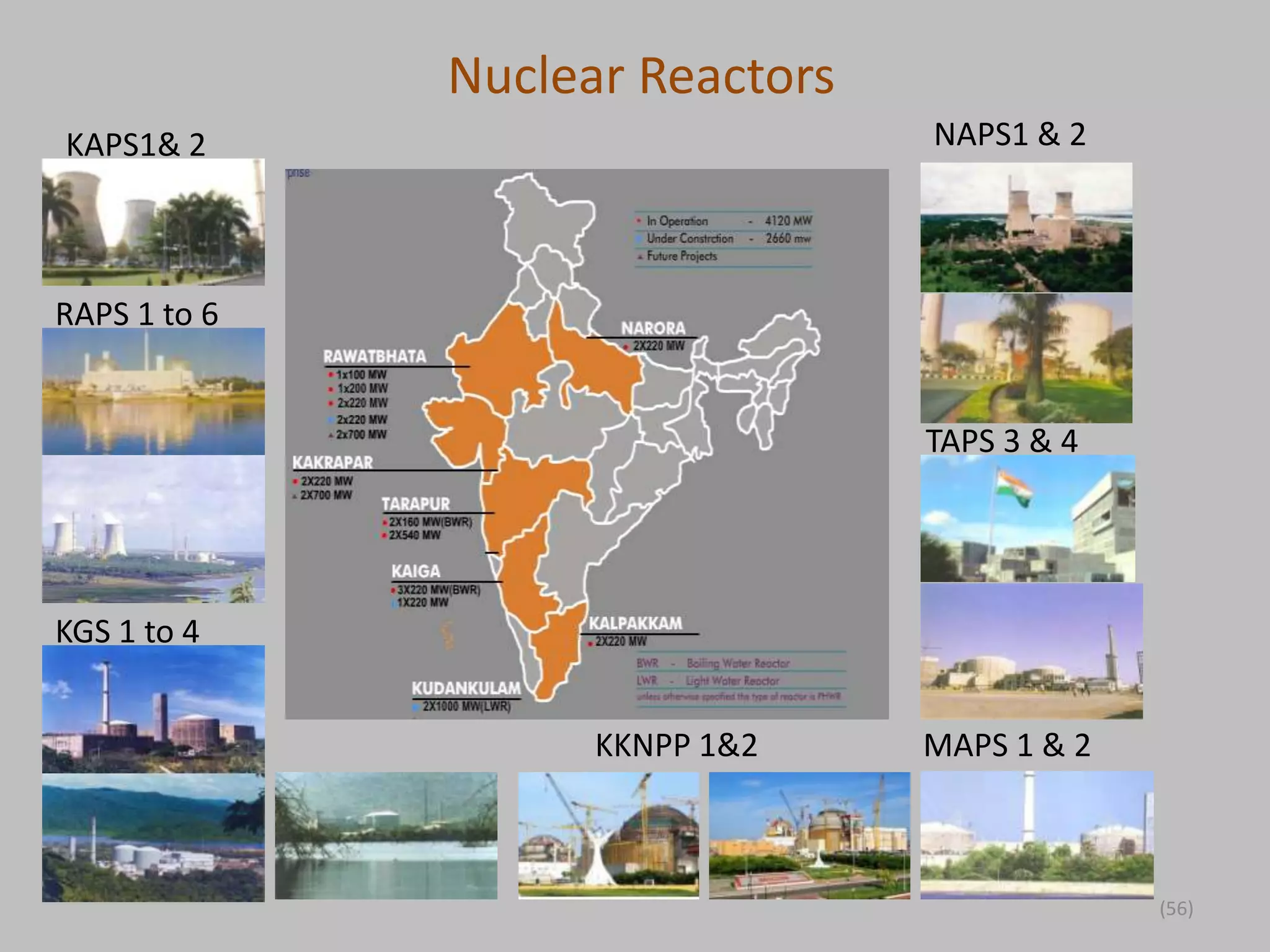
Nuclear Reactors
KAPS1& 2                         NAPS1 & 2


RAPS 1 to 6


                                 TAPS 3 & 4


KGS 1 to 4


                    KKNPP 1&2    MAPS 1 & 2


                                              (56)
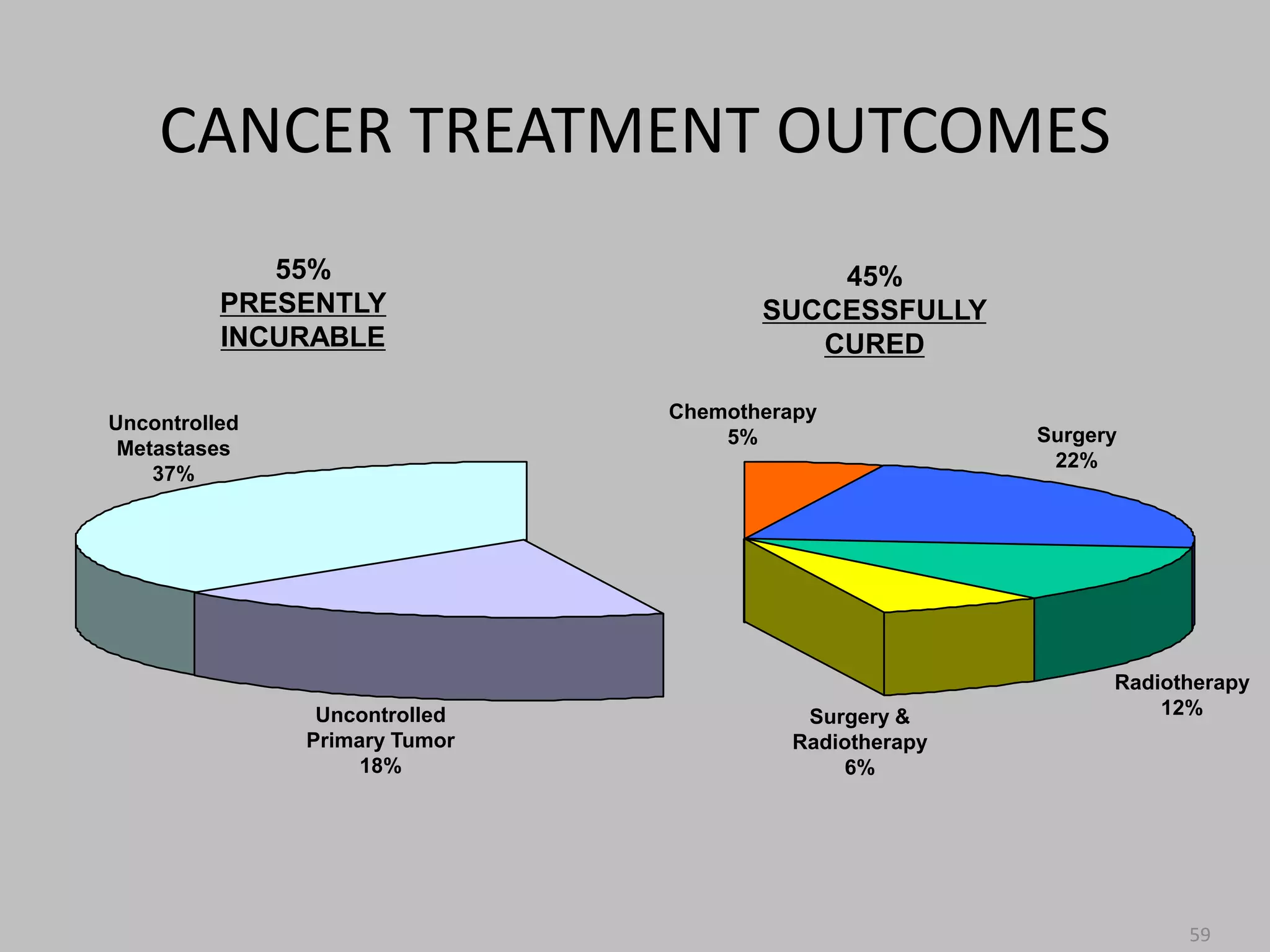
CANCER TREATMENT OUTCOMES
             55%                          45%
          PRESENTLY                   SUCCESSFULLY
          INCURABLE                      CURED

                               Chemotherapy
Uncontrolled
                                   5%                  Surgery
 Metastases
                                                        22%
    37%


                                                             Radiotherapy
                Uncontrolled             Surgery &               12%
               Primary Tumor            Radiotherapy
                    18%                     6%


                                                                   59
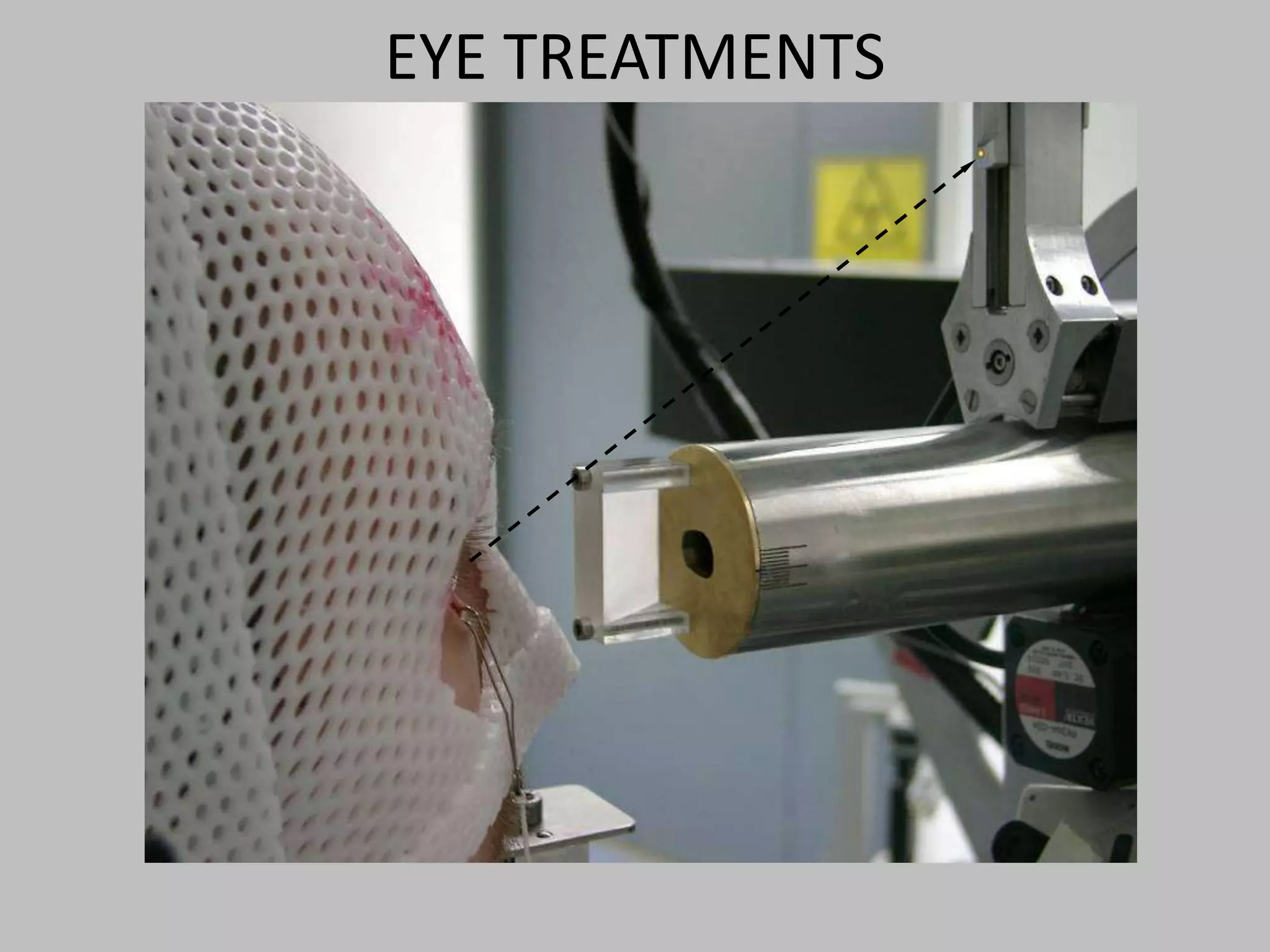
EYE TREATMENTS

      fixation light
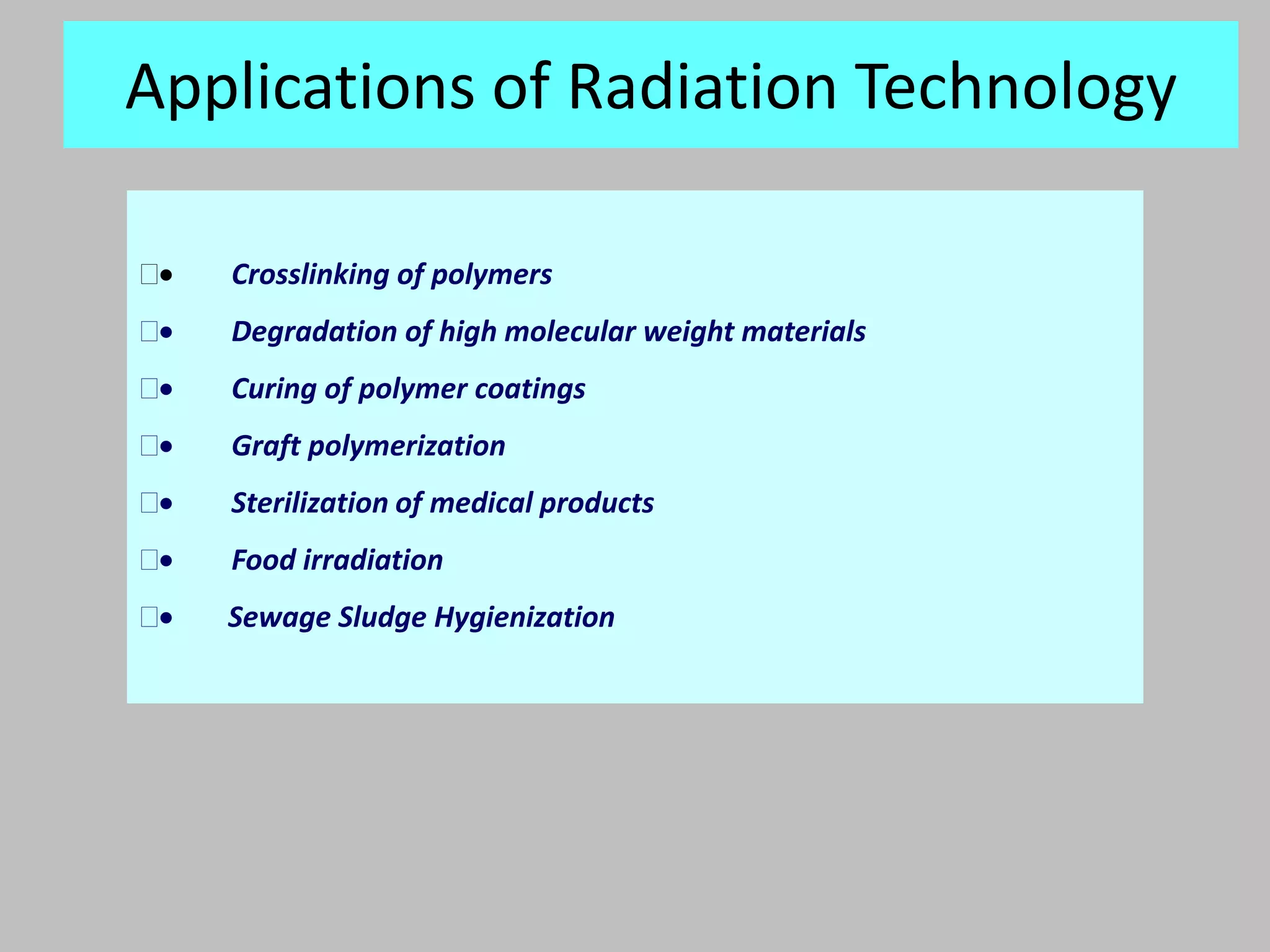
Applications of Radiation Technology

   Crosslinking of polymers
   Degradation of high molecular weight materials
   Curing of polymer coatings
   Graft polymerization
   Sterilization of medical products
   Food irradiation
   Sewage Sludge Hygienization
Thank You
    for
   your
 patience

Radiation detectors

  • 1.
    TYPES OF RADIATION/INTERACTION WITH MATTER/RADIATION DETECTORS Girish kumar Palvai Website: www.conceptualphysicstoday.com Email: palvaigirish@physicsdownloads.com
  • 2.
    Topics under Discussion What is Radiation?  Types of Radiation?  Interaction of radiation with matter.  Why Radiation Detection?  Types of Radiation detectors  Radiation Detectors in ECIL  Radiation --- harmful to mankind?
  • 3.
    Radiation could bereferred to as flux of energetic particles emanating from Nuclei /atomic events. The word radiation in the present world covers both high energy photons and energetic subatomic particles such as electrons, protons, -particles, fission products etc.
  • 4.
    Process of emissionof energetic subatomic/Nuclei particles due to change in state of certain atoms/nuclei. Such nuclei are called unstable nuclides. This phenomenon is called Radioactivity.
  • 5.
    Types of Radiation: 1. Uncharged Radiation ( Electromagnetic Radiation ) a) Photons (Gamma Rays & X-Rays ) b) Neutrons 2. Charged Particle Radiation : a) Light Charge Particle – eg: Beta ( electron ), Positron 3H, 14 C b) Heavy Charged Particle – eg :Alpha : 232Th, 238 U
  • 7.
    Types of Radiations Photons Particles Electromagnetic waves X-rays gamma-rays Electron Ions Neutron -ray Proton, -rays EB Commonly used Heavy ions radiation sources
  • 8.
    Cosmic Shower ~109-1021 eV (~ 6 GeV)  (~ km)  (100mb) 2 x 10¹⁸ particles (mainly protons) / s enter the atmosphere (ISOTROPIC) Upto ~100 • Interact with atmospheric nuclei MeV & produce secondary particles (muons, electrons, photons, neutrons: responsible for cosmic dose) Flux % H 1300 92.9 He 88 6.3 >He 10.7 1.06
  • 9.
    S o u r The Neutron Sources c e Cosmic radiations & High-energy particle accelerators are well-known neutron sources Cosmic rays: 2 types High-Energy Particle accelerators
  • 10.
    CYCLOTRONS / SYNCHROTRONS/LINEAR ACCELERATORS
  • 13.
    Interaction of GammaPhotons with matter Photoelectric effect: The kinetic energy Ee of the photoelectron is given by E e= hν–E b hν The cross section for photoelectric absorption depends on the atomic Ee number (Z) of the absorber and energy of the photon Eγ σPE α Z4.5 / Eγ3 13
  • 14.
    Compton scattering The scatteredphoton energy is given by E Esc  E 1 1 - cos   m0 c 2 The cross section for Compton scattering is hν e θ σ cs α Z / Eγ hν’ 14
  • 15.
    Pair Production The excessenergy above 1.02 MeV is shared between the positron and electron as kinetic energy, which are later slowed down in the stopping medium. Eγ= e- + e+ + Ee- + Ee+ The cross section for pair production varies with Z of the absorber and Energy of the photon as, σ pp α Z2 ln Eγ 15
  • 16.
    Relative Importance ofThree Major Interaction Mechanisms 16
  • 17.
    Interaction of Neutronswith matter • Charged particle emission (Slow neutrons) • Elastic scattering collision (Fast neutrons) • In elastic scattering collision (Fast Neutrons)
  • 18.
    Slow Neutrons Interaction 10B + 0n1   (5B11)   (3Li7 )+++ + (2He4 )++ + 2.34 Mev
  • 19.
    Fast Neutron Interaction In-Elastic scattering: - Excited Compound Nucleus Emitted Neutron Incident Neutron Gamma Ray Target nucleus
  • 20.
    Elastic scatter: • Theneutron and the nuclide collide and share a part of their kinetic energies. They rebound with speeds different from the original speeds, such that the total kinetic energy before and after the collision remains the same. If the nucleus is stationary before collision, it will gain energy from the neutron and start moving, and the neutron gets slowed down due to loss of kinetic energy. However, the residual nucleus is not excited but is in its ground state. • The most important process for slowing down of neutrons. • Total kinetic energy is conserved • E lost by the neutron is transferred to the recoiling particle. • Maximum energy transfer occurs with a head-on collision.
  • 21.
    Non elastic scatter •Differs from inelastic scattering in that a secondary particle that is not a neutron is emitted after the capture of the initial neutron. eg: 12C ( n, α ) 9Be ; Egamma = 1.75 MeV • Energy is transferred to the alpha particle and the de excitation gamma ray.
  • 22.
    Neutron capture • Sameas non elastic scatter, but by definition, neutron capture occurs only at low neutron energies (thermal energy range is < 0.025 eV). • Capture leads to the disappearance of the neutron. • Neutron capture accounts for a significant fraction of the energy transferred to tissue by neutrons in the low energy ranges. eg: 1H ( n, gamma ) 2H ; Egamma = 2.2 MeV Spallation • In this process, after the neutron is captured, the nucleus fragments into several parts. Only important at neutron energies in excess on 100 MeV. (cross sections are higher at 400-500 MeV).
  • 23.
    Why to detectRadiation? & How to detect Radiation
  • 24.
    Why to detectRadiation? • Environmental safety • Personal protection of occupational workers • Calibration of radioactive isotopes • Power regulation in nuclear reactors • Research applications • Estimation of radiation dose in treatment of patients and more…………….
  • 25.
    How to detectRadiation? Choose a radiation detector working on a particular principle of interaction (ionization/scintillation/etc) with known sensitivity to estimate the radiation under detection.
  • 26.
    Some Characteristics ofRadiation Detectors • Sensitivity • Operating voltage • Operating voltage region • Radiation detection range • Resolution (for pulse based) • Less dead time • Life time
  • 27.
    TYPES OF RADIATIONDETECTORS Gas Flow Scintillation Semi-Conductor Detectors Gas Filled Detectors Detectors Radiation Detectors Alpha Beta Gamma Neutron Other Particles Detectors Detectors Detectors Detectors & Energy GM Radiation
  • 28.
  • 29.
    GM Tube PlateauCharacteristic
  • 31.
  • 32.
    GAS FILLED DETECTORS GammaIon Chamber Gamma Ion Chamber B10F3 filled counter. Criticality Alarm Systems Area Monitoring He3 filled counter. Neutron Monitoring Fission Detector with MI Fission Detector with MI Neutron Monitoring cable for Source Range Self Powered Neutron Detector cable for Intermediate Monitoring ( BWR) Range Monitoring( BWR) Gamma Compensated neutron Ion chamber Uncompensated Neutron Ion Chamber with MI cable for Power Range Monitoring in PHWRs
  • 34.
    Neutron Detectors Fission Detectors B10 Lined Proportional Counters BF3 Proportional Counters He3 Proportional Counters B10 Coated Ion chambers Self Powered Neutron Detectors (SPND)
  • 35.
    B10 Lined ProportionalCounters  Application: Used normally for physical or normal start-up of Reactors.  Sensitivity From 0.8 to 20 CPS/nV  4 CPS/nV detectors are supplied regularly to NPCIL for Reactor Start-up  Enriched Boron (96% enriched amorphous fine powder) is the main constituent. 10B + 0n1   (5B11)   (3Li7 )+++ + (2He4 )++ + 2.34 Mev
  • 36.
    B10 Coated Ionchambers  Supplied regularly to NPCIL for Reactor Power Measurement in Intermediate and Power Range  Sensitivity: Neutron: 10-14 Amps/nv, Gamma: 10-11 Amps/R/hr (Un Compensated) 10-12 Amps/R/hr (Compensated)
  • 37.
    B10 coated Ionchamber with integral MI cable assembly  Boron-10 coated chamber with integral MI cable assembly  Neutron Sensitivity: 1x10-14 Amps/nv  Gamma Sensitivity: 2.5 x10⁻¹² Amps/R/h  Range: 104 to 1011 nv  Operating Voltage: 600 V  Operating Temperature: 100 deg C  Dimensions: 88 mm dia, 330 mm length,
  • 38.
    10BF Gas Filled Detectors 3  Sensitivity from 4 to 150 CPS/nv  25 CPS/nv detectors are supplied regularly to NPCIL, BARC for DNM and other systems  Enriched Boron Complex (B10 F3 CaF2 ).. 90% enriched powder) is the main conversion material to generate BF3 Gas by thermal decomposition.  B10 F3 CaF2 complex currently produced by HWB Generation and purification system is made by ECIL
  • 39.
    He3 Detectors  Sensitivity from 10 to 250 CPS/nv  Applications: SNM detection systems, research applications etc.  Supplied to IGCAR, BARC for Neutron well counters and other applications
  • 41.
    Fission Detectors • HEUbased  SRM, IRM, LPRM, Wide Range  Sensitivity From 10-3 to 1 CPS/nv, With & Without integral MI Cable  Supplied to BWR, FBTR • LEU (<20% Enrichment) based  Sensitivity From 10-3 to 0.18 CPS/nv, With & Without integral MI Cable  Supplied to BARC, PHWR  High Temperature (650o C) Fission Counter for PFBR
  • 42.
    FD for SourceRange Monitor Used for incore flux monitoring in BWRs.  Pulse mode operation U-235 (90% enriched) coated counter with integral MI cable assembly  Sensitivity: 10-3 CPS/nv  Range: 104 to 109 nv  Operating Voltage: 350 V  Operating Temperature: 300 deg C  Dimensions: 6 mm dia, 75 mm length, sensitive length: 25 mm
  • 43.
    Local Power RangeMonitor  U-235 (90% enriched) coated chamber with integral MI cable assembly  Neutron Sensitivity: 1x10-17 Amps/nv  Range: 1011 to 1013 nv  Gamma Sensitivity: Less than 5x10-14 Amps/R/h  Operating Voltage: 100 V  Operating Temperature: 300 deg C  Dimensions: 6 mm dia, 75 mm length, sensitive length: 25 mm
  • 44.
    Self Powered NeutronDetectors  Sensitivity: 10-22 Amps/nv  Operating temperature: Up to 3000C  Emitter: Cobalt, Vanadium, Platinum  Supplied regularly to NPCIL for Incore Flux Mapping  Fabricated with Integral MI Cable  Tested for hydrostatic pressure of 250 kg/cm2
  • 45.
    SPND with COBALTEMITTER SPND with VANADIUM EMITTER
  • 46.
  • 47.
    Gamma Detectors Gamma IonChambers • CRITICALITY-CAS-G11; • AREA MONITORING-G12, 12A; • ISOTOPE CALIBRATION- well type-G13; • ENVIRONMENTAL RADIATION MONITORING-G15, G17 • FUEL FAILURE DETECTION, DHRUVA , BARC-G20, G21
  • 48.
    Application: Criticality Alarm System • Gamma Field range: 1mR/hr to 1000R/hr • Sensitivity : 3 x 10⁻¹⁰ A/R/Hr • Fill gas: Nitrogen + Argon • Seismic qualified
  • 49.
    Application: Shut Down Area Range Monitor • Gamma Field range: 1mR/hr to 1000R/hr • Sensitivity : 4.5 x 10⁻⁹ A/R/Hr • Fill gas: Nitrogen + Argon • Seismic qualified
  • 50.
    Application: Wide Range Gamma Monitor • Gamma Field range: 100 mR/hr to 104 R/hr • Sensitivity : 1.0 x 10⁻¹⁰ A/R/Hr • Fill gas: Nitrogen + Argon • Seismic qualified
  • 51.
    GAMMA IONISATION CHAMBER#G12 & #G12A for SHUTDOWN AREA RADIATION MONITOR & WIDE RANGE GAMMA RADIATION MONITOR for PHWR APPLICATIONS
  • 52.
  • 54.
    Dose ~ altitude Cosmic ray Dose versus altitude NEUTRON SPECTRUM: HIGH ALTITUDE ~ H*(10) ALTITUDE
  • 55.
    Spectra: Accelerator & High-altitudes Flight route 100 mSv 100 mSv Measurements: Dedicated & passenger flights.
  • 56.
    Nuclear Reactors KAPS1& 2 NAPS1 & 2 RAPS 1 to 6 TAPS 3 & 4 KGS 1 to 4 KKNPP 1&2 MAPS 1 & 2 (56)
  • 59.
    CANCER TREATMENT OUTCOMES 55% 45% PRESENTLY SUCCESSFULLY INCURABLE CURED Chemotherapy Uncontrolled 5% Surgery Metastases 22% 37% Radiotherapy Uncontrolled Surgery & 12% Primary Tumor Radiotherapy 18% 6% 59
  • 60.
    EYE TREATMENTS fixation light
  • 61.
    Applications of RadiationTechnology  Crosslinking of polymers  Degradation of high molecular weight materials  Curing of polymer coatings  Graft polymerization  Sterilization of medical products  Food irradiation  Sewage Sludge Hygienization
  • 62.
    Thank You for your patience