Kingdoms and Christianity

Section 1
Kingdoms and Christianity

The Byzantine Empire
Preview
•

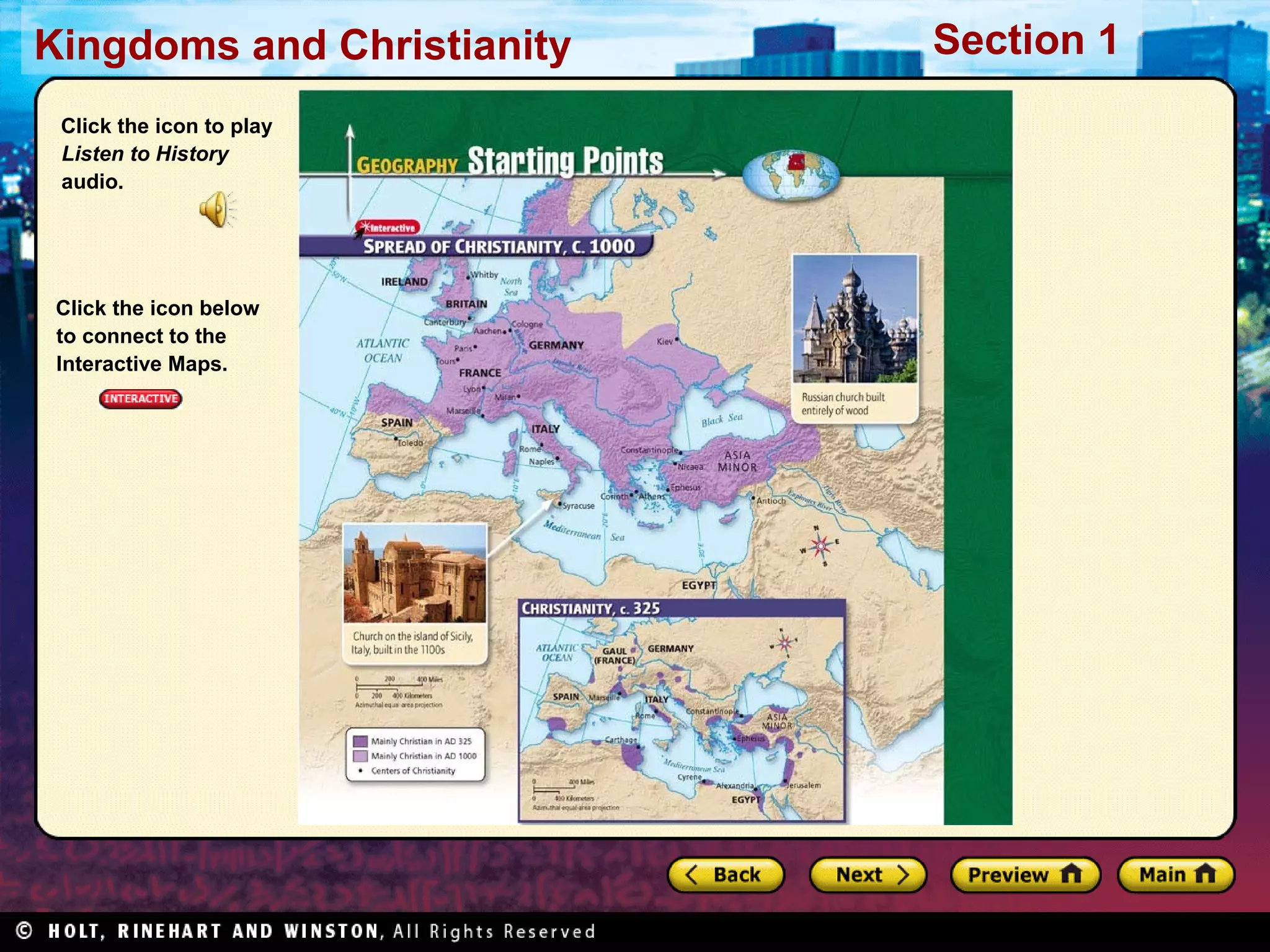
Starting Points Map: Spread of Christianity

•

Main Idea / Reading Focus

•

Emperors Rule in Constantinople

•

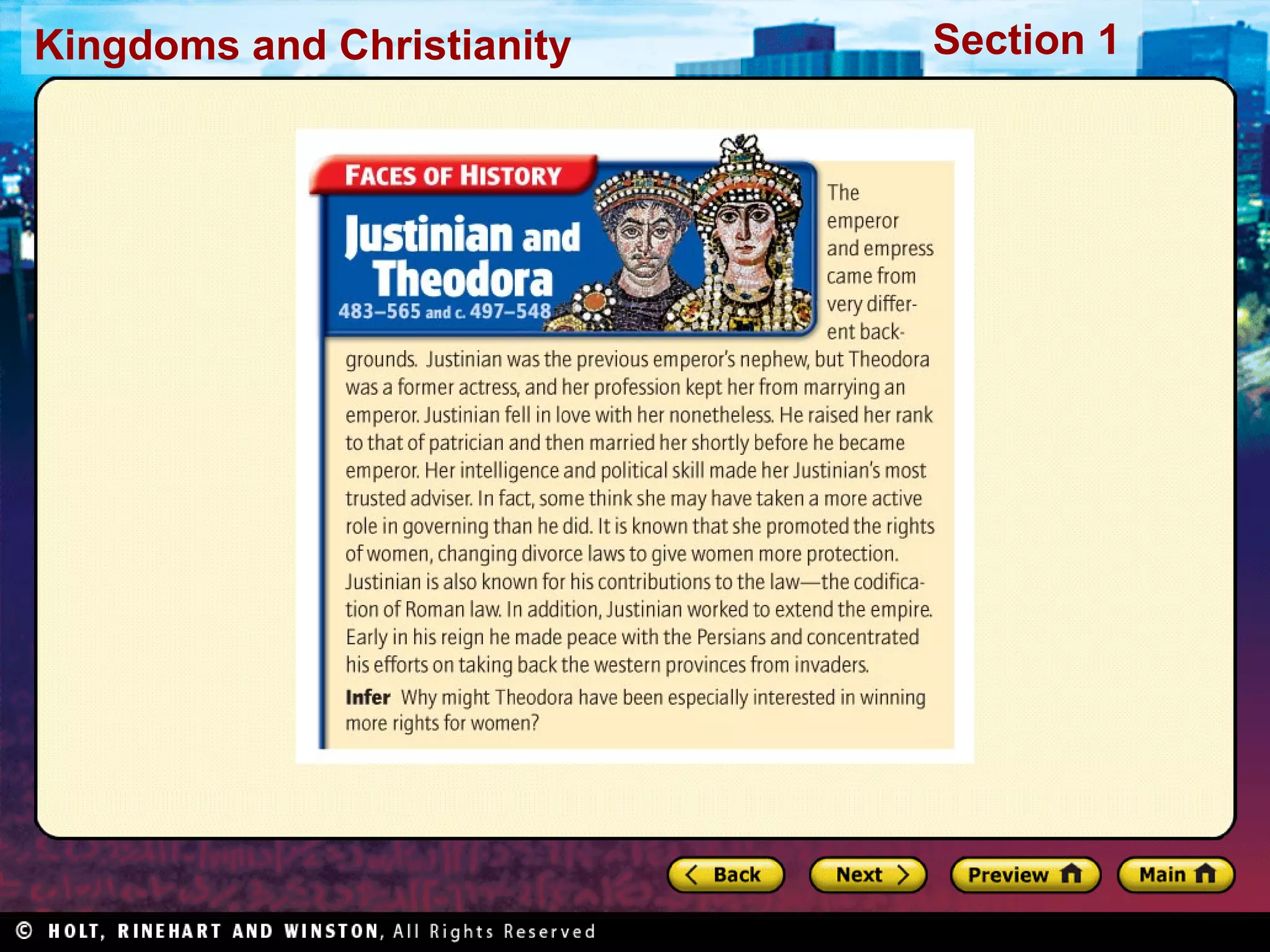
Faces of History: Justinian and Theodora

•

Byzantine Culture

•

The Empire Declines

Section 1
Kingdoms and Christianity
Click the icon to play
Listen to History
audio.

Click the icon below
to connect to the
Interactive Maps.

Section 1
Kingdoms and Christianity

Section 1

The Byzantine Empire
Main Idea
1. The Byzantine Empire, once the eastern half of the Roman
Empire, was held together for centuries by strong leaders,
profitable trade, and the influence of Christianity.

Reading Focus
• How did Byzantine emperors rule their empire from
Constantinople?
• What were some important features of Byzantine culture?
• What led to the decline of the Byzantine Empire?
Kingdoms and Christianity

Section 1

Emperors Rule in Constantinople
Constantinople—Greek for “The City of Constantine”—became the
capital of the roman Empire under Emperor Constantine I.

A New Rome

Location

• Constantinople seat of Eastern
Roman Empire

• Location on Bosporus Strait
helped control trade between
Asia, Europe

• Became known as Byzantine
Empire
• Remained capital of Eastern
Empire long after Rome fell
• Even before fall of Rome,
Constantinople larger, richer
city than Rome

• Also helped guard city from
attack
– Sea protected city on two
sides
– Heavily fortified walls
protected landward side
Kingdoms and Christianity

Section 1

Reclaiming Western Empire
Claim to Empire

Military Action

• Western part of empire still
claimed by eastern emperors

• Military action needed to
accomplish Justinian’s goal

• Byzantine emperor Justinian I
wanted to restore original
Roman Empire

• First had to reconquer North
African territories taken by
Germanic tribe, Vandals

Belisarius
• 533, Justinian sent ships,
troops to northern Africa
• Troops led by top general,
Belisarius

Successes
• By 534, fleet had recaptured
African region, absorbed back
into Roman Empire
• 535, Belisarius led troops to
Italy to retake that region
Section 1

Kingdoms and Christianity

Rebellion at Home
Facing Problems
• Justinian, wife Theodora
served as co-rulers of empire
• At home, faced threat from
rebels
• Many resented Justinian’s
efforts to reform empire’s
administration
• 532, opposition led to rebellion
called Nika Revolt

Rebellion Quelled
• Two factions led revolt: Greens
representing lower classes,
Blues upper classes
• Constantinople in flames,
Justinian prepared to flee
• Theodora stood firm, refused to
flee, back down, convinced
Justinian to do same
• Belisarius attacked rioters,
slaughtered them by thousands
Kingdoms and Christianity

Section 1
Kingdoms and Christianity

Section 1

2. Achievements
• Nika Revolt destroyed parts of Constantinople
• Gave Justinian, Theodora chance to rebuilt city with new monuments
• Most important new building, church, Hagia Sophia, “Holy Wisdom”
• Spectacular blend of domes, arches; building still stands

Justinian’s Code
• Justinian set up commission that codified, systematically arranged,
empire’s existing laws, legal opinions into clear system
• Corpus Juris Civilis had four parts; first part included all existing
constitutions from time of Emperor Hadrian
• Code later updated, expanded to include Justinian’s laws as well
Kingdoms and Christianity

Section 1

Changes after Justinian
• Justinian’s achievements many, but did not last
–

Died 565, left government nearly bankrupt from expenses of
taking back empire’s territory

–

Had expanded empire beyond what government could
effectively administer

–

Western provinces fell to migrating tribes after his death

• Reign of Heraclius began 610
–

Heraclius defeated Persians on eastern border

–

Settled Croats, Serbs within Balkan frontiers to west to act as
buffers against new invaders

–

Croats, Serbs converted to Christianity, extending Byzantine
influence into region
Kingdoms and Christianity

Section 1

Summarize
What did Justinian accomplish during his
reign?
Answer(s): put down the Nika Revolt, built the
Hagia Sophia, reformed Roman law
Kingdoms and Christianity

Section 1

Byzantine Culture
The Role of the Emperor
• Two institutions central to Byzantine culture—emperor, Christianity
• Emperor, priest-king, considered deputy of Jesus Christ on earth, his co-ruler
• Emperor responsible for both civil, religious law

Changing Culture
• Example of emperor’s influence reflected in empire’s changing culture
• People of Constantinople referred to selves as Roman, but Greek cultural
influences grew stronger

End to Roman Traditions
• Emperor Heraclius brought official end to Roman traditions
• Made Greek official language, replacing Latin
• Replaced old Roman imperial titles with Greek ones
Section 1

Kingdoms and Christianity

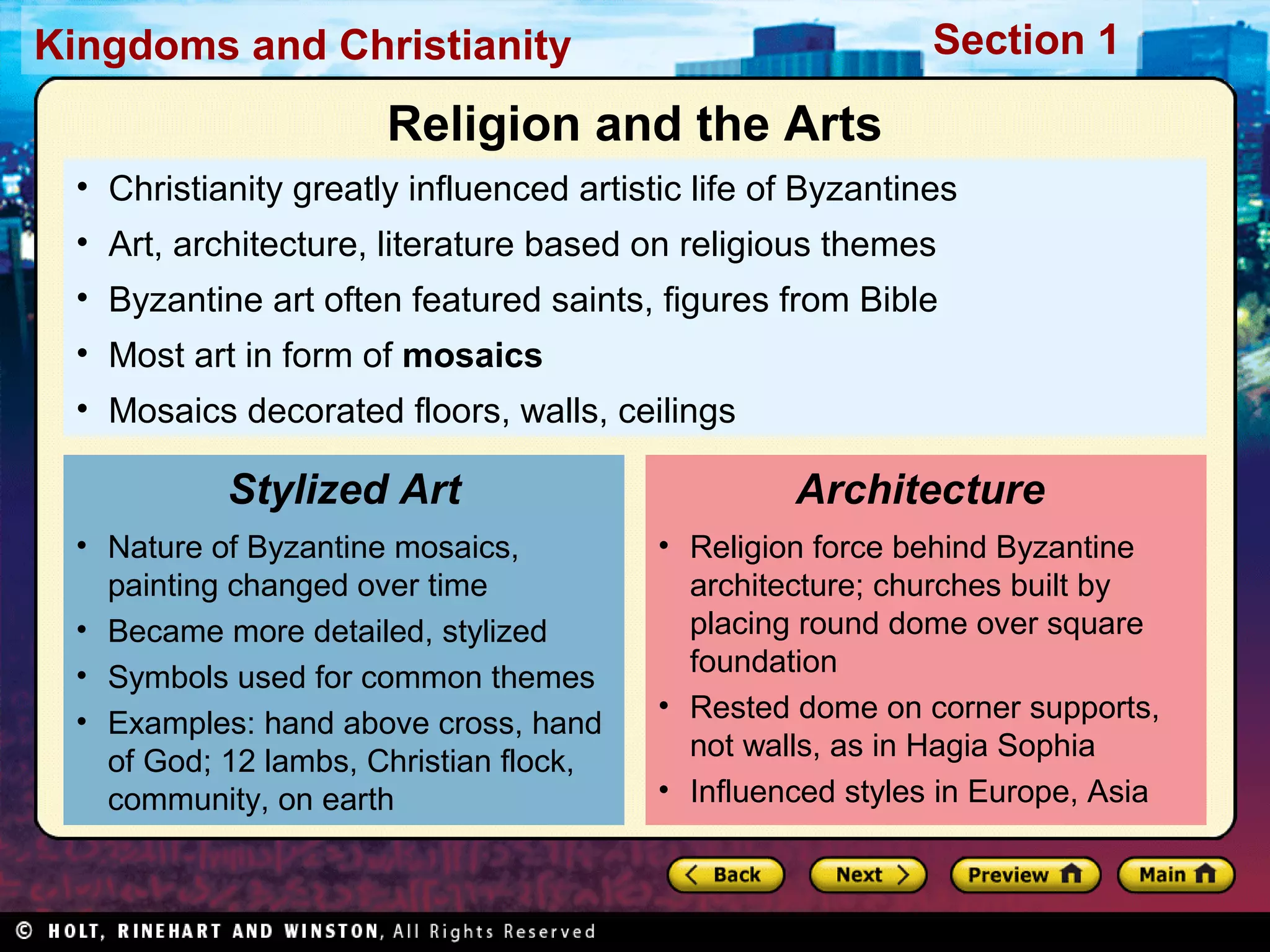
Religion and the Arts
• Christianity greatly influenced artistic life of Byzantines
• Art, architecture, literature based on religious themes
• Byzantine art often featured saints, figures from Bible
• Most art in form of mosaics
• Mosaics decorated floors, walls, ceilings

Stylized Art
• Nature of Byzantine mosaics,
painting changed over time
• Became more detailed, stylized
• Symbols used for common themes
• Examples: hand above cross, hand
of God; 12 lambs, Christian flock,
community, on earth

Architecture
• Religion force behind Byzantine
architecture; churches built by
placing round dome over square
foundation
• Rested dome on corner supports,
not walls, as in Hagia Sophia
• Influenced styles in Europe, Asia
Section 1

Kingdoms and Christianity

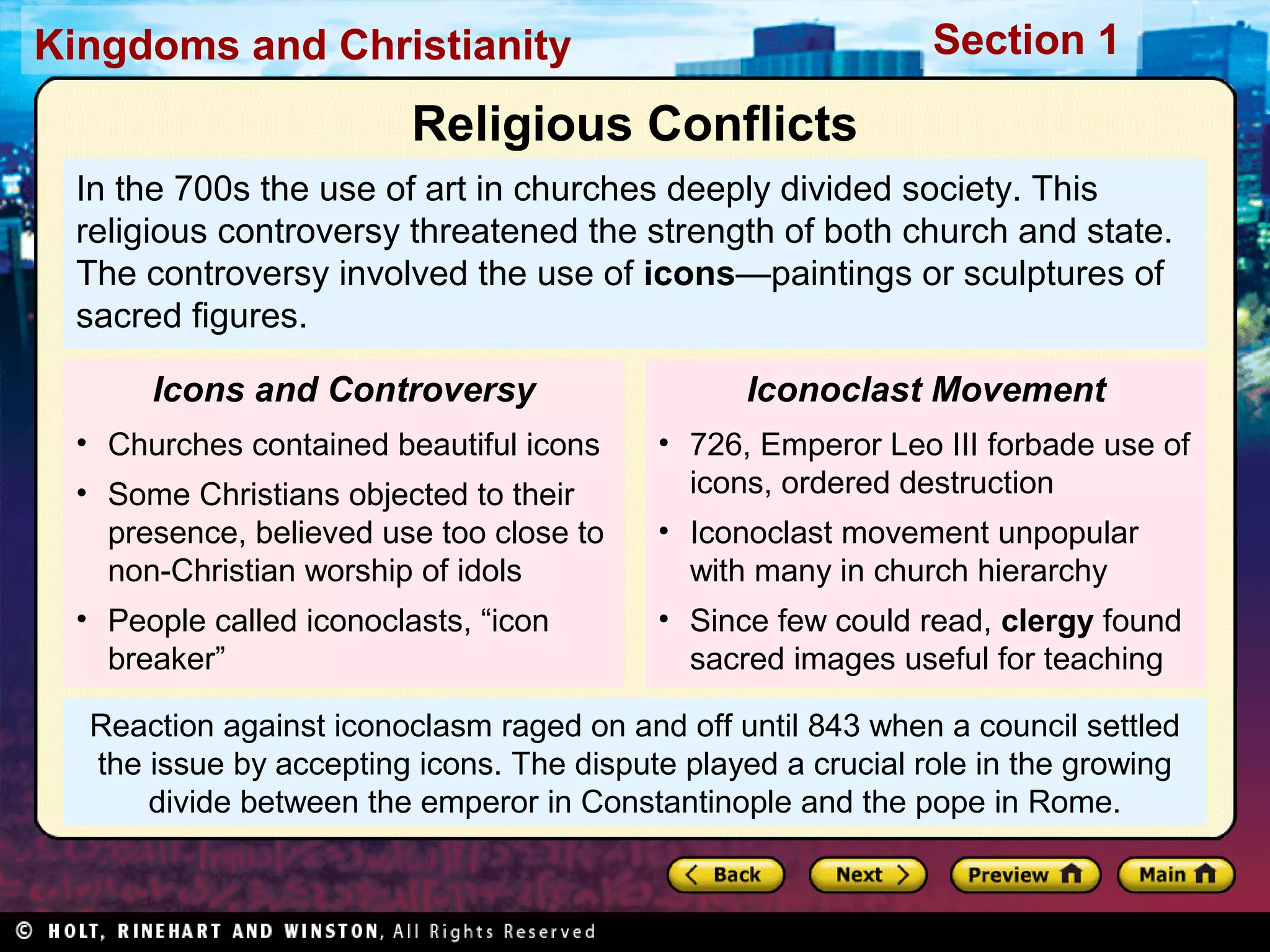
Religious Conflicts
In the 700s the use of art in churches deeply divided society. This
religious controversy threatened the strength of both church and state.
The controversy involved the use of icons—paintings or sculptures of
sacred figures.
Icons and Controversy

Iconoclast Movement

• Churches contained beautiful icons

• 726, Emperor Leo III forbade use of
icons, ordered destruction

• Some Christians objected to their
presence, believed use too close to
non-Christian worship of idols
• People called iconoclasts, “icon
breaker”

• Iconoclast movement unpopular
with many in church hierarchy
• Since few could read, clergy found
sacred images useful for teaching

Reaction against iconoclasm raged on and off until 843 when a council settled
the issue by accepting icons. The dispute played a crucial role in the growing
divide between the emperor in Constantinople and the pope in Rome.
Kingdoms and Christianity

Section 1

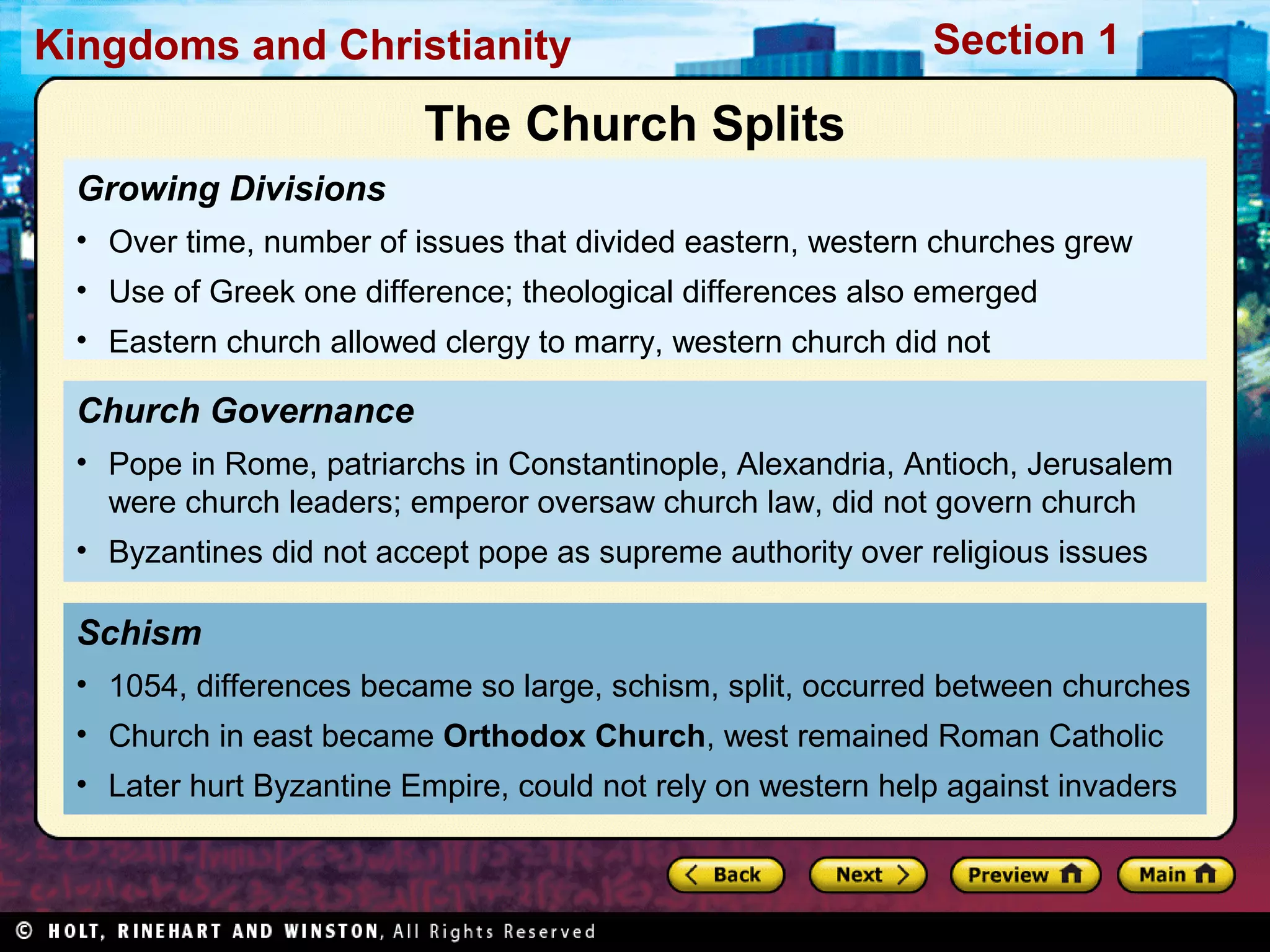
The Church Splits
Growing Divisions
• Over time, number of issues that divided eastern, western churches grew
• Use of Greek one difference; theological differences also emerged
• Eastern church allowed clergy to marry, western church did not

Church Governance
• Pope in Rome, patriarchs in Constantinople, Alexandria, Antioch, Jerusalem
were church leaders; emperor oversaw church law, did not govern church
• Byzantines did not accept pope as supreme authority over religious issues

Schism
• 1054, differences became so large, schism, split, occurred between churches
• Church in east became Orthodox Church, west remained Roman Catholic
• Later hurt Byzantine Empire, could not rely on western help against invaders
Kingdoms and Christianity

Section 1

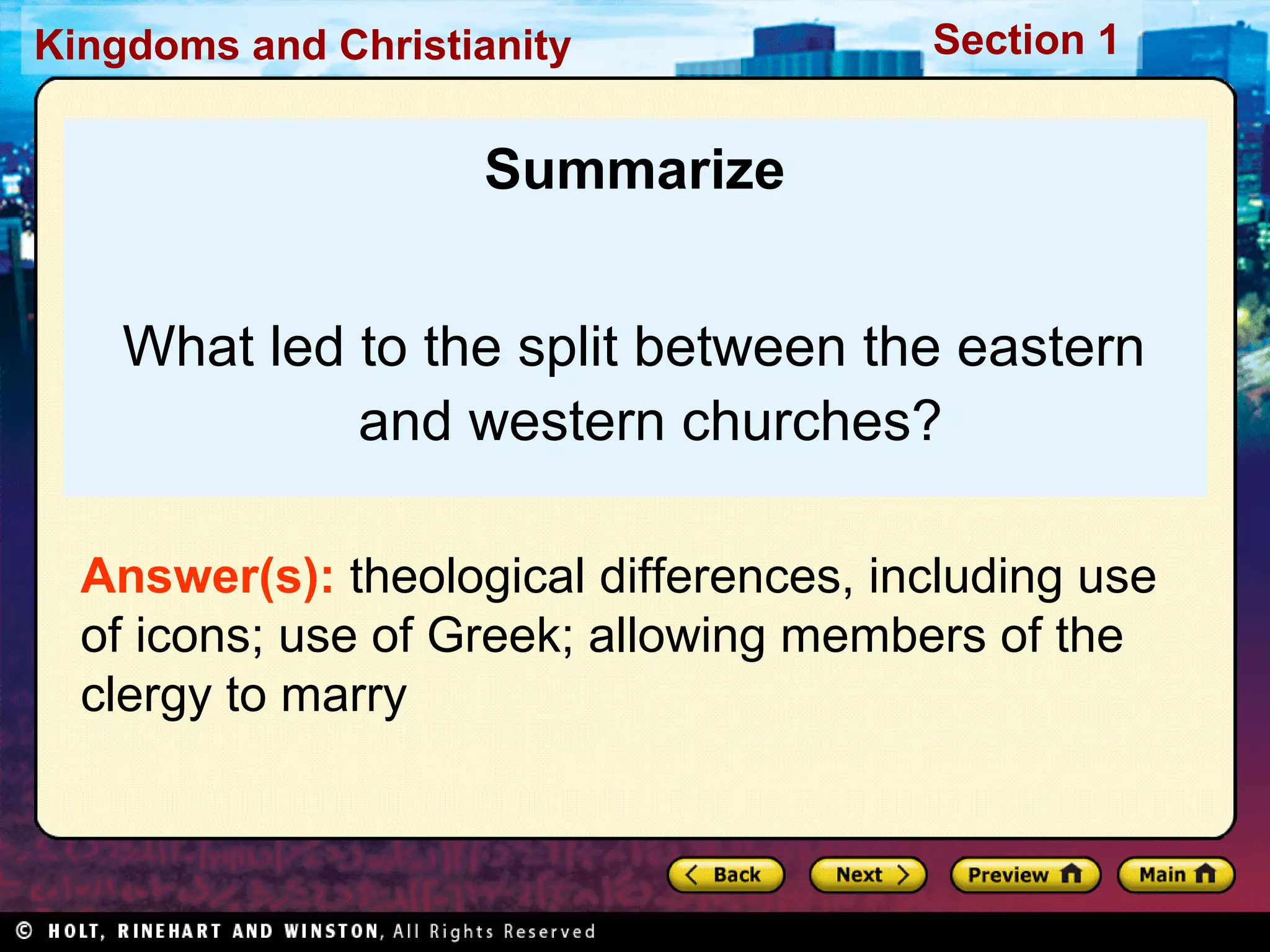
Summarize
What led to the split between the eastern
and western churches?
Answer(s): theological differences, including use
of icons; use of Greek; allowing members of the
clergy to marry
Section 1

Kingdoms and Christianity

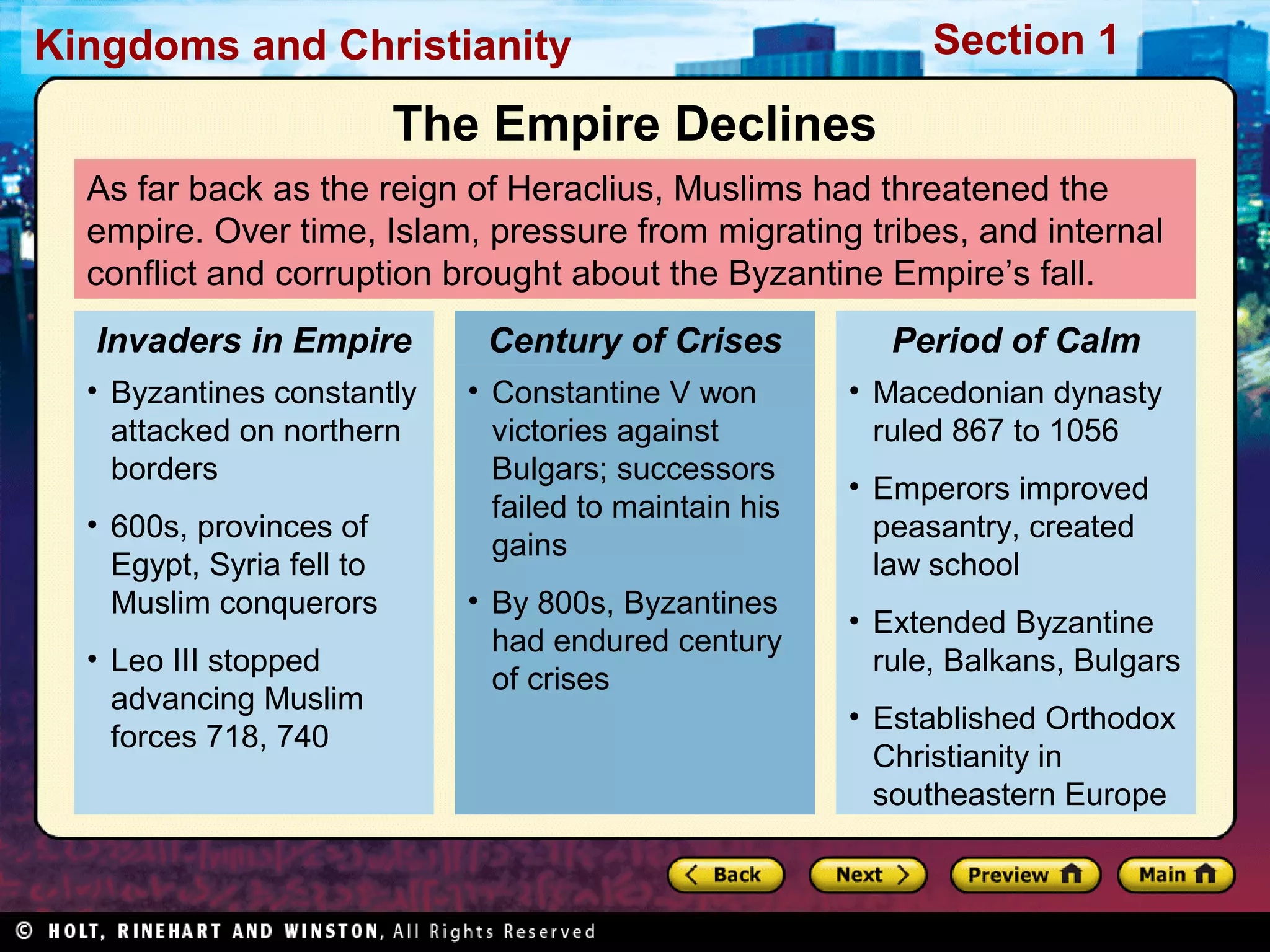
The Empire Declines
As far back as the reign of Heraclius, Muslims had threatened the
empire. Over time, Islam, pressure from migrating tribes, and internal
conflict and corruption brought about the Byzantine Empire’s fall.
Invaders in Empire

Century of Crises

• Byzantines constantly
attacked on northern
borders

• Constantine V won
victories against
Bulgars; successors
failed to maintain his
gains

• 600s, provinces of
Egypt, Syria fell to
Muslim conquerors
• Leo III stopped
advancing Muslim
forces 718, 740

• By 800s, Byzantines
had endured century
of crises

Period of Calm
• Macedonian dynasty
ruled 867 to 1056
• Emperors improved
peasantry, created
law school
• Extended Byzantine
rule, Balkans, Bulgars
• Established Orthodox
Christianity in
southeastern Europe
Section 1

Kingdoms and Christianity

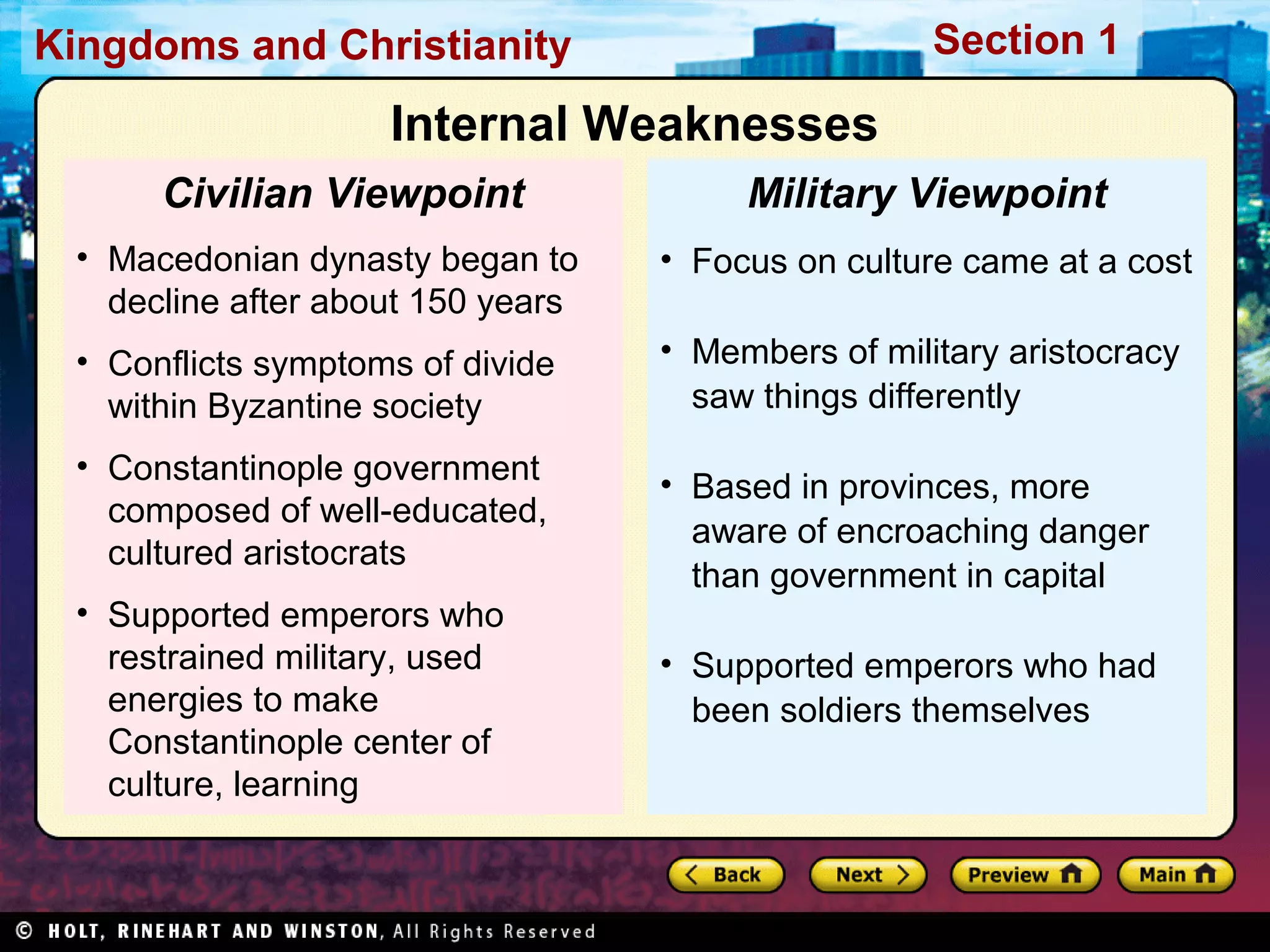
Internal Weaknesses
Civilian Viewpoint

Military Viewpoint

• Macedonian dynasty began to
decline after about 150 years

• Focus on culture came at a cost

• Conflicts symptoms of divide
within Byzantine society

• Members of military aristocracy
saw things differently

• Constantinople government
composed of well-educated,
cultured aristocrats
• Supported emperors who
restrained military, used
energies to make
Constantinople center of
culture, learning

• Based in provinces, more
aware of encroaching danger
than government in capital
• Supported emperors who had
been soldiers themselves
Section 1

Kingdoms and Christianity

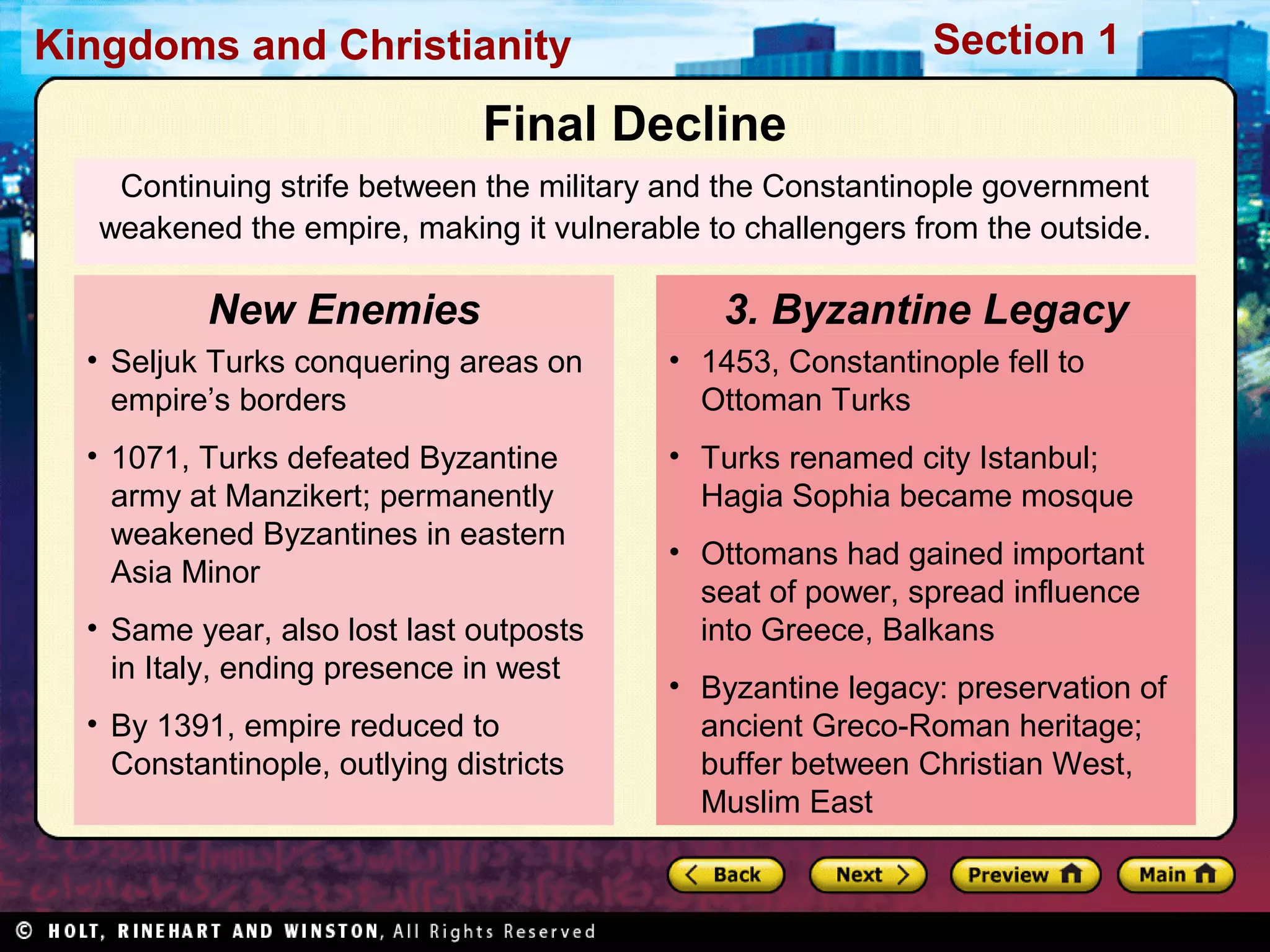
Final Decline
Continuing strife between the military and the Constantinople government
weakened the empire, making it vulnerable to challengers from the outside.

New Enemies

3. Byzantine Legacy

• Seljuk Turks conquering areas on
empire’s borders

• 1453, Constantinople fell to
Ottoman Turks

• 1071, Turks defeated Byzantine
army at Manzikert; permanently
weakened Byzantines in eastern
Asia Minor

• Turks renamed city Istanbul;
Hagia Sophia became mosque

• Same year, also lost last outposts
in Italy, ending presence in west
• By 1391, empire reduced to
Constantinople, outlying districts

• Ottomans had gained important
seat of power, spread influence
into Greece, Balkans
• Byzantine legacy: preservation of
ancient Greco-Roman heritage;
buffer between Christian West,
Muslim East
Kingdoms and Christianity

Section 1

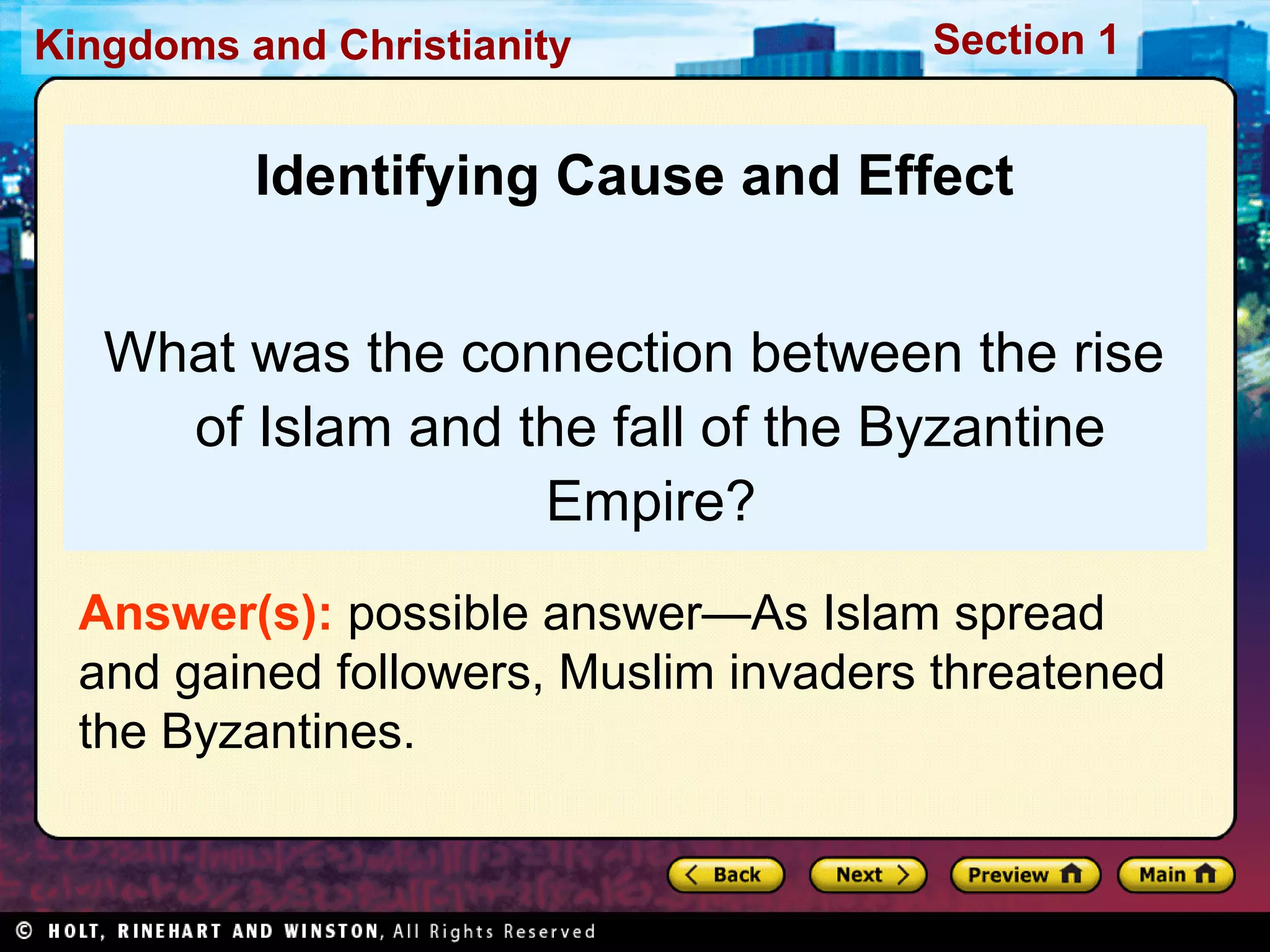
Identifying Cause and Effect
What was the connection between the rise
of Islam and the fall of the Byzantine
Empire?
Answer(s): possible answer—As Islam spread
and gained followers, Muslim invaders threatened
the Byzantines.

World History Ch. 12 Section 1 Notes

  • 1.
  • 2.
    Kingdoms and Christianity TheByzantine Empire Preview • Starting Points Map: Spread of Christianity • Main Idea / Reading Focus • Emperors Rule in Constantinople • Faces of History: Justinian and Theodora • Byzantine Culture • The Empire Declines Section 1
  • 3.
    Kingdoms and Christianity Clickthe icon to play Listen to History audio. Click the icon below to connect to the Interactive Maps. Section 1
  • 4.
    Kingdoms and Christianity Section1 The Byzantine Empire Main Idea 1. The Byzantine Empire, once the eastern half of the Roman Empire, was held together for centuries by strong leaders, profitable trade, and the influence of Christianity. Reading Focus • How did Byzantine emperors rule their empire from Constantinople? • What were some important features of Byzantine culture? • What led to the decline of the Byzantine Empire?
  • 5.
    Kingdoms and Christianity Section1 Emperors Rule in Constantinople Constantinople—Greek for “The City of Constantine”—became the capital of the roman Empire under Emperor Constantine I. A New Rome Location • Constantinople seat of Eastern Roman Empire • Location on Bosporus Strait helped control trade between Asia, Europe • Became known as Byzantine Empire • Remained capital of Eastern Empire long after Rome fell • Even before fall of Rome, Constantinople larger, richer city than Rome • Also helped guard city from attack – Sea protected city on two sides – Heavily fortified walls protected landward side
  • 6.
    Kingdoms and Christianity Section1 Reclaiming Western Empire Claim to Empire Military Action • Western part of empire still claimed by eastern emperors • Military action needed to accomplish Justinian’s goal • Byzantine emperor Justinian I wanted to restore original Roman Empire • First had to reconquer North African territories taken by Germanic tribe, Vandals Belisarius • 533, Justinian sent ships, troops to northern Africa • Troops led by top general, Belisarius Successes • By 534, fleet had recaptured African region, absorbed back into Roman Empire • 535, Belisarius led troops to Italy to retake that region
  • 7.
    Section 1 Kingdoms andChristianity Rebellion at Home Facing Problems • Justinian, wife Theodora served as co-rulers of empire • At home, faced threat from rebels • Many resented Justinian’s efforts to reform empire’s administration • 532, opposition led to rebellion called Nika Revolt Rebellion Quelled • Two factions led revolt: Greens representing lower classes, Blues upper classes • Constantinople in flames, Justinian prepared to flee • Theodora stood firm, refused to flee, back down, convinced Justinian to do same • Belisarius attacked rioters, slaughtered them by thousands
  • 8.
  • 9.
    Kingdoms and Christianity Section1 2. Achievements • Nika Revolt destroyed parts of Constantinople • Gave Justinian, Theodora chance to rebuilt city with new monuments • Most important new building, church, Hagia Sophia, “Holy Wisdom” • Spectacular blend of domes, arches; building still stands Justinian’s Code • Justinian set up commission that codified, systematically arranged, empire’s existing laws, legal opinions into clear system • Corpus Juris Civilis had four parts; first part included all existing constitutions from time of Emperor Hadrian • Code later updated, expanded to include Justinian’s laws as well
  • 10.
    Kingdoms and Christianity Section1 Changes after Justinian • Justinian’s achievements many, but did not last – Died 565, left government nearly bankrupt from expenses of taking back empire’s territory – Had expanded empire beyond what government could effectively administer – Western provinces fell to migrating tribes after his death • Reign of Heraclius began 610 – Heraclius defeated Persians on eastern border – Settled Croats, Serbs within Balkan frontiers to west to act as buffers against new invaders – Croats, Serbs converted to Christianity, extending Byzantine influence into region
  • 11.
    Kingdoms and Christianity Section1 Summarize What did Justinian accomplish during his reign? Answer(s): put down the Nika Revolt, built the Hagia Sophia, reformed Roman law
  • 12.
    Kingdoms and Christianity Section1 Byzantine Culture The Role of the Emperor • Two institutions central to Byzantine culture—emperor, Christianity • Emperor, priest-king, considered deputy of Jesus Christ on earth, his co-ruler • Emperor responsible for both civil, religious law Changing Culture • Example of emperor’s influence reflected in empire’s changing culture • People of Constantinople referred to selves as Roman, but Greek cultural influences grew stronger End to Roman Traditions • Emperor Heraclius brought official end to Roman traditions • Made Greek official language, replacing Latin • Replaced old Roman imperial titles with Greek ones
  • 13.
    Section 1 Kingdoms andChristianity Religion and the Arts • Christianity greatly influenced artistic life of Byzantines • Art, architecture, literature based on religious themes • Byzantine art often featured saints, figures from Bible • Most art in form of mosaics • Mosaics decorated floors, walls, ceilings Stylized Art • Nature of Byzantine mosaics, painting changed over time • Became more detailed, stylized • Symbols used for common themes • Examples: hand above cross, hand of God; 12 lambs, Christian flock, community, on earth Architecture • Religion force behind Byzantine architecture; churches built by placing round dome over square foundation • Rested dome on corner supports, not walls, as in Hagia Sophia • Influenced styles in Europe, Asia
  • 14.
    Section 1 Kingdoms andChristianity Religious Conflicts In the 700s the use of art in churches deeply divided society. This religious controversy threatened the strength of both church and state. The controversy involved the use of icons—paintings or sculptures of sacred figures. Icons and Controversy Iconoclast Movement • Churches contained beautiful icons • 726, Emperor Leo III forbade use of icons, ordered destruction • Some Christians objected to their presence, believed use too close to non-Christian worship of idols • People called iconoclasts, “icon breaker” • Iconoclast movement unpopular with many in church hierarchy • Since few could read, clergy found sacred images useful for teaching Reaction against iconoclasm raged on and off until 843 when a council settled the issue by accepting icons. The dispute played a crucial role in the growing divide between the emperor in Constantinople and the pope in Rome.
  • 15.
    Kingdoms and Christianity Section1 The Church Splits Growing Divisions • Over time, number of issues that divided eastern, western churches grew • Use of Greek one difference; theological differences also emerged • Eastern church allowed clergy to marry, western church did not Church Governance • Pope in Rome, patriarchs in Constantinople, Alexandria, Antioch, Jerusalem were church leaders; emperor oversaw church law, did not govern church • Byzantines did not accept pope as supreme authority over religious issues Schism • 1054, differences became so large, schism, split, occurred between churches • Church in east became Orthodox Church, west remained Roman Catholic • Later hurt Byzantine Empire, could not rely on western help against invaders
  • 16.
    Kingdoms and Christianity Section1 Summarize What led to the split between the eastern and western churches? Answer(s): theological differences, including use of icons; use of Greek; allowing members of the clergy to marry
  • 17.
    Section 1 Kingdoms andChristianity The Empire Declines As far back as the reign of Heraclius, Muslims had threatened the empire. Over time, Islam, pressure from migrating tribes, and internal conflict and corruption brought about the Byzantine Empire’s fall. Invaders in Empire Century of Crises • Byzantines constantly attacked on northern borders • Constantine V won victories against Bulgars; successors failed to maintain his gains • 600s, provinces of Egypt, Syria fell to Muslim conquerors • Leo III stopped advancing Muslim forces 718, 740 • By 800s, Byzantines had endured century of crises Period of Calm • Macedonian dynasty ruled 867 to 1056 • Emperors improved peasantry, created law school • Extended Byzantine rule, Balkans, Bulgars • Established Orthodox Christianity in southeastern Europe
  • 18.
    Section 1 Kingdoms andChristianity Internal Weaknesses Civilian Viewpoint Military Viewpoint • Macedonian dynasty began to decline after about 150 years • Focus on culture came at a cost • Conflicts symptoms of divide within Byzantine society • Members of military aristocracy saw things differently • Constantinople government composed of well-educated, cultured aristocrats • Supported emperors who restrained military, used energies to make Constantinople center of culture, learning • Based in provinces, more aware of encroaching danger than government in capital • Supported emperors who had been soldiers themselves
  • 19.
    Section 1 Kingdoms andChristianity Final Decline Continuing strife between the military and the Constantinople government weakened the empire, making it vulnerable to challengers from the outside. New Enemies 3. Byzantine Legacy • Seljuk Turks conquering areas on empire’s borders • 1453, Constantinople fell to Ottoman Turks • 1071, Turks defeated Byzantine army at Manzikert; permanently weakened Byzantines in eastern Asia Minor • Turks renamed city Istanbul; Hagia Sophia became mosque • Same year, also lost last outposts in Italy, ending presence in west • By 1391, empire reduced to Constantinople, outlying districts • Ottomans had gained important seat of power, spread influence into Greece, Balkans • Byzantine legacy: preservation of ancient Greco-Roman heritage; buffer between Christian West, Muslim East
  • 20.
    Kingdoms and Christianity Section1 Identifying Cause and Effect What was the connection between the rise of Islam and the fall of the Byzantine Empire? Answer(s): possible answer—As Islam spread and gained followers, Muslim invaders threatened the Byzantines.