Section 1
Nixon and the Watergate Scandal
• Describe Richard Nixon’s attitude toward
“big” government.
• Analyze Nixon’s southern strategy.
• Explain the Watergate incident and its
consequences.
Objectives
Section 1
Nixon and the Watergate Scandal
Terms and People
• silent majority − voters whom Nixon sought to
reach who did not demonstrate, but rather worked
and served quietly in “Middle America”
• stagflation − the dual conditions of a stagnating
economy and inflation
• OPEC − the Organization of Petroleum Exporting
Countries, a group of mostly Arab countries that
cooperates to regulate the price and supply of oil
• southern strategy − a plan to make the
Republican Party a powerful force in the South by
attracting the votes of blue-collar workers and
southern whites
Section 1
Nixon and the Watergate Scandal
Terms and People (continued)
• affirmative action − a policy that gives special
consideration to women and minorities, in order to
make up for past discrimination
• Watergate − the scandal that began with a
burglary of Democratic Party headquarters and led
to Nixon’s resignation
• Twenty-Fifth Amendment – an amendment to
the U.S. Constitution that describes the process of
presidential succession
• executive privilege − the principle that the
President has the right to keep certain information
confidential
Section 1
Nixon and the Watergate Scandal
President Nixon won reelection in a landslide in
1972.
Due to the Watergate scandal, however, he left
office in disgrace two years later. The event
changed Americans’ attitudes toward
government in a way that is still felt today.
What events led to Richard Nixon’s
resignation as President in 1974?
Section 1
Nixon and the Watergate Scandal
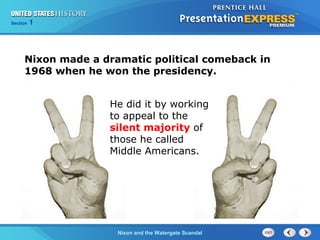
He did it by working
to appeal to the
silent majority of
those he called
Middle Americans.
Nixon made a dramatic political comeback in
1968 when he won the presidency.
Section 1
Nixon and the Watergate Scandal
Nixon tried to give power back to the state
governments but...
Nixon actually expanded the federal government
when he was in office.
Section 1
Nixon and the Watergate Scandal
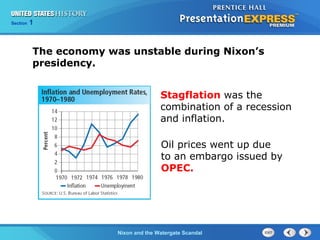
Stagflation was the
combination of a recession
and inflation.
The economy was unstable during Nixon’s
presidency.
Oil prices went up due
to an embargo issued by
OPEC.
Section 1
Nixon and the Watergate Scandal
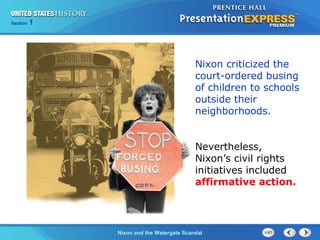
Nixon criticized the
court-ordered busing
of children to schools
outside their
neighborhoods.
Nevertheless,
Nixon’s civil rights
initiatives included
affirmative action.
Section 1
Nixon and the Watergate Scandal
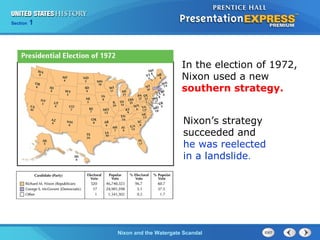
Nixon’s strategy
succeeded and
he was reelected
in a landslide.
In the election of 1972,
Nixon used a new
southern strategy.
Section 1
Nixon and the Watergate Scandal
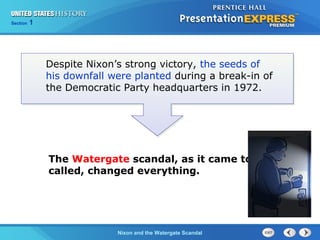
Despite Nixon’s strong victory, the seeds of
his downfall were planted during a break-in of
the Democratic Party headquarters in 1972.
The Watergate scandal, as it came to be
called, changed everything.
Section 1
Nixon and the Watergate Scandal
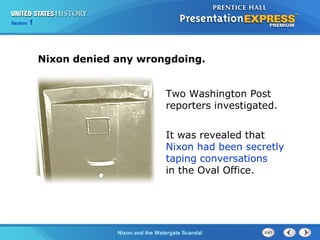
Two Washington Post
reporters investigated.
It was revealed that
Nixon had been secretly
taping conversations
in the Oval Office.
Nixon denied any wrongdoing.
Section 1
Nixon and the Watergate Scandal
Nixon refused
to turn over
the tapes,
citing
executive
privilege.
The Supreme
Court ordered
him to turn
them over.
Section 1
Nixon and the Watergate Scandal
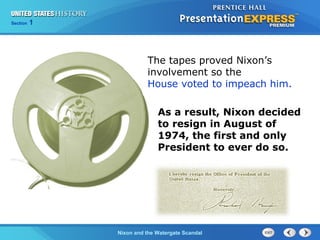
The tapes proved Nixon’s
involvement so the
House voted to impeach him.
As a result, Nixon decided
to resign in August of
1974, the first and only
President to ever do so.
Section 1
Nixon and the Watergate Scandal
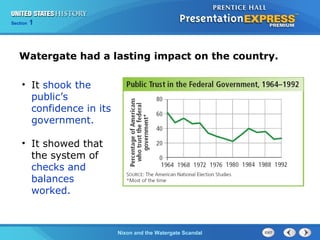
Watergate had a lasting impact on the country.
• It shook the
public’s
confidence in its
government.
• It showed that
the system of
checks and
balances
worked.
Section 1
Nixon and the Watergate Scandal
• Federal Election Campaign
Act Amendments (1974)
• Freedom of Information Act
Amendments (1974)
• Government in the
Sunshine Act (1976)
• Ethics in
Government Act
of 1978
Post-Watergate Government Reforms:
Section 1
Nixon and the Watergate Scandal
Section Review
Know It, Show It QuizQuickTake Quiz

Ush ch. 22 section 1 notes

  • 1.
    Section 1 Nixon andthe Watergate Scandal • Describe Richard Nixon’s attitude toward “big” government. • Analyze Nixon’s southern strategy. • Explain the Watergate incident and its consequences. Objectives
  • 2.
    Section 1 Nixon andthe Watergate Scandal Terms and People • silent majority − voters whom Nixon sought to reach who did not demonstrate, but rather worked and served quietly in “Middle America” • stagflation − the dual conditions of a stagnating economy and inflation • OPEC − the Organization of Petroleum Exporting Countries, a group of mostly Arab countries that cooperates to regulate the price and supply of oil • southern strategy − a plan to make the Republican Party a powerful force in the South by attracting the votes of blue-collar workers and southern whites
  • 3.
    Section 1 Nixon andthe Watergate Scandal Terms and People (continued) • affirmative action − a policy that gives special consideration to women and minorities, in order to make up for past discrimination • Watergate − the scandal that began with a burglary of Democratic Party headquarters and led to Nixon’s resignation • Twenty-Fifth Amendment – an amendment to the U.S. Constitution that describes the process of presidential succession • executive privilege − the principle that the President has the right to keep certain information confidential
  • 4.
    Section 1 Nixon andthe Watergate Scandal President Nixon won reelection in a landslide in 1972. Due to the Watergate scandal, however, he left office in disgrace two years later. The event changed Americans’ attitudes toward government in a way that is still felt today. What events led to Richard Nixon’s resignation as President in 1974?
  • 5.
    Section 1 Nixon andthe Watergate Scandal He did it by working to appeal to the silent majority of those he called Middle Americans. Nixon made a dramatic political comeback in 1968 when he won the presidency.
  • 6.
    Section 1 Nixon andthe Watergate Scandal Nixon tried to give power back to the state governments but... Nixon actually expanded the federal government when he was in office.
  • 7.
    Section 1 Nixon andthe Watergate Scandal Stagflation was the combination of a recession and inflation. The economy was unstable during Nixon’s presidency. Oil prices went up due to an embargo issued by OPEC.
  • 8.
    Section 1 Nixon andthe Watergate Scandal Nixon criticized the court-ordered busing of children to schools outside their neighborhoods. Nevertheless, Nixon’s civil rights initiatives included affirmative action.
  • 9.
    Section 1 Nixon andthe Watergate Scandal Nixon’s strategy succeeded and he was reelected in a landslide. In the election of 1972, Nixon used a new southern strategy.
  • 10.
    Section 1 Nixon andthe Watergate Scandal Despite Nixon’s strong victory, the seeds of his downfall were planted during a break-in of the Democratic Party headquarters in 1972. The Watergate scandal, as it came to be called, changed everything.
  • 11.
    Section 1 Nixon andthe Watergate Scandal Two Washington Post reporters investigated. It was revealed that Nixon had been secretly taping conversations in the Oval Office. Nixon denied any wrongdoing.
  • 12.
    Section 1 Nixon andthe Watergate Scandal Nixon refused to turn over the tapes, citing executive privilege. The Supreme Court ordered him to turn them over.
  • 13.
    Section 1 Nixon andthe Watergate Scandal The tapes proved Nixon’s involvement so the House voted to impeach him. As a result, Nixon decided to resign in August of 1974, the first and only President to ever do so.
  • 14.
    Section 1 Nixon andthe Watergate Scandal Watergate had a lasting impact on the country. • It shook the public’s confidence in its government. • It showed that the system of checks and balances worked.
  • 15.
    Section 1 Nixon andthe Watergate Scandal • Federal Election Campaign Act Amendments (1974) • Freedom of Information Act Amendments (1974) • Government in the Sunshine Act (1976) • Ethics in Government Act of 1978 Post-Watergate Government Reforms:
  • 16.
    Section 1 Nixon andthe Watergate Scandal Section Review Know It, Show It QuizQuickTake Quiz

Editor's Notes

  • #2 Place Objectives: .5” Horizontal, 1.25” Vertical Bullet List: 1” Horizontal, 2” Vertical
  • #3 Terms Objectives: .5” Horizontal, 1.25” Vertical Bullet List: 1” Horizontal, 2” Vertical
  • #4 Terms Objectives: .5” Horizontal, 1.25” Vertical Bullet List: 1” Horizontal, 2” Vertical
  • #8 Graph of inflation, HSUS: p. 1047.
  • #9 Photo of busing protest, HSUS: p. 1048.
  • #10 1972 presidential election map, HSUS: p. 1049.
  • #15 Public trust graph, HSUS: p. 1051.
  • #16 Laws passed after Watergate, HSUS: p. 1053.