Section 4
The George W. Bush Presidency
• Assess the outcome of the 2000 presidential
election.
• Explain the goals and achievements of
George W. Bush’s domestic policy.
• Analyze the impact of terrorist attacks on the
United States.
• Summarize the important issues of Bush’s
second term.
Objectives
Section 4
The George W. Bush Presidency
Terms and People
• George W. Bush – the Republican winner of the
2000 presidential election, he is the son of George
H.W. Bush and former governor of Texas
• No Child Left Behind Act –2002 law aimed at
improving the performance of schools through
mandated sanctions against schools not reaching
federal performance standards
• Taliban – the Islamic fundamentalist faction that
controlled most of Afghanistan from 1996-2001
Section 4
The George W. Bush Presidency
Terms and People (continued)
• Patriot Act − a law passed after 9/11 that gave
law enforcement broader powers in monitoring
possible terrorist activities
• Department of Homeland Security − a new
Cabinet-level department created by Bush to
coordinate domestic security efforts
• Weapons of Mass Destruction (WMD) −
nuclear, biological, and chemical weapons
intended to kill or harm on a large scale
Section 4
The George W. Bush Presidency
With the election of George W. Bush to the
presidency in 2000, Republicans controlled the
White House and Congress.
When the United States was attacked by
terrorists on September 11, 2001, Bush
moved the nation in a new direction.
What was the impact of Bush’s domestic
agenda and his response to the terrorist
attack against the United States?
Section 4
The George W. Bush Presidency
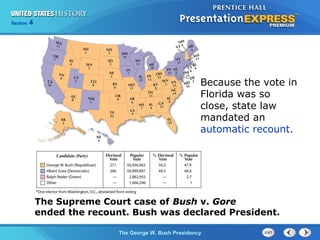
The election depended on Florida’s 25
electoral votes.
As Clinton’s second term neared its end in
2000, his Vice President, Al Gore, ran for the
Democrats against Republican George W. Bush
for President.
Although Gore won more popular votes than Bush,
the electoral vote margin was too close to call.
Section 4
The George W. Bush Presidency
Because the vote in
Florida was so
close, state law
mandated an
automatic recount.
The Supreme Court case of Bush v. Gore
ended the recount. Bush was declared President.
Section 4
The George W. Bush Presidency
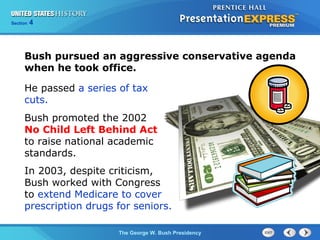
He passed a series of tax
cuts.
Bush promoted the 2002
No Child Left Behind Act
to raise national academic
standards.
Bush pursued an aggressive conservative agenda
when he took office.
In 2003, despite criticism,
Bush worked with Congress
to extend Medicare to cover
prescription drugs for seniors.
Section 4
The George W. Bush Presidency
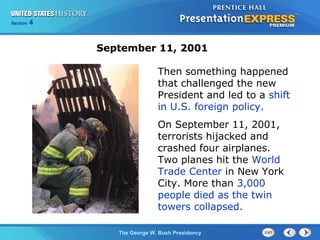
Then something happened
that challenged the new
President and led to a shift
in U.S. foreign policy.
On September 11, 2001,
terrorists hijacked and
crashed four airplanes.
Two planes hit the World
Trade Center in New York
City. More than 3,000
people died as the twin
towers collapsed.
September 11, 2001
Section 4
The George W. Bush Presidency
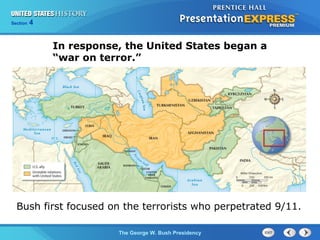
Bush first focused on the terrorists who perpetrated 9/11.
In response, the United States began a
“war on terror.”
Section 4
The George W. Bush Presidency
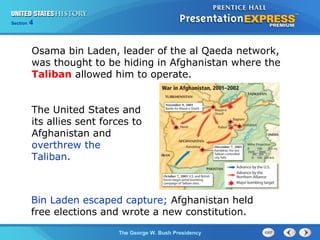
Osama bin Laden, leader of the al Qaeda network,
was thought to be hiding in Afghanistan where the
Taliban allowed him to operate.
The United States and
its allies sent forces to
Afghanistan and
overthrew the
Taliban.
Bin Laden escaped capture; Afghanistan held
free elections and wrote a new constitution.
Section 4
The George W. Bush Presidency
Bush worked to prevent future terrorist attacks with
the passage of the Patriot Act and the creation of
the Department of Homeland Security.
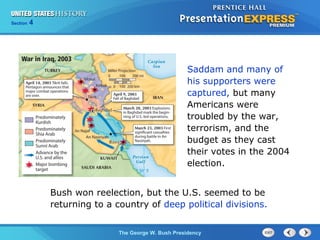
Bush then turned his attention to Iraq, where many
feared Saddam Hussein was stockpiling Weapons
of Mass Destruction (WMD).
In 2003, U.S. and British forces invaded Iraq.
Section 4
The George W. Bush Presidency
Saddam and many of
his supporters were
captured, but many
Americans were
troubled by the war,
terrorism, and the
budget as they cast
their votes in the 2004
election.
Bush won reelection, but the U.S. seemed to be
returning to a country of deep political divisions.
Section 4
The George W. Bush Presidency
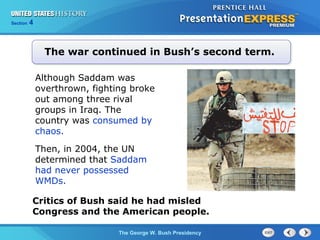
Although Saddam was
overthrown, fighting broke
out among three rival
groups in Iraq. The
country was consumed by
chaos.
The war continued in Bush’s second term.
Critics of Bush said he had misled
Congress and the American people.
Then, in 2004, the UN
determined that Saddam
had never possessed
WMDs.
Section 4
The George W. Bush Presidency
As the war continued, the federal deficit grew
larger.
Then, in 2005, Hurricane Katrina devastated the
U.S. Gulf Coast. Federal response to the disaster
was slow. Discontent with the administration grew.
The 2006 midterm
elections gave
control of the House
and the Senate back
to the Democrats.
Section 4
The George W. Bush Presidency
Section Review
Know It, Show It QuizQuickTake Quiz

Ush ch. 24 section 4 notes

  • 1.
    Section 4 The GeorgeW. Bush Presidency • Assess the outcome of the 2000 presidential election. • Explain the goals and achievements of George W. Bush’s domestic policy. • Analyze the impact of terrorist attacks on the United States. • Summarize the important issues of Bush’s second term. Objectives
  • 2.
    Section 4 The GeorgeW. Bush Presidency Terms and People • George W. Bush – the Republican winner of the 2000 presidential election, he is the son of George H.W. Bush and former governor of Texas • No Child Left Behind Act –2002 law aimed at improving the performance of schools through mandated sanctions against schools not reaching federal performance standards • Taliban – the Islamic fundamentalist faction that controlled most of Afghanistan from 1996-2001
  • 3.
    Section 4 The GeorgeW. Bush Presidency Terms and People (continued) • Patriot Act − a law passed after 9/11 that gave law enforcement broader powers in monitoring possible terrorist activities • Department of Homeland Security − a new Cabinet-level department created by Bush to coordinate domestic security efforts • Weapons of Mass Destruction (WMD) − nuclear, biological, and chemical weapons intended to kill or harm on a large scale
  • 4.
    Section 4 The GeorgeW. Bush Presidency With the election of George W. Bush to the presidency in 2000, Republicans controlled the White House and Congress. When the United States was attacked by terrorists on September 11, 2001, Bush moved the nation in a new direction. What was the impact of Bush’s domestic agenda and his response to the terrorist attack against the United States?
  • 5.
    Section 4 The GeorgeW. Bush Presidency The election depended on Florida’s 25 electoral votes. As Clinton’s second term neared its end in 2000, his Vice President, Al Gore, ran for the Democrats against Republican George W. Bush for President. Although Gore won more popular votes than Bush, the electoral vote margin was too close to call.
  • 6.
    Section 4 The GeorgeW. Bush Presidency Because the vote in Florida was so close, state law mandated an automatic recount. The Supreme Court case of Bush v. Gore ended the recount. Bush was declared President.
  • 7.
    Section 4 The GeorgeW. Bush Presidency He passed a series of tax cuts. Bush promoted the 2002 No Child Left Behind Act to raise national academic standards. Bush pursued an aggressive conservative agenda when he took office. In 2003, despite criticism, Bush worked with Congress to extend Medicare to cover prescription drugs for seniors.
  • 8.
    Section 4 The GeorgeW. Bush Presidency Then something happened that challenged the new President and led to a shift in U.S. foreign policy. On September 11, 2001, terrorists hijacked and crashed four airplanes. Two planes hit the World Trade Center in New York City. More than 3,000 people died as the twin towers collapsed. September 11, 2001
  • 9.
    Section 4 The GeorgeW. Bush Presidency Bush first focused on the terrorists who perpetrated 9/11. In response, the United States began a “war on terror.”
  • 10.
    Section 4 The GeorgeW. Bush Presidency Osama bin Laden, leader of the al Qaeda network, was thought to be hiding in Afghanistan where the Taliban allowed him to operate. The United States and its allies sent forces to Afghanistan and overthrew the Taliban. Bin Laden escaped capture; Afghanistan held free elections and wrote a new constitution.
  • 11.
    Section 4 The GeorgeW. Bush Presidency Bush worked to prevent future terrorist attacks with the passage of the Patriot Act and the creation of the Department of Homeland Security. Bush then turned his attention to Iraq, where many feared Saddam Hussein was stockpiling Weapons of Mass Destruction (WMD). In 2003, U.S. and British forces invaded Iraq.
  • 12.
    Section 4 The GeorgeW. Bush Presidency Saddam and many of his supporters were captured, but many Americans were troubled by the war, terrorism, and the budget as they cast their votes in the 2004 election. Bush won reelection, but the U.S. seemed to be returning to a country of deep political divisions.
  • 13.
    Section 4 The GeorgeW. Bush Presidency Although Saddam was overthrown, fighting broke out among three rival groups in Iraq. The country was consumed by chaos. The war continued in Bush’s second term. Critics of Bush said he had misled Congress and the American people. Then, in 2004, the UN determined that Saddam had never possessed WMDs.
  • 14.
    Section 4 The GeorgeW. Bush Presidency As the war continued, the federal deficit grew larger. Then, in 2005, Hurricane Katrina devastated the U.S. Gulf Coast. Federal response to the disaster was slow. Discontent with the administration grew. The 2006 midterm elections gave control of the House and the Senate back to the Democrats.
  • 15.
    Section 4 The GeorgeW. Bush Presidency Section Review Know It, Show It QuizQuickTake Quiz