Rome and Early Christianity Section 1
Rome and Early Christianity Section 1 
The Foundations of Rome 
Preview 
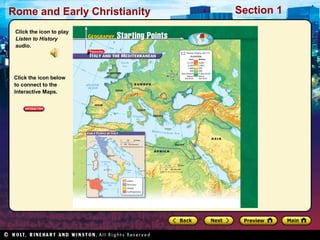
• Starting Points Map: Italy and the Mediterranean 
• Main Idea / Reading Focus 
• Roman Civilization Develops 
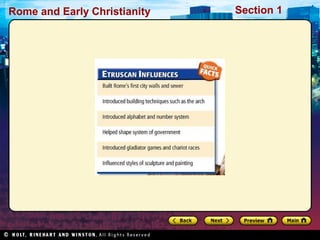
• Quick Facts: Etruscan Influences 
• Rome Becomes a Republic 
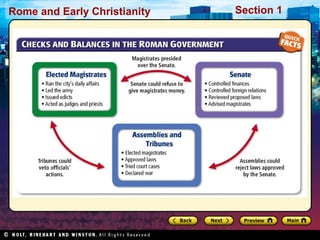
• Quick Facts: Checks and Balances in the Roman Government 
• The Republic Expands 
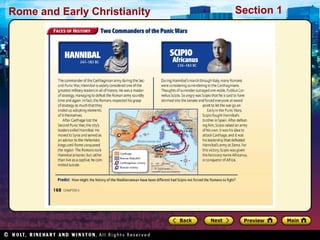
• Faces of History: Two Commanders of the Punic Wars
Rome and Early Christianity Section 1 
Click the icon to play 
Listen to History 
audio. 
Click the icon below 
to connect to the 
Interactive Maps.
Rome and Early Christianity Section 1 
The Foundations of Rome 
Main Idea 
1. From a small town on the banks of an Italian river, Rome grew 
to control the entire Mediterranean region. 
Reading Focus 
• Where and how did Roman civilization develop? 
• What led to Rome’s becoming a republic? 
• What were the major events in Rome’s expansion?
Rome and Early Christianity Section 1 
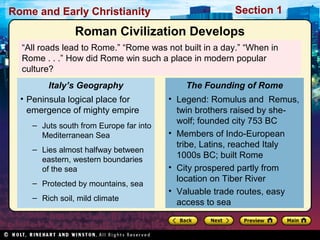
Roman Civilization Develops 
“All roads lead to Rome.” “Rome was not built in a day.” “When in 
Rome . . .” How did Rome win such a place in modern popular 
culture? 
Italy’s Geography 
• Peninsula logical place for 
emergence of mighty empire 
– Juts south from Europe far into 
Mediterranean Sea 
– Lies almost halfway between 
eastern, western boundaries 
of the sea 
– Protected by mountains, sea 
– Rich soil, mild climate 
The Founding of Rome 
• Legend: Romulus and Remus, 
twin brothers raised by she-wolf; 
founded city 753 BC 
• Members of Indo-European 
tribe, Latins, reached Italy 
1000s BC; built Rome 
• City prospered partly from 
location on Tiber River 
• Valuable trade routes, easy 
access to sea
Rome and Early Christianity Section 1 
The Etruscans 
• Rome first ruled by Latin Kings 
• Came under Etruscan rule, 600 BC 
• Etruscans came from northern Italy 
– Evidence found at cemeteries indicates Etruscans great 
metalworkers, jewelers 
– Etruscan culture heavily influenced by Greeks 
• Etruscans had great influence on Roman society
Rome and Early Christianity Section 1
Rome and Early Christianity Section 1 
Summarize 
What advantages did Rome’s location give 
the city? 
Answer(s): protected by mountains; sea provided 
protection and transportation; had rich soil, 
pleasant climate; located on major trade routes; 
Tiber River provided easy access to the sea
Rome and Early Christianity Section 1 
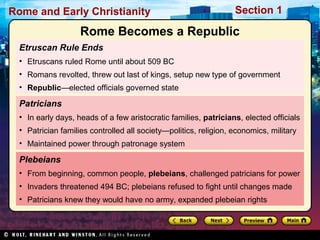
Rome Becomes a Republic 
Etruscan Rule Ends 
• Etruscans ruled Rome until about 509 BC 
• Romans revolted, threw out last of kings, setup new type of government 
• Republic—elected officials governed state 
Patricians 
• In early days, heads of a few aristocratic families, patricians, elected officials 
• Patrician families controlled all society—politics, religion, economics, military 
• Maintained power through patronage system 
Plebeians 
• From beginning, common people, plebeians, challenged patricians for power 
• Invaders threatened 494 BC; plebeians refused to fight until changes made 
• Patricians knew they would have no army, expanded plebeian rights
Rome and Early Christianity Section 1 
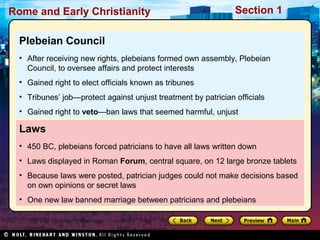
Plebeian Council 
• After receiving new rights, plebeians formed own assembly, Plebeian 
Council, to oversee affairs and protect interests 
• Gained right to elect officials known as tribunes 
• Tribunes’ job—protect against unjust treatment by patrician officials 
• Gained right to veto—ban laws that seemed harmful, unjust 
Laws 
• 450 BC, plebeians forced patricians to have all laws written down 
• Laws displayed in Roman Forum, central square, on 12 large bronze tablets 
• Because laws were posted, patrician judges could not make decisions based 
on own opinions or secret laws 
• One new law banned marriage between patricians and plebeians
Rome and Early Christianity Section 1 
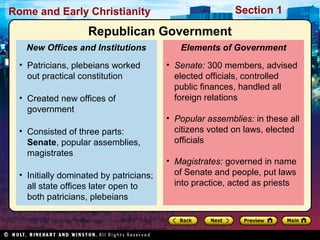
Republican Government 
Elements of Government 
• Senate: 300 members, advised 
elected officials, controlled 
public finances, handled all 
foreign relations 
• Popular assemblies: in these all 
citizens voted on laws, elected 
officials 
• Magistrates: governed in name 
of Senate and people, put laws 
into practice, acted as priests 
New Offices and Institutions 
• Patricians, plebeians worked 
out practical constitution 
• Created new offices of 
government 
• Consisted of three parts: 
Senate, popular assemblies, 
magistrates 
• Initially dominated by patricians; 
all state offices later open to 
both patricians, plebeians
Rome and Early Christianity Section 1 
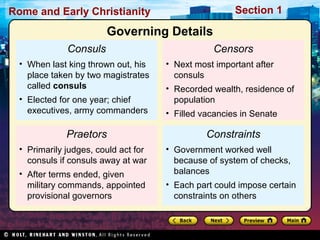
Consuls 
Governing Details 
• When last king thrown out, his 
place taken by two magistrates 
called consuls 
• Elected for one year; chief 
executives, army commanders 
Praetors 
• Primarily judges, could act for 
consuls if consuls away at war 
• After terms ended, given 
military commands, appointed 
provisional governors 
Censors 
• Next most important after 
consuls 
• Recorded wealth, residence of 
population 
• Filled vacancies in Senate 
Constraints 
• Government worked well 
because of system of checks, 
balances 
• Each part could impose certain 
constraints on others
Rome and Early Christianity Section 1
Rome and Early Christianity Section 1 
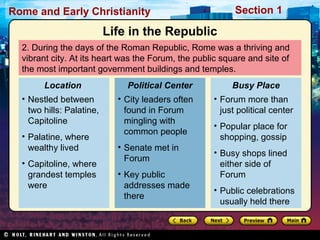
Life in the Republic 
2. During the days of the Roman Republic, Rome was a thriving and 
vibrant city. At its heart was the Forum, the public square and site of 
the most important government buildings and temples. 
Location 
• Nestled between 
two hills: Palatine, 
Capitoline 
• Palatine, where 
wealthy lived 
• Capitoline, where 
grandest temples 
were 
Political Center 
• City leaders often 
found in Forum 
mingling with 
common people 
• Senate met in 
Forum 
• Key public 
addresses made 
there 
Busy Place 
• Forum more than 
just political center 
• Popular place for 
shopping, gossip 
• Busy shops lined 
either side of 
Forum 
• Public celebrations 
usually held there
Rome and Early Christianity Section 1 
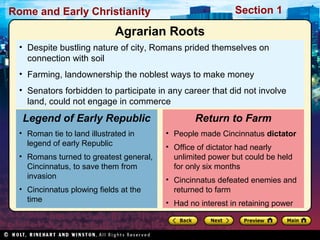
Agrarian Roots 
• Despite bustling nature of city, Romans prided themselves on 
connection with soil 
• Farming, landownership the noblest ways to make money 
• Senators forbidden to participate in any career that did not involve 
land, could not engage in commerce 
Legend of Early Republic 
• Roman tie to land illustrated in 
legend of early Republic 
• Romans turned to greatest general, 
Cincinnatus, to save them from 
invasion 
• Cincinnatus plowing fields at the 
time 
Return to Farm 
• People made Cincinnatus dictator 
• Office of dictator had nearly 
unlimited power but could be held 
for only six months 
• Cincinnatus defeated enemies and 
returned to farm 
• Had no interest in retaining power
Rome and Early Christianity Section 1 
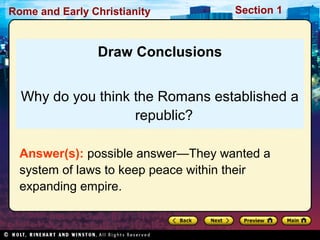
Draw Conclusions 
Why do you think the Romans established a 
republic? 
Answer(s): possible answer—They wanted a 
system of laws to keep peace within their 
expanding empire.
Rome and Early Christianity Section 1 
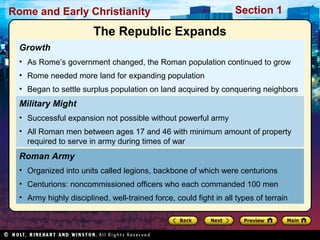
The Republic Expands 
Growth 
• As Rome’s government changed, the Roman population continued to grow 
• Rome needed more land for expanding population 
• Began to settle surplus population on land acquired by conquering neighbors 
Military Might 
• Successful expansion not possible without powerful army 
• All Roman men between ages 17 and 46 with minimum amount of property 
required to serve in army during times of war 
Roman Army 
• Organized into units called legions, backbone of which were centurions 
• Centurions: noncommissioned officers who each commanded 100 men 
• Army highly disciplined, well-trained force, could fight in all types of terrain
Rome and Early Christianity Section 1 
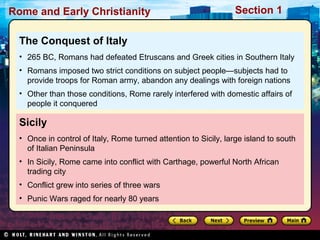
The Conquest of Italy 
• 265 BC, Romans had defeated Etruscans and Greek cities in Southern Italy 
• Romans imposed two strict conditions on subject people—subjects had to 
provide troops for Roman army, abandon any dealings with foreign nations 
• Other than those conditions, Rome rarely interfered with domestic affairs of 
people it conquered 
Sicily 
• Once in control of Italy, Rome turned attention to Sicily, large island to south 
of Italian Peninsula 
• In Sicily, Rome came into conflict with Carthage, powerful North African 
trading city 
• Conflict grew into series of three wars 
• Punic Wars raged for nearly 80 years
Rome and Early Christianity Section 1 
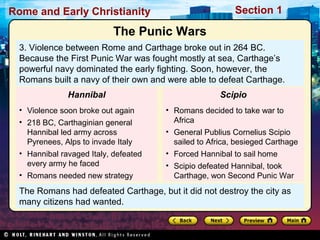
The Punic Wars 
3. Violence between Rome and Carthage broke out in 264 BC. 
Because the First Punic War was fought mostly at sea, Carthage’s 
powerful navy dominated the early fighting. Soon, however, the 
Romans built a navy of their own and were able to defeat Carthage. 
Hannibal 
• Violence soon broke out again 
• 218 BC, Carthaginian general 
Hannibal led army across 
Pyrenees, Alps to invade Italy 
• Hannibal ravaged Italy, defeated 
every army he faced 
• Romans needed new strategy 
Scipio 
• Romans decided to take war to 
Africa 
• General Publius Cornelius Scipio 
sailed to Africa, besieged Carthage 
• Forced Hannibal to sail home 
• Scipio defeated Hannibal, took 
Carthage, won Second Punic War 
The Romans had defeated Carthage, but it did not destroy the city as 
many citizens had wanted.
Rome and Early Christianity Section 1
Rome and Early Christianity Section 1 
Carthage Falls 
Huge losses of Second Punic War remained in 
memories of many Romans 
• 149 BC Rome decided to destroy old enemy once and 
for all 
– Declared war on Carthage for third time 
– After siege of three years, Carthage fell 
– Romans enslaved entire population, completely destroyed 
city 
– They banned any people from living there
Rome and Early Christianity Section 1 
The Conquest of Greece 
• Punic Wars raged in western republic; Rome involved in politics of 
eastern Mediterranean 
• Hellenistic kingdoms of Macedonia, Persia, and Egypt fought 
constantly; Greek city-states feared being conquered 
• City-states sought alliance with Rome 
Macedonia, Persia 
• Romans, Greek allies fought, and 
defeated Macedonia, Persia 
• Both became Roman provinces 
• Eventually Romans annexed 
Greece as province as well 
• Romans adopted many elements of 
Greek culture, particularly art 
Greek Culture 
• Romans also borrowed ideas of 
religion from Greeks, adopted their 
gods but changed the names 
• Not all Romans happy with growing 
Greek influence, thought Rome 
should remain purely Roman 
• Influence continued for many years
Rome and Early Christianity Section 1 
Sequence 
How did Rome come to dominate the 
Mediterranean world? 
Answer(s): by conquering its Mediterranean 
neighbors, including Carthage and Greece

World History Ch. 6 Section 1 Notes

  • 1.
    Rome and EarlyChristianity Section 1
  • 2.
    Rome and EarlyChristianity Section 1 The Foundations of Rome Preview • Starting Points Map: Italy and the Mediterranean • Main Idea / Reading Focus • Roman Civilization Develops • Quick Facts: Etruscan Influences • Rome Becomes a Republic • Quick Facts: Checks and Balances in the Roman Government • The Republic Expands • Faces of History: Two Commanders of the Punic Wars
  • 3.
    Rome and EarlyChristianity Section 1 Click the icon to play Listen to History audio. Click the icon below to connect to the Interactive Maps.
  • 4.
    Rome and EarlyChristianity Section 1 The Foundations of Rome Main Idea 1. From a small town on the banks of an Italian river, Rome grew to control the entire Mediterranean region. Reading Focus • Where and how did Roman civilization develop? • What led to Rome’s becoming a republic? • What were the major events in Rome’s expansion?
  • 5.
    Rome and EarlyChristianity Section 1 Roman Civilization Develops “All roads lead to Rome.” “Rome was not built in a day.” “When in Rome . . .” How did Rome win such a place in modern popular culture? Italy’s Geography • Peninsula logical place for emergence of mighty empire – Juts south from Europe far into Mediterranean Sea – Lies almost halfway between eastern, western boundaries of the sea – Protected by mountains, sea – Rich soil, mild climate The Founding of Rome • Legend: Romulus and Remus, twin brothers raised by she-wolf; founded city 753 BC • Members of Indo-European tribe, Latins, reached Italy 1000s BC; built Rome • City prospered partly from location on Tiber River • Valuable trade routes, easy access to sea
  • 6.
    Rome and EarlyChristianity Section 1 The Etruscans • Rome first ruled by Latin Kings • Came under Etruscan rule, 600 BC • Etruscans came from northern Italy – Evidence found at cemeteries indicates Etruscans great metalworkers, jewelers – Etruscan culture heavily influenced by Greeks • Etruscans had great influence on Roman society
  • 7.
    Rome and EarlyChristianity Section 1
  • 8.
    Rome and EarlyChristianity Section 1 Summarize What advantages did Rome’s location give the city? Answer(s): protected by mountains; sea provided protection and transportation; had rich soil, pleasant climate; located on major trade routes; Tiber River provided easy access to the sea
  • 9.
    Rome and EarlyChristianity Section 1 Rome Becomes a Republic Etruscan Rule Ends • Etruscans ruled Rome until about 509 BC • Romans revolted, threw out last of kings, setup new type of government • Republic—elected officials governed state Patricians • In early days, heads of a few aristocratic families, patricians, elected officials • Patrician families controlled all society—politics, religion, economics, military • Maintained power through patronage system Plebeians • From beginning, common people, plebeians, challenged patricians for power • Invaders threatened 494 BC; plebeians refused to fight until changes made • Patricians knew they would have no army, expanded plebeian rights
  • 10.
    Rome and EarlyChristianity Section 1 Plebeian Council • After receiving new rights, plebeians formed own assembly, Plebeian Council, to oversee affairs and protect interests • Gained right to elect officials known as tribunes • Tribunes’ job—protect against unjust treatment by patrician officials • Gained right to veto—ban laws that seemed harmful, unjust Laws • 450 BC, plebeians forced patricians to have all laws written down • Laws displayed in Roman Forum, central square, on 12 large bronze tablets • Because laws were posted, patrician judges could not make decisions based on own opinions or secret laws • One new law banned marriage between patricians and plebeians
  • 11.
    Rome and EarlyChristianity Section 1 Republican Government Elements of Government • Senate: 300 members, advised elected officials, controlled public finances, handled all foreign relations • Popular assemblies: in these all citizens voted on laws, elected officials • Magistrates: governed in name of Senate and people, put laws into practice, acted as priests New Offices and Institutions • Patricians, plebeians worked out practical constitution • Created new offices of government • Consisted of three parts: Senate, popular assemblies, magistrates • Initially dominated by patricians; all state offices later open to both patricians, plebeians
  • 12.
    Rome and EarlyChristianity Section 1 Consuls Governing Details • When last king thrown out, his place taken by two magistrates called consuls • Elected for one year; chief executives, army commanders Praetors • Primarily judges, could act for consuls if consuls away at war • After terms ended, given military commands, appointed provisional governors Censors • Next most important after consuls • Recorded wealth, residence of population • Filled vacancies in Senate Constraints • Government worked well because of system of checks, balances • Each part could impose certain constraints on others
  • 13.
    Rome and EarlyChristianity Section 1
  • 14.
    Rome and EarlyChristianity Section 1 Life in the Republic 2. During the days of the Roman Republic, Rome was a thriving and vibrant city. At its heart was the Forum, the public square and site of the most important government buildings and temples. Location • Nestled between two hills: Palatine, Capitoline • Palatine, where wealthy lived • Capitoline, where grandest temples were Political Center • City leaders often found in Forum mingling with common people • Senate met in Forum • Key public addresses made there Busy Place • Forum more than just political center • Popular place for shopping, gossip • Busy shops lined either side of Forum • Public celebrations usually held there
  • 15.
    Rome and EarlyChristianity Section 1 Agrarian Roots • Despite bustling nature of city, Romans prided themselves on connection with soil • Farming, landownership the noblest ways to make money • Senators forbidden to participate in any career that did not involve land, could not engage in commerce Legend of Early Republic • Roman tie to land illustrated in legend of early Republic • Romans turned to greatest general, Cincinnatus, to save them from invasion • Cincinnatus plowing fields at the time Return to Farm • People made Cincinnatus dictator • Office of dictator had nearly unlimited power but could be held for only six months • Cincinnatus defeated enemies and returned to farm • Had no interest in retaining power
  • 16.
    Rome and EarlyChristianity Section 1 Draw Conclusions Why do you think the Romans established a republic? Answer(s): possible answer—They wanted a system of laws to keep peace within their expanding empire.
  • 17.
    Rome and EarlyChristianity Section 1 The Republic Expands Growth • As Rome’s government changed, the Roman population continued to grow • Rome needed more land for expanding population • Began to settle surplus population on land acquired by conquering neighbors Military Might • Successful expansion not possible without powerful army • All Roman men between ages 17 and 46 with minimum amount of property required to serve in army during times of war Roman Army • Organized into units called legions, backbone of which were centurions • Centurions: noncommissioned officers who each commanded 100 men • Army highly disciplined, well-trained force, could fight in all types of terrain
  • 18.
    Rome and EarlyChristianity Section 1 The Conquest of Italy • 265 BC, Romans had defeated Etruscans and Greek cities in Southern Italy • Romans imposed two strict conditions on subject people—subjects had to provide troops for Roman army, abandon any dealings with foreign nations • Other than those conditions, Rome rarely interfered with domestic affairs of people it conquered Sicily • Once in control of Italy, Rome turned attention to Sicily, large island to south of Italian Peninsula • In Sicily, Rome came into conflict with Carthage, powerful North African trading city • Conflict grew into series of three wars • Punic Wars raged for nearly 80 years
  • 19.
    Rome and EarlyChristianity Section 1 The Punic Wars 3. Violence between Rome and Carthage broke out in 264 BC. Because the First Punic War was fought mostly at sea, Carthage’s powerful navy dominated the early fighting. Soon, however, the Romans built a navy of their own and were able to defeat Carthage. Hannibal • Violence soon broke out again • 218 BC, Carthaginian general Hannibal led army across Pyrenees, Alps to invade Italy • Hannibal ravaged Italy, defeated every army he faced • Romans needed new strategy Scipio • Romans decided to take war to Africa • General Publius Cornelius Scipio sailed to Africa, besieged Carthage • Forced Hannibal to sail home • Scipio defeated Hannibal, took Carthage, won Second Punic War The Romans had defeated Carthage, but it did not destroy the city as many citizens had wanted.
  • 20.
    Rome and EarlyChristianity Section 1
  • 21.
    Rome and EarlyChristianity Section 1 Carthage Falls Huge losses of Second Punic War remained in memories of many Romans • 149 BC Rome decided to destroy old enemy once and for all – Declared war on Carthage for third time – After siege of three years, Carthage fell – Romans enslaved entire population, completely destroyed city – They banned any people from living there
  • 22.
    Rome and EarlyChristianity Section 1 The Conquest of Greece • Punic Wars raged in western republic; Rome involved in politics of eastern Mediterranean • Hellenistic kingdoms of Macedonia, Persia, and Egypt fought constantly; Greek city-states feared being conquered • City-states sought alliance with Rome Macedonia, Persia • Romans, Greek allies fought, and defeated Macedonia, Persia • Both became Roman provinces • Eventually Romans annexed Greece as province as well • Romans adopted many elements of Greek culture, particularly art Greek Culture • Romans also borrowed ideas of religion from Greeks, adopted their gods but changed the names • Not all Romans happy with growing Greek influence, thought Rome should remain purely Roman • Influence continued for many years
  • 23.
    Rome and EarlyChristianity Section 1 Sequence How did Rome come to dominate the Mediterranean world? Answer(s): by conquering its Mediterranean neighbors, including Carthage and Greece