The High Middle Ages

Section 1
The High Middle Ages

The Crusades
Preview
•

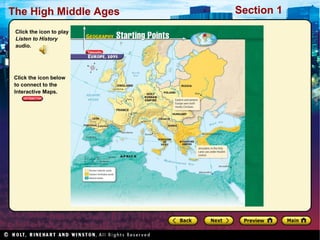
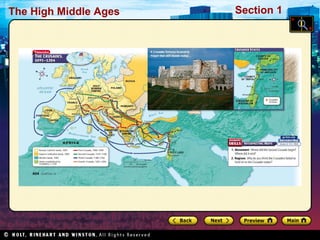
Starting Points Map: Europe,1095

•

Main Idea / Reading Focus

•

Launching the Crusades

•

Fighting the Crusades

•

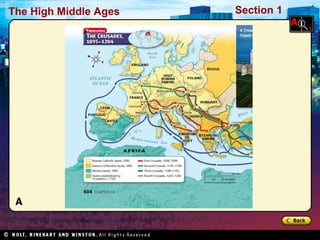
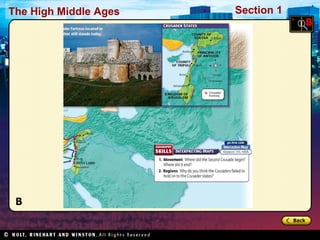
Map: The Crusades

•

Effects of the Crusades

•

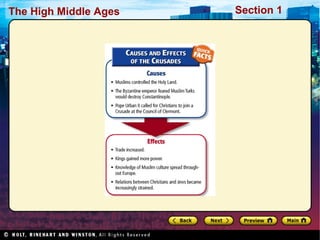
Quick Facts: Causes and Effects of the Crusades

Section 1
The High Middle Ages
Click the icon to play
Listen to History
audio.

Click the icon below
to connect to the
Interactive Maps.

Section 1
The High Middle Ages

Section 1

The Crusades
Main Idea
1. The Crusades, a series of attempts to gain Christian control of
the Holy Land, had a profound economic, political, and social
impact on the societies involved.

Reading Focus
• Why did the Europeans launch the Crusades?
• What happened during the Crusades?
• What were the effects of the Crusades?
Section 1

The High Middle Ages

Launching the Crusades
Goal of Crusades

Muslims Control Holy Land

• European Christians launched
series of religious wars,
Crusades, in Middle Ages

• Jerusalem in control of North
African Muslims, Fatimids, late
1000s

• Goal to take Jerusalem, Holy
Land, away from Muslims

• Turkish Muslims took control of
Persia, other lands, persecuted
Christians visiting region

• Jerusalem site of Holy Temple
of Jews, also where Jesus
crucified, buried, was to come
again
• Vital to Christians to control city

• Turks attacked Byzantine
Empire, destroyed army, 1071
• Emperor turned to Western
Europe, Pope Urban II, for help
The High Middle Ages

Section 1

The Council of Clermont
Pope Urban II called church leaders to council in
Clermont, France
• Described dangers faced by Byzantines
• Called on Christian warriors to put aside differences,
fight against Turks
– Effective call to arms
– Hundreds of knights, nobles volunteered for Crusade
– Set out to meet foes with slogan “God wills it!”
Section 1

The High Middle Ages

Sequence
What events led to the call for a Crusade?
Answer(s): Seljuk Turks conquered Holy Land,
threatened Byzantines; Byzantine emperor called
on pope for assistance
Section 1

The High Middle Ages

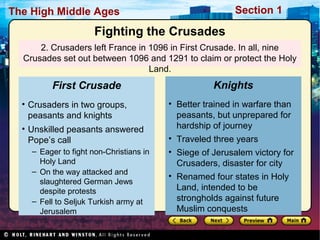
Fighting the Crusades
2. Crusaders left France in 1096 in First Crusade. In all, nine
Crusades set out between 1096 and 1291 to claim or protect the Holy
Land.

First Crusade
• Crusaders in two groups,
peasants and knights
• Unskilled peasants answered
Pope’s call
– Eager to fight non-Christians in
Holy Land
– On the way attacked and
slaughtered German Jews
despite protests
– Fell to Seljuk Turkish army at
Jerusalem

Knights
• Better trained in warfare than
peasants, but unprepared for
hardship of journey
• Traveled three years
• Siege of Jerusalem victory for
Crusaders, disaster for city
• Renamed four states in Holy
Land, intended to be
strongholds against future
Muslim conquests
The High Middle Ages

Section 1

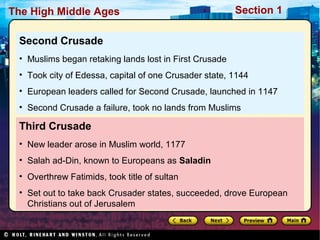
Second Crusade
• Muslims began retaking lands lost in First Crusade
• Took city of Edessa, capital of one Crusader state, 1144
• European leaders called for Second Crusade, launched in 1147
• Second Crusade a failure, took no lands from Muslims

Third Crusade
• New leader arose in Muslim world, 1177
• Salah ad-Din, known to Europeans as Saladin
• Overthrew Fatimids, took title of sultan
• Set out to take back Crusader states, succeeded, drove European
Christians out of Jerusalem
The High Middle Ages

Section 1

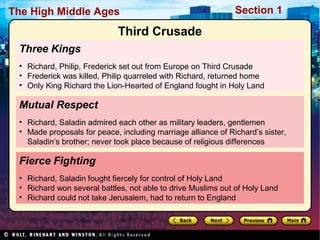
Third Crusade
Three Kings
• Richard, Philip, Frederick set out from Europe on Third Crusade
• Frederick was killed, Philip quarreled with Richard, returned home
• Only King Richard the Lion-Hearted of England fought in Holy Land

Mutual Respect
• Richard, Saladin admired each other as military leaders, gentlemen
• Made proposals for peace, including marriage alliance of Richard’s sister,
Saladin’s brother; never took place because of religious differences

Fierce Fighting
• Richard, Saladin fought fiercely for control of Holy Land
• Richard won several battles, not able to drive Muslims out of Holy Land
• Richard could not take Jerusalem, had to return to England
The High Middle Ages

Section 1

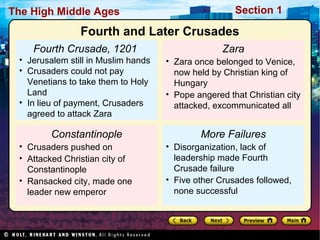
Fourth and Later Crusades
Fourth Crusade, 1201

Zara

• Jerusalem still in Muslim hands
• Crusaders could not pay
Venetians to take them to Holy
Land
• In lieu of payment, Crusaders
agreed to attack Zara

• Zara once belonged to Venice,
now held by Christian king of
Hungary
• Pope angered that Christian city
attacked, excommunicated all

Constantinople

More Failures

• Crusaders pushed on
• Attacked Christian city of
Constantinople
• Ransacked city, made one
leader new emperor

• Disorganization, lack of
leadership made Fourth
Crusade failure
• Five other Crusades followed,
none successful
The High Middle Ages

Section 1
The High Middle Ages

Section 1
The High Middle Ages

Section 1
The High Middle Ages

Section 1

Find the Main Idea
What was the goal of the Crusades?
Answer(s): to take Jerusalem and the Holy Land
away from the Muslims who controlled it
Section 1

The High Middle Ages

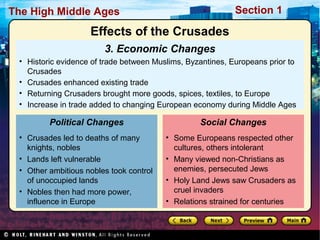
Effects of the Crusades
3. Economic Changes
• Historic evidence of trade between Muslims, Byzantines, Europeans prior to
Crusades
• Crusades enhanced existing trade
• Returning Crusaders brought more goods, spices, textiles, to Europe
• Increase in trade added to changing European economy during Middle Ages

Political Changes
• Crusades led to deaths of many
knights, nobles
• Lands left vulnerable
• Other ambitious nobles took control
of unoccupied lands
• Nobles then had more power,
influence in Europe

Social Changes
• Some Europeans respected other
cultures, others intolerant
• Many viewed non-Christians as
enemies, persecuted Jews
• Holy Land Jews saw Crusaders as
cruel invaders
• Relations strained for centuries
The High Middle Ages

Section 1
The High Middle Ages

Section 1

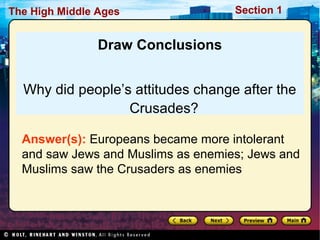
Draw Conclusions
Why did people’s attitudes change after the
Crusades?
Answer(s): Europeans became more intolerant
and saw Jews and Muslims as enemies; Jews and
Muslims saw the Crusaders as enemies

World History Ch. 14 Section 1 Notes

  • 1.
    The High MiddleAges Section 1
  • 2.
    The High MiddleAges The Crusades Preview • Starting Points Map: Europe,1095 • Main Idea / Reading Focus • Launching the Crusades • Fighting the Crusades • Map: The Crusades • Effects of the Crusades • Quick Facts: Causes and Effects of the Crusades Section 1
  • 3.
    The High MiddleAges Click the icon to play Listen to History audio. Click the icon below to connect to the Interactive Maps. Section 1
  • 4.
    The High MiddleAges Section 1 The Crusades Main Idea 1. The Crusades, a series of attempts to gain Christian control of the Holy Land, had a profound economic, political, and social impact on the societies involved. Reading Focus • Why did the Europeans launch the Crusades? • What happened during the Crusades? • What were the effects of the Crusades?
  • 5.
    Section 1 The HighMiddle Ages Launching the Crusades Goal of Crusades Muslims Control Holy Land • European Christians launched series of religious wars, Crusades, in Middle Ages • Jerusalem in control of North African Muslims, Fatimids, late 1000s • Goal to take Jerusalem, Holy Land, away from Muslims • Turkish Muslims took control of Persia, other lands, persecuted Christians visiting region • Jerusalem site of Holy Temple of Jews, also where Jesus crucified, buried, was to come again • Vital to Christians to control city • Turks attacked Byzantine Empire, destroyed army, 1071 • Emperor turned to Western Europe, Pope Urban II, for help
  • 6.
    The High MiddleAges Section 1 The Council of Clermont Pope Urban II called church leaders to council in Clermont, France • Described dangers faced by Byzantines • Called on Christian warriors to put aside differences, fight against Turks – Effective call to arms – Hundreds of knights, nobles volunteered for Crusade – Set out to meet foes with slogan “God wills it!”
  • 7.
    Section 1 The HighMiddle Ages Sequence What events led to the call for a Crusade? Answer(s): Seljuk Turks conquered Holy Land, threatened Byzantines; Byzantine emperor called on pope for assistance
  • 8.
    Section 1 The HighMiddle Ages Fighting the Crusades 2. Crusaders left France in 1096 in First Crusade. In all, nine Crusades set out between 1096 and 1291 to claim or protect the Holy Land. First Crusade • Crusaders in two groups, peasants and knights • Unskilled peasants answered Pope’s call – Eager to fight non-Christians in Holy Land – On the way attacked and slaughtered German Jews despite protests – Fell to Seljuk Turkish army at Jerusalem Knights • Better trained in warfare than peasants, but unprepared for hardship of journey • Traveled three years • Siege of Jerusalem victory for Crusaders, disaster for city • Renamed four states in Holy Land, intended to be strongholds against future Muslim conquests
  • 9.
    The High MiddleAges Section 1 Second Crusade • Muslims began retaking lands lost in First Crusade • Took city of Edessa, capital of one Crusader state, 1144 • European leaders called for Second Crusade, launched in 1147 • Second Crusade a failure, took no lands from Muslims Third Crusade • New leader arose in Muslim world, 1177 • Salah ad-Din, known to Europeans as Saladin • Overthrew Fatimids, took title of sultan • Set out to take back Crusader states, succeeded, drove European Christians out of Jerusalem
  • 10.
    The High MiddleAges Section 1 Third Crusade Three Kings • Richard, Philip, Frederick set out from Europe on Third Crusade • Frederick was killed, Philip quarreled with Richard, returned home • Only King Richard the Lion-Hearted of England fought in Holy Land Mutual Respect • Richard, Saladin admired each other as military leaders, gentlemen • Made proposals for peace, including marriage alliance of Richard’s sister, Saladin’s brother; never took place because of religious differences Fierce Fighting • Richard, Saladin fought fiercely for control of Holy Land • Richard won several battles, not able to drive Muslims out of Holy Land • Richard could not take Jerusalem, had to return to England
  • 11.
    The High MiddleAges Section 1 Fourth and Later Crusades Fourth Crusade, 1201 Zara • Jerusalem still in Muslim hands • Crusaders could not pay Venetians to take them to Holy Land • In lieu of payment, Crusaders agreed to attack Zara • Zara once belonged to Venice, now held by Christian king of Hungary • Pope angered that Christian city attacked, excommunicated all Constantinople More Failures • Crusaders pushed on • Attacked Christian city of Constantinople • Ransacked city, made one leader new emperor • Disorganization, lack of leadership made Fourth Crusade failure • Five other Crusades followed, none successful
  • 12.
    The High MiddleAges Section 1
  • 13.
    The High MiddleAges Section 1
  • 14.
    The High MiddleAges Section 1
  • 15.
    The High MiddleAges Section 1 Find the Main Idea What was the goal of the Crusades? Answer(s): to take Jerusalem and the Holy Land away from the Muslims who controlled it
  • 16.
    Section 1 The HighMiddle Ages Effects of the Crusades 3. Economic Changes • Historic evidence of trade between Muslims, Byzantines, Europeans prior to Crusades • Crusades enhanced existing trade • Returning Crusaders brought more goods, spices, textiles, to Europe • Increase in trade added to changing European economy during Middle Ages Political Changes • Crusades led to deaths of many knights, nobles • Lands left vulnerable • Other ambitious nobles took control of unoccupied lands • Nobles then had more power, influence in Europe Social Changes • Some Europeans respected other cultures, others intolerant • Many viewed non-Christians as enemies, persecuted Jews • Holy Land Jews saw Crusaders as cruel invaders • Relations strained for centuries
  • 17.
    The High MiddleAges Section 1
  • 18.
    The High MiddleAges Section 1 Draw Conclusions Why did people’s attitudes change after the Crusades? Answer(s): Europeans became more intolerant and saw Jews and Muslims as enemies; Jews and Muslims saw the Crusaders as enemies