Chapter 25 Section 1
The Cold War Begins
Section 3
The Rights Revolution Expands
• Explain how the Latino population grew after
World War I.
• Analyze the Latino and Native American rights
movements of the 1960s and 1970s.
• Describe the expansion of rights for consumers
and the disabled.
Objectives
Chapter 25 Section 1
The Cold War BeginsThe Rights Revolution Expands
Section 3
Terms and People
• Cesar Chavez − an influential Latino activist who
fought for farm laborers’ rights
• migrant farmworker − a worker who moved
from one place to another to pick crops
• UFW − the United Farm Workers, a union for
migrant farm workers
• Chicano movement − a Mexican-American effort
for social and political equality
Chapter 25 Section 1
The Cold War BeginsThe Rights Revolution Expands
Section 3
• AIM − the American Indian Movement, which
addressed civil rights issues for Native Americans
• Ralph Nader − a leader of the consumer rights
movement
Terms and People (continued)
Chapter 25 Section 1
The Cold War BeginsThe Rights Revolution Expands
Section 3
How did the rights movements of the
1960s and 1970s expand rights for
diverse groups of Americans?
1. Latinos and Native Americans worked to secure
their civil rights in the 1960s and 1970s. Activists
also worked to expand the rights of consumers
and people with disabilities.
Chapter 25 Section 1
The Cold War BeginsThe Rights Revolution Expands
Section 3
After World War I, the United States limited
immigration from Europe.
Beginning with World War II, the U.S.
experienced a growing demand for inexpensive
labor.
At the same time, Latin American countries had
increasing populations and shrinking job
opportunities.
2. Three factors created a steady stream of Latin
American immigrants to the United States.
1
2
3
Chapter 25 Section 1
The Cold War BeginsThe Rights Revolution Expands
Section 3
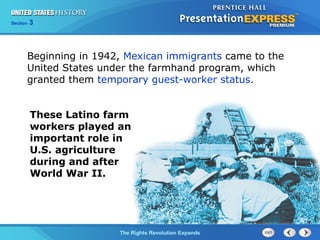
Beginning in 1942, Mexican immigrants came to the
United States under the farmhand program, which
granted them temporary guest-worker status.
These Latino farm
workers played an
important role in
U.S. agriculture
during and after
World War II.
Chapter 25 Section 1
The Cold War BeginsThe Rights Revolution Expands
Section 3
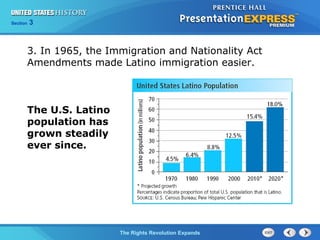
The U.S. Latino
population has
grown steadily
ever since.
3. In 1965, the Immigration and Nationality Act
Amendments made Latino immigration easier.
Chapter 25 Section 1
The Cold War BeginsThe Rights Revolution Expands
Section 3
Like other minorities,
Latinos fought for equal rights.
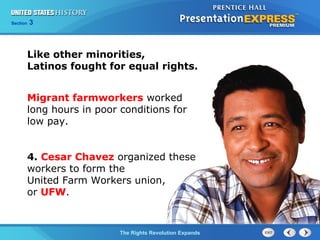
Migrant farmworkers worked
long hours in poor conditions for
low pay.
4. Cesar Chavez organized these
workers to form the
United Farm Workers union,
or UFW.
Chapter 25 Section 1
The Cold War BeginsThe Rights Revolution Expands
Section 3
The Chicano Movement worked to promote
Latino culture and political strength.
The movement had several main goals.
• inclusion of Latino heritage in education
• reduce poverty and improve opportunities for
Latinos
• greater Latino representation at all levels of
government
Chapter 25 Section 1
The Cold War BeginsThe Rights Revolution Expands
Section 3
The National Indian
Youth Council
(NIYC) first formed
to address native
fishing rights and
later expanded into
broad civil rights
issues.
Native American activism also grew in
the 1960s and 1970s.
The American Indian
Movement (AIM)
started as an activist
group for urban Native
Americans and soon
became involved with
land, legal, and self-
government issues.
Chapter 25 Section 1
The Cold War BeginsThe Rights Revolution Expands
Section 3
• Federal authorities
besieged the village.
• Gunfire killed two AIM
members.
After the standoff, the
government promised
to reexamine native
treaty rights.
In February 1973,
AIM occupied the
village of
Wounded Knee,
South Dakota,
site of an 1890
massacre of
Sioux.
Chapter 25 Section 1
The Cold War BeginsThe Rights Revolution Expands
Section 3
5. Native American activism resulted in
favorable legal changes.
The tribes also won
legal battles over
land, mineral, and
water rights.
The Indian Self-
Determination Act
of 1975 granted
tribes greater
control over
resources on their
reservations.
Chapter 25 Section 1
The Cold War BeginsThe Rights Revolution Expands
Section 3
• Ralph Nader formed
several consumer advocacy
groups to ensure that the
products people buy are
safe.
• The Nixon administration
proposed regulations for
safety in the workplace.
Reformers pushed for measures to
protect consumers and workers.
Chapter 25 Section 1
The Cold War BeginsThe Rights Revolution Expands
Section 3
By the 1970s, Americans with disabilities
were gaining more rights.
• People with physical and mental disabilities
participated in the Special Olympics.
• The government passed laws guaranteeing
people with disabilities equal access to
education.
Chapter 25 Section 1
The Cold War BeginsThe Rights Revolution Expands
Section 3
Section Review
Know It, Show It QuizQuickTake Quiz

US History Ch. 21 Section 3 Notes

  • 1.
    Chapter 25 Section1 The Cold War Begins Section 3 The Rights Revolution Expands • Explain how the Latino population grew after World War I. • Analyze the Latino and Native American rights movements of the 1960s and 1970s. • Describe the expansion of rights for consumers and the disabled. Objectives
  • 2.
    Chapter 25 Section1 The Cold War BeginsThe Rights Revolution Expands Section 3 Terms and People • Cesar Chavez − an influential Latino activist who fought for farm laborers’ rights • migrant farmworker − a worker who moved from one place to another to pick crops • UFW − the United Farm Workers, a union for migrant farm workers • Chicano movement − a Mexican-American effort for social and political equality
  • 3.
    Chapter 25 Section1 The Cold War BeginsThe Rights Revolution Expands Section 3 • AIM − the American Indian Movement, which addressed civil rights issues for Native Americans • Ralph Nader − a leader of the consumer rights movement Terms and People (continued)
  • 4.
    Chapter 25 Section1 The Cold War BeginsThe Rights Revolution Expands Section 3 How did the rights movements of the 1960s and 1970s expand rights for diverse groups of Americans? 1. Latinos and Native Americans worked to secure their civil rights in the 1960s and 1970s. Activists also worked to expand the rights of consumers and people with disabilities.
  • 5.
    Chapter 25 Section1 The Cold War BeginsThe Rights Revolution Expands Section 3 After World War I, the United States limited immigration from Europe. Beginning with World War II, the U.S. experienced a growing demand for inexpensive labor. At the same time, Latin American countries had increasing populations and shrinking job opportunities. 2. Three factors created a steady stream of Latin American immigrants to the United States. 1 2 3
  • 6.
    Chapter 25 Section1 The Cold War BeginsThe Rights Revolution Expands Section 3 Beginning in 1942, Mexican immigrants came to the United States under the farmhand program, which granted them temporary guest-worker status. These Latino farm workers played an important role in U.S. agriculture during and after World War II.
  • 7.
    Chapter 25 Section1 The Cold War BeginsThe Rights Revolution Expands Section 3 The U.S. Latino population has grown steadily ever since. 3. In 1965, the Immigration and Nationality Act Amendments made Latino immigration easier.
  • 8.
    Chapter 25 Section1 The Cold War BeginsThe Rights Revolution Expands Section 3 Like other minorities, Latinos fought for equal rights. Migrant farmworkers worked long hours in poor conditions for low pay. 4. Cesar Chavez organized these workers to form the United Farm Workers union, or UFW.
  • 9.
    Chapter 25 Section1 The Cold War BeginsThe Rights Revolution Expands Section 3 The Chicano Movement worked to promote Latino culture and political strength. The movement had several main goals. • inclusion of Latino heritage in education • reduce poverty and improve opportunities for Latinos • greater Latino representation at all levels of government
  • 10.
    Chapter 25 Section1 The Cold War BeginsThe Rights Revolution Expands Section 3 The National Indian Youth Council (NIYC) first formed to address native fishing rights and later expanded into broad civil rights issues. Native American activism also grew in the 1960s and 1970s. The American Indian Movement (AIM) started as an activist group for urban Native Americans and soon became involved with land, legal, and self- government issues.
  • 11.
    Chapter 25 Section1 The Cold War BeginsThe Rights Revolution Expands Section 3 • Federal authorities besieged the village. • Gunfire killed two AIM members. After the standoff, the government promised to reexamine native treaty rights. In February 1973, AIM occupied the village of Wounded Knee, South Dakota, site of an 1890 massacre of Sioux.
  • 12.
    Chapter 25 Section1 The Cold War BeginsThe Rights Revolution Expands Section 3 5. Native American activism resulted in favorable legal changes. The tribes also won legal battles over land, mineral, and water rights. The Indian Self- Determination Act of 1975 granted tribes greater control over resources on their reservations.
  • 13.
    Chapter 25 Section1 The Cold War BeginsThe Rights Revolution Expands Section 3 • Ralph Nader formed several consumer advocacy groups to ensure that the products people buy are safe. • The Nixon administration proposed regulations for safety in the workplace. Reformers pushed for measures to protect consumers and workers.
  • 14.
    Chapter 25 Section1 The Cold War BeginsThe Rights Revolution Expands Section 3 By the 1970s, Americans with disabilities were gaining more rights. • People with physical and mental disabilities participated in the Special Olympics. • The government passed laws guaranteeing people with disabilities equal access to education.
  • 15.
    Chapter 25 Section1 The Cold War BeginsThe Rights Revolution Expands Section 3 Section Review Know It, Show It QuizQuickTake Quiz