Ancient India and China Section 1
Ancient India and China Section 1 
Early India 
Preview 
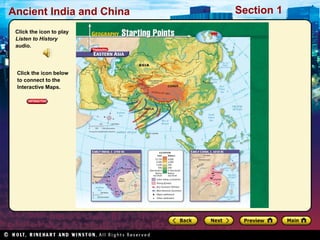
• Starting Points Map: Eastern Asia 
• Main Idea / Reading Focus 
• India’s Geography 
• Indus Valley Civilization 
• The Vedic Period 
• Quick Facts: The Varnas
Ancient India and China Section 1 
Click the icon to play 
Listen to History 
audio. 
Click the icon below 
to connect to the 
Interactive Maps.
Ancient India and China Section 1 
Early India 
Main Idea 
1. Early civilization arose in the Indus River Valley, flourished, 
and then mysteriously died out. Later India’s Vedic civilization 
developed a culture based on old and new beliefs. 
Reading Focus 
• How did India’s geography affect the development of 
civilization there? 
• What were the defining features of the Indus Valley 
Civilization? 
• What do we know about life in India’s Vedic period?
Ancient India and China Section 1 
India’s Geography 
Indus River flows across northwest edge of Indian 
subcontinent—large landmass, part of a continent 
• Home of one of ancient world’s great river valley 
civilizations 
• Indian subcontinent includes three major geographic 
zones 
– Far north: Himalaya, Hindu Kush mountain systems, separating 
India from rest of Asia 
– South: Deccan Plateau, high plateau receiving less rain than 
other parts of subcontinent 
– Between mountains, plateau are Northern Plains, where society 
first developed in India
Ancient India and China Section 1 
Floods and Annual Rainfall 
2. Monsoon Winds 
• Summer, monsoon winds from 
southwest bring warm air, 
heavy rains from Indian Ocean; 
most of annual rainfall at this 
time 
• Winter, northeast monsoons 
blow cool, dry air from Central 
Asia, drier months 
Fertile Region 
• Flood deposits from Indus, 
Ganges, Brahmaputra rivers 
enrich soil of Northern Plains, 
make it very fertile 
• Heavy rains also add to fertility 
of plains 
• Much of rain brought to India by 
seasonal winds, monsoons
Ancient India and China Section 1 
Water Critical Factor 
The people of India’s first civilizations depended upon the monsoons 
to bring the water that their crops needed. 
Monsoon Rains 
• Monsoon rains flooded rivers; 
rivers deposited fertile silt in 
which farmers could grow 
crops 
• With abundance of rainfall 
came threat of devastation 
Devastating Effects 
• Monsoon rains too heavy— 
crops, homes, lives could be 
lost 
• Monsoon rains too late, did 
not last long enough—people 
could not grow crops; famine 
became danger
Ancient India and China Section 1 
Describe 
What problems could monsoons cause for 
early Indians? 
Answer(s): flooding or drought
Ancient India and China Section 1 
Indus Valley Civilization 
People have lived in the northern parts of the Indian subcontinent for 
thousands of years. At first people lived as hunter-gatherers, but 
slowly people began to settle down in farming communities. 
First Civilization 
• Farm communities 
gave rise to India’s 
first civilization 
• Developed in valley 
of Indus River 
• Began 2500 BC, 
when people first 
developed writing 
system 
Cities, Settlements 
• 1920s,remains of 
two large cities first 
ruins found 
– Harappa 
– Mohenjo Daro 
• Civilization called 
Harappan 
• Other cities, towns 
since uncovered 
Indus Society 
• Settlements well 
planned, carefully 
laid out 
• Streets ran in grid 
pattern; major 
avenues twice as 
wide as minor 
streets
Ancient India and China Section 1 
Life in Towns and Cities 
• Water came from community wells, smaller wells in courtyards of homes 
• Public drainage systems carried away wastewater 
• Walled, elevated citadel—fortress—enclosed buildings like granaries, 
warehouses 
• Homes, workshops, shrines built outside citadel 
• Uniformity suggests central authority in power 
Economy 
• Economy likely based on agriculture, trade 
• Most probably farmed, herded livestock 
• In cities, many specialized in crafts like pottery, metalwork, jewelry 
• Indus traded goods with people nearby, distant civilizations 
• Traders from Indus Valley brought goods to locations as distant as Central 
Asia, Arabian Peninsula, Mesopotamia
Ancient India and China Section 1 
Society 
Few Details 
• Archaeologists, historians not able to learn many details about Indus society 
• Had writing system, but historians not able to read it 
• Some say Indus civilization single society, rather than collection of city-states 
Similarities 
• People shared common tool designs, standard set of weights, measures 
• Suggest single authority in control 
• Civilization thrived from about 2500 BC to 2000 BC, then began to decline 
Decline 
• No one knows what led to decline, or if single cause 
• Environmental damage suspected; flooding, disappearance of Sarasvati river 
• Invasion, disease may also have helped end civilization
Ancient India and China Section 1 
Analyze 
Why do historians know relatively little about 
Indus society? 
Answer(s): have not deciphered Indus writing
Ancient India and China Section 1 
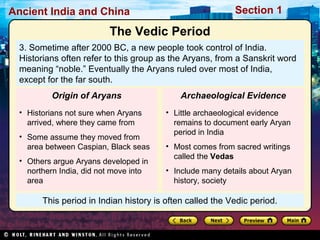
The Vedic Period 
3. Sometime after 2000 BC, a new people took control of India. 
Historians often refer to this group as the Aryans, from a Sanskrit word 
meaning “noble.” Eventually the Aryans ruled over most of India, 
except for the far south. 
Origin of Aryans 
• Historians not sure when Aryans 
arrived, where they came from 
• Some assume they moved from 
area between Caspian, Black seas 
• Others argue Aryans developed in 
northern India, did not move into 
area 
Archaeological Evidence 
• Little archaeological evidence 
remains to document early Aryan 
period in India 
• Most comes from sacred writings 
called the Vedas 
• Include many details about Aryan 
history, society 
This period in Indian history is often called the Vedic period.
Ancient India and China Section 1 
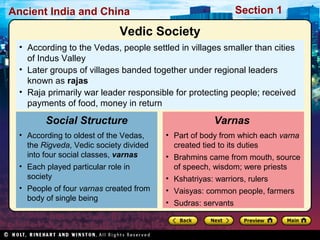
Vedic Society 
• According to the Vedas, people settled in villages smaller than cities 
of Indus Valley 
• Later groups of villages banded together under regional leaders 
known as rajas 
• Raja primarily war leader responsible for protecting people; received 
payments of food, money in return 
Social Structure 
• According to oldest of the Vedas, 
the Rigveda, Vedic society divided 
into four social classes, varnas 
• Each played particular role in 
society 
• People of four varnas created from 
body of single being 
Varnas 
• Part of body from which each varna 
created tied to its duties 
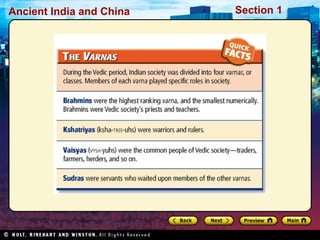
• Brahmins came from mouth, source 
of speech, wisdom; were priests 
• Kshatriyas: warriors, rulers 
• Vaisyas: common people, farmers 
• Sudras: servants
Ancient India and China Section 1
Ancient India and China Section 1 
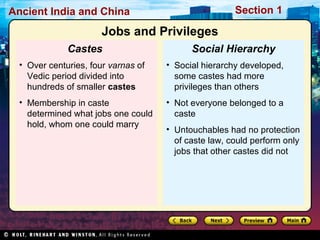
Jobs and Privileges 
Social Hierarchy 
• Social hierarchy developed, 
some castes had more 
privileges than others 
• Not everyone belonged to a 
caste 
• Untouchables had no protection 
of caste law, could perform only 
jobs that other castes did not 
Castes 
• Over centuries, four varnas of 
Vedic period divided into 
hundreds of smaller castes 
• Membership in caste 
determined what jobs one could 
hold, whom one could marry
Ancient India and China Section 1 
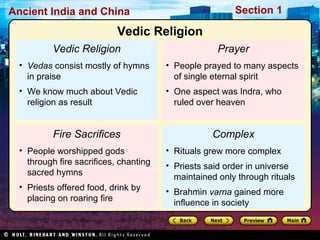
Vedic Religion 
Vedic Religion 
• Vedas consist mostly of hymns 
in praise 
• We know much about Vedic 
religion as result 
Fire Sacrifices 
• People worshipped gods 
through fire sacrifices, chanting 
sacred hymns 
• Priests offered food, drink by 
placing on roaring fire 
Prayer 
• People prayed to many aspects 
of single eternal spirit 
• One aspect was Indra, who 
ruled over heaven 
Complex 
• Rituals grew more complex 
• Priests said order in universe 
maintained only through rituals 
• Brahmin varna gained more 
influence in society
Ancient India and China Section 1 
Summarize 
How was Vedic society organized? 
Answer(s): into four social classes called varnas

World History Ch. 4 Section 1 Notes

  • 1.
    Ancient India andChina Section 1
  • 2.
    Ancient India andChina Section 1 Early India Preview • Starting Points Map: Eastern Asia • Main Idea / Reading Focus • India’s Geography • Indus Valley Civilization • The Vedic Period • Quick Facts: The Varnas
  • 3.
    Ancient India andChina Section 1 Click the icon to play Listen to History audio. Click the icon below to connect to the Interactive Maps.
  • 4.
    Ancient India andChina Section 1 Early India Main Idea 1. Early civilization arose in the Indus River Valley, flourished, and then mysteriously died out. Later India’s Vedic civilization developed a culture based on old and new beliefs. Reading Focus • How did India’s geography affect the development of civilization there? • What were the defining features of the Indus Valley Civilization? • What do we know about life in India’s Vedic period?
  • 5.
    Ancient India andChina Section 1 India’s Geography Indus River flows across northwest edge of Indian subcontinent—large landmass, part of a continent • Home of one of ancient world’s great river valley civilizations • Indian subcontinent includes three major geographic zones – Far north: Himalaya, Hindu Kush mountain systems, separating India from rest of Asia – South: Deccan Plateau, high plateau receiving less rain than other parts of subcontinent – Between mountains, plateau are Northern Plains, where society first developed in India
  • 6.
    Ancient India andChina Section 1 Floods and Annual Rainfall 2. Monsoon Winds • Summer, monsoon winds from southwest bring warm air, heavy rains from Indian Ocean; most of annual rainfall at this time • Winter, northeast monsoons blow cool, dry air from Central Asia, drier months Fertile Region • Flood deposits from Indus, Ganges, Brahmaputra rivers enrich soil of Northern Plains, make it very fertile • Heavy rains also add to fertility of plains • Much of rain brought to India by seasonal winds, monsoons
  • 7.
    Ancient India andChina Section 1 Water Critical Factor The people of India’s first civilizations depended upon the monsoons to bring the water that their crops needed. Monsoon Rains • Monsoon rains flooded rivers; rivers deposited fertile silt in which farmers could grow crops • With abundance of rainfall came threat of devastation Devastating Effects • Monsoon rains too heavy— crops, homes, lives could be lost • Monsoon rains too late, did not last long enough—people could not grow crops; famine became danger
  • 8.
    Ancient India andChina Section 1 Describe What problems could monsoons cause for early Indians? Answer(s): flooding or drought
  • 9.
    Ancient India andChina Section 1 Indus Valley Civilization People have lived in the northern parts of the Indian subcontinent for thousands of years. At first people lived as hunter-gatherers, but slowly people began to settle down in farming communities. First Civilization • Farm communities gave rise to India’s first civilization • Developed in valley of Indus River • Began 2500 BC, when people first developed writing system Cities, Settlements • 1920s,remains of two large cities first ruins found – Harappa – Mohenjo Daro • Civilization called Harappan • Other cities, towns since uncovered Indus Society • Settlements well planned, carefully laid out • Streets ran in grid pattern; major avenues twice as wide as minor streets
  • 10.
    Ancient India andChina Section 1 Life in Towns and Cities • Water came from community wells, smaller wells in courtyards of homes • Public drainage systems carried away wastewater • Walled, elevated citadel—fortress—enclosed buildings like granaries, warehouses • Homes, workshops, shrines built outside citadel • Uniformity suggests central authority in power Economy • Economy likely based on agriculture, trade • Most probably farmed, herded livestock • In cities, many specialized in crafts like pottery, metalwork, jewelry • Indus traded goods with people nearby, distant civilizations • Traders from Indus Valley brought goods to locations as distant as Central Asia, Arabian Peninsula, Mesopotamia
  • 11.
    Ancient India andChina Section 1 Society Few Details • Archaeologists, historians not able to learn many details about Indus society • Had writing system, but historians not able to read it • Some say Indus civilization single society, rather than collection of city-states Similarities • People shared common tool designs, standard set of weights, measures • Suggest single authority in control • Civilization thrived from about 2500 BC to 2000 BC, then began to decline Decline • No one knows what led to decline, or if single cause • Environmental damage suspected; flooding, disappearance of Sarasvati river • Invasion, disease may also have helped end civilization
  • 12.
    Ancient India andChina Section 1 Analyze Why do historians know relatively little about Indus society? Answer(s): have not deciphered Indus writing
  • 13.
    Ancient India andChina Section 1 The Vedic Period 3. Sometime after 2000 BC, a new people took control of India. Historians often refer to this group as the Aryans, from a Sanskrit word meaning “noble.” Eventually the Aryans ruled over most of India, except for the far south. Origin of Aryans • Historians not sure when Aryans arrived, where they came from • Some assume they moved from area between Caspian, Black seas • Others argue Aryans developed in northern India, did not move into area Archaeological Evidence • Little archaeological evidence remains to document early Aryan period in India • Most comes from sacred writings called the Vedas • Include many details about Aryan history, society This period in Indian history is often called the Vedic period.
  • 14.
    Ancient India andChina Section 1 Vedic Society • According to the Vedas, people settled in villages smaller than cities of Indus Valley • Later groups of villages banded together under regional leaders known as rajas • Raja primarily war leader responsible for protecting people; received payments of food, money in return Social Structure • According to oldest of the Vedas, the Rigveda, Vedic society divided into four social classes, varnas • Each played particular role in society • People of four varnas created from body of single being Varnas • Part of body from which each varna created tied to its duties • Brahmins came from mouth, source of speech, wisdom; were priests • Kshatriyas: warriors, rulers • Vaisyas: common people, farmers • Sudras: servants
  • 15.
    Ancient India andChina Section 1
  • 16.
    Ancient India andChina Section 1 Jobs and Privileges Social Hierarchy • Social hierarchy developed, some castes had more privileges than others • Not everyone belonged to a caste • Untouchables had no protection of caste law, could perform only jobs that other castes did not Castes • Over centuries, four varnas of Vedic period divided into hundreds of smaller castes • Membership in caste determined what jobs one could hold, whom one could marry
  • 17.
    Ancient India andChina Section 1 Vedic Religion Vedic Religion • Vedas consist mostly of hymns in praise • We know much about Vedic religion as result Fire Sacrifices • People worshipped gods through fire sacrifices, chanting sacred hymns • Priests offered food, drink by placing on roaring fire Prayer • People prayed to many aspects of single eternal spirit • One aspect was Indra, who ruled over heaven Complex • Rituals grew more complex • Priests said order in universe maintained only through rituals • Brahmin varna gained more influence in society
  • 18.
    Ancient India andChina Section 1 Summarize How was Vedic society organized? Answer(s): into four social classes called varnas