The Byzantine
Empire
The Eastern Roman Empire
The Byzantine
Empire
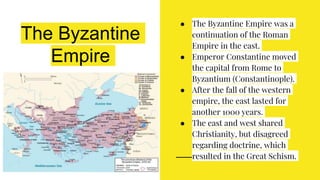
● The Byzantine Empire was a
continuation of the Roman
Empire in the east.
● Emperor Constantine moved
the capital from Rome to
Byzantium (Constantinople).
● After the fall of the western
empire, the east lasted for
another 1000 years.
● The east and west shared
Christianity, but disagreed
regarding doctrine, which
resulted in the Great Schism.
Constantinople
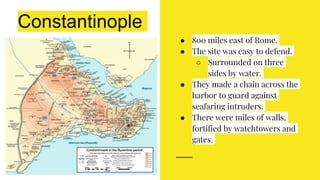
● 800 miles east of Rome.
● The site was easy to defend.
○ Surrounded on three
sides by water.
● They made a chain across the
harbor to guard against
seafaring intruders.
● There were miles of walls,
fortified by watchtowers and
gates.
Constantinople
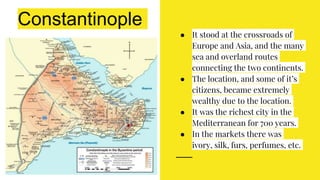
● It stood at the crossroads of
Europe and Asia, and the many
sea and overland routes
connecting the two continents.
● The location, and some of it’s
citizens, became extremely
wealthy due to the location.
● It was the richest city in the
Mediterranean for 700 years.
● In the markets there was
ivory, silk, furs, perfumes, etc.
Why was Constantinople
ideally located to be the
capital of the Byzantine
Empire?
Constantinople was easy to defend and
it lay at the crossroads
of many sea and overland trade routes
linking east and west.
What were some of
Constantinople’s main
features?
Constantinople was surrounded by water
on three sides and fortified by miles of walls
with watchtowers
and gates. A large chain protected the
mouth of its harbor. The city had a sewer
system, hospitals,
homes for the elderly, and orphanages.
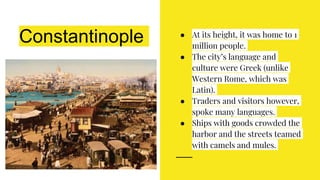
Constantinople ● At its height, it was home to 1
million people.
● The city’s language and
culture were Greek (unlike
Western Rome, which was
Latin).
● Traders and visitors however,
spoke many languages.
● Ships with goods crowded the
harbor and the streets teamed
with camels and mules.
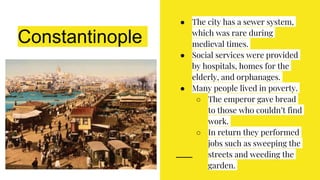
Constantinople
● The city has a sewer system,
which was rare during
medieval times.
● Social services were provided
by hospitals, homes for the
elderly, and orphanages.
● Many people lived in poverty.
○ The emperor gave bread
to those who couldn’t find
work.
○ In return they performed
jobs such as sweeping the
streets and weeding the
garden.
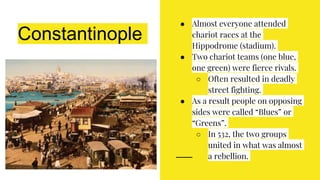
Constantinople
● Almost everyone attended
chariot races at the
Hippodrome (stadium).
● Two chariot teams (one blue,
one green) were fierce rivals.
○ Often resulted in deadly
street fighting.
● As a result people on opposing
sides were called “Blues” or
“Greens”.
○ In 532, the two groups
united in what was almost
a rebellion.
What was daily life like in
Constantinople?
Life in Constantinople was more advanced
than in western Europe. The city’s language
and culture were
Greek, but traders and visitors spoke many
languages. Most people lived in poverty.
Many people attended
chariot races. The emperor gave bread to
the unemployed, who did public works in
exchange.
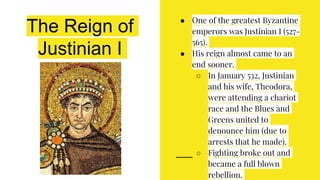
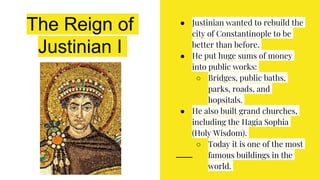
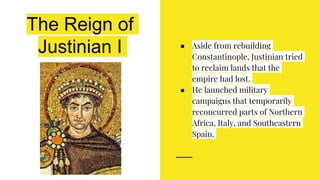
The Reign of
Justinian I
● One of the greatest Byzantine
emperors was Justinian I (527-
565).
● His reign almost came to an
end sooner.
○ In January 532, Justinian
and his wife, Theodora,
were attending a chariot
race and the Blues and
Greens united to
denounce him (due to
arrests that he made).
○ Fighting broke out and
became a full blown
rebellion.
The Reign of
Justinian I
● The rioting continued for one
week while Justinian and
Theodora hid in their palace.
● Justinian’s advisors wanted
him to leave, but Theodora
wanted him to stay and fight.
● With Theodora’s
encouragement, Justinian
ended the rebellion.
● 30,000 people were killed and
Constantinople was in ruins.
What event forced Justinian
to start rebuilding parts of
Constantinople?
Large parts of the city were ruined
when fighting in the Hippodrome
spilled into the streets and
escalated into a rebellion.
The Reign of
Justinian I
● Justinian wanted to rebuild the
city of Constantinople to be
better than before.
● He put huge sums of money
into public works:
○ Bridges, public baths,
parks, roads, and
hopsitals.
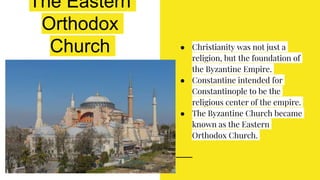
● He also built grand churches,
including the Hagia Sophia
(Holy Wisdom).
○ Today it is one of the most
famous buildings in the
world.
What were some of the
improvements made to
Constantinople as a result of
Justinian’s
public works projects?
New bridges, public baths, parks,
roads, and hospitals were built. In
addition, the Hagia Sophia, a
grand cathedral, was built.
The Reign of
Justinian I ● Aside from rebuilding
Constantinople, Justinian tried
to reclaim lands that the
empire had lost.
● He launched military
campaigns that temporarily
reconcurred parts of Northern
Africa, Italy, and Southeastern
Spain.
The Reign of
Justinian I
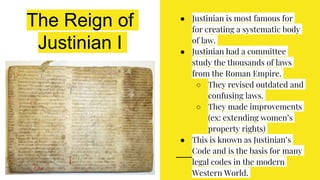
● Justinian is most famous for
for creating a systematic body
of law.
● Justinian had a committee
study the thousands of laws
from the Roman Empire.
○ They revised outdated and
confusing laws.
○ They made improvements
(ex: extending women’s
property rights)
● This is known as Justinian’s
Code and is the basis for many
legal codes in the modern
Western World.
How has Justinian’s Code
affected the modern world?
Justinian’s Code is the basis
for many legal codes in the
western world.
The Eastern
Orthodox
Church ● Christianity was not just a
religion, but the foundation of
the Byzantine Empire.
● Constantine intended for
Constantinople to be the
religious center of the empire.
● The Byzantine Church became
known as the Eastern
Orthodox Church.
The Eastern
Orthodox
Church
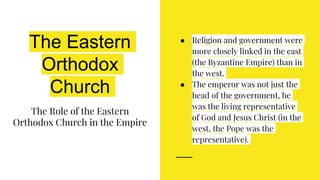
The Role of the Eastern
Orthodox Church in the Empire
● Religion and government were
more closely linked in the east
(the Byzantine Empire) than in
the west.
● The emperor was not just the
head of the government, he
was the living representative
of God and Jesus Christ (in the
west, the Pope was the
representative).
The Eastern
Orthodox
Church
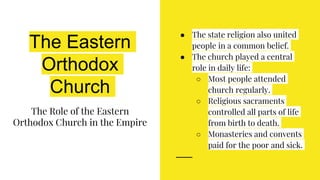
The Role of the Eastern
Orthodox Church in the Empire
● The state religion also united
people in a common belief.
● The church played a central
role in daily life:
○ Most people attended
church regularly.
○ Religious sacraments
controlled all parts of life
from birth to death.
○ Monasteries and convents
paid for the poor and sick.
The Eastern
Orthodox
Church
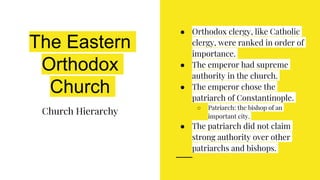
Church Hierarchy
● Orthodox clergy, like Catholic
clergy, were ranked in order of
importance.
● The emperor had supreme
authority in the church.
● The emperor chose the
patriarch of Constantinople.
○ Patriarch: the bishop of an
important city.
● The patriarch did not claim
strong authority over other
patriarchs and bishops.
The Eastern
Orthodox
Church
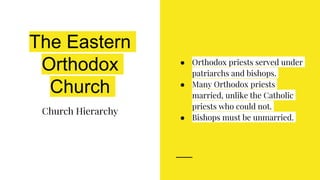
Church Hierarchy
● Orthodox priests served under
patriarchs and bishops.
● Many Orthodox priests
married, unlike the Catholic
priests who could not.
● Bishops must be unmarried.
What was the relationship
between religion and
government in the
Byzantine Empire?
Religion and government were closely
linked. The emperor was believed
to be both the head of the government
and the living representative of
Jesus Christ.
How did the Eastern
Orthodox Church play a
central role in the daily life of
Byzantines?
Most people attended church regularly
and received sacraments at every stage
of their lives.
Monasteries and convents cared for
the poor and sick.
The Eastern
Orthodox
Church
Liturgy and Prayer
● The Orthodox church service
is the Divine Liturgy.
● Both the clergy and
worshippers san the liturgy.
● The liturgy was conducted in
Greek, or the local language.
● Liturgy: a sacred rite of public
worship.
● Orthodox Christians also
prayed to saints.
● Most important were Saint
Basil (charity and reformation)
and Saint Cyril (created the
Cyrillic alphabet).
The Eastern
Orthodox
Church
Architecture and Art
● The Hagia Sophia served as a
model for many Orthodox
churches.
● The architecture reflects
Orthodox views:
○ The simple based
represents the earthly
world.
○ The “dome of heaven” rests
on top.
○ Rich decorations on the
insided reminded
worshippers what it would
be like to enter God’s
kingdom.
The Eastern
Orthodox
Church
Architecture and Art
● The Orthodox used many
images in its services and
prayers (inspired by Ancient
Greece).
● Byzantine artists created
beautiful icons, painted on
small wood panels.
○ Icon: a type of religious
painting considered
sacred.
● Artists also fashioned sacred
images as mosaics and painted
them as murals.
The Eastern
Orthodox
Church
Architecture and Art
● An image of Christ (Jesus) as
the Pantocrator (ruler of all)
gazes down from the dome of
every church.
● Christ was usually shown
holding a gospel and giving a
blessing.
● Most churches also placed
Mary and Jesus over the alter.
The Eastern
Orthodox
Church
Architecture and Art
● Most Byzantines believed that
sacred pictures helped to
bring them closer to God.
● This became a source of
violent disagreement.
Conflict
Between the
East and West
● Medieval Europe and the Byzantine
Empire were united by Christianity.
● Over the centuries, cultural,
political, and religious differences
brought them into conflict.
● They were already very different:
○ East = many cities, trade, and
wealthy
○ West = rural, agricultural, less
wealthy
● Even more pronounced after the Fall
of the Western Empire.
○ East = shaped by Greek heritage
and spoke Greek.
○ West = influenced by Frankish
and Germanic cultures and
Conflict
Between the
East and West
● MOST IMPORTANTLY the
Pope in the West had become
powerful figures and claimed
supreme religious authority.
● In the East, however, the
emperors and patriarchs
resisted such claims, as the
emperor controlled the
patriarch.
Conflict
Between the
East and West
Iconoclasm
● The first religious
disagreement between the
West and East regarded
religious icons.
● Many Christians used images
of Mary, Jesus, and and the
saints in worship and prayer.
○ In the East, some people believed
they were worshipping the icons
as if they were divine.
● In 730 C.E./A.D., Pope Leo III
banned the use of religious
images in all Christian
churches and homes.
Conflict
Between the
East and West
Iconoclasm
● The policy of Iconoclasm (icon
smashing) destroyed A LOT of
religious art.
● People protested.
● In Rome, popes were angry
because Leo III’s order applied
to the parts of Italy under
Byzantine control.
● Pope Gregory III
excommunicated Emperor Leo
III.
● The Byzantine Empire lifted
the ban in 834 C.E./A.D., but
the split had become created.
Why did Byzantine emperor
Leo III forbid the use of icons
in 730? How did the pope
react
to Leo’s order?
Leo III believed that people were
wrongly worshiping the icons
themselves. Pope Gregory III
excommunicated the emperor.
Conflict
Between the
East and West
The Crowning of a Holy Roman
Emperor
● Another major disagreement
occurred in 800 C.E./A.D.
● At the time, Empress Irene ruled
the Byzantine Empire, and as she
was a woman, the Catholic Pope
did not view her as a true ruler.
● The Pope needed a strong ruler to
protect the west.
○ As a result, Pope Leo III
crowned Charlemagne
(Charles the Great), who was
king of the Franks, as the Holy
Roman Empire.
● This outraged the Byzantines, who
felt that they were the rightful
What event in 800 increased
tensions between the east
and west?
In 800 Leo crowned Charlemagne, the
king of the Franks, as Holy
Roman emperor. This outraged the
Byzantines, who felt they were
the rightful rulers of the Roman
Empire.
Conflict
Between the
East and West
The Final Break
● Matters came to a head
between the east and west in
1054 C.E./A.D.
● The patriarch of
Constantinople, Cerularius,
closed all churches that
worshiped with western
rights.
● Pope Leo IX was furious and
sent Cardinal Humbert to
Constantinople.
● Humbert walked up to the
alter in the Hagia Sophia and
gave Cerularius an order from
the Pope that excommunicated
Conflict
Between the
East and West
The Final Break
● Cerularius responded by
excommunicating Cardinal
Humbert.
○ This was symbolic as the
Orthodox Patriarch did not have
the power of excommunication.
● This showed that the schism
(the split, the formal division)
between the east and west was
complete.
● The Western Roman Catholic
Church and Eastern Orthodox
Church would from there
forth remain separate.
How did the relationship
between the Eastern
Orthodox Church
and the Roman Catholic
Church change in 1054?
In 1054 a schism, or formal division,
resulted in the Eastern
Orthodox Church and the Roman
Catholic Church becoming
two separate Christian churches.

The Byzantine Empire

  • 1.
  • 2.
    The Byzantine Empire ● TheByzantine Empire was a continuation of the Roman Empire in the east. ● Emperor Constantine moved the capital from Rome to Byzantium (Constantinople). ● After the fall of the western empire, the east lasted for another 1000 years. ● The east and west shared Christianity, but disagreed regarding doctrine, which resulted in the Great Schism.
  • 3.
    Constantinople ● 800 mileseast of Rome. ● The site was easy to defend. ○ Surrounded on three sides by water. ● They made a chain across the harbor to guard against seafaring intruders. ● There were miles of walls, fortified by watchtowers and gates.
  • 4.
    Constantinople ● It stoodat the crossroads of Europe and Asia, and the many sea and overland routes connecting the two continents. ● The location, and some of it’s citizens, became extremely wealthy due to the location. ● It was the richest city in the Mediterranean for 700 years. ● In the markets there was ivory, silk, furs, perfumes, etc.
  • 5.
    Why was Constantinople ideallylocated to be the capital of the Byzantine Empire?
  • 6.
    Constantinople was easyto defend and it lay at the crossroads of many sea and overland trade routes linking east and west.
  • 7.
    What were someof Constantinople’s main features?
  • 8.
    Constantinople was surroundedby water on three sides and fortified by miles of walls with watchtowers and gates. A large chain protected the mouth of its harbor. The city had a sewer system, hospitals, homes for the elderly, and orphanages.
  • 9.
    Constantinople ● Atits height, it was home to 1 million people. ● The city’s language and culture were Greek (unlike Western Rome, which was Latin). ● Traders and visitors however, spoke many languages. ● Ships with goods crowded the harbor and the streets teamed with camels and mules.
  • 10.
    Constantinople ● The cityhas a sewer system, which was rare during medieval times. ● Social services were provided by hospitals, homes for the elderly, and orphanages. ● Many people lived in poverty. ○ The emperor gave bread to those who couldn’t find work. ○ In return they performed jobs such as sweeping the streets and weeding the garden.
  • 11.
    Constantinople ● Almost everyoneattended chariot races at the Hippodrome (stadium). ● Two chariot teams (one blue, one green) were fierce rivals. ○ Often resulted in deadly street fighting. ● As a result people on opposing sides were called “Blues” or “Greens”. ○ In 532, the two groups united in what was almost a rebellion.
  • 12.
    What was dailylife like in Constantinople?
  • 13.
    Life in Constantinoplewas more advanced than in western Europe. The city’s language and culture were Greek, but traders and visitors spoke many languages. Most people lived in poverty. Many people attended chariot races. The emperor gave bread to the unemployed, who did public works in exchange.
  • 14.
    The Reign of JustinianI ● One of the greatest Byzantine emperors was Justinian I (527- 565). ● His reign almost came to an end sooner. ○ In January 532, Justinian and his wife, Theodora, were attending a chariot race and the Blues and Greens united to denounce him (due to arrests that he made). ○ Fighting broke out and became a full blown rebellion.
  • 15.
    The Reign of JustinianI ● The rioting continued for one week while Justinian and Theodora hid in their palace. ● Justinian’s advisors wanted him to leave, but Theodora wanted him to stay and fight. ● With Theodora’s encouragement, Justinian ended the rebellion. ● 30,000 people were killed and Constantinople was in ruins.
  • 16.
    What event forcedJustinian to start rebuilding parts of Constantinople?
  • 17.
    Large parts ofthe city were ruined when fighting in the Hippodrome spilled into the streets and escalated into a rebellion.
  • 18.
    The Reign of JustinianI ● Justinian wanted to rebuild the city of Constantinople to be better than before. ● He put huge sums of money into public works: ○ Bridges, public baths, parks, roads, and hopsitals. ● He also built grand churches, including the Hagia Sophia (Holy Wisdom). ○ Today it is one of the most famous buildings in the world.
  • 19.
    What were someof the improvements made to Constantinople as a result of Justinian’s public works projects?
  • 20.
    New bridges, publicbaths, parks, roads, and hospitals were built. In addition, the Hagia Sophia, a grand cathedral, was built.
  • 21.
    The Reign of JustinianI ● Aside from rebuilding Constantinople, Justinian tried to reclaim lands that the empire had lost. ● He launched military campaigns that temporarily reconcurred parts of Northern Africa, Italy, and Southeastern Spain.
  • 22.
    The Reign of JustinianI ● Justinian is most famous for for creating a systematic body of law. ● Justinian had a committee study the thousands of laws from the Roman Empire. ○ They revised outdated and confusing laws. ○ They made improvements (ex: extending women’s property rights) ● This is known as Justinian’s Code and is the basis for many legal codes in the modern Western World.
  • 23.
    How has Justinian’sCode affected the modern world?
  • 24.
    Justinian’s Code isthe basis for many legal codes in the western world.
  • 25.
    The Eastern Orthodox Church ●Christianity was not just a religion, but the foundation of the Byzantine Empire. ● Constantine intended for Constantinople to be the religious center of the empire. ● The Byzantine Church became known as the Eastern Orthodox Church.
  • 26.
    The Eastern Orthodox Church The Roleof the Eastern Orthodox Church in the Empire ● Religion and government were more closely linked in the east (the Byzantine Empire) than in the west. ● The emperor was not just the head of the government, he was the living representative of God and Jesus Christ (in the west, the Pope was the representative).
  • 27.
    The Eastern Orthodox Church The Roleof the Eastern Orthodox Church in the Empire ● The state religion also united people in a common belief. ● The church played a central role in daily life: ○ Most people attended church regularly. ○ Religious sacraments controlled all parts of life from birth to death. ○ Monasteries and convents paid for the poor and sick.
  • 28.
    The Eastern Orthodox Church Church Hierarchy ●Orthodox clergy, like Catholic clergy, were ranked in order of importance. ● The emperor had supreme authority in the church. ● The emperor chose the patriarch of Constantinople. ○ Patriarch: the bishop of an important city. ● The patriarch did not claim strong authority over other patriarchs and bishops.
  • 29.
    The Eastern Orthodox Church Church Hierarchy ●Orthodox priests served under patriarchs and bishops. ● Many Orthodox priests married, unlike the Catholic priests who could not. ● Bishops must be unmarried.
  • 30.
    What was therelationship between religion and government in the Byzantine Empire?
  • 31.
    Religion and governmentwere closely linked. The emperor was believed to be both the head of the government and the living representative of Jesus Christ.
  • 32.
    How did theEastern Orthodox Church play a central role in the daily life of Byzantines?
  • 33.
    Most people attendedchurch regularly and received sacraments at every stage of their lives. Monasteries and convents cared for the poor and sick.
  • 34.
    The Eastern Orthodox Church Liturgy andPrayer ● The Orthodox church service is the Divine Liturgy. ● Both the clergy and worshippers san the liturgy. ● The liturgy was conducted in Greek, or the local language. ● Liturgy: a sacred rite of public worship. ● Orthodox Christians also prayed to saints. ● Most important were Saint Basil (charity and reformation) and Saint Cyril (created the Cyrillic alphabet).
  • 35.
    The Eastern Orthodox Church Architecture andArt ● The Hagia Sophia served as a model for many Orthodox churches. ● The architecture reflects Orthodox views: ○ The simple based represents the earthly world. ○ The “dome of heaven” rests on top. ○ Rich decorations on the insided reminded worshippers what it would be like to enter God’s kingdom.
  • 36.
    The Eastern Orthodox Church Architecture andArt ● The Orthodox used many images in its services and prayers (inspired by Ancient Greece). ● Byzantine artists created beautiful icons, painted on small wood panels. ○ Icon: a type of religious painting considered sacred. ● Artists also fashioned sacred images as mosaics and painted them as murals.
  • 37.
    The Eastern Orthodox Church Architecture andArt ● An image of Christ (Jesus) as the Pantocrator (ruler of all) gazes down from the dome of every church. ● Christ was usually shown holding a gospel and giving a blessing. ● Most churches also placed Mary and Jesus over the alter.
  • 38.
    The Eastern Orthodox Church Architecture andArt ● Most Byzantines believed that sacred pictures helped to bring them closer to God. ● This became a source of violent disagreement.
  • 39.
    Conflict Between the East andWest ● Medieval Europe and the Byzantine Empire were united by Christianity. ● Over the centuries, cultural, political, and religious differences brought them into conflict. ● They were already very different: ○ East = many cities, trade, and wealthy ○ West = rural, agricultural, less wealthy ● Even more pronounced after the Fall of the Western Empire. ○ East = shaped by Greek heritage and spoke Greek. ○ West = influenced by Frankish and Germanic cultures and
  • 40.
    Conflict Between the East andWest ● MOST IMPORTANTLY the Pope in the West had become powerful figures and claimed supreme religious authority. ● In the East, however, the emperors and patriarchs resisted such claims, as the emperor controlled the patriarch.
  • 41.
    Conflict Between the East andWest Iconoclasm ● The first religious disagreement between the West and East regarded religious icons. ● Many Christians used images of Mary, Jesus, and and the saints in worship and prayer. ○ In the East, some people believed they were worshipping the icons as if they were divine. ● In 730 C.E./A.D., Pope Leo III banned the use of religious images in all Christian churches and homes.
  • 42.
    Conflict Between the East andWest Iconoclasm ● The policy of Iconoclasm (icon smashing) destroyed A LOT of religious art. ● People protested. ● In Rome, popes were angry because Leo III’s order applied to the parts of Italy under Byzantine control. ● Pope Gregory III excommunicated Emperor Leo III. ● The Byzantine Empire lifted the ban in 834 C.E./A.D., but the split had become created.
  • 43.
    Why did Byzantineemperor Leo III forbid the use of icons in 730? How did the pope react to Leo’s order?
  • 44.
    Leo III believedthat people were wrongly worshiping the icons themselves. Pope Gregory III excommunicated the emperor.
  • 45.
    Conflict Between the East andWest The Crowning of a Holy Roman Emperor ● Another major disagreement occurred in 800 C.E./A.D. ● At the time, Empress Irene ruled the Byzantine Empire, and as she was a woman, the Catholic Pope did not view her as a true ruler. ● The Pope needed a strong ruler to protect the west. ○ As a result, Pope Leo III crowned Charlemagne (Charles the Great), who was king of the Franks, as the Holy Roman Empire. ● This outraged the Byzantines, who felt that they were the rightful
  • 46.
    What event in800 increased tensions between the east and west?
  • 47.
    In 800 Leocrowned Charlemagne, the king of the Franks, as Holy Roman emperor. This outraged the Byzantines, who felt they were the rightful rulers of the Roman Empire.
  • 48.
    Conflict Between the East andWest The Final Break ● Matters came to a head between the east and west in 1054 C.E./A.D. ● The patriarch of Constantinople, Cerularius, closed all churches that worshiped with western rights. ● Pope Leo IX was furious and sent Cardinal Humbert to Constantinople. ● Humbert walked up to the alter in the Hagia Sophia and gave Cerularius an order from the Pope that excommunicated
  • 49.
    Conflict Between the East andWest The Final Break ● Cerularius responded by excommunicating Cardinal Humbert. ○ This was symbolic as the Orthodox Patriarch did not have the power of excommunication. ● This showed that the schism (the split, the formal division) between the east and west was complete. ● The Western Roman Catholic Church and Eastern Orthodox Church would from there forth remain separate.
  • 50.
    How did therelationship between the Eastern Orthodox Church and the Roman Catholic Church change in 1054?
  • 51.
    In 1054 aschism, or formal division, resulted in the Eastern Orthodox Church and the Roman Catholic Church becoming two separate Christian churches.