The Early Middle Ages

Power of the Church
Preview
•

Main Idea / Reading Focus

•

Religion in the Middle Ages

•

Growth of Papal Power

•

Changes in Monasticism

•

Visual Study Guide / Quick Facts

•

Video: The Impact of the Feudal System in Europe

Section 5
The Early Middle Ages

Section 5

Power of the Church
Main Idea
1. Reform and changes swept through the Christian Church, one
of the most influential institutions in medieval Europe.

Reading Focus
• What was the nature and influence of religion in the Middle
Ages?
• What led to the growth of papal power in Europe?
• What changes in monasticism were introduced in the Middle
Ages?
The Early Middle Ages

Section 5

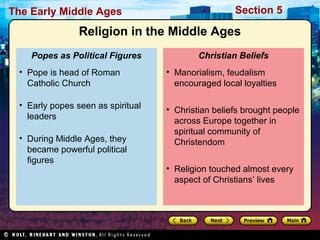
Religion in the Middle Ages
Popes as Political Figures

Christian Beliefs

• Pope is head of Roman
Catholic Church

• Manorialism, feudalism
encouraged local loyalties

• Early popes seen as spiritual
leaders

• Christian beliefs brought people
across Europe together in
spiritual community of
Christendom

• During Middle Ages, they
became powerful political
figures

• Religion touched almost every
aspect of Christians’ lives
The Early Middle Ages

Section 5

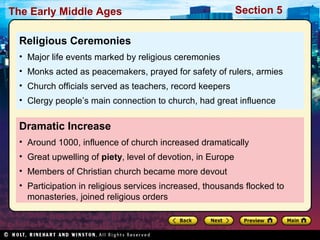
Religious Ceremonies
• Major life events marked by religious ceremonies
• Monks acted as peacemakers, prayed for safety of rulers, armies
• Church officials served as teachers, record keepers
• Clergy people’s main connection to church, had great influence

Dramatic Increase
• Around 1000, influence of church increased dramatically
• Great upwelling of piety, level of devotion, in Europe
• Members of Christian church became more devout
• Participation in religious services increased, thousands flocked to
monasteries, joined religious orders
The Early Middle Ages

Section 5

Identify Cause and Effect
Why was the medieval clergy so influential?
Answer(s): Christian church had strong influence
over daily lives of most Europeans; clergy were
the people's link to the church
Section 5

The Early Middle Ages

Growth of Papal Power
2. Not only were Europe’s common people inspired by a new sense of
piety, many clergy members sought ways to improve conditions.

Papacy
• 900s, 1000s, pope had little
authority
• Considered head of church,
but local bishops made most
important religious decisions
• Papacy not held in high regard
• Few popes noted for religious
devotion; most were nobles
concerned with increasing own
power

Church Reforms
• 1049, first of series of clever,
capable popes dedicated to
reforming papacy came to
power, Leo IX
• Believed that Europe’s clergy
had become corrupt, wanted
to reform it
• Concerned with simony,
buying and selling of church
offices by bishops
The Early Middle Ages

Section 5

Power and Conflict
Excommunication
• Bishops guilty of bad offenses excommunicated, cast out of church
• No greater punishment for Christians in Middle Ages
• Person excommunicated could not take part in Eucharist, could not be saved

Reforms
• Leo became more active in governing church than other popes in past
• Reforms brought him into conflict with political, religious leaders
• Many bishops believed pope had no authority to tell them how to act

Conflict
• One who rejected Leo’s authority, bishop of Constantinople
• 1054, Leo excommunicated bishop, split Christian Church in two
• Those who agreed Leo called Roman Catholics; those who sided with
bishop, Orthodox
The Early Middle Ages

Section 5

Popes and Politics
Popes gained influence over people’s religious
lives, also over European politics
• Pope became head of huge network of ecclesiastical
courts, heard cases on religious, moral matters
• Pope also ruled territories, like Papal States
– Had ability to raise armies to defend territories
– Several popes hired Normans to fight wars
– Crusades against Muslims launched by popes
Section 5

The Early Middle Ages

Conflict over Bishops
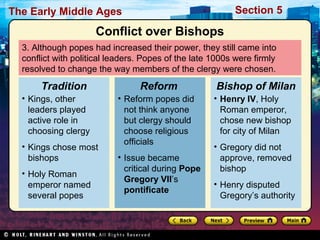
3. Although popes had increased their power, they still came into
conflict with political leaders. Popes of the late 1000s were firmly
resolved to change the way members of the clergy were chosen.

Tradition
• Kings, other
leaders played
active role in
choosing clergy
• Kings chose most
bishops
• Holy Roman
emperor named
several popes

Reform
• Reform popes did
not think anyone
but clergy should
choose religious
officials
• Issue became
critical during Pope
Gregory VII’s
pontificate

Bishop of Milan
• Henry IV, Holy
Roman emperor,
chose new bishop
for city of Milan
• Gregory did not
approve, removed
bishop
• Henry disputed
Gregory’s authority
Section 5

The Early Middle Ages

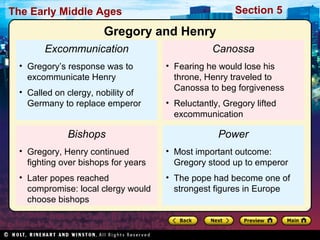
Gregory and Henry
Excommunication
• Gregory’s response was to
excommunicate Henry
• Called on clergy, nobility of
Germany to replace emperor

Bishops

Canossa
• Fearing he would lose his
throne, Henry traveled to
Canossa to beg forgiveness
• Reluctantly, Gregory lifted
excommunication

Power

• Gregory, Henry continued
fighting over bishops for years

• Most important outcome:
Gregory stood up to emperor

• Later popes reached
compromise: local clergy would
choose bishops

• The pope had become one of
strongest figures in Europe
Section 5

The Early Middle Ages

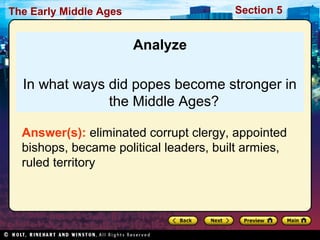
Analyze
In what ways did popes become stronger in
the Middle Ages?
Answer(s): eliminated corrupt clergy, appointed
bishops, became political leaders, built armies,
ruled territory
The Early Middle Ages

Section 5

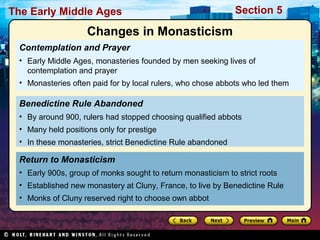
Changes in Monasticism
Contemplation and Prayer
• Early Middle Ages, monasteries founded by men seeking lives of
contemplation and prayer
• Monasteries often paid for by local rulers, who chose abbots who led them

Benedictine Rule Abandoned
• By around 900, rulers had stopped choosing qualified abbots
• Many held positions only for prestige
• In these monasteries, strict Benedictine Rule abandoned

Return to Monasticism
• Early 900s, group of monks sought to return monasticism to strict roots
• Established new monastery at Cluny, France, to live by Benedictine Rule
• Monks of Cluny reserved right to choose own abbot
Section 5

The Early Middle Ages

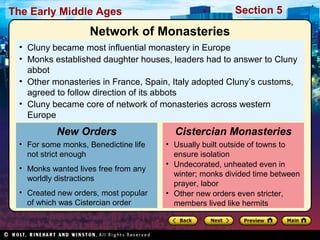
Network of Monasteries
• Cluny became most influential monastery in Europe
• Monks established daughter houses, leaders had to answer to Cluny
abbot
• Other monasteries in France, Spain, Italy adopted Cluny’s customs,
agreed to follow direction of its abbots
• Cluny became core of network of monasteries across western
Europe

New Orders
• For some monks, Benedictine life
not strict enough
• Monks wanted lives free from any
worldly distractions
• Created new orders, most popular
of which was Cistercian order

Cistercian Monasteries
• Usually built outside of towns to
ensure isolation
• Undecorated, unheated even in
winter; monks divided time between
prayer, labor
• Other new orders even stricter,
members lived like hermits
The Early Middle Ages

Section 5

Find the Main Idea
What changes were introduced to
monasticism?
Answer(s): stricter rules, monks stayed out of
politics, simplified lives
The Early Middle Ages

Section 5
Section 5

The Early Middle Ages

Video
The Impact of the Feudal System in Europe

Click above to play the video.

World History Ch. 13 Section 5 Notes

  • 1.
    The Early MiddleAges Power of the Church Preview • Main Idea / Reading Focus • Religion in the Middle Ages • Growth of Papal Power • Changes in Monasticism • Visual Study Guide / Quick Facts • Video: The Impact of the Feudal System in Europe Section 5
  • 2.
    The Early MiddleAges Section 5 Power of the Church Main Idea 1. Reform and changes swept through the Christian Church, one of the most influential institutions in medieval Europe. Reading Focus • What was the nature and influence of religion in the Middle Ages? • What led to the growth of papal power in Europe? • What changes in monasticism were introduced in the Middle Ages?
  • 3.
    The Early MiddleAges Section 5 Religion in the Middle Ages Popes as Political Figures Christian Beliefs • Pope is head of Roman Catholic Church • Manorialism, feudalism encouraged local loyalties • Early popes seen as spiritual leaders • Christian beliefs brought people across Europe together in spiritual community of Christendom • During Middle Ages, they became powerful political figures • Religion touched almost every aspect of Christians’ lives
  • 4.
    The Early MiddleAges Section 5 Religious Ceremonies • Major life events marked by religious ceremonies • Monks acted as peacemakers, prayed for safety of rulers, armies • Church officials served as teachers, record keepers • Clergy people’s main connection to church, had great influence Dramatic Increase • Around 1000, influence of church increased dramatically • Great upwelling of piety, level of devotion, in Europe • Members of Christian church became more devout • Participation in religious services increased, thousands flocked to monasteries, joined religious orders
  • 5.
    The Early MiddleAges Section 5 Identify Cause and Effect Why was the medieval clergy so influential? Answer(s): Christian church had strong influence over daily lives of most Europeans; clergy were the people's link to the church
  • 6.
    Section 5 The EarlyMiddle Ages Growth of Papal Power 2. Not only were Europe’s common people inspired by a new sense of piety, many clergy members sought ways to improve conditions. Papacy • 900s, 1000s, pope had little authority • Considered head of church, but local bishops made most important religious decisions • Papacy not held in high regard • Few popes noted for religious devotion; most were nobles concerned with increasing own power Church Reforms • 1049, first of series of clever, capable popes dedicated to reforming papacy came to power, Leo IX • Believed that Europe’s clergy had become corrupt, wanted to reform it • Concerned with simony, buying and selling of church offices by bishops
  • 7.
    The Early MiddleAges Section 5 Power and Conflict Excommunication • Bishops guilty of bad offenses excommunicated, cast out of church • No greater punishment for Christians in Middle Ages • Person excommunicated could not take part in Eucharist, could not be saved Reforms • Leo became more active in governing church than other popes in past • Reforms brought him into conflict with political, religious leaders • Many bishops believed pope had no authority to tell them how to act Conflict • One who rejected Leo’s authority, bishop of Constantinople • 1054, Leo excommunicated bishop, split Christian Church in two • Those who agreed Leo called Roman Catholics; those who sided with bishop, Orthodox
  • 8.
    The Early MiddleAges Section 5 Popes and Politics Popes gained influence over people’s religious lives, also over European politics • Pope became head of huge network of ecclesiastical courts, heard cases on religious, moral matters • Pope also ruled territories, like Papal States – Had ability to raise armies to defend territories – Several popes hired Normans to fight wars – Crusades against Muslims launched by popes
  • 9.
    Section 5 The EarlyMiddle Ages Conflict over Bishops 3. Although popes had increased their power, they still came into conflict with political leaders. Popes of the late 1000s were firmly resolved to change the way members of the clergy were chosen. Tradition • Kings, other leaders played active role in choosing clergy • Kings chose most bishops • Holy Roman emperor named several popes Reform • Reform popes did not think anyone but clergy should choose religious officials • Issue became critical during Pope Gregory VII’s pontificate Bishop of Milan • Henry IV, Holy Roman emperor, chose new bishop for city of Milan • Gregory did not approve, removed bishop • Henry disputed Gregory’s authority
  • 10.
    Section 5 The EarlyMiddle Ages Gregory and Henry Excommunication • Gregory’s response was to excommunicate Henry • Called on clergy, nobility of Germany to replace emperor Bishops Canossa • Fearing he would lose his throne, Henry traveled to Canossa to beg forgiveness • Reluctantly, Gregory lifted excommunication Power • Gregory, Henry continued fighting over bishops for years • Most important outcome: Gregory stood up to emperor • Later popes reached compromise: local clergy would choose bishops • The pope had become one of strongest figures in Europe
  • 11.
    Section 5 The EarlyMiddle Ages Analyze In what ways did popes become stronger in the Middle Ages? Answer(s): eliminated corrupt clergy, appointed bishops, became political leaders, built armies, ruled territory
  • 12.
    The Early MiddleAges Section 5 Changes in Monasticism Contemplation and Prayer • Early Middle Ages, monasteries founded by men seeking lives of contemplation and prayer • Monasteries often paid for by local rulers, who chose abbots who led them Benedictine Rule Abandoned • By around 900, rulers had stopped choosing qualified abbots • Many held positions only for prestige • In these monasteries, strict Benedictine Rule abandoned Return to Monasticism • Early 900s, group of monks sought to return monasticism to strict roots • Established new monastery at Cluny, France, to live by Benedictine Rule • Monks of Cluny reserved right to choose own abbot
  • 13.
    Section 5 The EarlyMiddle Ages Network of Monasteries • Cluny became most influential monastery in Europe • Monks established daughter houses, leaders had to answer to Cluny abbot • Other monasteries in France, Spain, Italy adopted Cluny’s customs, agreed to follow direction of its abbots • Cluny became core of network of monasteries across western Europe New Orders • For some monks, Benedictine life not strict enough • Monks wanted lives free from any worldly distractions • Created new orders, most popular of which was Cistercian order Cistercian Monasteries • Usually built outside of towns to ensure isolation • Undecorated, unheated even in winter; monks divided time between prayer, labor • Other new orders even stricter, members lived like hermits
  • 14.
    The Early MiddleAges Section 5 Find the Main Idea What changes were introduced to monasticism? Answer(s): stricter rules, monks stayed out of politics, simplified lives
  • 15.
    The Early MiddleAges Section 5
  • 16.
    Section 5 The EarlyMiddle Ages Video The Impact of the Feudal System in Europe Click above to play the video.