Renaissance and Reformation

Section 3

The Protestant Reformation
Preview
•

Main Idea / Reading Focus

•

Catholicism in the 1400s

•

Martin Luther

•

The Spread of Protestantism

•

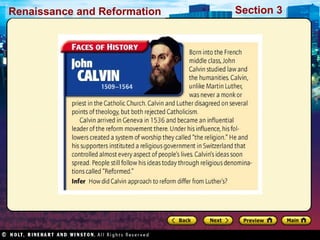
Faces of History: John Calvin

•

Protestantism Spreads to England

•

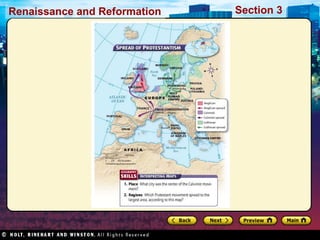
Map: Spread of Protestantism
Renaissance and Reformation

Section 3

The Protestant Reformation
Main Idea
1. Criticism of the Roman Catholic Church led to a religious
movement called the Protestant Reformation and brought
changes in religion and politics across Europe.

Reading Focus
• What was the state of Catholicism in the 1400s?
• How did Martin Luther challenge the Catholic Church?
• How did Protestantism spread to other areas?
• What were the effects of the Reformation in England?
Section 3

Renaissance and Reformation

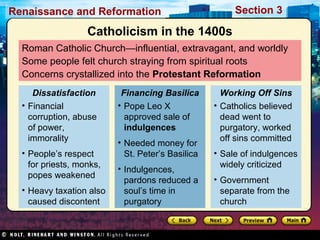
Catholicism in the 1400s
Roman Catholic Church—influential, extravagant, and worldly
Some people felt church straying from spiritual roots
Concerns crystallized into the Protestant Reformation
Dissatisfaction
• Financial
corruption, abuse
of power,
immorality
• People’s respect
for priests, monks,
popes weakened
• Heavy taxation also
caused discontent

Financing Basilica
• Pope Leo X
approved sale of
indulgences
• Needed money for
St. Peter’s Basilica
• Indulgences,
pardons reduced a
soul’s time in
purgatory

Working Off Sins
• Catholics believed
dead went to
purgatory, worked
off sins committed
• Sale of indulgences
widely criticized
• Government
separate from the
church
Section 3

Renaissance and Reformation

Early Reformers
John Wycliffe
• Two men stepped forward to
challenge the church
• Englishman John Wycliffe
believed church should give up
earthly possessions
• His views unpopular with
church officials
• Was removed from teaching
position

Jan Hus
• From Bohemia, Jan Hus
preached against immorality
and worldliness of Catholic
Church
• Excommunicated by Pope
Gregory XII; later arrested, tried
for heresy and burned at stake
• These influential theologians
openly criticized church
• Beginnings of discussions that
eventually led to reform
Renaissance and Reformation

Section 3

Summarize
What conditions led to the Protestant
Reformation?
Answer(s): Church's financial corruption;
immorality; abuse of power
Section 3

Renaissance and Reformation

Martin Luther
2. Martin Luther’s public criticism of the church in 1517 marks the
symbolical beginning of the Protestant Reformation.

The Ninety-Five Theses
• Martin Luther believed selling
indulgences sinful
• In theses, said indulgences
had no power to remit sin
• Criticized power of pope,
wealth of church
• Theses written in Latin,
intended for church leaders,
not common people

Stimulated Discussion
• Nailing theses to church door
common practice; doors used
like community bulletin boards
• Theses stimulated discussion
among university intellectuals
• Published, distributed across
Europe, widely read by
intellectuals, clergy, laypeople
• Desire for reform grew
Renaissance and Reformation

Section 3

Luther’s Message
• Following publication of theses, Luther continued to study, debate
• Contradicted basic Catholic beliefs, insisted God’s grace cannot be
won by good works; faith alone needed
• 1519, declared only head of Christian Church was Jesus, not pope

Empowered the People
• Insisted that individual Christians should be own interpreters of
scripture, Christian practices should come only from Bible
• To aid this process, Luther translated Bible into German
• Translation allowed more people to read Bible without aid of clergy
Section 3

Renaissance and Reformation

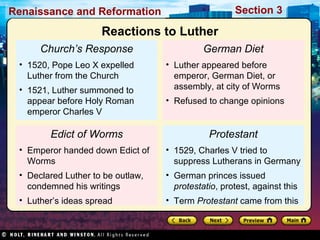
Reactions to Luther
Church’s Response
• 1520, Pope Leo X expelled
Luther from the Church
• 1521, Luther summoned to
appear before Holy Roman
emperor Charles V

German Diet
• Luther appeared before
emperor, German Diet, or
assembly, at city of Worms
• Refused to change opinions

Edict of Worms

Protestant

• Emperor handed down Edict of
Worms

• 1529, Charles V tried to
suppress Lutherans in Germany

• Declared Luther to be outlaw,
condemned his writings

• German princes issued
protestatio, protest, against this

• Luther’s ideas spread

• Term Protestant came from this
Renaissance and Reformation

Section 3

Identify Supporting Details
Describe the ideas of Martin Luther and how
they contradicted the church’s teachings of
his day.
Answer(s): God's grace cannot be won by good
works but by faith; leader of church is Jesus, not
pope; people can interpret scripture; practices
come from Bible; challenged Catholic practices
and the authority of the pope
Renaissance and Reformation

Section 3

The Spread of Protestantism
•
•
•

Luther’s stand against the church opened the door for others
Differing ideas on religious matters put forth.
As Lutheranism arose in Germany, new religious movements
began in Switzerland and other places in Europe.
Ulrich Zwingli

• Born in Switzerland, entered
priesthood at 22, preached ideas
similar to Martin Luther’s
• Many ideas viewed as radical
• His church based on theocracy,
government in which church, state
joined; officials divinely inspired

Opposed by Luther
• Many supported Zwingli, others did
not, including Luther
• Luther accused Zwingli of
tampering with word of God
• Without Lutherans’ support, Swiss
Protestants vulnerable to attack by
Catholics

When the disagreement between Swiss Protestants and Catholics
erupted into war, Zwingli was a casualty. He died in battle in 1531.
Renaissance and Reformation

Section 3

John Calvin
Background
• John Calvin most important Protestant reformer next to Martin Luther
• Educated in France, influenced by Erasmus, Renaissance humanists
• Supported reforms of Luther in Germany

Influenced by Augustine
• Preached doctrine of predestination
• God knows who will be saved, guides lives of those destined for salvation
• Nothing humans can do, good or bad, will change predestined end

People Sinful by Nature
• Geneva became theocracy under Calvin; strict laws regulated behavior
• Strictness at heart of Calvinism’s appeal, gave sense of mission, discipline
• Calvinists making world fit for “elect” who had been chosen for salvation
Renaissance and Reformation

Section 3
Renaissance and Reformation

Section 3

Other Reformers
John Knox
• Spokesman for the Reformation in Scotland
– Knox’s Reformed Church replaced Roman Catholic Church
– Laid groundwork for later Presbyterian denomination

Anabaptists
• Different beliefs about baptism; insisted on rebaptizing
adults
– Crime punishable by death at that time
– Anabaptist Church evolved into Hutterites, the Mennonites, and
the Amish Mennonites
Renaissance and Reformation

Section 3

Make Generalizations
How did the ideas of reformers who came
after Luther differ from those of Luther?
Answer(s): some were more radical; included
ideas of theocracy, predestination
Renaissance and Reformation

Section 3

Protestantism Spreads to England
• 3. Protestant Reformation began with criticisms of the Catholic
Church by priests and other religious thinkers.
• Reformation began with the king in England

A King’s Protest

Annulment

Opposition

• 1509, Henry VIII
became king, age 17
• Devout Catholic
• Wrote angry protests
against Luther’s ideas
• Actions won him title
“Defender of the
Faith”
• By 1525, Henry had
only one child, Mary

• Henry wanted male
heir, thought female
monarch would
weaken England
• Decided to have
marriage to Catherine
annulled
• Pope would not agree
to annulment

• Catherine, nephew
Holy Roman Emperor
Charles V, also
opposed annulment
• Dilemma became “the
king’s great matter”
• Arguing with Pope,
Henry fell in love with
Anne Boleyn
Renaissance and Reformation

Section 3

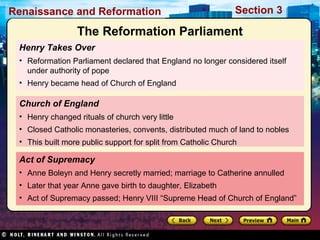
The Reformation Parliament
Henry Takes Over
• Reformation Parliament declared that England no longer considered itself
under authority of pope
• Henry became head of Church of England

Church of England
• Henry changed rituals of church very little
• Closed Catholic monasteries, convents, distributed much of land to nobles
• This built more public support for split from Catholic Church

Act of Supremacy
• Anne Boleyn and Henry secretly married; marriage to Catherine annulled
• Later that year Anne gave birth to daughter, Elizabeth
• Act of Supremacy passed; Henry VIII “Supreme Head of Church of England”
Section 3

Renaissance and Reformation

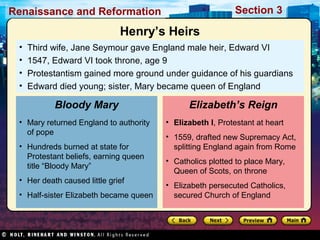
Henry’s Heirs
•
•
•
•

Third wife, Jane Seymour gave England male heir, Edward VI
1547, Edward VI took throne, age 9
Protestantism gained more ground under guidance of his guardians
Edward died young; sister, Mary became queen of England

Bloody Mary
• Mary returned England to authority
of pope
• Hundreds burned at state for
Protestant beliefs, earning queen
title “Bloody Mary”
• Her death caused little grief
• Half-sister Elizabeth became queen

Elizabeth’s Reign
• Elizabeth I, Protestant at heart
• 1559, drafted new Supremacy Act,
splitting England again from Rome
• Catholics plotted to place Mary,
Queen of Scots, on throne
• Elizabeth persecuted Catholics,
secured Church of England
Renaissance and Reformation

Section 3
Renaissance and Reformation

Section 3

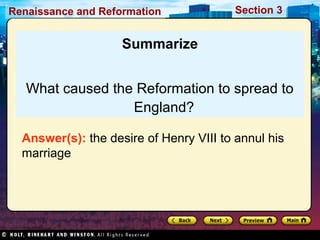
Summarize
What caused the Reformation to spread to
England?
Answer(s): the desire of Henry VIII to annul his
marriage

World History Ch. 15 Section 3 Notes

  • 1.
    Renaissance and Reformation Section3 The Protestant Reformation Preview • Main Idea / Reading Focus • Catholicism in the 1400s • Martin Luther • The Spread of Protestantism • Faces of History: John Calvin • Protestantism Spreads to England • Map: Spread of Protestantism
  • 2.
    Renaissance and Reformation Section3 The Protestant Reformation Main Idea 1. Criticism of the Roman Catholic Church led to a religious movement called the Protestant Reformation and brought changes in religion and politics across Europe. Reading Focus • What was the state of Catholicism in the 1400s? • How did Martin Luther challenge the Catholic Church? • How did Protestantism spread to other areas? • What were the effects of the Reformation in England?
  • 3.
    Section 3 Renaissance andReformation Catholicism in the 1400s Roman Catholic Church—influential, extravagant, and worldly Some people felt church straying from spiritual roots Concerns crystallized into the Protestant Reformation Dissatisfaction • Financial corruption, abuse of power, immorality • People’s respect for priests, monks, popes weakened • Heavy taxation also caused discontent Financing Basilica • Pope Leo X approved sale of indulgences • Needed money for St. Peter’s Basilica • Indulgences, pardons reduced a soul’s time in purgatory Working Off Sins • Catholics believed dead went to purgatory, worked off sins committed • Sale of indulgences widely criticized • Government separate from the church
  • 4.
    Section 3 Renaissance andReformation Early Reformers John Wycliffe • Two men stepped forward to challenge the church • Englishman John Wycliffe believed church should give up earthly possessions • His views unpopular with church officials • Was removed from teaching position Jan Hus • From Bohemia, Jan Hus preached against immorality and worldliness of Catholic Church • Excommunicated by Pope Gregory XII; later arrested, tried for heresy and burned at stake • These influential theologians openly criticized church • Beginnings of discussions that eventually led to reform
  • 5.
    Renaissance and Reformation Section3 Summarize What conditions led to the Protestant Reformation? Answer(s): Church's financial corruption; immorality; abuse of power
  • 6.
    Section 3 Renaissance andReformation Martin Luther 2. Martin Luther’s public criticism of the church in 1517 marks the symbolical beginning of the Protestant Reformation. The Ninety-Five Theses • Martin Luther believed selling indulgences sinful • In theses, said indulgences had no power to remit sin • Criticized power of pope, wealth of church • Theses written in Latin, intended for church leaders, not common people Stimulated Discussion • Nailing theses to church door common practice; doors used like community bulletin boards • Theses stimulated discussion among university intellectuals • Published, distributed across Europe, widely read by intellectuals, clergy, laypeople • Desire for reform grew
  • 7.
    Renaissance and Reformation Section3 Luther’s Message • Following publication of theses, Luther continued to study, debate • Contradicted basic Catholic beliefs, insisted God’s grace cannot be won by good works; faith alone needed • 1519, declared only head of Christian Church was Jesus, not pope Empowered the People • Insisted that individual Christians should be own interpreters of scripture, Christian practices should come only from Bible • To aid this process, Luther translated Bible into German • Translation allowed more people to read Bible without aid of clergy
  • 8.
    Section 3 Renaissance andReformation Reactions to Luther Church’s Response • 1520, Pope Leo X expelled Luther from the Church • 1521, Luther summoned to appear before Holy Roman emperor Charles V German Diet • Luther appeared before emperor, German Diet, or assembly, at city of Worms • Refused to change opinions Edict of Worms Protestant • Emperor handed down Edict of Worms • 1529, Charles V tried to suppress Lutherans in Germany • Declared Luther to be outlaw, condemned his writings • German princes issued protestatio, protest, against this • Luther’s ideas spread • Term Protestant came from this
  • 9.
    Renaissance and Reformation Section3 Identify Supporting Details Describe the ideas of Martin Luther and how they contradicted the church’s teachings of his day. Answer(s): God's grace cannot be won by good works but by faith; leader of church is Jesus, not pope; people can interpret scripture; practices come from Bible; challenged Catholic practices and the authority of the pope
  • 10.
    Renaissance and Reformation Section3 The Spread of Protestantism • • • Luther’s stand against the church opened the door for others Differing ideas on religious matters put forth. As Lutheranism arose in Germany, new religious movements began in Switzerland and other places in Europe. Ulrich Zwingli • Born in Switzerland, entered priesthood at 22, preached ideas similar to Martin Luther’s • Many ideas viewed as radical • His church based on theocracy, government in which church, state joined; officials divinely inspired Opposed by Luther • Many supported Zwingli, others did not, including Luther • Luther accused Zwingli of tampering with word of God • Without Lutherans’ support, Swiss Protestants vulnerable to attack by Catholics When the disagreement between Swiss Protestants and Catholics erupted into war, Zwingli was a casualty. He died in battle in 1531.
  • 11.
    Renaissance and Reformation Section3 John Calvin Background • John Calvin most important Protestant reformer next to Martin Luther • Educated in France, influenced by Erasmus, Renaissance humanists • Supported reforms of Luther in Germany Influenced by Augustine • Preached doctrine of predestination • God knows who will be saved, guides lives of those destined for salvation • Nothing humans can do, good or bad, will change predestined end People Sinful by Nature • Geneva became theocracy under Calvin; strict laws regulated behavior • Strictness at heart of Calvinism’s appeal, gave sense of mission, discipline • Calvinists making world fit for “elect” who had been chosen for salvation
  • 12.
  • 13.
    Renaissance and Reformation Section3 Other Reformers John Knox • Spokesman for the Reformation in Scotland – Knox’s Reformed Church replaced Roman Catholic Church – Laid groundwork for later Presbyterian denomination Anabaptists • Different beliefs about baptism; insisted on rebaptizing adults – Crime punishable by death at that time – Anabaptist Church evolved into Hutterites, the Mennonites, and the Amish Mennonites
  • 14.
    Renaissance and Reformation Section3 Make Generalizations How did the ideas of reformers who came after Luther differ from those of Luther? Answer(s): some were more radical; included ideas of theocracy, predestination
  • 15.
    Renaissance and Reformation Section3 Protestantism Spreads to England • 3. Protestant Reformation began with criticisms of the Catholic Church by priests and other religious thinkers. • Reformation began with the king in England A King’s Protest Annulment Opposition • 1509, Henry VIII became king, age 17 • Devout Catholic • Wrote angry protests against Luther’s ideas • Actions won him title “Defender of the Faith” • By 1525, Henry had only one child, Mary • Henry wanted male heir, thought female monarch would weaken England • Decided to have marriage to Catherine annulled • Pope would not agree to annulment • Catherine, nephew Holy Roman Emperor Charles V, also opposed annulment • Dilemma became “the king’s great matter” • Arguing with Pope, Henry fell in love with Anne Boleyn
  • 16.
    Renaissance and Reformation Section3 The Reformation Parliament Henry Takes Over • Reformation Parliament declared that England no longer considered itself under authority of pope • Henry became head of Church of England Church of England • Henry changed rituals of church very little • Closed Catholic monasteries, convents, distributed much of land to nobles • This built more public support for split from Catholic Church Act of Supremacy • Anne Boleyn and Henry secretly married; marriage to Catherine annulled • Later that year Anne gave birth to daughter, Elizabeth • Act of Supremacy passed; Henry VIII “Supreme Head of Church of England”
  • 17.
    Section 3 Renaissance andReformation Henry’s Heirs • • • • Third wife, Jane Seymour gave England male heir, Edward VI 1547, Edward VI took throne, age 9 Protestantism gained more ground under guidance of his guardians Edward died young; sister, Mary became queen of England Bloody Mary • Mary returned England to authority of pope • Hundreds burned at state for Protestant beliefs, earning queen title “Bloody Mary” • Her death caused little grief • Half-sister Elizabeth became queen Elizabeth’s Reign • Elizabeth I, Protestant at heart • 1559, drafted new Supremacy Act, splitting England again from Rome • Catholics plotted to place Mary, Queen of Scots, on throne • Elizabeth persecuted Catholics, secured Church of England
  • 18.
  • 19.
    Renaissance and Reformation Section3 Summarize What caused the Reformation to spread to England? Answer(s): the desire of Henry VIII to annul his marriage