Chapter 25 Section 1
The Cold War Begins
Section 1
The Counterculture
• Describe the rise of the counterculture.
• List the major characteristics of the counterculture.
• Evaluate the impact of the counterculture on
American values and society.
Objectives
Chapter 25 Section 1
The Cold War BeginsThe Counterculture
Section 1
Terms and People
• counterculture − a movement in which people
adopted values that ran counter to the mainstream
culture
• generation gap − a lack of understanding and
communication between the older and younger
generations
• Beatles − a hugely popular British rock band that
spearheaded the cultural revolution of the 1960s
Chapter 25 Section 1
The Cold War BeginsThe Counterculture
Section 1
• commune − a small community whose residents
have common interests and share resources
• Haight-Ashbury − a center of the counterculture
in San Francisco, California
• Timothy Leary − a political radical who preached
that drugs could free the mind
Terms and People (continued)
Chapter 25 Section 1
The Cold War BeginsThe Counterculture
Section 1
What was the counterculture, and
what impact did it have on American
society?
1. In the 1960s, youths rebelled against long-
standing customs in dress, music, and personal
behavior.
The counterculture both challenged traditional
values and unleashed a movement to reassert
basic values.
Chapter 25 Section 1
The Cold War BeginsThe Counterculture
Section 1
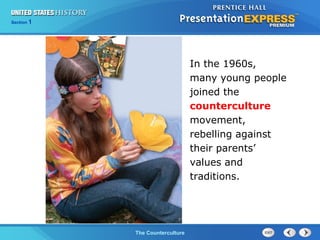
In the 1960s,
many young people
joined the
counterculture
movement,
rebelling against
their parents’
values and
traditions.
Chapter 25 Section 1
The Cold War BeginsThe Counterculture
Section 1
the Beat
movement of
the 1950s,
which rejected
materialism
the civil rights
movement,
prompted people
to question
traditional
boundaries
the Vietnam
antiwar movement,
which introduced
the idea of social
and political protest
The counterculture arose from
several influences.
Chapter 25 Section 1
The Cold War BeginsThe Counterculture
Section 1
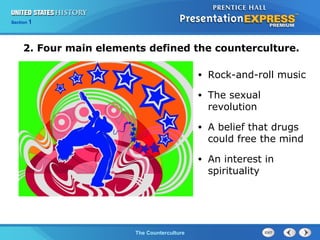
2. Four main elements defined the counterculture.
• Rock-and-roll music
• The sexual
revolution
• A belief that drugs
could free the mind
• An interest in
spirituality
Chapter 25 Section 1
The Cold War BeginsThe Counterculture
Section 1
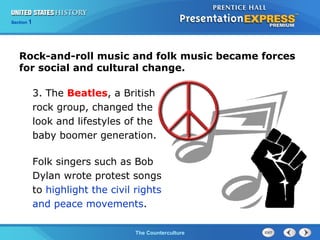
Rock-and-roll music and folk music became forces
for social and cultural change.
3. The Beatles, a British
rock group, changed the
look and lifestyles of the
baby boomer generation.
Folk singers such as Bob
Dylan wrote protest songs
to highlight the civil rights
and peace movements.
Chapter 25 Section 1
The Cold War BeginsThe Counterculture
Section 1
4. The counterculture rejected many traditional
restrictions on behavior.
• The sexual revolution called for the separation of
sex from traditional family life.
• Some people lived together in communes:
small communities of “hippies” who
shared common interests and resources.
• Many hippies believed that drugs could free the
mind.
Chapter 25 Section 1
The Cold War BeginsThe Counterculture
Section 1
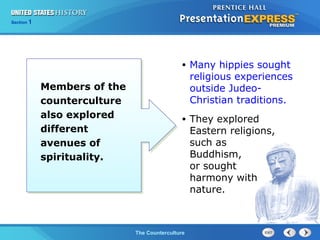
Members of the
counterculture
also explored
different
avenues of
spirituality.
• Many hippies sought
religious experiences
outside Judeo-
Christian traditions.
• They explored
Eastern religions,
such as
Buddhism,
or sought
harmony with
nature.
Chapter 25 Section 1
The Cold War BeginsThe Counterculture
Section 1
5. Differences in values created a generation gap
between young people and their parents.
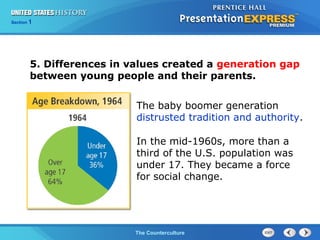
The baby boomer generation
distrusted tradition and authority.
In the mid-1960s, more than a
third of the U.S. population was
under 17. They became a force
for social change.
Chapter 25 Section 1
The Cold War BeginsThe Counterculture
Section 1
The counterculture had some positive effects
on American society.
• Many young people rejected materialism.
• Groups such as women and the physically
challenged sought equality.
• Colleges and universities began to offer
multicultural programs of study.
Chapter 25 Section 1
The Cold War BeginsThe Counterculture
Section 1
The negative aspects of the countercultural
movement brought about its end.
• Drug addiction and overdose deaths rose.
• Violence at a Rolling Stones concert
contradicted the hippies’ message of peace
and love.
• Many people believed the counterculture
had become shallow and self-centered.
Chapter 25 Section 1
The Cold War BeginsThe Counterculture
Section 1
Section Review
Know It, Show It QuizQuickTake Quiz

US History Ch. 21 Section 1 Notes

  • 1.
    Chapter 25 Section1 The Cold War Begins Section 1 The Counterculture • Describe the rise of the counterculture. • List the major characteristics of the counterculture. • Evaluate the impact of the counterculture on American values and society. Objectives
  • 2.
    Chapter 25 Section1 The Cold War BeginsThe Counterculture Section 1 Terms and People • counterculture − a movement in which people adopted values that ran counter to the mainstream culture • generation gap − a lack of understanding and communication between the older and younger generations • Beatles − a hugely popular British rock band that spearheaded the cultural revolution of the 1960s
  • 3.
    Chapter 25 Section1 The Cold War BeginsThe Counterculture Section 1 • commune − a small community whose residents have common interests and share resources • Haight-Ashbury − a center of the counterculture in San Francisco, California • Timothy Leary − a political radical who preached that drugs could free the mind Terms and People (continued)
  • 4.
    Chapter 25 Section1 The Cold War BeginsThe Counterculture Section 1 What was the counterculture, and what impact did it have on American society? 1. In the 1960s, youths rebelled against long- standing customs in dress, music, and personal behavior. The counterculture both challenged traditional values and unleashed a movement to reassert basic values.
  • 5.
    Chapter 25 Section1 The Cold War BeginsThe Counterculture Section 1 In the 1960s, many young people joined the counterculture movement, rebelling against their parents’ values and traditions.
  • 6.
    Chapter 25 Section1 The Cold War BeginsThe Counterculture Section 1 the Beat movement of the 1950s, which rejected materialism the civil rights movement, prompted people to question traditional boundaries the Vietnam antiwar movement, which introduced the idea of social and political protest The counterculture arose from several influences.
  • 7.
    Chapter 25 Section1 The Cold War BeginsThe Counterculture Section 1 2. Four main elements defined the counterculture. • Rock-and-roll music • The sexual revolution • A belief that drugs could free the mind • An interest in spirituality
  • 8.
    Chapter 25 Section1 The Cold War BeginsThe Counterculture Section 1 Rock-and-roll music and folk music became forces for social and cultural change. 3. The Beatles, a British rock group, changed the look and lifestyles of the baby boomer generation. Folk singers such as Bob Dylan wrote protest songs to highlight the civil rights and peace movements.
  • 9.
    Chapter 25 Section1 The Cold War BeginsThe Counterculture Section 1 4. The counterculture rejected many traditional restrictions on behavior. • The sexual revolution called for the separation of sex from traditional family life. • Some people lived together in communes: small communities of “hippies” who shared common interests and resources. • Many hippies believed that drugs could free the mind.
  • 10.
    Chapter 25 Section1 The Cold War BeginsThe Counterculture Section 1 Members of the counterculture also explored different avenues of spirituality. • Many hippies sought religious experiences outside Judeo- Christian traditions. • They explored Eastern religions, such as Buddhism, or sought harmony with nature.
  • 11.
    Chapter 25 Section1 The Cold War BeginsThe Counterculture Section 1 5. Differences in values created a generation gap between young people and their parents. The baby boomer generation distrusted tradition and authority. In the mid-1960s, more than a third of the U.S. population was under 17. They became a force for social change.
  • 12.
    Chapter 25 Section1 The Cold War BeginsThe Counterculture Section 1 The counterculture had some positive effects on American society. • Many young people rejected materialism. • Groups such as women and the physically challenged sought equality. • Colleges and universities began to offer multicultural programs of study.
  • 13.
    Chapter 25 Section1 The Cold War BeginsThe Counterculture Section 1 The negative aspects of the countercultural movement brought about its end. • Drug addiction and overdose deaths rose. • Violence at a Rolling Stones concert contradicted the hippies’ message of peace and love. • Many people believed the counterculture had become shallow and self-centered.
  • 14.
    Chapter 25 Section1 The Cold War BeginsThe Counterculture Section 1 Section Review Know It, Show It QuizQuickTake Quiz