Chapter 25 Section 1
The Cold War BeginsThe Women’s Rights Movement
Section 2
• Analyze how a movement for women’s rights
arose in the 1960s.
• Explain the goals and tactics of the women’s
movement.
• Assess the impact of the women’s movement
on American society.
Objectives
Chapter 25 Section 1
The Cold War Begins
Section 2
The Women’s Rights Movement
Terms and People
• feminism − the theory of the political, social, and
economic equality of men and women
• Betty Friedan − author of the groundbreaking
book The Feminine Mystique
• NOW − the National Organization for Women,
which worked for “true equality for all women”
• ERA − the Equal Rights Amendment, a proposed
Constitutional amendment to guarantee gender
equality under the law
Chapter 25 Section 1
The Cold War Begins
Section 2
The Women’s Rights Movement
• Gloria Steinem − a feminist leader and writer
who sought to raise the public’s awareness of
gender issues
• Phyllis Schlafly − a conservative political activist
who opposed the women’s movement
• Roe v. Wade − the controversial Supreme Court
case that legalized abortion
Terms and People (continued)
Chapter 25 Section 1
The Cold War Begins
Section 2
The Women’s Rights Movement
What led to the rise of the women’s
movement, and what impact did it
have on American society?
1. After World War II, women gave up their jobs
and returned to their homes to raise families. In
the 1960s and 1970s, however, the women’s
movement worked to attain equality for women
and change American life.
Chapter 25 Section 1
The Cold War Begins
Section 2
The Women’s Rights Movement
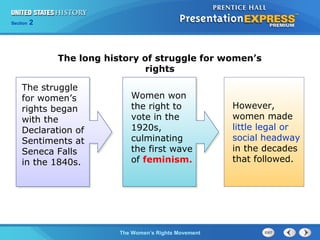
The struggle
for women’s
rights began
with the
Declaration of
Sentiments at
Seneca Falls
in the 1840s.
Women won
the right to
vote in the
1920s,
culminating
the first wave
of feminism.
However,
women made
little legal or
social headway
in the decades
that followed.
The long history of struggle for women’s
rights
Chapter 25 Section 1
The Cold War Begins
Section 2
The Women’s Rights Movement
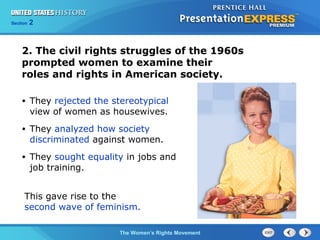
2. The civil rights struggles of the 1960s
prompted women to examine their
roles and rights in American society.
• They rejected the stereotypical
view of women as housewives.
• They analyzed how society
discriminated against women.
• They sought equality in jobs and
job training.
This gave rise to the
second wave of feminism.
Chapter 25 Section 1
The Cold War Begins
Section 2
The Women’s Rights Movement
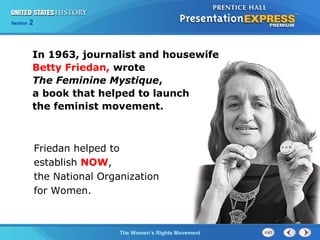
In 1963, journalist and housewife
Betty Friedan, wrote
The Feminine Mystique,
a book that helped to launch
the feminist movement.
Friedan helped to
establish NOW,
the National Organization
for Women.
Chapter 25 Section 1
The Cold War Begins
Section 2
The Women’s Rights Movement
• Passage of the ERA, the
Equal Rights Amendment
• Protecting women’s
reproductive rights
NOW attacked
stereotypes
and identified
two main
priorities.
NOW’s goal was to achieve
“true equality for all women.”
Chapter 25 Section 1
The Cold War Begins
Section 2
The Women’s Rights Movement
The Equal Rights Amendment was a
proposed Constitutional amendment
to guarantee equality between men and women.
Political conservatives such as
Phyllis Schlafly opposed the ERA,
arguing it would hurt families and allow
the military to draft women.
In the end, the ERA
narrowly failed to
become part of the
Constitution.
Chapter 25 Section 1
The Cold War Begins
Section 2
The Women’s Rights Movement
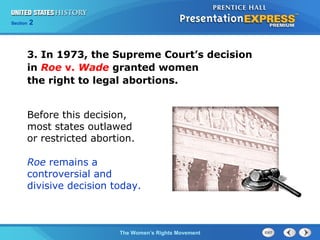
3. In 1973, the Supreme Court’s decision
in Roe v. Wade granted women
the right to legal abortions.
Before this decision,
most states outlawed
or restricted abortion.
Roe remains a
controversial and
divisive decision today.
Chapter 25 Section 1
The Cold War Begins
Section 2
The Women’s Rights Movement
• NOW filed many lawsuits with the Equal
Employment Opportunity Commission to
stop workplace discrimination.
• Title IX of the 1972 Higher Education Act
banned discrimination in education.
• In 1974, the Equal Opportunity Credit act
made it illegal to deny a woman credit
because of her gender.
4. The women’s rights movement made
legal progress in the 1960s and 1970s.
Chapter 25 Section 1
The Cold War Begins
Section 2
The Women’s Rights Movement
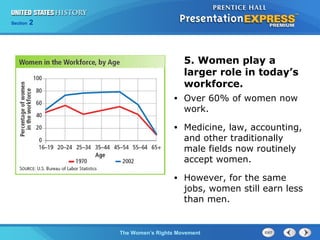
• Over 60% of women now
work.
• Medicine, law, accounting,
and other traditionally
male fields now routinely
accept women.
• However, for the same
jobs, women still earn less
than men.
5. Women play a
larger role in today’s
workforce.
Chapter 25 Section 1
The Cold War BeginsThe Women’s Rights Movement
Section 2
Section Review
Know It, Show It QuizQuickTake Quiz

US History Ch. 21 Section 2 Notes

  • 1.
    Chapter 25 Section1 The Cold War BeginsThe Women’s Rights Movement Section 2 • Analyze how a movement for women’s rights arose in the 1960s. • Explain the goals and tactics of the women’s movement. • Assess the impact of the women’s movement on American society. Objectives
  • 2.
    Chapter 25 Section1 The Cold War Begins Section 2 The Women’s Rights Movement Terms and People • feminism − the theory of the political, social, and economic equality of men and women • Betty Friedan − author of the groundbreaking book The Feminine Mystique • NOW − the National Organization for Women, which worked for “true equality for all women” • ERA − the Equal Rights Amendment, a proposed Constitutional amendment to guarantee gender equality under the law
  • 3.
    Chapter 25 Section1 The Cold War Begins Section 2 The Women’s Rights Movement • Gloria Steinem − a feminist leader and writer who sought to raise the public’s awareness of gender issues • Phyllis Schlafly − a conservative political activist who opposed the women’s movement • Roe v. Wade − the controversial Supreme Court case that legalized abortion Terms and People (continued)
  • 4.
    Chapter 25 Section1 The Cold War Begins Section 2 The Women’s Rights Movement What led to the rise of the women’s movement, and what impact did it have on American society? 1. After World War II, women gave up their jobs and returned to their homes to raise families. In the 1960s and 1970s, however, the women’s movement worked to attain equality for women and change American life.
  • 5.
    Chapter 25 Section1 The Cold War Begins Section 2 The Women’s Rights Movement The struggle for women’s rights began with the Declaration of Sentiments at Seneca Falls in the 1840s. Women won the right to vote in the 1920s, culminating the first wave of feminism. However, women made little legal or social headway in the decades that followed. The long history of struggle for women’s rights
  • 6.
    Chapter 25 Section1 The Cold War Begins Section 2 The Women’s Rights Movement 2. The civil rights struggles of the 1960s prompted women to examine their roles and rights in American society. • They rejected the stereotypical view of women as housewives. • They analyzed how society discriminated against women. • They sought equality in jobs and job training. This gave rise to the second wave of feminism.
  • 7.
    Chapter 25 Section1 The Cold War Begins Section 2 The Women’s Rights Movement In 1963, journalist and housewife Betty Friedan, wrote The Feminine Mystique, a book that helped to launch the feminist movement. Friedan helped to establish NOW, the National Organization for Women.
  • 8.
    Chapter 25 Section1 The Cold War Begins Section 2 The Women’s Rights Movement • Passage of the ERA, the Equal Rights Amendment • Protecting women’s reproductive rights NOW attacked stereotypes and identified two main priorities. NOW’s goal was to achieve “true equality for all women.”
  • 9.
    Chapter 25 Section1 The Cold War Begins Section 2 The Women’s Rights Movement The Equal Rights Amendment was a proposed Constitutional amendment to guarantee equality between men and women. Political conservatives such as Phyllis Schlafly opposed the ERA, arguing it would hurt families and allow the military to draft women. In the end, the ERA narrowly failed to become part of the Constitution.
  • 10.
    Chapter 25 Section1 The Cold War Begins Section 2 The Women’s Rights Movement 3. In 1973, the Supreme Court’s decision in Roe v. Wade granted women the right to legal abortions. Before this decision, most states outlawed or restricted abortion. Roe remains a controversial and divisive decision today.
  • 11.
    Chapter 25 Section1 The Cold War Begins Section 2 The Women’s Rights Movement • NOW filed many lawsuits with the Equal Employment Opportunity Commission to stop workplace discrimination. • Title IX of the 1972 Higher Education Act banned discrimination in education. • In 1974, the Equal Opportunity Credit act made it illegal to deny a woman credit because of her gender. 4. The women’s rights movement made legal progress in the 1960s and 1970s.
  • 12.
    Chapter 25 Section1 The Cold War Begins Section 2 The Women’s Rights Movement • Over 60% of women now work. • Medicine, law, accounting, and other traditionally male fields now routinely accept women. • However, for the same jobs, women still earn less than men. 5. Women play a larger role in today’s workforce.
  • 13.
    Chapter 25 Section1 The Cold War BeginsThe Women’s Rights Movement Section 2 Section Review Know It, Show It QuizQuickTake Quiz