Section 3
Global Politics and Economics
• Analyze how the United States responded to
changes in the global economy.
• Assess the foreign policy goals and actions of
the Clinton administration.
• Describe U.S. relations with various Middle
Eastern countries and groups.
Objectives
Section 3
Global Politics and Economics
Terms and People
• EU – the European Union, an economic and
political union of European nations established in
1993
• NAFTA – the North American Free Trade
Agreement, signed in 1993, which called for the
removal of trade restrictions between Canada,
Mexico, and the United States
• GATT – the General Agreement on Tariffs and
Trade, an international agreement first signed in
1947 aimed at lowering trade barriers
Section 3
Global Politics and Economics
Terms and People (continued)
• WTO – the World Trade Organization, which
replaced GATT in 1995, to encourage the
expansion of world trade
• ethnic cleansing − a systematic effort to purge
an area or society of an ethnic group through
murder or deportation
• al Qaeda − a terrorist group established by
Osama bin Laden to rid Muslim countries of
Western influence
Section 3
Global Politics and Economics
After the Cold War ended, the United States
carved out a new role in a world of
globalization and increasing regional conflict.
No longer defined by an opposition to
communism, America faced this new era
under the leadership of President Clinton.
What role did the United States take
on in global politics and economics
following the Cold War?
Section 3
Global Politics and Economics
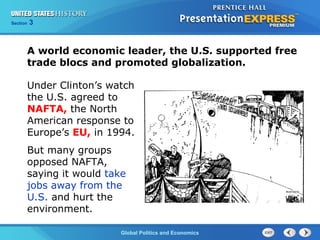
A world economic leader, the U.S. supported free
trade blocs and promoted globalization.
Under Clinton’s watch
the U.S. agreed to
NAFTA, the North
American response to
Europe’s EU, in 1994.
But many groups
opposed NAFTA,
saying it would take
jobs away from the
U.S. and hurt the
environment.
Section 3
Global Politics and Economics
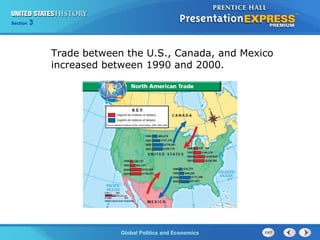
Trade between the U.S., Canada, and Mexico
increased between 1990 and 2000.
Section 3
Global Politics and Economics
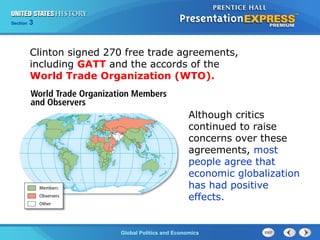
Clinton signed 270 free trade agreements,
including GATT and the accords of the
World Trade Organization (WTO).
Although critics
continued to raise
concerns over these
agreements, most
people agree that
economic globalization
has had positive
effects.
Section 3
Global Politics and Economics
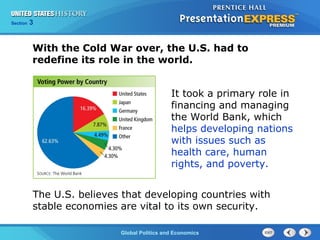
It took a primary role in
financing and managing
the World Bank, which
helps developing nations
with issues such as
health care, human
rights, and poverty.
The U.S. believes that developing countries with
stable economies are vital to its own security.
With the Cold War over, the U.S. had to
redefine its role in the world.
Section 3
Global Politics and Economics
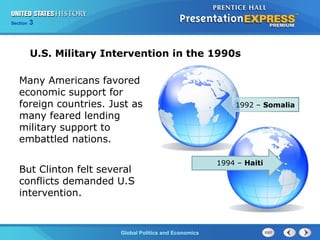
U.S. Military Intervention in the 1990s
Many Americans favored
economic support for
foreign countries. Just as
many feared lending
military support to
embattled nations.
But Clinton felt several
conflicts demanded U.S
intervention.
1992 – Somalia
1994 – Haiti
Section 3
Global Politics and Economics
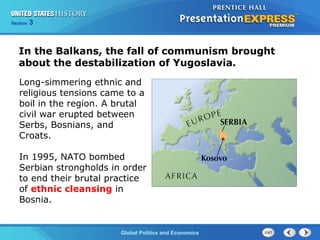
In the Balkans, the fall of communism brought
about the destabilization of Yugoslavia.
Long-simmering ethnic and
religious tensions came to a
boil in the region. A brutal
civil war erupted between
Serbs, Bosnians, and
Croats.
In 1995, NATO bombed
Serbian strongholds in order
to end their brutal practice
of ethnic cleansing in
Bosnia.
Section 3
Global Politics and Economics
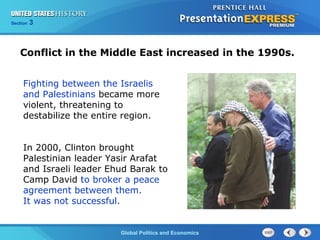
Fighting between the Israelis
and Palestinians became more
violent, threatening to
destabilize the entire region.
In 2000, Clinton brought
Palestinian leader Yasir Arafat
and Israeli leader Ehud Barak to
Camp David to broker a peace
agreement between them.
It was not successful.
Conflict in the Middle East increased in the 1990s.
Section 3
Global Politics and Economics
The U.S. itself became a target of
Middle Eastern extremists.
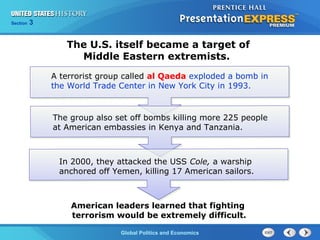
A terrorist group called al Qaeda exploded a bomb in
the World Trade Center in New York City in 1993.
The group also set off bombs killing more 225 people
at American embassies in Kenya and Tanzania.
In 2000, they attacked the USS Cole, a warship
anchored off Yemen, killing 17 American sailors.
American leaders learned that fighting
terrorism would be extremely difficult.
Section 3
Global Politics and Economics
Section Review
Know It, Show It QuizQuickTake Quiz

Ush ch. 24 section 3 notes

  • 1.
    Section 3 Global Politicsand Economics • Analyze how the United States responded to changes in the global economy. • Assess the foreign policy goals and actions of the Clinton administration. • Describe U.S. relations with various Middle Eastern countries and groups. Objectives
  • 2.
    Section 3 Global Politicsand Economics Terms and People • EU – the European Union, an economic and political union of European nations established in 1993 • NAFTA – the North American Free Trade Agreement, signed in 1993, which called for the removal of trade restrictions between Canada, Mexico, and the United States • GATT – the General Agreement on Tariffs and Trade, an international agreement first signed in 1947 aimed at lowering trade barriers
  • 3.
    Section 3 Global Politicsand Economics Terms and People (continued) • WTO – the World Trade Organization, which replaced GATT in 1995, to encourage the expansion of world trade • ethnic cleansing − a systematic effort to purge an area or society of an ethnic group through murder or deportation • al Qaeda − a terrorist group established by Osama bin Laden to rid Muslim countries of Western influence
  • 4.
    Section 3 Global Politicsand Economics After the Cold War ended, the United States carved out a new role in a world of globalization and increasing regional conflict. No longer defined by an opposition to communism, America faced this new era under the leadership of President Clinton. What role did the United States take on in global politics and economics following the Cold War?
  • 5.
    Section 3 Global Politicsand Economics A world economic leader, the U.S. supported free trade blocs and promoted globalization. Under Clinton’s watch the U.S. agreed to NAFTA, the North American response to Europe’s EU, in 1994. But many groups opposed NAFTA, saying it would take jobs away from the U.S. and hurt the environment.
  • 6.
    Section 3 Global Politicsand Economics Trade between the U.S., Canada, and Mexico increased between 1990 and 2000.
  • 7.
    Section 3 Global Politicsand Economics Clinton signed 270 free trade agreements, including GATT and the accords of the World Trade Organization (WTO). Although critics continued to raise concerns over these agreements, most people agree that economic globalization has had positive effects.
  • 8.
    Section 3 Global Politicsand Economics It took a primary role in financing and managing the World Bank, which helps developing nations with issues such as health care, human rights, and poverty. The U.S. believes that developing countries with stable economies are vital to its own security. With the Cold War over, the U.S. had to redefine its role in the world.
  • 9.
    Section 3 Global Politicsand Economics U.S. Military Intervention in the 1990s Many Americans favored economic support for foreign countries. Just as many feared lending military support to embattled nations. But Clinton felt several conflicts demanded U.S intervention. 1992 – Somalia 1994 – Haiti
  • 10.
    Section 3 Global Politicsand Economics In the Balkans, the fall of communism brought about the destabilization of Yugoslavia. Long-simmering ethnic and religious tensions came to a boil in the region. A brutal civil war erupted between Serbs, Bosnians, and Croats. In 1995, NATO bombed Serbian strongholds in order to end their brutal practice of ethnic cleansing in Bosnia.
  • 11.
    Section 3 Global Politicsand Economics Fighting between the Israelis and Palestinians became more violent, threatening to destabilize the entire region. In 2000, Clinton brought Palestinian leader Yasir Arafat and Israeli leader Ehud Barak to Camp David to broker a peace agreement between them. It was not successful. Conflict in the Middle East increased in the 1990s.
  • 12.
    Section 3 Global Politicsand Economics The U.S. itself became a target of Middle Eastern extremists. A terrorist group called al Qaeda exploded a bomb in the World Trade Center in New York City in 1993. The group also set off bombs killing more 225 people at American embassies in Kenya and Tanzania. In 2000, they attacked the USS Cole, a warship anchored off Yemen, killing 17 American sailors. American leaders learned that fighting terrorism would be extremely difficult.
  • 13.
    Section 3 Global Politicsand Economics Section Review Know It, Show It QuizQuickTake Quiz