#?

The Byzantine Empire

Textbook pages 298-313
Growth of the Byzantine Empire
•   Constantinople:
    – Protection of eastern frontier
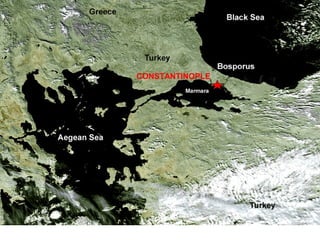
    – Easily fortified (defendable), on natural
      harbor. Overlooked the Bosporus Strait.
    – Away from Germanic invasions
    – Seat of power until Ottoman Conquest in
      1453
CONSTANTINOPLE
• Crossroads of Trade:
  - Goods coming from Europe, Asia, Africa
  - Silk and paper industry thriving.
  - Taxes on trade and industry provide
  money for gov’t, army, and buildings
  -Cultural melting pot: (Roman law, Greek
      culture, and Orthodox Christianity)
• Greek + Roman = Greco-Roman
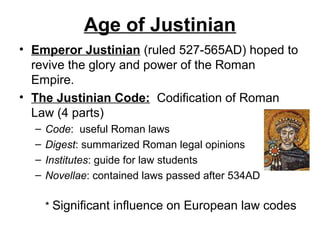
Age of Justinian
• Emperor Justinian (ruled 527-565AD) hoped to
  revive the glory and power of the Roman
  Empire.
• The Justinian Code: Codification of Roman
  Law (4 parts)
  –   Code: useful Roman laws
  –   Digest: summarized Roman legal opinions
  –   Institutes: guide for law students
  –   Novellae: contained laws passed after 534AD

      * Significant influence on European law codes
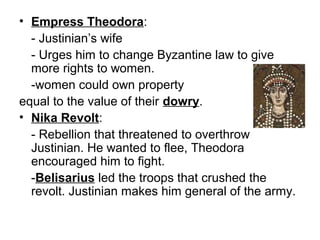
• Empress Theodora:
  - Justinian’s wife
  - Urges him to change Byzantine law to give
  more rights to women.
  -women could own property
equal to the value of their dowry.
• Nika Revolt:
  - Rebellion that threatened to overthrow
  Justinian. He wanted to flee, Theodora
  encouraged him to fight.
  -Belisarius led the troops that crushed the
  revolt. Justinian makes him general of the army.
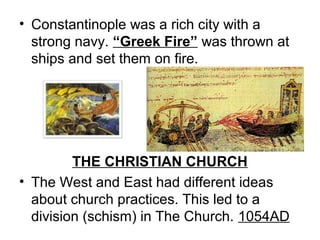
• Constantinople was a rich city with a
  strong navy. “Greek Fire” was thrown at
  ships and set them on fire.


         THE CHRISTIAN CHURCH
• The West and East had different ideas
  about church practices. This led to a
  division (schism) in The Church. 1054AD
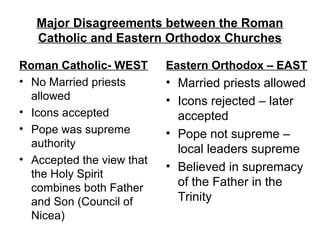
Major Disagreements between the Roman
   Catholic and Eastern Orthodox Churches

Roman Catholic- WEST       Eastern Orthodox – EAST
• No Married priests       • Married priests allowed
  allowed                  • Icons rejected – later
• Icons accepted             accepted
• Pope was supreme         • Pope not supreme –
  authority
                             local leaders supreme
• Accepted the view that
                           • Believed in supremacy
  the Holy Spirit
  combines both Father       of the Father in the
  and Son (Council of        Trinity
  Nicea)
Byzantine Culture
• Passed on to future generations the learning of
  ancient Greece, Rome, and the East.
• Cyril and Methodius went to teach the Slavs the
  Bible. They gave them an alphabet which is
  known as Cyrillic.
• Mosaics and architecture.
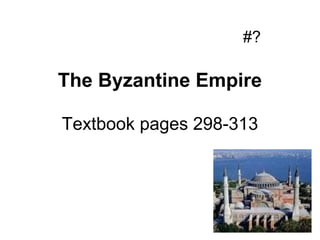
  - Hagia Sophia- Church, one of the world’s
  biggest buildings
DECLINE – Many different groups invade the
  Byzantine Empire. 1453AD the Ottoman Turks
  capture Constantinople. End of Byzantine Empire

Byzantine Empire Notes

  • 1.
  • 2.
    Growth of theByzantine Empire • Constantinople: – Protection of eastern frontier – Easily fortified (defendable), on natural harbor. Overlooked the Bosporus Strait. – Away from Germanic invasions – Seat of power until Ottoman Conquest in 1453
  • 3.
  • 5.
    • Crossroads ofTrade: - Goods coming from Europe, Asia, Africa - Silk and paper industry thriving. - Taxes on trade and industry provide money for gov’t, army, and buildings -Cultural melting pot: (Roman law, Greek culture, and Orthodox Christianity) • Greek + Roman = Greco-Roman
  • 6.
    Age of Justinian •Emperor Justinian (ruled 527-565AD) hoped to revive the glory and power of the Roman Empire. • The Justinian Code: Codification of Roman Law (4 parts) – Code: useful Roman laws – Digest: summarized Roman legal opinions – Institutes: guide for law students – Novellae: contained laws passed after 534AD * Significant influence on European law codes
  • 7.
    • Empress Theodora: - Justinian’s wife - Urges him to change Byzantine law to give more rights to women. -women could own property equal to the value of their dowry. • Nika Revolt: - Rebellion that threatened to overthrow Justinian. He wanted to flee, Theodora encouraged him to fight. -Belisarius led the troops that crushed the revolt. Justinian makes him general of the army.
  • 8.
    • Constantinople wasa rich city with a strong navy. “Greek Fire” was thrown at ships and set them on fire. THE CHRISTIAN CHURCH • The West and East had different ideas about church practices. This led to a division (schism) in The Church. 1054AD
  • 9.
    Major Disagreements betweenthe Roman Catholic and Eastern Orthodox Churches Roman Catholic- WEST Eastern Orthodox – EAST • No Married priests • Married priests allowed allowed • Icons rejected – later • Icons accepted accepted • Pope was supreme • Pope not supreme – authority local leaders supreme • Accepted the view that • Believed in supremacy the Holy Spirit combines both Father of the Father in the and Son (Council of Trinity Nicea)
  • 10.
    Byzantine Culture • Passedon to future generations the learning of ancient Greece, Rome, and the East. • Cyril and Methodius went to teach the Slavs the Bible. They gave them an alphabet which is known as Cyrillic. • Mosaics and architecture. - Hagia Sophia- Church, one of the world’s biggest buildings DECLINE – Many different groups invade the Byzantine Empire. 1453AD the Ottoman Turks capture Constantinople. End of Byzantine Empire