Rome and Early Christianity Section 5 
The Fall of Rome 
Preview 
• Main Idea / Reading Focus 
• The Empire Weakens 
• Attempts at Reform 
• Invasion and Fall 
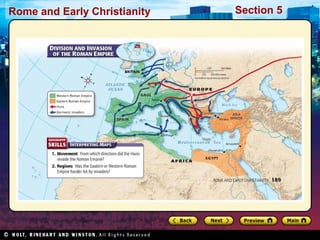
• Map: Division and Invasion of the Roman Empire 
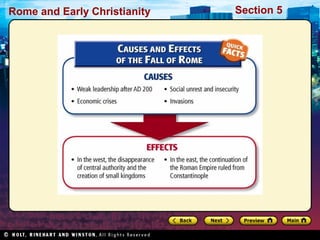
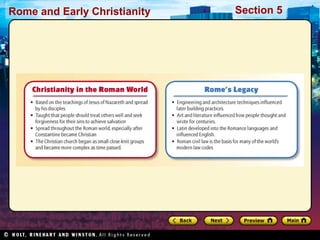
• Quick Facts: Causes and Effects of the Fall of Rome 
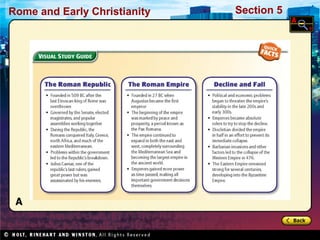
• Visual Study Guide / Quick Facts 
• Video: The Impact of Ancient Rome on the World Today
Rome and Early Christianity Section 5 
The Fall of Rome 
Main Idea 
1. Events and conditions inside as well as outside the Roman 
Empire weakened it and led to its collapse in the west in the 
400s. 
Reading Focus 
• What problems weakened the empire in the 200s? 
• How did Diocletian and Constantine attempt to reform the 
empire? 
• What caused the invasion and ultimate fall of the empire in the 
400s?
Rome and Early Christianity Section 5 
The Empire Weakens 
The Roman army’s inability to stop the Huns was one symptom of the 
weakness that befell the empire after the end of the Pax Romana. 
Weak Leaders 
• After 180, empire confronted 
by challenges from outside, 
growing problems within 
• When last of Good Emperors 
died, Rome had no strong 
leader 
• Civil wars broke out 
• Rome under increasing threat 
of invasions on eastern, 
western frontiers 
Military Dictatorship 
• Emperors increased size of 
Rome’s army 
• Demands on financial 
resources, military caused 
economic crisis 
• Empire: military dictatorship 
• Legions deposed emperors, 
elevated own leaders to 
throne 
• Twenty emperors in 49 years; 
all but one died violently
Rome and Early Christianity Section 5 
Economic Troubles 
• Insecurity of civil wars, invasions affected Roman life 
• Robbery, piracy increased; travel hazardous 
• Merchants feared to ship goods 
• Military needs required more revenue; emperors raised taxes 
Inflation 
• Value of money declined as taxes rose 
• Emperors minted new coins with copper, lead, and silver 
• People refused to accept currency at face value 
• Result was dramatic rise in prices, or inflation
Rome and Early Christianity Section 5 
Analyze 
What problems faced Rome in the late 
200s? 
Answer(s): The empire had weak leaders, civil 
wars, threats of invasion, and inflation led to a 
weak economy. Piracy and robbery made travel 
hazardous.
Rome and Early Christianity Section 5 
Attempts at Reform 
The crises of the 200s shattered the Roman world. Drastic reforms 
had to be made if the empire were to survive. Two capable emperors 
rose to power and gave the empire another two centuries of life. 
Diocletian 
• Diocletian took 
power, 284 
• Changed empire 
into absolute 
monarchy 
• Placed self above 
subjects, ruled with 
no accountability to 
anyone 
Divided Empire 
• Divided empire in 
two to improve 
efficiency 
• Ruled eastern half 
himself, appointed 
co-emperor to rule 
western provinces 
• Caesars helped run 
empire 
Rigid Order 
• Forced society into 
rigid order 
• Sons to follow 
trades, social 
positions of fathers 
• Peasants tied to 
land they farmed 
• Increased army, full 
attention to defense
Rome and Early Christianity Section 5 
Economic Reforms 
Imperial economy came under state direction 
with Diocletian 
• Commercial, manufacturing activities geared toward 
needs of imperial defense 
– New tax system raised more money for government, army 
– Reforms drastic, successful 
• Saved empire from immediate economic collapse
Rome and Early Christianity Section 5 
State Control 
Constantine 
• Constantine continued state 
control over society 
• Made two profound decisions to 
affect direction of future empire: 
converted to Christianity; built 
new capital—Constantinople, 
“city of Constantine”—on site of 
village of Byzantium 
• Eastern half of empire richer, 
better defended; Constantine 
wanted capital there 
Diocletian Retires 
• Diocletian’s initiatives worked 
well while he remained emperor 
• Diocletian, co-emperor retired, 
305; two caesars rose to 
become co-emperors 
• New emperors quarreled; 
empire plunged into civil war 
• 312, order restored when 
Constantine declared emperor 
by his troops; put end to fighting
Rome and Early Christianity Section 5 
Analyze 
How did Diocletian and Constantine try to 
save Rome? 
Answer(s): Diocletian—tried to make 
governmental and economic reforms and build up 
the army; Constantine—moved capital to the 
eastern half of the empire
Rome and Early Christianity Section 5 
Invasion and Fall 
2. Unfortunately, the reforms of Diocletian and Constantine did not 
solve the overwhelming problems of the empire. During the 300s and 
400s, these problems were only worsened by tribal peoples’ increasing 
pressures on the empire’s frontier. 
The Invaders 
• Germanic tribes lived along, raided 
Rome’s frontiers for centuries 
• New peoples moved west from 
Central Asia, pushed Germanic 
tribes into empire 
• Rulers in Rome, Constantinople 
tried to hold empire together 
Huns 
• Late 300s, Huns stormed out of 
east and sent Germanic tribes 
fleeing 
• Imperial defenses in east held, but 
those in west overwhelmed 
• Huns formed vast empire among 
nomadic steppe peoples of Eurasia 
About 370 Huns attacked the Ostrogoths, a Germanic people living 
north of the Black Sea.
Rome and Early Christianity Section 5 
Migrating Tribes 
Goths 
• Assault on Ostrogoths frightened kinsmen, Visigoths 
• Visigoths fled into Roman Empire, Italy 
• Visigoths captured and sacked Rome itself, 410 
Vandals 
• Other migrating tribes soon attacked Roman Empire 
• Infamous for destroying everything in path; Vandals attacked Rome in 450s 
• Term vandal came to mean “one who causes senseless destruction” 
3. Attila 
• Leader of Huns, led attack on Gaul 
• Roman army allied with Visigoths, defeated Huns, 451 
• Attila next turned on Rome; but Pope Leo I persuaded him to leave Italy
Rome and Early Christianity Section 5
Rome and Early Christianity Section 5 
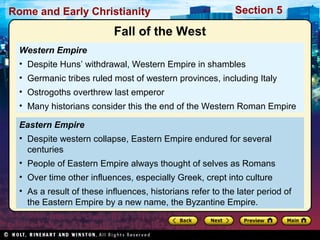
Fall of the West 
Western Empire 
• Despite Huns’ withdrawal, Western Empire in shambles 
• Germanic tribes ruled most of western provinces, including Italy 
• Ostrogoths overthrew last emperor 
• Many historians consider this the end of the Western Roman Empire 
Eastern Empire 
• Despite western collapse, Eastern Empire endured for several 
centuries 
• People of Eastern Empire always thought of selves as Romans 
• Over time other influences, especially Greek, crept into culture 
• As a result of these influences, historians refer to the later period of 
the Eastern Empire by a new name, the Byzantine Empire.
Rome and Early Christianity Section 5
Rome and Early Christianity Section 5 
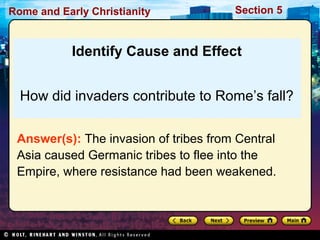
Identify Cause and Effect 
How did invaders contribute to Rome’s fall? 
Answer(s): The invasion of tribes from Central 
Asia caused Germanic tribes to flee into the 
Empire, where resistance had been weakened.
Rome and Early Christianity Section 5
Rome and Early Christianity Section 5 
Video 
The Impact of Ancient Rome on the World 
Today 
Click above to play the video.

World History Ch. 6 Section 5 Notes

  • 1.
    Rome and EarlyChristianity Section 5 The Fall of Rome Preview • Main Idea / Reading Focus • The Empire Weakens • Attempts at Reform • Invasion and Fall • Map: Division and Invasion of the Roman Empire • Quick Facts: Causes and Effects of the Fall of Rome • Visual Study Guide / Quick Facts • Video: The Impact of Ancient Rome on the World Today
  • 2.
    Rome and EarlyChristianity Section 5 The Fall of Rome Main Idea 1. Events and conditions inside as well as outside the Roman Empire weakened it and led to its collapse in the west in the 400s. Reading Focus • What problems weakened the empire in the 200s? • How did Diocletian and Constantine attempt to reform the empire? • What caused the invasion and ultimate fall of the empire in the 400s?
  • 3.
    Rome and EarlyChristianity Section 5 The Empire Weakens The Roman army’s inability to stop the Huns was one symptom of the weakness that befell the empire after the end of the Pax Romana. Weak Leaders • After 180, empire confronted by challenges from outside, growing problems within • When last of Good Emperors died, Rome had no strong leader • Civil wars broke out • Rome under increasing threat of invasions on eastern, western frontiers Military Dictatorship • Emperors increased size of Rome’s army • Demands on financial resources, military caused economic crisis • Empire: military dictatorship • Legions deposed emperors, elevated own leaders to throne • Twenty emperors in 49 years; all but one died violently
  • 4.
    Rome and EarlyChristianity Section 5 Economic Troubles • Insecurity of civil wars, invasions affected Roman life • Robbery, piracy increased; travel hazardous • Merchants feared to ship goods • Military needs required more revenue; emperors raised taxes Inflation • Value of money declined as taxes rose • Emperors minted new coins with copper, lead, and silver • People refused to accept currency at face value • Result was dramatic rise in prices, or inflation
  • 5.
    Rome and EarlyChristianity Section 5 Analyze What problems faced Rome in the late 200s? Answer(s): The empire had weak leaders, civil wars, threats of invasion, and inflation led to a weak economy. Piracy and robbery made travel hazardous.
  • 6.
    Rome and EarlyChristianity Section 5 Attempts at Reform The crises of the 200s shattered the Roman world. Drastic reforms had to be made if the empire were to survive. Two capable emperors rose to power and gave the empire another two centuries of life. Diocletian • Diocletian took power, 284 • Changed empire into absolute monarchy • Placed self above subjects, ruled with no accountability to anyone Divided Empire • Divided empire in two to improve efficiency • Ruled eastern half himself, appointed co-emperor to rule western provinces • Caesars helped run empire Rigid Order • Forced society into rigid order • Sons to follow trades, social positions of fathers • Peasants tied to land they farmed • Increased army, full attention to defense
  • 7.
    Rome and EarlyChristianity Section 5 Economic Reforms Imperial economy came under state direction with Diocletian • Commercial, manufacturing activities geared toward needs of imperial defense – New tax system raised more money for government, army – Reforms drastic, successful • Saved empire from immediate economic collapse
  • 8.
    Rome and EarlyChristianity Section 5 State Control Constantine • Constantine continued state control over society • Made two profound decisions to affect direction of future empire: converted to Christianity; built new capital—Constantinople, “city of Constantine”—on site of village of Byzantium • Eastern half of empire richer, better defended; Constantine wanted capital there Diocletian Retires • Diocletian’s initiatives worked well while he remained emperor • Diocletian, co-emperor retired, 305; two caesars rose to become co-emperors • New emperors quarreled; empire plunged into civil war • 312, order restored when Constantine declared emperor by his troops; put end to fighting
  • 9.
    Rome and EarlyChristianity Section 5 Analyze How did Diocletian and Constantine try to save Rome? Answer(s): Diocletian—tried to make governmental and economic reforms and build up the army; Constantine—moved capital to the eastern half of the empire
  • 10.
    Rome and EarlyChristianity Section 5 Invasion and Fall 2. Unfortunately, the reforms of Diocletian and Constantine did not solve the overwhelming problems of the empire. During the 300s and 400s, these problems were only worsened by tribal peoples’ increasing pressures on the empire’s frontier. The Invaders • Germanic tribes lived along, raided Rome’s frontiers for centuries • New peoples moved west from Central Asia, pushed Germanic tribes into empire • Rulers in Rome, Constantinople tried to hold empire together Huns • Late 300s, Huns stormed out of east and sent Germanic tribes fleeing • Imperial defenses in east held, but those in west overwhelmed • Huns formed vast empire among nomadic steppe peoples of Eurasia About 370 Huns attacked the Ostrogoths, a Germanic people living north of the Black Sea.
  • 11.
    Rome and EarlyChristianity Section 5 Migrating Tribes Goths • Assault on Ostrogoths frightened kinsmen, Visigoths • Visigoths fled into Roman Empire, Italy • Visigoths captured and sacked Rome itself, 410 Vandals • Other migrating tribes soon attacked Roman Empire • Infamous for destroying everything in path; Vandals attacked Rome in 450s • Term vandal came to mean “one who causes senseless destruction” 3. Attila • Leader of Huns, led attack on Gaul • Roman army allied with Visigoths, defeated Huns, 451 • Attila next turned on Rome; but Pope Leo I persuaded him to leave Italy
  • 12.
    Rome and EarlyChristianity Section 5
  • 13.
    Rome and EarlyChristianity Section 5 Fall of the West Western Empire • Despite Huns’ withdrawal, Western Empire in shambles • Germanic tribes ruled most of western provinces, including Italy • Ostrogoths overthrew last emperor • Many historians consider this the end of the Western Roman Empire Eastern Empire • Despite western collapse, Eastern Empire endured for several centuries • People of Eastern Empire always thought of selves as Romans • Over time other influences, especially Greek, crept into culture • As a result of these influences, historians refer to the later period of the Eastern Empire by a new name, the Byzantine Empire.
  • 14.
    Rome and EarlyChristianity Section 5
  • 15.
    Rome and EarlyChristianity Section 5 Identify Cause and Effect How did invaders contribute to Rome’s fall? Answer(s): The invasion of tribes from Central Asia caused Germanic tribes to flee into the Empire, where resistance had been weakened.
  • 16.
    Rome and EarlyChristianity Section 5
  • 17.
    Rome and EarlyChristianity Section 5
  • 18.
    Rome and EarlyChristianity Section 5
  • 19.
    Rome and EarlyChristianity Section 5 Video The Impact of Ancient Rome on the World Today Click above to play the video.