Nile Civilizations Section 1
Nile Civilizations Section 1 
The Kingdom of Egypt 
Preview 
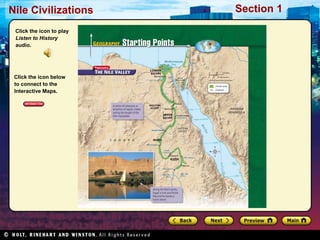
• Starting Points Map: The Nile Valley 
• Main Idea / Reading Focus 
• Geography and Early Egypt 
• The Old Kingdom 
• The Middle Kingdom 
• The New Kingdom 
• Map: The New Kingdom 
• Faces of History: Hatshepsut
Nile Civilizations Section 1 
Click the icon to play 
Listen to History 
audio. 
Click the icon below 
to connect to the 
Interactive Maps.
Nile Civilizations Section 1 
The Kingdom of Egypt 
Main Idea 
1. Egypt was one of the most stable and long-lasting civilizations 
of the ancient world. 
Reading Focus 
• How did geography influence Egypt’s early history? 
• What achievements were made in the Old Kingdom? 
• What happened during the Middle Kingdom? 
• What was Egypt like during the New Kingdom?
Nile Civilizations Section 1 
Geography and Early Egypt 
• The Nile 
– Most important physical feature in Egypt 
– 4,000 miles long; flows through the Sahara Desert 
• Without the Nile’s waters, no one could live there. 
Geography of Egypt 
• The Nile flooded every year 
– Predictable floodwaters with spring rains 
– Left rich, black silt 
• Narrow band of fertile soil 
• Became home of Egyptian civilization
Nile Civilizations Section 1 
Geographical Features 
Cataracts 
• Nile afforded protection 
itself 
• Flowed through cataracts 
to the south 
• Currents and waterfalls 
made sailing impossible 
• Not an easy invasion route 
Delta 
• Egypt’s most fertile soil in 
Nile Delta 
• Silt deposits at mouth of 
river 
• Black Land of rich arable 
soil 
• Red Land unlivable but 
afforded protection
Nile Civilizations Section 1 
2. Two Kingdoms 
• First farming villages as early as 5000 BC 
• Northern Kingdom, Lower Egypt 
– Mild climate; cobra goddess worshipped 
• Southern Kingdom, Upper Egypt 
– Warmer climate; prayed to a vulture goddess 
Unification 
• Two kingdoms unified around 3100 BC 
• Upper Egypt ruler Menes conquered north 
– Founded capital city of Memphis 
– Adopted both symbols, the snake and the vulture 
• First of 31 dynasties
Nile Civilizations Section 1 
Draw Conclusions 
How did geography affect where the early 
Egyptians lived? 
Answer(s): They lived in a narrow strip of fertile 
land where they could raise crops. It was 
surrounded by inhospitable desert, which would 
not easily support life.
Nile Civilizations Section 1 
The Old Kingdom 
Many of the institutions for which the Egyptian civilization is known 
were created during the period which began around 2650 BC. 
The Pyramids 
• Most famous symbols of Egypt 
• Largest located near Giza 
• Built as tombs for rulers 
– Hollow chamber for burial 
– Treasures buried with them 
– Deadly traps within 
• Design changed to smooth-sided 
over time 
Building Pyramids 
• Took great planning and skill 
• Ordered when kings took the 
throne 
• Built from the inside out 
• Not built by slaves 
– Peasants required to work 
one month per year 
– Professional craftspeople 
like architects, artists
Nile Civilizations Section 1 
The Pharaohs 
• The head of the government was the king 
• Became known as pharaoh (“great house”) 
• Had great power because he was believed to be a god 
• Egypt a theocracy, a state ruled by religious figures 
Egyptian Bureaucracy 
• Pharaoh could not rule Egypt alone 
• Aided by bureaucracy, many of whom were pharaoh’s relatives 
• Most powerful official was the vizier 
• Hundreds of lesser officials kept Egypt running smoothly
Nile Civilizations Section 1 
Summarize 
What Egyptian institutions were developed 
during the Old Kingdom? 
Answer(s): a government headed by the 
pharaoh, highly structured bureaucracy
Nile Civilizations Section 1 
The Middle Kingdom 
Old Kingdom collapsed around 2100 BC 
Warfare, economic strife for almost 200 years 
• New dynasty began Middle Kingdom 2055 BC 
– Strong leadership brought stability 
– Trade with surrounding lands encouraged 
• Trade routes not always safe 
– Fortresses built along the Nile 
– The Hyksos invaded, conquered around 1650 BC
Nile Civilizations Section 1 
Summarize 
How did the Middle Kingdom rise and fall? 
Answer(s): new dynasty came to power after 
almost 200 years of chaos; brought stability and 
economic prosperity; Middle Kingdom fell when 
Egypt was invaded by the Hyksos, who conquered 
Lower Egypt
Nile Civilizations Section 1 
The New Kingdom 
Hyksos ruled almost 100 
years 
•Not harsh, but resented 
•Defeated by nobles from Thebes 
who became new rulers of Egypt 
First permanent army 
• Traditional foot soldiers 
• Archers and charioteers 
• Adopted weapons from Hyksos 
Securing Egypt 
• Egypt could not rely on 
geography for protection 
• Desert and sea not enough 
• Had to build powerful military 
Created an empire 
• Egypt to rule beyond Nile Valley 
• Headed south into Nubia 
• Also campaigns east into Asia
Nile Civilizations Section 1
Nile Civilizations Section 1 
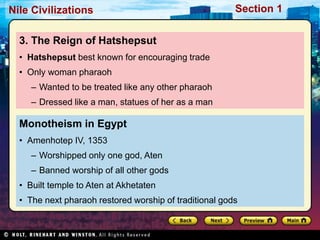
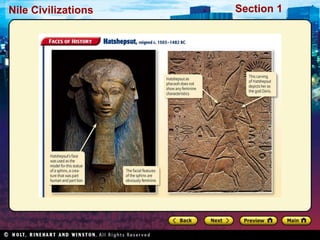
3. The Reign of Hatshepsut 
• Hatshepsut best known for encouraging trade 
• Only woman pharaoh 
– Wanted to be treated like any other pharaoh 
– Dressed like a man, statues of her as a man 
Monotheism in Egypt 
• Amenhotep IV, 1353 
– Worshipped only one god, Aten 
– Banned worship of all other gods 
• Built temple to Aten at Akhetaten 
• The next pharaoh restored worship of traditional gods
Nile Civilizations Section 1
Nile Civilizations Section 1 
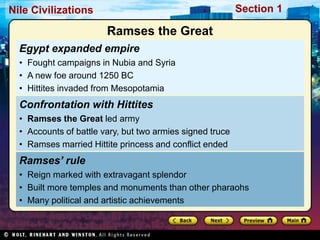
Ramses the Great 
Egypt expanded empire 
• Fought campaigns in Nubia and Syria 
• A new foe around 1250 BC 
• Hittites invaded from Mesopotamia 
Confrontation with Hittites 
• Ramses the Great led army 
• Accounts of battle vary, but two armies signed truce 
• Ramses married Hittite princess and conflict ended 
Ramses’ rule 
• Reign marked with extravagant splendor 
• Built more temples and monuments than other pharaohs 
• Many political and artistic achievements
Nile Civilizations Section 1 
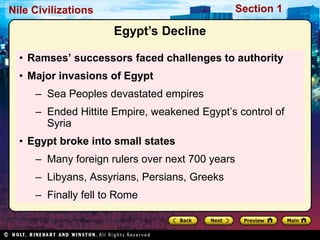
Egypt’s Decline 
• Ramses’ successors faced challenges to authority 
• Major invasions of Egypt 
– Sea Peoples devastated empires 
– Ended Hittite Empire, weakened Egypt’s control of 
Syria 
• Egypt broke into small states 
– Many foreign rulers over next 700 years 
– Libyans, Assyrians, Persians, Greeks 
– Finally fell to Rome
Nile Civilizations Section 1 
Sequence 
How did Egypt grow and change during the 
New Kingdom? 
Answer(s): built strong military, created own 
empire, increased trade

WH Ch. 3 Section 1 Notes

  • 1.
  • 2.
    Nile Civilizations Section1 The Kingdom of Egypt Preview • Starting Points Map: The Nile Valley • Main Idea / Reading Focus • Geography and Early Egypt • The Old Kingdom • The Middle Kingdom • The New Kingdom • Map: The New Kingdom • Faces of History: Hatshepsut
  • 3.
    Nile Civilizations Section1 Click the icon to play Listen to History audio. Click the icon below to connect to the Interactive Maps.
  • 4.
    Nile Civilizations Section1 The Kingdom of Egypt Main Idea 1. Egypt was one of the most stable and long-lasting civilizations of the ancient world. Reading Focus • How did geography influence Egypt’s early history? • What achievements were made in the Old Kingdom? • What happened during the Middle Kingdom? • What was Egypt like during the New Kingdom?
  • 5.
    Nile Civilizations Section1 Geography and Early Egypt • The Nile – Most important physical feature in Egypt – 4,000 miles long; flows through the Sahara Desert • Without the Nile’s waters, no one could live there. Geography of Egypt • The Nile flooded every year – Predictable floodwaters with spring rains – Left rich, black silt • Narrow band of fertile soil • Became home of Egyptian civilization
  • 6.
    Nile Civilizations Section1 Geographical Features Cataracts • Nile afforded protection itself • Flowed through cataracts to the south • Currents and waterfalls made sailing impossible • Not an easy invasion route Delta • Egypt’s most fertile soil in Nile Delta • Silt deposits at mouth of river • Black Land of rich arable soil • Red Land unlivable but afforded protection
  • 7.
    Nile Civilizations Section1 2. Two Kingdoms • First farming villages as early as 5000 BC • Northern Kingdom, Lower Egypt – Mild climate; cobra goddess worshipped • Southern Kingdom, Upper Egypt – Warmer climate; prayed to a vulture goddess Unification • Two kingdoms unified around 3100 BC • Upper Egypt ruler Menes conquered north – Founded capital city of Memphis – Adopted both symbols, the snake and the vulture • First of 31 dynasties
  • 8.
    Nile Civilizations Section1 Draw Conclusions How did geography affect where the early Egyptians lived? Answer(s): They lived in a narrow strip of fertile land where they could raise crops. It was surrounded by inhospitable desert, which would not easily support life.
  • 9.
    Nile Civilizations Section1 The Old Kingdom Many of the institutions for which the Egyptian civilization is known were created during the period which began around 2650 BC. The Pyramids • Most famous symbols of Egypt • Largest located near Giza • Built as tombs for rulers – Hollow chamber for burial – Treasures buried with them – Deadly traps within • Design changed to smooth-sided over time Building Pyramids • Took great planning and skill • Ordered when kings took the throne • Built from the inside out • Not built by slaves – Peasants required to work one month per year – Professional craftspeople like architects, artists
  • 10.
    Nile Civilizations Section1 The Pharaohs • The head of the government was the king • Became known as pharaoh (“great house”) • Had great power because he was believed to be a god • Egypt a theocracy, a state ruled by religious figures Egyptian Bureaucracy • Pharaoh could not rule Egypt alone • Aided by bureaucracy, many of whom were pharaoh’s relatives • Most powerful official was the vizier • Hundreds of lesser officials kept Egypt running smoothly
  • 11.
    Nile Civilizations Section1 Summarize What Egyptian institutions were developed during the Old Kingdom? Answer(s): a government headed by the pharaoh, highly structured bureaucracy
  • 12.
    Nile Civilizations Section1 The Middle Kingdom Old Kingdom collapsed around 2100 BC Warfare, economic strife for almost 200 years • New dynasty began Middle Kingdom 2055 BC – Strong leadership brought stability – Trade with surrounding lands encouraged • Trade routes not always safe – Fortresses built along the Nile – The Hyksos invaded, conquered around 1650 BC
  • 13.
    Nile Civilizations Section1 Summarize How did the Middle Kingdom rise and fall? Answer(s): new dynasty came to power after almost 200 years of chaos; brought stability and economic prosperity; Middle Kingdom fell when Egypt was invaded by the Hyksos, who conquered Lower Egypt
  • 14.
    Nile Civilizations Section1 The New Kingdom Hyksos ruled almost 100 years •Not harsh, but resented •Defeated by nobles from Thebes who became new rulers of Egypt First permanent army • Traditional foot soldiers • Archers and charioteers • Adopted weapons from Hyksos Securing Egypt • Egypt could not rely on geography for protection • Desert and sea not enough • Had to build powerful military Created an empire • Egypt to rule beyond Nile Valley • Headed south into Nubia • Also campaigns east into Asia
  • 15.
  • 16.
    Nile Civilizations Section1 3. The Reign of Hatshepsut • Hatshepsut best known for encouraging trade • Only woman pharaoh – Wanted to be treated like any other pharaoh – Dressed like a man, statues of her as a man Monotheism in Egypt • Amenhotep IV, 1353 – Worshipped only one god, Aten – Banned worship of all other gods • Built temple to Aten at Akhetaten • The next pharaoh restored worship of traditional gods
  • 17.
  • 18.
    Nile Civilizations Section1 Ramses the Great Egypt expanded empire • Fought campaigns in Nubia and Syria • A new foe around 1250 BC • Hittites invaded from Mesopotamia Confrontation with Hittites • Ramses the Great led army • Accounts of battle vary, but two armies signed truce • Ramses married Hittite princess and conflict ended Ramses’ rule • Reign marked with extravagant splendor • Built more temples and monuments than other pharaohs • Many political and artistic achievements
  • 19.
    Nile Civilizations Section1 Egypt’s Decline • Ramses’ successors faced challenges to authority • Major invasions of Egypt – Sea Peoples devastated empires – Ended Hittite Empire, weakened Egypt’s control of Syria • Egypt broke into small states – Many foreign rulers over next 700 years – Libyans, Assyrians, Persians, Greeks – Finally fell to Rome
  • 20.
    Nile Civilizations Section1 Sequence How did Egypt grow and change during the New Kingdom? Answer(s): built strong military, created own empire, increased trade