SUBMITTED TO:- SUBMITTED BY:-
AR. KIRTI VARANDANI
HISTORY OF ARCHITECTURE
Early Christian and
Byzantine
Architecture
Thefall ofthe Roman Empire?
The rise of Christianityinthe Roman empire
LatinandByzantine Architecture
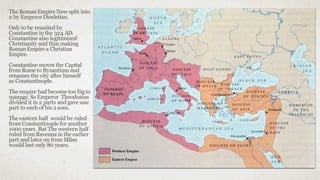
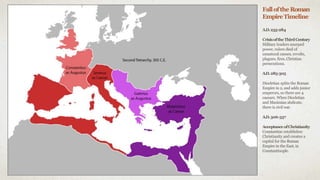
The RomanEmpire Now split into
2 by EmperorDiocletian.
Onlyto be reunited by
Constantine in the 324 AD.
Constantine also legitimized
Christianity and thus making
RomanEmpire a Christian
Empire.
Constantine moves the Capital
from Rome to Byzantium and
renames the city after himself
as Constantinople.
The empire had become too bigto
manage. So Emperor Theodosius
divided it in 2 parts and gave one
part to each of his 2sons.
The eastern half would be ruled
from Constantinople for another
1000 years. But The western half
ruled from Ravenna in the earlier
part and later on from Milan
would last only 80 years.
The single most importantsocial
phenomenon of the Early
Christian period was the spread
and acceptance of the Christian
religion.
During the period from the first
century to the third century after
the death of Jesus, Christianity
was a secret society. This was
due to the fact that it was
considered dangerous and
subversive by the emperors that
Christianity was dangerous to
their authority and people used
to believe that Christians were a
threat to their old Pagan religion
andbeliefs.
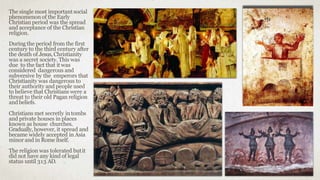
Christians met secretly intombs
and private houses in places
known as house churches.
Gradually, however, it spread and
became widely accepted in Asia
minor and in Rome itself.
The religion was tolerated butit
did not have any kind of legal
status until 313 AD.
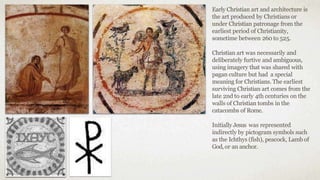
Early Christian art and architecture is
the art produced by Christians or
under Christian patronage from the
earliest period of Christianity,
sometime between 260 to 525.
Christian art was necessarily and
deliberately furtive and ambiguous,
using imagery that was shared with
pagan culture but had a special
meaning for Christians. The earliest
surviving Christian art comes from the
late 2nd to early 4th centuries on the
walls of Christian tombs in the
catacombs of Rome.
Initially Jesus was represented
indirectly by pictogram symbols such
as the Ichthys (fish), peacock, Lamb of
God,or an anchor.
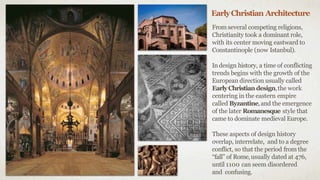
EarlyChristian Architecture
From several competing religions,
Christianity took a dominant role,
with its center moving eastward to
Constantinople (now Istanbul).
Indesign history, a time of conflicting
trends begins with the growth of the
European direction usually called
EarlyChristiandesign,the work
centering in the eastern empire
called Byzantine,and the emergence
of the later Romanesque style that
came to dominate medieval Europe.
These aspects of design history
overlap, interrelate, and to a degree
conflict, so that the period from the
“fall” of Rome,usually dated at 476,
until 1100 can seem disordered
and confusing.
EarlyChristian Architecture
Basilica
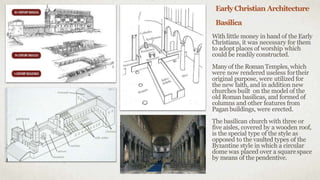
With little money in hand of the Early
Christians, it was necessary for them
to adopt places of worship which
could be readily constructed.
Many of the Roman Temples, which
were now rendered useless fortheir
original purpose, were utilized for
the new faith, and in addition new
churches built on the model of the
old Roman basilicas, and formed of
columns and other features from
Pagan buildings, were erected.
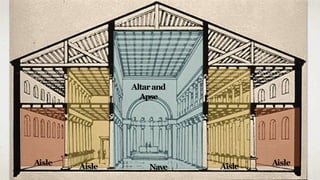
The basilican church with three or
five aisles, covered by a wooden roof,
is the special type of the style as
opposed to the vaulted types of the
Byzantine style in which a circular
dome was placed over a squarespace
by means of the pendentive.
AisleAisle Aisle Aisle
Altarand
Apse
Nave
FalloftheRoman
EmpireTimeline
A.D.235-284
CrisisoftheThirdCentury
Military leaders usurped
power, rulers died of
unnatural causes, revolts,
plagues, fires, Christian
persecutions.
A.D.285-305
Diocletian splits the Roman
Empire in 2, and adds junior
emperors, so there are 4
caesars. When Diocletian
and Maximian abdicate,
there is civil war.
A.D.306-337
AcceptanceofChristianity
Constantine establishes
Christianity and creates a
capital for the Roman
Empire in the East, in
Constantinople.
FalloftheRoman
EmpireTimeline
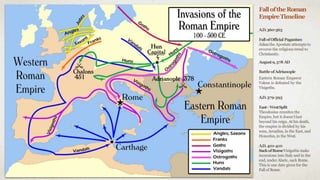
A.D.360-363
FallofOfficial Paganism
Julianthe Apostate attemptsto
reverse the religious trend to
Christianity.
August9,378 AD
BattleofAdrianople
Eastern Roman Emperor
Valens is defeated by the
Visigoths.
A.D.379-395
East- WestSplit
Theodosius reunites the
Empire, but it doesn'tlast
beyond his reign. At his death,
the empire is divided by his
sons, Arcadius, in the East, and
Honorius,in the West.
A.D.401-410
SackofRomeVisigoths make
incursions into Italy and in the
end, under Alaric, sack Rome.
This is one date given for the
Fall of Rome.
Fallofthe
RomanEmpire
Timeline
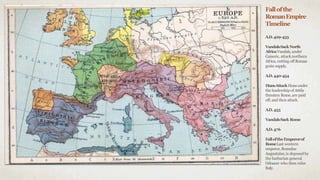
A.D.429-435
VandalsSackNorth
AfricaVandals,under
Gaiseric, attacknorthern
Africa, cutting off Roman
grain supply.
A.D.440-454
HunsAttackHunsunder
the leadership of Attila
threaten Rome,are paid
off,and then attack.
A.D.455
VandalsSack Rome
A.D.476
FalloftheEmperorof
RomeLast western
emperor,Romulus
Augustulus,is deposedby
the barbarian general
Odoacer who then rules
Italy.
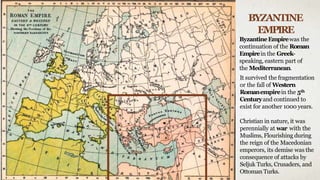
BYZANTINE
EMPIRE
ByzantineEmpirewas the
continuation of the Roman
Empirein the Greek-
speaking, eastern part of
the Mediterranean.
It survived the fragmentation
or the fall of Western
Romanempirein the 5th
Centuryand continued to
exist for another 1000 years.
Christian in nature, it was
perennially at war with the
Muslims, Flourishing during
the reign of the Macedonian
emperors, its demise was the
consequence of attacks by
Seljuk Turks, Crusaders, and
Ottoman Turks.
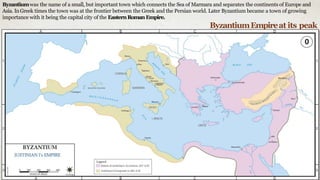
Byzantiumwas the name of a small, but important town which connects the Sea of Marmara and separates the continents of Europe and
Asia. InGreek times the town was at the frontier between the Greek and the Persian world. Later Byzantium became a town of growing
importance with it being the capital city of the EasternRoman Empire.
ByzantiumEmpireat its peak
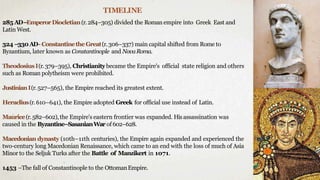
TIMELINE
285 AD–EmperorDiocletian(r.284–305) divided the Roman empire into Greek East and
Latin West.
324 –330AD- ConstantinetheGreat(r.306–337) main capital shifted from Rome to
Byzantium, later known as Constantinople and NovaRoma.
TheodosiusI(r.379–395), Christianitybecame the Empire's official state religion and others
such as Roman polytheism were prohibited.
JustinianI(r.527–565), the Empire reached its greatest extent.
Heraclius(r.610–641), the Empire adopted Greek for official use instead of Latin.
Maurice(r.582–602),the Empire's eastern frontier was expanded. Hisassassination was
caused in the Byzantine–SasanianWar of 602–628.
Macedonian dynasty (10th–11th centuries), the Empire again expanded and experienced the
two-century long Macedonian Renaissance, which came to an end with the loss of much of Asia
Minor to the Seljuk Turks after the Battle of Manzikert in 1071.
1453 –The fall of Constantinople to the OttomanEmpire.
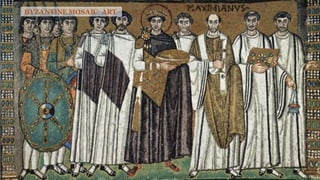
BYZANTINE MOSAIC ART
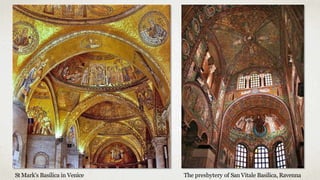
St Mark's Basilica in Venice The presbytery of San Vitale Basilica, Ravenna
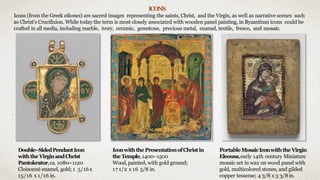
IconwiththePresentationofChristin
theTemple, 1400–1500
Wood, painted, with gold ground;
17 1/2 x 16 5/8 in.
Double–SidedPendantIcon
withtheVirginandChrist
Pantokrator,ca. 1080–1120
Cloisonné enamel, gold; 1 5/16x
15/16 x 1/16 in.
PortableMosaicIconwiththeVirgin
Eleousa,early 14th century Miniature
mosaic set in wax on wood panel with
gold, multicolored stones, and gilded
copper tesserae; 4 3/8 x 3 3/8in.
ICONS
Icons (from the Greek eikones) are sacred images representing the saints, Christ, and the Virgin, as well as narrative scenes such
as Christ's Crucifixion. While today the term is most closely associated with wooden panel painting, in Byzantium icons could be
crafted in all media, including marble, ivory, ceramic, gemstone, precious metal, enamel, textile, fresco, and mosaic.
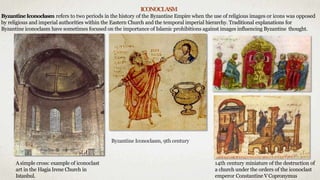
ICONOCLASM
ByzantineIconoclasm refers to two periods in the history of the Byzantine Empire when the use of religious images or icons was opposed
by religious and imperial authorities within the Eastern Church and the temporal imperial hierarchy. Traditional explanations for
Byzantine iconoclasm have sometimes focused on the importance of Islamic prohibitions against images influencing Byzantine thought.
Asimple cross: example of iconoclast
art in the Hagia Irene Church in
Istanbul.
14th century miniature of the destruction of
a church under the orders of the iconoclast
emperor Constantine VCopronymus
Byzantine Iconoclasm, 9th century
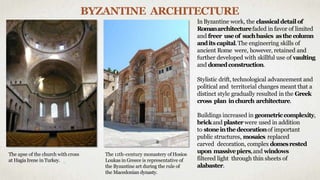
BYZANTINE ARCHITECTURE
InByzantine work, the classicaldetail of
Romanarchitecturefaded in favor of limited
and freer useof suchbasics asthecolumn
andits capital.The engineering skills of
ancient Rome were, however, retained and
further developed with skillful use of vaulting
and domedconstruction.
Stylistic drift, technological advancement and
political and territorial changes meant that a
distinct style gradually resulted in the Greek
cross plan inchurch architecture.
Buildings increased in geometriccomplexity,
brick and plaster were used in addition
to stoneinthedecorationof important
public structures, mosaics replaced
carved decoration, complex domesrested
upon massivepiers,and windows
filtered light through thin sheets of
alabaster.
The 11th-century monastery ofHosios
Loukas in Greece is representative of
the Byzantine art during the rule of
the Macedonian dynasty.
The apse of the church with cross
at Hagia Irene in Turkey.
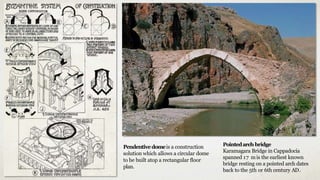
Pointedarch bridge
Karamagara Bridge in Cappadocia
spanned 17 mis the earliest known
bridge resting on a pointed arch dates
back to the 5th or 6th century AD.
Pendentive domeis a construction
solution which allows a circular dome
to be built atop a rectangular floor
plan.
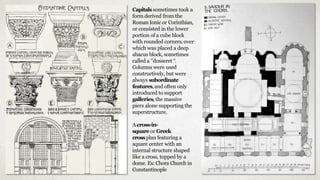
Capitals sometimes took a
form derived from the
Roman Ionic or Corinthian,
or consisted in the lower
portion of a cube block
with rounded corners, over
which was placed a deep
abacus block, sometimes
called a "dosseret “.
Columns were used
constructively, but were
always subordinate
features,and often only
introduced to support
galleries,the massive
piers alone supporting the
superstructure.
Across-in-
square or Greek
crossplan featuring a
square center with an
internal structure shaped
like a cross, topped by a
dome. Ex:Chora Church in
Constantinople
EVOLUTION OF CHURCH
ARCHITECTURE
HARSHITA SINGHAL
EVOLUTION OF CHURCH ARCHITECTURE
CHRISTIAN CHURCH ARCHITECTURE INDICATES THE
CULTURAL INFLUENCE ON CHRISTIAN AND REFLECT
THE SPIRITUAL IDEAS DOMINANT IN THE PERIOD
CHURCHES BUILT.
 THE ARCHITECTURE OF CHURCH IS INFLUENCED
THROUGH THEIR BELIEVES.
 THE DESIGN OF CHURCHES CHANGED SUBSTANTLY
OVER THE CENTURIES.
 ROMAN ARCHITECTURE WAS USED LATER THE
BASILICA STYLE BECAME PRACTICAL.
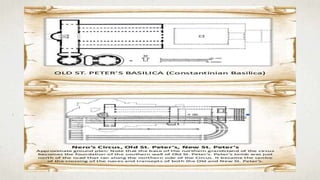
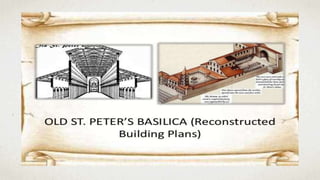
ST.PETER BASILICA {OLD}
 THE SAINT PETER’S CHURCH, ALSO CALLED ST.PETER’S
BASILICA IS A LATE RENAISSANCE CHURCH WITHIN
VATICAN CITY. IT IS EUROPE’S LARGEST CHRISTIAN
CHURCH.
 IT IS THE SECOND CHURCH TO STAND ABOVE THE CRYPT
BELIEVED TO HOLD THE BODY OF SAINT PETER’S THE
FIRST POP.
 ST. PETER’S IS BUILT IN A SHAPE OF CROSS.
 CONSTRUCTION OF PRESENT BASILICA BEGAN ON 18
APRIL 1506 AND WAS COMPLETED ON 18 NOVEMBER 1628
 AS AARCHITECTURE , IT IS REGARDED AS THE
GREATEST BUILDING OF ITS AGE.
 THE CHURCH WAS MODELLED ON THE BASILICA USED
AS A MEETING HALL AND THEN CONTENTINE THE GREAT
BUILD THE CHURCH TO CELEBRATE THE ACCEPTANCE OF
CHRISTIANITY.
 IN 1452 POPE NICOLAS V BEGAN TO RESTORE AND
EXPAND THE CHURCH. THE RESTORATION CONTINUED
TILL 1506WHEN POPE JULIUS II DECIDED TO REBUILD THE
CHURCH.
 DURING ITS CONTRUCTION ,10 DIFFERENT ARCHITECTS
WORKED ON ST. PETER’S AND CHANGED ITS DESIGN
THE EXTERIOR
 THE NEW CHURCH IS DESIGNED BY GIAN LORENZO
BERNINI.
 AN AVENUE ALMOST 1.5 KM LONG LEADS TO TIBER
RIVER , A LARGE OPEN SPACE IN FRONT OF THE CHURCH.
 A RED GRANITE OBELISK (SHAFT) STANDS 26 METERS
HIGH IN THE PIAZZA’S CENTRE .
 THE PIAZZA WHICH WAS COMPLETED IN 1667 CONTAINS
TWO FOUNTAIN AND TWO ROWS OF CLOUMN ARRANGED
IN SEMICIRCULAR ON OPPOSITE SIDES OF PIAZZA.
THE INTERIOR
 THE IN TERIOR PF CHURCH IS BUILD IN BAROQUE STYLE
.
 BERNINI WHO WAS A SCULPTURE, CREATED MANY OF
ITS FAMOUS FEATURE IN THE 1650S.
 HE BUILD THE ELABORATE BRONZE
BALDOCCHINO(CANOPY) OVER THE MAIN ALTER.
 THE FOUR PRINCIPAL DIVISION OF THE BALISICA
EXTENDED FROM THE DOME AND CONNECTED THROUGH
A DOME PIERS.
 THE GENERAL DECORATION CONSISTS OFCOLOURED
MARBLE STUCO FIGURES , RICH GILDING, MOSAIC
DECORATION, AND MARBLE FIGURES ON THE PILASTERS
CEILING AND WALLS.
 NO CHAIRS OR PIEWS OBSTRUCT THE VIEWS OF EYES
ROVES FREELY OVER THE GLITTERING SURFACE OF THE
MARBLE PAVEMENT WHERE THERE IS ROOMS FOR
THOUSANDS OF PEOPLE.
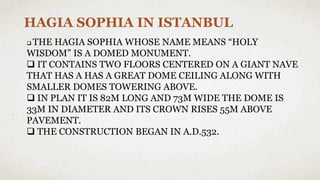
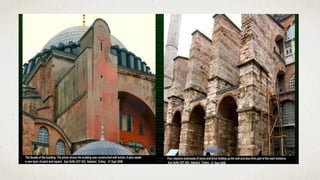
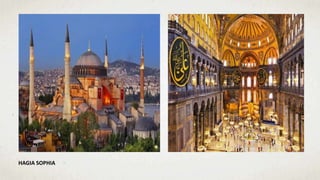
HAGIA SOPHIA IN ISTANBUL
 THE HAGIA SOPHIA WHOSE NAME MEANS “HOLY
WISDOM” IS A DOMED MONUMENT.
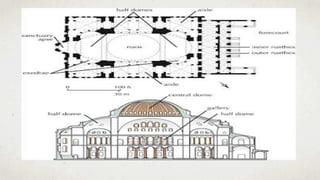
 IT CONTAINS TWO FLOORS CENTERED ON A GIANT NAVE
THAT HAS A HAS A GREAT DOME CEILING ALONG WITH
SMALLER DOMES TOWERING ABOVE.
 IN PLAN IT IS 82M LONG AND 73M WIDE THE DOME IS
33M IN DIAMETER AND ITS CROWN RISES 55M ABOVE
PAVEMENT.
 THE CONSTRUCTION BEGAN IN A.D.532.
 THE MOST IMPRESSIVE FEATURE IS ASIZE OF THE BUILDING THE ENORMOUS INTERIOR SPACE
THAT IT ENCLOSURE.
 ON THE BASE OF DOME THERE IS ROWS OF 40 WINDOWS
 THESE WINDOWS ILLUMINATE THE INTERIOR FORM FROM ALL SIDES AND CREATING AN
IMPRESSION OF LIGHT.
HAGIA SOPHIA
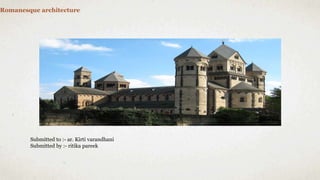
Romanesque architecture
Submitted to :- ar. Kirti varandhani
Submitted by :- ritika pareek
• Romanesque architecture is an architectural style of medieval Europe characterised by semi-circular arches.
• There is no consensus for the beginning date of the Romanesque style, with proposals ranging from the 6th to the
11th century, this later date being the most commonly held.
• It developed in the 12th century into the Gothic style, marked by pointed arches.
• Romanesque is inspired by roman architecture.
What Is Romanesque
architecture?
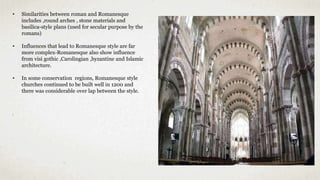
• Similarities between roman and Romanesque
includes ,round arches , stone materials and
basilica-style plans (used for secular purpose by the
romans)
• Influences that lead to Romanesque style are far
more complex-Romanesque also show influence
from visi gothic ,Carolingian ,byzantine and Islamic
architecture.
• In some conservation regions, Romanesque style
churches continued to be built well in 1200 and
there was considerable over lap between the style.
Romanesque architecture
• Combining features of contemporary western roman and byzantine buildings , Romanesque architecture is known by
massive quality, its thick walls, round arches, study piers, groin vaults, large towers and decorative arcading
• Each building has clearly defined forms and they are frequently of very regular, symmetrical plan so that the overall
appearances is one of simplicity when compared with the gothic buildings that were to follow.
• The style can be identified right across Europe, despite regional characteristic and different materials.
Characteristic of Romanesque
• harmonious proportions.
• stone barrel vault or groin vault.
• thick and heavy walls.
• thick and heavy pillars.
• small windows.
• round arches supporting the roof.
• round "blind arches" used extensively for decoration inside and out (especially exteriors).
• nave with side aisles (though some modest churches are aisleless).
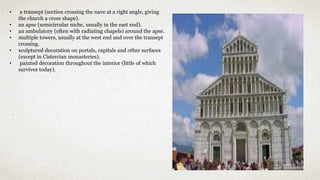
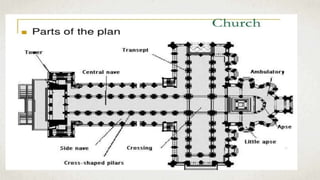
• a transept (section crossing the nave at a right angle, giving
the church a cross shape).
• an apse (semicircular niche, usually in the east end).
• an ambulatory (often with radiating chapels) around the apse.
• multiple towers, usually at the west end and over the transept
crossing.
• sculptured decoration on portals, capitals and other surfaces
(except in Cistercian monasteries).
• painted decoration throughout the interior (little of which
survives today).
Typologies
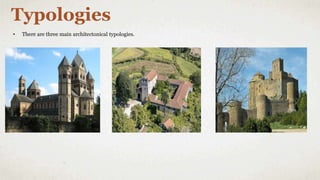
• There are three main architectonical typologies.
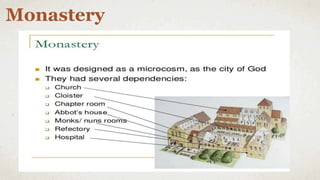
Monastery
Church
• It was the main building.
• It symbolized God’s kingdom.
• The holiest part was the apse.
• It had cross shape.
• Symbolism was important.
Circular parts reflect perfection so they were linked to God.
Squared parts are related to the human.
Characteristics:
Monumental, trying to imitate the Roman models in the Pilgrimage churches.
Small in country churches .
They were designed for advertising Catholic church.
They were lasting, made of stone.
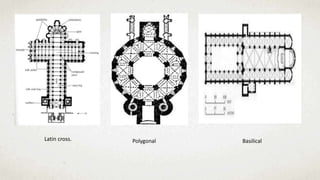
Plans could be:
1- Latin cross.
2- Polygonal .
3- Basilical
Latin cross. Polygonal Basilical
• Parts of the plan.
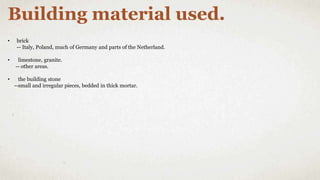
Building material used.
• brick
-- Italy, Poland, much of Germany and parts of the Netherland.
• limestone, granite.
-- other areas.
• the building stone
--small and irregular pieces, bedded in thick mortar.
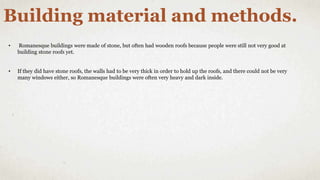
Building material and methods.
• Romanesque buildings were made of stone, but often had wooden roofs because people were still not very good at
building stone roofs yet.
• If they did have stone roofs, the walls had to be very thick in order to hold up the roofs, and there could not be very
many windows either, so Romanesque buildings were often very heavy and dark inside.
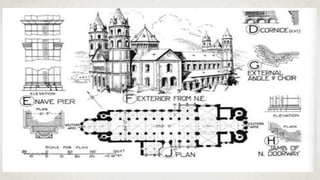
WORMS
CATHEDRAL
(WORMSER DOM)
WORMS, GERMANY
BY HARDIK KAPIL
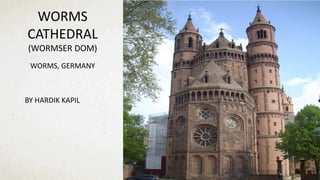
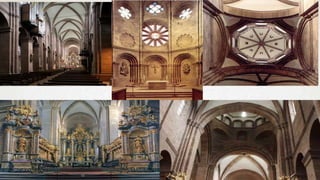
The Cathedral of St. Peter (Wormser Dom, Worms Cathedral) is one of the finest examples of
Romanesque architecture in Germany.
Its original Romanesque architecture and splendid carvings are still exceptionally well-
preserved.
The cathedral was erected on the ruins of an earlier church built in the Romanesque original.
Construction started: 1110
Opened: 1200
Only the ground plan and the lower part of the western towers belong to the original building
consecrated in 1110. The remainder was mostly finished by 1181, but the west choir and the
vaulting were built in the 13th century, the elaborate south portal was added in the 14th
century, and the central dome has been rebuilt.
Features:
Cross shape
Apse (Holiest place)
Naves
Transept
Tower
Ambulatory
Vault
Round arches
Small windows
Symbolism:
Circular parts- Perfection- linked to god
Square parts- related to humans
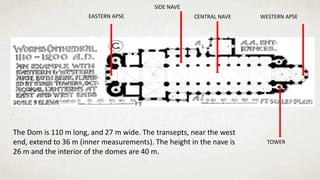
EASTERN APSE
SIDE NAVE
CENTRAL NAVE WESTERN APSE
TOWER
The Dom is 110 m long, and 27 m wide. The transepts, near the west
end, extend to 36 m (inner measurements). The height in the nave is
26 m and the interior of the domes are 40 m.
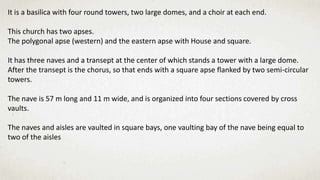
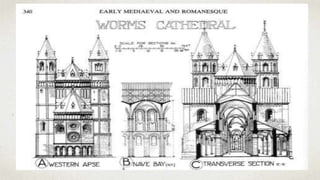
It is a basilica with four round towers, two large domes, and a choir at each end.
This church has two apses.
The polygonal apse (western) and the eastern apse with House and square.
It has three naves and a transept at the center of which stands a tower with a large dome.
After the transept is the chorus, so that ends with a square apse flanked by two semi-circular
towers.
The nave is 57 m long and 11 m wide, and is organized into four sections covered by cross
vaults.
The naves and aisles are vaulted in square bays, one vaulting bay of the nave being equal to
two of the aisles
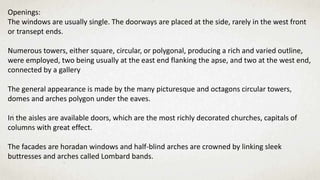
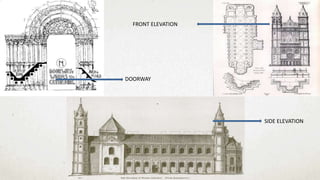
Openings:
The windows are usually single. The doorways are placed at the side, rarely in the west front
or transept ends.
Numerous towers, either square, circular, or polygonal, producing a rich and varied outline,
were employed, two being usually at the east end flanking the apse, and two at the west end,
connected by a gallery
The general appearance is made by the many picturesque and octagons circular towers,
domes and arches polygon under the eaves.
In the aisles are available doors, which are the most richly decorated churches, capitals of
columns with great effect.
The facades are horadan windows and half-blind arches are crowned by linking sleek
buttresses and arches called Lombard bands.
DOORWAY
FRONT ELEVATION
SIDE ELEVATION
ABOUT:
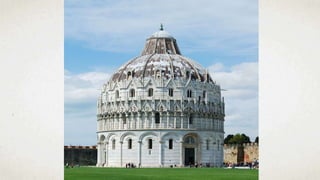
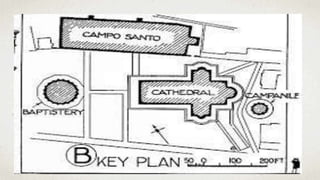
The Pisa Baptistery of St. John is a Roman Catholic ecclesiastical building in Pisa, Italy.
Construction started in 1152 to replace an older baptistery, and when it was completed in 1363, it became the second building, in
chronological order, in the Piazza dei Miracoli, near the Duomo di Pisa and the cathedral's free-standing campanile, the
famous Leaning Tower of Pisa.
The baptistery was designed by Diotisalvi, whose signature can be read on two pillars inside the building, with the date 1153.
The largest baptistery in Italy, it is 54.86 m high, with a diameter of 34.13 m.
The Pisa Baptistery is an example of the transition from the Romanesque style to theGothic style: the lower section is in the
Romanesque style, with rounded arches, while the upper sections are in the Gothic style, with pointed arches.
The Baptistery is constructed of marble.
The portal, facing the facade of the cathedral, is flanked by two classical columns, while the inner jambs are executed in Byzantine
style.
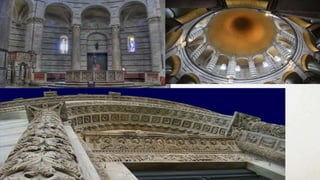
The lintel is divided in two tiers. The lower one depicts several episodes in the life of St. John
the Baptist, while the upper one shows Christ between the Madonna and St John the Baptist,
flanked by angels and the evangelists.
The interior is overwhelming and lacks decoration. The octagonal font at the centre dates
from 1246 and was made by Guido Bigarelli da Como. The bronze sculpture of St. John the
Baptist at the centre of the font, is a work by Italo Griselli.
The pulpit was sculpted between 1255-1260 by Nicola Pisano, father of Giovanni, the artist
who produced the pulpit in the Duomo. The scenes on the pulpit, and especially the classical
form of the nude Hercules, show Nicola Pisano's qualities as the most important precursor
of Italian Renaissance sculpture by reinstating antique representations: surveys of
the Italian Renaissance often begin with the year 1260, the year that Nicola Pisano dated this
pulpit.
Constructed on the same unstable sand as the tower and cathedral, the
Baptistery leans 0.6 degrees toward the cathedral. Originally the shape
of the Baptistery, according to the project by Diotisalvi, was different.
It was perhaps similar to the church of Holy Sepulchre in Pisa, with its
pyramidal roof. After the death of the architect, Nicola Pisano
continued the work, changing the style to the more modern Gothic
one. Also an external roof was added giving the shape of a cupola. As a
side effect of the two roofs, the pyramidal inner one and the domed
external one, the interior is acoustically perfect, making of that space
a resonating chamber.
Earlychristianandbyzantine

Earlychristianandbyzantine

  • 1.
    SUBMITTED TO:- SUBMITTEDBY:- AR. KIRTI VARANDANI HISTORY OF ARCHITECTURE Early Christian and Byzantine Architecture
  • 2.
    Thefall ofthe RomanEmpire? The rise of Christianityinthe Roman empire LatinandByzantine Architecture
  • 3.
    The RomanEmpire Nowsplit into 2 by EmperorDiocletian. Onlyto be reunited by Constantine in the 324 AD. Constantine also legitimized Christianity and thus making RomanEmpire a Christian Empire. Constantine moves the Capital from Rome to Byzantium and renames the city after himself as Constantinople. The empire had become too bigto manage. So Emperor Theodosius divided it in 2 parts and gave one part to each of his 2sons. The eastern half would be ruled from Constantinople for another 1000 years. But The western half ruled from Ravenna in the earlier part and later on from Milan would last only 80 years.
  • 4.
    The single mostimportantsocial phenomenon of the Early Christian period was the spread and acceptance of the Christian religion. During the period from the first century to the third century after the death of Jesus, Christianity was a secret society. This was due to the fact that it was considered dangerous and subversive by the emperors that Christianity was dangerous to their authority and people used to believe that Christians were a threat to their old Pagan religion andbeliefs. Christians met secretly intombs and private houses in places known as house churches. Gradually, however, it spread and became widely accepted in Asia minor and in Rome itself. The religion was tolerated butit did not have any kind of legal status until 313 AD.
  • 5.
    Early Christian artand architecture is the art produced by Christians or under Christian patronage from the earliest period of Christianity, sometime between 260 to 525. Christian art was necessarily and deliberately furtive and ambiguous, using imagery that was shared with pagan culture but had a special meaning for Christians. The earliest surviving Christian art comes from the late 2nd to early 4th centuries on the walls of Christian tombs in the catacombs of Rome. Initially Jesus was represented indirectly by pictogram symbols such as the Ichthys (fish), peacock, Lamb of God,or an anchor.
  • 6.
    EarlyChristian Architecture From severalcompeting religions, Christianity took a dominant role, with its center moving eastward to Constantinople (now Istanbul). Indesign history, a time of conflicting trends begins with the growth of the European direction usually called EarlyChristiandesign,the work centering in the eastern empire called Byzantine,and the emergence of the later Romanesque style that came to dominate medieval Europe. These aspects of design history overlap, interrelate, and to a degree conflict, so that the period from the “fall” of Rome,usually dated at 476, until 1100 can seem disordered and confusing.
  • 7.
    EarlyChristian Architecture Basilica With littlemoney in hand of the Early Christians, it was necessary for them to adopt places of worship which could be readily constructed. Many of the Roman Temples, which were now rendered useless fortheir original purpose, were utilized for the new faith, and in addition new churches built on the model of the old Roman basilicas, and formed of columns and other features from Pagan buildings, were erected. The basilican church with three or five aisles, covered by a wooden roof, is the special type of the style as opposed to the vaulted types of the Byzantine style in which a circular dome was placed over a squarespace by means of the pendentive.
  • 8.
  • 9.
    FalloftheRoman EmpireTimeline A.D.235-284 CrisisoftheThirdCentury Military leaders usurped power,rulers died of unnatural causes, revolts, plagues, fires, Christian persecutions. A.D.285-305 Diocletian splits the Roman Empire in 2, and adds junior emperors, so there are 4 caesars. When Diocletian and Maximian abdicate, there is civil war. A.D.306-337 AcceptanceofChristianity Constantine establishes Christianity and creates a capital for the Roman Empire in the East, in Constantinople.
  • 10.
    FalloftheRoman EmpireTimeline A.D.360-363 FallofOfficial Paganism Julianthe Apostateattemptsto reverse the religious trend to Christianity. August9,378 AD BattleofAdrianople Eastern Roman Emperor Valens is defeated by the Visigoths. A.D.379-395 East- WestSplit Theodosius reunites the Empire, but it doesn'tlast beyond his reign. At his death, the empire is divided by his sons, Arcadius, in the East, and Honorius,in the West. A.D.401-410 SackofRomeVisigoths make incursions into Italy and in the end, under Alaric, sack Rome. This is one date given for the Fall of Rome.
  • 11.
    Fallofthe RomanEmpire Timeline A.D.429-435 VandalsSackNorth AfricaVandals,under Gaiseric, attacknorthern Africa, cuttingoff Roman grain supply. A.D.440-454 HunsAttackHunsunder the leadership of Attila threaten Rome,are paid off,and then attack. A.D.455 VandalsSack Rome A.D.476 FalloftheEmperorof RomeLast western emperor,Romulus Augustulus,is deposedby the barbarian general Odoacer who then rules Italy.
  • 12.
    BYZANTINE EMPIRE ByzantineEmpirewas the continuation ofthe Roman Empirein the Greek- speaking, eastern part of the Mediterranean. It survived the fragmentation or the fall of Western Romanempirein the 5th Centuryand continued to exist for another 1000 years. Christian in nature, it was perennially at war with the Muslims, Flourishing during the reign of the Macedonian emperors, its demise was the consequence of attacks by Seljuk Turks, Crusaders, and Ottoman Turks.
  • 13.
    Byzantiumwas the nameof a small, but important town which connects the Sea of Marmara and separates the continents of Europe and Asia. InGreek times the town was at the frontier between the Greek and the Persian world. Later Byzantium became a town of growing importance with it being the capital city of the EasternRoman Empire. ByzantiumEmpireat its peak
  • 14.
    TIMELINE 285 AD–EmperorDiocletian(r.284–305) dividedthe Roman empire into Greek East and Latin West. 324 –330AD- ConstantinetheGreat(r.306–337) main capital shifted from Rome to Byzantium, later known as Constantinople and NovaRoma. TheodosiusI(r.379–395), Christianitybecame the Empire's official state religion and others such as Roman polytheism were prohibited. JustinianI(r.527–565), the Empire reached its greatest extent. Heraclius(r.610–641), the Empire adopted Greek for official use instead of Latin. Maurice(r.582–602),the Empire's eastern frontier was expanded. Hisassassination was caused in the Byzantine–SasanianWar of 602–628. Macedonian dynasty (10th–11th centuries), the Empire again expanded and experienced the two-century long Macedonian Renaissance, which came to an end with the loss of much of Asia Minor to the Seljuk Turks after the Battle of Manzikert in 1071. 1453 –The fall of Constantinople to the OttomanEmpire.
  • 15.
  • 16.
    St Mark's Basilicain Venice The presbytery of San Vitale Basilica, Ravenna
  • 17.
    IconwiththePresentationofChristin theTemple, 1400–1500 Wood, painted,with gold ground; 17 1/2 x 16 5/8 in. Double–SidedPendantIcon withtheVirginandChrist Pantokrator,ca. 1080–1120 Cloisonné enamel, gold; 1 5/16x 15/16 x 1/16 in. PortableMosaicIconwiththeVirgin Eleousa,early 14th century Miniature mosaic set in wax on wood panel with gold, multicolored stones, and gilded copper tesserae; 4 3/8 x 3 3/8in. ICONS Icons (from the Greek eikones) are sacred images representing the saints, Christ, and the Virgin, as well as narrative scenes such as Christ's Crucifixion. While today the term is most closely associated with wooden panel painting, in Byzantium icons could be crafted in all media, including marble, ivory, ceramic, gemstone, precious metal, enamel, textile, fresco, and mosaic.
  • 18.
    ICONOCLASM ByzantineIconoclasm refers totwo periods in the history of the Byzantine Empire when the use of religious images or icons was opposed by religious and imperial authorities within the Eastern Church and the temporal imperial hierarchy. Traditional explanations for Byzantine iconoclasm have sometimes focused on the importance of Islamic prohibitions against images influencing Byzantine thought. Asimple cross: example of iconoclast art in the Hagia Irene Church in Istanbul. 14th century miniature of the destruction of a church under the orders of the iconoclast emperor Constantine VCopronymus Byzantine Iconoclasm, 9th century
  • 19.
    BYZANTINE ARCHITECTURE InByzantine work,the classicaldetail of Romanarchitecturefaded in favor of limited and freer useof suchbasics asthecolumn andits capital.The engineering skills of ancient Rome were, however, retained and further developed with skillful use of vaulting and domedconstruction. Stylistic drift, technological advancement and political and territorial changes meant that a distinct style gradually resulted in the Greek cross plan inchurch architecture. Buildings increased in geometriccomplexity, brick and plaster were used in addition to stoneinthedecorationof important public structures, mosaics replaced carved decoration, complex domesrested upon massivepiers,and windows filtered light through thin sheets of alabaster. The 11th-century monastery ofHosios Loukas in Greece is representative of the Byzantine art during the rule of the Macedonian dynasty. The apse of the church with cross at Hagia Irene in Turkey.
  • 20.
    Pointedarch bridge Karamagara Bridgein Cappadocia spanned 17 mis the earliest known bridge resting on a pointed arch dates back to the 5th or 6th century AD. Pendentive domeis a construction solution which allows a circular dome to be built atop a rectangular floor plan.
  • 21.
    Capitals sometimes tooka form derived from the Roman Ionic or Corinthian, or consisted in the lower portion of a cube block with rounded corners, over which was placed a deep abacus block, sometimes called a "dosseret “. Columns were used constructively, but were always subordinate features,and often only introduced to support galleries,the massive piers alone supporting the superstructure. Across-in- square or Greek crossplan featuring a square center with an internal structure shaped like a cross, topped by a dome. Ex:Chora Church in Constantinople
  • 22.
  • 23.
    EVOLUTION OF CHURCHARCHITECTURE CHRISTIAN CHURCH ARCHITECTURE INDICATES THE CULTURAL INFLUENCE ON CHRISTIAN AND REFLECT THE SPIRITUAL IDEAS DOMINANT IN THE PERIOD CHURCHES BUILT.  THE ARCHITECTURE OF CHURCH IS INFLUENCED THROUGH THEIR BELIEVES.  THE DESIGN OF CHURCHES CHANGED SUBSTANTLY OVER THE CENTURIES.  ROMAN ARCHITECTURE WAS USED LATER THE BASILICA STYLE BECAME PRACTICAL.
  • 24.
    ST.PETER BASILICA {OLD} THE SAINT PETER’S CHURCH, ALSO CALLED ST.PETER’S BASILICA IS A LATE RENAISSANCE CHURCH WITHIN VATICAN CITY. IT IS EUROPE’S LARGEST CHRISTIAN CHURCH.  IT IS THE SECOND CHURCH TO STAND ABOVE THE CRYPT BELIEVED TO HOLD THE BODY OF SAINT PETER’S THE FIRST POP.  ST. PETER’S IS BUILT IN A SHAPE OF CROSS.  CONSTRUCTION OF PRESENT BASILICA BEGAN ON 18 APRIL 1506 AND WAS COMPLETED ON 18 NOVEMBER 1628
  • 25.
     AS AARCHITECTURE, IT IS REGARDED AS THE GREATEST BUILDING OF ITS AGE.  THE CHURCH WAS MODELLED ON THE BASILICA USED AS A MEETING HALL AND THEN CONTENTINE THE GREAT BUILD THE CHURCH TO CELEBRATE THE ACCEPTANCE OF CHRISTIANITY.  IN 1452 POPE NICOLAS V BEGAN TO RESTORE AND EXPAND THE CHURCH. THE RESTORATION CONTINUED TILL 1506WHEN POPE JULIUS II DECIDED TO REBUILD THE CHURCH.  DURING ITS CONTRUCTION ,10 DIFFERENT ARCHITECTS WORKED ON ST. PETER’S AND CHANGED ITS DESIGN
  • 28.
    THE EXTERIOR  THENEW CHURCH IS DESIGNED BY GIAN LORENZO BERNINI.  AN AVENUE ALMOST 1.5 KM LONG LEADS TO TIBER RIVER , A LARGE OPEN SPACE IN FRONT OF THE CHURCH.  A RED GRANITE OBELISK (SHAFT) STANDS 26 METERS HIGH IN THE PIAZZA’S CENTRE .  THE PIAZZA WHICH WAS COMPLETED IN 1667 CONTAINS TWO FOUNTAIN AND TWO ROWS OF CLOUMN ARRANGED IN SEMICIRCULAR ON OPPOSITE SIDES OF PIAZZA.
  • 29.
    THE INTERIOR  THEIN TERIOR PF CHURCH IS BUILD IN BAROQUE STYLE .  BERNINI WHO WAS A SCULPTURE, CREATED MANY OF ITS FAMOUS FEATURE IN THE 1650S.  HE BUILD THE ELABORATE BRONZE BALDOCCHINO(CANOPY) OVER THE MAIN ALTER.  THE FOUR PRINCIPAL DIVISION OF THE BALISICA EXTENDED FROM THE DOME AND CONNECTED THROUGH A DOME PIERS.
  • 30.
     THE GENERALDECORATION CONSISTS OFCOLOURED MARBLE STUCO FIGURES , RICH GILDING, MOSAIC DECORATION, AND MARBLE FIGURES ON THE PILASTERS CEILING AND WALLS.  NO CHAIRS OR PIEWS OBSTRUCT THE VIEWS OF EYES ROVES FREELY OVER THE GLITTERING SURFACE OF THE MARBLE PAVEMENT WHERE THERE IS ROOMS FOR THOUSANDS OF PEOPLE.
  • 31.
    HAGIA SOPHIA INISTANBUL  THE HAGIA SOPHIA WHOSE NAME MEANS “HOLY WISDOM” IS A DOMED MONUMENT.  IT CONTAINS TWO FLOORS CENTERED ON A GIANT NAVE THAT HAS A HAS A GREAT DOME CEILING ALONG WITH SMALLER DOMES TOWERING ABOVE.  IN PLAN IT IS 82M LONG AND 73M WIDE THE DOME IS 33M IN DIAMETER AND ITS CROWN RISES 55M ABOVE PAVEMENT.  THE CONSTRUCTION BEGAN IN A.D.532.
  • 34.
     THE MOSTIMPRESSIVE FEATURE IS ASIZE OF THE BUILDING THE ENORMOUS INTERIOR SPACE THAT IT ENCLOSURE.  ON THE BASE OF DOME THERE IS ROWS OF 40 WINDOWS  THESE WINDOWS ILLUMINATE THE INTERIOR FORM FROM ALL SIDES AND CREATING AN IMPRESSION OF LIGHT.
  • 35.
  • 36.
    Romanesque architecture Submitted to:- ar. Kirti varandhani Submitted by :- ritika pareek
  • 37.
    • Romanesque architectureis an architectural style of medieval Europe characterised by semi-circular arches. • There is no consensus for the beginning date of the Romanesque style, with proposals ranging from the 6th to the 11th century, this later date being the most commonly held. • It developed in the 12th century into the Gothic style, marked by pointed arches. • Romanesque is inspired by roman architecture. What Is Romanesque architecture?
  • 38.
    • Similarities betweenroman and Romanesque includes ,round arches , stone materials and basilica-style plans (used for secular purpose by the romans) • Influences that lead to Romanesque style are far more complex-Romanesque also show influence from visi gothic ,Carolingian ,byzantine and Islamic architecture. • In some conservation regions, Romanesque style churches continued to be built well in 1200 and there was considerable over lap between the style.
  • 39.
    Romanesque architecture • Combiningfeatures of contemporary western roman and byzantine buildings , Romanesque architecture is known by massive quality, its thick walls, round arches, study piers, groin vaults, large towers and decorative arcading • Each building has clearly defined forms and they are frequently of very regular, symmetrical plan so that the overall appearances is one of simplicity when compared with the gothic buildings that were to follow. • The style can be identified right across Europe, despite regional characteristic and different materials.
  • 40.
    Characteristic of Romanesque •harmonious proportions. • stone barrel vault or groin vault. • thick and heavy walls. • thick and heavy pillars. • small windows. • round arches supporting the roof. • round "blind arches" used extensively for decoration inside and out (especially exteriors). • nave with side aisles (though some modest churches are aisleless).
  • 41.
    • a transept(section crossing the nave at a right angle, giving the church a cross shape). • an apse (semicircular niche, usually in the east end). • an ambulatory (often with radiating chapels) around the apse. • multiple towers, usually at the west end and over the transept crossing. • sculptured decoration on portals, capitals and other surfaces (except in Cistercian monasteries). • painted decoration throughout the interior (little of which survives today).
  • 42.
    Typologies • There arethree main architectonical typologies.
  • 43.
  • 44.
    Church • It wasthe main building. • It symbolized God’s kingdom. • The holiest part was the apse. • It had cross shape. • Symbolism was important. Circular parts reflect perfection so they were linked to God. Squared parts are related to the human.
  • 45.
    Characteristics: Monumental, trying toimitate the Roman models in the Pilgrimage churches. Small in country churches . They were designed for advertising Catholic church. They were lasting, made of stone. Plans could be: 1- Latin cross. 2- Polygonal . 3- Basilical
  • 46.
  • 47.
    • Parts ofthe plan.
  • 48.
    Building material used. •brick -- Italy, Poland, much of Germany and parts of the Netherland. • limestone, granite. -- other areas. • the building stone --small and irregular pieces, bedded in thick mortar.
  • 49.
    Building material andmethods. • Romanesque buildings were made of stone, but often had wooden roofs because people were still not very good at building stone roofs yet. • If they did have stone roofs, the walls had to be very thick in order to hold up the roofs, and there could not be very many windows either, so Romanesque buildings were often very heavy and dark inside.
  • 50.
  • 51.
    The Cathedral ofSt. Peter (Wormser Dom, Worms Cathedral) is one of the finest examples of Romanesque architecture in Germany. Its original Romanesque architecture and splendid carvings are still exceptionally well- preserved. The cathedral was erected on the ruins of an earlier church built in the Romanesque original. Construction started: 1110 Opened: 1200 Only the ground plan and the lower part of the western towers belong to the original building consecrated in 1110. The remainder was mostly finished by 1181, but the west choir and the vaulting were built in the 13th century, the elaborate south portal was added in the 14th century, and the central dome has been rebuilt.
  • 52.
    Features: Cross shape Apse (Holiestplace) Naves Transept Tower Ambulatory Vault Round arches Small windows Symbolism: Circular parts- Perfection- linked to god Square parts- related to humans
  • 53.
    EASTERN APSE SIDE NAVE CENTRALNAVE WESTERN APSE TOWER The Dom is 110 m long, and 27 m wide. The transepts, near the west end, extend to 36 m (inner measurements). The height in the nave is 26 m and the interior of the domes are 40 m.
  • 54.
    It is abasilica with four round towers, two large domes, and a choir at each end. This church has two apses. The polygonal apse (western) and the eastern apse with House and square. It has three naves and a transept at the center of which stands a tower with a large dome. After the transept is the chorus, so that ends with a square apse flanked by two semi-circular towers. The nave is 57 m long and 11 m wide, and is organized into four sections covered by cross vaults. The naves and aisles are vaulted in square bays, one vaulting bay of the nave being equal to two of the aisles
  • 55.
    Openings: The windows areusually single. The doorways are placed at the side, rarely in the west front or transept ends. Numerous towers, either square, circular, or polygonal, producing a rich and varied outline, were employed, two being usually at the east end flanking the apse, and two at the west end, connected by a gallery The general appearance is made by the many picturesque and octagons circular towers, domes and arches polygon under the eaves. In the aisles are available doors, which are the most richly decorated churches, capitals of columns with great effect. The facades are horadan windows and half-blind arches are crowned by linking sleek buttresses and arches called Lombard bands.
  • 56.
  • 60.
    ABOUT: The Pisa Baptisteryof St. John is a Roman Catholic ecclesiastical building in Pisa, Italy. Construction started in 1152 to replace an older baptistery, and when it was completed in 1363, it became the second building, in chronological order, in the Piazza dei Miracoli, near the Duomo di Pisa and the cathedral's free-standing campanile, the famous Leaning Tower of Pisa. The baptistery was designed by Diotisalvi, whose signature can be read on two pillars inside the building, with the date 1153.
  • 61.
    The largest baptisteryin Italy, it is 54.86 m high, with a diameter of 34.13 m. The Pisa Baptistery is an example of the transition from the Romanesque style to theGothic style: the lower section is in the Romanesque style, with rounded arches, while the upper sections are in the Gothic style, with pointed arches. The Baptistery is constructed of marble. The portal, facing the facade of the cathedral, is flanked by two classical columns, while the inner jambs are executed in Byzantine style.
  • 63.
    The lintel isdivided in two tiers. The lower one depicts several episodes in the life of St. John the Baptist, while the upper one shows Christ between the Madonna and St John the Baptist, flanked by angels and the evangelists. The interior is overwhelming and lacks decoration. The octagonal font at the centre dates from 1246 and was made by Guido Bigarelli da Como. The bronze sculpture of St. John the Baptist at the centre of the font, is a work by Italo Griselli. The pulpit was sculpted between 1255-1260 by Nicola Pisano, father of Giovanni, the artist who produced the pulpit in the Duomo. The scenes on the pulpit, and especially the classical form of the nude Hercules, show Nicola Pisano's qualities as the most important precursor of Italian Renaissance sculpture by reinstating antique representations: surveys of the Italian Renaissance often begin with the year 1260, the year that Nicola Pisano dated this pulpit.
  • 65.
    Constructed on thesame unstable sand as the tower and cathedral, the Baptistery leans 0.6 degrees toward the cathedral. Originally the shape of the Baptistery, according to the project by Diotisalvi, was different. It was perhaps similar to the church of Holy Sepulchre in Pisa, with its pyramidal roof. After the death of the architect, Nicola Pisano continued the work, changing the style to the more modern Gothic one. Also an external roof was added giving the shape of a cupola. As a side effect of the two roofs, the pyramidal inner one and the domed external one, the interior is acoustically perfect, making of that space a resonating chamber.