INTRODUCTION
• In the past most drugs have been discovered either by
identifying the active ingredient from traditional remedies or
by serendipitous discovery.
• But now we know diseases are controlled at molecular and
physiological level.
• Also shape of an molecule at atomic level is well understood.
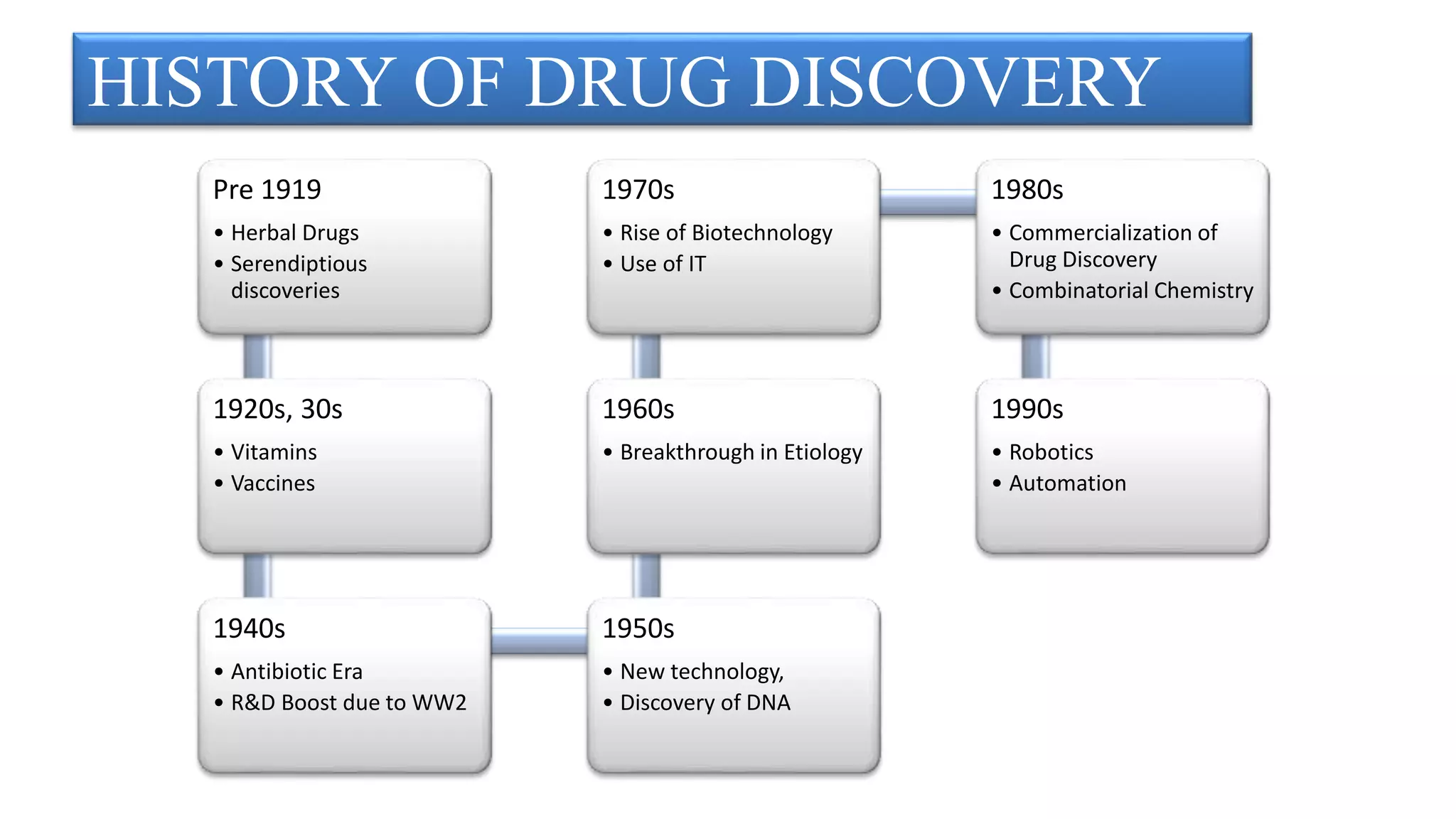
HISTORY OF DRUG DISCOVERY
Pre 1919
• Herbal Drugs
• Serendiptious
discoveries
1920s, 30s
• Vitamins
• Vaccines
1940s
• Antibiotic Era
• R&D Boost due to WW2
1950s
• New technology,
• Discovery of DNA
1960s
• Breakthrough in Etiology
1970s
• Rise of Biotechnology
• Use of IT
1980s
• Commercialization of
Drug Discovery
• Combinatorial Chemistry
1990s
• Robotics
• Automation
TOP COMPANIES BY R&D EXPENSE
Sr. No. Company R & D spend($bn)
1 Novartis 7.9
2 Merck & Co 8.1
3 Roche 7.8
4 GlaxoSmithKline 5.7
5 Sanofi 5.8
6 Pfizer 9.1
7 Johnson & Johnson 4.5
8 Eli Lilly 4.7
9 AstraZeneca 4.2
10 Takeda 3.4
11 Bayer 2.3
12 Bristol-Myers Squibb 3.3
13 Boehringer Ingelheim 3.1
14 Amgen 2.8
15 Novo Nordisk 1.7
THE PROCESSTHE PROCESS
In broader sense drug discovery and development can be defined
• “A process that starts with the identification of disease and therapeutic
target of interest and include methodology, assay development ,lead
identification and characterization in vitro ,formulation and animal
pharmacological studies ,pharmacokinetics and safety studies in animals
and clinical studies in the human .”Different stages include
 Basic research
 Feasibility studies
 Programme
 Non-Clinical development
 Clinical Development
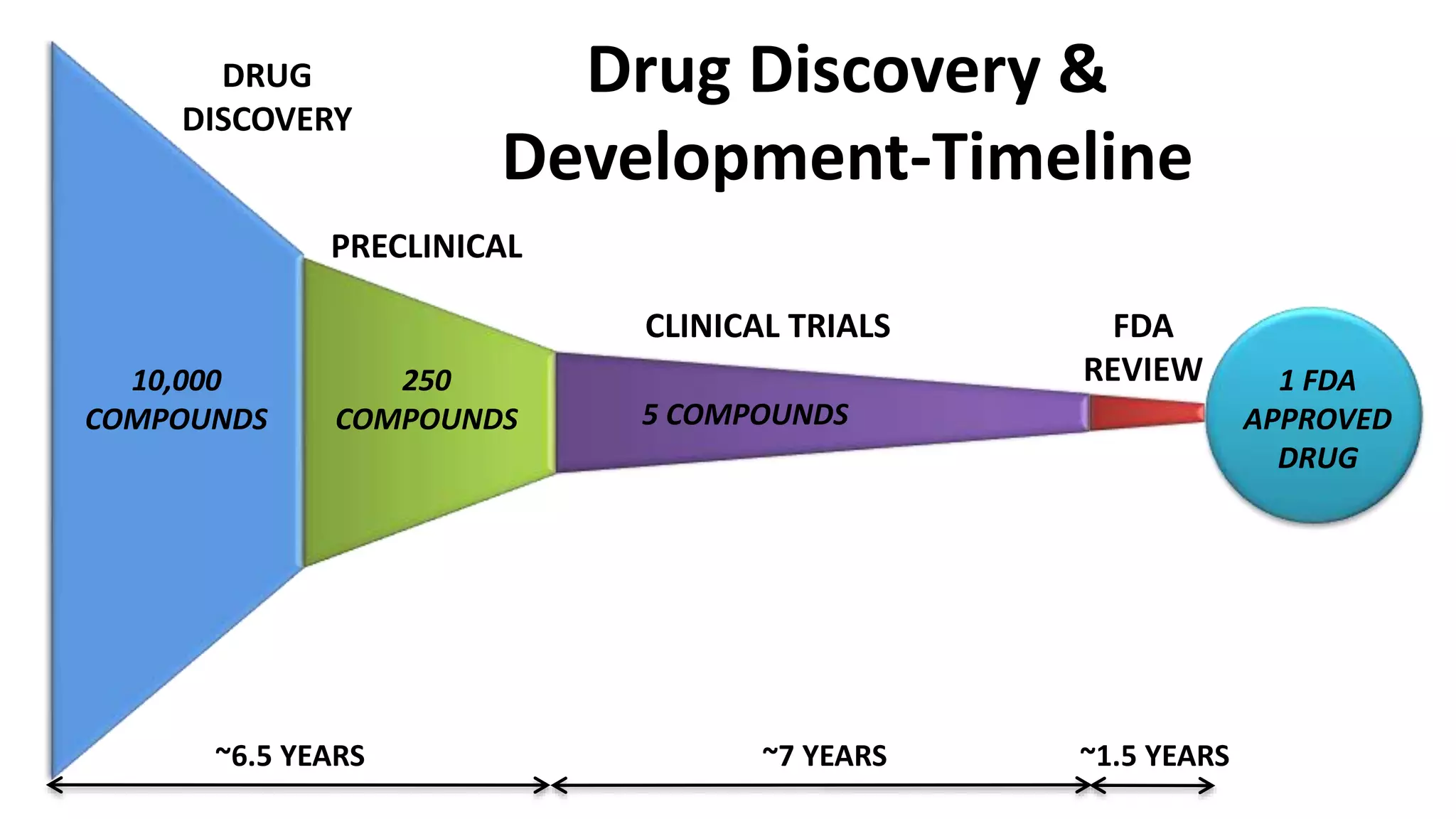
10,000
COMPOUNDS
250
COMPOUNDS 5 COMPOUNDS
1 FDA
APPROVED
DRUG
~6.5 YEARS ~7 YEARS ~1.5 YEARS
DRUG
DISCOVERY
PRECLINICAL
CLINICAL TRIALS FDA
REVIEW
Drug Discovery &
Development-Timeline
Target
Selection
• Cellular and
Genetic
Targets
• Genomics
• Proteomics
• Bioinformatics
Lead
Discovery
• Synthesis and
Isolation
• Combinatorial
Chemistry
• Assay
development
• High-
Throughput
Screening
Medicinal
Chemistry
• Library
Development
• SAR Studies
• In Silico
Screening
• Chemical
Synthesis
In Vitro
Studies
• Drug Affinity
and
Selectivity
• Cell Disease
Models
• MOA
• Lead
Candidate
Refinement
Preclinical
studies
• Animal
models of
Disease States
• Behavioural
Studies
• Functional
Imaging
• Ex-Vivo
Studies
Clinical
Trials and
Therapeutics
DRUG DISCOVERY
• It is phase during which the candidates or target of interest are selected on
the basis of their pharmacological bases
• Drugs Discovery methods:
– Random Screening
– Molecular Designing
– Drug Metabolites
– Serendipity
Target Selection Lead
Discovery
Medicinal
Chemistry
In Vitro
Studies
Preclinical
studies
Clinical
Trials
Cellular &
Genetic Targets
Genomics
Proteomics
Bioinformatics
TARGET SELECTION
• Target selection in drug discovery is defined as the decision to focus
on finding an agent with a particular biological action that is
anticipated to have therapeutic utility
• Target identification: to identify molecular targets that are involved in
disease progression.
• Target validation: to prove that manipulating the molecular target can
provide therapeutic benefit for patients.
Target Selection Lead
Discovery
Medicinal
Chemistry
In Vitro
Studies
Preclinical
studies
Clinical
Trials
Cellular &
Genetic Targets
Genomics
Proteomics
Bioinformatics
TARGET SELECTION
Biochemical Classes of Drug Targets
 G-protein coupled receptors - 45%
 enzymes - 28%
 hormones and factors - 11%
 ion channels - 5%
 nuclear receptors - 2%
Techniques for Target Identification
Target Selection Lead
Discovery
Medicinal
Chemistry
In Vitro
Studies
Preclinical
studies
Clinical
Trials
Cellular &
Genetic Targets
Genomics
Proteomics
Bioinformatics
Cellular & Genetic Targets
•Involves the identification of the function of a
potential therapeutic drug target and its role in
the disease process
•Drugs usually act on either cellular or genetic
chemicals in the body, known as targets, which
are believed to be associated with disease.
Target Selection Lead
Discovery
Medicinal
Chemistry
In Vitro
Studies
Preclinical
studies
Clinical
Trials
Cellular &
Genetic Targets
Genomics
Proteomics
Bioinformatics
 Genomics
•The study of genes and their function. Genomics
aims to understand the structure of the genome,
including the mapping genes and sequencing the
DNA.
•Human Genome consists of a sequence of around 3
billion nucleotides (the A C G T bases) which in turn
probably encode 35,000 – 50,000 genes.
Target Selection Lead
Discovery
Medicinal
Chemistry
In Vitro
Studies
Preclinical
studies
Clinical
Trials
Cellular &
Genetic Targets
Genomics
Proteomics
Bioinformatics
Proteomics
•It is the study of the proteome, the complete set of proteins
produced by a species, using the technologies of large –
scale protein separation and identification.
•It is also at the protein level that disease processes become
manifest, and at which most (91%) drugs act.
•Therefore, the analysis of proteins (including protein-protein,
protein-nucleic acid, and protein ligand interactions) will be
utmost importance to target discovery.
Target Selection Lead
Discovery
Medicinal
Chemistry
In Vitro
Studies
Preclinical
studies
Clinical
Trials
Cellular &
Genetic Targets
Genomics
Proteomics
Bioinformatics
Continued….
•Proteomics is the systematic high-throughput
separation and characterization of proteins
within biological systems.
•Target identification with proteomics is
performed by comparing the protein
expression levels in normal and diseased
tissues.
Target Selection Lead
Discovery
Medicinal
Chemistry
In Vitro
Studies
Preclinical
studies
Clinical
Trials
Cellular &
Genetic Targets
Genomics
Proteomics
Bioinformatics
Bioinformatics
Bioinformatics is a branch of molecular biology that involves extensive
analysisof biological data using computers, for the purpose of enhancing
biological research.
It plays a key role in various stages of the drug discovery process including
 target identification
 computer screening of chemical compounds and
Target Selection Lead
Discovery
Medicinal
Chemistry
In Vitro
Studies
Preclinical
studies
Clinical
Trials
Cellular &
Genetic Targets
Genomics
Proteomics
Bioinformatics
Continued…
•Bioinformatics methods are used to transform the raw sequence
into meaningful information (eg. genes and their encoded
proteins) and to compare whole genomes (disease vs. not).
•Can compare the entire genome of pathogenic and non-
pathogenic strains of a microbe and identify genes/proteins
associated with pathogenism
•Using gene expression micro arrays and gene chip technologies, a
single device can be used to evaluate and compare the expression
of up to 20000 genes of healthy and diseased individuals at once
Target Selection Lead
Discovery
Medicinal
Chemistry
In Vitro
Studies
Preclinical
studies
Clinical
Trials
Synthesis and
Isolation
Combinatorial
Chemistry
Assay
Development
High
Throughput
Screening
LEAD DISCOVERY
• A lead compound is an organic molecule that act as
a prototype drug around which further optimization
is centered and focused”
• Identification of small molecule modulators of
protein function
• The process of transforming these into high-content
lead series.
Target Selection Lead
Discovery
Medicinal
Chemistry
In Vitro
Studies
Preclinical
studies
Clinical
Trials
Synthesis and
Isolation
Combinatorial
Chemistry
Assay
Development
High
Throughput
Screening
Synthesis and Isolation
• Separation of mixture
• Separation of impurities
• In vitro chemical synthesis
• Biosynthetic intermediate
Approaches For Lead Discovery
Serendipity:
• It is to follow when chance is very less. It has been the historically the most successful way of
discovering the drugs. E.g discovery of lavemisol,Vaproic acid.
Endogenous Source:
• Human disease arises from disturbance of the normal biochemical processes. A logical
therapeutic approach is the administration of one or more of these naturally occurring
endogenous molecules or their analougues.The most important approach under this source is
Peptidomimetic Chemistry using non-peptides to mimic endogenous peptide activity.
Target Selection Lead
Discovery
Medicinal
Chemistry
In Vitro
Studies
Preclinical
studies
Clinical
Trials
Continued…
Exogenous Source: (Ethanobotany or Ethanopharmacology)
• The molecules which are endogenous to the other life form such as plants and animals but do
not occur naturally within human body ,such molecules are classed as exogenous molecule for
prospective of drug designing for human beings
Rational Drug Design
• Approximately 2000 small molecules that theoretically exist in our world out of which
1052 are drug like molecules and many of which are purely synthetic and cannot occur
naturally. Thus there is an opportunity to explore the none naturally occurring synthetic
compounds as potential source of lead compound
Target Selection Lead
Discovery
Medicinal
Chemistry
In Vitro
Studies
Preclinical
studies
Clinical
Trials
Synthesis and
Isolation
Combinatorial
Chemistry
Assay
Development
High
Throughput
Screening
Continued…
Combinatorial Chemistry
Rapid synthesis of or computer simulation of large no. of different but
structurally related molecules
• Search new leads
• Optimization of target affinity & selectivity.
• ADME properties
• Reduce toxicity and eliminate side effects
Target Selection Lead
Discovery
Medicinal
Chemistry
In Vitro
Studies
Preclinical
studies
Clinical
Trials
Synthesis and
Isolation
Combinatorial
Chemistry
Assay
Development
High
Throughput
Screening
Continued…
High throughput screening
• It refers to the process by which pharmaceutical companies are able to obtain
initial screening data up to 1 million compounds testing against as many as 50
different biological targets/years. This expansion of data collection by several
orders of magnitude is primarily due to advancement in Robotics,
combinatorial chemistry and instrumentation.
• Screening of drug target against selection of chemicals.
• Identification of highly target specific compounds.
Target Selection Lead
Discovery
Medicinal
Chemistry
In Vitro
Studies
Preclinical
studies
Clinical
Trials
Assay Development
• Used for measuring the activity of a drug.
• Discriminate between compounds.
• Evaluate:
• Expressed protein targets.
• Enzyme/ substrate interactions.
Synthesis and
Isolation
Combinatorial
Chemistry
Assay
Development
High
Throughput
Screening
Target Selection Lead
Discovery
Medicinal
Chemistry
In Vitro
Studies
Preclinical
studies
Clinical
Trials
Library
Development
SAR Studies
In Silico
Screening
Chemical
Synthesis
MEDICINAL CHEMISTRY
• It’s a discipline at the intersection of synthetic organic chemistry and
pharmacology.
• Focuses on small organic molecules (and not on biologics and
inorganic compounds)
• Used in
• Drug discovery (hits)
• Lead optimization (hit to lead)
Target Selection Lead
Discovery
Medicinal
Chemistry
In Vitro
Studies
In Vivo
Studies
Clinical
Trials
Library
Development
SAR Studies
In Silico
Screening
Chemical
Synthesis
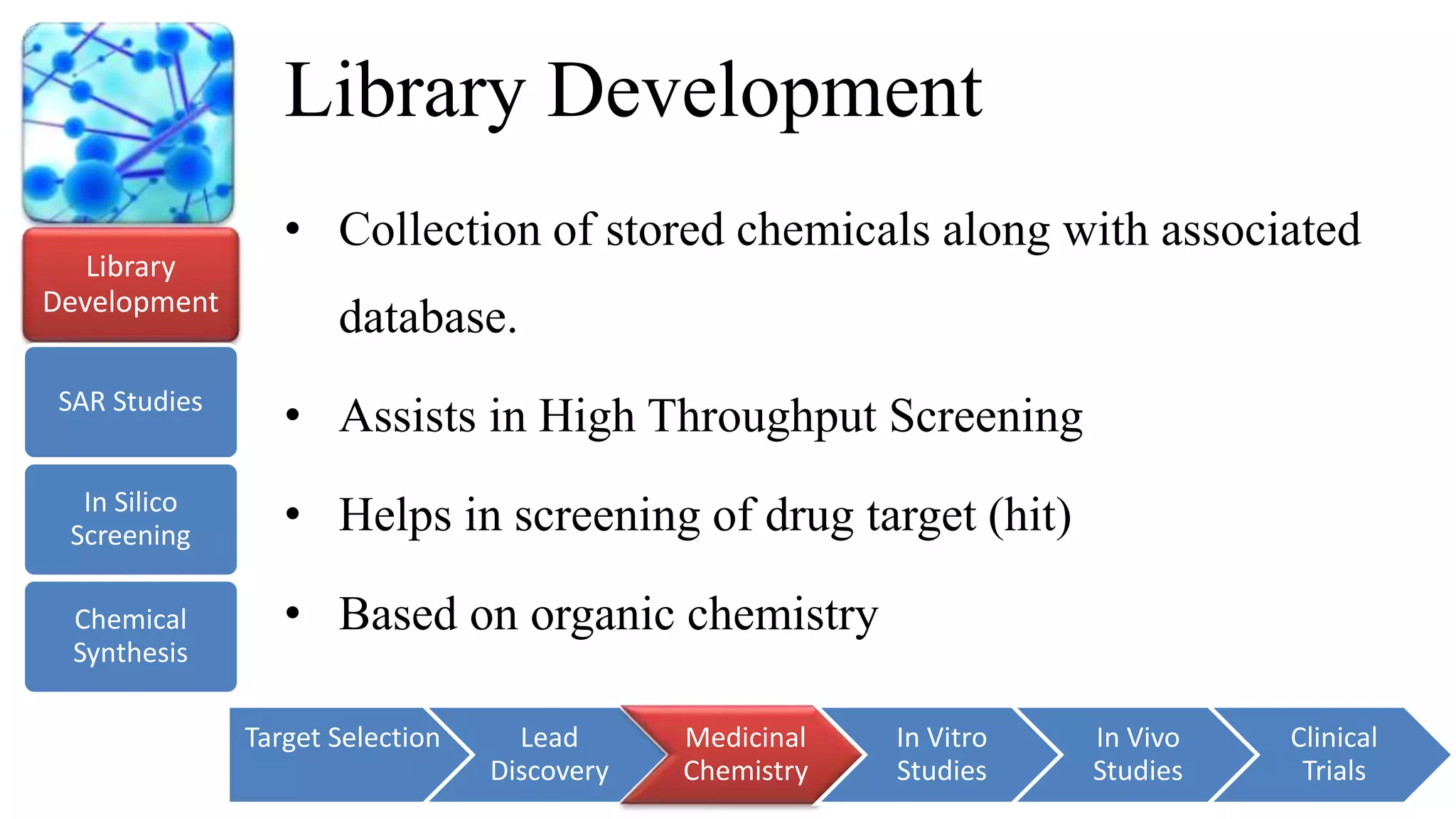
Library Development
• Collection of stored chemicals along with associated
database.
• Assists in High Throughput Screening
• Helps in screening of drug target (hit)
• Based on organic chemistry
Target Selection Lead
Discovery
Medicinal
Chemistry
In Vitro
Studies
In Vivo
Studies
Clinical
Trials
Library
Development
SAR Studies
In Silico
Screening
Chemical
Synthesis
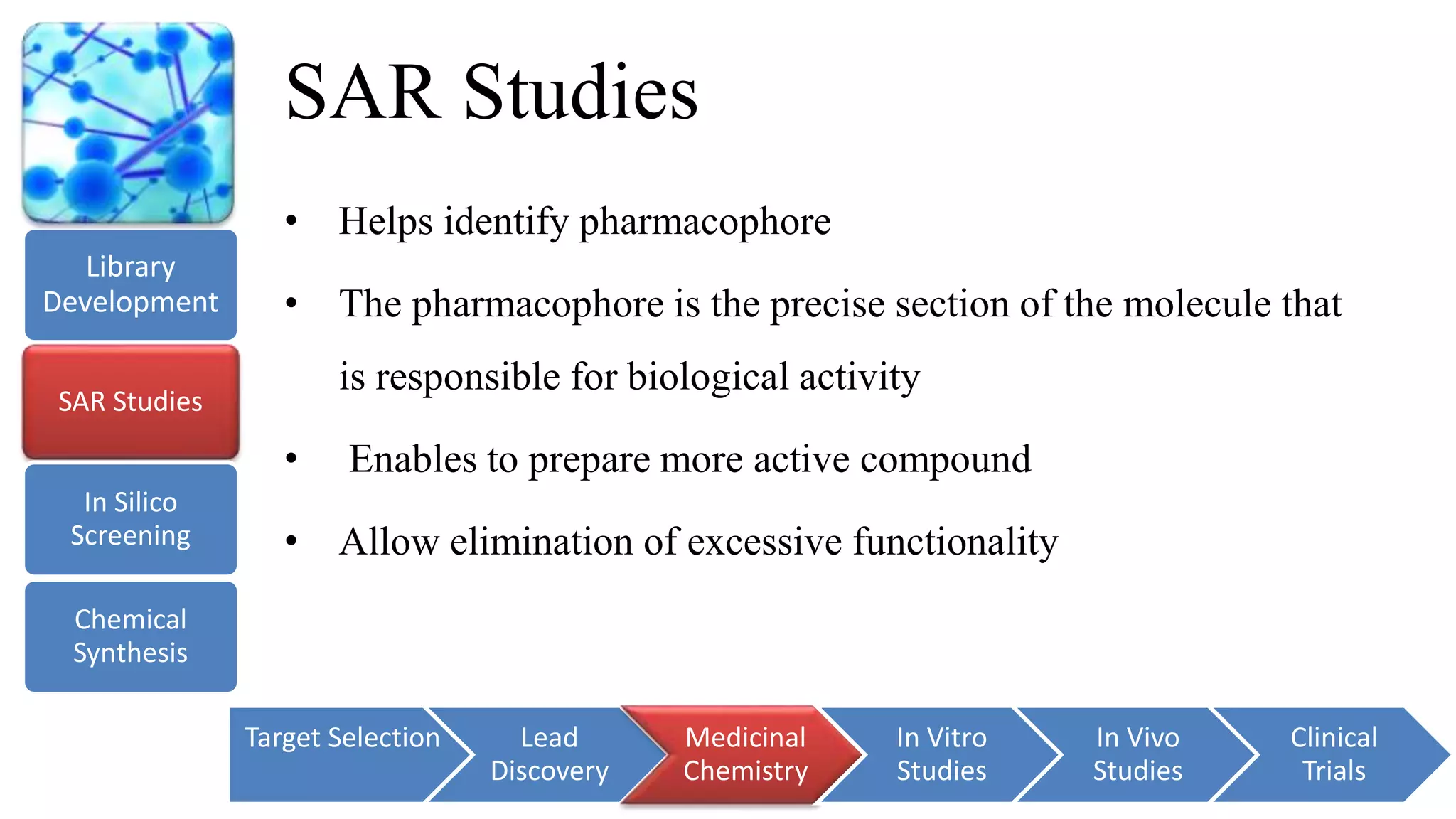
SAR Studies
• Helps identify pharmacophore
• The pharmacophore is the precise section of the molecule that
is responsible for biological activity
• Enables to prepare more active compound
• Allow elimination of excessive functionality
Target Selection Lead
Discovery
Medicinal
Chemistry
In Vitro
Studies
Preclinical
studies
Clinical
Trials
Library
Development
SAR Studies
In Silico
Screening
Chemical
Synthesis
In silico screening
• Computer simulated screening of chemicals
• Helps in finding structures that are most likely to
bind to drug target.
• Economic than HTS
Target Selection Lead
Discovery
Medicinal
Chemistry
In Vitro
Studies
Preclinical
studies
Clinical
Trials
Library
Development
SAR Studies
In Silico
Screening
Chemical
Synthesis
Chemical Synthesis
• Involve production of lead compound in suitable quantity
and quality to allow large scale animal and eventual,
extensive human clinical trials
• Optimization of chemical route for bulk industrial
production.
• Suitable drug formulation
Target Selection Lead
Discovery
Medicinal
Chemistry
In Vitro
Studies
Preclinical
studies
Clinical
Trials
Drug Affinity
and Selectivity
Cell Disease
Models
MOA
Lead Candidate
Refinement
In Vitro Studies
• (In glass) studies using component of organism i.e. test tube
experiments
• Examples-
• Cells derived from multicellular organisms
• Subcellular components (Ribosomes, mitochondria)
• Cellular/ subcellular extracts (wheat germ, reticulocyte
extract)
• Purified molecules (DNA,RNA)
PRECLINICAL STUDIES
• The aim of this stage is to satisfy all the requirements that have to be met
before a new compound is deemed ready to be tested for the first time in
humans. The work falls into four categories
• Pharmacological testing
• Preliminary Toxicological testing
• Pharmacokinetics studies i.e ADME studies
• Chemical and pharmaceutical assessment to assess the feasibility of large scale
synthesis and purification.
Animal models
of Disease States
Behavioural
Studies
Functional
Imaging
Ex-Vivo
Studies
Target Selection Lead
Discovery
Medicinal
Chemistry
In Vitro
Studies
Preclinical
studies
Clinical
Trials
Target Selection Lead
Discovery
Medicinal
Chemistry
In Vitro
Studies
Preclinical
studies
Clinical
Trials
Animal models of
Disease States
Behavioural
Studies
Functional
Imaging
Ex-Vivo Studies
PRECLINICAL STUDIES
• Its experimentation using a whole, living organism.
• Gives information about,
• Metabolic profile
• Toxicology
• Drug interaction
Target Selection Lead
Discovery
Medicinal
Chemistry
In Vitro
Studies
Preclinical
studies
Clinical
Trials
Animal models of
Disease States
Behavioural
Studies
Functional
Imaging
Ex-Vivo Studies
Animal models of disease states
• Test conditions involving induced disease or injury similar to
human conditions.
• Must be equivalent in mechanism of cause.
• Can predict human toxicity in 71% of the cases.
• Eg. SCID mice-HIV
Target Selection Lead
Discovery
Medicinal
Chemistry
In Vitro
Studies
Preclinical
studies
Clinical
Trials
Animal models of
Disease States
Behavioural
Studies
Functional
Imaging
Ex-Vivo Studies
Behavioural Studies
• Tools to investigate behavioural results of drugs.
• Used to observe depression and mental disorders..
• Example:
• Despair based- Forced swimming/ Tail suspension
• Reward based
• Anxiety Based
Target Selection Lead
Discovery
Medicinal
Chemistry
In Vitro
Studies
Preclinical
Studies
Clinical
Trials
Animal models of
Disease States
Behavioural
Studies
Functional
Imaging
Ex-Vivo Studies
Functional Imaging
• Method of detecting or measuring changes in metabolism,
blood flow, regional chemical composition, and absorption.
• Tracers are used
• MRI
• CT-Scan
Target Selection Lead
Discovery
Medicinal
Chemistry
In Vitro
Studies
Preclinical
studies
Clinical
Trials
Animal models of
Disease States
Behavioural
Studies
Functional
Imaging
Ex-Vivo Studies
Ex-Vivo Studies
• Experimentation on tissue in an artificial environment outside the
organism with the minimum alteration of natural conditions.
• Counters ethical issues.
• Examples:
• Measurement of tissue properties
• Realistic models for surgery
Target Selection Lead
Discovery
Medicinal
Chemistry
In Vitro
Studies
Preclinical
studies
Clinical
Trials
Phase-I
Phase-II
Phase-III
Phase-IV
CLINICAL TRIALS
• Set of procedures in medical research and drug
development to study the safety and efficacy of new drug.
• Essential to get marketing approval from regulatory
authorities.
• May require upto 7 years.
Target Selection Lead
Discovery
Medicinal
Chemistry
In Vitro
Studies
Preclinical
studies
Clinical
Trials
Phase-I
Phase-II
Phase-III
Phase-IV
Phase I:
• Clinical Pharmacologic Evaluation
• First stage of testing in human subjects.
• 20-50 Healthy Volunteers
• Concerned With:
– Human Toxicity.
– Tolerated Dosage Range
– Pharma-cology/dynamics
Target Selection Lead
Discovery
Medicinal
Chemistry
In Vitro
Studies
Preclinical
studies
Clinical
Trials
Phase-I
Phase-II
Phase-III
Phase-IV
Phase II:
• Controlled Clinical Evaluation.
• 50-300 Patients
• Controlled Single Blind Technique
• Concerned With:
– Safety
– Efficacy
– Drug Toxicity&Drug Interaction
Target Selection Lead
Discovery
Medicinal
Chemistry
In Vitro
Studies
Preclinical
studies
Clinical
Trials
Phase-I
Phase-II
Phase-III
Phase-IV
Phase III:
• Extended Clinical Trials.
• Most expensive & time consuming.
• 250-1000 Patients.
• Controlled Double Blind Technique.
• Concerned With:
– Safety, Efficacy
– Comparison with other Drugs
– Package Insert
Target Selection Lead
Discovery
Medicinal
Chemistry
In Vitro
Studies
Preclinical
studies
Clinical
Trials
Phase-I
Phase-II
Phase-III
Phase-IV
Phase IV:
• Post Marketing Surveillance.
• Designed to detect any rare or long-term adverse effects.
• Adverse Drug Reaction Monitoring
ABSTRACT 1
• A review article highlight the use of genomics and proteomics in pharmaceutical drug discovery and
development stating that One of the most pressing issues facing the pharmaceutical industry is the
tremendous dropout rate of lead drug candidates. Genomics and proteomics are today well established in
drug discovery and development, in combination with combinatorial chemistry and high-throughput
screening, are helping to bring forward a matchless number of potential lead compounds. Over the last two
decades, several new genomic technologies have been developed in hopes of addressing the issues of target
identification and lead candidate optimization. Proteomics is a technology platform that is gaining
widespread use in drug discovery and drug development programs. Defined as the protein complement of
the genome, the proteome is a varied and dynamic repertoire of molecules that in many ways dictates the
functional form that is taken by the genome. We focus in this article on recent progress and innovations
utilizing “omics” technologies to identify and validate drug targets, discover disease biomarkers, and design
more effective drugs.( SHARMA NEHA and HARIKUMAR S.L,2013)4
ABSTRACT 2
• A study carried out by Abdul Wadood et al(2014) on the in silico technique illustrates that Hepatitis C virus (HCV) infection
is an alarming and growing threat to public health. The present treatment gives limited efficacy and is poorly tolerated,
recommending the urgent medical demand for novel therapeutics. NS3/4A protease is a significant emerging target for the
treatment of HCV infection. This work reports the complex-based pharmacophore modeling to find out the important
pharmacophoric features essential for the inhibition of both protease and helicase activity of NS3/4A protein of HCV. A seven
featured pharmacophore model of HCV NS3/4A protease was developed from the crystal structure of NS3/4A protease in
complex with a macrocyclic inhibitor interacting with both protease and helicase sites residues via MOE pharmacophore
constructing tool. It consists of four hydrogen bond acceptors (Acc), one hydrophobic (Hyd), one for lone pair or active
hydrogen (Atom L) and a heavy atom feature (Atom Q). The generated pharmacophore model was validated by a test
database of seventy known inhibitors containing 55 active and 15 inactive/least active compounds. The validated
pharmacophore model was used to virtually screen the ChemBridge database. As a result of screening 1009 hits were
retrieved and were subjected to filtering by Lipinski’s rule of five on the basis of which 786 hits were selected for further
assessment using molecular docking studies. Finally, 15 hits of different scaffolds having interactions with important active
site residues were predicted as lead candidates. These candidates having unique scaffolds have a strong likelihood to act as
further starting points in the development of novel and potent NS3/4A protease inhibitors.( Abdul Wadood,et al,2014)6
)
RECENTLY APPROVED DRUGS
BY FDA(2014
Generic Therapeutic Use
Testosterone undecanoate Treatment of hypogonadism
Dapagliflozin Type II diabetes
Droxidopa Neurogenic orthostatic hypotension
Ibrutinib Chronic lymphocytic leukemia
Tasimelteon Non-24-hour sleep-wake disorder
Drug discovery

Drug discovery

  • 3.
    INTRODUCTION • In thepast most drugs have been discovered either by identifying the active ingredient from traditional remedies or by serendipitous discovery. • But now we know diseases are controlled at molecular and physiological level. • Also shape of an molecule at atomic level is well understood.
  • 4.
    HISTORY OF DRUGDISCOVERY Pre 1919 • Herbal Drugs • Serendiptious discoveries 1920s, 30s • Vitamins • Vaccines 1940s • Antibiotic Era • R&D Boost due to WW2 1950s • New technology, • Discovery of DNA 1960s • Breakthrough in Etiology 1970s • Rise of Biotechnology • Use of IT 1980s • Commercialization of Drug Discovery • Combinatorial Chemistry 1990s • Robotics • Automation
  • 5.
    TOP COMPANIES BYR&D EXPENSE Sr. No. Company R & D spend($bn) 1 Novartis 7.9 2 Merck & Co 8.1 3 Roche 7.8 4 GlaxoSmithKline 5.7 5 Sanofi 5.8 6 Pfizer 9.1 7 Johnson & Johnson 4.5 8 Eli Lilly 4.7 9 AstraZeneca 4.2 10 Takeda 3.4 11 Bayer 2.3 12 Bristol-Myers Squibb 3.3 13 Boehringer Ingelheim 3.1 14 Amgen 2.8 15 Novo Nordisk 1.7
  • 6.
  • 7.
    In broader sensedrug discovery and development can be defined • “A process that starts with the identification of disease and therapeutic target of interest and include methodology, assay development ,lead identification and characterization in vitro ,formulation and animal pharmacological studies ,pharmacokinetics and safety studies in animals and clinical studies in the human .”Different stages include  Basic research  Feasibility studies  Programme  Non-Clinical development  Clinical Development
  • 8.
    10,000 COMPOUNDS 250 COMPOUNDS 5 COMPOUNDS 1FDA APPROVED DRUG ~6.5 YEARS ~7 YEARS ~1.5 YEARS DRUG DISCOVERY PRECLINICAL CLINICAL TRIALS FDA REVIEW Drug Discovery & Development-Timeline
  • 9.
    Target Selection • Cellular and Genetic Targets •Genomics • Proteomics • Bioinformatics Lead Discovery • Synthesis and Isolation • Combinatorial Chemistry • Assay development • High- Throughput Screening Medicinal Chemistry • Library Development • SAR Studies • In Silico Screening • Chemical Synthesis In Vitro Studies • Drug Affinity and Selectivity • Cell Disease Models • MOA • Lead Candidate Refinement Preclinical studies • Animal models of Disease States • Behavioural Studies • Functional Imaging • Ex-Vivo Studies Clinical Trials and Therapeutics
  • 11.
    DRUG DISCOVERY • Itis phase during which the candidates or target of interest are selected on the basis of their pharmacological bases • Drugs Discovery methods: – Random Screening – Molecular Designing – Drug Metabolites – Serendipity
  • 12.
    Target Selection Lead Discovery Medicinal Chemistry InVitro Studies Preclinical studies Clinical Trials Cellular & Genetic Targets Genomics Proteomics Bioinformatics TARGET SELECTION • Target selection in drug discovery is defined as the decision to focus on finding an agent with a particular biological action that is anticipated to have therapeutic utility • Target identification: to identify molecular targets that are involved in disease progression. • Target validation: to prove that manipulating the molecular target can provide therapeutic benefit for patients.
  • 13.
    Target Selection Lead Discovery Medicinal Chemistry InVitro Studies Preclinical studies Clinical Trials Cellular & Genetic Targets Genomics Proteomics Bioinformatics TARGET SELECTION Biochemical Classes of Drug Targets  G-protein coupled receptors - 45%  enzymes - 28%  hormones and factors - 11%  ion channels - 5%  nuclear receptors - 2% Techniques for Target Identification
  • 14.
    Target Selection Lead Discovery Medicinal Chemistry InVitro Studies Preclinical studies Clinical Trials Cellular & Genetic Targets Genomics Proteomics Bioinformatics Cellular & Genetic Targets •Involves the identification of the function of a potential therapeutic drug target and its role in the disease process •Drugs usually act on either cellular or genetic chemicals in the body, known as targets, which are believed to be associated with disease.
  • 15.
    Target Selection Lead Discovery Medicinal Chemistry InVitro Studies Preclinical studies Clinical Trials Cellular & Genetic Targets Genomics Proteomics Bioinformatics  Genomics •The study of genes and their function. Genomics aims to understand the structure of the genome, including the mapping genes and sequencing the DNA. •Human Genome consists of a sequence of around 3 billion nucleotides (the A C G T bases) which in turn probably encode 35,000 – 50,000 genes.
  • 16.
    Target Selection Lead Discovery Medicinal Chemistry InVitro Studies Preclinical studies Clinical Trials Cellular & Genetic Targets Genomics Proteomics Bioinformatics Proteomics •It is the study of the proteome, the complete set of proteins produced by a species, using the technologies of large – scale protein separation and identification. •It is also at the protein level that disease processes become manifest, and at which most (91%) drugs act. •Therefore, the analysis of proteins (including protein-protein, protein-nucleic acid, and protein ligand interactions) will be utmost importance to target discovery.
  • 17.
    Target Selection Lead Discovery Medicinal Chemistry InVitro Studies Preclinical studies Clinical Trials Cellular & Genetic Targets Genomics Proteomics Bioinformatics Continued…. •Proteomics is the systematic high-throughput separation and characterization of proteins within biological systems. •Target identification with proteomics is performed by comparing the protein expression levels in normal and diseased tissues.
  • 18.
    Target Selection Lead Discovery Medicinal Chemistry InVitro Studies Preclinical studies Clinical Trials Cellular & Genetic Targets Genomics Proteomics Bioinformatics Bioinformatics Bioinformatics is a branch of molecular biology that involves extensive analysisof biological data using computers, for the purpose of enhancing biological research. It plays a key role in various stages of the drug discovery process including  target identification  computer screening of chemical compounds and
  • 19.
    Target Selection Lead Discovery Medicinal Chemistry InVitro Studies Preclinical studies Clinical Trials Cellular & Genetic Targets Genomics Proteomics Bioinformatics Continued… •Bioinformatics methods are used to transform the raw sequence into meaningful information (eg. genes and their encoded proteins) and to compare whole genomes (disease vs. not). •Can compare the entire genome of pathogenic and non- pathogenic strains of a microbe and identify genes/proteins associated with pathogenism •Using gene expression micro arrays and gene chip technologies, a single device can be used to evaluate and compare the expression of up to 20000 genes of healthy and diseased individuals at once
  • 20.
    Target Selection Lead Discovery Medicinal Chemistry InVitro Studies Preclinical studies Clinical Trials Synthesis and Isolation Combinatorial Chemistry Assay Development High Throughput Screening LEAD DISCOVERY • A lead compound is an organic molecule that act as a prototype drug around which further optimization is centered and focused” • Identification of small molecule modulators of protein function • The process of transforming these into high-content lead series.
  • 21.
    Target Selection Lead Discovery Medicinal Chemistry InVitro Studies Preclinical studies Clinical Trials Synthesis and Isolation Combinatorial Chemistry Assay Development High Throughput Screening Synthesis and Isolation • Separation of mixture • Separation of impurities • In vitro chemical synthesis • Biosynthetic intermediate
  • 22.
    Approaches For LeadDiscovery Serendipity: • It is to follow when chance is very less. It has been the historically the most successful way of discovering the drugs. E.g discovery of lavemisol,Vaproic acid. Endogenous Source: • Human disease arises from disturbance of the normal biochemical processes. A logical therapeutic approach is the administration of one or more of these naturally occurring endogenous molecules or their analougues.The most important approach under this source is Peptidomimetic Chemistry using non-peptides to mimic endogenous peptide activity. Target Selection Lead Discovery Medicinal Chemistry In Vitro Studies Preclinical studies Clinical Trials
  • 23.
    Continued… Exogenous Source: (Ethanobotanyor Ethanopharmacology) • The molecules which are endogenous to the other life form such as plants and animals but do not occur naturally within human body ,such molecules are classed as exogenous molecule for prospective of drug designing for human beings Rational Drug Design • Approximately 2000 small molecules that theoretically exist in our world out of which 1052 are drug like molecules and many of which are purely synthetic and cannot occur naturally. Thus there is an opportunity to explore the none naturally occurring synthetic compounds as potential source of lead compound
  • 24.
    Target Selection Lead Discovery Medicinal Chemistry InVitro Studies Preclinical studies Clinical Trials Synthesis and Isolation Combinatorial Chemistry Assay Development High Throughput Screening Continued… Combinatorial Chemistry Rapid synthesis of or computer simulation of large no. of different but structurally related molecules • Search new leads • Optimization of target affinity & selectivity. • ADME properties • Reduce toxicity and eliminate side effects
  • 25.
    Target Selection Lead Discovery Medicinal Chemistry InVitro Studies Preclinical studies Clinical Trials Synthesis and Isolation Combinatorial Chemistry Assay Development High Throughput Screening Continued… High throughput screening • It refers to the process by which pharmaceutical companies are able to obtain initial screening data up to 1 million compounds testing against as many as 50 different biological targets/years. This expansion of data collection by several orders of magnitude is primarily due to advancement in Robotics, combinatorial chemistry and instrumentation. • Screening of drug target against selection of chemicals. • Identification of highly target specific compounds.
  • 26.
    Target Selection Lead Discovery Medicinal Chemistry InVitro Studies Preclinical studies Clinical Trials Assay Development • Used for measuring the activity of a drug. • Discriminate between compounds. • Evaluate: • Expressed protein targets. • Enzyme/ substrate interactions. Synthesis and Isolation Combinatorial Chemistry Assay Development High Throughput Screening
  • 27.
    Target Selection Lead Discovery Medicinal Chemistry InVitro Studies Preclinical studies Clinical Trials Library Development SAR Studies In Silico Screening Chemical Synthesis MEDICINAL CHEMISTRY • It’s a discipline at the intersection of synthetic organic chemistry and pharmacology. • Focuses on small organic molecules (and not on biologics and inorganic compounds) • Used in • Drug discovery (hits) • Lead optimization (hit to lead)
  • 28.
    Target Selection Lead Discovery Medicinal Chemistry InVitro Studies In Vivo Studies Clinical Trials Library Development SAR Studies In Silico Screening Chemical Synthesis Library Development • Collection of stored chemicals along with associated database. • Assists in High Throughput Screening • Helps in screening of drug target (hit) • Based on organic chemistry
  • 29.
    Target Selection Lead Discovery Medicinal Chemistry InVitro Studies In Vivo Studies Clinical Trials Library Development SAR Studies In Silico Screening Chemical Synthesis SAR Studies • Helps identify pharmacophore • The pharmacophore is the precise section of the molecule that is responsible for biological activity • Enables to prepare more active compound • Allow elimination of excessive functionality
  • 30.
    Target Selection Lead Discovery Medicinal Chemistry InVitro Studies Preclinical studies Clinical Trials Library Development SAR Studies In Silico Screening Chemical Synthesis In silico screening • Computer simulated screening of chemicals • Helps in finding structures that are most likely to bind to drug target. • Economic than HTS
  • 31.
    Target Selection Lead Discovery Medicinal Chemistry InVitro Studies Preclinical studies Clinical Trials Library Development SAR Studies In Silico Screening Chemical Synthesis Chemical Synthesis • Involve production of lead compound in suitable quantity and quality to allow large scale animal and eventual, extensive human clinical trials • Optimization of chemical route for bulk industrial production. • Suitable drug formulation
  • 32.
    Target Selection Lead Discovery Medicinal Chemistry InVitro Studies Preclinical studies Clinical Trials Drug Affinity and Selectivity Cell Disease Models MOA Lead Candidate Refinement In Vitro Studies • (In glass) studies using component of organism i.e. test tube experiments • Examples- • Cells derived from multicellular organisms • Subcellular components (Ribosomes, mitochondria) • Cellular/ subcellular extracts (wheat germ, reticulocyte extract) • Purified molecules (DNA,RNA)
  • 34.
    PRECLINICAL STUDIES • Theaim of this stage is to satisfy all the requirements that have to be met before a new compound is deemed ready to be tested for the first time in humans. The work falls into four categories • Pharmacological testing • Preliminary Toxicological testing • Pharmacokinetics studies i.e ADME studies • Chemical and pharmaceutical assessment to assess the feasibility of large scale synthesis and purification. Animal models of Disease States Behavioural Studies Functional Imaging Ex-Vivo Studies Target Selection Lead Discovery Medicinal Chemistry In Vitro Studies Preclinical studies Clinical Trials
  • 35.
    Target Selection Lead Discovery Medicinal Chemistry InVitro Studies Preclinical studies Clinical Trials Animal models of Disease States Behavioural Studies Functional Imaging Ex-Vivo Studies PRECLINICAL STUDIES • Its experimentation using a whole, living organism. • Gives information about, • Metabolic profile • Toxicology • Drug interaction
  • 36.
    Target Selection Lead Discovery Medicinal Chemistry InVitro Studies Preclinical studies Clinical Trials Animal models of Disease States Behavioural Studies Functional Imaging Ex-Vivo Studies Animal models of disease states • Test conditions involving induced disease or injury similar to human conditions. • Must be equivalent in mechanism of cause. • Can predict human toxicity in 71% of the cases. • Eg. SCID mice-HIV
  • 37.
    Target Selection Lead Discovery Medicinal Chemistry InVitro Studies Preclinical studies Clinical Trials Animal models of Disease States Behavioural Studies Functional Imaging Ex-Vivo Studies Behavioural Studies • Tools to investigate behavioural results of drugs. • Used to observe depression and mental disorders.. • Example: • Despair based- Forced swimming/ Tail suspension • Reward based • Anxiety Based
  • 38.
    Target Selection Lead Discovery Medicinal Chemistry InVitro Studies Preclinical Studies Clinical Trials Animal models of Disease States Behavioural Studies Functional Imaging Ex-Vivo Studies Functional Imaging • Method of detecting or measuring changes in metabolism, blood flow, regional chemical composition, and absorption. • Tracers are used • MRI • CT-Scan
  • 39.
    Target Selection Lead Discovery Medicinal Chemistry InVitro Studies Preclinical studies Clinical Trials Animal models of Disease States Behavioural Studies Functional Imaging Ex-Vivo Studies Ex-Vivo Studies • Experimentation on tissue in an artificial environment outside the organism with the minimum alteration of natural conditions. • Counters ethical issues. • Examples: • Measurement of tissue properties • Realistic models for surgery
  • 40.
    Target Selection Lead Discovery Medicinal Chemistry InVitro Studies Preclinical studies Clinical Trials Phase-I Phase-II Phase-III Phase-IV CLINICAL TRIALS • Set of procedures in medical research and drug development to study the safety and efficacy of new drug. • Essential to get marketing approval from regulatory authorities. • May require upto 7 years.
  • 41.
    Target Selection Lead Discovery Medicinal Chemistry InVitro Studies Preclinical studies Clinical Trials Phase-I Phase-II Phase-III Phase-IV Phase I: • Clinical Pharmacologic Evaluation • First stage of testing in human subjects. • 20-50 Healthy Volunteers • Concerned With: – Human Toxicity. – Tolerated Dosage Range – Pharma-cology/dynamics
  • 42.
    Target Selection Lead Discovery Medicinal Chemistry InVitro Studies Preclinical studies Clinical Trials Phase-I Phase-II Phase-III Phase-IV Phase II: • Controlled Clinical Evaluation. • 50-300 Patients • Controlled Single Blind Technique • Concerned With: – Safety – Efficacy – Drug Toxicity&Drug Interaction
  • 43.
    Target Selection Lead Discovery Medicinal Chemistry InVitro Studies Preclinical studies Clinical Trials Phase-I Phase-II Phase-III Phase-IV Phase III: • Extended Clinical Trials. • Most expensive & time consuming. • 250-1000 Patients. • Controlled Double Blind Technique. • Concerned With: – Safety, Efficacy – Comparison with other Drugs – Package Insert
  • 44.
    Target Selection Lead Discovery Medicinal Chemistry InVitro Studies Preclinical studies Clinical Trials Phase-I Phase-II Phase-III Phase-IV Phase IV: • Post Marketing Surveillance. • Designed to detect any rare or long-term adverse effects. • Adverse Drug Reaction Monitoring
  • 46.
    ABSTRACT 1 • Areview article highlight the use of genomics and proteomics in pharmaceutical drug discovery and development stating that One of the most pressing issues facing the pharmaceutical industry is the tremendous dropout rate of lead drug candidates. Genomics and proteomics are today well established in drug discovery and development, in combination with combinatorial chemistry and high-throughput screening, are helping to bring forward a matchless number of potential lead compounds. Over the last two decades, several new genomic technologies have been developed in hopes of addressing the issues of target identification and lead candidate optimization. Proteomics is a technology platform that is gaining widespread use in drug discovery and drug development programs. Defined as the protein complement of the genome, the proteome is a varied and dynamic repertoire of molecules that in many ways dictates the functional form that is taken by the genome. We focus in this article on recent progress and innovations utilizing “omics” technologies to identify and validate drug targets, discover disease biomarkers, and design more effective drugs.( SHARMA NEHA and HARIKUMAR S.L,2013)4
  • 47.
    ABSTRACT 2 • Astudy carried out by Abdul Wadood et al(2014) on the in silico technique illustrates that Hepatitis C virus (HCV) infection is an alarming and growing threat to public health. The present treatment gives limited efficacy and is poorly tolerated, recommending the urgent medical demand for novel therapeutics. NS3/4A protease is a significant emerging target for the treatment of HCV infection. This work reports the complex-based pharmacophore modeling to find out the important pharmacophoric features essential for the inhibition of both protease and helicase activity of NS3/4A protein of HCV. A seven featured pharmacophore model of HCV NS3/4A protease was developed from the crystal structure of NS3/4A protease in complex with a macrocyclic inhibitor interacting with both protease and helicase sites residues via MOE pharmacophore constructing tool. It consists of four hydrogen bond acceptors (Acc), one hydrophobic (Hyd), one for lone pair or active hydrogen (Atom L) and a heavy atom feature (Atom Q). The generated pharmacophore model was validated by a test database of seventy known inhibitors containing 55 active and 15 inactive/least active compounds. The validated pharmacophore model was used to virtually screen the ChemBridge database. As a result of screening 1009 hits were retrieved and were subjected to filtering by Lipinski’s rule of five on the basis of which 786 hits were selected for further assessment using molecular docking studies. Finally, 15 hits of different scaffolds having interactions with important active site residues were predicted as lead candidates. These candidates having unique scaffolds have a strong likelihood to act as further starting points in the development of novel and potent NS3/4A protease inhibitors.( Abdul Wadood,et al,2014)6
  • 48.
  • 49.
    Generic Therapeutic Use Testosteroneundecanoate Treatment of hypogonadism Dapagliflozin Type II diabetes Droxidopa Neurogenic orthostatic hypotension Ibrutinib Chronic lymphocytic leukemia Tasimelteon Non-24-hour sleep-wake disorder