PHARMACOPHORE
Dr. Sachin Panwar
Junior Resident
Depatment of Pharmacology
KGMU, Lucknow
THIS SLIDE IS ONLY FOR EDUCATIONAL PURPOSE
• “An ensemble of steric and electronic features that is necessary to
ensure the optimal supramolecular interactions with a specific
biological target and to trigger (or block) its biological response"
-IUPAC
• Hydrogen-bond donors and acceptors, positively and negatively
charged groups, and hydrophobic regions are typical features
• A pharmacophore model explains how structurally diverse ligands
can bind to a common receptor site.
• Pharmacophore models can be used to identify potential leads
through virtual screening of novel ligands that will bind to the same
receptor.
HISTORY
• Pharmacophores were established by Lemont Kier.
• He first mentions the concept in 1967 and uses the term in a
publication in 1971
• Pharmacophore approaches have become one of the major tools in
drug discovery.
• Various ligand-based and structure-based methods have been
developed for improved pharmacophore modeling
• These methods have been successfully and extensively applied in
virtual screening, De novo design and lead optimization.
• Despite these successes, pharmacophore approaches have not
reached their expected full capacity
LIGAND BASED DESIGN
Pharmcophore
• Molecular framework that carries ( phoros) for drug’s,
( pharmacon) biological activity.
• More important technique
QSAR( Quantitative structure & activity relationship)
• Many actives & inactives - known compound of receptor
• It is assumed that molecules having similar structure will have similar
chemical properties.
QSAR
• The information provided by a compound, or set of compounds
known to bind to the desired target
• This inf. is used to identify new compounds from the external
databases of chemical compounds using machine learning methods
ZINC15 ( CHEMICAL LIBRARIES)
• A database of commercially-available compounds for virtual
screening.
• ZINC contains over 35 million purchasable compounds in ready-to-
dock, 3D formats.
WHAT IS PHARMACOPHORE?
• Common 3D arrangement of functionality that can be presented by
all active molecules to interact with target receptor
Structure and function:
• Molecular flexibility and shape are important
• Conformational generation is necessary
• Bits of the molecule which interact strongly and specifically with the
binding site
• Hydrogen bond groups, hydrophobes etc. presented by all active
molecules.
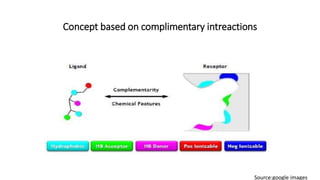
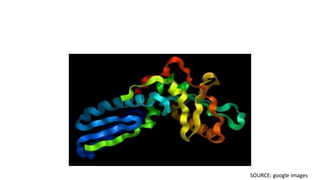
Concept based on complimentary intreactions
Source:google images
MODEL DEVELOPMENT
• The process for developing a pharmacophore model generally
involves the following steps:
1) Select a training set of ligands –
• Choose a structurally diverse set of molecules that will be used for
developing the pharmacophore model.
2).Conformational analysis –
• Generate a set of low energy conformations
• They are likely to contain the bioactive conformation for each of the
selected molecules.
3).Molecular superimposition –
• Fit all combinations of the low-energy conformations of the
molecules.
• Similar functional groups common to all molecules in the set might
be fitted (e.g., phenyl rings or carboxylic acid groups).
• The set of conformation that results in the best fit is presumed to be
the active conformation.
4).Abstraction –
• Transform the superimposed molecules into an abstract
representation.
• e.g. superimposed phenyl rings might be referred to more
conceptually as an 'aromatic ring' pharmacophore element.
• Hydroxy groups could be designated as a 'hydrogen-
bond donor/acceptor' pharmacophore element.
5).Validation –
• A pharmacophore model is a hypothesis accounting for the observed
biological activities of a set of molecules that bind to a
common biological target.
• The model is only valid in so far as it is able to account for differences
in biological activity of a range of molecules.
• As the biological activities of new molecules become available, the
pharmacophore model can be updated to further refine it.
AUTOMATED PHARMACOPHORE MODELLING METHODS
• HypoGen dataset
• Structurally diverse PREDICTIVE MODEL
• Activity data required HypoGen
• HipHop dataset
• 2-32 molecules A TRUE
• Activity data not required PHARMACOPHORE
• Input molecules must be active Model
APPLICATIONS
• Pharmacophores are used to define the essential features of one or
more molecules with the same biological activity.
• A database of diverse chemical compounds can then be searched for
more molecules which share the same features arranged in the same
relative orientation.
• Pharmacophores are also used as the starting point for
developing new drug models.
Aid in drug discovery
SOSA: NEW LEADS FROM OLD DRUGS
• Selective Optimization of Side Activities
• Start screening with a limited set of carefully chosen, structurally
diverse, drug molecules.
• Already bioavailability and toxicity studies have been performed and
as they have proven usefulness in human therapy.
Optimize hits
• In order to increase the affinity for the new target and decrease the
affinity for the other targets.
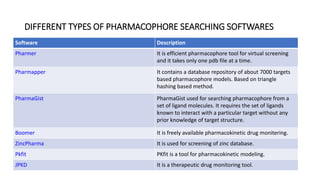
DIFFERENT TYPES OF PHARMACOPHORE SEARCHING SOFTWARES
Software Description
Pharmer It is efficient pharmacophore tool for virtual screening
and it takes only one pdb file at a time.
Pharmapper It contains a database repository of about 7000 targets
based pharmacophore models. Based on triangle
hashing based method.
PharmaGist PharmaGist used for searching pharmacophore from a
set of ligand molecules. It requires the set of ligands
known to interact with a particular target without any
prior knowledge of target structure.
Boomer It is freely available pharmacokinetic drug monitering.
ZincPharma It is used for screening of zinc database.
Pkfit PKfit is a tool for pharmacokinetic modeling.
JPKD It is a therapeutic drug monitoring tool.
WORKING OF PHARMACOPHORE
PHAMACOPHORE MODEL:
• Explains how structurally diverse ligands can bind to a common
receptor site
WORKING OF PHARMACOPHORE
Typical Pharmcophore factors:
• Hydrophobic centroids -CH3, -C2H5
• Aromatic Rings
• Hydrogen bond acceptors
• Hydrogen bond donors -OH, -NH
• Cations & Anions
WORKING OF PHARMACOPHORE
• 1st identify Pharmacophore
• Then identify diverse chemical compounds which share same features
using database
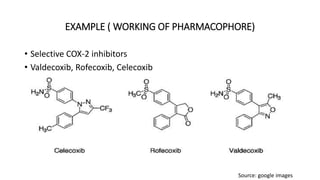
EXAMPLE ( WORKING OF PHARMACOPHORE)
• Selective COX-2 inhibitors
• Valdecoxib, Rofecoxib, Celecoxib
Source: google images
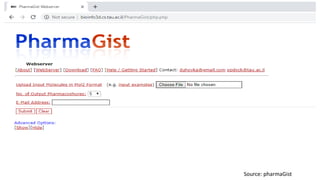
PHARMAGIST
• Its freely available on web for Pharmacophore detection
• It is ligand based
• Doesn’t require structure of target receptors
• GO to web address: http://bioinfo3d.cs.tau.ac.il/PharmaGist/php.php
Source: pharmaGist
• mol2 format
• Consists of structures of celecoxib, valdecoxib, rofecoxib
• Upload the file
• Results comes on email.
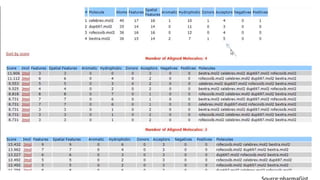
• We see the Highest scores.
• NOW,
• We go to Pymol
• Construct Pharmacophore design using:
- No. of ATOMS
- HYDROGEN acceptors/donors
- No. of Hydrophobic bonds etc.
SOURCE: google images
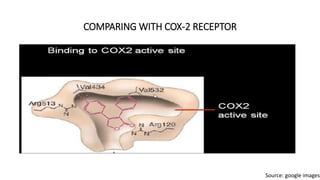
COMPARING WITH COX-2 RECEPTOR
Source: google images
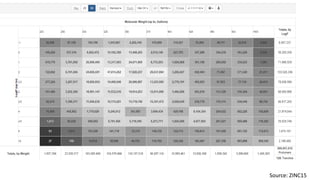
• Go to ZINC 15, ZINC PHARMER Like databases
• Upload PHARMACOPHORE in mol2
• Retrieve molecules which have same structure
Source: ZINC15
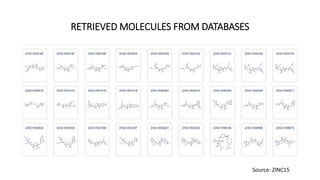
RETRIEVED MOLECULES FROM DATABASES
Source: ZINC15
• Select molecules with lowest Energy
• Test best molecules for activity
FINGERPRINTING STIMULATION
• Part of chemiinformatics
• Stimulation coefficents( TANIMOTO/ JACCARD)
• HIGH for similar structures
• Onlinecalculator for TANIMOTO- ChemMine TOOL.
SUMMARY
• A pharmacophore model explains how structurally diverse ligands
can bind to a common receptor site.
• MOST IMPORTANT EVOVING TECHNIQUE FOR DRUG DISCOVERY.
• Different types of pharmacophore searching softwares
Pharmer, PharmaGist, ZincPharma etc
THANK YOU

Pharmacophore

  • 1.
    PHARMACOPHORE Dr. Sachin Panwar JuniorResident Depatment of Pharmacology KGMU, Lucknow
  • 2.
    THIS SLIDE ISONLY FOR EDUCATIONAL PURPOSE
  • 3.
    • “An ensembleof steric and electronic features that is necessary to ensure the optimal supramolecular interactions with a specific biological target and to trigger (or block) its biological response" -IUPAC
  • 4.
    • Hydrogen-bond donorsand acceptors, positively and negatively charged groups, and hydrophobic regions are typical features
  • 5.
    • A pharmacophoremodel explains how structurally diverse ligands can bind to a common receptor site. • Pharmacophore models can be used to identify potential leads through virtual screening of novel ligands that will bind to the same receptor.
  • 6.
    HISTORY • Pharmacophores wereestablished by Lemont Kier. • He first mentions the concept in 1967 and uses the term in a publication in 1971
  • 7.
    • Pharmacophore approacheshave become one of the major tools in drug discovery. • Various ligand-based and structure-based methods have been developed for improved pharmacophore modeling
  • 8.
    • These methodshave been successfully and extensively applied in virtual screening, De novo design and lead optimization. • Despite these successes, pharmacophore approaches have not reached their expected full capacity
  • 9.
    LIGAND BASED DESIGN Pharmcophore •Molecular framework that carries ( phoros) for drug’s, ( pharmacon) biological activity. • More important technique
  • 10.
    QSAR( Quantitative structure& activity relationship) • Many actives & inactives - known compound of receptor • It is assumed that molecules having similar structure will have similar chemical properties.
  • 11.
    QSAR • The informationprovided by a compound, or set of compounds known to bind to the desired target • This inf. is used to identify new compounds from the external databases of chemical compounds using machine learning methods
  • 12.
    ZINC15 ( CHEMICALLIBRARIES) • A database of commercially-available compounds for virtual screening. • ZINC contains over 35 million purchasable compounds in ready-to- dock, 3D formats.
  • 13.
    WHAT IS PHARMACOPHORE? •Common 3D arrangement of functionality that can be presented by all active molecules to interact with target receptor
  • 14.
    Structure and function: •Molecular flexibility and shape are important • Conformational generation is necessary • Bits of the molecule which interact strongly and specifically with the binding site • Hydrogen bond groups, hydrophobes etc. presented by all active molecules.
  • 15.
    Concept based oncomplimentary intreactions Source:google images
  • 16.
    MODEL DEVELOPMENT • Theprocess for developing a pharmacophore model generally involves the following steps: 1) Select a training set of ligands – • Choose a structurally diverse set of molecules that will be used for developing the pharmacophore model.
  • 17.
    2).Conformational analysis – •Generate a set of low energy conformations • They are likely to contain the bioactive conformation for each of the selected molecules.
  • 18.
    3).Molecular superimposition – •Fit all combinations of the low-energy conformations of the molecules. • Similar functional groups common to all molecules in the set might be fitted (e.g., phenyl rings or carboxylic acid groups). • The set of conformation that results in the best fit is presumed to be the active conformation.
  • 19.
    4).Abstraction – • Transformthe superimposed molecules into an abstract representation. • e.g. superimposed phenyl rings might be referred to more conceptually as an 'aromatic ring' pharmacophore element. • Hydroxy groups could be designated as a 'hydrogen- bond donor/acceptor' pharmacophore element.
  • 20.
    5).Validation – • Apharmacophore model is a hypothesis accounting for the observed biological activities of a set of molecules that bind to a common biological target. • The model is only valid in so far as it is able to account for differences in biological activity of a range of molecules.
  • 21.
    • As thebiological activities of new molecules become available, the pharmacophore model can be updated to further refine it.
  • 22.
    AUTOMATED PHARMACOPHORE MODELLINGMETHODS • HypoGen dataset • Structurally diverse PREDICTIVE MODEL • Activity data required HypoGen • HipHop dataset • 2-32 molecules A TRUE • Activity data not required PHARMACOPHORE • Input molecules must be active Model
  • 23.
    APPLICATIONS • Pharmacophores areused to define the essential features of one or more molecules with the same biological activity. • A database of diverse chemical compounds can then be searched for more molecules which share the same features arranged in the same relative orientation.
  • 24.
    • Pharmacophores arealso used as the starting point for developing new drug models. Aid in drug discovery
  • 25.
    SOSA: NEW LEADSFROM OLD DRUGS • Selective Optimization of Side Activities • Start screening with a limited set of carefully chosen, structurally diverse, drug molecules. • Already bioavailability and toxicity studies have been performed and as they have proven usefulness in human therapy.
  • 26.
    Optimize hits • Inorder to increase the affinity for the new target and decrease the affinity for the other targets.
  • 27.
    DIFFERENT TYPES OFPHARMACOPHORE SEARCHING SOFTWARES Software Description Pharmer It is efficient pharmacophore tool for virtual screening and it takes only one pdb file at a time. Pharmapper It contains a database repository of about 7000 targets based pharmacophore models. Based on triangle hashing based method. PharmaGist PharmaGist used for searching pharmacophore from a set of ligand molecules. It requires the set of ligands known to interact with a particular target without any prior knowledge of target structure. Boomer It is freely available pharmacokinetic drug monitering. ZincPharma It is used for screening of zinc database. Pkfit PKfit is a tool for pharmacokinetic modeling. JPKD It is a therapeutic drug monitoring tool.
  • 28.
    WORKING OF PHARMACOPHORE PHAMACOPHOREMODEL: • Explains how structurally diverse ligands can bind to a common receptor site
  • 29.
    WORKING OF PHARMACOPHORE TypicalPharmcophore factors: • Hydrophobic centroids -CH3, -C2H5 • Aromatic Rings • Hydrogen bond acceptors • Hydrogen bond donors -OH, -NH • Cations & Anions
  • 30.
    WORKING OF PHARMACOPHORE •1st identify Pharmacophore • Then identify diverse chemical compounds which share same features using database
  • 31.
    EXAMPLE ( WORKINGOF PHARMACOPHORE) • Selective COX-2 inhibitors • Valdecoxib, Rofecoxib, Celecoxib Source: google images
  • 32.
    PHARMAGIST • Its freelyavailable on web for Pharmacophore detection • It is ligand based • Doesn’t require structure of target receptors • GO to web address: http://bioinfo3d.cs.tau.ac.il/PharmaGist/php.php
  • 33.
  • 34.
    • mol2 format •Consists of structures of celecoxib, valdecoxib, rofecoxib • Upload the file • Results comes on email.
  • 36.
    • We seethe Highest scores.
  • 37.
    • NOW, • Wego to Pymol • Construct Pharmacophore design using: - No. of ATOMS - HYDROGEN acceptors/donors - No. of Hydrophobic bonds etc.
  • 38.
  • 39.
    COMPARING WITH COX-2RECEPTOR Source: google images
  • 40.
    • Go toZINC 15, ZINC PHARMER Like databases • Upload PHARMACOPHORE in mol2 • Retrieve molecules which have same structure
  • 41.
  • 42.
    RETRIEVED MOLECULES FROMDATABASES Source: ZINC15
  • 43.
    • Select moleculeswith lowest Energy • Test best molecules for activity
  • 44.
    FINGERPRINTING STIMULATION • Partof chemiinformatics • Stimulation coefficents( TANIMOTO/ JACCARD) • HIGH for similar structures
  • 45.
    • Onlinecalculator forTANIMOTO- ChemMine TOOL.
  • 46.
    SUMMARY • A pharmacophoremodel explains how structurally diverse ligands can bind to a common receptor site. • MOST IMPORTANT EVOVING TECHNIQUE FOR DRUG DISCOVERY. • Different types of pharmacophore searching softwares Pharmer, PharmaGist, ZincPharma etc
  • 47.