 History
 Methods of drug discovery
› Traditional
› Current
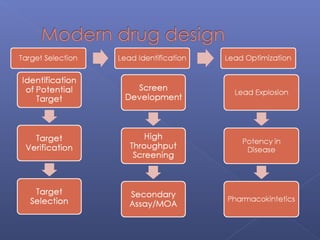
 Life cycle of drug discovery
› Traditional
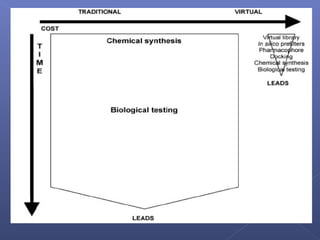
› CADD
 Introduction to CADD
 Objectives of CADD
 Priciples involoved in CADD
 Softwares for CADD
 Advantages over traditional method of drug design
 Future trends
 Success stories of CADD
 References
Early 19th century - extraction of compounds from
plants (morphine, cocaine).
Late 19th century - fewer natural products used, more
synthetic substances. Dye and chemical companies
start research labs and discover medical applications.
(Bayer)
1905 - John Langley: Theory of receptive substances
which stated “The concept of specific receptors that
bind drugs or transmitter substances onto the cell,
thereby either initiating biological effects or inhibiting
cellular functions”
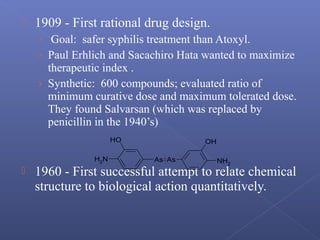
 1909 - First rational drug design.
› Goal: safer syphilis treatment than Atoxyl.
› Paul Erhlich and Sacachiro Hata wanted to maximize
therapeutic index .
› Synthetic: 600 compounds; evaluated ratio of
minimum curative dose and maximum tolerated dose.
They found Salvarsan (which was replaced by
penicillin in the 1940’s)
 1960 - First successful attempt to relate chemical
structure to biological action quantitatively.
As As
OH
NH2
OH
NH2
Mid to late 20th century - understand disease states,
biological structures, processes, drug transport,
distribution, metabolism. Medicinal chemists use
this knowledge to modify chemical structure to
influence a drug’s activity, stability, etc.
The time from conception to approval of a new
drug is typically 10-15 years.
• The estimated cost to bring to market a successful
drug is now $800 million!
• 20% cost increase per year.
 Mainly by accident
 Can be discovered by
› screening of new drugs
› modification for improvement
› mechanistic based drug design
› combining techniques
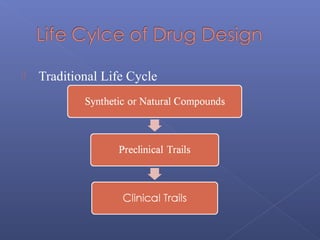
 Traditional Life Cycle
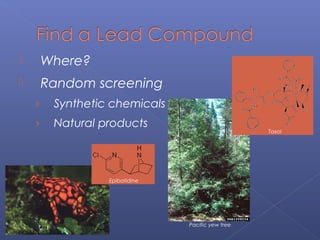
 Where?
 Random screening
› Synthetic chemicals
› Natural products
Epibatidine
Pacific yew tree
Taxol
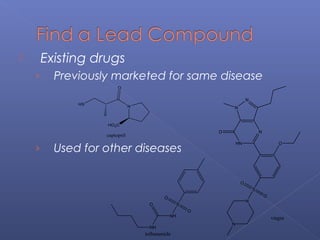
 Existing drugs
› Previously marketed for same disease
› Used for other diseases
O
NH
S
O
O
NH
tolbutamide
N
O
HS
HO2C
captopril
N
N
S
O
O
N
N
N
HN
O
O
viagra
 Existing drugs
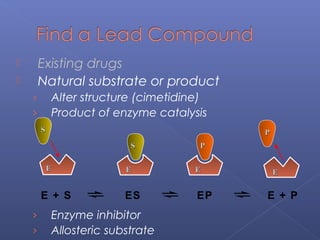
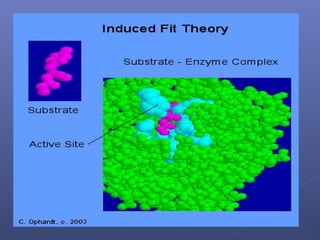
 Natural substrate or product
› Alter structure (cimetidine)
› Product of enzyme catalysis
› Enzyme inhibitor
› Allosteric substrate
SS
EE
ES
PP
EE
EP
PP
EE
E + P
EE
SS
E + S
EE
 Existing drugs
 Natural substrate or product
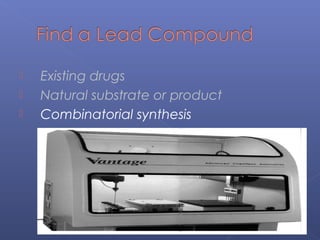
 Combinatorial synthesis
 Existing drugs
 Natural substrate or product
 Combinatorial synthesis
 Computer-aided design
› X-ray crystallography of binding sites
› Molecular modeling to design drug
 Existing drugs
 Natural substrate or product
 Combinatorial synthesis
 Computer-aided design
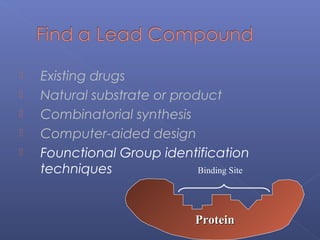
 Founctional Group identification
techniques Binding Site
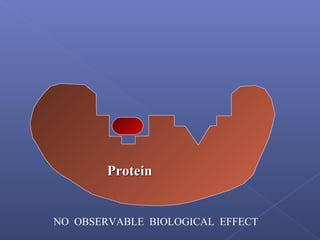
ProteinProtein
ProteinProtein
NO OBSERVABLE BIOLOGICAL EFFECT
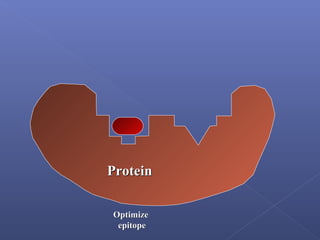
ProteinProtein
OptimizeOptimize
epitopeepitope
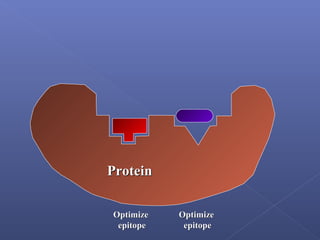
ProteinProtein
OptimizeOptimize
epitopeepitope
OptimizeOptimize
epitopeepitope
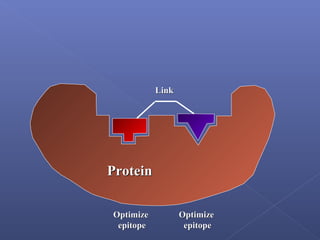
ProteinProtein
OptimizeOptimize
epitopeepitope
OptimizeOptimize
epitopeepitope
LinkLink
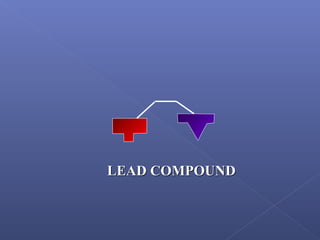
LEAD COMPOUNDLEAD COMPOUND
 Computer Aided drug design
 lies In the hand of computational scientists, who
are able to manipulate molecule on the screen
 Rather it is a complex process involving many
scientist from various stream working together.
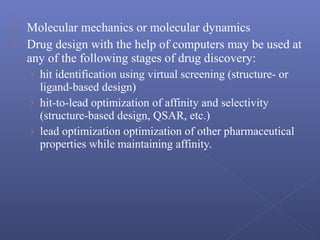
 Molecular mechanics or molecular dynamics
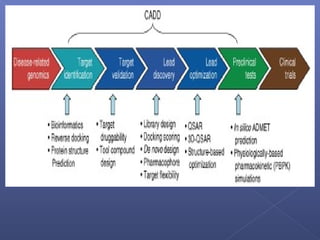
 Drug design with the help of computers may be used at
any of the following stages of drug discovery:
› hit identification using virtual screening (structure- or
ligand-based design)
› hit-to-lead optimization of affinity and selectivity
(structure-based design, QSAR, etc.)
› lead optimization optimization of other pharmaceutical
properties while maintaining affinity.
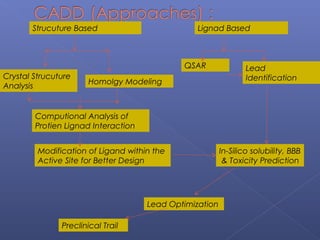
Strucuture Based
Crystal Strucuture
Analysis
Homolgy Modeling
Computional Analysis of
Protien Lignad Interaction
Modification of Ligand within the
Active Site for Better Design
Lignad Based
QSAR Lead
Identification
In-Silico solubility, BBB
& Toxicity Prediction
Lead Optimization
Preclinical Trail
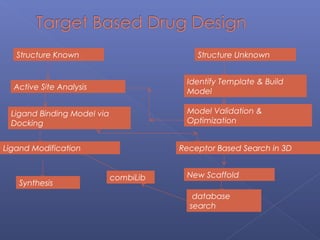
Structure Known Structure Unknown
Active Site Analysis
Ligand Binding Model via
Docking
Ligand Modification
Identify Template & Build
Model
Model Validation &
Optimization
Receptor Based Search in 3D
New Scaffold
database
search
combiLib
Synthesis
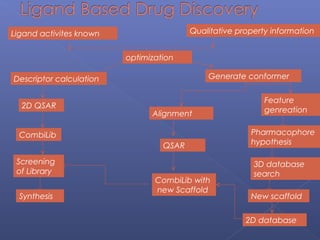
Ligand activites known Qualitative property information
optimization
Descriptor calculation Generate conformer
Feature
genreation
Pharmacophore
hypothesis
3D database
search
New scaffold
2D database
CombiLib with
new Scaffold
QSAR
Alignment
2D QSAR
CombiLib
Screening
of Library
Synthesis
 To change from:
› Random screening against disease assays
› Natural products, synthetic chemicals
 To:
› Rational drug design and testing
› Speed-up screening process
› Efficient screening (focused, target directed)
› De novo design (target directed)
› Integration of testing into design process
› Fail drugs fast (remove hopeless ones as early as possible)
 Molecular Mechanics
 Quantum Mechanics
Molecular mechanics refers to the use of classical mechanics
to model the geometry and motions of molecules.
Molecular mechanics methods are based on the following
principles:
1) Nuclei and electrons are lumped into atom-like
particles.
2) Atom-like particles are spherical (radii obtained from
measurements or theory) and have a net charge (obtained
from theory).
3) Interactions are based on springs and classical
potentials.
4) Interactions must be preassigned to specific sets of
atoms.
5) Interactions determine the spatial distribution of atom-
like particles and their energies.
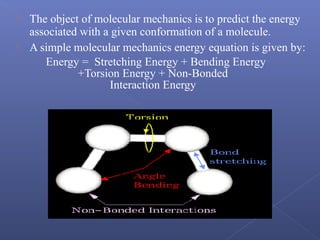
 The object of molecular mechanics is to predict the energy
associated with a given conformation of a molecule.
 A simple molecular mechanics energy equation is given by:
Energy = Stretching Energy + Bending Energy
+Torsion Energy + Non-Bonded
Interaction Energy
 The stretching energy equation is based on Hooke's law.
 This equation estimates the energy associated with
vibration about the equilibrium bond length
 In plot we notice that the model tends to break down as a
bond is stretched towards the point of dissociation
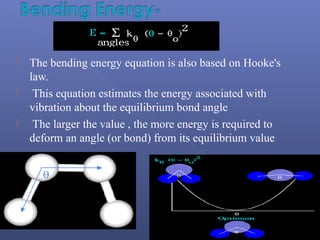
 The bending energy equation is also based on Hooke's
law.
 This equation estimates the energy associated with
vibration about the equilibrium bond angle
 The larger the value , the more energy is required to
deform an angle (or bond) from its equilibrium value
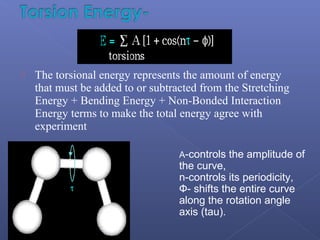
 The torsional energy represents the amount of energy
that must be added to or subtracted from the Stretching
Energy + Bending Energy + Non-Bonded Interaction
Energy terms to make the total energy agree with
experiment
A-controls the amplitude of
the curve,
n-controls its periodicity,
Ф- shifts the entire curve
along the rotation angle
axis (tau).
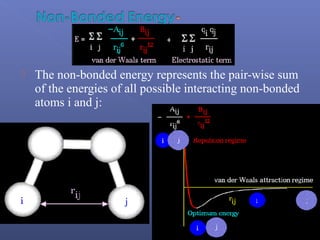
 The non-bonded energy represents the pair-wise sum
of the energies of all possible interacting non-bonded
atoms i and j:
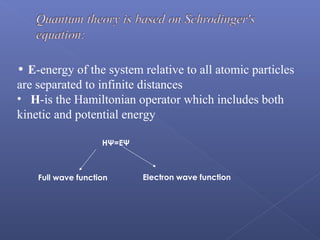
Quantum theory uses well known physical
constants ,such as velocity of light, values for the
masses & charges of nuclear particles to
calcaulate molecular properties
The equation from which molecular properties can
be derived from schrodinger equation
HΨ=EΨ
HΨ=EΨ
Full wave function Electron wave function
• E-energy of the system relative to all atomic particles
are separated to infinite distances
• H-is the Hamiltonian operator which includes both
kinetic and potential energy
 Ab initio method
limited to ten no’s of atoms and & best
performed using super computers.
 semiempirical
limited to hundreds of atoms can be
applied to organics ,organometalics and
small oligomers.
 Nuclei and electrons are distinguished from
each other.
 Electron-electron (usually averaged) and
electron-nuclear interactions are explicit.
 Interactions are governed by nuclear and
electron charges (i.e. potential energy) and
electron motions.
 Interactions determine the spatial distribution
of nuclei and electrons and their energies.
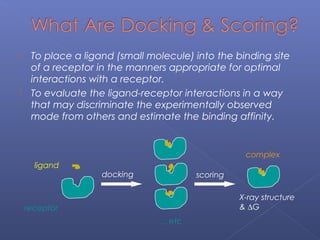
 To place a ligand (small molecule) into the binding site
of a receptor in the manners appropriate for optimal
interactions with a receptor.
 To evaluate the ligand-receptor interactions in a way
that may discriminate the experimentally observed
mode from others and estimate the binding affinity.
ligand
receptor
complex
docking scoring
… etc
X-ray structure
& ∆G
 To Reduce cost
 Core of the target-based structure-based drug design
(SBDD) for lead generation and optimization.
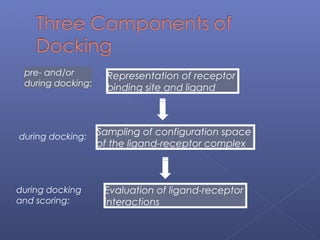
Representation of receptor
binding site and ligand
pre- and/or
during docking:
Sampling of configuration space
of the ligand-receptor complex
during docking:
Evaluation of ligand-receptor
interactions
during docking
and scoring:
• Protien – Ligand Studies
• Flexible Ligand, Rigid Receptor
• Search much Larger Space
• Search the conformational Space using
Molecular Dynamic
• Protien- Protien Docking
• Both Molecule Usually Considered Rigid
• 6 Degree of freedom
• 1st
aplly stearic Constrains to limits search
Space & then examine Energetic of Possible
Binding Conformation.
 Determine the lowest free energy structures for
the receptor-ligand complex
 Search database and rank hits for lead
generation
 Calculate the differential binding of a ligand to
two different macromolecular receptors
 Study the geometry of a particular complex
 Propose modification of a lead molecules to
optimize potency or other properties
 de novo design for lead generation
 Library design
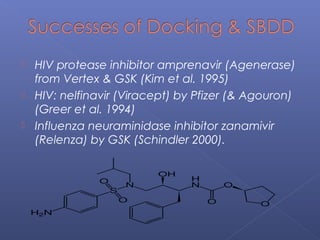
 HIV protease inhibitor amprenavir (Agenerase)
from Vertex & GSK (Kim et al. 1995)
 HIV: nelfinavir (Viracept) by Pfizer (& Agouron)
(Greer et al. 1994)
 Influenza neuraminidase inhibitor zanamivir
(Relenza) by GSK (Schindler 2000).
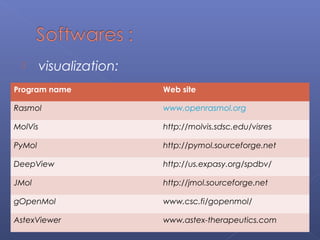
 visualization:
Program name Web site
Rasmol www.openrasmol.org
MolVis http://molvis.sdsc.edu/visres
PyMol http://pymol.sourceforge.net
DeepView http://us.expasy.org/spdbv/
JMol http://jmol.sourceforge.net
gOpenMol www.csc.fi/gopenmol/
AstexViewer www.astex-therapeutics.com
 Docking:
Program name Web site
ArgusDock www.Arguslab.com
DOCK https://dock.compbio.uscsf
.edu
FRED www.eyesopen.com
eHITS www.symbiosys.ca/
Autodock www.scripps.edu
FTDock www.bmm.icnet.uk/dockin
g/ftdock.html
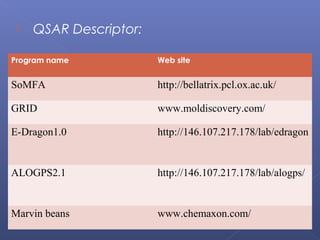
 QSAR Descriptor:
Program name Web site
SoMFA http://bellatrix.pcl.ox.ac.uk/
GRID www.moldiscovery.com/
E-Dragon1.0 http://146.107.217.178/lab/edragon
ALOGPS2.1 http://146.107.217.178/lab/alogps/
Marvin beans www.chemaxon.com/
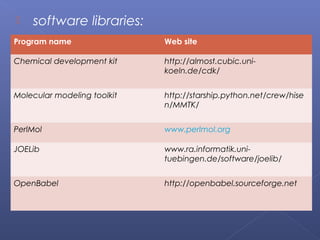
 software libraries:
Program name Web site
Chemical development kit http://almost.cubic.uni-
koeln.de/cdk/
Molecular modeling toolkit http://starship.python.net/crew/hise
n/MMTK/
PerlMol www.perlmol.org
JOELib www.ra.informatik.uni-
tuebingen.de/software/joelib/
OpenBabel http://openbabel.sourceforge.net
 Time
 cost
 Accuracy
 information about the disease
 screening is reduced
 Database screening
 less manpower is required
 Shape signatures
 Inverse docking
 • K+ ion channel blocker
• structural based discovery
• G. Schneider et al., J. Computer-Aided Mol.
Design 14, 487-494, 2000
 • Ca2+ antagonist / T-channel blocker
• chemical descriptor based discovery
• G. Schneider et al., Angew. Chem. Int. Ed. Engl. 39,
4130-4133, 2000
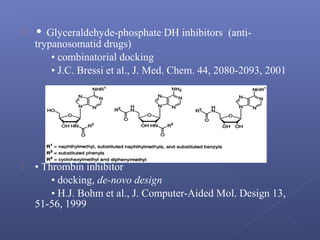
 • Glyceraldehyde-phosphate DH inhibitors (anti-
trypanosomatid drugs)
• combinatorial docking
• J.C. Bressi et al., J. Med. Chem. 44, 2080-2093, 2001
 • Thrombin inhibitor
• docking, de-novo design
• H.J. Bohm et al., J. Computer-Aided Mol. Design 13,
51-56, 1999
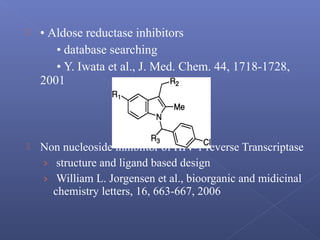
 • Aldose reductase inhibitors
• database searching
• Y. Iwata et al., J. Med. Chem. 44, 1718-1728,
2001
 Non nucleoside inhibiitor of HIV-1 reverse Transcriptase
› structure and ligand based design
› William L. Jorgensen et al., bioorganic and midicinal
chemistry letters, 16, 663-667, 2006
 DDT , “Keynote review: Structural biology and drug
discovery” Miles Congreve,Christopher W.Murray and Tom
L.Blundell, Volume 10, Number 13 • July 2005
 Current Opinion on Pharmacology“Computer-aided drug-
discovery techniquesthataccountfor receptor flexibility”
Jacob DDurrant and JAndrewMcCammon, 10, 1-5, 2010.
 Bioorganic and Medicinal chemistry “Drug Guru: A
computer software program for drug design using medicinal
chemistry rules” , Kent D. Stewart, Melisa Shirodaa and
Craig A. James, 14, 7011–7022, 2010.
 Chemico-Biological Interactions, “Computer-aided drug
discovery and development (CADDD): Insilico-
chemico-biological approach”, I.M. Kapetanovic, 171,
165–176. (2008) .
 Drug Discovery Today “Shape Signatures: speeding up
computer-aided drug discovery”, Peter J. Meek et al. ,
Volume 11, Numbers 19/20 October 2006.
 DDT, “Optimizing the use of open-source software
applications in drug discovery”, Werner J.Geldenhuys et
al., Volume 11, Number 3/4 • February 2006.
 Bioorganic & Medicinal Chemistry Letters “Computer-
aided design of non-nucleoside inhibitors of HIV-1
reverse transcriptase” , 16, 663–667, 2006.
 Drug Discovery Today: Technologies, “ New
technologies in computer-aided drug design: Toward
target identification and new chemical entity discovery”,
Yun Tang, Weiliang Zhu, Kaixian Chen, Hualiang Jiang,
Vol. 3, No. 3 2006.
 Journal of Molecular Graphics and Modelling,
“Combining structure-based drug design and
pharmacophores”, Renate Griffith, 23, 439–446, 2005.
 Chemistry & Biology, “The Process of Structure-Based
Drug Design”, Vol. 10, 787–797, September, 2003.
 EMBO-Course: “Methods for Protein Simulation &
Drug Design.” Shanghai, China, September 13-24,
2004.
 The Organic Chemistry of the drug design & drug
action by Richard B. Silverman
 Principles of Medicinal Chemistry by William O.Foye.
 Burger’s Medicinal Chemistry & Drug Discovery, Sixth
edition
 Wilson & Gisvold’s Textbook of Organic Medicinal &
Pharmaceutical Chemistry, Eleventh edition.
 Google Search Engine
 www.sciencedirect.com
Computer aided drug design

Computer aided drug design

  • 2.
     History  Methodsof drug discovery › Traditional › Current  Life cycle of drug discovery › Traditional › CADD  Introduction to CADD  Objectives of CADD  Priciples involoved in CADD  Softwares for CADD  Advantages over traditional method of drug design  Future trends  Success stories of CADD  References
  • 3.
    Early 19th century- extraction of compounds from plants (morphine, cocaine). Late 19th century - fewer natural products used, more synthetic substances. Dye and chemical companies start research labs and discover medical applications. (Bayer) 1905 - John Langley: Theory of receptive substances which stated “The concept of specific receptors that bind drugs or transmitter substances onto the cell, thereby either initiating biological effects or inhibiting cellular functions”
  • 4.
     1909 -First rational drug design. › Goal: safer syphilis treatment than Atoxyl. › Paul Erhlich and Sacachiro Hata wanted to maximize therapeutic index . › Synthetic: 600 compounds; evaluated ratio of minimum curative dose and maximum tolerated dose. They found Salvarsan (which was replaced by penicillin in the 1940’s)  1960 - First successful attempt to relate chemical structure to biological action quantitatively. As As OH NH2 OH NH2
  • 5.
    Mid to late20th century - understand disease states, biological structures, processes, drug transport, distribution, metabolism. Medicinal chemists use this knowledge to modify chemical structure to influence a drug’s activity, stability, etc.
  • 6.
    The time fromconception to approval of a new drug is typically 10-15 years. • The estimated cost to bring to market a successful drug is now $800 million! • 20% cost increase per year.
  • 7.
     Mainly byaccident  Can be discovered by › screening of new drugs › modification for improvement › mechanistic based drug design › combining techniques
  • 8.
  • 10.
     Where?  Randomscreening › Synthetic chemicals › Natural products Epibatidine Pacific yew tree Taxol
  • 11.
     Existing drugs ›Previously marketed for same disease › Used for other diseases O NH S O O NH tolbutamide N O HS HO2C captopril N N S O O N N N HN O O viagra
  • 12.
     Existing drugs Natural substrate or product › Alter structure (cimetidine) › Product of enzyme catalysis › Enzyme inhibitor › Allosteric substrate SS EE ES PP EE EP PP EE E + P EE SS E + S EE
  • 13.
     Existing drugs Natural substrate or product  Combinatorial synthesis
  • 14.
     Existing drugs Natural substrate or product  Combinatorial synthesis  Computer-aided design › X-ray crystallography of binding sites › Molecular modeling to design drug
  • 15.
     Existing drugs Natural substrate or product  Combinatorial synthesis  Computer-aided design  Founctional Group identification techniques Binding Site ProteinProtein
  • 16.
  • 17.
  • 18.
  • 19.
  • 20.
  • 23.
     Computer Aideddrug design  lies In the hand of computational scientists, who are able to manipulate molecule on the screen  Rather it is a complex process involving many scientist from various stream working together.
  • 24.
     Molecular mechanicsor molecular dynamics  Drug design with the help of computers may be used at any of the following stages of drug discovery: › hit identification using virtual screening (structure- or ligand-based design) › hit-to-lead optimization of affinity and selectivity (structure-based design, QSAR, etc.) › lead optimization optimization of other pharmaceutical properties while maintaining affinity.
  • 25.
    Strucuture Based Crystal Strucuture Analysis HomolgyModeling Computional Analysis of Protien Lignad Interaction Modification of Ligand within the Active Site for Better Design Lignad Based QSAR Lead Identification In-Silico solubility, BBB & Toxicity Prediction Lead Optimization Preclinical Trail
  • 26.
    Structure Known StructureUnknown Active Site Analysis Ligand Binding Model via Docking Ligand Modification Identify Template & Build Model Model Validation & Optimization Receptor Based Search in 3D New Scaffold database search combiLib Synthesis
  • 27.
    Ligand activites knownQualitative property information optimization Descriptor calculation Generate conformer Feature genreation Pharmacophore hypothesis 3D database search New scaffold 2D database CombiLib with new Scaffold QSAR Alignment 2D QSAR CombiLib Screening of Library Synthesis
  • 28.
     To changefrom: › Random screening against disease assays › Natural products, synthetic chemicals  To: › Rational drug design and testing › Speed-up screening process › Efficient screening (focused, target directed) › De novo design (target directed) › Integration of testing into design process › Fail drugs fast (remove hopeless ones as early as possible)
  • 29.
     Molecular Mechanics Quantum Mechanics
  • 30.
    Molecular mechanics refersto the use of classical mechanics to model the geometry and motions of molecules. Molecular mechanics methods are based on the following principles: 1) Nuclei and electrons are lumped into atom-like particles. 2) Atom-like particles are spherical (radii obtained from measurements or theory) and have a net charge (obtained from theory). 3) Interactions are based on springs and classical potentials. 4) Interactions must be preassigned to specific sets of atoms. 5) Interactions determine the spatial distribution of atom- like particles and their energies.
  • 31.
     The objectof molecular mechanics is to predict the energy associated with a given conformation of a molecule.  A simple molecular mechanics energy equation is given by: Energy = Stretching Energy + Bending Energy +Torsion Energy + Non-Bonded Interaction Energy
  • 32.
     The stretchingenergy equation is based on Hooke's law.  This equation estimates the energy associated with vibration about the equilibrium bond length  In plot we notice that the model tends to break down as a bond is stretched towards the point of dissociation
  • 33.
     The bendingenergy equation is also based on Hooke's law.  This equation estimates the energy associated with vibration about the equilibrium bond angle  The larger the value , the more energy is required to deform an angle (or bond) from its equilibrium value
  • 34.
     The torsionalenergy represents the amount of energy that must be added to or subtracted from the Stretching Energy + Bending Energy + Non-Bonded Interaction Energy terms to make the total energy agree with experiment A-controls the amplitude of the curve, n-controls its periodicity, Ф- shifts the entire curve along the rotation angle axis (tau).
  • 35.
     The non-bondedenergy represents the pair-wise sum of the energies of all possible interacting non-bonded atoms i and j:
  • 36.
    Quantum theory useswell known physical constants ,such as velocity of light, values for the masses & charges of nuclear particles to calcaulate molecular properties The equation from which molecular properties can be derived from schrodinger equation HΨ=EΨ
  • 37.
    HΨ=EΨ Full wave functionElectron wave function • E-energy of the system relative to all atomic particles are separated to infinite distances • H-is the Hamiltonian operator which includes both kinetic and potential energy
  • 38.
     Ab initiomethod limited to ten no’s of atoms and & best performed using super computers.  semiempirical limited to hundreds of atoms can be applied to organics ,organometalics and small oligomers.
  • 39.
     Nuclei andelectrons are distinguished from each other.  Electron-electron (usually averaged) and electron-nuclear interactions are explicit.  Interactions are governed by nuclear and electron charges (i.e. potential energy) and electron motions.  Interactions determine the spatial distribution of nuclei and electrons and their energies.
  • 40.
     To placea ligand (small molecule) into the binding site of a receptor in the manners appropriate for optimal interactions with a receptor.  To evaluate the ligand-receptor interactions in a way that may discriminate the experimentally observed mode from others and estimate the binding affinity. ligand receptor complex docking scoring … etc X-ray structure & ∆G
  • 41.
     To Reducecost  Core of the target-based structure-based drug design (SBDD) for lead generation and optimization.
  • 42.
    Representation of receptor bindingsite and ligand pre- and/or during docking: Sampling of configuration space of the ligand-receptor complex during docking: Evaluation of ligand-receptor interactions during docking and scoring:
  • 43.
    • Protien –Ligand Studies • Flexible Ligand, Rigid Receptor • Search much Larger Space • Search the conformational Space using Molecular Dynamic • Protien- Protien Docking • Both Molecule Usually Considered Rigid • 6 Degree of freedom • 1st aplly stearic Constrains to limits search Space & then examine Energetic of Possible Binding Conformation.
  • 44.
     Determine thelowest free energy structures for the receptor-ligand complex  Search database and rank hits for lead generation  Calculate the differential binding of a ligand to two different macromolecular receptors  Study the geometry of a particular complex  Propose modification of a lead molecules to optimize potency or other properties  de novo design for lead generation  Library design
  • 45.
     HIV proteaseinhibitor amprenavir (Agenerase) from Vertex & GSK (Kim et al. 1995)  HIV: nelfinavir (Viracept) by Pfizer (& Agouron) (Greer et al. 1994)  Influenza neuraminidase inhibitor zanamivir (Relenza) by GSK (Schindler 2000).
  • 47.
     visualization: Program nameWeb site Rasmol www.openrasmol.org MolVis http://molvis.sdsc.edu/visres PyMol http://pymol.sourceforge.net DeepView http://us.expasy.org/spdbv/ JMol http://jmol.sourceforge.net gOpenMol www.csc.fi/gopenmol/ AstexViewer www.astex-therapeutics.com
  • 48.
     Docking: Program nameWeb site ArgusDock www.Arguslab.com DOCK https://dock.compbio.uscsf .edu FRED www.eyesopen.com eHITS www.symbiosys.ca/ Autodock www.scripps.edu FTDock www.bmm.icnet.uk/dockin g/ftdock.html
  • 49.
     QSAR Descriptor: Programname Web site SoMFA http://bellatrix.pcl.ox.ac.uk/ GRID www.moldiscovery.com/ E-Dragon1.0 http://146.107.217.178/lab/edragon ALOGPS2.1 http://146.107.217.178/lab/alogps/ Marvin beans www.chemaxon.com/
  • 50.
     software libraries: Programname Web site Chemical development kit http://almost.cubic.uni- koeln.de/cdk/ Molecular modeling toolkit http://starship.python.net/crew/hise n/MMTK/ PerlMol www.perlmol.org JOELib www.ra.informatik.uni- tuebingen.de/software/joelib/ OpenBabel http://openbabel.sourceforge.net
  • 51.
     Time  cost Accuracy  information about the disease  screening is reduced  Database screening  less manpower is required
  • 52.
     Shape signatures Inverse docking
  • 53.
     • K+ion channel blocker • structural based discovery • G. Schneider et al., J. Computer-Aided Mol. Design 14, 487-494, 2000  • Ca2+ antagonist / T-channel blocker • chemical descriptor based discovery • G. Schneider et al., Angew. Chem. Int. Ed. Engl. 39, 4130-4133, 2000
  • 54.
     • Glyceraldehyde-phosphateDH inhibitors (anti- trypanosomatid drugs) • combinatorial docking • J.C. Bressi et al., J. Med. Chem. 44, 2080-2093, 2001  • Thrombin inhibitor • docking, de-novo design • H.J. Bohm et al., J. Computer-Aided Mol. Design 13, 51-56, 1999
  • 55.
     • Aldosereductase inhibitors • database searching • Y. Iwata et al., J. Med. Chem. 44, 1718-1728, 2001  Non nucleoside inhibiitor of HIV-1 reverse Transcriptase › structure and ligand based design › William L. Jorgensen et al., bioorganic and midicinal chemistry letters, 16, 663-667, 2006
  • 56.
     DDT ,“Keynote review: Structural biology and drug discovery” Miles Congreve,Christopher W.Murray and Tom L.Blundell, Volume 10, Number 13 • July 2005  Current Opinion on Pharmacology“Computer-aided drug- discovery techniquesthataccountfor receptor flexibility” Jacob DDurrant and JAndrewMcCammon, 10, 1-5, 2010.  Bioorganic and Medicinal chemistry “Drug Guru: A computer software program for drug design using medicinal chemistry rules” , Kent D. Stewart, Melisa Shirodaa and Craig A. James, 14, 7011–7022, 2010.
  • 57.
     Chemico-Biological Interactions,“Computer-aided drug discovery and development (CADDD): Insilico- chemico-biological approach”, I.M. Kapetanovic, 171, 165–176. (2008) .  Drug Discovery Today “Shape Signatures: speeding up computer-aided drug discovery”, Peter J. Meek et al. , Volume 11, Numbers 19/20 October 2006.  DDT, “Optimizing the use of open-source software applications in drug discovery”, Werner J.Geldenhuys et al., Volume 11, Number 3/4 • February 2006.  Bioorganic & Medicinal Chemistry Letters “Computer- aided design of non-nucleoside inhibitors of HIV-1 reverse transcriptase” , 16, 663–667, 2006.
  • 58.
     Drug DiscoveryToday: Technologies, “ New technologies in computer-aided drug design: Toward target identification and new chemical entity discovery”, Yun Tang, Weiliang Zhu, Kaixian Chen, Hualiang Jiang, Vol. 3, No. 3 2006.  Journal of Molecular Graphics and Modelling, “Combining structure-based drug design and pharmacophores”, Renate Griffith, 23, 439–446, 2005.  Chemistry & Biology, “The Process of Structure-Based Drug Design”, Vol. 10, 787–797, September, 2003.  EMBO-Course: “Methods for Protein Simulation & Drug Design.” Shanghai, China, September 13-24, 2004.
  • 59.
     The OrganicChemistry of the drug design & drug action by Richard B. Silverman  Principles of Medicinal Chemistry by William O.Foye.  Burger’s Medicinal Chemistry & Drug Discovery, Sixth edition  Wilson & Gisvold’s Textbook of Organic Medicinal & Pharmaceutical Chemistry, Eleventh edition.  Google Search Engine  www.sciencedirect.com