Molecular design for drug discovery 
Peter W Kenny 
http://fbdd-lit.blogspot.com
Outline of presentation 
•Some thoughts on molecular design 
•Design of compound libraries for screening 
•Relationships between structures as framework for analysingbiological activity and physicochemical properties
Some things that make drug design difficult 
•Having to exploit targets that are weakly-linked to human disease 
•Poor understanding and prediction of toxicity 
•Inability to measure free (unbound) physiological concentrations of drug for remote targets (e.g. intracellular or on far side of blood brain barrier) 
Dansla merde: http://fbdd-lit.blogspot.com/2011/09/dans-la-merde.html
Molecular Design 
•Control of behaviorof compounds and materials by manipulation of molecular properties 
•Hypothesis-driven or prediction-driven 
•Sampling of chemical space 
–For example, does fragment-based screening allow better control of sampling resolution? 
Kenny, Montanari, Propopczyk, Sala, Sartori(2013) JCAMD 27:655-664 DOI 
Kenny JCIM 2009 49:1234-1244 DOI
TEP= [퐷푟푢푔푿,푡]푓푟푒푒 퐾푑 
Target engagement potential (TEP) 
A basis for pharmaceutical molecular design? 
Design objectives 
•Low Kdfor target(s) 
•High (hopefully undetectable) Kdfor antitargets 
•Ability to control[Drug(X,t)]free 
Kenny, Leitão& MontanariJCAMD 2014 28:699-710 DOI
Property-based design as search for ‘sweet spot’ 
Green and red lines represent probability of achieving ‘satisfactory’ affinity and ‘satisfactory’ ADMET characteristics respectively. The blue line shows the product of these probabilities and characterizes the ‘sweet spot’. This way of thinking about the ‘sweet spot’ has similarities with Hann molecular complexity model 
Kenny & Montanari, JCAMD 2013 27:1-13 DOI
Hypothesis-driven Molecular Design 
•Ask good questions with informative compounds and relevant assays 
•Framework for establishing structure-activity relationships (SARs) as efficiently as possible 
•Molecular interactions provide natural framework in which to pose design hypotheses 
Kenny JCIM 2009 49:1234-1244 DOIHypothesis-driven design versus prediction driven molecular design 
Linussonet al JMC 2000 43:1320-1328 DOIStatistical molecular design 
Bissantz, Kuhn & Stahl JMC 2010 53:5061-5084 DOIMedicinal chemist’s guide to molecular interactions
Do1 
Do2 
Ac1 
Kenny JCIM 2009 49:1234-1244 DOI 
Illustrating hypothesis-driven design 
Adenine bioisosteres 
Ac2
Watson-Crick Donor & Acceptor Electrostatic Potentials for 
Adenine Isosteres 
Vmin (Ac1) 
Va (Do1) 
Kenny JCIM 2009 49:1234-1244 DOI
PTP1B (Diabetes/Obesity): Fragment elaboration 
Literature SAR was mapped onto intial fragment hit (green). Note overlay of 
aromatic rings of elaborated fragment (blue) and difluorophosphonate (red). 
Black et al BMCL 2005 15:2503-2507 DOI 
Inactive at 200mM 
15 mM 
3000 mM 
3 mM 
150 mM 
(Conformational lock) 
130 mM 
(3-Phenyl substituent)
“Why can’t we pray for something good, like a tighter bombing pattern, for example? Couldn’t we pray for a tighter bombing pattern?” , Heller, Catch 22, 1961 
Design of compound libraries for screening 
(a view from Hanoi with additional insight from Heller)
Measures of Diversity&Coverage 
• 
• 
• 
• 
• 
• 
• 
• 
• 
• 
• 
• 
• 
• 
• 
2-Dimensionalrepresentationofchemicalspaceisusedheretoillustrateconceptsofdiversityandcoverage.Starsindicatecompoundsselectedtosamplethisregionofchemicalspace.Inthisrepresentation,similarcompoundsareclosetogether.
Neighborhoods and library design
Coverage, Diversity & Library Design 
• 
• 
• 
• 
• 
• 
• 
• 
• 
• 
• 
• 
•
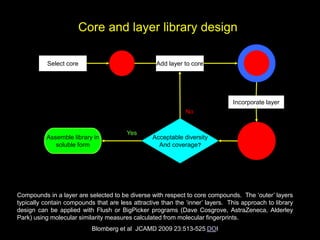
Acceptable diversity 
And coverage? 
Assemble library in 
soluble form 
Add layer to core 
Incorporate layer 
Yes 
No 
Select core 
Core and layer library design 
Compoundsinalayerareselectedtobediversewithrespecttocorecompounds.The‘outer’layerstypicallycontaincompoundsthatarelessattractivethanthe‘inner’layers.ThisapproachtolibrarydesigncanbeappliedwithFlushorBigPickerprograms(DaveCosgrove,AstraZeneca,AlderleyPark)usingmolecularsimilaritymeasurescalculatedfrommolecularfingerprints. 
Blomberget al JCAMD 2009 23:513-525 DOI
Sample 
Availability 
Molecular 
Connectivity 
Physical 
Properties 
screening samples 
Close analogs 
Ease of synthetic 
elaboration 
Molecular 
complexity 
Ionisation 
Lipophilicity 
Solubility 
Molecular 
recognition 
elements 
Molecular shape 
3D Pharmacophore 
Privileged 
substructures 
Undesirable 
substructures 
Molecular 
size 
3D Molecular 
Structure 
Fragment selection criteria 
Why I don’t use the rule of 3: http://fbdd-lit.blogspot.com/2011/01/rule-of-three-considered-harmful.html
Library design for phenotypic screening 
• 
• 
• 
• 
• 
• 
• 
• 
• 
• 
• 
• 
• 
• 
• 
Chemicalfingerprintstypicallyusedtocalculatemolecularsimilaritywhilebiologicalfingerprintscanbeuseddirectly(samplingofactivesfromdifferentassays) 
Biology (assay results) 
Chemistry (structures)
Another way to look at structure-activity relationships?
Leatherface molecule editor 
From chain saw to Matched Molecular Pairs 
c-[A;!R] 
bnd 1 2 
c-Br 
cul 2 
hyd 1 1 
[nX2]1c([OH])cccc1 
hyd 1 1 
hyd 3 -1 
bnd 2 3 2 
Kenny & Sadowski Structure modification in chemical databases, Methods and Principles in Medicinal 
Chemistry (Chemoinformatics in Drug Discovery 2005, 23, 271-285 DOI
MUDO Molecule Editor 
•SMIRKS-based re-write of Leatherfaceusing OEChem 
•Can also process 3D structures (e.g. form covalent bond between protein and ligand) 
•Identification of matched molecular pairs much simpler than with Leatherface 
Kenny, Montanari, Propopczyk, Sala, SartoriJCAMD 2013 27:655-664 DOI 
K777 docked (green) covalently to Cruzainwith crystallographic ligand
Examples of relationships between structures 
Tanimoto coefficient (foyfi) for structures is 0.90 
Ester is methylated acid Amides are ‘reversed’
Glycogen Phosphorylase inhibitors: 
Series comparison 
DpIC50 
DlogFu 
DlogS 
0.38 (0.06) 
-0.30 (0.06) 
-0.29 (0.13) 
DpIC50 
DlogFu 
DlogS 
0.21 (0.06) 
0.13 (0.04) 
0.20 (0.09) 
DpIC50 
DlogFu 
DlogS 
0.29 (0.07) 
-0.42 (0.08) 
-0.62 (0.13) 
Standard errors in mean values in parenthesis 
Birch et al BMCL 2009 19:850-853 DOI
Effect of bioisosteric replacement 
on plasma protein binding 
? 
Date of Analysis N DlogFu SE SD %increase 
2003 7 -0.64 0.09 0.23 0 
2008 12 -0.60 0.06 0.20 0 
Mining PPB database for carboxylate/tetrazole pairs suggested that bioisosteric 
replacement would lead to decrease in Fu so tetrazoles were not synthesised. 
Birch et al BMCL 2009 19:850-853 DOI
-0.316 
-0.315 
-0.296 
-0.295 
Bioisosterism: Carboxylate& tetrazole 
-0.262 
-0.261 
-0.268 
-0.268 
Kenny JCIM 2009 49:1234-1244 DOI
Amide N DlogS SE SD %Increase 
Acyclic (aliphatic amine) 109 0.59 0.07 0.71 76 
Cyclic 9 0.18 0.15 0.47 44 
Benzanilides 9 1.49 0.25 0.76 100 
Effect of amide N-methylation on aqueous solubility 
is dependent on substructural context 
Birch et al BMCL 2009 19:850-853 DOI
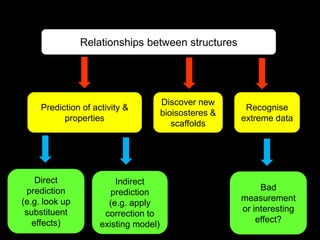
Relationships between structures 
Discover new bioisosteres& scaffolds 
Prediction of activity & properties 
Recognise extreme data 
Direct prediction 
(e.g. look up substituent effects) 
Indirect prediction 
(e.g. apply correction to existing model) 
Bad measurement or interesting effect?
•Molecular design is not just about prediction so how can we make hypothesis-driven design more systematic and efficient? 
•Screening library design as optimization of bombing patterns 
•Even molecules can have meaningful relationships 
Stuff to think about
Spare slides follow…
(Descriptor-based) QSAR/QSPR: Some questions 
•How valid is methodology (especially for validation) when distribution of compounds in training/test space is highly non-uniform? 
•Are models predicting activity or locating neighbours? 
•To what extent are ‘global’ models just ensembles of local models? 
•How well do the methods handle ‘activity cliffs’? 
•How should we account for sizes of descriptor pools when comparing model performance?
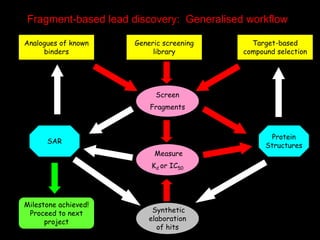
Fragment-based lead discovery: Generalised workflow 
Target-based compound selection 
Analogues of known binders 
Generic screening library 
Measure Kdor IC50 
Screen Fragments 
Synthetic elaboration of hits 
SAR 
Protein 
Structures 
Milestone achieved! 
Proceed to next project
Polarity 
N 
ClogP≤ 5 
Acc ≤ 10; Don ≤5 
An alternative view of the Rule of 5
Does octanol/water ‘see’ hydrogen bond donors? 
--0.06 -0.23 -0.24 
--1.01 -0.66 
Sangster lab database of octanol/water partition coefficients: http://logkow.cisti.nrc.ca/logkow/index.jsp 
--1.05
logPoct = 2.1 
logPalk = 1.9 
DlogP = 0.2 
logPoct = 1.5 
logPalk = -0.8 
DlogP = 2.3 
logPoct = 2.5 
logPalk = -1.8 
DlogP = 4.3 
Differences in octanol/water and alkane/water logP values 
reflect hydrogen bonding between solute and octanol 
Toulmin et al (2008) J Med Chem 51:3720-3730 DOI
Basis for ClogPalkmodel 
logPalk 
MSA/Å2 
Kenny, Montanari& Propopczyket al (2013) JCAMD 27:389-402 DOI
퐶푙표푔푃푎푙푘=푙표푔푃0+푠×푀푆퐴− 푖 Δ푙표푔푃퐹퐺,푖− 푗 Δ푙표푔푃퐼푛푡,푗 
ClogPalkfrom perturbation of saturated hydrocarbon 
logPalkpredicted for saturated hydrocarbon 
Perturbation by functional groups 
Perturbation by interactions between functional groups 
Kenny, Montanari& Propopczyket al (2013) JCAMD 27:389-402 DOI
Performance of ClogPalkmodel 
Hydrocortisone 
Cortisone 
(logPalkClogPalk)/2 
logPalkClogPalk 
Atropine 
Propanolol 
Papavarlne 
Kenny, Montanari& Propopczyket al (2013) JCAMD 27:389-402 DOI

UCT Oct 2014

  • 1.
    Molecular design fordrug discovery Peter W Kenny http://fbdd-lit.blogspot.com
  • 2.
    Outline of presentation •Some thoughts on molecular design •Design of compound libraries for screening •Relationships between structures as framework for analysingbiological activity and physicochemical properties
  • 3.
    Some things thatmake drug design difficult •Having to exploit targets that are weakly-linked to human disease •Poor understanding and prediction of toxicity •Inability to measure free (unbound) physiological concentrations of drug for remote targets (e.g. intracellular or on far side of blood brain barrier) Dansla merde: http://fbdd-lit.blogspot.com/2011/09/dans-la-merde.html
  • 4.
    Molecular Design •Controlof behaviorof compounds and materials by manipulation of molecular properties •Hypothesis-driven or prediction-driven •Sampling of chemical space –For example, does fragment-based screening allow better control of sampling resolution? Kenny, Montanari, Propopczyk, Sala, Sartori(2013) JCAMD 27:655-664 DOI Kenny JCIM 2009 49:1234-1244 DOI
  • 5.
    TEP= [퐷푟푢푔푿,푡]푓푟푒푒 퐾푑 Target engagement potential (TEP) A basis for pharmaceutical molecular design? Design objectives •Low Kdfor target(s) •High (hopefully undetectable) Kdfor antitargets •Ability to control[Drug(X,t)]free Kenny, Leitão& MontanariJCAMD 2014 28:699-710 DOI
  • 6.
    Property-based design assearch for ‘sweet spot’ Green and red lines represent probability of achieving ‘satisfactory’ affinity and ‘satisfactory’ ADMET characteristics respectively. The blue line shows the product of these probabilities and characterizes the ‘sweet spot’. This way of thinking about the ‘sweet spot’ has similarities with Hann molecular complexity model Kenny & Montanari, JCAMD 2013 27:1-13 DOI
  • 7.
    Hypothesis-driven Molecular Design •Ask good questions with informative compounds and relevant assays •Framework for establishing structure-activity relationships (SARs) as efficiently as possible •Molecular interactions provide natural framework in which to pose design hypotheses Kenny JCIM 2009 49:1234-1244 DOIHypothesis-driven design versus prediction driven molecular design Linussonet al JMC 2000 43:1320-1328 DOIStatistical molecular design Bissantz, Kuhn & Stahl JMC 2010 53:5061-5084 DOIMedicinal chemist’s guide to molecular interactions
  • 8.
    Do1 Do2 Ac1 Kenny JCIM 2009 49:1234-1244 DOI Illustrating hypothesis-driven design Adenine bioisosteres Ac2
  • 9.
    Watson-Crick Donor &Acceptor Electrostatic Potentials for Adenine Isosteres Vmin (Ac1) Va (Do1) Kenny JCIM 2009 49:1234-1244 DOI
  • 10.
    PTP1B (Diabetes/Obesity): Fragmentelaboration Literature SAR was mapped onto intial fragment hit (green). Note overlay of aromatic rings of elaborated fragment (blue) and difluorophosphonate (red). Black et al BMCL 2005 15:2503-2507 DOI Inactive at 200mM 15 mM 3000 mM 3 mM 150 mM (Conformational lock) 130 mM (3-Phenyl substituent)
  • 11.
    “Why can’t wepray for something good, like a tighter bombing pattern, for example? Couldn’t we pray for a tighter bombing pattern?” , Heller, Catch 22, 1961 Design of compound libraries for screening (a view from Hanoi with additional insight from Heller)
  • 12.
    Measures of Diversity&Coverage • • • • • • • • • • • • • • • 2-Dimensionalrepresentationofchemicalspaceisusedheretoillustrateconceptsofdiversityandcoverage.Starsindicatecompoundsselectedtosamplethisregionofchemicalspace.Inthisrepresentation,similarcompoundsareclosetogether.
  • 13.
  • 14.
    Coverage, Diversity &Library Design • • • • • • • • • • • • •
  • 15.
    Acceptable diversity Andcoverage? Assemble library in soluble form Add layer to core Incorporate layer Yes No Select core Core and layer library design Compoundsinalayerareselectedtobediversewithrespecttocorecompounds.The‘outer’layerstypicallycontaincompoundsthatarelessattractivethanthe‘inner’layers.ThisapproachtolibrarydesigncanbeappliedwithFlushorBigPickerprograms(DaveCosgrove,AstraZeneca,AlderleyPark)usingmolecularsimilaritymeasurescalculatedfrommolecularfingerprints. Blomberget al JCAMD 2009 23:513-525 DOI
  • 16.
    Sample Availability Molecular Connectivity Physical Properties screening samples Close analogs Ease of synthetic elaboration Molecular complexity Ionisation Lipophilicity Solubility Molecular recognition elements Molecular shape 3D Pharmacophore Privileged substructures Undesirable substructures Molecular size 3D Molecular Structure Fragment selection criteria Why I don’t use the rule of 3: http://fbdd-lit.blogspot.com/2011/01/rule-of-three-considered-harmful.html
  • 17.
    Library design forphenotypic screening • • • • • • • • • • • • • • • Chemicalfingerprintstypicallyusedtocalculatemolecularsimilaritywhilebiologicalfingerprintscanbeuseddirectly(samplingofactivesfromdifferentassays) Biology (assay results) Chemistry (structures)
  • 18.
    Another way tolook at structure-activity relationships?
  • 19.
    Leatherface molecule editor From chain saw to Matched Molecular Pairs c-[A;!R] bnd 1 2 c-Br cul 2 hyd 1 1 [nX2]1c([OH])cccc1 hyd 1 1 hyd 3 -1 bnd 2 3 2 Kenny & Sadowski Structure modification in chemical databases, Methods and Principles in Medicinal Chemistry (Chemoinformatics in Drug Discovery 2005, 23, 271-285 DOI
  • 20.
    MUDO Molecule Editor •SMIRKS-based re-write of Leatherfaceusing OEChem •Can also process 3D structures (e.g. form covalent bond between protein and ligand) •Identification of matched molecular pairs much simpler than with Leatherface Kenny, Montanari, Propopczyk, Sala, SartoriJCAMD 2013 27:655-664 DOI K777 docked (green) covalently to Cruzainwith crystallographic ligand
  • 21.
    Examples of relationshipsbetween structures Tanimoto coefficient (foyfi) for structures is 0.90 Ester is methylated acid Amides are ‘reversed’
  • 22.
    Glycogen Phosphorylase inhibitors: Series comparison DpIC50 DlogFu DlogS 0.38 (0.06) -0.30 (0.06) -0.29 (0.13) DpIC50 DlogFu DlogS 0.21 (0.06) 0.13 (0.04) 0.20 (0.09) DpIC50 DlogFu DlogS 0.29 (0.07) -0.42 (0.08) -0.62 (0.13) Standard errors in mean values in parenthesis Birch et al BMCL 2009 19:850-853 DOI
  • 23.
    Effect of bioisostericreplacement on plasma protein binding ? Date of Analysis N DlogFu SE SD %increase 2003 7 -0.64 0.09 0.23 0 2008 12 -0.60 0.06 0.20 0 Mining PPB database for carboxylate/tetrazole pairs suggested that bioisosteric replacement would lead to decrease in Fu so tetrazoles were not synthesised. Birch et al BMCL 2009 19:850-853 DOI
  • 24.
    -0.316 -0.315 -0.296 -0.295 Bioisosterism: Carboxylate& tetrazole -0.262 -0.261 -0.268 -0.268 Kenny JCIM 2009 49:1234-1244 DOI
  • 25.
    Amide N DlogSSE SD %Increase Acyclic (aliphatic amine) 109 0.59 0.07 0.71 76 Cyclic 9 0.18 0.15 0.47 44 Benzanilides 9 1.49 0.25 0.76 100 Effect of amide N-methylation on aqueous solubility is dependent on substructural context Birch et al BMCL 2009 19:850-853 DOI
  • 26.
    Relationships between structures Discover new bioisosteres& scaffolds Prediction of activity & properties Recognise extreme data Direct prediction (e.g. look up substituent effects) Indirect prediction (e.g. apply correction to existing model) Bad measurement or interesting effect?
  • 27.
    •Molecular design isnot just about prediction so how can we make hypothesis-driven design more systematic and efficient? •Screening library design as optimization of bombing patterns •Even molecules can have meaningful relationships Stuff to think about
  • 28.
  • 29.
    (Descriptor-based) QSAR/QSPR: Somequestions •How valid is methodology (especially for validation) when distribution of compounds in training/test space is highly non-uniform? •Are models predicting activity or locating neighbours? •To what extent are ‘global’ models just ensembles of local models? •How well do the methods handle ‘activity cliffs’? •How should we account for sizes of descriptor pools when comparing model performance?
  • 30.
    Fragment-based lead discovery:Generalised workflow Target-based compound selection Analogues of known binders Generic screening library Measure Kdor IC50 Screen Fragments Synthetic elaboration of hits SAR Protein Structures Milestone achieved! Proceed to next project
  • 31.
    Polarity N ClogP≤5 Acc ≤ 10; Don ≤5 An alternative view of the Rule of 5
  • 32.
    Does octanol/water ‘see’hydrogen bond donors? --0.06 -0.23 -0.24 --1.01 -0.66 Sangster lab database of octanol/water partition coefficients: http://logkow.cisti.nrc.ca/logkow/index.jsp --1.05
  • 33.
    logPoct = 2.1 logPalk = 1.9 DlogP = 0.2 logPoct = 1.5 logPalk = -0.8 DlogP = 2.3 logPoct = 2.5 logPalk = -1.8 DlogP = 4.3 Differences in octanol/water and alkane/water logP values reflect hydrogen bonding between solute and octanol Toulmin et al (2008) J Med Chem 51:3720-3730 DOI
  • 34.
    Basis for ClogPalkmodel logPalk MSA/Å2 Kenny, Montanari& Propopczyket al (2013) JCAMD 27:389-402 DOI
  • 35.
    퐶푙표푔푃푎푙푘=푙표푔푃0+푠×푀푆퐴− 푖 Δ푙표푔푃퐹퐺,푖−푗 Δ푙표푔푃퐼푛푡,푗 ClogPalkfrom perturbation of saturated hydrocarbon logPalkpredicted for saturated hydrocarbon Perturbation by functional groups Perturbation by interactions between functional groups Kenny, Montanari& Propopczyket al (2013) JCAMD 27:389-402 DOI
  • 36.
    Performance of ClogPalkmodel Hydrocortisone Cortisone (logPalkClogPalk)/2 logPalkClogPalk Atropine Propanolol Papavarlne Kenny, Montanari& Propopczyket al (2013) JCAMD 27:389-402 DOI