PRODRUG DESIGN
Presented by:
Aditya Sharma
M.S. (Pharm)
Pharmaceutical Analysis
NIPER Guwahati1
Content
 Introduction
 Prodrug Concept
 Classification of Prodrugs
 Prodrugs of Functional Group
 Prodrug to Improve Patient Acceptability
 Prodrug for Slow and Prolonged Release
(Sustained Drug Action)
 Enhancement of Solubility
 Prodrug to Improve Absorption
 Site Specific Drug Delivery
 Rationale of Prodrug Design
 Practical Considerations
 Conclusion
 References
https://www.lexology.com/library/detail.aspx?g=cce810fb-22c5-4bf4-a366-b51a89bf81f0
2
Introduction
• Almost all drugs possess some undesirable
physicochemical and biological properties.
• Drug candidates are often discontinued due to
issues of poor pharmacokinetic properties or
high toxicities
• Their therapeutic efficacy can be improved by
eliminating the undesirable properties while
retaining the desirable ones.
• This can be achieved through biological, physical
or chemical means.
3
Definition
• The term prodrug, introduced in 1958 by Adrien Albert, relates to “Biologically
inert derivatives of drug molecules that undergo an enzymatic and/or chemical
conversion in vivo to release the pharmacologically active parent drug.”
• A prodrug is a chemically modified inert drug precursor, which upon
biotransformation liberates the pharmacologically active parent compound.
4
Prodrug Concept
• The awareness that the onset, intensity and duration of drug action are greatly
affected by the physicochemical properties of drug has promoted the emergence
of various prodrugs.
• Most of the limitations can be overcame by prodrug approach, but after
overcoming the various barriers, the prodrug should rapidly convert into active
moiety after reaching the target site.
• The design of an efficient, stable, safe, acceptable and aesthetic way to target a
drug to its site of action while overcoming various physical, chemical and social
barriers is certainly the utilization of the prodrug approach holds great potential.
5
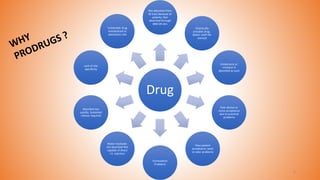
Drug
Not absorbed from
GI tract because of
polarity. Not
absorbed through
BBB OR skin
Chemically
unstable drug .
Better shelf life
wanted
Intolerance or
irritation if
absorbed as such
Poor doctor or
nurse acceptance
due to practical
problems
Poor patient
acceptance, taste
or odor problems
Formulation
Problems
Water insoluble-
not absorbed-Not
capable of direct
I.V. injection
Absorbed too
quickly. Sustained
release required
Lack of site
specificity
Vulnerable drug
metabolized at
absorption site
6
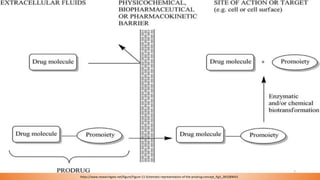
https://www.researchgate.net/figure/Figure-11-Schematic-representation-of-the-prodrug-concept_fig3_283289043
7
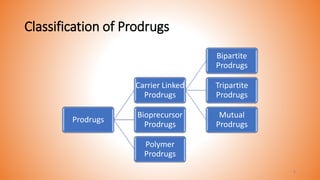
Classification of Prodrugs
Prodrugs
Carrier Linked
Prodrugs
Bipartite
Prodrugs
Tripartite
Prodrugs
Mutual
Prodrugs
Bioprecursor
Prodrugs
Polymer
Prodrugs
8
Carrier Linked Prodrug
• Carrier linked prodrug consists of the attachment of a carrier group to the active
drug to alter its physicochemical properties.
• The subsequent enzymatic or non-enzymatic mechanism releases the active drug
moiety.
9
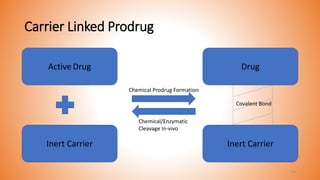
Carrier Linked Prodrug
Active Drug Drug
Inert Carrier Inert Carrier
Chemical Prodrug Formation
Chemical/Enzymatic
Cleavage In-vivo
Covalent Bond
10
Bipartite Prodrug
• It is composed of one carrier (group) attached to the drugs.
• Such prodrugs have greatly modified lipophilicity due to the attached carrier. The
active drug is released by hydrolytic cleavage either chemically or enzymatically.
11
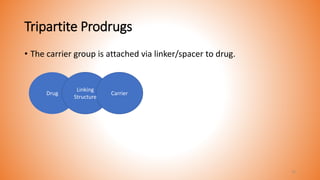
Tripartite Prodrugs
• The carrier group is attached via linker/spacer to drug.
Drug
Linking
Structure
Carrier
12
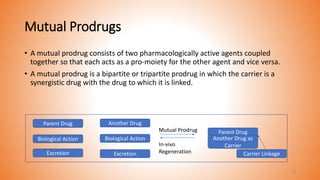
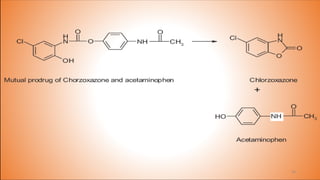
Mutual Prodrugs
• A mutual prodrug consists of two pharmacologically active agents coupled
together so that each acts as a pro-moiety for the other agent and vice versa.
• A mutual prodrug is a bipartite or tripartite prodrug in which the carrier is a
synergistic drug with the drug to which it is linked.
Parent Drug
Biological Action
Excretion
Another Drug
Biological Action
Excretion
Mutual Prodrug
In-vivo
Regeneration
Parent Drug
Another Drug as
Carrier
Carrier Linkage
13
14
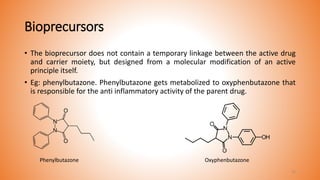
Bioprecursors
• The bioprecursor does not contain a temporary linkage between the active drug
and carrier moiety, but designed from a molecular modification of an active
principle itself.
• Eg: phenylbutazone. Phenylbutazone gets metabolized to oxyphenbutazone that
is responsible for the anti inflammatory activity of the parent drug.
Phenylbutazone Oxyphenbutazone
15
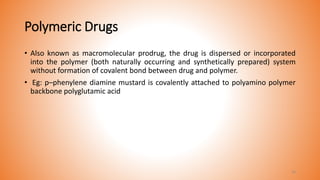
Polymeric Drugs
• Also known as macromolecular prodrug, the drug is dispersed or incorporated
into the polymer (both naturally occurring and synthetically prepared) system
without formation of covalent bond between drug and polymer.
• Eg: p–phenylene diamine mustard is covalently attached to polyamino polymer
backbone polyglutamic acid
16
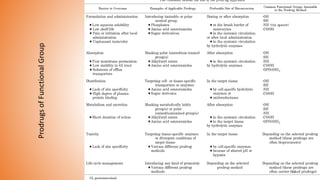
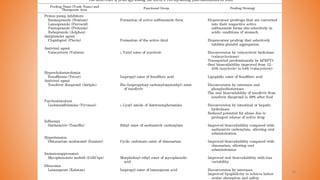
ProdrugsofFunctionalGroup
17
18
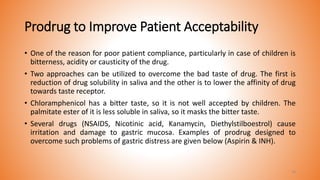
Prodrug to Improve Patient Acceptability
• One of the reason for poor patient compliance, particularly in case of children is
bitterness, acidity or causticity of the drug.
• Two approaches can be utilized to overcome the bad taste of drug. The first is
reduction of drug solubility in saliva and the other is to lower the affinity of drug
towards taste receptor.
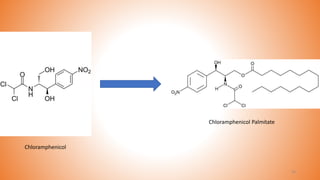
• Chloramphenicol has a bitter taste, so it is not well accepted by children. The
palmitate ester of it is less soluble in saliva, so it masks the bitter taste.
• Several drugs (NSAIDS, Nicotinic acid, Kanamycin, Diethylstilboestrol) cause
irritation and damage to gastric mucosa. Examples of prodrug designed to
overcome such problems of gastric distress are given below (Aspirin & INH).
19
Chloramphenicol Palmitate
Chloramphenicol
20
Prodrug for Slow and Prolonged Release
(Sustained Drug Action)
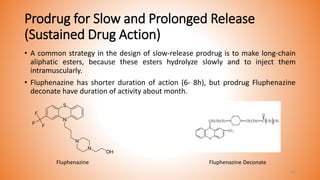
• A common strategy in the design of slow-release prodrug is to make long-chain
aliphatic esters, because these esters hydrolyze slowly and to inject them
intramuscularly.
• Fluphenazine has shorter duration of action (6- 8h), but prodrug Fluphenazine
deconate have duration of activity about month.
Fluphenazine Fluphenazine Deconate
21
Enhancement of Solubility
• The prodrug approach can be used to increase or decrease the solubility of a
drug, depending on its ultimate use.
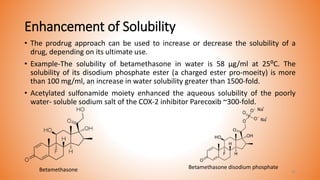
• Example-The solubility of betamethasone in water is 58 μg/ml at 25⁰C. The
solubility of its disodium phosphate ester (a charged ester pro-moeity) is more
than 100 mg/ml, an increase in water solubility greater than 1500-fold.
• Acetylated sulfonamide moiety enhanced the aqueous solubility of the poorly
water- soluble sodium salt of the COX-2 inhibitor Parecoxib ~300-fold.
Betamethasone Betamethasone disodium phosphate
22
Prodrug to Improve Absorption
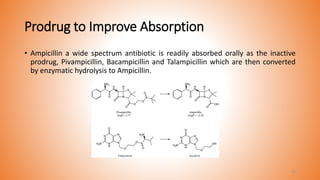
• Ampicillin a wide spectrum antibiotic is readily absorbed orally as the inactive
prodrug, Pivampicillin, Bacampicillin and Talampicillin which are then converted
by enzymatic hydrolysis to Ampicillin.
23
Site Specific Drug Delivery
• After its absorption into the systemic circulation, the drug is distributed to the
various parts of the body including the target site as well as the non-target tissue.
• These problems can be overcome by targeting the drug specifically to its site of
action by prodrug design.
• The prodrug is converted into its active form only in the target organ/tissue by
utilizing either specific enzymes or a pH value different from the normal pH for
activation e.g. 5- amino salicylic acid.
• Tumour cells contain a higher concentration of phosphates and amidases than do
normal cells. Consequently a prodrug of cytotoxic agent could be directed to
tumour cells if either of these enzymes was important to prodrug activation
process. Diethylstilbestrol diphosphate was designedfor site-specific delivery of
diethylstilbestrol to prostatic carcinoma tissue.
24
Site Specific Drug Delivery in Chemotherapy
Directed Enzyme Prodrug Therapy (DEPT)
• Many chemotherapy drugs for cancer lack tumour specificity and the
doses required to reach therapeutic levels in the tumour are often
toxic to other tissues.
• (DEPT) uses enzymes artificially introduced into the body to convert
Prodrugs, which have no or poor biological activity, to the active form
in the desired location within the body.
• DEPT strategies are an experimental method of reducing the systemic
toxicity of a drug, by achieving high levels of the active drug only at
the desired site.
25
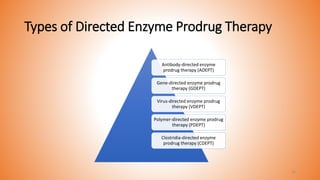
Types of Directed Enzyme Prodrug Therapy
Antibody-directed enzyme
prodrug therapy (ADEPT)
Gene-directed enzyme prodrug
therapy (GDEPT)
Virus-directed enzyme prodrug
therapy (VDEPT)
Polymer-directed enzyme prodrug
therapy (PDEPT)
Clostridia-directed enzyme
prodrug therapy (CDEPT)
26
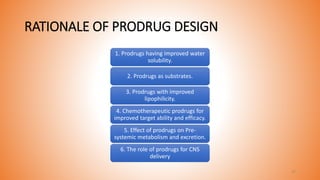
RATIONALE OF PRODRUG DESIGN
1. Prodrugs having improved water
solubility.
2. Prodrugs as substrates.
3. Prodrugs with improved
lipophilicity.
4. Chemotherapeutic prodrugs for
improved target ability and efficacy.
5. Effect of prodrugs on Pre-
systemic metabolism and excretion.
6. The role of prodrugs for CNS
delivery
27
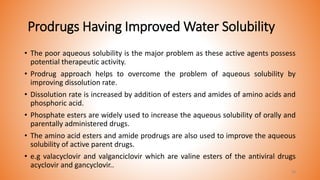
Prodrugs Having Improved Water Solubility
• The poor aqueous solubility is the major problem as these active agents possess
potential therapeutic activity.
• Prodrug approach helps to overcome the problem of aqueous solubility by
improving dissolution rate.
• Dissolution rate is increased by addition of esters and amides of amino acids and
phosphoric acid.
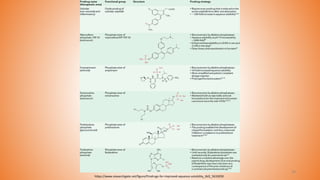
• Phosphate esters are widely used to increase the aqueous solubility of orally and
parentally administered drugs.
• The amino acid esters and amide prodrugs are also used to improve the aqueous
solubility of active parent drugs.
• e.g valacyclovir and valganciclovir which are valine esters of the antiviral drugs
acyclovir and gancyclovir..
28
https://www.researchgate.net/figure/Prodrugs-for-improved-aqueous-solubility_tbl2_5633050
29
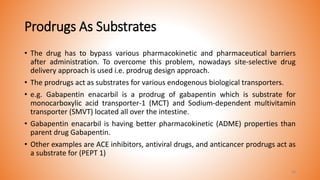
Prodrugs As Substrates
• The drug has to bypass various pharmacokinetic and pharmaceutical barriers
after administration. To overcome this problem, nowadays site-selective drug
delivery approach is used i.e. prodrug design approach.
• The prodrugs act as substrates for various endogenous biological transporters.
• e.g. Gabapentin enacarbil is a prodrug of gabapentin which is substrate for
monocarboxylic acid transporter-1 (MCT) and Sodium-dependent multivitamin
transporter (SMVT) located all over the intestine.
• Gabapentin enacarbil is having better pharmacokinetic (ADME) properties than
parent drug Gabapentin.
• Other examples are ACE inhibitors, antiviral drugs, and anticancer prodrugs act as
a substrate for (PEPT 1)
30
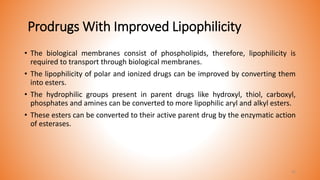
Prodrugs With Improved Lipophilicity
• The biological membranes consist of phospholipids, therefore, lipophilicity is
required to transport through biological membranes.
• The lipophilicity of polar and ionized drugs can be improved by converting them
into esters.
• The hydrophilic groups present in parent drugs like hydroxyl, thiol, carboxyl,
phosphates and amines can be converted to more lipophilic aryl and alkyl esters.
• These esters can be converted to their active parent drug by the enzymatic action
of esterases.
31
Chemotherapeutic Prodrugs for Improved
Target Ability & Efficacy
• Anticancer agents exerts their oncostatic action by inhibition of proliferation and
arresting cell cycle .
• But the oncostatic drugs have poor selectivity in selecting tumour cells, so they
affect normal cells.
• Anticancer prodrug is transported to neoplastic cells and will undergo conversion
to cytotoxic parent drug by local or recombinant enzymes.
• Anticancer drugs are designed to target specific cells as compared to normal cells.
• For improving the specificity of chemotherapy is enzyme-activated prodrug
therapy in which a non-toxic drug is converted into a cytotoxic agents,
• i.e. antimetabolites and alkylating agents. E.g. ADEPT, GDEPT
32
Effect of Prodrugs on Pre-systemic Metabolism
& Excretion
• The availability of the drug in systemic circulation is affected by pre-systemic
metabolism of the drugs in GIT and the liver.
• Which results in the inadequate quantity of drug at the desired site of action or
target.
• This problem has been overcome by altering the route of administration and
development of formulation such as sublingual route and by controlled release
formulations.
• Pre-systemic metabolism can be inhibited by the prodrug approach by masking
the metabolically labile functional groups.
• e.g Terbutaline (used to treat asthma) undergoes rapid pre-systemic metabolism,
therefore, it has been prevented by converting its phenolic groups to Bis-
dimethyl- carbamate (bambuterol).
33
The Role of Prodrugs for CNS Delivery
• Development of drug across CNS is ineffective due to the decrease capacity of the
drug across the BBB(BLOOD BRAIN BARRIER).
• The passage of drugs across BBB is achieved by intrinsic transporter protein
located at luminal and abluminal cells of epithelial cells. The Mechanisms by
which a compound to enter the brain.
(a) Increasing the passive diffusion by masking polar groups.
(b) Increasing the carrier-mediated or receptor-mediated transport through BBB.
(c) Decreasing the efflux of drug from the brain into the blood.
34
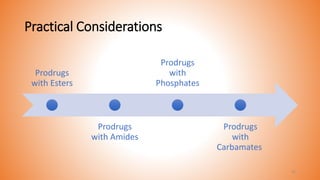
Practical Considerations
Prodrugs
with Esters
Prodrugs
with Amides
Prodrugs
with
Phosphates
Prodrugs
with
Carbamates
35
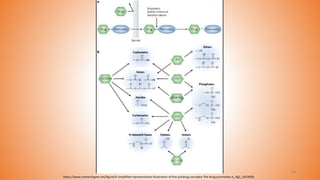
https://www.researchgate.net/figure/A-simplified-representative-illustration-of-the-prodrug-concepta-The-drug-promoiety-is_fig2_5633050
36
Prodrugs With Esters
• Esters undergoes hydrolysis easily and has more aqueous solubility compared to
the parent drug.
• For example: Palmarumycin is a lipophilic drug with poor aqueous solubility and
shows poor anticancer activity in vivo.
• They glycyl-ester derivative of palmarumycin is found to have seven times
increased aqueous solubility than that of parent drug.
37
Prodrugs With Amides
• The amide prodrugs are also used for increasing aqueous solubility of parent drug
and its bioavailability.
• Compared to esters, amide bonds are more stable to enzymatic hydrolysis.
• (a) DW2282 (26) is chemically (S)-1-[1-(4-aminobenzoyl)-2,3-dihydro-1H- indol-6-
sulphonyl]-4-phenyl-imidazolidin-2-one, which is an anticancer drug with low
water solubility (0.024 mg/mL) and higher gastrointestinal toxic effects.
• Many amino acid prodrugs were synthesized almost all of them attained higher
water solubility as compared to the parent drug.
• One of the compound have shown very good aqueous solubility (0.865 mg/mL)
and bioavailability by oral route.
38
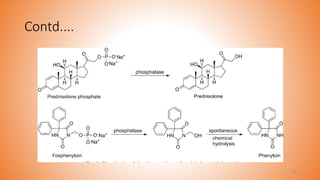
Prodrugs With Phosphates
• The phosphate prodrugs have been proven to increase the aqueous solubility and
bioavailability of the parent drug.
• Phosphate prodrugs get converted to its parent drug by the action of intestinal
alkaline phosphatase enzyme.
• A prodrug of benzimidazole derivative α-6-chloro-2-(methylthio)-5-(napthalen-1-
yloxy)-1H- benzo[d] imidazole. The prodrug synthesized by linking disodium
phosphate and found be 50,000-folds higher water soluble than the parent drug.
39
Contd....
40
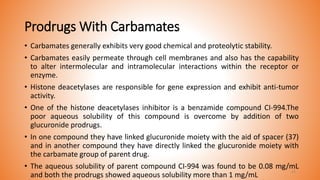
Prodrugs With Carbamates
• Carbamates generally exhibits very good chemical and proteolytic stability.
• Carbamates easily permeate through cell membranes and also has the capability
to alter intermolecular and intramolecular interactions within the receptor or
enzyme.
• Histone deacetylases are responsible for gene expression and exhibit anti-tumor
activity.
• One of the histone deacetylases inhibitor is a benzamide compound CI-994.The
poor aqueous solubility of this compound is overcome by addition of two
glucuronide prodrugs.
• In one compound they have linked glucuronide moiety with the aid of spacer (37)
and in another compound they have directly linked the glucuronide moiety with
the carbamate group of parent drug.
• The aqueous solubility of parent compound CI-994 was found to be 0.08 mg/mL
and both the prodrugs showed aqueous solubility more than 1 mg/mL
41
Conclusion
• The prodrug approach has been used to overcome the limitations arising
due to various undesirable drug properties to optimize clinical drug
applications.
• Prodrug design is becoming elaborated also in the development of efficient
and elective drug delivery systems. Hence prodrugs can be considered as
chemical modifications to solve problems associated with
pharmacokinetics and site specific delivery of drugs.
• The targeted prodrug approach intended for site specific action can be
combined with gene delivery and controlled expression of enzyme carrier
proteins and thus can lead to promising strategy to achieve very precise
and direct effect at the site of desired action with minimal effects on rest of
the body.
42
References
• Patil S.J., P.J. Shirote, Prodrug Approach: An Effective Solution to Overcome Side-effects,
International Journal of Medical and Pharmaceutical Sciences, Vol 1, Issue 7, Pg. No. 1-13, 2011.
• Jolanta B. Zawilska, Jakub Wojcieszak, Agnieszka B. Olejniczak, Prodrugs: A Challenge for the Drug
Development, Pharmacological Reports, 65, Pg. No. 1-14, 2013.
• Arik Dahan, Ellen M. Zimmermann and Shimon Ben-Shabat, Modern Prodrug Design for Targeted
Oral Drug Delivery, Molecules, 19, Pg. No. 16489-16505, 2014.
• Jarkko Rautio, Hanna Kumpulainen, Tycho Heimbach, Reza Oliyai§, Dooman Oh|, Tomi Järvinen
and Jouko Savolainen, Prodrugs: design and clinical applications, Nature Reviews: Drug Discovery,
Vol.7, Pg. No.255-270, March 2008.
• Longqin Hu, The prodrug approach to better targeting,Pg. No. 28-32 August 2004. • V.S. Tegeli,
Y.S. Thorat, G.K. Chougule, U.S. Shivsharan, G.B. Gajeli, S.T. Kumbhar, Concepts and Advances In
Prodrug Technology, International Journal of Drug Formulation & Research, Vol. 1(iii), Pg.No. 32-
57, Nov.-Dec. 2010.
43
• V. Stell, Pro-drugs: An Overview and Definition, PRO-DRUGS, Pg. No. 1-115, 1975.
• Kuei-Meng Wu, A New Classification of Prodrugs: Regulatory Perspectives, Pharmaceuticals, 2, Pg.
No. 77-81, 2009.
• Supriya Shirke, Sheetal Shewale and Manik Satpute, Prodrug Design: An Overview, International
Journal of Pharmaceutical, Chemical and Biological Sciences, 5(1), Pg. No. 232- 241, 2015.
• Kristiina M. Huttunen, Hannu Raunio, and Jarkko Rautio, Prodrugs—from Serendipity to Rational
Design, Pharmacological Reviews, Vol. 63, No. 3, Pg. No. 750–771, 2011.
• Yashveer Singh, Matthew Palombo, and Patrick J. Sinko, Recent Trends in Targeted Anticancer
Prodrug and Conjugate Design, Curr Med Chem, 15(18), Pg. No. 1802–1826, 2008.
• Hanna Kumpulainen, Novel Prodrug Structures for Improved Drug Delivery, Pg. No. 15-131, 2007.
• Sunil S. Jambhekar, Chapter 3 Physicochemical and Biopharmaceutical Properties of Drug
Substances and Pharmacokinetics, Foye’s Principles of Medicinal Chemistry, 7th Edition, Pg. 74-
76, 2013.
• D. M. Brahmankar and Sunil B. Jaiswal, Biopharmaceutics and Pharmacokinetics – A Treatise,
Chapter 6 Prodrugs, 159 – 177, 1995
44
45

Prodrug Design

  • 1.
    PRODRUG DESIGN Presented by: AdityaSharma M.S. (Pharm) Pharmaceutical Analysis NIPER Guwahati1
  • 2.
    Content  Introduction  ProdrugConcept  Classification of Prodrugs  Prodrugs of Functional Group  Prodrug to Improve Patient Acceptability  Prodrug for Slow and Prolonged Release (Sustained Drug Action)  Enhancement of Solubility  Prodrug to Improve Absorption  Site Specific Drug Delivery  Rationale of Prodrug Design  Practical Considerations  Conclusion  References https://www.lexology.com/library/detail.aspx?g=cce810fb-22c5-4bf4-a366-b51a89bf81f0 2
  • 3.
    Introduction • Almost alldrugs possess some undesirable physicochemical and biological properties. • Drug candidates are often discontinued due to issues of poor pharmacokinetic properties or high toxicities • Their therapeutic efficacy can be improved by eliminating the undesirable properties while retaining the desirable ones. • This can be achieved through biological, physical or chemical means. 3
  • 4.
    Definition • The termprodrug, introduced in 1958 by Adrien Albert, relates to “Biologically inert derivatives of drug molecules that undergo an enzymatic and/or chemical conversion in vivo to release the pharmacologically active parent drug.” • A prodrug is a chemically modified inert drug precursor, which upon biotransformation liberates the pharmacologically active parent compound. 4
  • 5.
    Prodrug Concept • Theawareness that the onset, intensity and duration of drug action are greatly affected by the physicochemical properties of drug has promoted the emergence of various prodrugs. • Most of the limitations can be overcame by prodrug approach, but after overcoming the various barriers, the prodrug should rapidly convert into active moiety after reaching the target site. • The design of an efficient, stable, safe, acceptable and aesthetic way to target a drug to its site of action while overcoming various physical, chemical and social barriers is certainly the utilization of the prodrug approach holds great potential. 5
  • 6.
    Drug Not absorbed from GItract because of polarity. Not absorbed through BBB OR skin Chemically unstable drug . Better shelf life wanted Intolerance or irritation if absorbed as such Poor doctor or nurse acceptance due to practical problems Poor patient acceptance, taste or odor problems Formulation Problems Water insoluble- not absorbed-Not capable of direct I.V. injection Absorbed too quickly. Sustained release required Lack of site specificity Vulnerable drug metabolized at absorption site 6
  • 7.
  • 8.
    Classification of Prodrugs Prodrugs CarrierLinked Prodrugs Bipartite Prodrugs Tripartite Prodrugs Mutual Prodrugs Bioprecursor Prodrugs Polymer Prodrugs 8
  • 9.
    Carrier Linked Prodrug •Carrier linked prodrug consists of the attachment of a carrier group to the active drug to alter its physicochemical properties. • The subsequent enzymatic or non-enzymatic mechanism releases the active drug moiety. 9
  • 10.
    Carrier Linked Prodrug ActiveDrug Drug Inert Carrier Inert Carrier Chemical Prodrug Formation Chemical/Enzymatic Cleavage In-vivo Covalent Bond 10
  • 11.
    Bipartite Prodrug • Itis composed of one carrier (group) attached to the drugs. • Such prodrugs have greatly modified lipophilicity due to the attached carrier. The active drug is released by hydrolytic cleavage either chemically or enzymatically. 11
  • 12.
    Tripartite Prodrugs • Thecarrier group is attached via linker/spacer to drug. Drug Linking Structure Carrier 12
  • 13.
    Mutual Prodrugs • Amutual prodrug consists of two pharmacologically active agents coupled together so that each acts as a pro-moiety for the other agent and vice versa. • A mutual prodrug is a bipartite or tripartite prodrug in which the carrier is a synergistic drug with the drug to which it is linked. Parent Drug Biological Action Excretion Another Drug Biological Action Excretion Mutual Prodrug In-vivo Regeneration Parent Drug Another Drug as Carrier Carrier Linkage 13
  • 14.
  • 15.
    Bioprecursors • The bioprecursordoes not contain a temporary linkage between the active drug and carrier moiety, but designed from a molecular modification of an active principle itself. • Eg: phenylbutazone. Phenylbutazone gets metabolized to oxyphenbutazone that is responsible for the anti inflammatory activity of the parent drug. Phenylbutazone Oxyphenbutazone 15
  • 16.
    Polymeric Drugs • Alsoknown as macromolecular prodrug, the drug is dispersed or incorporated into the polymer (both naturally occurring and synthetically prepared) system without formation of covalent bond between drug and polymer. • Eg: p–phenylene diamine mustard is covalently attached to polyamino polymer backbone polyglutamic acid 16
  • 17.
  • 18.
  • 19.
    Prodrug to ImprovePatient Acceptability • One of the reason for poor patient compliance, particularly in case of children is bitterness, acidity or causticity of the drug. • Two approaches can be utilized to overcome the bad taste of drug. The first is reduction of drug solubility in saliva and the other is to lower the affinity of drug towards taste receptor. • Chloramphenicol has a bitter taste, so it is not well accepted by children. The palmitate ester of it is less soluble in saliva, so it masks the bitter taste. • Several drugs (NSAIDS, Nicotinic acid, Kanamycin, Diethylstilboestrol) cause irritation and damage to gastric mucosa. Examples of prodrug designed to overcome such problems of gastric distress are given below (Aspirin & INH). 19
  • 20.
  • 21.
    Prodrug for Slowand Prolonged Release (Sustained Drug Action) • A common strategy in the design of slow-release prodrug is to make long-chain aliphatic esters, because these esters hydrolyze slowly and to inject them intramuscularly. • Fluphenazine has shorter duration of action (6- 8h), but prodrug Fluphenazine deconate have duration of activity about month. Fluphenazine Fluphenazine Deconate 21
  • 22.
    Enhancement of Solubility •The prodrug approach can be used to increase or decrease the solubility of a drug, depending on its ultimate use. • Example-The solubility of betamethasone in water is 58 μg/ml at 25⁰C. The solubility of its disodium phosphate ester (a charged ester pro-moeity) is more than 100 mg/ml, an increase in water solubility greater than 1500-fold. • Acetylated sulfonamide moiety enhanced the aqueous solubility of the poorly water- soluble sodium salt of the COX-2 inhibitor Parecoxib ~300-fold. Betamethasone Betamethasone disodium phosphate 22
  • 23.
    Prodrug to ImproveAbsorption • Ampicillin a wide spectrum antibiotic is readily absorbed orally as the inactive prodrug, Pivampicillin, Bacampicillin and Talampicillin which are then converted by enzymatic hydrolysis to Ampicillin. 23
  • 24.
    Site Specific DrugDelivery • After its absorption into the systemic circulation, the drug is distributed to the various parts of the body including the target site as well as the non-target tissue. • These problems can be overcome by targeting the drug specifically to its site of action by prodrug design. • The prodrug is converted into its active form only in the target organ/tissue by utilizing either specific enzymes or a pH value different from the normal pH for activation e.g. 5- amino salicylic acid. • Tumour cells contain a higher concentration of phosphates and amidases than do normal cells. Consequently a prodrug of cytotoxic agent could be directed to tumour cells if either of these enzymes was important to prodrug activation process. Diethylstilbestrol diphosphate was designedfor site-specific delivery of diethylstilbestrol to prostatic carcinoma tissue. 24
  • 25.
    Site Specific DrugDelivery in Chemotherapy Directed Enzyme Prodrug Therapy (DEPT) • Many chemotherapy drugs for cancer lack tumour specificity and the doses required to reach therapeutic levels in the tumour are often toxic to other tissues. • (DEPT) uses enzymes artificially introduced into the body to convert Prodrugs, which have no or poor biological activity, to the active form in the desired location within the body. • DEPT strategies are an experimental method of reducing the systemic toxicity of a drug, by achieving high levels of the active drug only at the desired site. 25
  • 26.
    Types of DirectedEnzyme Prodrug Therapy Antibody-directed enzyme prodrug therapy (ADEPT) Gene-directed enzyme prodrug therapy (GDEPT) Virus-directed enzyme prodrug therapy (VDEPT) Polymer-directed enzyme prodrug therapy (PDEPT) Clostridia-directed enzyme prodrug therapy (CDEPT) 26
  • 27.
    RATIONALE OF PRODRUGDESIGN 1. Prodrugs having improved water solubility. 2. Prodrugs as substrates. 3. Prodrugs with improved lipophilicity. 4. Chemotherapeutic prodrugs for improved target ability and efficacy. 5. Effect of prodrugs on Pre- systemic metabolism and excretion. 6. The role of prodrugs for CNS delivery 27
  • 28.
    Prodrugs Having ImprovedWater Solubility • The poor aqueous solubility is the major problem as these active agents possess potential therapeutic activity. • Prodrug approach helps to overcome the problem of aqueous solubility by improving dissolution rate. • Dissolution rate is increased by addition of esters and amides of amino acids and phosphoric acid. • Phosphate esters are widely used to increase the aqueous solubility of orally and parentally administered drugs. • The amino acid esters and amide prodrugs are also used to improve the aqueous solubility of active parent drugs. • e.g valacyclovir and valganciclovir which are valine esters of the antiviral drugs acyclovir and gancyclovir.. 28
  • 29.
  • 30.
    Prodrugs As Substrates •The drug has to bypass various pharmacokinetic and pharmaceutical barriers after administration. To overcome this problem, nowadays site-selective drug delivery approach is used i.e. prodrug design approach. • The prodrugs act as substrates for various endogenous biological transporters. • e.g. Gabapentin enacarbil is a prodrug of gabapentin which is substrate for monocarboxylic acid transporter-1 (MCT) and Sodium-dependent multivitamin transporter (SMVT) located all over the intestine. • Gabapentin enacarbil is having better pharmacokinetic (ADME) properties than parent drug Gabapentin. • Other examples are ACE inhibitors, antiviral drugs, and anticancer prodrugs act as a substrate for (PEPT 1) 30
  • 31.
    Prodrugs With ImprovedLipophilicity • The biological membranes consist of phospholipids, therefore, lipophilicity is required to transport through biological membranes. • The lipophilicity of polar and ionized drugs can be improved by converting them into esters. • The hydrophilic groups present in parent drugs like hydroxyl, thiol, carboxyl, phosphates and amines can be converted to more lipophilic aryl and alkyl esters. • These esters can be converted to their active parent drug by the enzymatic action of esterases. 31
  • 32.
    Chemotherapeutic Prodrugs forImproved Target Ability & Efficacy • Anticancer agents exerts their oncostatic action by inhibition of proliferation and arresting cell cycle . • But the oncostatic drugs have poor selectivity in selecting tumour cells, so they affect normal cells. • Anticancer prodrug is transported to neoplastic cells and will undergo conversion to cytotoxic parent drug by local or recombinant enzymes. • Anticancer drugs are designed to target specific cells as compared to normal cells. • For improving the specificity of chemotherapy is enzyme-activated prodrug therapy in which a non-toxic drug is converted into a cytotoxic agents, • i.e. antimetabolites and alkylating agents. E.g. ADEPT, GDEPT 32
  • 33.
    Effect of Prodrugson Pre-systemic Metabolism & Excretion • The availability of the drug in systemic circulation is affected by pre-systemic metabolism of the drugs in GIT and the liver. • Which results in the inadequate quantity of drug at the desired site of action or target. • This problem has been overcome by altering the route of administration and development of formulation such as sublingual route and by controlled release formulations. • Pre-systemic metabolism can be inhibited by the prodrug approach by masking the metabolically labile functional groups. • e.g Terbutaline (used to treat asthma) undergoes rapid pre-systemic metabolism, therefore, it has been prevented by converting its phenolic groups to Bis- dimethyl- carbamate (bambuterol). 33
  • 34.
    The Role ofProdrugs for CNS Delivery • Development of drug across CNS is ineffective due to the decrease capacity of the drug across the BBB(BLOOD BRAIN BARRIER). • The passage of drugs across BBB is achieved by intrinsic transporter protein located at luminal and abluminal cells of epithelial cells. The Mechanisms by which a compound to enter the brain. (a) Increasing the passive diffusion by masking polar groups. (b) Increasing the carrier-mediated or receptor-mediated transport through BBB. (c) Decreasing the efflux of drug from the brain into the blood. 34
  • 35.
    Practical Considerations Prodrugs with Esters Prodrugs withAmides Prodrugs with Phosphates Prodrugs with Carbamates 35
  • 36.
  • 37.
    Prodrugs With Esters •Esters undergoes hydrolysis easily and has more aqueous solubility compared to the parent drug. • For example: Palmarumycin is a lipophilic drug with poor aqueous solubility and shows poor anticancer activity in vivo. • They glycyl-ester derivative of palmarumycin is found to have seven times increased aqueous solubility than that of parent drug. 37
  • 38.
    Prodrugs With Amides •The amide prodrugs are also used for increasing aqueous solubility of parent drug and its bioavailability. • Compared to esters, amide bonds are more stable to enzymatic hydrolysis. • (a) DW2282 (26) is chemically (S)-1-[1-(4-aminobenzoyl)-2,3-dihydro-1H- indol-6- sulphonyl]-4-phenyl-imidazolidin-2-one, which is an anticancer drug with low water solubility (0.024 mg/mL) and higher gastrointestinal toxic effects. • Many amino acid prodrugs were synthesized almost all of them attained higher water solubility as compared to the parent drug. • One of the compound have shown very good aqueous solubility (0.865 mg/mL) and bioavailability by oral route. 38
  • 39.
    Prodrugs With Phosphates •The phosphate prodrugs have been proven to increase the aqueous solubility and bioavailability of the parent drug. • Phosphate prodrugs get converted to its parent drug by the action of intestinal alkaline phosphatase enzyme. • A prodrug of benzimidazole derivative α-6-chloro-2-(methylthio)-5-(napthalen-1- yloxy)-1H- benzo[d] imidazole. The prodrug synthesized by linking disodium phosphate and found be 50,000-folds higher water soluble than the parent drug. 39
  • 40.
  • 41.
    Prodrugs With Carbamates •Carbamates generally exhibits very good chemical and proteolytic stability. • Carbamates easily permeate through cell membranes and also has the capability to alter intermolecular and intramolecular interactions within the receptor or enzyme. • Histone deacetylases are responsible for gene expression and exhibit anti-tumor activity. • One of the histone deacetylases inhibitor is a benzamide compound CI-994.The poor aqueous solubility of this compound is overcome by addition of two glucuronide prodrugs. • In one compound they have linked glucuronide moiety with the aid of spacer (37) and in another compound they have directly linked the glucuronide moiety with the carbamate group of parent drug. • The aqueous solubility of parent compound CI-994 was found to be 0.08 mg/mL and both the prodrugs showed aqueous solubility more than 1 mg/mL 41
  • 42.
    Conclusion • The prodrugapproach has been used to overcome the limitations arising due to various undesirable drug properties to optimize clinical drug applications. • Prodrug design is becoming elaborated also in the development of efficient and elective drug delivery systems. Hence prodrugs can be considered as chemical modifications to solve problems associated with pharmacokinetics and site specific delivery of drugs. • The targeted prodrug approach intended for site specific action can be combined with gene delivery and controlled expression of enzyme carrier proteins and thus can lead to promising strategy to achieve very precise and direct effect at the site of desired action with minimal effects on rest of the body. 42
  • 43.
    References • Patil S.J.,P.J. Shirote, Prodrug Approach: An Effective Solution to Overcome Side-effects, International Journal of Medical and Pharmaceutical Sciences, Vol 1, Issue 7, Pg. No. 1-13, 2011. • Jolanta B. Zawilska, Jakub Wojcieszak, Agnieszka B. Olejniczak, Prodrugs: A Challenge for the Drug Development, Pharmacological Reports, 65, Pg. No. 1-14, 2013. • Arik Dahan, Ellen M. Zimmermann and Shimon Ben-Shabat, Modern Prodrug Design for Targeted Oral Drug Delivery, Molecules, 19, Pg. No. 16489-16505, 2014. • Jarkko Rautio, Hanna Kumpulainen, Tycho Heimbach, Reza Oliyai§, Dooman Oh|, Tomi Järvinen and Jouko Savolainen, Prodrugs: design and clinical applications, Nature Reviews: Drug Discovery, Vol.7, Pg. No.255-270, March 2008. • Longqin Hu, The prodrug approach to better targeting,Pg. No. 28-32 August 2004. • V.S. Tegeli, Y.S. Thorat, G.K. Chougule, U.S. Shivsharan, G.B. Gajeli, S.T. Kumbhar, Concepts and Advances In Prodrug Technology, International Journal of Drug Formulation & Research, Vol. 1(iii), Pg.No. 32- 57, Nov.-Dec. 2010. 43
  • 44.
    • V. Stell,Pro-drugs: An Overview and Definition, PRO-DRUGS, Pg. No. 1-115, 1975. • Kuei-Meng Wu, A New Classification of Prodrugs: Regulatory Perspectives, Pharmaceuticals, 2, Pg. No. 77-81, 2009. • Supriya Shirke, Sheetal Shewale and Manik Satpute, Prodrug Design: An Overview, International Journal of Pharmaceutical, Chemical and Biological Sciences, 5(1), Pg. No. 232- 241, 2015. • Kristiina M. Huttunen, Hannu Raunio, and Jarkko Rautio, Prodrugs—from Serendipity to Rational Design, Pharmacological Reviews, Vol. 63, No. 3, Pg. No. 750–771, 2011. • Yashveer Singh, Matthew Palombo, and Patrick J. Sinko, Recent Trends in Targeted Anticancer Prodrug and Conjugate Design, Curr Med Chem, 15(18), Pg. No. 1802–1826, 2008. • Hanna Kumpulainen, Novel Prodrug Structures for Improved Drug Delivery, Pg. No. 15-131, 2007. • Sunil S. Jambhekar, Chapter 3 Physicochemical and Biopharmaceutical Properties of Drug Substances and Pharmacokinetics, Foye’s Principles of Medicinal Chemistry, 7th Edition, Pg. 74- 76, 2013. • D. M. Brahmankar and Sunil B. Jaiswal, Biopharmaceutics and Pharmacokinetics – A Treatise, Chapter 6 Prodrugs, 159 – 177, 1995 44
  • 45.