
Presented by : ANAND SAGAR TIWARI
M.Pharm (Second Semester))
 Introduction
 Basic concepts
 Role of different tools in Target discovery and
validation
 Role of transgenic animals in target validation
 Historically drugs were discovered by identifying
the active ingredient from traditional remedies or
by serendipitous discovery as with penicillin.
 Recently the diseases are being controlled at
molecular and physiological levels.
 After sequencing of human genome, allowed rapid
cloning HTS has been used against isolated
biological targets.
 Hits from these screens are then tested in cells and
then in animals for efficacy.
 What is a target ?
 The target is the naturally existing cellular or
molecular structure involved in the pathology of
interest where the drug in development is meant to
act.
 Established targets are those for which there is a
good scientific understanding and how it is
involved in human pathology.
 A target is termed druggable if its activity can be
modulated by a therapeutic (small drug molecule
or biologic).
 Has a confirmed role in the pathophysiology of the
disease.
 Target expression is not evenly distributed
throughout.
 Target’s 3D structure is available to assess
druggability.
 Easily assayable using High throughput screening.
 Should possess a promising toxicity profile,
potential adverse effects which are predictable.
 Proposed target has a favourable intellectual
property (IP) status.
 Screening and design: The process of finding a
new drug target for a particular disease usually
involves HTS.
 Herein large libraries of chemicals are tested for
their ability to modify the target.
 e.g. If the target is novel GPCR, compounds will
be screened for their ability to inhibit or stimulate
that receptor.
 Important function of HTS is to show the
selectivity of compounds for the chosen target.
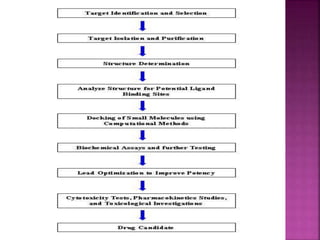
 What is Target identification ?
 Target identification is the process of identifying the
direct molecular target. e.g. Protein or nucleic acid of a
small molecule.
 It is aimed at finding the efficacy target of a drug or
other xenobiotics.
 The techniques used may be based on principles of
biochemistry, biophysics, genetics or other disciplines.
 A good drug target needs to be relevant to the disease
phenotype and should be amenable to therapeutic
evaluation.
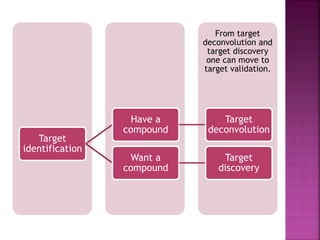
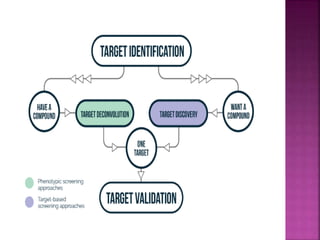
 Target identification is carried out by target
deconvolution or target discovery.
From target
deconvolution and
target discovery
one can move to
target validation.
Target
identification
Have a
compound
Target
deconvolution
Want a
compound
Target
discovery
 In target based drug discovery biological targets
are already established.
 Target role in the disease process is known.
 Target is then used to create relevant system based
assays and vast compound libraries.
 These are screened in search of a hit– a candidate
drug.
 Target-based drug discovery can exploit numerous
approaches including crystallography,
computational modelling, genomics, biochemistry.
 Thus uncovering how a drug interacts with a target
of interest.
 It also enables:
i. Development of structure activity
relationship(SAR)
ii. Development of biomarkers.
iii. Discovery of future therapeutics that act at the
specific target of interest.
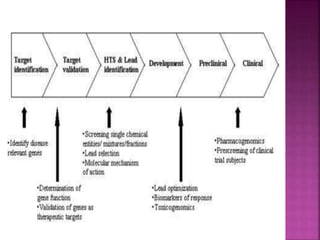
 Preclinical drug target validation has the aim to
increase confidence in a particular drug target.
 It is the process by means of which the predicted
molecular target of a small molecule is verified.
 While the validation of a drug’s efficacy and
toxicity in animal models is valuable, the ultimate
test is in clinical setting.
 It is broken down into two key steps
i. Reproducibility
ii. Introduce variation to the ligand
 It is in contrast to genetics which refers to the
study of individual genes and their roles in
inheritance.
 Genomics aims at the collective characterization
and quantification of all of an organism’s genes,
their interrelations and influence on an organism.
 Genomics also involves the sequencing and
analysis of genomes through high throughput
DNA sequencing and Bioinformatics to analyze
the function of each genome.
Genomics has provided applications in many fields
namely;
 Genomic medicine: Next generation genomic
techniques has allowed researchers to drastically
understand the genetic bases of drug response and
disease.
 Synthetic biology and bioengineering
 Conservation genomics: Conservationist can use
the information gathered by genome sequencing in
order to better evaluate genetic factors key to
species conservation such as the genetic diversity
of a population or whether an individual is
heterozygous for a recessive disorder.
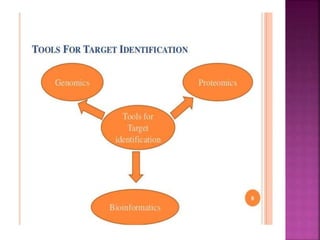
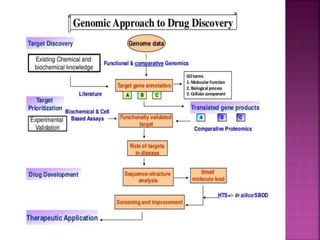
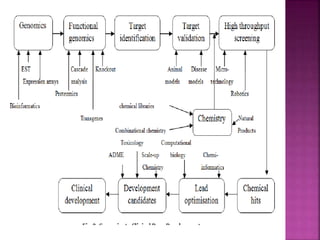
 Target identification is based upon molecular
information derived from genome sequences and
protein structures.
 Genomics helps in the identity comparison for
nucleic acid sequences.
 For preparing the databases of model organisms.
This helps to screen:
 Rare specific genes
 Virulence genes
 Bacterial membrane translocation proteins.
 During preclinical studies the genes linked with
drug metabolism could be genotyped in patients
recruited for phase I trials.
 If efficacy data are collected during phase I trials,
polymorphisms in the drug target gene could be
typed in phase I participants.
 Their linkage with side-effects or variation in drug
response can be assessed.
 The negative results can be further refined during
phase II clinical trials.
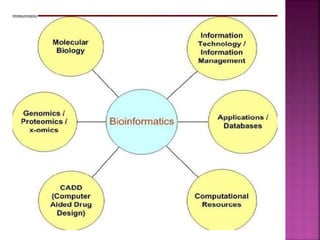
 Bioinformatics is an interdisciplinary field that
develops methods and software tools for
understanding biological data, especially when the
data is large and complex.
 Such identification is concerned with the better
understanding of the genetic basis of disease.
 Common uses of bioinformatics include the
identification of candidate genes and single
nucleotide polymorphism
 Bioinformatics has been of great importance to
develop fast and accurate target identification and
prediction method for the drug discovery.
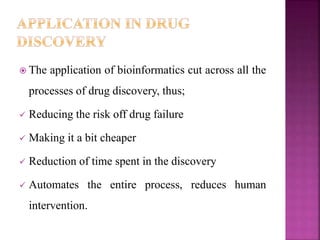
 The application of bioinformatics cut across all the
processes of drug discovery, thus;
 Reducing the risk off drug failure
 Making it a bit cheaper
 Reduction of time spent in the discovery
 Automates the entire process, reduces human
intervention.
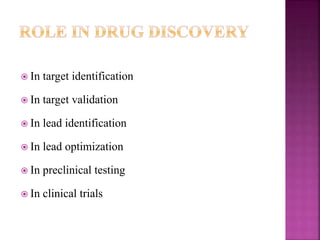
 In target identification
 In target validation
 In lead identification
 In lead optimization
 In preclinical testing
 In clinical trials
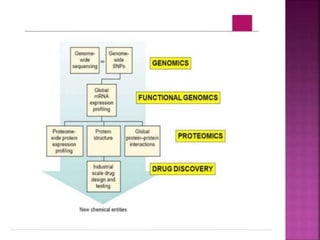
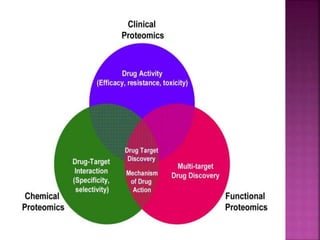
 Proteomics is defined as the large scale study of
proteins.
 Proteome is defined as the entire set of proteins
that is produced or modified by an organism or
system.
 Proteomic approach of target identification
includes finding an unstable protein that causes
undesirable effect and then usage of a molecule to
identify its effect.
1. Protein expression profiling: identification of
proteins in a sample as a function of a particular
state of cell.
2. Protein network mapping : To determine protein
interaction with each other in living organism.
3. Mapping of protein modifications: Task to
identify how and where proteins are modified
post-translationally.
4. Helps to study drug MoA , Disease Biomarkers,
Epigenetics, Spatial localization etc.
 Genome analysis does not account for post
translation processes unlike proteomics.
 Thus focus shifted from genomics to proteomics.
 The significance lies in the comparison of cells
from normal tissue with those representing a
disease state.
 This comparison enables the identification of
disease-specific biomarkers used for diagnostic or
prognostic tests.
 At the same time it identifies target proteins that
have the potential for drug targets.
 One such approach is comparative proteomics,
based on labelling proteins from normal and
diseased tissue with different fluorescent dyes Cy3
and Cy5, mixing the proteins together and
separating them by isoelectric point and molecular
weight.
 In addition proteomics can analyze biomarkers by
quantifying individual proteins and show the
separation in between one or more protein spots on
a scanned image from two dimensional gel
electrophoresis.
 e.g. Proteomic differences between early and
advanced stages of an illness can be observed.
Microarrays
Zinc finger proteins
Antisense technology
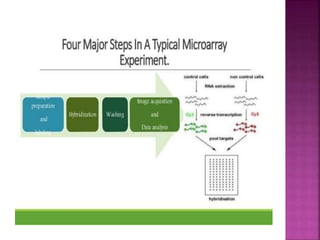
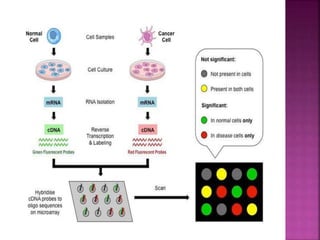
 A microarray is a laboratory tool used to detect the
expression of thousand gees at the same time.
 The core principle of microarray is hybridization.
 Each known gene or probe occupies a specific site on
the chip and varying level of fluorescent activity shows
varying level of gene activity.
 A DNA microarray also known as DNA chip or biochip
is a collection of microscopic DNA spots attached to a
solid support surface.
 The microarray technique has been sub-classified
based on the sample to be analysed:
 DNA microarray
 Protein microarray
 Antibody microarray
 Tissue microarray
 Chemical compound microarray
 Microarray based studies provide essential impetus for
identification of disease causing genes in malignancies.
 Has a role in identification of genes for new and
unique potential drug targets.
 It also predicts drug responsiveness for individual
patients.
 It helps to finally initiate gene therapy and prevention
strategies.
 Array based gene expression analysis has enabled
parallel monitoring of cellular transcription at the
level of the genome.
 Understanding of normal and abnormal cell
biochemistry and thus on the choice of targets for
drug design.
 e.g. Data generated from High density
oligonucleotides microarray in oncology identified
97 genes as physiological targets.
 Further characterization of these genes should
provide insights into proliferation pathway thus
providing potential therapeutic targets.
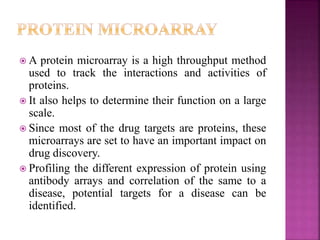
 A protein microarray is a high throughput method
used to track the interactions and activities of
proteins.
 It also helps to determine their function on a large
scale.
 Since most of the drug targets are proteins, these
microarrays are set to have an important impact on
drug discovery.
 Profiling the different expression of protein using
antibody arrays and correlation of the same to a
disease, potential targets for a disease can be
identified.
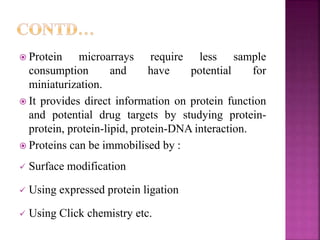
 Protein microarrays require less sample
consumption and have potential for
miniaturization.
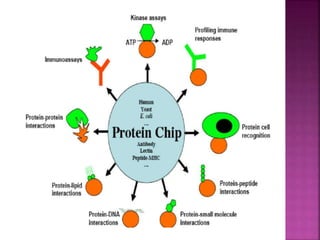
 It provides direct information on protein function
and potential drug targets by studying protein-
protein, protein-lipid, protein-DNA interaction.
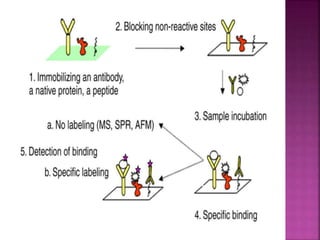
 Proteins can be immobilised by :
 Surface modification
 Using expressed protein ligation
 Using Click chemistry etc.
 Antisense oligonucleotides are short , single
stranded DNA molecules that interact with mRNA
to prevent translation of a targeted gene.
 This is done by preventing the mRNA instructions
from reaching the ribosome and inhibiting protein
synthesis.
 Thus antisense oligonucleotides are unmodified or
chemically modified ssDNA, RNA or their
analogs.
 Two classes can be discerned i.e. RNase H
dependent oligonucleotides and steric blocker
oligonucleotides.
 For successful application of antisense
oligonucleotides several problems need to be
addressed. They are:
 Accessible sites of target RNA for oligonucleotides
binding have to be identified.
 They need to be protected against nuclease enzyme
attack.
 Cellular uptake and correct intracellular
localization should be made feasible.
 E.g. Phospho-thioate-deoxy-nucleotides, 2-O-
methyl etc.
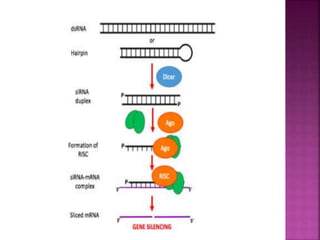
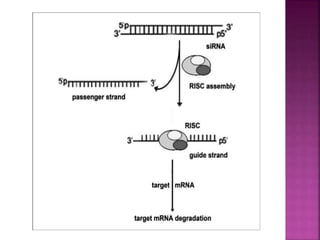
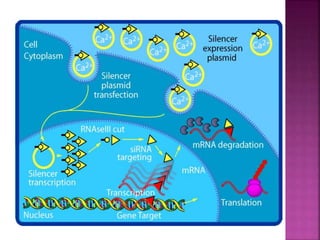
 Small interfering RNA or short interfering RNA
are 20-25 base pair in length.
 It interferes with the expression of specific genes
with complementary nucleotide sequence.
 Thus degrading mRNA after transcription,
preventing translation.
 The Dicer enzyme catalyzes production of siRNAs
from long dsRNAs and small hairpin RNAs.
 Artificial induction of the natural RNAi is now
routinely used to specifically silence target genes.
 Applied for gene function, identification of
molecules involved in biochemical pathways, lead
optimisation and functional genomics.
 The most common use is in target validation
experiments.
 They are able to regulate the expression of genes
by a phenomenon known as RNA interference.
 A zinc finger is a small protein structural motif.
 These are among the most abundant proteins in
eukaryotic genomes.
 They have a diverse functions including DNA
recognition, RNA packaging, transcriptional
activation, regulation of apoptosis, protein folding.
 Zinc finger proteins that recognise novel DNA
sequences form the basis of drug discovery and
therapeutics.
 These proteins have been used as the DNA-
binding domains of novel transcription factors.
 Useful for validating genes as drug targets.
 Also used for engineering cell lines for small
molecule screening and protein production.
 Recently these are used as a basis for novel human
therapeutics.
 Direct way involves designing ZFPs to validate the
phenotypic effects of activating or repressing a
gene.
 Alternatively libraries may be used to screen cells
for desired phenotypic changes.
 The use and usefulness of transgenic animals in
the discovery of new medicine has been vital these
days.
 Mouse and man are very similar at the genetic
level.
 Genetic alteration in the mouse often result in
functional changes predicting the relevant
pharmacological effect in man.
 Genetically modified mice possess many
characteristics making them useful for
understanding novel disease mechanism.
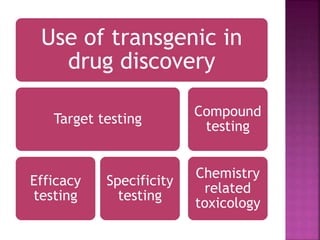
Use of transgenic in
drug discovery
Target testing
Efficacy
testing
Specificity
testing
Compound
testing
Chemistry
related
toxicology
 Transgenic animals can be used widely in the
process of discovering new medicines, e.g. In
validation of potential new drug targets and in
understanding of specificity, efficacy & safety of
compounds. Other roles are:
 Disease modelling and drug development
 Target validation
 Compound validation
 Efficacy evaluation
 Specificity evaluation
 Safety evaluation
 Replacing non-human primate models
Target discovery and validation

Target discovery and validation

  • 1.
    Presented by :ANAND SAGAR TIWARI M.Pharm (Second Semester))
  • 2.
     Introduction  Basicconcepts  Role of different tools in Target discovery and validation  Role of transgenic animals in target validation
  • 3.
     Historically drugswere discovered by identifying the active ingredient from traditional remedies or by serendipitous discovery as with penicillin.  Recently the diseases are being controlled at molecular and physiological levels.  After sequencing of human genome, allowed rapid cloning HTS has been used against isolated biological targets.  Hits from these screens are then tested in cells and then in animals for efficacy.
  • 6.
     What isa target ?  The target is the naturally existing cellular or molecular structure involved in the pathology of interest where the drug in development is meant to act.  Established targets are those for which there is a good scientific understanding and how it is involved in human pathology.  A target is termed druggable if its activity can be modulated by a therapeutic (small drug molecule or biologic).
  • 7.
     Has aconfirmed role in the pathophysiology of the disease.  Target expression is not evenly distributed throughout.  Target’s 3D structure is available to assess druggability.  Easily assayable using High throughput screening.  Should possess a promising toxicity profile, potential adverse effects which are predictable.  Proposed target has a favourable intellectual property (IP) status.
  • 8.
     Screening anddesign: The process of finding a new drug target for a particular disease usually involves HTS.  Herein large libraries of chemicals are tested for their ability to modify the target.  e.g. If the target is novel GPCR, compounds will be screened for their ability to inhibit or stimulate that receptor.  Important function of HTS is to show the selectivity of compounds for the chosen target.
  • 9.
     What isTarget identification ?  Target identification is the process of identifying the direct molecular target. e.g. Protein or nucleic acid of a small molecule.  It is aimed at finding the efficacy target of a drug or other xenobiotics.  The techniques used may be based on principles of biochemistry, biophysics, genetics or other disciplines.  A good drug target needs to be relevant to the disease phenotype and should be amenable to therapeutic evaluation.  Target identification is carried out by target deconvolution or target discovery.
  • 10.
    From target deconvolution and targetdiscovery one can move to target validation. Target identification Have a compound Target deconvolution Want a compound Target discovery
  • 12.
     In targetbased drug discovery biological targets are already established.  Target role in the disease process is known.  Target is then used to create relevant system based assays and vast compound libraries.  These are screened in search of a hit– a candidate drug.
  • 13.
     Target-based drugdiscovery can exploit numerous approaches including crystallography, computational modelling, genomics, biochemistry.  Thus uncovering how a drug interacts with a target of interest.  It also enables: i. Development of structure activity relationship(SAR) ii. Development of biomarkers. iii. Discovery of future therapeutics that act at the specific target of interest.
  • 14.
     Preclinical drugtarget validation has the aim to increase confidence in a particular drug target.  It is the process by means of which the predicted molecular target of a small molecule is verified.  While the validation of a drug’s efficacy and toxicity in animal models is valuable, the ultimate test is in clinical setting.  It is broken down into two key steps i. Reproducibility ii. Introduce variation to the ligand
  • 17.
     It isin contrast to genetics which refers to the study of individual genes and their roles in inheritance.  Genomics aims at the collective characterization and quantification of all of an organism’s genes, their interrelations and influence on an organism.  Genomics also involves the sequencing and analysis of genomes through high throughput DNA sequencing and Bioinformatics to analyze the function of each genome.
  • 18.
    Genomics has providedapplications in many fields namely;  Genomic medicine: Next generation genomic techniques has allowed researchers to drastically understand the genetic bases of drug response and disease.  Synthetic biology and bioengineering  Conservation genomics: Conservationist can use the information gathered by genome sequencing in order to better evaluate genetic factors key to species conservation such as the genetic diversity of a population or whether an individual is heterozygous for a recessive disorder.
  • 21.
     Target identificationis based upon molecular information derived from genome sequences and protein structures.  Genomics helps in the identity comparison for nucleic acid sequences.  For preparing the databases of model organisms. This helps to screen:  Rare specific genes  Virulence genes  Bacterial membrane translocation proteins.
  • 22.
     During preclinicalstudies the genes linked with drug metabolism could be genotyped in patients recruited for phase I trials.  If efficacy data are collected during phase I trials, polymorphisms in the drug target gene could be typed in phase I participants.  Their linkage with side-effects or variation in drug response can be assessed.  The negative results can be further refined during phase II clinical trials.
  • 23.
     Bioinformatics isan interdisciplinary field that develops methods and software tools for understanding biological data, especially when the data is large and complex.  Such identification is concerned with the better understanding of the genetic basis of disease.  Common uses of bioinformatics include the identification of candidate genes and single nucleotide polymorphism  Bioinformatics has been of great importance to develop fast and accurate target identification and prediction method for the drug discovery.
  • 25.
     The applicationof bioinformatics cut across all the processes of drug discovery, thus;  Reducing the risk off drug failure  Making it a bit cheaper  Reduction of time spent in the discovery  Automates the entire process, reduces human intervention.
  • 26.
     In targetidentification  In target validation  In lead identification  In lead optimization  In preclinical testing  In clinical trials
  • 27.
     Proteomics isdefined as the large scale study of proteins.  Proteome is defined as the entire set of proteins that is produced or modified by an organism or system.  Proteomic approach of target identification includes finding an unstable protein that causes undesirable effect and then usage of a molecule to identify its effect.
  • 28.
    1. Protein expressionprofiling: identification of proteins in a sample as a function of a particular state of cell. 2. Protein network mapping : To determine protein interaction with each other in living organism. 3. Mapping of protein modifications: Task to identify how and where proteins are modified post-translationally. 4. Helps to study drug MoA , Disease Biomarkers, Epigenetics, Spatial localization etc.
  • 29.
     Genome analysisdoes not account for post translation processes unlike proteomics.  Thus focus shifted from genomics to proteomics.  The significance lies in the comparison of cells from normal tissue with those representing a disease state.  This comparison enables the identification of disease-specific biomarkers used for diagnostic or prognostic tests.  At the same time it identifies target proteins that have the potential for drug targets.
  • 30.
     One suchapproach is comparative proteomics, based on labelling proteins from normal and diseased tissue with different fluorescent dyes Cy3 and Cy5, mixing the proteins together and separating them by isoelectric point and molecular weight.  In addition proteomics can analyze biomarkers by quantifying individual proteins and show the separation in between one or more protein spots on a scanned image from two dimensional gel electrophoresis.  e.g. Proteomic differences between early and advanced stages of an illness can be observed.
  • 33.
  • 34.
     A microarrayis a laboratory tool used to detect the expression of thousand gees at the same time.  The core principle of microarray is hybridization.  Each known gene or probe occupies a specific site on the chip and varying level of fluorescent activity shows varying level of gene activity.  A DNA microarray also known as DNA chip or biochip is a collection of microscopic DNA spots attached to a solid support surface.
  • 36.
     The microarraytechnique has been sub-classified based on the sample to be analysed:  DNA microarray  Protein microarray  Antibody microarray  Tissue microarray  Chemical compound microarray
  • 37.
     Microarray basedstudies provide essential impetus for identification of disease causing genes in malignancies.  Has a role in identification of genes for new and unique potential drug targets.  It also predicts drug responsiveness for individual patients.  It helps to finally initiate gene therapy and prevention strategies.
  • 38.
     Array basedgene expression analysis has enabled parallel monitoring of cellular transcription at the level of the genome.  Understanding of normal and abnormal cell biochemistry and thus on the choice of targets for drug design.  e.g. Data generated from High density oligonucleotides microarray in oncology identified 97 genes as physiological targets.  Further characterization of these genes should provide insights into proliferation pathway thus providing potential therapeutic targets.
  • 40.
     A proteinmicroarray is a high throughput method used to track the interactions and activities of proteins.  It also helps to determine their function on a large scale.  Since most of the drug targets are proteins, these microarrays are set to have an important impact on drug discovery.  Profiling the different expression of protein using antibody arrays and correlation of the same to a disease, potential targets for a disease can be identified.
  • 41.
     Protein microarraysrequire less sample consumption and have potential for miniaturization.  It provides direct information on protein function and potential drug targets by studying protein- protein, protein-lipid, protein-DNA interaction.  Proteins can be immobilised by :  Surface modification  Using expressed protein ligation  Using Click chemistry etc.
  • 44.
     Antisense oligonucleotidesare short , single stranded DNA molecules that interact with mRNA to prevent translation of a targeted gene.  This is done by preventing the mRNA instructions from reaching the ribosome and inhibiting protein synthesis.  Thus antisense oligonucleotides are unmodified or chemically modified ssDNA, RNA or their analogs.  Two classes can be discerned i.e. RNase H dependent oligonucleotides and steric blocker oligonucleotides.
  • 45.
     For successfulapplication of antisense oligonucleotides several problems need to be addressed. They are:  Accessible sites of target RNA for oligonucleotides binding have to be identified.  They need to be protected against nuclease enzyme attack.  Cellular uptake and correct intracellular localization should be made feasible.  E.g. Phospho-thioate-deoxy-nucleotides, 2-O- methyl etc.
  • 46.
     Small interferingRNA or short interfering RNA are 20-25 base pair in length.  It interferes with the expression of specific genes with complementary nucleotide sequence.  Thus degrading mRNA after transcription, preventing translation.  The Dicer enzyme catalyzes production of siRNAs from long dsRNAs and small hairpin RNAs.
  • 47.
     Artificial inductionof the natural RNAi is now routinely used to specifically silence target genes.  Applied for gene function, identification of molecules involved in biochemical pathways, lead optimisation and functional genomics.  The most common use is in target validation experiments.  They are able to regulate the expression of genes by a phenomenon known as RNA interference.
  • 51.
     A zincfinger is a small protein structural motif.  These are among the most abundant proteins in eukaryotic genomes.  They have a diverse functions including DNA recognition, RNA packaging, transcriptional activation, regulation of apoptosis, protein folding.  Zinc finger proteins that recognise novel DNA sequences form the basis of drug discovery and therapeutics.
  • 52.
     These proteinshave been used as the DNA- binding domains of novel transcription factors.  Useful for validating genes as drug targets.  Also used for engineering cell lines for small molecule screening and protein production.  Recently these are used as a basis for novel human therapeutics.  Direct way involves designing ZFPs to validate the phenotypic effects of activating or repressing a gene.  Alternatively libraries may be used to screen cells for desired phenotypic changes.
  • 53.
     The useand usefulness of transgenic animals in the discovery of new medicine has been vital these days.  Mouse and man are very similar at the genetic level.  Genetic alteration in the mouse often result in functional changes predicting the relevant pharmacological effect in man.  Genetically modified mice possess many characteristics making them useful for understanding novel disease mechanism.
  • 54.
    Use of transgenicin drug discovery Target testing Efficacy testing Specificity testing Compound testing Chemistry related toxicology
  • 55.
     Transgenic animalscan be used widely in the process of discovering new medicines, e.g. In validation of potential new drug targets and in understanding of specificity, efficacy & safety of compounds. Other roles are:  Disease modelling and drug development  Target validation  Compound validation  Efficacy evaluation  Specificity evaluation  Safety evaluation  Replacing non-human primate models