CHEMICAL DATA
Abhik Seal
Indiana University Bloomington (dsdht.wikispaces.com)
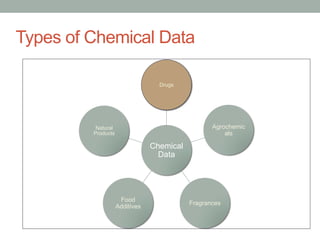
Types of Chemical Data
Chemical
Data
Drugs
Agrochemic
als
Fragrances
Food
Additives
Natural
Products
Data on Drugs
•  Chemical Properties
a) Solubility
b) ADME & Pharmacokinetics /Pharmacodynamics
c) LD50, IC50
d) Structural Properties
e) Chemical Reactions
f ) Chemogenomics interactions
Chemical-gene interactions
Chemical-disease interactions
Chemical-GO enriched interactions
Chemical-pathway enriched associations
•  Adverse events / side effects of drugs
•  Toxicological data
Data on Drugs (ADME)
Cell permeability and Absorption example
Real World Drug Discovery A Chemist’s Guide to Biotech and Pharmaceutical Research
Partition coefficients
1-Octanol is the most frequently used lipid phase in pharmaceutical research.
This is because:
§  It has a polar and non polar region (like a membrane phospholipid)
§  Po/w is fairly easy to measure
§  Po/w often correlates well with many biological properties
§  It can be predicted fairly accurately using computational models
Xaqueous
Xoctanol
P
Partition coefficient P (usually expressed as log10P or logP) is defined as:
P =
[X]octanol
[X]aqueous
P is a measure of the relative affinity of a molecule for the lipid and aqueous phases in
the absence of ionisation.
Modeling LogP an example
LogP for a molecule can be calculated from a sum of fragmental or atom-based terms plus
various corrections.
logP = Σ fragments + Σ corrections
C: 3.16 M: 3.16 PHENYLBUTAZONE
Class | Type | Log(P) Contribution Description Value
FRAGMENT | # 1 | 3,5-pyrazolidinedione -3.240
ISOLATING |CARBON| 5 Aliphatic isolating carbon(s) 0.975
ISOLATING |CARBON| 12 Aromatic isolating carbon(s) 1.560
EXFRAGMENT|BRANCH| 1 chain and 0 cluster branch(es) -0.130
EXFRAGMENT|HYDROG| 20 H(s) on isolating carbons 4.540
EXFRAGMENT|BONDS | 3 chain and 2 alicyclic (net) -0.540
RESULT | 2.11 |All fragments measured clogP 3.165
clogP for windows output
N
N
C
C
C
C
C
C
C
O
C
C
O
C
C
C
C
C
C
C
C
C
C
H
H
H
H
H H
H
H
H
H
H
H
H
H
H
H
H
H
H
HPhenylbutazone
Branch
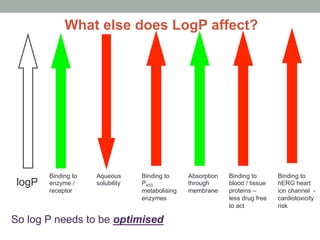
logP
Binding to
enzyme /
receptor
Aqueous
solubility
Binding to
P450
metabolising
enzymes
Absorption
through
membrane
Binding to
blood / tissue
proteins –
less drug free
to act
Binding to
hERG heart
ion channel -
cardiotoxicity
risk
So log P needs to be optimised
What else does LogP affect?
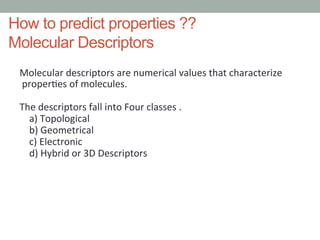
How to predict properties ??
Molecular Descriptors
Molecular	
  descriptors	
  are	
  numerical	
  values	
  that	
  characterize	


  proper4es	
  of	
  molecules.	


The	
  descriptors	
  fall	
  into	
  Four	
  classes	
  .	


  a)	
  Topological	


  b)	
  Geometrical	


  c)	
  Electronic	


  d)	
  Hybrid	
  or	
  3D	
  Descriptors	
  
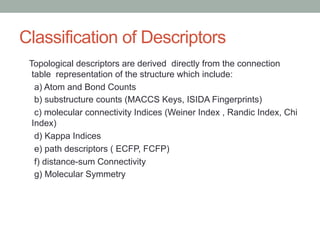
Classification of Descriptors
Topological descriptors are derived directly from the connection
table representation of the structure which include:
a) Atom and Bond Counts
b) substructure counts (MACCS Keys, ISIDA Fingerprints)
c) molecular connectivity Indices (Weiner Index , Randic Index, Chi
Index)
d) Kappa Indices
e) path descriptors ( ECFP, FCFP)
f) distance-sum Connectivity
g) Molecular Symmetry
Classification of Descriptors
Geometrical descriptors are derived from the three-dimensional
representations and include:
a) principal moments of inertia,
b) molecular volume,
c) solvent-accessible surface area,
d) Charged partial Surface area
e) Molecular Surface area
Classification of Descriptors
Electronic descriptors characterize the molecular structures with such as :
•  Dipole moment,
•  Quadrupole moment,
•  Polarizibility,
•  HOMO and LUMO energies,
•  Dielectric energy
•  Molar Refractivity
ToolsTo calculate Molecular Descriptors
Freely available some examples
•  CDK tool
http://rguha.net/code/java/cdkdesc.html
•  RDKit
http://www.rdkit.org/
•  POWER MV
http://nisla05.niss.org/PowerMV/?q=PowerMV/
•  MOLD2
http://www.fda.gov/ScienceResearch/BioinformaticsTools/
Mold2/default.htm
•  PADEL Descriptor
http://www.downv.com/Windows/install-PaDEL-
Descriptor-10439915.htm

Chemical data

  • 1.
    CHEMICAL DATA Abhik Seal IndianaUniversity Bloomington (dsdht.wikispaces.com)
  • 2.
    Types of ChemicalData Chemical Data Drugs Agrochemic als Fragrances Food Additives Natural Products
  • 3.
    Data on Drugs • Chemical Properties a) Solubility b) ADME & Pharmacokinetics /Pharmacodynamics c) LD50, IC50 d) Structural Properties e) Chemical Reactions f ) Chemogenomics interactions Chemical-gene interactions Chemical-disease interactions Chemical-GO enriched interactions Chemical-pathway enriched associations •  Adverse events / side effects of drugs •  Toxicological data
  • 4.
    Data on Drugs(ADME) Cell permeability and Absorption example Real World Drug Discovery A Chemist’s Guide to Biotech and Pharmaceutical Research
  • 5.
    Partition coefficients 1-Octanol isthe most frequently used lipid phase in pharmaceutical research. This is because: §  It has a polar and non polar region (like a membrane phospholipid) §  Po/w is fairly easy to measure §  Po/w often correlates well with many biological properties §  It can be predicted fairly accurately using computational models Xaqueous Xoctanol P Partition coefficient P (usually expressed as log10P or logP) is defined as: P = [X]octanol [X]aqueous P is a measure of the relative affinity of a molecule for the lipid and aqueous phases in the absence of ionisation.
  • 6.
    Modeling LogP anexample LogP for a molecule can be calculated from a sum of fragmental or atom-based terms plus various corrections. logP = Σ fragments + Σ corrections C: 3.16 M: 3.16 PHENYLBUTAZONE Class | Type | Log(P) Contribution Description Value FRAGMENT | # 1 | 3,5-pyrazolidinedione -3.240 ISOLATING |CARBON| 5 Aliphatic isolating carbon(s) 0.975 ISOLATING |CARBON| 12 Aromatic isolating carbon(s) 1.560 EXFRAGMENT|BRANCH| 1 chain and 0 cluster branch(es) -0.130 EXFRAGMENT|HYDROG| 20 H(s) on isolating carbons 4.540 EXFRAGMENT|BONDS | 3 chain and 2 alicyclic (net) -0.540 RESULT | 2.11 |All fragments measured clogP 3.165 clogP for windows output N N C C C C C C C O C C O C C C C C C C C C C H H H H H H H H H H H H H H H H H H H HPhenylbutazone Branch
  • 7.
    logP Binding to enzyme / receptor Aqueous solubility Bindingto P450 metabolising enzymes Absorption through membrane Binding to blood / tissue proteins – less drug free to act Binding to hERG heart ion channel - cardiotoxicity risk So log P needs to be optimised What else does LogP affect?
  • 8.
    How to predictproperties ?? Molecular Descriptors Molecular  descriptors  are  numerical  values  that  characterize          proper4es  of  molecules.     The  descriptors  fall  into  Four  classes  .          a)  Topological          b)  Geometrical          c)  Electronic            d)  Hybrid  or  3D  Descriptors  
  • 9.
    Classification of Descriptors Topologicaldescriptors are derived directly from the connection table representation of the structure which include: a) Atom and Bond Counts b) substructure counts (MACCS Keys, ISIDA Fingerprints) c) molecular connectivity Indices (Weiner Index , Randic Index, Chi Index) d) Kappa Indices e) path descriptors ( ECFP, FCFP) f) distance-sum Connectivity g) Molecular Symmetry
  • 10.
    Classification of Descriptors Geometricaldescriptors are derived from the three-dimensional representations and include: a) principal moments of inertia, b) molecular volume, c) solvent-accessible surface area, d) Charged partial Surface area e) Molecular Surface area
  • 11.
    Classification of Descriptors Electronicdescriptors characterize the molecular structures with such as : •  Dipole moment, •  Quadrupole moment, •  Polarizibility, •  HOMO and LUMO energies, •  Dielectric energy •  Molar Refractivity
  • 12.
    ToolsTo calculate MolecularDescriptors Freely available some examples •  CDK tool http://rguha.net/code/java/cdkdesc.html •  RDKit http://www.rdkit.org/ •  POWER MV http://nisla05.niss.org/PowerMV/?q=PowerMV/ •  MOLD2 http://www.fda.gov/ScienceResearch/BioinformaticsTools/ Mold2/default.htm •  PADEL Descriptor http://www.downv.com/Windows/install-PaDEL- Descriptor-10439915.htm