






Molecular Modeling and
Virtual screening
Techniques
Abhijit Debnath
Asst. Professor
NIET, Pharmacy Institute
Greater Noida
Friday, June 11, 2021
1
Unit: 3
Abhijit Debnath | BP807ET-CADD | Unit-3
Subject Name: CADD (Elective)
(BP 807 ET)
Course Details
(B. Pharm 8th Sem)
Noida Institute of Engineering and Technology
(Pharmacy Institute) Greater Noida
Friday, June 11, 2021 2
SYLLABUS
Abhijit Debnath | BP807ET-CADD | Unit-3
Friday, June 11, 2021 3
CONTENT
Abhijit Debnath | BP807ET-CADD | Unit-3
• Virtual Screening techniques: Drug likeness screening, Concept of pharmacophore mapping and
pharmacophore based Screening.
• Molecular docking: Rigid docking, flexible docking, manual docking, Docking based screening. De novo
drug design.
Objectives: Upon completion of the subject student shall be able to;
1. Virtual Screening techniques
2. Molecular docking
Friday, June 11, 2021
Abhijit Debnath | BP807ET-CADD | Unit-3
4
COURSE OBJECTIVE
Friday, June 11, 2021 Abhijit Debnath | BP807ET-CADD | Unit-3 5
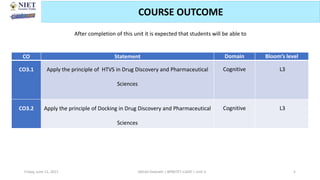
COURSE OUTCOME
CO Statement Domain Bloom’s level
CO3.1 Apply the principle of HTVS in Drug Discovery and Pharmaceutical
Sciences
Cognitive L3
CO3.2 Apply the principle of Docking in Drug Discovery and Pharmaceutical
Sciences
Cognitive L3
After completion of this unit it is expected that students will be able to
Friday, June 11, 2021 Abhijit Debnath | BP807ET-CADD | Unit-3 6
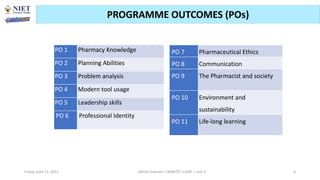
PROGRAMME OUTCOMES (POs)
PO 1 Pharmacy Knowledge
PO 2 Planning Abilities
PO 3 Problem analysis
PO 4 Modern tool usage
PO 5 Leadership skills
PO 6 Professional Identity
PO 7 Pharmaceutical Ethics
PO 8 Communication
PO 9 The Pharmacist and society
PO 10 Environment and
sustainability
PO 11 Life-long learning
Friday, June 11, 2021 Abhijit Debnath | BP807ET-CADD | Unit-3 7
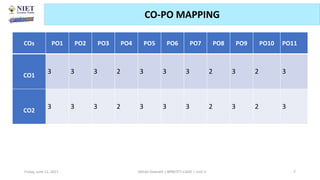
CO-PO MAPPING
COs PO1 PO2 PO3 PO4 PO5 PO6 PO7 PO8 PO9 PO10 PO11
CO1
3 3 3 2 3 3 3 2 3 2 3
CO2
3 3 3 2 3 3 3 2 3 2 3
TOPIC OBJECTIVE
• Learning the basics of Molecular Docking, Pharmacophore Mapping and Virtual Screening to
Screen Large Database for Drug Discovery.
8
• After completion of this unit it is expected that students will be able to
Thursday, May 13, 2021 Abhijit Debnath | BP807ET-CADD | Unit-1 9
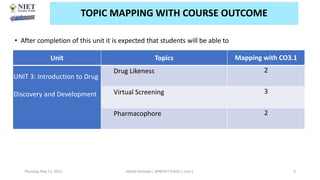
TOPIC MAPPING WITH COURSE OUTCOME
Unit Topics Mapping with CO3.1
UNIT 3: Introduction to Drug
Discovery and Development
Drug Likeness 2
Virtual Screening 3
Pharmacophore 2
• After completion of this unit it is expected that students will be able to
Thursday, May 13, 2021 Abhijit Debnath | BP807ET-CADD | Unit-1 1
0
TOPIC MAPPING WITH COURSE OUTCOME
Unit Topics Mapping with CO3.2
UNIT 3: Introduction to Drug
Discovery and Development
Molecular Docking 3
Docking based Virtual Screening 2
Thursday, May 13, 2021 Abhijit Debnath | BP807ET-CADD | Unit-1 1
1
TOPIC OBJECTIVE MAPPING WITH COURSE OUTCOME
Topics Topic Objective Mapping with CO
Drug Likeness To learn about various Drug Likeness Rules
Virtual Screening To be get skilled with High Throughput Virtual Screening CO3.1
Pharmacophore To know about the Ligand based virtual screening CO3.1
Molecular Docking To understand the receptor ligand interaction at molecular
level
CO3.2
Docking based Virtual
Screening
To be get skilled with High Throughput Virtual Screening by
using the knowledge Structure Based Drug Design
CO3.1
• Students must have basic knowledge of Biochemistry and Medicinal Chemistry
• Students must have basic knowledge of genetic engineering, medicine and fermentation technology.
• Students must have basic knowledge of SAR and QSAR.
Friday, June 11, 2021 Abhijit Debnath | BP807ET-CADD | Unit-3 12
PREREQUISITE AND RECAP
Virtual Screening techniques
Friday, June 11, 2021 Abhijit Debnath | BP807ET-CADD | Unit-3 13
CO3.1
Noida Institute of Engineering and Technology
(Pharmacy Institute) Greater Noida
Virtual Screening techniques
Friday, June 11, 2021 Abhijit Debnath | BP807ET-CADD | Unit-3 14
 Screening in Drug Discovery
 Drug Likeness
 Virtual Screening
 Ligand-Based Methods
 Similarity Searching
 Pharmacophore Mapping
 Machine learning Methods
 Structure Based Methods (Molecular
Docking)
Noida Institute of Engineering and Technology
(Pharmacy Institute) Greater Noida
CO3.1
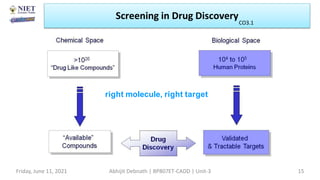
right molecule, right target
Screening in Drug Discovery
Friday, June 11, 2021 Abhijit Debnath | BP807ET-CADD | Unit-3 15
CO3.1
High-throughput screening Combinatorial chemistry
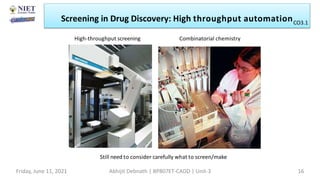
Still need to consider carefully what to screen/make
Screening in Drug Discovery: High throughput automation
Friday, June 11, 2021 Abhijit Debnath | BP807ET-CADD | Unit-3 16
CO3.1
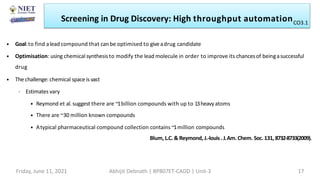
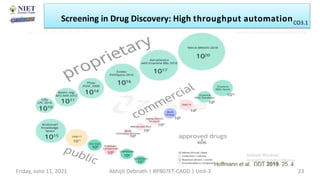
• Goal:to find alead compound that can be optimised to giveadrug candidate
• Optimisation: using chemical synthesisto modify the lead molecule in order to improve its chancesof beingasuccessful
drug
• The challenge: chemical spaceis vast
– Estimates vary
• Reymond et al. suggest there are ~1billion compounds with up to 13heavyatoms
• There are ~30 million known compounds
• Atypical pharmaceutical compound collection contains ~1million compounds
Blum, L.C. & Reymond, J.-louis .J.Am. Chem. Soc. 131, 8732-8733(2009).
Screening in Drug Discovery: High throughput automation
Friday, June 11, 2021 Abhijit Debnath | BP807ET-CADD | Unit-3 17
CO3.1
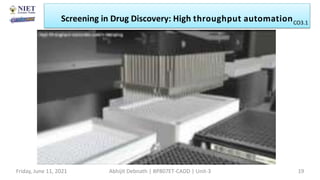
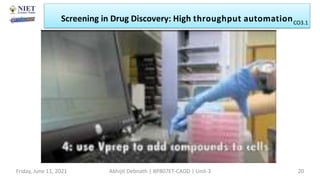
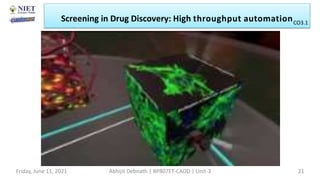
• Highthroughput screening allows large (up to 1million) numbers of compounds to be tested
– Butverysmall proportion of“available”compounds
– Largescale screeningis expensive
– Not all targets are suitable for HTS
Screening in Drug Discovery: High throughput automation
Friday, June 11, 2021 Abhijit Debnath | BP807ET-CADD | Unit-3 18
CO3.1
Screening in Drug Discovery: High throughput automation
Friday, June 11, 2021 Abhijit Debnath | BP807ET-CADD | Unit-3 19
CO3.1
Screening in Drug Discovery: High throughput automation
Friday, June 11, 2021 Abhijit Debnath | BP807ET-CADD | Unit-3 20
CO3.1
Screening in Drug Discovery: High throughput automation
Friday, June 11, 2021 Abhijit Debnath | BP807ET-CADD | Unit-3 21
CO3.1
• Virtual screening refers to a range of in-silico techniques used to search large compound databases to select a smaller
number for biologicaltesting
• Virtual screening can be used to
– Select compounds for screening from in-housedatabases
– Choose compounds to purchase from external suppliers
– Decide which compounds to synthesisenext
• The technique applied depends on the amount of information availableabout the particular diseasetarget
Virtual Screening
Friday, June 11, 2021 Abhijit Debnath | BP807ET-CADD | Unit-3 22
CO3.1
Screening in Drug Discovery: High throughput automation
Friday, June 11, 2021 Abhijit Debnath | BP807ET-CADD | Unit-3 23
CO3.1
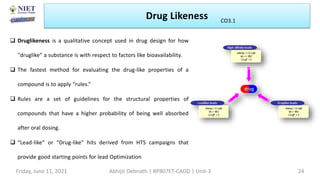
 Druglikeness is a qualitative concept used in drug design for how
"druglike" a substance is with respect to factors like bioavailability.
 The fastest method for evaluating the drug-like properties of a
compound is to apply “rules.”
 Rules are a set of guidelines for the structural properties of
compounds that have a higher probability of being well absorbed
after oral dosing.
 “Lead-like” or “Drug-like” hits derived from HTS campaigns that
provide good starting points for lead Optimization
Drug Likeness
Friday, June 11, 2021 Abhijit Debnath | BP807ET-CADD | Unit-3 24
CO3.1
Drug Likeness
Friday, June 11, 2021 Abhijit Debnath | BP807ET-CADD | Unit-3 25
CO3.1
 It is estimated from the molecular structure before the substance is even synthesized and tested. A druglike molecule
has properties such as:
 Solubility in both water and fat, as an orally administered drug needs to pass through the intestinal lining after it is
consumed, be carried in aqueous blood and penetrate the lipid-based cell membrane to reach the inside of a cell.
• A model compound for the lipophilic cellular membrane is 1-octanol (a lipophilic hydrocarbon), so the logarithm
of the octanol-water partition coefficient, known as LogP, is used to predict the solubility of a potential oral
drug.
• This coefficient can be experimentally measured or predicted computationally, in which case it is sometimes
called "cLogP".
Drug Likeness
Friday, June 11, 2021 Abhijit Debnath | BP807ET-CADD | Unit-3 26
CO3.1
Drug Likeness
Friday, June 11, 2021 Abhijit Debnath | BP807ET-CADD | Unit-3 27
CO3.1
 Potency at the biological target.
• High potency (high value of pIC50) is a desirable attribute in drug candidates, as it reduces the risk of non-
specific, off-target pharmacology at a given concentration.
• When associated with low clearance, high potency also allows for low total dose, which lowers the risk of
idiosyncratic drug reactions.
 Ligand efficiency and lipophilic efficiency.
Drug Likeness
Friday, June 11, 2021 Abhijit Debnath | BP807ET-CADD | Unit-3 28
CO3.1
 Molecular weight:
• The smaller the better, because diffusion is directly affected.
• The great majority of drugs on the market have molecular weights between 200 and 600 Daltons, and
particularly <500; they belong to the group of small molecules.
Drug Likeness
Friday, June 11, 2021 Abhijit Debnath | BP807ET-CADD | Unit-3 29
CO3.1
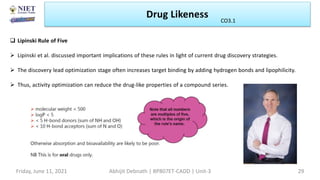
 Lipinski Rule of Five
 Lipinski et al. discussed important implications of these rules in light of current drug discovery strategies.
 The discovery lead optimization stage often increases target binding by adding hydrogen bonds and lipophilicity.
 Thus, activity optimization can reduce the drug-like properties of a compound series.
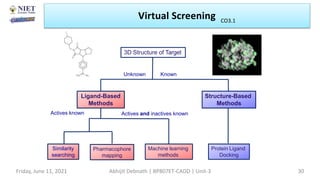
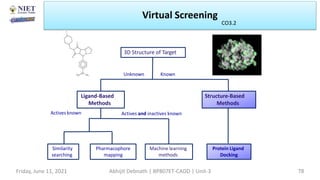
Ligand-Based
Methods
Structure-Based
Methods
Unknown
3D Structure of Target
Known
Actives known Actives and inactives known
Machine learning
methods
Pharmacophore
mapping
Similarity
searching
Protein Ligand
Docking
Virtual Screening
Friday, June 11, 2021 Abhijit Debnath | BP807ET-CADD | Unit-3 30
CO3.1
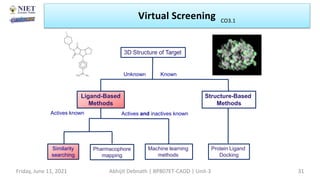
Ligand-Based
Methods
Structure-Based
Methods
Unknown
3D Structure of Target
Known
Actives known Actives and inactives known
Machine learning
methods
Pharmacophore
mapping
Similarity
searching
Protein Ligand
Docking
Virtual Screening
Friday, June 11, 2021 Abhijit Debnath | BP807ET-CADD | Unit-3 31
CO3.1
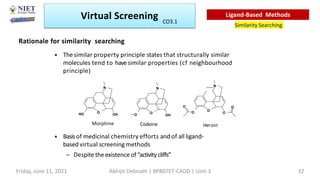
• The similar property principle states that structurally similar
molecules tend to havesimilar properties (cf neighbourhood
principle)
• Basisof medicinal chemistry efforts and of all ligand-
based virtual screening methods
– Despitetheexistence of“activitycliffs”
N
O
OH
HO
Morphine
N
O
OH
O
Codeine
N
O
O
O
O
O
Heroin
Virtual Screening
Rationale for similarity searching
Similarity Searching
Ligand-Based Methods
Friday, June 11, 2021 Abhijit Debnath | BP807ET-CADD | Unit-3 32
CO3.1
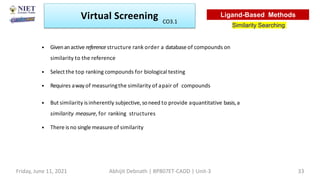
• Givenanactive reference structure rank order a database of compounds on
similarity to the reference
• Select the top ranking compounds for biological testing
• Requires away of measuringthe similarity of apair of compounds
• But similarity isinherently subjective, soneed to provide aquantitative basis,a
similarity measure, for ranking structures
• There is no singlemeasure of similarity
Virtual Screening
Similarity Searching
Ligand-Based Methods
Friday, June 11, 2021 Abhijit Debnath | BP807ET-CADD | Unit-3 33
CO3.1
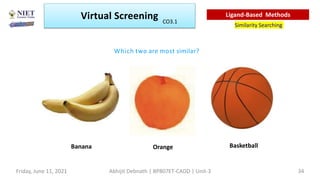
Which two are most similar?
Banana Orange Basketball
Virtual Screening
Similarity Searching
Ligand-Based Methods
Friday, June 11, 2021 Abhijit Debnath | BP807ET-CADD | Unit-3 34
CO3.1
Three components of a similarity measure
• Molecular descriptors
– Numerical values assignedto structures
• Physicochemicalproperties, e.g.,MW, logP,MR,PSA,....
• 2Dproperties: fingerprints, topological indices, maximum
common substructures
• 3Dproperties:fingerprints, molecular fields
• Similarity coefficient
– Aquantitative measure of similarity between two sets of molecular descriptors
• Canalso useaweighting function to ensure equal (or non-equal) contributions from all parts of the measure
Todeschini & Consonni, Handbook of Molecular Descriptors Wiley-VCH,2009
Virtual Screening
Similarity Searching
Ligand-Based Methods
Friday, June 11, 2021 Abhijit Debnath | BP807ET-CADD | Unit-3 35
CO3.1
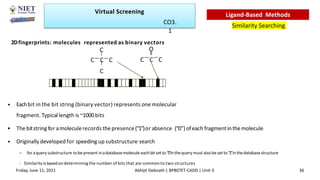
2Dfingerprints: molecules represented as binary vectors
• Eachbit in the bit string (binary vector) represents one molecular
fragment. Typical length is ~1000bits
• The bitstring for amoleculerecords thepresence(“1”)or absence (“0”) ofeach fragmentinthemolecule
• Originally developed for speeding up substructure search
– foraquery substructure tobe present inadatabasemolecule eachbitset to “1”inthequery must alsobe set to“1
”inthedatabasestructure
- Similarity is basedon determining the number of bits that are common to two structures
C
C C C
C
O
C C C
Virtual Screening
Similarity Searching
Ligand-Based Methods
Friday, June 11, 2021 Abhijit Debnath | BP807ET-CADD | Unit-3 36
CO3.
1
C
C
C
C
N C N
C
C
C
C
C C
C
C
C
C
C
C
C
N N
C
C C
a.Augmented Atom
C rs C rd C rs C
b.Atom Sequence
C rs C rs C rd C
c. Bond Sequence
AArs AArsAArd AA
d. Ring Composition
N rs C rd C rs C rs C rs
e.Ring Fusion
XX3 XX3 XX3 XX2 XX2
f.Atom Pair
N 0;3 - 2 - C 0;3
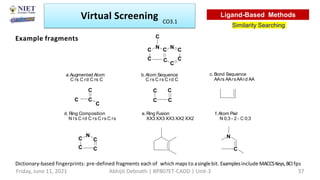
Example fragments
Dictionary-based fingerprints: pre-defined fragments each of which maps to asinglebit. Examplesinclude MACCSKeys,BCIfps
Virtual Screening
Similarity Searching
Ligand-Based Methods
Friday, June 11, 2021 Abhijit Debnath | BP807ET-CADD | Unit-3 37
CO3.1
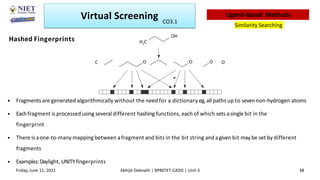
Hashed Fingerprints
*
• Fragmentsare generated algorithmically without the need for a dictionary eg,all paths up to sevennon-hydrogen atoms
• Eachfragment is processed using several different hashing functions, eachof which sets asingle bit in the
fingerprint
• There is aone-to-many mapping between afragment and bits in the bit string and agivenbit maybe set by different
fragments
• Examples:Daylight, UNITYfingerprints
OH
H3C
C O
O O O
Virtual Screening
Similarity Searching
Ligand-Based Methods
Friday, June 11, 2021 Abhijit Debnath | BP807ET-CADD | Unit-3 38
CO3.1
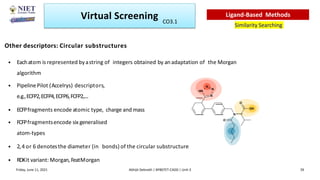
Other descriptors: Circular substructures
• Eachatom is represented byastring of integers obtained by an adaptation of the Morgan
algorithm
• PipelinePilot (Accelrys) descriptors,
e.g.,ECFP2,ECFP4,ECFP6,FCFP2,....
• ECFPfragments encode atomic type, charge and mass
• FCFPfragmentsencode six generalised
atom-types
• 2,4 or 6 denotesthe diameter (in bonds) of the circular substructure
• RDKit variant: Morgan, FeatMorgan
N
N
N
HN
N
O
OH
O
Virtual Screening
Similarity Searching
Ligand-Based Methods
Friday, June 11, 2021 Abhijit Debnath | BP807ET-CADD | Unit-3 39
CO3.1
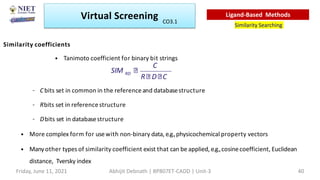
Similarity coefficients
• Tanimoto coefficient for binary bit strings
– Cbits set in common in the referenceand databasestructure
– Rbits set in referencestructure
– Dbits set in databasestructure
• More complex form for usewith non-binary data, e.g.,physicochemical property vectors
• Manyother types of similarity coefficient exist that can be applied, e.g.,cosinecoefficient, Euclidean
distance, Tversky index
R D C
C
RD
SIM
Virtual Screening
Similarity Searching
Ligand-Based Methods
Friday, June 11, 2021 Abhijit Debnath | BP807ET-CADD | Unit-3 40
CO3.1
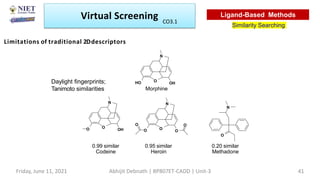
Limitations of traditional 2Ddescriptors
N
OH
HO O
Morphine
N
O
OH
O
0.99 similar
Codeine
N
O
O
O
O
O
0.95 similar
Heroin
N
O
0.20 similar
Methadone
Daylight fingerprints;
Tanimoto similarities
Virtual Screening
Similarity Searching
Ligand-Based Methods
Friday, June 11, 2021 Abhijit Debnath | BP807ET-CADD | Unit-3 41
CO3.1
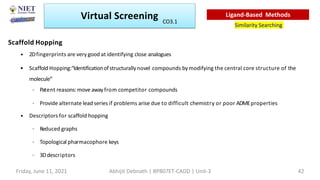
Scaffold Hopping
• 2Dfingerprints are very good at identifying close analogues
• Scaffold Hopping:“Identificationofstructurally novel compounds by modifying the central core structure of the
molecule”
– Patent reasons:move awayfrom competitor compounds
– Provide alternate lead series if problems arise due to difficult chemistry or poor ADMEproperties
• Descriptors for scaffold hopping
– Reduced graphs
– Topological pharmacophore keys
– 3Ddescriptors
Virtual Screening
Similarity Searching
Ligand-Based Methods
Friday, June 11, 2021 Abhijit Debnath | BP807ET-CADD | Unit-3 42
CO3.1
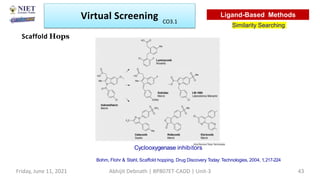
Cyclooxygenase inhibitors
Bohm, Flohr & Stahl, Scaffold hopping. Drug Discovery Today: Technologies, 2004, 1,217-224
Scaffold Hops
Virtual Screening
Similarity Searching
Ligand-Based Methods
Friday, June 11, 2021 Abhijit Debnath | BP807ET-CADD | Unit-3 43
CO3.1
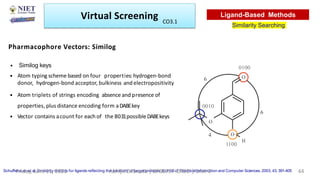
Pharmacophore Vectors: Similog
• Similog keys
• Atom typing scheme based on four properties:hydrogen-bond
donor, hydrogen-bond acceptor, bulkiness and electropositivity
• Atom triplets of strings encoding absence and presence of
properties, plus distance encoding form aDABEkey
• Vector contains acount for each of the 8031possible DABEkeys
Schuffenauer et al. Similarity metrics for ligands reflecting the similarity of target proteins Journal of Chemical Information and Computer Sciences, 2003, 43, 391-405
0010
6
6
4
0100
O
O
1100
H
O
Virtual Screening
Similarity Searching
Ligand-Based Methods
Friday, June 11, 2021 Abhijit Debnath | BP807ET-CADD | Unit-3 44
CO3.1
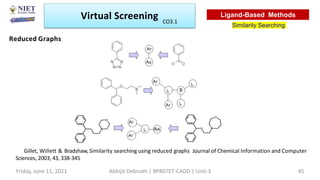
Gillet, Willett & Bradshaw, Similarity searching using reduced graphs Journal of Chemical Information and Computer
Sciences, 2003, 43, 338-345
Reduced Graphs
Virtual Screening
Similarity Searching
Ligand-Based Methods
Friday, June 11, 2021 Abhijit Debnath | BP807ET-CADD | Unit-3 45
CO3.1
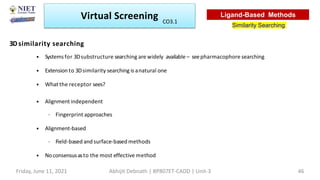
3Dsimilarity searching
• Systems for 3Dsubstructure searching are widely available – seepharmacophore searching
• Extension to 3Dsimilarity searching is anatural one
• What the receptor sees?
• Alignment independent
– Fingerprint approaches
• Alignment-based
– Field-based and surface-based methods
• Noconsensusasto the most effective method
Virtual Screening
Similarity Searching
Ligand-Based Methods
Friday, June 11, 2021 Abhijit Debnath | BP807ET-CADD | Unit-3 46
CO3.1
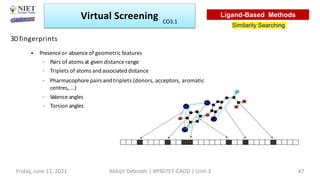
• Presenceor absenceof geometric features
– Pairs of atoms at given distance range
– Triplets of atoms and associated distance
– Pharmacophore pairs and triplets (donors, acceptors, aromatic
centres,....)
– Valence angles
– Torsion angles
3Dfingerprints
Virtual Screening
Similarity Searching
Ligand-Based Methods
Friday, June 11, 2021 Abhijit Debnath | BP807ET-CADD | Unit-3 47
CO3.1
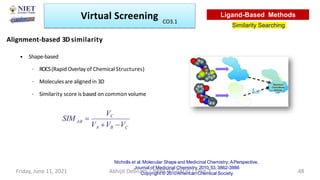
Alignment-based 3D similarity
• Shape-based
– ROCS(Rapid Overlayof Chemical Structures)
– Moleculesare aligned in 3D
– Similarity score is based on common volume
Nicholls et al, Molecular Shape and Medicinal Chemistry; APerspective.
Journal of Medicinal Chemistry, 2010,53, 3862-3886
Copyright © 2010American Chemical Society
Virtual Screening
Similarity Searching
Ligand-Based Methods
Friday, June 11, 2021 Abhijit Debnath | BP807ET-CADD | Unit-3 48
CO3.1
C
VA VB V
VC
AB
SIM 
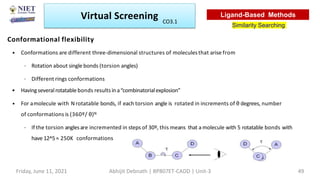
Conformational flexibility
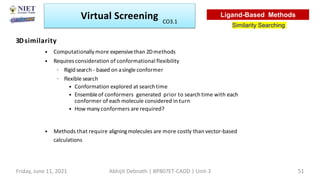
• Conformations are different three-dimensional structures of moleculesthat arise from
– Rotation about single bonds (torsion angles)
– Different rings conformations
• Havingseveralrotatable bonds results ina“combinatorialexplosion”
• For amolecule with N rotatable bonds, if each torsion angle is rotated in increments of θ degrees, number
of conformations is (360º/ θ)N
– If the torsion anglesare incremented in steps of 30º, this means that a molecule with 5 rotatable bonds with
have 12^5≈ 250K conformations
Virtual Screening
Similarity Searching
Ligand-Based Methods
Friday, June 11, 2021 Abhijit Debnath | BP807ET-CADD | Unit-3 49
CO3.1
Two approaches to handling conformational flexibility
Conformer selection
• When anew molecule is to be registered in adatabase,a
conformational analysis is used to select diverse
conformers spanningthe low-energy conformational
space
• Eachsuch conformer is loaded into the database and
then searched asif it was asingle,rigid structure
• Trade-off betweeneffectivenessof coverage(selection of
many conformers) and efficiency of searching(selection
of few conformers)
Exploration of conformational space
• Useof trianglesmoothing to identify min-max
distances betweeneach atom-pair
• Creation of adistance-range (rather than adistance) graph
for each databasestructure
• Screen and graph search of the min-max distance data using
appropriately modified algorithms
• Final conformational analysis (by varyingtorsional angles) of
the hits resulting from the screen/graph searches
Virtual Screening
Similarity Searching
Ligand-Based Methods
Friday, June 11, 2021 Abhijit Debnath | BP807ET-CADD | Unit-3 50
CO3.1
3Dsimilarity
• Computationally more expensivethan 2Dmethods
• Requires consideration of conformational flexibility
– Rigid search - based on asingle conformer
– Flexible search
• Conformation explored at search time
• Ensembleof conformers generated prior to search time with each
conformer of each molecule considered in turn
• How many conformers are required?
• Methods that require aligningmolecules are more costly than vector-based
calculations
Virtual Screening
Similarity Searching
Ligand-Based Methods
Friday, June 11, 2021 Abhijit Debnath | BP807ET-CADD | Unit-3 51
CO3.1
Evaluation of similarity methods
• Retrospective search
• For areference compound of known activity, search againsta
database that contains other actives and decoy compounds
– Determine where the active compounds appear in the ranked list
– Agood similarity measure will cluster the known actives at the top of the
ranking
– Performance measures: enrichment factors, AUC,BEDROC,.....
• Comparative studies suggest that 2Dfingerprints are most effective
– Good at identifying"me-too"compounds but lessgood at scaffold hopping
• R.P
.Sheridan and S.K.Kearsley (2002) Drug Discovery Today,7,903- 911
– “We have come to regard looking for ‘thebest’ way of searching chemical databases asafutile exercise. In both
retrospective and prospective studies, different methods select different subsets of actives for the same biological
activityand thesame method might work better on some activitiesthan others”
Virtual Screening
Similarity Searching
Ligand-Based Methods
Friday, June 11, 2021 Abhijit Debnath | BP807ET-CADD | Unit-3 52
CO3.1
Data fusion
• Fusion of ranked lists generated for sameactive compound (similarity fusion)
– Do asimilarity search for areference structure and rank the database in
order of decreasingsimilarity
– Repeatwith different representations, coefficients, etc.
– Sum the rank positions for agivenstructure to give an overall fused rank position
– Thefused rankingsform the output from the search
• Consistencyof search performance across arange of reference structures, types of fingerprint, biological
activities etc.
• Analogousapproaches (called consensus scoring) used in docking studies
Virtual Screening
Similarity Searching
Ligand-Based Methods
Friday, June 11, 2021 Abhijit Debnath | BP807ET-CADD | Unit-3 53
CO3.1
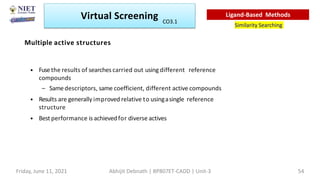
Multiple active structures
• Fusethe results of searches carried out using different reference
compounds
– Samedescriptors, same coefficient, different active compounds
• Results are generally improved relative to usingasingle reference
structure
• Best performance is achievedfor diverse actives
Virtual Screening
Similarity Searching
Ligand-Based Methods
Friday, June 11, 2021 Abhijit Debnath | BP807ET-CADD | Unit-3 54
CO3.1
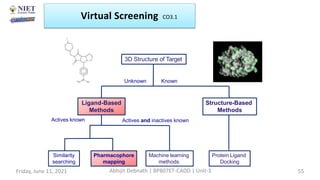
Ligand-Based
Methods
Structure-Based
Methods
Unknown
3D Structure of Target
Known
Actives known Actives and inactives known
Machine learning
methods
Pharmacophore
mapping
Similarity
searching
Protein Ligand
Docking
Virtual Screening
Friday, June 11, 2021 Abhijit Debnath | BP807ET-CADD | Unit-3 55
CO3.1
Multiple actives known: phamacophore
searching
Virtual Screening
Pharmacophore Mapping
Ligand-Based Methods
Friday, June 11, 2021 Abhijit Debnath | BP807ET-CADD | Unit-3 56
CO3.1
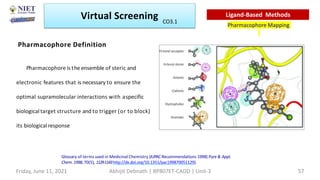
Pharmacophore is the ensemble of steric and
electronic features that is necessary to ensure the
optimal supramolecular interactions with aspecific
biological target structure and to trigger (or to block)
its biological response
Pharmacophore Definition
Glossary of terms used in Medicinal Chemistry (IUPAC Recommendations 1998) Pure & Appl.
Chem.1998,70(5), 1129-1143http://dx.doi.org/10.1351/pac199870051129).
Virtual Screening
Pharmacophore Mapping
Ligand-Based Methods
Friday, June 11, 2021 Abhijit Debnath | BP807ET-CADD | Unit-3 57
CO3.1
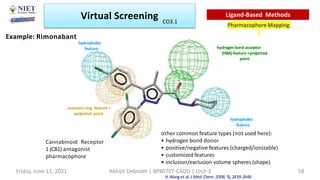
H.Wang et al.J.Med.Chem.2008, 51,2439-2446
hydrogenbond acceptor
(HBA)feature+projected
point
hydrophobic
feature
hydrophobic
feature
aromaticring feature+
projected point
Cannabinoid Receptor
1 (CB1) antagonist
pharmacophore
other common feature types (not used here):
• hydrogen bond donor
• positive/negative features (charged/ionizable)
• customized features
• inclusion/exclusion volume spheres (shape)
Example: Rimonabant
Virtual Screening
Pharmacophore Mapping
Ligand-Based Methods
Friday, June 11, 2021 Abhijit Debnath | BP807ET-CADD | Unit-3 58
CO3.1
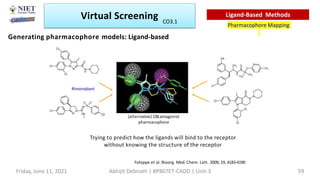
Generating pharmacophore models: Ligand-based
(alternative) CB1antagonist
pharmacophore
Trying to predict how the ligands will bind to the receptor
without knowing the structure of the receptor
Foloppe et al. Bioorg. Med. Chem. Lett. 2009, 19, 4183-4190
Rimonabant
Virtual Screening
Pharmacophore Mapping
Ligand-Based Methods
Friday, June 11, 2021 Abhijit Debnath | BP807ET-CADD | Unit-3 59
CO3.1
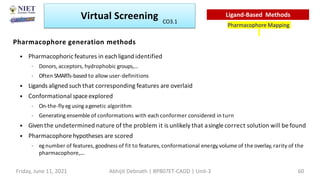
Pharmacophore generation methods
• Pharmacophoric features in eachligand identified
– Donors, acceptors, hydrophobic groups,...
– Often SMARTs-based to allow user-definitions
• Ligands aligned such that corresponding features are overlaid
• Conformational spaceexplored
– On-the-fly egusingagenetic algorithm
– Generating ensemble of conformations with each conformer considered in turn
• Given the undetermined nature of the problem it is unlikely that asingle correct solution will be found
• Pharmacophore hypotheses are scored
– egnumber of features, goodness of fit to features,conformational energy,volume of the overlay, rarity of the
pharmacophore,....
Virtual Screening
Pharmacophore Mapping
Ligand-Based Methods
Friday, June 11, 2021 Abhijit Debnath | BP807ET-CADD | Unit-3 60
CO3.1
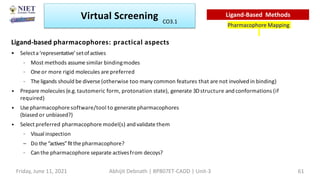
Ligand-based pharmacophores: practical aspects
• Selecta‘representative’setofactives
– Most methods assume similar bindingmodes
– Oneor more rigid molecules are preferred
– The ligands should be diverse (otherwise too many common features that are not involved in binding)
• Prepare molecules (e.g. tautomeric form, protonation state), generate 3Dstructure and conformations (if
required)
• Usepharmacophore software/tool to generate pharmacophores
(biased or unbiased?)
• Select preferred pharmacophore model(s) and validatethem
– Visual inspection
– Do the“actives”fitthepharmacophore?
– Canthe pharmacophore separate activesfrom decoys?
Virtual Screening
Pharmacophore Mapping
Ligand-Based Methods
Friday, June 11, 2021 Abhijit Debnath | BP807ET-CADD | Unit-3 61
CO3.1
D.Schulster et al.Bioorg. Med.Chem.2011,19,7168-7180
(http://dx.doi.org/10.1016/j.bmc.2011.09.056)
U.Grienke et al. Bioorg. Med. Chem.2011,19,6779-6791
(http://dx.doi.org/10.1016/j.bmc.2011.09.039)
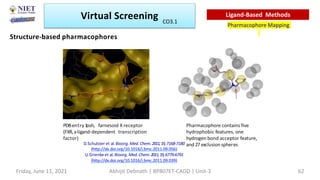
Pharmacophore contains five
hydrophobic features, one
hydrogen bond acceptor feature,
and 27exclusion spheres
PDBentry1
osh, farnesoid X receptor
(FXR,aligand-dependent transcription
factor)
Structure-based pharmacophores
Virtual Screening
Pharmacophore Mapping
Ligand-Based Methods
Friday, June 11, 2021 Abhijit Debnath | BP807ET-CADD | Unit-3 62
CO3.1
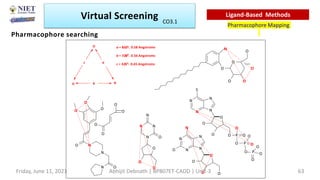
Pharmacophore searching
O
O N
a
b
c
a = 8.62+- 0.58 Angstroms
b = 7.08+- 0.56 Angstroms
c = 3.35+- 0.65 Angstroms
O
O
O
O
O
O
N
O
O
O
N
N
N O
O
O
O
O
O
N
N
N
N
S
O
O
O
O
O
O
O P
O
O
O P O O
O P
N
N
N
N
N
O
O
O O
O
N
N
N
O
N
O
O
O
Virtual Screening
Pharmacophore Mapping
Ligand-Based Methods
Friday, June 11, 2021 Abhijit Debnath | BP807ET-CADD | Unit-3 63
CO3.1
Database searching
• Conformational search
– On-the-fly
– Ensemble of conformers
• Databasesearchshould be“compatible”withparametersused to generate the pharmacophore
– Thesame pharmacophore feature definitions should be used to describethe databasestructuresaswere used to generate
the pharmacophore
– Thedatabaseshould be generated usingthe sameprotocol asused to generate the pharmacophore
– What toleranceshould be used to allow amatch?
• If two pharmacophore features are separatedby 5Åwhat distance rangeis acceptable: 4.5-5.5Å;4-6Å?
• Shouldall tolerances be the same?
• What effect does this haveon recall and precision?
– Canexclusion/inclusion volumes be used?
Virtual Screening
Pharmacophore Mapping
Ligand-Based Methods
Friday, June 11, 2021 Abhijit Debnath | BP807ET-CADD | Unit-3 64
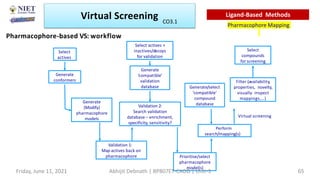
Select
actives
Generate
conformers
Generate
(Modify)
pharmacophore
models
Validation 1:
Map actives back on
pharmacophore
Validation 2:
Search validation
database – enrichment,
specificity, sensitivity?
Prioritise/select
pharmacophore
model(s)
Perform
search/mapping(s)
Generate/select
‘compatible’
compound
database
Select actives +
inactives/decoys
for validation
Generate
‘compatible’
validation
database
Filter (availability,
properties, novelty,
visually inspect
mappings,…)
Select
compounds
for screening
Virtual screening
Pharmacophore-based VS: workflow
Virtual Screening
Pharmacophore Mapping
Ligand-Based Methods
Friday, June 11, 2021 Abhijit Debnath | BP807ET-CADD | Unit-3 65
CO3.1
H. Wang et al. J.Med.Chem.2008,51,2439-2446
(http://dx.doi.org/10.1021/jm701519h)
Rimonabant
Cannabinoid
Receptor 1 (CB1)
antagonist
pharmacophore
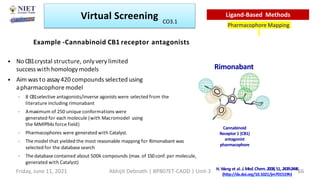
Example -Cannabinoid CB1 receptor antagonists
• No CB1crystal structure, only very limited
successwith homology models
• Aim was to assay420 compounds selected using
apharmacophore model
– 8 CB1selective antagonists/inverse agonists were selected from the
literature including rimonabant
– Amaximum of 250 unique conformations were
generated for each molecule (with Macromodel using
the MMFF94s force field)
– Pharmacophores were generated with Catalyst.
– Themodel that yielded the most reasonable mapping for Rimonabant was
selected for the databasesearch
– The databasecontained about 500k compounds (max. of 150conf. per molecule,
generated with Catalyst)
Virtual Screening
Pharmacophore Mapping
Ligand-Based Methods
Friday, June 11, 2021 Abhijit Debnath | BP807ET-CADD | Unit-3 66
CO3.1
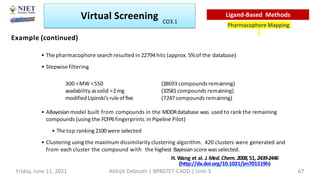
• The pharmacophore search resulted in 22794hits (approx. 5%of the database)
• Stepwise filtering
300 <MW <550
availability assolid >2mg
modified Lipinski’sruleoffive
(18693 compounds remaining)
(10581compounds remaining)
(7247compounds remaining)
• ABayesian model built from compounds in the MDDRdatabase was used to rank the remaining
compounds (using the FCFP6fingerprints in Pipeline Pilot)
• Thetop ranking2100were selected
• Clustering using the maximum dissimilarity clustering algorithm. 420 clusters were generated and
from each cluster the compound with the highest Bayesian score was selected.
H. Wang et al. J.Med.Chem.2008,51,2439-2446
(http://dx.doi.org/10.1021/jm701519h)
Example (continued)
Virtual Screening
Pharmacophore Mapping
Ligand-Based Methods
Friday, June 11, 2021 Abhijit Debnath | BP807ET-CADD | Unit-3 67
CO3.1
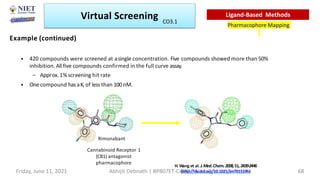
• 420 compounds were screened at asingle concentration. Five compounds showed more than 50%
inhibition. Allfive compounds confirmed in the full curve assay.
– Approx. 1%screening hit rate
• One compound hasaKi of less than 100nM.
Rimonabant
Cannabinoid Receptor 1
(CB1) antagonist
pharmacophore
H. Wang et al. J.Med.Chem.2008,51,2439-2446
(http://dx.doi.org/10.1021/jm701519h)
Example (continued)
Virtual Screening
Pharmacophore Mapping
Ligand-Based Methods
Friday, June 11, 2021 Abhijit Debnath | BP807ET-CADD | Unit-3 68
CO3.1
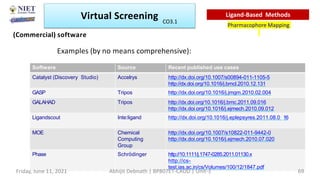
Software Source Recent published use cases
Catalyst (Discovery Studio) Accelrys http://dx.doi.org/10.1007/s00894-011-1105-5
http://dx.doi.org/10.1016/j.bmcl.2010.12.131
GASP Tripos http://dx.doi.org/10.1016/j.jmgm.2010.02.004
GALAHAD Tripos http://dx.doi.org/10.1016/j.bmc.2011.09.016
http://dx.doi.org/10.1016/j.ejmech.2010.09.012
Ligandscout Inte:ligand http://dx.doi.org/10.1016/j.eplepsyres.2011.08.0 16
MOE Chemical
Computing
Group
http://dx.doi.org/10.1007/s10822-011-9442-0
http://dx.doi.org/10.1016/j.ejmech.2010.07.020
Phase Schrödinger http://10.1111/j.1747-0285.2011.01130.x
http://cs-
test.ias.ac.in/cs/Volumes/100/12/1847.pdf
Examples (by no means comprehensive):
(Commercial) software
Virtual Screening
Pharmacophore Mapping
Ligand-Based Methods
Friday, June 11, 2021 Abhijit Debnath | BP807ET-CADD | Unit-3 69
CO3.1
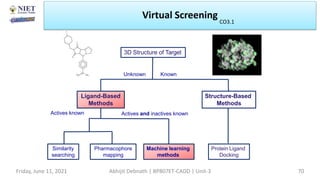
Ligand-Based
Methods
Structure-Based
Methods
Unknown
3D Structure of Target
Known
Actives known Actives and inactives known
Machine learning
methods
Pharmacophore
mapping
Similarity
searching
Protein Ligand
Docking
Friday, June 11, 2021 Abhijit Debnath | BP807ET-CADD | Unit-3 70
Virtual Screening
CO3.1
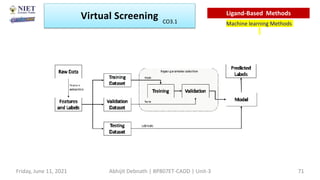
Virtual Screening
Machine learning Methods
Ligand-Based Methods
Friday, June 11, 2021 Abhijit Debnath | BP807ET-CADD | Unit-3 71
CO3.1
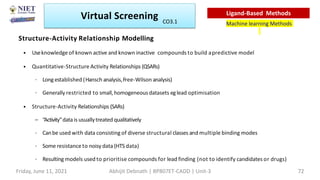
Structure-Activity Relationship Modelling
• Useknowledge of known active and known inactive compounds to build apredictive model
• Quantitative-Structure Activity Relationships (QSARs)
– Longestablished (Hansch analysis,Free-Wilson analysis)
– Generally restricted to small,homogeneous datasets eglead optimisation
• Structure-Activity Relationships (SARs)
– “Activity”datais usuallytreated qualitatively
– Canbe used with data consisting of diverse structural classes and multiple binding modes
– Some resistance to noisy data (HTS data)
– Resulting models used to prioritise compounds for lead finding (not to identify candidates or drugs)
Virtual Screening
Machine learning Methods
Ligand-Based Methods
Friday, June 11, 2021 Abhijit Debnath | BP807ET-CADD | Unit-3 72
CO3.1
C3
C1
C4
C2
C5
.
.
.
.
.
.
.
.
.
.
.
Likelihood
of
being
active
Top Ranked
Compounds Picked
for Testing
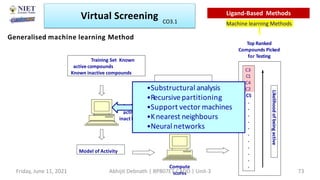
Training Set Known
active compounds
Known inactive compounds
Model of Activity
Anal
acti
inact
Untested compounds
C1, C2, C3, C4, C5 …
yse
ves
ives
Compute
scores
Generalised machine learning Method
•Substructural analysis
•Recursivepartitioning
•Support vector machines
•Knearest neighbours
•Neural networks
Virtual Screening
Machine learning Methods
Ligand-Based Methods
Friday, June 11, 2021 Abhijit Debnath | BP807ET-CADD | Unit-3 73
CO3.1
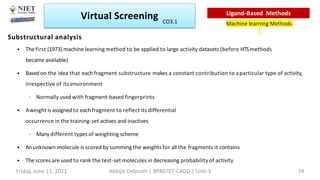
Substructural analysis
• The first (1973) machine learningmethod to be applied to large activity datasets (before HTSmethods
became available)
• Basedon the idea that each fragment substructure makes a constant contribution to aparticular type of activity,
irrespective of its environment
– Normally used with fragment-based fingerprints
• Aweight is assignedto eachfragment to reflect its differential
occurrence in the training-set actives and inactives
– Manydifferent types of weighting scheme
• Anunknown molecule is scored by summing the weights for all the fragments it contains
• The scores are used to rank the test-set molecules in decreasing probability of activity
Virtual Screening
Machine learning Methods
Ligand-Based Methods
Friday, June 11, 2021 Abhijit Debnath | BP807ET-CADD | Unit-3 74
CO3.1
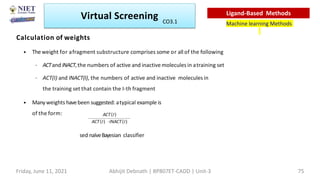
Calculation of weights
• Theweight for afragment substructure comprises some or all of the following
– ACTand INACT,the numbers of active and inactive molecules in atraining set
– ACT(I) and INACT(I), the numbers of active and inactive moleculesin
the training set that contain the I-th fragment
• Manyweights havebeen suggested: atypical example is
of the form:
sed naïveBayesian classifier
Virtual Screening
Machine learning Methods
Ligand-Based Methods
Friday, June 11, 2021 Abhijit Debnath | BP807ET-CADD | Unit-3 75
CO3.1
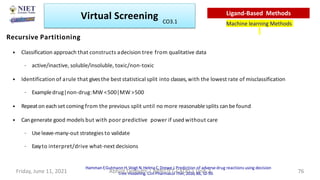
Recursive Partitioning
• Classification approach that constructs adecision tree from qualitative data
– active/inactive, soluble/insoluble, toxic/non-toxic
• Identification of arule that givesthe best statistical split into classes,with the lowest rate of misclassification
– Exampledrug|non-drug:MW <500|MW >500
• Repeaton eachset coming from the previous split until no more reasonable splits can be found
• Cangenerate good models but with poor predictive power if used without care
– Useleave-many-out strategies to validate
– Easyto interpret/drive what-next decisions
Hamman F
,Gutmann H.Voigt N,HelmaC,Drewe J.Prediction of adverse drug reactions using decision
tree modeling.Clin PharmacolTher, 2010,88, 52-59.
Virtual Screening
Machine learning Methods
Ligand-Based Methods
Friday, June 11, 2021 Abhijit Debnath | BP807ET-CADD | Unit-3 76
CO3.1
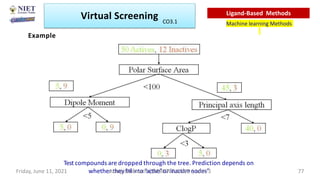
Test compounds are dropped through the tree. Prediction depends on
whether theyfallinto“active”or inactive nodes”
Virtual Screening
Machine learning Methods
Ligand-Based Methods
Example
Friday, June 11, 2021 Abhijit Debnath | BP807ET-CADD | Unit-3 77
CO3.1
Ligand-Based
Methods
Structure-Based
Methods
Unknown
3D Structure of Target
Known
Actives known Actives and inactives known
Machine learning
methods
Pharmacophore
mapping
Similarity
searching
Protein Ligand
Docking
Friday, June 11, 2021 Abhijit Debnath | BP807ET-CADD | Unit-3 78
Virtual Screening
CO3.2
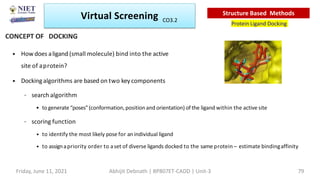
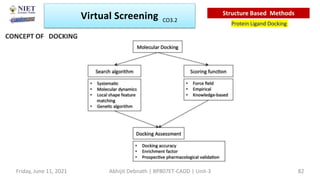
• How does aligand (small molecule) bind into the active
site of aprotein?
• Dockingalgorithms are based on two key components
– search algorithm
• to generate “poses”(conformation,positionand orientation) of the ligand within the active site
– scoring function
• to identify the most likely pose for an individual ligand
• to assignapriority order to aset of diverse ligands docked to the same protein – estimate bindingaffinity
Virtual Screening
Protein Ligand Docking
Structure Based Methods
CONCEPT OF DOCKING
Friday, June 11, 2021 Abhijit Debnath | BP807ET-CADD | Unit-3 79
CO3.2
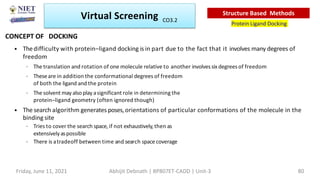
• Thedifficulty with protein–ligand docking is in part due to the fact that it involves many degrees of
freedom
– The translation and rotation of one molecule relative to another involvessixdegrees of freedom
– Theseare in addition the conformational degrees of freedom
of both the ligand and the protein
– The solvent may also play asignificant role in determining the
protein–ligand geometry (often ignored though)
• The search algorithm generates poses,orientations of particular conformations of the molecule in the
binding site
– Tries to cover the search space,if not exhaustively,then as
extensivelyaspossible
– There is atradeoff between time and search spacecoverage
Virtual Screening
Protein Ligand Docking
Structure Based Methods
CONCEPT OF DOCKING
Friday, June 11, 2021 Abhijit Debnath | BP807ET-CADD | Unit-3 80
CO3.2
Virtual Screening
Protein Ligand Docking
Structure Based Methods
CONCEPT OF DOCKING
Abhijit Debnath | BP807ET-CADD | Unit-3
Friday, June 11, 2021 81
CO3.2
Virtual Screening
Protein Ligand Docking
Structure Based Methods
CONCEPT OF DOCKING
Friday, June 11, 2021 Abhijit Debnath | BP807ET-CADD | Unit-3 82
CO3.2
Virtual Screening
Protein Ligand Docking
Structure Based Methods
DOCKING TOOLS
Friday, June 11, 2021 Abhijit Debnath | BP807ET-CADD | Unit-3 83
CO3.2
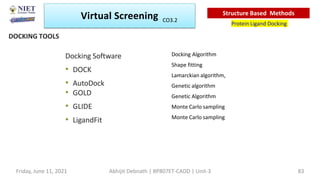
Docking Software
• DOCK
• AutoDock
• GOLD
• GLIDE
• LigandFit
Docking Algorithm
Shape fitting
Lamarckian algorithm,
Genetic algorithm
Genetic Algorithm
Monte Carlo sampling
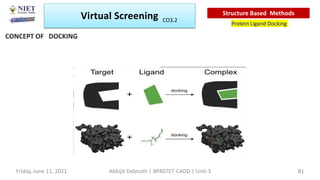
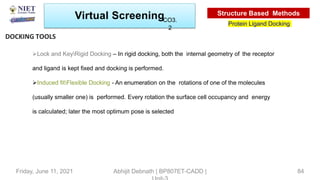
Lock and KeyRigid Docking – In rigid docking, both the internal geometry of the receptor
and ligand is kept fixed and docking is performed.
Induced fitFlexible Docking - An enumeration on the rotations of one of the molecules
(usually smaller one) is performed. Every rotation the surface cell occupancy and energy
is calculated; later the most optimum pose is selected
Virtual Screening
Protein Ligand Docking
Structure Based Methods
DOCKING TOOLS
Abhijit Debnath | BP807ET-CADD |
Friday, June 11, 2021 84
CO3.
2
Virtual Screening
Protein Ligand Docking
Structure Based Methods
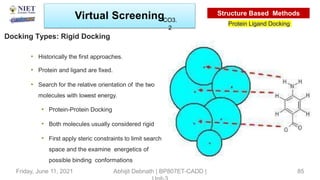
• Historically the first approaches.
• Protein and ligand are fixed.
• Search for the relative orientation of the two
molecules with lowest energy.
• Protein-Protein Docking
• Both molecules usually considered rigid
• First apply steric constraints to limit search
space and the examine energetics of
possible binding conformations
Docking Types: Rigid Docking
Abhijit Debnath | BP807ET-CADD |
Friday, June 11, 2021 85
CO3.
2
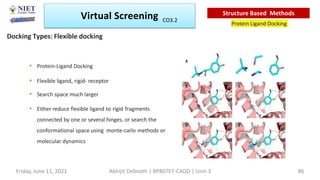
• Protein-Ligand Docking
• Flexible ligand, rigid- receptor
• Search space much larger
• Either reduce flexible ligand to rigid fragments
connected by one or several hinges, or search the
conformational space using monte-carlo methods or
molecular dynamics
Virtual Screening
Protein Ligand Docking
Structure Based Methods
Docking Types: Flexible docking
Abhijit Debnath | BP807ET-CADD | Unit-3
Friday, June 11, 2021 86
CO3.2
• Bound docking
• Unbound docking
• Global docking
• Local docking
Virtual Screening
Protein Ligand Docking
Structure Based Methods
Kinds of Docking
Abhijit Debnath | BP807ET-CADD | Unit-3
Friday, June 11, 2021 87
CO3.2
Virtual Screening
Protein Ligand Docking
Structure Based Methods
Kinds of Docking
Abhijit Debnath | BP807ET-CADD | Unit-3
Friday, June 11, 2021 88
CO3.2
•The complex structure is known.
•The receptor and the ligand in the complex are
pulled apart and reassembled.
•In bound docking the goal is to reproduce a
known complex where the starting coordinates of
the individual molecules are taken from the crystal
of the complex
• Individually determined protein structures
are used.
•In the unbound docking, which is a
significantly more difficult problem, the
starting coordinates are taken from the
unbound molecules
Bound docking Unbound docking
• The general problem includes a search for the location of the binding site and a search to
figure out the exact orientation of the ligand in the binding site. A program that do both
makes a Global docking
• Global docking is more demanding in terms of computational time and the results are
less accurate
Virtual Screening
Protein Ligand Docking
Structure Based Methods
Kinds of Docking: Global docking
Abhijit Debnath | BP807ET-CADD | Unit-3
Friday, June 11, 2021 89
CO3.2
• Sometimes the location of the binding site is known. In this case we only need to orient
the ligand in the binding site. In this case the problem is called Local docking
Virtual Screening
Protein Ligand Docking
Structure Based Methods
Kinds of Docking: Local docking
Abhijit Debnath | BP807ET-CADD | Unit-3
Friday, June 11, 2021 90
CO3.2
• Inverse docking-small molecules of interest are dock into library of receptor.
• Covalent docking-it is used to study the covalent character between ligand and
receptor. It provides stronger binding affinity that prolongs the duration of biological
effects
Virtual Screening
Protein Ligand Docking
Structure Based Methods
Methodological advances
Abhijit Debnath | BP807ET-CADD | Unit-3
Friday, June 11, 2021 91
CO3.2
 Determine all possible optimal conformation for a given complex (protein-ligand/ protein-protein)
 Calculate the energy of resulting complex & of each individual interactions.
Conformational search strategies include-
• Systematic method
• Random method
• Simulation method
Virtual Screening
Protein Ligand Docking
Structure Based Methods
Search Algorithm
Abhijit Debnath | BP807ET-CADD | Unit-3
Friday, June 11, 2021 92
CO3.2
• it uses incremental construction and conformational search databases
• This search algorithm explores all the degree of freedom in a molecule.
• Ligands are often incremenatlly grown into the active site.
• Step wise or incremental search can be accomplished in different ways
• While docking various molecular fragments into the active site region and linking them covalently
or alternatively by dividing dock ligands into rigid (core fragment) and by flexible(side chain)
Search Algorithm
Virtual Screening
Protein Ligand Docking
Structure Based Methods
Abhijit Debnath | BP807ET-CADD | Unit-3
Friday, June 11, 2021 93
CO3.2
• Once the rigid core is defined they are dock into the active site.
Flexible regions are added in an incremental fashion. Another method of systematic search is use of
library of pre-generated conformations.
library conformations are typically only calculated once and the search problem is therefore reduced
to rigid body docking procedure.
Systematic Search Contd…
Virtual Screening
Protein Ligand Docking
Structure Based Methods
CO2
Abhijit Debnath | BP807ET-CADD | Unit-3
Friday, June 11, 2021 94
CO3.2
Search Algorithm: Random search
•This method operate by making random change to either single ligand or population of ligand.
•A newly obtained ligand is evaluated on the bases of pre defined probability function.
•Basic idea is to take into consideration of already explored area of conformation space.
•Todetermine if a molecular conformation is accepted or not, the root mean square value is calculated
between current molecular coordinates and every previously recorded conformations.
• Random search uses two algorithms-
 Monte Carlo algorithm
 Genetic algorithm
Virtual Screening
Protein Ligand Docking
Structure Based Methods
Abhijit Debnath | BP807ET-CADD | Unit-3
Friday, June 11, 2021 95
CO3.2
• It uses algorithms like molecular dynamics and energy minimization.
• In this approach, proteins are typically held rigid, and the ligand is allowed to freely explore their
conformational space.
• The generated conformations are then docked successively into the protein, and an MD simulation
consisting of
a simulated annealing protocol is performed.
• This is usually supplemented with short MD energy minimization steps, and the energies
determined from the MD runs are used for ranking the overall scoring. Although this is a
computer-expensive method (involving potentially hundreds of MD runs).
Search Algorithm: Simulation Search
Virtual Screening
Protein Ligand Docking
Structure Based Methods
Abhijit Debnath | BP807ET-CADD | Unit-3
Friday, June 11, 2021 96
CO3.2
 The evaluation and ranking of predicted ligand conformations is a crucial aspect of structure-based
virtual screening.
 Scoring functions implemented in docking programs make various assumptions and simplifications
in the evaluation of modeled complexes
 They do not fully account for a number of physical phenomena that determine molecular
recognition — for example, entropic effects.
 Affinity scoring functions are applied to the energetically best pose or n best poses found for each
molecule, and comparing the affinity scores for different molecules gives their relative rank-ordering.
Search Algorithm: Scoring Function
Virtual Screening
Protein Ligand Docking
Structure Based Methods
CO2
Abhijit Debnath | BP807ET-CADD | Unit-3
Friday, June 11, 2021 97
CO3.2
•Essentially, following types or classes of scoring functions are currently applied:
1. Force-field-based scoring
2. Empirical scoring functions
3. Knowledge-based scoring functions
4. Consensus scoring
5. Shape & Chemical Complementary Scores
Scoring Function
Virtual Screening
Protein Ligand Docking
Structure Based Methods
Abhijit Debnath | BP807ET-CADD | Unit-3
Friday, June 11, 2021 98
CO3.2
• Broadly speaking, scoring functions can be divided into the following
classes:
• Forcefield-based
• Based on terms from molecular mechanics forcefields
• GoldScore, DOCK, AutoDock
• Empirical
• Parameterised against experimental binding affinities
• ChemScore, PLP, Glide SP/XP
• Knowledge-based potentials
• Based on statistical analysis of observed pairwise distributions
• PMF, DrugScore, ASP
Classes of scoring function
Virtual Screening
Protein Ligand Docking
Structure Based Methods
Abhijit Debnath | BP807ET-CADD |
Friday, June 11, 2021 99
CO3.
2
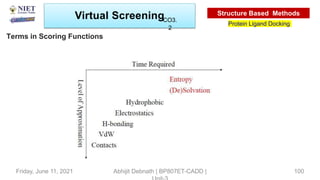
Terms in Scoring Functions
Virtual Screening
Protein Ligand Docking
Structure Based Methods
Abhijit Debnath | BP807ET-CADD |
Friday, June 11, 2021 100
CO3.
2
• Divide accessible protein surface into zones:
– Hydrophobic
– Hydrogen-bond donating
– Hydrogen-bond accepting
• Do the same for the ligand surface
• Find ligand orientation with best complementarity score
Shape & Chemical Complementary Scores
Virtual Screening
Protein Ligand Docking
Structure Based Methods
Abhijit Debnath | BP807ET-CADD | Unit-3
Friday, June 11, 2021 101
CO3.2
Abhijit Debnath | BP807ET-CADD |
Friday, June 11, 2021 102
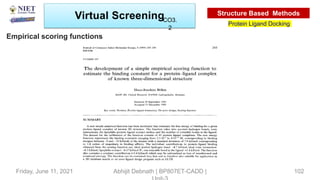
Empirical scoring functions
Virtual Screening
Protein Ligand Docking
Structure Based Methods
CO3.
2
• This scoring function is an empirical scoring function
• Empirical = incorporates some experimental data
• The coefficients (∆G) in the equation were determined using multiple linear
regression on experimental binding data for 45 protein–ligand complexes
• Although the terms in the equation may differ, this general approach has been
applied to the development of many different empirical scoring functions
Böhm’s empirical scoring function
Virtual Screening
Protein Ligand Docking
Structure Based Methods
Abhijit Debnath | BP807ET-CADD |
Friday, June 11, 2021 103
CO3.
2
• In general, scoring functions assume that the free energy of binding can be written as a
linear sum of terms to reflect the various contributions to binding.
• Bohm’s scoring function included contributions from hydrogen bonding, ionic interactions,
lipophilic interactions and the loss of internal conformational freedom of the ligand.
Böhm’s empirical scoring function
Virtual Screening
Protein Ligand Docking
Structure Based Methods
Abhijit Debnath | BP807ET-CADD | Unit-3
Friday, June 11, 2021 104
CO3.2
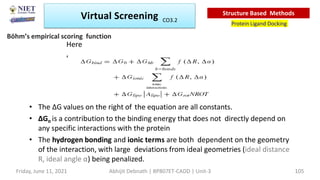
Here
,
Abhijit Debnath | BP807ET-CADD | Unit-3
Friday, June 11, 2021 105
• The ∆G values on the right of the equation are all constants.
• ∆Go is a contribution to the binding energy that does not directly depend on
any specific interactions with the protein
• The hydrogen bonding and ionic terms are both dependent on the geometry
of the interaction, with large deviations from ideal geometries (ideal distance
R, ideal angle α) being penalized.
Böhm’s empirical scoring function
Virtual Screening
Protein Ligand Docking
Structure Based Methods
CO3.2
•Knowledge-based scoring functions are designed to reproduce experimental
structures rather than binding energies.
•Free energies of molecular interactions are derived from structural information on Protein-
ligand complexes contained in PDB.
• Boltzmann-Like Statistics of Interatomic
Contacts suggests:
Knowledge-based Scoring Function
Virtual Screening
Protein Ligand Docking
Structure Based Methods
CO2
Abhijit Debnath | BP807ET-CADD | Unit-3
Friday, June 11, 2021 106
CO3.2
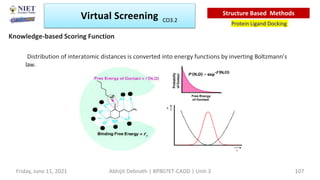
Distribution of interatomic distances is converted into energy functions by inverting Boltzmann’s
law.
Abhijit Debnath | BP807ET-CADD | Unit-3
Friday, June 11, 2021 107
Knowledge-based Scoring Function
Virtual Screening
Protein Ligand Docking
Structure Based Methods
CO3.2
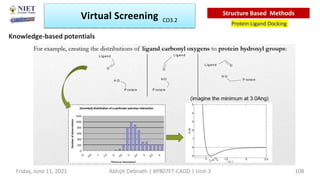
Knowledge-based potentials
Virtual Screening
Protein Ligand Docking
Structure Based Methods
Abhijit Debnath | BP807ET-CADD | Unit-3
Friday, June 11, 2021 108
CO3.2
•Molecular mechanics force fields usually quantify the sum of two energies, the receptor–
ligand interaction energy and internal ligand energy(such as steric strain induced by binding).
•Most force field scoring functions only consider a single Protein conformation, which makes
it possible to omit the Calculation of internal protein energy, which greatly simplifies Scoring.
ForceField based Scoring
Nonbonding interactions (ligand-protein):
-van der Waals
-electrostatics
Amber force field
•Consensus scoring combines information from different scores to
balance errors in single scores and improve the Probability of identifying
‘true’ ligands.
• An exemplary implementation of consensus scoring is
X-CSCORE60, which combines GOLD-like, DOCK-like, ChemScore, PMF and
FlexX scoring functions.
Virtual Screening
Protein Ligand Docking
Structure Based Methods
Abhijit Debnath | BP807ET-CADD | Unit-3
Friday, June 11, 2021 109
CO3.2
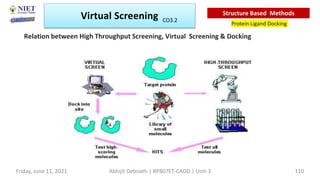
Relation between High Throughput Screening, Virtual Screening & Docking
Virtual Screening
Protein Ligand Docking
Structure Based Methods
Abhijit Debnath | BP807ET-CADD | Unit-3
Friday, June 11, 2021 110
CO3.2
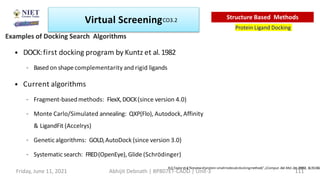
• DOCK:first docking program by Kuntz et al.1982
– Based on shapecomplementarity and rigid ligands
• Current algorithms
– Fragment-basedmethods: FlexX,DOCK(since version 4.0)
– Monte Carlo/Simulated annealing: QXP(Flo), Autodock, Affinity
& LigandFit (Accelrys)
– Genetic algorithms: GOLD,AutoDock (since version 3.0)
– Systematic search: FRED(OpenEye), Glide (Schrödinger)
R.D.Tayloretal.“Areviewofprotein-smallmoleculedockingmethods”,J.Comput.Aid.Mol.Des.2002, 16,151-166.
Examples of Docking Search Algorithms
Virtual Screening
Protein Ligand Docking
Structure Based Methods
Friday, June 11, 2021 Abhijit Debnath | BP807ET-CADD | Unit-3 111
CO3.2
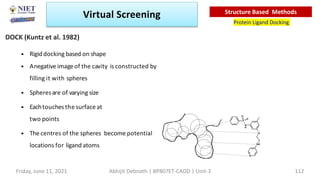
• Rigiddocking based on shape
• Anegative imageof the cavity is constructed by
filling it with spheres
• Spheresare of varying size
• Eachtouches the surface at
two points
• The centres of the spheres become potential
locations for ligand atoms
N
H
O
NH
O
S
O
N
DOCK (Kuntz et al. 1982)
Virtual Screening
Protein Ligand Docking
Structure Based Methods
Friday, June 11, 2021 Abhijit Debnath | BP807ET-CADD | Unit-3 112
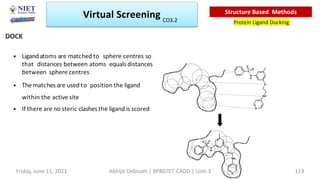
• Ligandatoms are matched to sphere centres so
that distances between atoms equals distances
between sphere centres
• The matches are used to position the ligand
within the active site
• If there are no steric clashes the ligand is scored
S
N
H
O
NH
O O
N
S
N
H
O
NH
O
O
N
DOCK
Virtual Screening
Protein Ligand Docking
Structure Based Methods
Friday, June 11, 2021 Abhijit Debnath | BP807ET-CADD | Unit-3 113
CO3.2
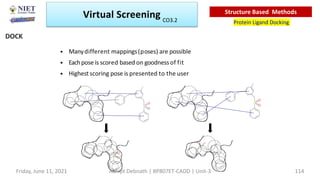
• Manydifferent mappings(poses) are possible
• Eachpose is scored based on goodnessof fit
• Highestscoring pose is presented to the user
DOCK
Virtual Screening
Protein Ligand Docking
Structure Based Methods
Friday, June 11, 2021 Abhijit Debnath | BP807ET-CADD | Unit-3 114
CO3.2
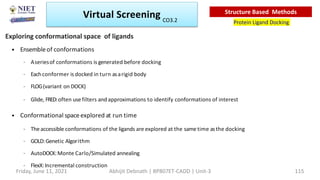
• Ensembleof conformations
– Aseriesof conformations is generated before docking
– Eachconformer is docked in turn asarigid body
– FLOG(variant on DOCK)
– Glide, FRED:often usefilters and approximations to identify conformations of interest
• Conformational spaceexplored at run time
– The accessible conformations of the ligands are explored at the sametime asthe docking
– GOLD:Genetic Algorithm
– AutoDOCK:Monte Carlo/Simulated annealing
– FlexX:Incremental construction
Exploring conformational space of ligands
Virtual Screening
Protein Ligand Docking
Structure Based Methods
Friday, June 11, 2021 Abhijit Debnath | BP807ET-CADD | Unit-3 115
CO3.2
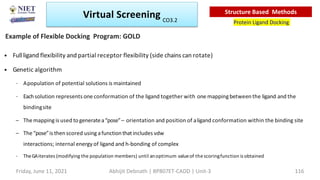
• Fullligand flexibility and partial receptor flexibility (side chains can rotate)
• Genetic algorithm
– Apopulation of potential solutions is maintained
– Eachsolution represents one conformation of the ligand together with one mappingbetweenthe ligand and the
bindingsite
– Themapping is used to generatea“pose”– orientation and position of aligand conformation within the binding site
– The“pose”is thenscored using afunctionthatincludes vdw
interactions; internal energy of ligand and h-bonding of complex
– TheGAiterates (modifying the population members) until anoptimum valueof thescoringfunction is obtained
Example of Flexible Docking Program: GOLD
Virtual Screening
Protein Ligand Docking
Structure Based Methods
Friday, June 11, 2021 Abhijit Debnath | BP807ET-CADD | Unit-3 116
CO3.2
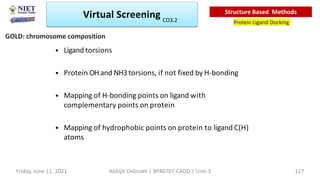
• Ligand torsions
• Protein OHand NH3torsions, if not fixed by H-bonding
• Mapping of H-bonding points on ligand with
complementary points on protein
• Mapping of hydrophobic points on protein to ligand C(H)
atoms
GOLD: chromosome composition
Virtual Screening
Protein Ligand Docking
Structure Based Methods
Friday, June 11, 2021 Abhijit Debnath | BP807ET-CADD | Unit-3 117
CO3.2
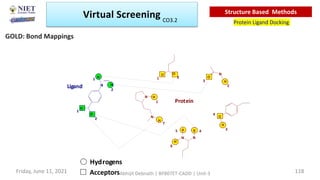
O
N
N
N
N
O
Ligand
Protein
Hydrogens
Acceptors
N
O
O
O
H
H
H
H
N
H
1
H
1
1
1
2
H
2
O
2
H
2
3
3
4
4
5
H
6
7
GOLD: Bond Mappings
Virtual Screening
Protein Ligand Docking
Structure Based Methods
Friday, June 11, 2021 Abhijit Debnath | BP807ET-CADD | Unit-3 118
CO3.2
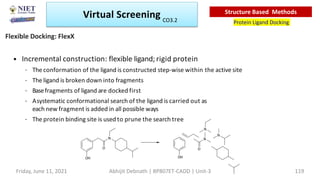
• Incremental construction: flexible ligand; rigid protein
– The conformation of the ligand is constructed step-wise within the active site
– The ligand is broken down into fragments
– Basefragments of ligand are docked first
– Asystematic conformational search of the ligand is carried out as
each new fragment is added in all possible ways
– The protein binding site is used to prune the search tree
N
O
OH OH
O
N
N
N
Flexible Docking: FlexX
Virtual Screening
Protein Ligand Docking
Structure Based Methods
Friday, June 11, 2021 Abhijit Debnath | BP807ET-CADD | Unit-3 119
CO3.2
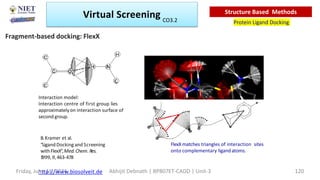
FlexX matches triangles of interaction sites
onto complementary ligand atoms.
Interaction model:
Interaction centre of first group lies
approximatelyon interaction surface of
second group.
B.Kramer et al.
“LigandDocking and Screening
withFlexX”,Med.Chem.Res.
1
999,9,463-478
http://www.biosolveit.de
Fragment-based docking: FlexX
Virtual Screening
Protein Ligand Docking
Structure Based Methods
Friday, June 11, 2021 Abhijit Debnath | BP807ET-CADD | Unit-3 120
CO3.2
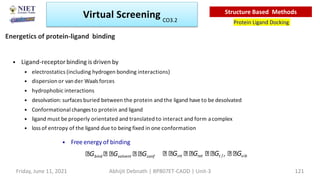
Gint Grot Gt /r Gvib
• Ligand-receptor binding is driven by
• electrostatics (including hydrogen bonding interactions)
• dispersion or vander Waalsforces
• hydrophobic interactions
• desolvation: surfaces buried between the protein and the ligand haveto be desolvated
• Conformational changesto protein and ligand
• ligand must be properly orientated and translated to interact and form acomplex
• loss of entropy of the ligand due to being fixed in one conformation
• Free energy of binding
Gbind Gsolvent Gconf
Energetics of protein-ligand binding
Virtual Screening
Protein Ligand Docking
Structure Based Methods
Friday, June 11, 2021 Abhijit Debnath | BP807ET-CADD | Unit-3 121
CO3.2
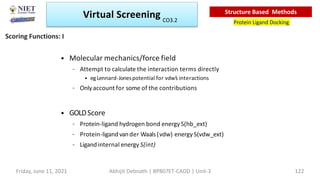
• Molecular mechanics/force field
– Attempt to calculate the interaction terms directly
• egLennard-Jonespotential for vdw’
s interactions
– Onlyaccount for some of the contributions
• GOLDScore
– Protein-ligand hydrogen bond energy S(hb_ext)
– Protein-ligand vander Waals(vdw) energy S(vdw_ext)
– Ligandinternal energy S(int)
Scoring Functions: I
Virtual Screening
Protein Ligand Docking
Structure Based Methods
Friday, June 11, 2021 Abhijit Debnath | BP807ET-CADD | Unit-3 122
CO3.2
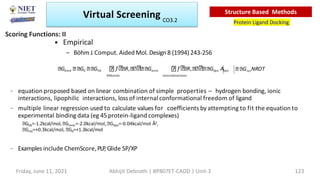
• Empirical
– BöhmJ.Comput. Aided Mol. Design8 (1994) 243-256
– equation proposed based on linear combination of simple properties – hydrogen bonding, ionic
interactions, lipophilic interactions, loss of internal conformational freedom of ligand
– multiple linear regression used to calculate values for coefficients by attempting to fit the equation to
experimental binding data (eg 45 protein-ligand complexes)
Ghb=-1.2kcal/mol, Gionic=-2.0kcal/mol, Glipo=-0.04kcal/mol Å2,
Grot=+0.3kcal/mol, G0=+1.3kcal/mol
– Examples include ChemScore,PLP
, Glide SP/XP
GrotNROT
Gbind G0 Ghb f R, Gionic f R, Glipo Alipo
h bonds ionicinteractions
Scoring Functions: II
Virtual Screening
Protein Ligand Docking
Structure Based Methods
Friday, June 11, 2021 Abhijit Debnath | BP807ET-CADD | Unit-3 123
CO3.2
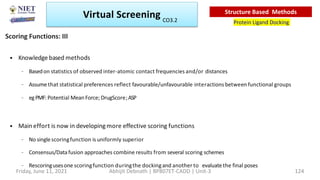
• Knowledgebased methods
– Basedon statistics of observed inter-atomic contact frequencies and/or distances
– Assumethat statistical preferences reflect favourable/unfavourable interactions between functional groups
– egPMF: Potential Mean Force; DrugScore;ASP
• Main effort is now in developingmore effective scoring functions
– No singlescoringfunction is uniformly superior
– Consensus/Datafusion approaches combine results from several scoring schemes
– Rescoringusesone scoringfunction duringthe dockingand another to evaluatethe final poses
Scoring Functions: III
Virtual Screening
Protein Ligand Docking
Structure Based Methods
Friday, June 11, 2021 Abhijit Debnath | BP807ET-CADD | Unit-3 124
CO3.2
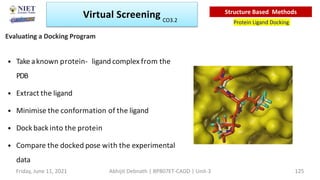
• Take aknown protein- ligand complex from the
PDB
• Extract the ligand
• Minimise the conformation of the ligand
• Dock back into the protein
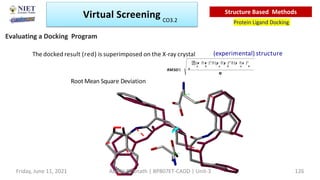
• Compare the docked pose with the experimental
data
Evaluating a Docking Program
Virtual Screening
Protein Ligand Docking
Structure Based Methods
Friday, June 11, 2021 Abhijit Debnath | BP807ET-CADD | Unit-3 125
CO3.2
The docked result (red) is superimposed on the X-ray crystal (experimental) structure
Root Mean Square Deviation
(x x )2
(y y )2
(z z )2
a b a b a b
N
N
RMSD
Evaluating a Docking Program
Virtual Screening
Protein Ligand Docking
Structure Based Methods
Friday, June 11, 2021 Abhijit Debnath | BP807ET-CADD | Unit-3 126
CO3.2
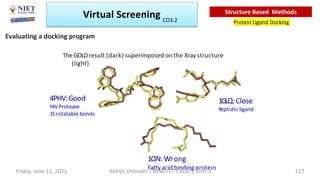
The GOLDresult (dark) superimposed on the Xray structure
(light)
4PHV:Good
HIVProtease
15rotatable bonds
1GLQ:Close
Peptidic ligand
1CIN:Wrong
Fatty acid binding protein
Evaluating a docking program
Virtual Screening
Protein Ligand Docking
Structure Based Methods
Friday, June 11, 2021 Abhijit Debnath | BP807ET-CADD | Unit-3 127
CO3.2
• GOLDvalidation
– 305 complexes found in PDB(CCDC/Astex dataset)
– ligand extracted from complex
– ligand minimised
– docked back to protein
– GOLDprediction compared with original crystal structure
• ~72%success rate using stringent criteria
• G.Jones, P
.Willett, R.C.Glen, A.R.Leach & R.Taylor, J.Mol. Biol
1997,267, 727-748
• J.W.M. Nissink etal.“ANew Test Set for ValidatingPredictions of Protein-LigandInteraction”,Proteins 2002,49,
457-471.
GOLD: Validation
Virtual Screening
Protein Ligand Docking
Structure Based Methods
CO2
Friday, June 11, 2021 Abhijit Debnath | BP807ET-CADD | Unit-3 128
CO3.2
• Need to ensure all residues are in the correct protonation and tautomeric states
• Protein conformation
– Canbe several examples of the same protein but with different ligands bound
– The conformation of the binding site can vary from one complex to another
– Which should be used in the virtual screening experiment?
• Ensemble docking to different protein conformations may be required where there are large changes in
the binding site
Issues related to the protein
Virtual Screening
Protein Ligand Docking
Structure Based Methods
Friday, June 11, 2021 Abhijit Debnath | BP807ET-CADD | Unit-3 129
CO3.2
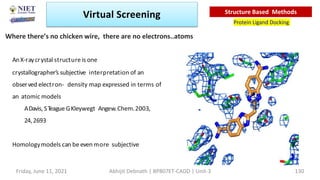
AnX-raycrystal structure is one
crystallographer’s subjective interpretation of an
observed electron- density map expressed in terms of
an atomic models
ADavis, ST
eague GKleywegt Angew.Chem.2003,
24,2693
Homologymodels can be even more subjective
Where there’s no chicken wire, there are no electrons..atoms
Virtual Screening
Protein Ligand Docking
Structure Based Methods
Friday, June 11, 2021 Abhijit Debnath | BP807ET-CADD | Unit-3 130
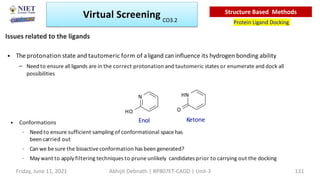
• Theprotonation state and tautomeric form of aligand caninfluence its hydrogen bonding ability
– Need to ensure all ligands are in the correct protonation and tautomeric states or enumerate and dock all
possibilities
• Conformations
– Need to ensure sufficient sampling of conformational space has
been carried out
– Can we be sure the bioactive conformation hasbeen generated?
– Maywant to apply filtering techniques to prune unlikely candidates prior to carrying out the docking
Enol Ketone
N
HO
HN
O
Issues related to the ligands
Virtual Screening
Protein Ligand Docking
Structure Based Methods
Friday, June 11, 2021 Abhijit Debnath | BP807ET-CADD | Unit-3 131
CO3.2
• Most docking programs take account of conformational flexibility of the ligand but very flexible ligands are still difficult
• Some protein-ligand interactions occur viaawater molecules
– Canswitch waters on and off in the binding site but usually based on positions seenin the x-ray structure
• Some docking programs allow protein side chain flexibility
– Full protein flexibility cannot yet be handled except by molecular
dynamics with is extremely computationally demanding
• Scoring functions
– Reasonablygood at finding the correct pose for agivenprotein-ligand complex
– Lessgood at ranking different ligands against the same protein (virtual screening)
• Varietyof different post-processing procedures are available to help reorder the output
Current Status of Docking: 1
Virtual Screening
Protein Ligand Docking
Structure Based Methods
Friday, June 11, 2021 Abhijit Debnath | BP807ET-CADD | Unit-3 132
CO3.2
• Despite its limitations docking is very widely used and there are manysuccessstories
– seeKolb et al.Curr. Opin.Biotech., 2009, 20,429, and Waszkowyczet al.,WIREsComp Mol. Sci., 2011,1,229)
• Performance varies from target to target, and scoring function to scoring function
– Seefor example, Plewczynski et al, “Can we trust docking results? Evaluation of seven commonly used programs
on PDBbind database”
,J.Comp.Chem.,2011,32,742.
• Care needs to be taken when preparing both the protein and the ligands
• The more information you have(and use!), the better your chances
– Targeted library, docking constraints, filtering poses, seeding with known actives, comparing with known crystal poses
Current Status of Docking: 2
Virtual Screening
Protein Ligand Docking
Structure Based Methods
Friday, June 11, 2021 Abhijit Debnath | BP807ET-CADD | Unit-3 133
CO3.2
• Wide range of virtual screening techniques havebeen developed
• Theperformance of different methods varieson different datasets
• Increased complexity in descriptors and method does not necessarily lead to greater success
• Combining different approaches can lead to improved results
• Computational filters should be applied to remove undesirable compounds from further
consideration
Conclusions
Virtual Screening
Protein Ligand Docking
Structure Based Methods
Friday, June 11, 2021 Abhijit Debnath | BP807ET-CADD | Unit-3 134
CO3.2
Youtube /other Video Links
https://www.youtube.com/watch?v=-k8msfqMI6Y
https://www.youtube.com/watch?v=3Tvdf2AUekg
https://www.youtube.com/watch?v=tCEQesj50gg
Friday, June 11, 2021 Abhijit Debnath | BP807ET-CADD | Unit-3 135
Faculty Video Links/ Youtube & NPTEL Video
Links and Online Courses Details (if any)
Friday, June 11, 2021 Abhijit Debnath | BP807ET-CADD | Unit-3 136
Summary
Docking is very popular now a days in the discovery. Because of Docking lots of new drug
molecules are now in the market. By using Molecular Docking a large database can be
screened and lead molecule can be identified, which can be further take to lead Optimization
followed by in vitro and in Vivo studies.
Friday, June 11, 2021 Abhijit Debnath | BP807ET-CADD | Unit-3 137
DAILY QUIZ
Q.1 Physiochemical Properties that are not used in the calculation of Drug likeness are:
(a) Molecular Weight
(b) LogP
(c) TPSA
(d) Resonance
Q.2 Select the right Webserver used in Drug likeness calculation?
(a) Swiss ADMET
(b) British ADME
(c) Swiss ABME
(d) Swiss ADME
Q.3 _ Rule is associated with Drug Likeness.
(a) Lipinski Rule
(b) Fleming’s Rule
(c) Bayer’s Rule
(d) Newton Law
Friday, June 11, 2021 Abhijit Debnath | BP807ET-CADD | Unit-3 138
DAILY QUIZ
Q.4 According to Ghose rule Molecular weight of a Drug Like Molecule should be
(a) <550
(b) <488
(c) < 480
(d) <500
Q.5 According to Lipinski rule Molecular weight of a Drug Like Molecule should be
(a) <550
(b) <530
(c) <510
(d) <500
Q.6 Which of the following approach is considered under the ‘Ligand based drug designing’ ?
a) Molecular docking
b) Pharmacophore modeling
c) QSAR Modeling
d) b and c both .
Friday, June 11, 2021 Abhijit Debnath | BP807ET-CADD | Unit-3 139
DAILY QUIZ
Q.7 CoMFA method is used for
a) 4D-QSAR
b) 3D-QSAR
c) 5D-QSAR
d) 6D-QSAR
Q.8 Which of the following method used for virtual screening
a) ADMET analyses
b) QSAR modeling
c) Pharmacophore modeling
d) All of the above
Q.9 Which one is the application of bioinformatics
a) Design of primers
b) Grouping of proteins into families
c) Reconstructing genes from EST sequences
d) All
Friday, June 11, 2021 Abhijit Debnath | BP807ET-CADD | Unit-3 140
DAILY QUIZ
Q.10. What is meant by docking?
a) The process by which two different structures are compared by molecular modelling.
b) The process by which a lead compound is simplified by removing excess functional groups.
c) The process by which drugs are fitted into their target binding sites using molecular modelling.
d) The process by which a pharmacophore is identified.
Friday, June 11, 2021 Abhijit Debnath | BP807ET-CADD | Unit-3 141
WEEKLY ASSIGNMENT
Q.1. What is Drug Likeness?
Q.2. What is pharmacophore?
Q.3. Define Rigid docking
Q.4. Define flexible docking
Q.5. Define manual docking
Q.6. What are the Applications of pharmacophore
Q.7. What are the common features of Pharmacophore
Q.8. Define Immune suppressions
Q.9. How do you will Develop a Pharmacophore Model.
Friday, June 11, 2021 Abhijit Debnath | BP807ET-CADD | Unit-3 142
MCQ s
Q.01 According to Ghose rule Molecular weight of a Drug Like Molecule should be
(a) <550
(b) <488
(c) < 480
(d) <500
Q.02 According to Lipinski rule Molecular weight of a Drug Like Molecule should be
(a) <550
(b) <530
(c) <510
(d) <500
Q.03 Which of the following approach is considered under the ‘Ligand based drug designing’ ?
a) Molecular docking
b) Pharmacophore modeling
c) QSAR Modeling
d) b and c both .
Friday, June 11, 2021 Abhijit Debnath | BP807ET-CADD | Unit-3 143
MCQ s
Q.04. Which of the following operations or calculations would generally be carried out using molecular mechanics?
a) Molecular orbital energies
b) Energy minimisation
c) Electrostatic potentials
d) Transition-state geometries
Q.05 Which of the following method used for virtual screening
a) ADMET analyses
b) QSAR modeling
c) Pharmacophore modeling
d) All of the above
Q.06 Which one is the application of bioinformatics
a) Design of primers
b) Grouping of proteins into families
c) Reconstructing genes from EST sequences
d) All
Friday, June 11, 2021 Abhijit Debnath | BP807ET-CADD | Unit-3 144
MCQ s
Q.07. During pregnancy, drug distribution is more. Which of the following sentences describe the given fact better?
a) The baby needs more drug
b) The mother needs more drug due to high metabolism
c) The surface area increases in the mother’s body due to the presence of uterus, placenta, and foetus. Thus more area for
distribution of drugs
d) The growth of the uterus, placenta, and foetus increases the volume thus increasing distribution. And even the baby forms a
separate compartment for a drug to get distributed
Friday, June 11, 2021 Abhijit Debnath | BP807ET-CADD | Unit-3 145
MCQ s
Q.08. What happens when an obese person is given with a lipophilic drug?
a) Drug aggregation will begin
b) He cannot absorb lipophilic drugs
c) High adipose tissue take up most of the lipophilic drug
d) A large amount of drug is needed as the person’s weight is more
Q.09. In meningitis and encephalitis polar antibiotics gain access to BBB which don’t happen to a healthy person.
a) True
b) b) False
Q.10. Infants have high albumin content.
a) True
b) False
Friday, June 11, 2021 Abhijit Debnath | BP807ET-CADD | Unit-3 146
EXPECTED QUESTIONS FOR UNIVERSITY EXAM
.
Q.1. What are the types of Virtual Screening?
Q.2. Write the Concept of pharmacophore
Q.3. What is pharmacophore mapping
Q.4. Describe Molecular docking.
Q.5. Describe Docking based screening
PREVIOUS YEAR QUESTION PAPER
Thursday, May 13, 2021 Abhijit Debnath | BP807ET-CADD | Unit-1 14
7
Friday, June 11, 2021 Abhijit Debnath | BP807ET-CADD | Unit-3 148
REFERENCES AND BOOKS TO BE FOLLOWED
• Delgado JN, Remers WA eds “Wilson & Gisvold’s Text Book of Organic Medicinal & Pharmaceutical Chemistry”
Lippincott, New York.
• Foye WO “Principles of Medicinal chemistry ‘Lea & Febiger.
• Koro lkovas A, Burckhalter JH. “Essentials of Medicinal Chemistry” Wiley Interscience.
• Wolf ME, ed “The Basis of Medicinal Chemistry, Burger’s Medicinal Chemistry” John Wiley & Sons, New York.
Friday, June 11, 2021 Abhijit Debnath | BP807ET-CADD | Unit-3 149
Noida Institute of Engineering and Technology
(Pharmacy Institute) Greater Noida

Molecular Modeling and virtual screening techniques

  • 1.
    Molecular Modeling and Virtualscreening Techniques Abhijit Debnath Asst. Professor NIET, Pharmacy Institute Greater Noida Friday, June 11, 2021 1 Unit: 3 Abhijit Debnath | BP807ET-CADD | Unit-3 Subject Name: CADD (Elective) (BP 807 ET) Course Details (B. Pharm 8th Sem) Noida Institute of Engineering and Technology (Pharmacy Institute) Greater Noida
  • 2.
    Friday, June 11,2021 2 SYLLABUS Abhijit Debnath | BP807ET-CADD | Unit-3
  • 3.
    Friday, June 11,2021 3 CONTENT Abhijit Debnath | BP807ET-CADD | Unit-3 • Virtual Screening techniques: Drug likeness screening, Concept of pharmacophore mapping and pharmacophore based Screening. • Molecular docking: Rigid docking, flexible docking, manual docking, Docking based screening. De novo drug design.
  • 4.
    Objectives: Upon completionof the subject student shall be able to; 1. Virtual Screening techniques 2. Molecular docking Friday, June 11, 2021 Abhijit Debnath | BP807ET-CADD | Unit-3 4 COURSE OBJECTIVE
  • 5.
    Friday, June 11,2021 Abhijit Debnath | BP807ET-CADD | Unit-3 5 COURSE OUTCOME CO Statement Domain Bloom’s level CO3.1 Apply the principle of HTVS in Drug Discovery and Pharmaceutical Sciences Cognitive L3 CO3.2 Apply the principle of Docking in Drug Discovery and Pharmaceutical Sciences Cognitive L3 After completion of this unit it is expected that students will be able to
  • 6.
    Friday, June 11,2021 Abhijit Debnath | BP807ET-CADD | Unit-3 6 PROGRAMME OUTCOMES (POs) PO 1 Pharmacy Knowledge PO 2 Planning Abilities PO 3 Problem analysis PO 4 Modern tool usage PO 5 Leadership skills PO 6 Professional Identity PO 7 Pharmaceutical Ethics PO 8 Communication PO 9 The Pharmacist and society PO 10 Environment and sustainability PO 11 Life-long learning
  • 7.
    Friday, June 11,2021 Abhijit Debnath | BP807ET-CADD | Unit-3 7 CO-PO MAPPING COs PO1 PO2 PO3 PO4 PO5 PO6 PO7 PO8 PO9 PO10 PO11 CO1 3 3 3 2 3 3 3 2 3 2 3 CO2 3 3 3 2 3 3 3 2 3 2 3
  • 8.
    TOPIC OBJECTIVE • Learningthe basics of Molecular Docking, Pharmacophore Mapping and Virtual Screening to Screen Large Database for Drug Discovery. 8
  • 9.
    • After completionof this unit it is expected that students will be able to Thursday, May 13, 2021 Abhijit Debnath | BP807ET-CADD | Unit-1 9 TOPIC MAPPING WITH COURSE OUTCOME Unit Topics Mapping with CO3.1 UNIT 3: Introduction to Drug Discovery and Development Drug Likeness 2 Virtual Screening 3 Pharmacophore 2
  • 10.
    • After completionof this unit it is expected that students will be able to Thursday, May 13, 2021 Abhijit Debnath | BP807ET-CADD | Unit-1 1 0 TOPIC MAPPING WITH COURSE OUTCOME Unit Topics Mapping with CO3.2 UNIT 3: Introduction to Drug Discovery and Development Molecular Docking 3 Docking based Virtual Screening 2
  • 11.
    Thursday, May 13,2021 Abhijit Debnath | BP807ET-CADD | Unit-1 1 1 TOPIC OBJECTIVE MAPPING WITH COURSE OUTCOME Topics Topic Objective Mapping with CO Drug Likeness To learn about various Drug Likeness Rules Virtual Screening To be get skilled with High Throughput Virtual Screening CO3.1 Pharmacophore To know about the Ligand based virtual screening CO3.1 Molecular Docking To understand the receptor ligand interaction at molecular level CO3.2 Docking based Virtual Screening To be get skilled with High Throughput Virtual Screening by using the knowledge Structure Based Drug Design CO3.1
  • 12.
    • Students musthave basic knowledge of Biochemistry and Medicinal Chemistry • Students must have basic knowledge of genetic engineering, medicine and fermentation technology. • Students must have basic knowledge of SAR and QSAR. Friday, June 11, 2021 Abhijit Debnath | BP807ET-CADD | Unit-3 12 PREREQUISITE AND RECAP
  • 13.
    Virtual Screening techniques Friday,June 11, 2021 Abhijit Debnath | BP807ET-CADD | Unit-3 13 CO3.1 Noida Institute of Engineering and Technology (Pharmacy Institute) Greater Noida
  • 14.
    Virtual Screening techniques Friday,June 11, 2021 Abhijit Debnath | BP807ET-CADD | Unit-3 14  Screening in Drug Discovery  Drug Likeness  Virtual Screening  Ligand-Based Methods  Similarity Searching  Pharmacophore Mapping  Machine learning Methods  Structure Based Methods (Molecular Docking) Noida Institute of Engineering and Technology (Pharmacy Institute) Greater Noida CO3.1
  • 15.
    right molecule, righttarget Screening in Drug Discovery Friday, June 11, 2021 Abhijit Debnath | BP807ET-CADD | Unit-3 15 CO3.1
  • 16.
    High-throughput screening Combinatorialchemistry Still need to consider carefully what to screen/make Screening in Drug Discovery: High throughput automation Friday, June 11, 2021 Abhijit Debnath | BP807ET-CADD | Unit-3 16 CO3.1
  • 17.
    • Goal:to findalead compound that can be optimised to giveadrug candidate • Optimisation: using chemical synthesisto modify the lead molecule in order to improve its chancesof beingasuccessful drug • The challenge: chemical spaceis vast – Estimates vary • Reymond et al. suggest there are ~1billion compounds with up to 13heavyatoms • There are ~30 million known compounds • Atypical pharmaceutical compound collection contains ~1million compounds Blum, L.C. & Reymond, J.-louis .J.Am. Chem. Soc. 131, 8732-8733(2009). Screening in Drug Discovery: High throughput automation Friday, June 11, 2021 Abhijit Debnath | BP807ET-CADD | Unit-3 17 CO3.1
  • 18.
    • Highthroughput screeningallows large (up to 1million) numbers of compounds to be tested – Butverysmall proportion of“available”compounds – Largescale screeningis expensive – Not all targets are suitable for HTS Screening in Drug Discovery: High throughput automation Friday, June 11, 2021 Abhijit Debnath | BP807ET-CADD | Unit-3 18 CO3.1
  • 19.
    Screening in DrugDiscovery: High throughput automation Friday, June 11, 2021 Abhijit Debnath | BP807ET-CADD | Unit-3 19 CO3.1
  • 20.
    Screening in DrugDiscovery: High throughput automation Friday, June 11, 2021 Abhijit Debnath | BP807ET-CADD | Unit-3 20 CO3.1
  • 21.
    Screening in DrugDiscovery: High throughput automation Friday, June 11, 2021 Abhijit Debnath | BP807ET-CADD | Unit-3 21 CO3.1
  • 22.
    • Virtual screeningrefers to a range of in-silico techniques used to search large compound databases to select a smaller number for biologicaltesting • Virtual screening can be used to – Select compounds for screening from in-housedatabases – Choose compounds to purchase from external suppliers – Decide which compounds to synthesisenext • The technique applied depends on the amount of information availableabout the particular diseasetarget Virtual Screening Friday, June 11, 2021 Abhijit Debnath | BP807ET-CADD | Unit-3 22 CO3.1
  • 23.
    Screening in DrugDiscovery: High throughput automation Friday, June 11, 2021 Abhijit Debnath | BP807ET-CADD | Unit-3 23 CO3.1
  • 24.
     Druglikeness isa qualitative concept used in drug design for how "druglike" a substance is with respect to factors like bioavailability.  The fastest method for evaluating the drug-like properties of a compound is to apply “rules.”  Rules are a set of guidelines for the structural properties of compounds that have a higher probability of being well absorbed after oral dosing.  “Lead-like” or “Drug-like” hits derived from HTS campaigns that provide good starting points for lead Optimization Drug Likeness Friday, June 11, 2021 Abhijit Debnath | BP807ET-CADD | Unit-3 24 CO3.1
  • 25.
    Drug Likeness Friday, June11, 2021 Abhijit Debnath | BP807ET-CADD | Unit-3 25 CO3.1
  • 26.
     It isestimated from the molecular structure before the substance is even synthesized and tested. A druglike molecule has properties such as:  Solubility in both water and fat, as an orally administered drug needs to pass through the intestinal lining after it is consumed, be carried in aqueous blood and penetrate the lipid-based cell membrane to reach the inside of a cell. • A model compound for the lipophilic cellular membrane is 1-octanol (a lipophilic hydrocarbon), so the logarithm of the octanol-water partition coefficient, known as LogP, is used to predict the solubility of a potential oral drug. • This coefficient can be experimentally measured or predicted computationally, in which case it is sometimes called "cLogP". Drug Likeness Friday, June 11, 2021 Abhijit Debnath | BP807ET-CADD | Unit-3 26 CO3.1
  • 27.
    Drug Likeness Friday, June11, 2021 Abhijit Debnath | BP807ET-CADD | Unit-3 27 CO3.1  Potency at the biological target. • High potency (high value of pIC50) is a desirable attribute in drug candidates, as it reduces the risk of non- specific, off-target pharmacology at a given concentration. • When associated with low clearance, high potency also allows for low total dose, which lowers the risk of idiosyncratic drug reactions.  Ligand efficiency and lipophilic efficiency.
  • 28.
    Drug Likeness Friday, June11, 2021 Abhijit Debnath | BP807ET-CADD | Unit-3 28 CO3.1  Molecular weight: • The smaller the better, because diffusion is directly affected. • The great majority of drugs on the market have molecular weights between 200 and 600 Daltons, and particularly <500; they belong to the group of small molecules.
  • 29.
    Drug Likeness Friday, June11, 2021 Abhijit Debnath | BP807ET-CADD | Unit-3 29 CO3.1  Lipinski Rule of Five  Lipinski et al. discussed important implications of these rules in light of current drug discovery strategies.  The discovery lead optimization stage often increases target binding by adding hydrogen bonds and lipophilicity.  Thus, activity optimization can reduce the drug-like properties of a compound series.
  • 30.
    Ligand-Based Methods Structure-Based Methods Unknown 3D Structure ofTarget Known Actives known Actives and inactives known Machine learning methods Pharmacophore mapping Similarity searching Protein Ligand Docking Virtual Screening Friday, June 11, 2021 Abhijit Debnath | BP807ET-CADD | Unit-3 30 CO3.1
  • 31.
    Ligand-Based Methods Structure-Based Methods Unknown 3D Structure ofTarget Known Actives known Actives and inactives known Machine learning methods Pharmacophore mapping Similarity searching Protein Ligand Docking Virtual Screening Friday, June 11, 2021 Abhijit Debnath | BP807ET-CADD | Unit-3 31 CO3.1
  • 32.
    • The similarproperty principle states that structurally similar molecules tend to havesimilar properties (cf neighbourhood principle) • Basisof medicinal chemistry efforts and of all ligand- based virtual screening methods – Despitetheexistence of“activitycliffs” N O OH HO Morphine N O OH O Codeine N O O O O O Heroin Virtual Screening Rationale for similarity searching Similarity Searching Ligand-Based Methods Friday, June 11, 2021 Abhijit Debnath | BP807ET-CADD | Unit-3 32 CO3.1
  • 33.
    • Givenanactive referencestructure rank order a database of compounds on similarity to the reference • Select the top ranking compounds for biological testing • Requires away of measuringthe similarity of apair of compounds • But similarity isinherently subjective, soneed to provide aquantitative basis,a similarity measure, for ranking structures • There is no singlemeasure of similarity Virtual Screening Similarity Searching Ligand-Based Methods Friday, June 11, 2021 Abhijit Debnath | BP807ET-CADD | Unit-3 33 CO3.1
  • 34.
    Which two aremost similar? Banana Orange Basketball Virtual Screening Similarity Searching Ligand-Based Methods Friday, June 11, 2021 Abhijit Debnath | BP807ET-CADD | Unit-3 34 CO3.1
  • 35.
    Three components ofa similarity measure • Molecular descriptors – Numerical values assignedto structures • Physicochemicalproperties, e.g.,MW, logP,MR,PSA,.... • 2Dproperties: fingerprints, topological indices, maximum common substructures • 3Dproperties:fingerprints, molecular fields • Similarity coefficient – Aquantitative measure of similarity between two sets of molecular descriptors • Canalso useaweighting function to ensure equal (or non-equal) contributions from all parts of the measure Todeschini & Consonni, Handbook of Molecular Descriptors Wiley-VCH,2009 Virtual Screening Similarity Searching Ligand-Based Methods Friday, June 11, 2021 Abhijit Debnath | BP807ET-CADD | Unit-3 35 CO3.1
  • 36.
    2Dfingerprints: molecules representedas binary vectors • Eachbit in the bit string (binary vector) represents one molecular fragment. Typical length is ~1000bits • The bitstring for amoleculerecords thepresence(“1”)or absence (“0”) ofeach fragmentinthemolecule • Originally developed for speeding up substructure search – foraquery substructure tobe present inadatabasemolecule eachbitset to “1”inthequery must alsobe set to“1 ”inthedatabasestructure - Similarity is basedon determining the number of bits that are common to two structures C C C C C O C C C Virtual Screening Similarity Searching Ligand-Based Methods Friday, June 11, 2021 Abhijit Debnath | BP807ET-CADD | Unit-3 36 CO3. 1
  • 37.
    C C C C N C N C C C C CC C C C C C C C N N C C C a.Augmented Atom C rs C rd C rs C b.Atom Sequence C rs C rs C rd C c. Bond Sequence AArs AArsAArd AA d. Ring Composition N rs C rd C rs C rs C rs e.Ring Fusion XX3 XX3 XX3 XX2 XX2 f.Atom Pair N 0;3 - 2 - C 0;3 Example fragments Dictionary-based fingerprints: pre-defined fragments each of which maps to asinglebit. Examplesinclude MACCSKeys,BCIfps Virtual Screening Similarity Searching Ligand-Based Methods Friday, June 11, 2021 Abhijit Debnath | BP807ET-CADD | Unit-3 37 CO3.1
  • 38.
    Hashed Fingerprints * • Fragmentsaregenerated algorithmically without the need for a dictionary eg,all paths up to sevennon-hydrogen atoms • Eachfragment is processed using several different hashing functions, eachof which sets asingle bit in the fingerprint • There is aone-to-many mapping between afragment and bits in the bit string and agivenbit maybe set by different fragments • Examples:Daylight, UNITYfingerprints OH H3C C O O O O Virtual Screening Similarity Searching Ligand-Based Methods Friday, June 11, 2021 Abhijit Debnath | BP807ET-CADD | Unit-3 38 CO3.1
  • 39.
    Other descriptors: Circularsubstructures • Eachatom is represented byastring of integers obtained by an adaptation of the Morgan algorithm • PipelinePilot (Accelrys) descriptors, e.g.,ECFP2,ECFP4,ECFP6,FCFP2,.... • ECFPfragments encode atomic type, charge and mass • FCFPfragmentsencode six generalised atom-types • 2,4 or 6 denotesthe diameter (in bonds) of the circular substructure • RDKit variant: Morgan, FeatMorgan N N N HN N O OH O Virtual Screening Similarity Searching Ligand-Based Methods Friday, June 11, 2021 Abhijit Debnath | BP807ET-CADD | Unit-3 39 CO3.1
  • 40.
    Similarity coefficients • Tanimotocoefficient for binary bit strings – Cbits set in common in the referenceand databasestructure – Rbits set in referencestructure – Dbits set in databasestructure • More complex form for usewith non-binary data, e.g.,physicochemical property vectors • Manyother types of similarity coefficient exist that can be applied, e.g.,cosinecoefficient, Euclidean distance, Tversky index R D C C RD SIM Virtual Screening Similarity Searching Ligand-Based Methods Friday, June 11, 2021 Abhijit Debnath | BP807ET-CADD | Unit-3 40 CO3.1
  • 41.
    Limitations of traditional2Ddescriptors N OH HO O Morphine N O OH O 0.99 similar Codeine N O O O O O 0.95 similar Heroin N O 0.20 similar Methadone Daylight fingerprints; Tanimoto similarities Virtual Screening Similarity Searching Ligand-Based Methods Friday, June 11, 2021 Abhijit Debnath | BP807ET-CADD | Unit-3 41 CO3.1
  • 42.
    Scaffold Hopping • 2Dfingerprintsare very good at identifying close analogues • Scaffold Hopping:“Identificationofstructurally novel compounds by modifying the central core structure of the molecule” – Patent reasons:move awayfrom competitor compounds – Provide alternate lead series if problems arise due to difficult chemistry or poor ADMEproperties • Descriptors for scaffold hopping – Reduced graphs – Topological pharmacophore keys – 3Ddescriptors Virtual Screening Similarity Searching Ligand-Based Methods Friday, June 11, 2021 Abhijit Debnath | BP807ET-CADD | Unit-3 42 CO3.1
  • 43.
    Cyclooxygenase inhibitors Bohm, Flohr& Stahl, Scaffold hopping. Drug Discovery Today: Technologies, 2004, 1,217-224 Scaffold Hops Virtual Screening Similarity Searching Ligand-Based Methods Friday, June 11, 2021 Abhijit Debnath | BP807ET-CADD | Unit-3 43 CO3.1
  • 44.
    Pharmacophore Vectors: Similog •Similog keys • Atom typing scheme based on four properties:hydrogen-bond donor, hydrogen-bond acceptor, bulkiness and electropositivity • Atom triplets of strings encoding absence and presence of properties, plus distance encoding form aDABEkey • Vector contains acount for each of the 8031possible DABEkeys Schuffenauer et al. Similarity metrics for ligands reflecting the similarity of target proteins Journal of Chemical Information and Computer Sciences, 2003, 43, 391-405 0010 6 6 4 0100 O O 1100 H O Virtual Screening Similarity Searching Ligand-Based Methods Friday, June 11, 2021 Abhijit Debnath | BP807ET-CADD | Unit-3 44 CO3.1
  • 45.
    Gillet, Willett &Bradshaw, Similarity searching using reduced graphs Journal of Chemical Information and Computer Sciences, 2003, 43, 338-345 Reduced Graphs Virtual Screening Similarity Searching Ligand-Based Methods Friday, June 11, 2021 Abhijit Debnath | BP807ET-CADD | Unit-3 45 CO3.1
  • 46.
    3Dsimilarity searching • Systemsfor 3Dsubstructure searching are widely available – seepharmacophore searching • Extension to 3Dsimilarity searching is anatural one • What the receptor sees? • Alignment independent – Fingerprint approaches • Alignment-based – Field-based and surface-based methods • Noconsensusasto the most effective method Virtual Screening Similarity Searching Ligand-Based Methods Friday, June 11, 2021 Abhijit Debnath | BP807ET-CADD | Unit-3 46 CO3.1
  • 47.
    • Presenceor absenceofgeometric features – Pairs of atoms at given distance range – Triplets of atoms and associated distance – Pharmacophore pairs and triplets (donors, acceptors, aromatic centres,....) – Valence angles – Torsion angles 3Dfingerprints Virtual Screening Similarity Searching Ligand-Based Methods Friday, June 11, 2021 Abhijit Debnath | BP807ET-CADD | Unit-3 47 CO3.1
  • 48.
    Alignment-based 3D similarity •Shape-based – ROCS(Rapid Overlayof Chemical Structures) – Moleculesare aligned in 3D – Similarity score is based on common volume Nicholls et al, Molecular Shape and Medicinal Chemistry; APerspective. Journal of Medicinal Chemistry, 2010,53, 3862-3886 Copyright © 2010American Chemical Society Virtual Screening Similarity Searching Ligand-Based Methods Friday, June 11, 2021 Abhijit Debnath | BP807ET-CADD | Unit-3 48 CO3.1 C VA VB V VC AB SIM 
  • 49.
    Conformational flexibility • Conformationsare different three-dimensional structures of moleculesthat arise from – Rotation about single bonds (torsion angles) – Different rings conformations • Havingseveralrotatable bonds results ina“combinatorialexplosion” • For amolecule with N rotatable bonds, if each torsion angle is rotated in increments of θ degrees, number of conformations is (360º/ θ)N – If the torsion anglesare incremented in steps of 30º, this means that a molecule with 5 rotatable bonds with have 12^5≈ 250K conformations Virtual Screening Similarity Searching Ligand-Based Methods Friday, June 11, 2021 Abhijit Debnath | BP807ET-CADD | Unit-3 49 CO3.1
  • 50.
    Two approaches tohandling conformational flexibility Conformer selection • When anew molecule is to be registered in adatabase,a conformational analysis is used to select diverse conformers spanningthe low-energy conformational space • Eachsuch conformer is loaded into the database and then searched asif it was asingle,rigid structure • Trade-off betweeneffectivenessof coverage(selection of many conformers) and efficiency of searching(selection of few conformers) Exploration of conformational space • Useof trianglesmoothing to identify min-max distances betweeneach atom-pair • Creation of adistance-range (rather than adistance) graph for each databasestructure • Screen and graph search of the min-max distance data using appropriately modified algorithms • Final conformational analysis (by varyingtorsional angles) of the hits resulting from the screen/graph searches Virtual Screening Similarity Searching Ligand-Based Methods Friday, June 11, 2021 Abhijit Debnath | BP807ET-CADD | Unit-3 50 CO3.1
  • 51.
    3Dsimilarity • Computationally moreexpensivethan 2Dmethods • Requires consideration of conformational flexibility – Rigid search - based on asingle conformer – Flexible search • Conformation explored at search time • Ensembleof conformers generated prior to search time with each conformer of each molecule considered in turn • How many conformers are required? • Methods that require aligningmolecules are more costly than vector-based calculations Virtual Screening Similarity Searching Ligand-Based Methods Friday, June 11, 2021 Abhijit Debnath | BP807ET-CADD | Unit-3 51 CO3.1
  • 52.
    Evaluation of similaritymethods • Retrospective search • For areference compound of known activity, search againsta database that contains other actives and decoy compounds – Determine where the active compounds appear in the ranked list – Agood similarity measure will cluster the known actives at the top of the ranking – Performance measures: enrichment factors, AUC,BEDROC,..... • Comparative studies suggest that 2Dfingerprints are most effective – Good at identifying"me-too"compounds but lessgood at scaffold hopping • R.P .Sheridan and S.K.Kearsley (2002) Drug Discovery Today,7,903- 911 – “We have come to regard looking for ‘thebest’ way of searching chemical databases asafutile exercise. In both retrospective and prospective studies, different methods select different subsets of actives for the same biological activityand thesame method might work better on some activitiesthan others” Virtual Screening Similarity Searching Ligand-Based Methods Friday, June 11, 2021 Abhijit Debnath | BP807ET-CADD | Unit-3 52 CO3.1
  • 53.
    Data fusion • Fusionof ranked lists generated for sameactive compound (similarity fusion) – Do asimilarity search for areference structure and rank the database in order of decreasingsimilarity – Repeatwith different representations, coefficients, etc. – Sum the rank positions for agivenstructure to give an overall fused rank position – Thefused rankingsform the output from the search • Consistencyof search performance across arange of reference structures, types of fingerprint, biological activities etc. • Analogousapproaches (called consensus scoring) used in docking studies Virtual Screening Similarity Searching Ligand-Based Methods Friday, June 11, 2021 Abhijit Debnath | BP807ET-CADD | Unit-3 53 CO3.1
  • 54.
    Multiple active structures •Fusethe results of searches carried out using different reference compounds – Samedescriptors, same coefficient, different active compounds • Results are generally improved relative to usingasingle reference structure • Best performance is achievedfor diverse actives Virtual Screening Similarity Searching Ligand-Based Methods Friday, June 11, 2021 Abhijit Debnath | BP807ET-CADD | Unit-3 54 CO3.1
  • 55.
    Ligand-Based Methods Structure-Based Methods Unknown 3D Structure ofTarget Known Actives known Actives and inactives known Machine learning methods Pharmacophore mapping Similarity searching Protein Ligand Docking Virtual Screening Friday, June 11, 2021 Abhijit Debnath | BP807ET-CADD | Unit-3 55 CO3.1
  • 56.
    Multiple actives known:phamacophore searching Virtual Screening Pharmacophore Mapping Ligand-Based Methods Friday, June 11, 2021 Abhijit Debnath | BP807ET-CADD | Unit-3 56 CO3.1
  • 57.
    Pharmacophore is theensemble of steric and electronic features that is necessary to ensure the optimal supramolecular interactions with aspecific biological target structure and to trigger (or to block) its biological response Pharmacophore Definition Glossary of terms used in Medicinal Chemistry (IUPAC Recommendations 1998) Pure & Appl. Chem.1998,70(5), 1129-1143http://dx.doi.org/10.1351/pac199870051129). Virtual Screening Pharmacophore Mapping Ligand-Based Methods Friday, June 11, 2021 Abhijit Debnath | BP807ET-CADD | Unit-3 57 CO3.1
  • 58.
    H.Wang et al.J.Med.Chem.2008,51,2439-2446 hydrogenbond acceptor (HBA)feature+projected point hydrophobic feature hydrophobic feature aromaticring feature+ projected point Cannabinoid Receptor 1 (CB1) antagonist pharmacophore other common feature types (not used here): • hydrogen bond donor • positive/negative features (charged/ionizable) • customized features • inclusion/exclusion volume spheres (shape) Example: Rimonabant Virtual Screening Pharmacophore Mapping Ligand-Based Methods Friday, June 11, 2021 Abhijit Debnath | BP807ET-CADD | Unit-3 58 CO3.1
  • 59.
    Generating pharmacophore models:Ligand-based (alternative) CB1antagonist pharmacophore Trying to predict how the ligands will bind to the receptor without knowing the structure of the receptor Foloppe et al. Bioorg. Med. Chem. Lett. 2009, 19, 4183-4190 Rimonabant Virtual Screening Pharmacophore Mapping Ligand-Based Methods Friday, June 11, 2021 Abhijit Debnath | BP807ET-CADD | Unit-3 59 CO3.1
  • 60.
    Pharmacophore generation methods •Pharmacophoric features in eachligand identified – Donors, acceptors, hydrophobic groups,... – Often SMARTs-based to allow user-definitions • Ligands aligned such that corresponding features are overlaid • Conformational spaceexplored – On-the-fly egusingagenetic algorithm – Generating ensemble of conformations with each conformer considered in turn • Given the undetermined nature of the problem it is unlikely that asingle correct solution will be found • Pharmacophore hypotheses are scored – egnumber of features, goodness of fit to features,conformational energy,volume of the overlay, rarity of the pharmacophore,.... Virtual Screening Pharmacophore Mapping Ligand-Based Methods Friday, June 11, 2021 Abhijit Debnath | BP807ET-CADD | Unit-3 60 CO3.1
  • 61.
    Ligand-based pharmacophores: practicalaspects • Selecta‘representative’setofactives – Most methods assume similar bindingmodes – Oneor more rigid molecules are preferred – The ligands should be diverse (otherwise too many common features that are not involved in binding) • Prepare molecules (e.g. tautomeric form, protonation state), generate 3Dstructure and conformations (if required) • Usepharmacophore software/tool to generate pharmacophores (biased or unbiased?) • Select preferred pharmacophore model(s) and validatethem – Visual inspection – Do the“actives”fitthepharmacophore? – Canthe pharmacophore separate activesfrom decoys? Virtual Screening Pharmacophore Mapping Ligand-Based Methods Friday, June 11, 2021 Abhijit Debnath | BP807ET-CADD | Unit-3 61 CO3.1
  • 62.
    D.Schulster et al.Bioorg.Med.Chem.2011,19,7168-7180 (http://dx.doi.org/10.1016/j.bmc.2011.09.056) U.Grienke et al. Bioorg. Med. Chem.2011,19,6779-6791 (http://dx.doi.org/10.1016/j.bmc.2011.09.039) Pharmacophore contains five hydrophobic features, one hydrogen bond acceptor feature, and 27exclusion spheres PDBentry1 osh, farnesoid X receptor (FXR,aligand-dependent transcription factor) Structure-based pharmacophores Virtual Screening Pharmacophore Mapping Ligand-Based Methods Friday, June 11, 2021 Abhijit Debnath | BP807ET-CADD | Unit-3 62 CO3.1
  • 63.
    Pharmacophore searching O O N a b c a= 8.62+- 0.58 Angstroms b = 7.08+- 0.56 Angstroms c = 3.35+- 0.65 Angstroms O O O O O O N O O O N N N O O O O O O N N N N S O O O O O O O P O O O P O O O P N N N N N O O O O O N N N O N O O O Virtual Screening Pharmacophore Mapping Ligand-Based Methods Friday, June 11, 2021 Abhijit Debnath | BP807ET-CADD | Unit-3 63 CO3.1
  • 64.
    Database searching • Conformationalsearch – On-the-fly – Ensemble of conformers • Databasesearchshould be“compatible”withparametersused to generate the pharmacophore – Thesame pharmacophore feature definitions should be used to describethe databasestructuresaswere used to generate the pharmacophore – Thedatabaseshould be generated usingthe sameprotocol asused to generate the pharmacophore – What toleranceshould be used to allow amatch? • If two pharmacophore features are separatedby 5Åwhat distance rangeis acceptable: 4.5-5.5Å;4-6Å? • Shouldall tolerances be the same? • What effect does this haveon recall and precision? – Canexclusion/inclusion volumes be used? Virtual Screening Pharmacophore Mapping Ligand-Based Methods Friday, June 11, 2021 Abhijit Debnath | BP807ET-CADD | Unit-3 64
  • 65.
    Select actives Generate conformers Generate (Modify) pharmacophore models Validation 1: Map activesback on pharmacophore Validation 2: Search validation database – enrichment, specificity, sensitivity? Prioritise/select pharmacophore model(s) Perform search/mapping(s) Generate/select ‘compatible’ compound database Select actives + inactives/decoys for validation Generate ‘compatible’ validation database Filter (availability, properties, novelty, visually inspect mappings,…) Select compounds for screening Virtual screening Pharmacophore-based VS: workflow Virtual Screening Pharmacophore Mapping Ligand-Based Methods Friday, June 11, 2021 Abhijit Debnath | BP807ET-CADD | Unit-3 65 CO3.1
  • 66.
    H. Wang etal. J.Med.Chem.2008,51,2439-2446 (http://dx.doi.org/10.1021/jm701519h) Rimonabant Cannabinoid Receptor 1 (CB1) antagonist pharmacophore Example -Cannabinoid CB1 receptor antagonists • No CB1crystal structure, only very limited successwith homology models • Aim was to assay420 compounds selected using apharmacophore model – 8 CB1selective antagonists/inverse agonists were selected from the literature including rimonabant – Amaximum of 250 unique conformations were generated for each molecule (with Macromodel using the MMFF94s force field) – Pharmacophores were generated with Catalyst. – Themodel that yielded the most reasonable mapping for Rimonabant was selected for the databasesearch – The databasecontained about 500k compounds (max. of 150conf. per molecule, generated with Catalyst) Virtual Screening Pharmacophore Mapping Ligand-Based Methods Friday, June 11, 2021 Abhijit Debnath | BP807ET-CADD | Unit-3 66 CO3.1
  • 67.
    • The pharmacophoresearch resulted in 22794hits (approx. 5%of the database) • Stepwise filtering 300 <MW <550 availability assolid >2mg modified Lipinski’sruleoffive (18693 compounds remaining) (10581compounds remaining) (7247compounds remaining) • ABayesian model built from compounds in the MDDRdatabase was used to rank the remaining compounds (using the FCFP6fingerprints in Pipeline Pilot) • Thetop ranking2100were selected • Clustering using the maximum dissimilarity clustering algorithm. 420 clusters were generated and from each cluster the compound with the highest Bayesian score was selected. H. Wang et al. J.Med.Chem.2008,51,2439-2446 (http://dx.doi.org/10.1021/jm701519h) Example (continued) Virtual Screening Pharmacophore Mapping Ligand-Based Methods Friday, June 11, 2021 Abhijit Debnath | BP807ET-CADD | Unit-3 67 CO3.1
  • 68.
    • 420 compoundswere screened at asingle concentration. Five compounds showed more than 50% inhibition. Allfive compounds confirmed in the full curve assay. – Approx. 1%screening hit rate • One compound hasaKi of less than 100nM. Rimonabant Cannabinoid Receptor 1 (CB1) antagonist pharmacophore H. Wang et al. J.Med.Chem.2008,51,2439-2446 (http://dx.doi.org/10.1021/jm701519h) Example (continued) Virtual Screening Pharmacophore Mapping Ligand-Based Methods Friday, June 11, 2021 Abhijit Debnath | BP807ET-CADD | Unit-3 68 CO3.1
  • 69.
    Software Source Recentpublished use cases Catalyst (Discovery Studio) Accelrys http://dx.doi.org/10.1007/s00894-011-1105-5 http://dx.doi.org/10.1016/j.bmcl.2010.12.131 GASP Tripos http://dx.doi.org/10.1016/j.jmgm.2010.02.004 GALAHAD Tripos http://dx.doi.org/10.1016/j.bmc.2011.09.016 http://dx.doi.org/10.1016/j.ejmech.2010.09.012 Ligandscout Inte:ligand http://dx.doi.org/10.1016/j.eplepsyres.2011.08.0 16 MOE Chemical Computing Group http://dx.doi.org/10.1007/s10822-011-9442-0 http://dx.doi.org/10.1016/j.ejmech.2010.07.020 Phase Schrödinger http://10.1111/j.1747-0285.2011.01130.x http://cs- test.ias.ac.in/cs/Volumes/100/12/1847.pdf Examples (by no means comprehensive): (Commercial) software Virtual Screening Pharmacophore Mapping Ligand-Based Methods Friday, June 11, 2021 Abhijit Debnath | BP807ET-CADD | Unit-3 69 CO3.1
  • 70.
    Ligand-Based Methods Structure-Based Methods Unknown 3D Structure ofTarget Known Actives known Actives and inactives known Machine learning methods Pharmacophore mapping Similarity searching Protein Ligand Docking Friday, June 11, 2021 Abhijit Debnath | BP807ET-CADD | Unit-3 70 Virtual Screening CO3.1
  • 71.
    Virtual Screening Machine learningMethods Ligand-Based Methods Friday, June 11, 2021 Abhijit Debnath | BP807ET-CADD | Unit-3 71 CO3.1
  • 72.
    Structure-Activity Relationship Modelling •Useknowledge of known active and known inactive compounds to build apredictive model • Quantitative-Structure Activity Relationships (QSARs) – Longestablished (Hansch analysis,Free-Wilson analysis) – Generally restricted to small,homogeneous datasets eglead optimisation • Structure-Activity Relationships (SARs) – “Activity”datais usuallytreated qualitatively – Canbe used with data consisting of diverse structural classes and multiple binding modes – Some resistance to noisy data (HTS data) – Resulting models used to prioritise compounds for lead finding (not to identify candidates or drugs) Virtual Screening Machine learning Methods Ligand-Based Methods Friday, June 11, 2021 Abhijit Debnath | BP807ET-CADD | Unit-3 72 CO3.1
  • 73.
    C3 C1 C4 C2 C5 . . . . . . . . . . . Likelihood of being active Top Ranked Compounds Picked forTesting Training Set Known active compounds Known inactive compounds Model of Activity Anal acti inact Untested compounds C1, C2, C3, C4, C5 … yse ves ives Compute scores Generalised machine learning Method •Substructural analysis •Recursivepartitioning •Support vector machines •Knearest neighbours •Neural networks Virtual Screening Machine learning Methods Ligand-Based Methods Friday, June 11, 2021 Abhijit Debnath | BP807ET-CADD | Unit-3 73 CO3.1
  • 74.
    Substructural analysis • Thefirst (1973) machine learningmethod to be applied to large activity datasets (before HTSmethods became available) • Basedon the idea that each fragment substructure makes a constant contribution to aparticular type of activity, irrespective of its environment – Normally used with fragment-based fingerprints • Aweight is assignedto eachfragment to reflect its differential occurrence in the training-set actives and inactives – Manydifferent types of weighting scheme • Anunknown molecule is scored by summing the weights for all the fragments it contains • The scores are used to rank the test-set molecules in decreasing probability of activity Virtual Screening Machine learning Methods Ligand-Based Methods Friday, June 11, 2021 Abhijit Debnath | BP807ET-CADD | Unit-3 74 CO3.1
  • 75.
    Calculation of weights •Theweight for afragment substructure comprises some or all of the following – ACTand INACT,the numbers of active and inactive molecules in atraining set – ACT(I) and INACT(I), the numbers of active and inactive moleculesin the training set that contain the I-th fragment • Manyweights havebeen suggested: atypical example is of the form: sed naïveBayesian classifier Virtual Screening Machine learning Methods Ligand-Based Methods Friday, June 11, 2021 Abhijit Debnath | BP807ET-CADD | Unit-3 75 CO3.1
  • 76.
    Recursive Partitioning • Classificationapproach that constructs adecision tree from qualitative data – active/inactive, soluble/insoluble, toxic/non-toxic • Identification of arule that givesthe best statistical split into classes,with the lowest rate of misclassification – Exampledrug|non-drug:MW <500|MW >500 • Repeaton eachset coming from the previous split until no more reasonable splits can be found • Cangenerate good models but with poor predictive power if used without care – Useleave-many-out strategies to validate – Easyto interpret/drive what-next decisions Hamman F ,Gutmann H.Voigt N,HelmaC,Drewe J.Prediction of adverse drug reactions using decision tree modeling.Clin PharmacolTher, 2010,88, 52-59. Virtual Screening Machine learning Methods Ligand-Based Methods Friday, June 11, 2021 Abhijit Debnath | BP807ET-CADD | Unit-3 76 CO3.1
  • 77.
    Test compounds aredropped through the tree. Prediction depends on whether theyfallinto“active”or inactive nodes” Virtual Screening Machine learning Methods Ligand-Based Methods Example Friday, June 11, 2021 Abhijit Debnath | BP807ET-CADD | Unit-3 77 CO3.1
  • 78.
    Ligand-Based Methods Structure-Based Methods Unknown 3D Structure ofTarget Known Actives known Actives and inactives known Machine learning methods Pharmacophore mapping Similarity searching Protein Ligand Docking Friday, June 11, 2021 Abhijit Debnath | BP807ET-CADD | Unit-3 78 Virtual Screening CO3.2
  • 79.
    • How doesaligand (small molecule) bind into the active site of aprotein? • Dockingalgorithms are based on two key components – search algorithm • to generate “poses”(conformation,positionand orientation) of the ligand within the active site – scoring function • to identify the most likely pose for an individual ligand • to assignapriority order to aset of diverse ligands docked to the same protein – estimate bindingaffinity Virtual Screening Protein Ligand Docking Structure Based Methods CONCEPT OF DOCKING Friday, June 11, 2021 Abhijit Debnath | BP807ET-CADD | Unit-3 79 CO3.2
  • 80.
    • Thedifficulty withprotein–ligand docking is in part due to the fact that it involves many degrees of freedom – The translation and rotation of one molecule relative to another involvessixdegrees of freedom – Theseare in addition the conformational degrees of freedom of both the ligand and the protein – The solvent may also play asignificant role in determining the protein–ligand geometry (often ignored though) • The search algorithm generates poses,orientations of particular conformations of the molecule in the binding site – Tries to cover the search space,if not exhaustively,then as extensivelyaspossible – There is atradeoff between time and search spacecoverage Virtual Screening Protein Ligand Docking Structure Based Methods CONCEPT OF DOCKING Friday, June 11, 2021 Abhijit Debnath | BP807ET-CADD | Unit-3 80 CO3.2
  • 81.
    Virtual Screening Protein LigandDocking Structure Based Methods CONCEPT OF DOCKING Abhijit Debnath | BP807ET-CADD | Unit-3 Friday, June 11, 2021 81 CO3.2
  • 82.
    Virtual Screening Protein LigandDocking Structure Based Methods CONCEPT OF DOCKING Friday, June 11, 2021 Abhijit Debnath | BP807ET-CADD | Unit-3 82 CO3.2
  • 83.
    Virtual Screening Protein LigandDocking Structure Based Methods DOCKING TOOLS Friday, June 11, 2021 Abhijit Debnath | BP807ET-CADD | Unit-3 83 CO3.2 Docking Software • DOCK • AutoDock • GOLD • GLIDE • LigandFit Docking Algorithm Shape fitting Lamarckian algorithm, Genetic algorithm Genetic Algorithm Monte Carlo sampling Monte Carlo sampling
  • 84.
    Lock and KeyRigidDocking – In rigid docking, both the internal geometry of the receptor and ligand is kept fixed and docking is performed. Induced fitFlexible Docking - An enumeration on the rotations of one of the molecules (usually smaller one) is performed. Every rotation the surface cell occupancy and energy is calculated; later the most optimum pose is selected Virtual Screening Protein Ligand Docking Structure Based Methods DOCKING TOOLS Abhijit Debnath | BP807ET-CADD | Friday, June 11, 2021 84 CO3. 2
  • 85.
    Virtual Screening Protein LigandDocking Structure Based Methods • Historically the first approaches. • Protein and ligand are fixed. • Search for the relative orientation of the two molecules with lowest energy. • Protein-Protein Docking • Both molecules usually considered rigid • First apply steric constraints to limit search space and the examine energetics of possible binding conformations Docking Types: Rigid Docking Abhijit Debnath | BP807ET-CADD | Friday, June 11, 2021 85 CO3. 2
  • 86.
    • Protein-Ligand Docking •Flexible ligand, rigid- receptor • Search space much larger • Either reduce flexible ligand to rigid fragments connected by one or several hinges, or search the conformational space using monte-carlo methods or molecular dynamics Virtual Screening Protein Ligand Docking Structure Based Methods Docking Types: Flexible docking Abhijit Debnath | BP807ET-CADD | Unit-3 Friday, June 11, 2021 86 CO3.2
  • 87.
    • Bound docking •Unbound docking • Global docking • Local docking Virtual Screening Protein Ligand Docking Structure Based Methods Kinds of Docking Abhijit Debnath | BP807ET-CADD | Unit-3 Friday, June 11, 2021 87 CO3.2
  • 88.
    Virtual Screening Protein LigandDocking Structure Based Methods Kinds of Docking Abhijit Debnath | BP807ET-CADD | Unit-3 Friday, June 11, 2021 88 CO3.2 •The complex structure is known. •The receptor and the ligand in the complex are pulled apart and reassembled. •In bound docking the goal is to reproduce a known complex where the starting coordinates of the individual molecules are taken from the crystal of the complex • Individually determined protein structures are used. •In the unbound docking, which is a significantly more difficult problem, the starting coordinates are taken from the unbound molecules Bound docking Unbound docking
  • 89.
    • The generalproblem includes a search for the location of the binding site and a search to figure out the exact orientation of the ligand in the binding site. A program that do both makes a Global docking • Global docking is more demanding in terms of computational time and the results are less accurate Virtual Screening Protein Ligand Docking Structure Based Methods Kinds of Docking: Global docking Abhijit Debnath | BP807ET-CADD | Unit-3 Friday, June 11, 2021 89 CO3.2
  • 90.
    • Sometimes thelocation of the binding site is known. In this case we only need to orient the ligand in the binding site. In this case the problem is called Local docking Virtual Screening Protein Ligand Docking Structure Based Methods Kinds of Docking: Local docking Abhijit Debnath | BP807ET-CADD | Unit-3 Friday, June 11, 2021 90 CO3.2
  • 91.
    • Inverse docking-smallmolecules of interest are dock into library of receptor. • Covalent docking-it is used to study the covalent character between ligand and receptor. It provides stronger binding affinity that prolongs the duration of biological effects Virtual Screening Protein Ligand Docking Structure Based Methods Methodological advances Abhijit Debnath | BP807ET-CADD | Unit-3 Friday, June 11, 2021 91 CO3.2
  • 92.
     Determine allpossible optimal conformation for a given complex (protein-ligand/ protein-protein)  Calculate the energy of resulting complex & of each individual interactions. Conformational search strategies include- • Systematic method • Random method • Simulation method Virtual Screening Protein Ligand Docking Structure Based Methods Search Algorithm Abhijit Debnath | BP807ET-CADD | Unit-3 Friday, June 11, 2021 92 CO3.2
  • 93.
    • it usesincremental construction and conformational search databases • This search algorithm explores all the degree of freedom in a molecule. • Ligands are often incremenatlly grown into the active site. • Step wise or incremental search can be accomplished in different ways • While docking various molecular fragments into the active site region and linking them covalently or alternatively by dividing dock ligands into rigid (core fragment) and by flexible(side chain) Search Algorithm Virtual Screening Protein Ligand Docking Structure Based Methods Abhijit Debnath | BP807ET-CADD | Unit-3 Friday, June 11, 2021 93 CO3.2
  • 94.
    • Once therigid core is defined they are dock into the active site. Flexible regions are added in an incremental fashion. Another method of systematic search is use of library of pre-generated conformations. library conformations are typically only calculated once and the search problem is therefore reduced to rigid body docking procedure. Systematic Search Contd… Virtual Screening Protein Ligand Docking Structure Based Methods CO2 Abhijit Debnath | BP807ET-CADD | Unit-3 Friday, June 11, 2021 94 CO3.2
  • 95.
    Search Algorithm: Randomsearch •This method operate by making random change to either single ligand or population of ligand. •A newly obtained ligand is evaluated on the bases of pre defined probability function. •Basic idea is to take into consideration of already explored area of conformation space. •Todetermine if a molecular conformation is accepted or not, the root mean square value is calculated between current molecular coordinates and every previously recorded conformations. • Random search uses two algorithms-  Monte Carlo algorithm  Genetic algorithm Virtual Screening Protein Ligand Docking Structure Based Methods Abhijit Debnath | BP807ET-CADD | Unit-3 Friday, June 11, 2021 95 CO3.2
  • 96.
    • It usesalgorithms like molecular dynamics and energy minimization. • In this approach, proteins are typically held rigid, and the ligand is allowed to freely explore their conformational space. • The generated conformations are then docked successively into the protein, and an MD simulation consisting of a simulated annealing protocol is performed. • This is usually supplemented with short MD energy minimization steps, and the energies determined from the MD runs are used for ranking the overall scoring. Although this is a computer-expensive method (involving potentially hundreds of MD runs). Search Algorithm: Simulation Search Virtual Screening Protein Ligand Docking Structure Based Methods Abhijit Debnath | BP807ET-CADD | Unit-3 Friday, June 11, 2021 96 CO3.2
  • 97.
     The evaluationand ranking of predicted ligand conformations is a crucial aspect of structure-based virtual screening.  Scoring functions implemented in docking programs make various assumptions and simplifications in the evaluation of modeled complexes  They do not fully account for a number of physical phenomena that determine molecular recognition — for example, entropic effects.  Affinity scoring functions are applied to the energetically best pose or n best poses found for each molecule, and comparing the affinity scores for different molecules gives their relative rank-ordering. Search Algorithm: Scoring Function Virtual Screening Protein Ligand Docking Structure Based Methods CO2 Abhijit Debnath | BP807ET-CADD | Unit-3 Friday, June 11, 2021 97 CO3.2
  • 98.
    •Essentially, following typesor classes of scoring functions are currently applied: 1. Force-field-based scoring 2. Empirical scoring functions 3. Knowledge-based scoring functions 4. Consensus scoring 5. Shape & Chemical Complementary Scores Scoring Function Virtual Screening Protein Ligand Docking Structure Based Methods Abhijit Debnath | BP807ET-CADD | Unit-3 Friday, June 11, 2021 98 CO3.2
  • 99.
    • Broadly speaking,scoring functions can be divided into the following classes: • Forcefield-based • Based on terms from molecular mechanics forcefields • GoldScore, DOCK, AutoDock • Empirical • Parameterised against experimental binding affinities • ChemScore, PLP, Glide SP/XP • Knowledge-based potentials • Based on statistical analysis of observed pairwise distributions • PMF, DrugScore, ASP Classes of scoring function Virtual Screening Protein Ligand Docking Structure Based Methods Abhijit Debnath | BP807ET-CADD | Friday, June 11, 2021 99 CO3. 2
  • 100.
    Terms in ScoringFunctions Virtual Screening Protein Ligand Docking Structure Based Methods Abhijit Debnath | BP807ET-CADD | Friday, June 11, 2021 100 CO3. 2
  • 101.
    • Divide accessibleprotein surface into zones: – Hydrophobic – Hydrogen-bond donating – Hydrogen-bond accepting • Do the same for the ligand surface • Find ligand orientation with best complementarity score Shape & Chemical Complementary Scores Virtual Screening Protein Ligand Docking Structure Based Methods Abhijit Debnath | BP807ET-CADD | Unit-3 Friday, June 11, 2021 101 CO3.2
  • 102.
    Abhijit Debnath |BP807ET-CADD | Friday, June 11, 2021 102 Empirical scoring functions Virtual Screening Protein Ligand Docking Structure Based Methods CO3. 2
  • 103.
    • This scoringfunction is an empirical scoring function • Empirical = incorporates some experimental data • The coefficients (∆G) in the equation were determined using multiple linear regression on experimental binding data for 45 protein–ligand complexes • Although the terms in the equation may differ, this general approach has been applied to the development of many different empirical scoring functions Böhm’s empirical scoring function Virtual Screening Protein Ligand Docking Structure Based Methods Abhijit Debnath | BP807ET-CADD | Friday, June 11, 2021 103 CO3. 2
  • 104.
    • In general,scoring functions assume that the free energy of binding can be written as a linear sum of terms to reflect the various contributions to binding. • Bohm’s scoring function included contributions from hydrogen bonding, ionic interactions, lipophilic interactions and the loss of internal conformational freedom of the ligand. Böhm’s empirical scoring function Virtual Screening Protein Ligand Docking Structure Based Methods Abhijit Debnath | BP807ET-CADD | Unit-3 Friday, June 11, 2021 104 CO3.2
  • 105.
    Here , Abhijit Debnath |BP807ET-CADD | Unit-3 Friday, June 11, 2021 105 • The ∆G values on the right of the equation are all constants. • ∆Go is a contribution to the binding energy that does not directly depend on any specific interactions with the protein • The hydrogen bonding and ionic terms are both dependent on the geometry of the interaction, with large deviations from ideal geometries (ideal distance R, ideal angle α) being penalized. Böhm’s empirical scoring function Virtual Screening Protein Ligand Docking Structure Based Methods CO3.2
  • 106.
    •Knowledge-based scoring functionsare designed to reproduce experimental structures rather than binding energies. •Free energies of molecular interactions are derived from structural information on Protein- ligand complexes contained in PDB. • Boltzmann-Like Statistics of Interatomic Contacts suggests: Knowledge-based Scoring Function Virtual Screening Protein Ligand Docking Structure Based Methods CO2 Abhijit Debnath | BP807ET-CADD | Unit-3 Friday, June 11, 2021 106 CO3.2
  • 107.
    Distribution of interatomicdistances is converted into energy functions by inverting Boltzmann’s law. Abhijit Debnath | BP807ET-CADD | Unit-3 Friday, June 11, 2021 107 Knowledge-based Scoring Function Virtual Screening Protein Ligand Docking Structure Based Methods CO3.2
  • 108.
    Knowledge-based potentials Virtual Screening ProteinLigand Docking Structure Based Methods Abhijit Debnath | BP807ET-CADD | Unit-3 Friday, June 11, 2021 108 CO3.2
  • 109.
    •Molecular mechanics forcefields usually quantify the sum of two energies, the receptor– ligand interaction energy and internal ligand energy(such as steric strain induced by binding). •Most force field scoring functions only consider a single Protein conformation, which makes it possible to omit the Calculation of internal protein energy, which greatly simplifies Scoring. ForceField based Scoring Nonbonding interactions (ligand-protein): -van der Waals -electrostatics Amber force field •Consensus scoring combines information from different scores to balance errors in single scores and improve the Probability of identifying ‘true’ ligands. • An exemplary implementation of consensus scoring is X-CSCORE60, which combines GOLD-like, DOCK-like, ChemScore, PMF and FlexX scoring functions. Virtual Screening Protein Ligand Docking Structure Based Methods Abhijit Debnath | BP807ET-CADD | Unit-3 Friday, June 11, 2021 109 CO3.2
  • 110.
    Relation between HighThroughput Screening, Virtual Screening & Docking Virtual Screening Protein Ligand Docking Structure Based Methods Abhijit Debnath | BP807ET-CADD | Unit-3 Friday, June 11, 2021 110 CO3.2
  • 111.
    • DOCK:first dockingprogram by Kuntz et al.1982 – Based on shapecomplementarity and rigid ligands • Current algorithms – Fragment-basedmethods: FlexX,DOCK(since version 4.0) – Monte Carlo/Simulated annealing: QXP(Flo), Autodock, Affinity & LigandFit (Accelrys) – Genetic algorithms: GOLD,AutoDock (since version 3.0) – Systematic search: FRED(OpenEye), Glide (Schrödinger) R.D.Tayloretal.“Areviewofprotein-smallmoleculedockingmethods”,J.Comput.Aid.Mol.Des.2002, 16,151-166. Examples of Docking Search Algorithms Virtual Screening Protein Ligand Docking Structure Based Methods Friday, June 11, 2021 Abhijit Debnath | BP807ET-CADD | Unit-3 111 CO3.2
  • 112.
    • Rigiddocking basedon shape • Anegative imageof the cavity is constructed by filling it with spheres • Spheresare of varying size • Eachtouches the surface at two points • The centres of the spheres become potential locations for ligand atoms N H O NH O S O N DOCK (Kuntz et al. 1982) Virtual Screening Protein Ligand Docking Structure Based Methods Friday, June 11, 2021 Abhijit Debnath | BP807ET-CADD | Unit-3 112
  • 113.
    • Ligandatoms arematched to sphere centres so that distances between atoms equals distances between sphere centres • The matches are used to position the ligand within the active site • If there are no steric clashes the ligand is scored S N H O NH O O N S N H O NH O O N DOCK Virtual Screening Protein Ligand Docking Structure Based Methods Friday, June 11, 2021 Abhijit Debnath | BP807ET-CADD | Unit-3 113 CO3.2
  • 114.
    • Manydifferent mappings(poses)are possible • Eachpose is scored based on goodnessof fit • Highestscoring pose is presented to the user DOCK Virtual Screening Protein Ligand Docking Structure Based Methods Friday, June 11, 2021 Abhijit Debnath | BP807ET-CADD | Unit-3 114 CO3.2
  • 115.
    • Ensembleof conformations –Aseriesof conformations is generated before docking – Eachconformer is docked in turn asarigid body – FLOG(variant on DOCK) – Glide, FRED:often usefilters and approximations to identify conformations of interest • Conformational spaceexplored at run time – The accessible conformations of the ligands are explored at the sametime asthe docking – GOLD:Genetic Algorithm – AutoDOCK:Monte Carlo/Simulated annealing – FlexX:Incremental construction Exploring conformational space of ligands Virtual Screening Protein Ligand Docking Structure Based Methods Friday, June 11, 2021 Abhijit Debnath | BP807ET-CADD | Unit-3 115 CO3.2
  • 116.
    • Fullligand flexibilityand partial receptor flexibility (side chains can rotate) • Genetic algorithm – Apopulation of potential solutions is maintained – Eachsolution represents one conformation of the ligand together with one mappingbetweenthe ligand and the bindingsite – Themapping is used to generatea“pose”– orientation and position of aligand conformation within the binding site – The“pose”is thenscored using afunctionthatincludes vdw interactions; internal energy of ligand and h-bonding of complex – TheGAiterates (modifying the population members) until anoptimum valueof thescoringfunction is obtained Example of Flexible Docking Program: GOLD Virtual Screening Protein Ligand Docking Structure Based Methods Friday, June 11, 2021 Abhijit Debnath | BP807ET-CADD | Unit-3 116 CO3.2
  • 117.
    • Ligand torsions •Protein OHand NH3torsions, if not fixed by H-bonding • Mapping of H-bonding points on ligand with complementary points on protein • Mapping of hydrophobic points on protein to ligand C(H) atoms GOLD: chromosome composition Virtual Screening Protein Ligand Docking Structure Based Methods Friday, June 11, 2021 Abhijit Debnath | BP807ET-CADD | Unit-3 117 CO3.2
  • 118.
    O N N N N O Ligand Protein Hydrogens Acceptors N O O O H H H H N H 1 H 1 1 1 2 H 2 O 2 H 2 3 3 4 4 5 H 6 7 GOLD: Bond Mappings VirtualScreening Protein Ligand Docking Structure Based Methods Friday, June 11, 2021 Abhijit Debnath | BP807ET-CADD | Unit-3 118 CO3.2
  • 119.
    • Incremental construction:flexible ligand; rigid protein – The conformation of the ligand is constructed step-wise within the active site – The ligand is broken down into fragments – Basefragments of ligand are docked first – Asystematic conformational search of the ligand is carried out as each new fragment is added in all possible ways – The protein binding site is used to prune the search tree N O OH OH O N N N Flexible Docking: FlexX Virtual Screening Protein Ligand Docking Structure Based Methods Friday, June 11, 2021 Abhijit Debnath | BP807ET-CADD | Unit-3 119 CO3.2
  • 120.
    FlexX matches trianglesof interaction sites onto complementary ligand atoms. Interaction model: Interaction centre of first group lies approximatelyon interaction surface of second group. B.Kramer et al. “LigandDocking and Screening withFlexX”,Med.Chem.Res. 1 999,9,463-478 http://www.biosolveit.de Fragment-based docking: FlexX Virtual Screening Protein Ligand Docking Structure Based Methods Friday, June 11, 2021 Abhijit Debnath | BP807ET-CADD | Unit-3 120 CO3.2
  • 121.
    Gint Grot Gt/r Gvib • Ligand-receptor binding is driven by • electrostatics (including hydrogen bonding interactions) • dispersion or vander Waalsforces • hydrophobic interactions • desolvation: surfaces buried between the protein and the ligand haveto be desolvated • Conformational changesto protein and ligand • ligand must be properly orientated and translated to interact and form acomplex • loss of entropy of the ligand due to being fixed in one conformation • Free energy of binding Gbind Gsolvent Gconf Energetics of protein-ligand binding Virtual Screening Protein Ligand Docking Structure Based Methods Friday, June 11, 2021 Abhijit Debnath | BP807ET-CADD | Unit-3 121 CO3.2
  • 122.
    • Molecular mechanics/forcefield – Attempt to calculate the interaction terms directly • egLennard-Jonespotential for vdw’ s interactions – Onlyaccount for some of the contributions • GOLDScore – Protein-ligand hydrogen bond energy S(hb_ext) – Protein-ligand vander Waals(vdw) energy S(vdw_ext) – Ligandinternal energy S(int) Scoring Functions: I Virtual Screening Protein Ligand Docking Structure Based Methods Friday, June 11, 2021 Abhijit Debnath | BP807ET-CADD | Unit-3 122 CO3.2
  • 123.
    • Empirical – BöhmJ.Comput.Aided Mol. Design8 (1994) 243-256 – equation proposed based on linear combination of simple properties – hydrogen bonding, ionic interactions, lipophilic interactions, loss of internal conformational freedom of ligand – multiple linear regression used to calculate values for coefficients by attempting to fit the equation to experimental binding data (eg 45 protein-ligand complexes) Ghb=-1.2kcal/mol, Gionic=-2.0kcal/mol, Glipo=-0.04kcal/mol Å2, Grot=+0.3kcal/mol, G0=+1.3kcal/mol – Examples include ChemScore,PLP , Glide SP/XP GrotNROT Gbind G0 Ghb f R, Gionic f R, Glipo Alipo h bonds ionicinteractions Scoring Functions: II Virtual Screening Protein Ligand Docking Structure Based Methods Friday, June 11, 2021 Abhijit Debnath | BP807ET-CADD | Unit-3 123 CO3.2
  • 124.
    • Knowledgebased methods –Basedon statistics of observed inter-atomic contact frequencies and/or distances – Assumethat statistical preferences reflect favourable/unfavourable interactions between functional groups – egPMF: Potential Mean Force; DrugScore;ASP • Main effort is now in developingmore effective scoring functions – No singlescoringfunction is uniformly superior – Consensus/Datafusion approaches combine results from several scoring schemes – Rescoringusesone scoringfunction duringthe dockingand another to evaluatethe final poses Scoring Functions: III Virtual Screening Protein Ligand Docking Structure Based Methods Friday, June 11, 2021 Abhijit Debnath | BP807ET-CADD | Unit-3 124 CO3.2
  • 125.
    • Take aknownprotein- ligand complex from the PDB • Extract the ligand • Minimise the conformation of the ligand • Dock back into the protein • Compare the docked pose with the experimental data Evaluating a Docking Program Virtual Screening Protein Ligand Docking Structure Based Methods Friday, June 11, 2021 Abhijit Debnath | BP807ET-CADD | Unit-3 125 CO3.2
  • 126.
    The docked result(red) is superimposed on the X-ray crystal (experimental) structure Root Mean Square Deviation (x x )2 (y y )2 (z z )2 a b a b a b N N RMSD Evaluating a Docking Program Virtual Screening Protein Ligand Docking Structure Based Methods Friday, June 11, 2021 Abhijit Debnath | BP807ET-CADD | Unit-3 126 CO3.2
  • 127.
    The GOLDresult (dark)superimposed on the Xray structure (light) 4PHV:Good HIVProtease 15rotatable bonds 1GLQ:Close Peptidic ligand 1CIN:Wrong Fatty acid binding protein Evaluating a docking program Virtual Screening Protein Ligand Docking Structure Based Methods Friday, June 11, 2021 Abhijit Debnath | BP807ET-CADD | Unit-3 127 CO3.2
  • 128.
    • GOLDvalidation – 305complexes found in PDB(CCDC/Astex dataset) – ligand extracted from complex – ligand minimised – docked back to protein – GOLDprediction compared with original crystal structure • ~72%success rate using stringent criteria • G.Jones, P .Willett, R.C.Glen, A.R.Leach & R.Taylor, J.Mol. Biol 1997,267, 727-748 • J.W.M. Nissink etal.“ANew Test Set for ValidatingPredictions of Protein-LigandInteraction”,Proteins 2002,49, 457-471. GOLD: Validation Virtual Screening Protein Ligand Docking Structure Based Methods CO2 Friday, June 11, 2021 Abhijit Debnath | BP807ET-CADD | Unit-3 128 CO3.2
  • 129.
    • Need toensure all residues are in the correct protonation and tautomeric states • Protein conformation – Canbe several examples of the same protein but with different ligands bound – The conformation of the binding site can vary from one complex to another – Which should be used in the virtual screening experiment? • Ensemble docking to different protein conformations may be required where there are large changes in the binding site Issues related to the protein Virtual Screening Protein Ligand Docking Structure Based Methods Friday, June 11, 2021 Abhijit Debnath | BP807ET-CADD | Unit-3 129 CO3.2
  • 130.
    AnX-raycrystal structure isone crystallographer’s subjective interpretation of an observed electron- density map expressed in terms of an atomic models ADavis, ST eague GKleywegt Angew.Chem.2003, 24,2693 Homologymodels can be even more subjective Where there’s no chicken wire, there are no electrons..atoms Virtual Screening Protein Ligand Docking Structure Based Methods Friday, June 11, 2021 Abhijit Debnath | BP807ET-CADD | Unit-3 130
  • 131.
    • Theprotonation stateand tautomeric form of aligand caninfluence its hydrogen bonding ability – Need to ensure all ligands are in the correct protonation and tautomeric states or enumerate and dock all possibilities • Conformations – Need to ensure sufficient sampling of conformational space has been carried out – Can we be sure the bioactive conformation hasbeen generated? – Maywant to apply filtering techniques to prune unlikely candidates prior to carrying out the docking Enol Ketone N HO HN O Issues related to the ligands Virtual Screening Protein Ligand Docking Structure Based Methods Friday, June 11, 2021 Abhijit Debnath | BP807ET-CADD | Unit-3 131 CO3.2
  • 132.
    • Most dockingprograms take account of conformational flexibility of the ligand but very flexible ligands are still difficult • Some protein-ligand interactions occur viaawater molecules – Canswitch waters on and off in the binding site but usually based on positions seenin the x-ray structure • Some docking programs allow protein side chain flexibility – Full protein flexibility cannot yet be handled except by molecular dynamics with is extremely computationally demanding • Scoring functions – Reasonablygood at finding the correct pose for agivenprotein-ligand complex – Lessgood at ranking different ligands against the same protein (virtual screening) • Varietyof different post-processing procedures are available to help reorder the output Current Status of Docking: 1 Virtual Screening Protein Ligand Docking Structure Based Methods Friday, June 11, 2021 Abhijit Debnath | BP807ET-CADD | Unit-3 132 CO3.2
  • 133.
    • Despite itslimitations docking is very widely used and there are manysuccessstories – seeKolb et al.Curr. Opin.Biotech., 2009, 20,429, and Waszkowyczet al.,WIREsComp Mol. Sci., 2011,1,229) • Performance varies from target to target, and scoring function to scoring function – Seefor example, Plewczynski et al, “Can we trust docking results? Evaluation of seven commonly used programs on PDBbind database” ,J.Comp.Chem.,2011,32,742. • Care needs to be taken when preparing both the protein and the ligands • The more information you have(and use!), the better your chances – Targeted library, docking constraints, filtering poses, seeding with known actives, comparing with known crystal poses Current Status of Docking: 2 Virtual Screening Protein Ligand Docking Structure Based Methods Friday, June 11, 2021 Abhijit Debnath | BP807ET-CADD | Unit-3 133 CO3.2
  • 134.
    • Wide rangeof virtual screening techniques havebeen developed • Theperformance of different methods varieson different datasets • Increased complexity in descriptors and method does not necessarily lead to greater success • Combining different approaches can lead to improved results • Computational filters should be applied to remove undesirable compounds from further consideration Conclusions Virtual Screening Protein Ligand Docking Structure Based Methods Friday, June 11, 2021 Abhijit Debnath | BP807ET-CADD | Unit-3 134 CO3.2
  • 135.
    Youtube /other VideoLinks https://www.youtube.com/watch?v=-k8msfqMI6Y https://www.youtube.com/watch?v=3Tvdf2AUekg https://www.youtube.com/watch?v=tCEQesj50gg Friday, June 11, 2021 Abhijit Debnath | BP807ET-CADD | Unit-3 135 Faculty Video Links/ Youtube & NPTEL Video Links and Online Courses Details (if any)
  • 136.
    Friday, June 11,2021 Abhijit Debnath | BP807ET-CADD | Unit-3 136 Summary Docking is very popular now a days in the discovery. Because of Docking lots of new drug molecules are now in the market. By using Molecular Docking a large database can be screened and lead molecule can be identified, which can be further take to lead Optimization followed by in vitro and in Vivo studies.
  • 137.
    Friday, June 11,2021 Abhijit Debnath | BP807ET-CADD | Unit-3 137 DAILY QUIZ Q.1 Physiochemical Properties that are not used in the calculation of Drug likeness are: (a) Molecular Weight (b) LogP (c) TPSA (d) Resonance Q.2 Select the right Webserver used in Drug likeness calculation? (a) Swiss ADMET (b) British ADME (c) Swiss ABME (d) Swiss ADME Q.3 _ Rule is associated with Drug Likeness. (a) Lipinski Rule (b) Fleming’s Rule (c) Bayer’s Rule (d) Newton Law
  • 138.
    Friday, June 11,2021 Abhijit Debnath | BP807ET-CADD | Unit-3 138 DAILY QUIZ Q.4 According to Ghose rule Molecular weight of a Drug Like Molecule should be (a) <550 (b) <488 (c) < 480 (d) <500 Q.5 According to Lipinski rule Molecular weight of a Drug Like Molecule should be (a) <550 (b) <530 (c) <510 (d) <500 Q.6 Which of the following approach is considered under the ‘Ligand based drug designing’ ? a) Molecular docking b) Pharmacophore modeling c) QSAR Modeling d) b and c both .
  • 139.
    Friday, June 11,2021 Abhijit Debnath | BP807ET-CADD | Unit-3 139 DAILY QUIZ Q.7 CoMFA method is used for a) 4D-QSAR b) 3D-QSAR c) 5D-QSAR d) 6D-QSAR Q.8 Which of the following method used for virtual screening a) ADMET analyses b) QSAR modeling c) Pharmacophore modeling d) All of the above Q.9 Which one is the application of bioinformatics a) Design of primers b) Grouping of proteins into families c) Reconstructing genes from EST sequences d) All
  • 140.
    Friday, June 11,2021 Abhijit Debnath | BP807ET-CADD | Unit-3 140 DAILY QUIZ Q.10. What is meant by docking? a) The process by which two different structures are compared by molecular modelling. b) The process by which a lead compound is simplified by removing excess functional groups. c) The process by which drugs are fitted into their target binding sites using molecular modelling. d) The process by which a pharmacophore is identified.
  • 141.
    Friday, June 11,2021 Abhijit Debnath | BP807ET-CADD | Unit-3 141 WEEKLY ASSIGNMENT Q.1. What is Drug Likeness? Q.2. What is pharmacophore? Q.3. Define Rigid docking Q.4. Define flexible docking Q.5. Define manual docking Q.6. What are the Applications of pharmacophore Q.7. What are the common features of Pharmacophore Q.8. Define Immune suppressions Q.9. How do you will Develop a Pharmacophore Model.
  • 142.
    Friday, June 11,2021 Abhijit Debnath | BP807ET-CADD | Unit-3 142 MCQ s Q.01 According to Ghose rule Molecular weight of a Drug Like Molecule should be (a) <550 (b) <488 (c) < 480 (d) <500 Q.02 According to Lipinski rule Molecular weight of a Drug Like Molecule should be (a) <550 (b) <530 (c) <510 (d) <500 Q.03 Which of the following approach is considered under the ‘Ligand based drug designing’ ? a) Molecular docking b) Pharmacophore modeling c) QSAR Modeling d) b and c both .
  • 143.
    Friday, June 11,2021 Abhijit Debnath | BP807ET-CADD | Unit-3 143 MCQ s Q.04. Which of the following operations or calculations would generally be carried out using molecular mechanics? a) Molecular orbital energies b) Energy minimisation c) Electrostatic potentials d) Transition-state geometries Q.05 Which of the following method used for virtual screening a) ADMET analyses b) QSAR modeling c) Pharmacophore modeling d) All of the above Q.06 Which one is the application of bioinformatics a) Design of primers b) Grouping of proteins into families c) Reconstructing genes from EST sequences d) All
  • 144.
    Friday, June 11,2021 Abhijit Debnath | BP807ET-CADD | Unit-3 144 MCQ s Q.07. During pregnancy, drug distribution is more. Which of the following sentences describe the given fact better? a) The baby needs more drug b) The mother needs more drug due to high metabolism c) The surface area increases in the mother’s body due to the presence of uterus, placenta, and foetus. Thus more area for distribution of drugs d) The growth of the uterus, placenta, and foetus increases the volume thus increasing distribution. And even the baby forms a separate compartment for a drug to get distributed
  • 145.
    Friday, June 11,2021 Abhijit Debnath | BP807ET-CADD | Unit-3 145 MCQ s Q.08. What happens when an obese person is given with a lipophilic drug? a) Drug aggregation will begin b) He cannot absorb lipophilic drugs c) High adipose tissue take up most of the lipophilic drug d) A large amount of drug is needed as the person’s weight is more Q.09. In meningitis and encephalitis polar antibiotics gain access to BBB which don’t happen to a healthy person. a) True b) b) False Q.10. Infants have high albumin content. a) True b) False
  • 146.
    Friday, June 11,2021 Abhijit Debnath | BP807ET-CADD | Unit-3 146 EXPECTED QUESTIONS FOR UNIVERSITY EXAM . Q.1. What are the types of Virtual Screening? Q.2. Write the Concept of pharmacophore Q.3. What is pharmacophore mapping Q.4. Describe Molecular docking. Q.5. Describe Docking based screening
  • 147.
    PREVIOUS YEAR QUESTIONPAPER Thursday, May 13, 2021 Abhijit Debnath | BP807ET-CADD | Unit-1 14 7
  • 148.
    Friday, June 11,2021 Abhijit Debnath | BP807ET-CADD | Unit-3 148 REFERENCES AND BOOKS TO BE FOLLOWED • Delgado JN, Remers WA eds “Wilson & Gisvold’s Text Book of Organic Medicinal & Pharmaceutical Chemistry” Lippincott, New York. • Foye WO “Principles of Medicinal chemistry ‘Lea & Febiger. • Koro lkovas A, Burckhalter JH. “Essentials of Medicinal Chemistry” Wiley Interscience. • Wolf ME, ed “The Basis of Medicinal Chemistry, Burger’s Medicinal Chemistry” John Wiley & Sons, New York.
  • 149.
    Friday, June 11,2021 Abhijit Debnath | BP807ET-CADD | Unit-3 149 Noida Institute of Engineering and Technology (Pharmacy Institute) Greater Noida