Respiratory Physiology
Presented by:
Dr. Pravin Prasad
Medical officer, ED
Grande International Hospital
Academic Session I
Supervisor:
Dr. Ajay Singh Thapa
Head of Department, ED
Grande International Hospital
Discussion Topics
• Lung Mechanics: 13 slides
• Alveolar-Blood Gas Exchange: 5 slides
• Transport of O2 and CO2: 4 slides
• Regulation of Respiration: 4 slides
• Hypoxemia and its types: 8 slides
Respiratory Physiology
Lung Mechanics
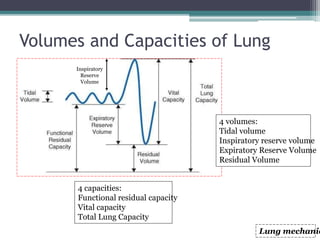
Volumes and Capacities of Lung
4 volumes:
Tidal volume
Inspiratory reserve volume
Expiratory Reserve Volume
Residual Volume
4 capacities:
Functional residual capacity
Vital capacity
Total Lung Capacity
Inspiratory
Reserve
Volume
Lung mechanic
Ventilation
• Total Ventilation
▫ Total volume of air moved in or out of the lungs per
minute
• Alveolar ventilation
▫ Represents room air delivered to the respiratory zone
per minute
• Why the gap??
▫ Anatomic Dead space is the space in the respiratory
system prior to the respiratory zone
*Physiological Dead Space= Anatomic dead space +
Alveolar dead space
Lung Mechanics
• Muscles of Respiration
▫ Inspiration: diaphragm
▫ Expiration: primarily passive process; abdominal
muscles
• Forces acting on Lung System
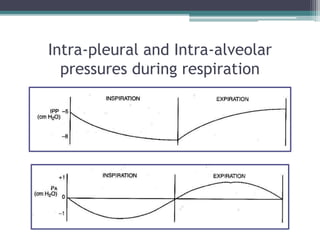
▫ Intra-pleural pressure, Intra-alveolar pressure
▫ Lung Recoil (tissue collagen/elastins, surface
tension: Laplace law)
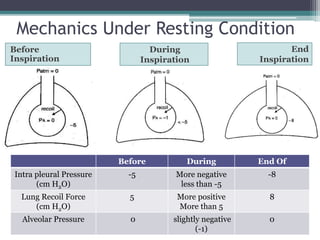
Mechanics Under Resting Condition
During
Inspiration
Before During End Of
Intra pleural Pressure
(cm H2O)
-5 More negative
less than -5
-8
Lung Recoil Force
(cm H2O)
5 More positive
More than 5
8
Alveolar Pressure 0 slightly negative
(-1)
0
Before
Inspiration
End
Inspiration
Expiration??
• Passive process
• Relaxation of inspiratory muscles returns intra-
pleural pressure to -5 cm H2O
• Followed by lung deflation, driven by lung recoil
till it becomes equal to intra-pleural pressure
• Smaller alveoli containing larger amount of
gases: intra-alveolar pressure increases
• Air flows outside and the intra-alveolar pressure
becomes zero.
Intra-pleural and Intra-alveolar
pressures during respiration
Intra-pleural and Intra-alveolar
pressures: Applied Part
• Pneumo-thorax
• Positive Pressure Ventilation
▫ Assisted Control Mode Ventilation
▫ Positive End Expiration Pressure
Lung Recoil
• Tissue Elastins/ Collagens
• Surface Tension: Laplace Law
• Role of Surfactant??
▫ Decrease surface tension
▫ Bias the surface tension
▫ Reduce the chance of pulmonary edema
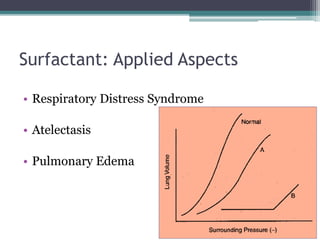
Surfactant: Applied Aspects
• Respiratory Distress Syndrome
• Atelectasis
• Pulmonary Edema
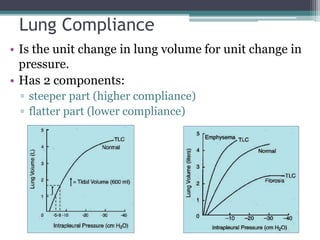
Lung Compliance
• Is the unit change in lung volume for unit change in
pressure.
• Has 2 components:
▫ steeper part (higher compliance)
▫ flatter part (lower compliance)
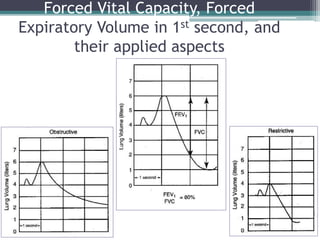
Forced Vital Capacity, Forced
Expiratory Volume in 1st second, and
their applied aspects
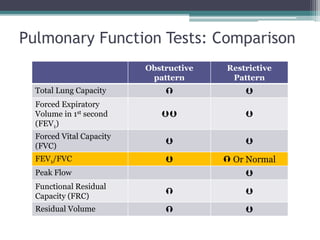
Pulmonary Function Tests: Comparison
Obstructive
pattern
Restrictive
Pattern
Total Lung Capacity  
Forced Expiratory
Volume in 1st second
(FEV1)
 
Forced Vital Capacity
(FVC)
 
FEV1/FVC   Or Normal
Peak Flow 
Functional Residual
Capacity (FRC)
 
Residual Volume  
Respiratory Physiology
Alveolar-Blood Gas Exchange
Alveolar Blood Gas Exchange
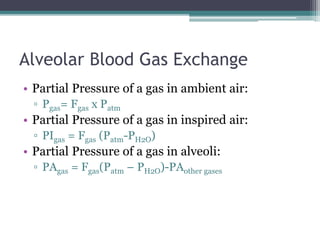
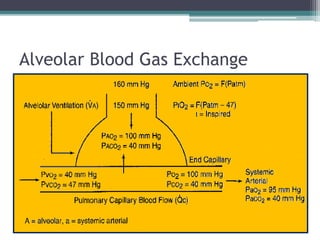
• Partial Pressure of a gas in ambient air:
▫ Pgas= Fgas x Patm
• Partial Pressure of a gas in inspired air:
▫ PIgas = Fgas (Patm-PH2O)
• Partial Pressure of a gas in alveoli:
▫ PAgas = Fgas(Patm – PH2O)-PAother gases
Alveolar Blood Gas Exchange
Factors Affecting Alveolar CO2
Concentration
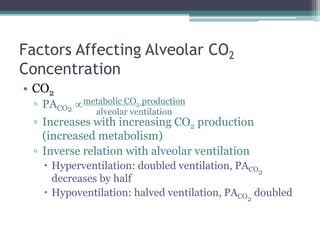
• CO2
▫ PACO2 
▫ Increases with increasing CO2 production
(increased metabolism)
▫ Inverse relation with alveolar ventilation
 Hyperventilation: doubled ventilation, PACO2
decreases by half
 Hypoventilation: halved ventilation, PACO2
doubled
metabolic CO2 production
alveolar ventilation
Factors Affecting Alveolar O2
Concentration
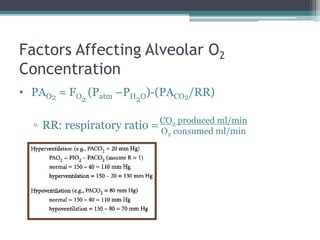
• PAO2 = FO2
(Patm –PH2O)-(PACO2/RR)
▫ RR: respiratory ratio =CO2 produced ml/min
O2 consumed ml/min
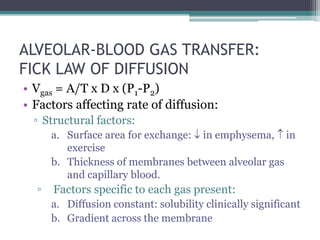
ALVEOLAR-BLOOD GAS TRANSFER:
FICK LAW OF DIFFUSION
• Vgas = A/T x D x (P1-P2)
• Factors affecting rate of diffusion:
▫ Structural factors:
a. Surface area for exchange:  in emphysema,  in
exercise
b. Thickness of membranes between alveolar gas
and capillary blood.
▫ Factors specific to each gas present:
a. Diffusion constant: solubility clinically significant
b. Gradient across the membrane
Respiratory Physiology
Transport of O2 and CO2
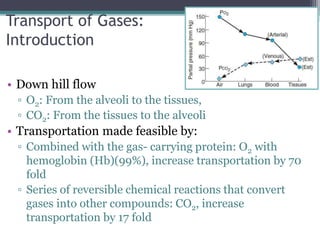
Transport of Gases:
Introduction
• Down hill flow
▫ O2: From the alveoli to the tissues,
▫ CO2: From the tissues to the alveoli
• Transportation made feasible by:
▫ Combined with the gas- carrying protein: O2 with
hemoglobin (Hb)(99%), increase transportation by 70
fold
▫ Series of reversible chemical reactions that convert
gases into other compounds: CO2, increase
transportation by 17 fold
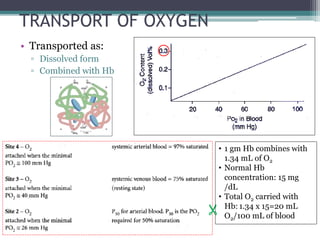
TRANSPORT OF OXYGEN
• Transported as:
▫ Dissolved form
▫ Combined with Hb

• 1 gm Hb combines with
1.34 mL of O2
• Normal Hb
concentration: 15 mg
/dL
• Total O2 carried with
Hb: 1.34 x 15=20 mL
O2/100 mL of blood
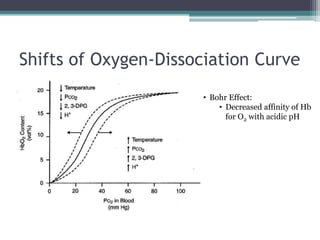
Shifts of Oxygen-Dissociation Curve
• Bohr Effect:
• Decreased affinity of Hb
for O2 with acidic pH
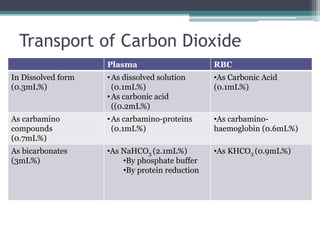
Transport of Carbon Dioxide
Plasma RBC
In Dissolved form
(0.3mL%)
•As dissolved solution
(0.1mL%)
•As carbonic acid
((0.2mL%)
•As Carbonic Acid
(0.1mL%)
As carbamino
compounds
(0.7mL%)
•As carbamino-proteins
(0.1mL%)
•As carbamino-
haemoglobin (0.6mL%)
As bicarbonates
(3mL%)
•As NaHCO3 (2.1mL%)
•By phosphate buffer
•By protein reduction
•As KHCO3 (0.9mL%)
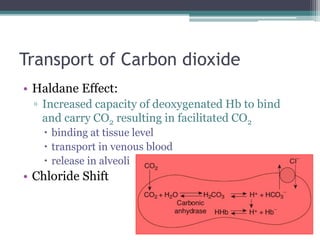
Transport of Carbon dioxide
• Haldane Effect:
▫ Increased capacity of deoxygenated Hb to bind
and carry CO2 resulting in facilitated CO2
 binding at tissue level
 transport in venous blood
 release in alveoli
• Chloride Shift
Respiratory Acidosis and Alkalosis
• Respiratory acidosis:
▫ pH decreases
▫ Increased arterial PCO2
▫ Compensation: excretion of H+ ion and retention
of HCO3
- ions by kidneys
• Respiratory alkalosis:
▫ pH increases
▫ Decreased arterial PCO2
▫ Compensation: retention of H+ ion and excretion
of HCO3
- ions by kidneys
Metabolic Acidosis and Alkalosis
• Metabolic Acidosis:
▫ Decrease in pH
▫ Strong acids added to blood, H+ ions fixed by
generation of H2CO3, dissociates in to H2O and
CO2, CO2 removed by lungs: rapid process
▫ No change in PCO2
▫ Compensation: increased ventilation to remove
PCO2, returning pH to normal
• Metabolic Alkalosis: ??
Respiratory Physiology
Regulation of Respiration
Control Systems
• Neural Control:
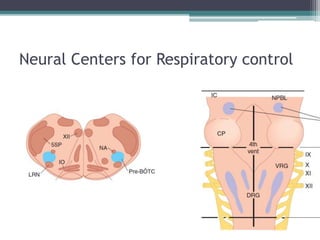
▫ Medullary Control:
 Pre-Botzinger complex (pre-BOTC)
 Rhythmic discharges passed through phrenic nerves
 NK1 receptors and μ-opioid receptors on these neurons:
substance P stimulates and opioids inhibit respiration
 Dorsal and Ventral groups of respiratory neurons
 Efferents to pre-BOTC
▫ Pontine Control:
 Puenmotaxic center (Nucleus parabrachialis, NPBL)
 Inspiratory areas and Expiratory areas
 Afferents from lungs and airways: via vagus nerve.
 Efferents: Medulla
Neural Centers for Respiratory control
Receptors
• Central Chemo-receptors
▫ Stimulated by CSF [H+] and CO2
▫ Adaptation occurs
▫ Insensitive to PO2 and arterial H+
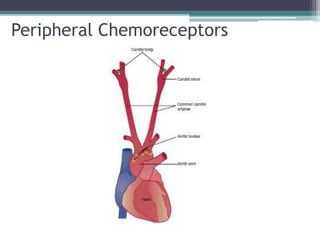
• Peripheral Chemo-receptors
▫ Carotid bodies:
 near carotid sinus, afferents to CN IX
▫ Aortic bodies:
 Aortic arch, afferents to CN X
▫ Contains:
 H+/CO2 receptors: less sensitive, but maintains the normal
drive.
 Po2 receptors: responds to PO2 (dissolved O2) and not to total
oxygen content(bound to Hb).
 Do not contribute to normal drive.
 Activated if PaO2 <50-60 mmHg
▫ Do not adapt.
Peripheral Chemoreceptors
Respiratory Physiology
Hypoxemia
Hypoxia
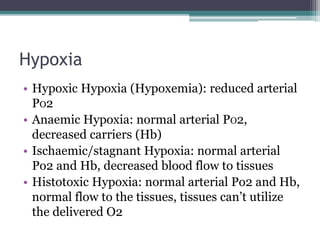
• Hypoxic Hypoxia (Hypoxemia): reduced arterial
PO2
• Anaemic Hypoxia: normal arterial PO2,
decreased carriers (Hb)
• Ischaemic/stagnant Hypoxia: normal arterial
Po2 and Hb, decreased blood flow to tissues
• Histotoxic Hypoxia: normal arterial Po2 and Hb,
normal flow to the tissues, tissues can’t utilize
the delivered O2
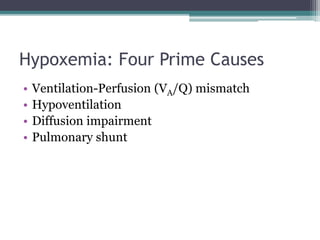
Hypoxemia: Four Prime Causes
• Ventilation-Perfusion (VA/Q) mismatch
• Hypoventilation
• Diffusion impairment
• Pulmonary shunt
Ventilation-Perfusion Mismatch
• Regional Differences in Ventilation
▫ Due to effects of gravity over intra-plueral fluid
column.
• Regional differences in Perfusion
▫ Gravity
▫ Pulmonary artery diameter
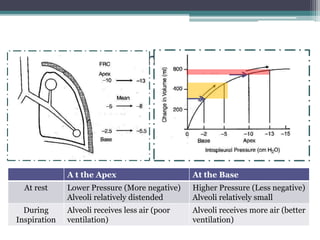
Regional Differences in Ventilation
A t the Apex At the Base
At rest Lower Pressure (More negative)
Alveoli relatively distended
Higher Pressure (Less negative)
Alveoli relatively small
During
Inspiration
Alveoli receives less air (poor
ventilation)
Alveoli receives more air (better
ventilation)
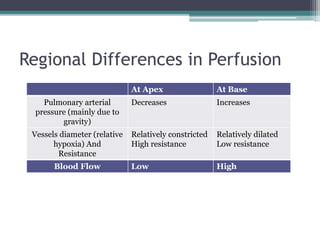
Regional Differences in Perfusion
At Apex At Base
Pulmonary arterial
pressure (mainly due to
gravity)
Decreases Increases
Vessels diameter (relative
hypoxia) And
Resistance
Relatively constricted
High resistance
Relatively dilated
Low resistance
Blood Flow Low High
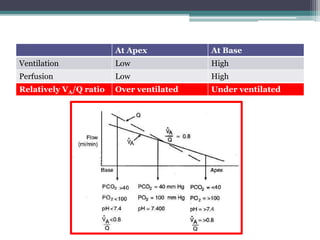
Ventilation-Perfusion Relationships
At Apex At Base
Ventilation Low High
Perfusion Low High
Relatively VA/Q ratio Over ventilated Under ventilated
Hypoventilation
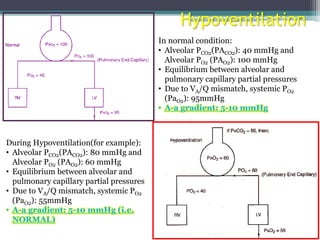
In normal condition:
• Alveolar PCO2(PACO2): 40 mmHg and
Alveolar PO2 (PAO2): 100 mmHg
• Equilibrium between alveolar and
pulmonary capillary partial pressures
• Due to VA/Q mismatch, systemic PO2
(PaO2): 95mmHg
• A-a gradient: 5-10 mmHg
During Hypoventilation(for example):
• Alveolar PCO2(PACO2): 80 mmHg and
Alveolar PO2 (PAO2): 60 mmHg
• Equilibrium between alveolar and
pulmonary capillary partial pressures
• Due to VA/Q mismatch, systemic PO2
(PaO2): 55mmHg
• A-a gradient: 5-10 mmHg (i.e.
NORMAL)
Diffusion Impairment
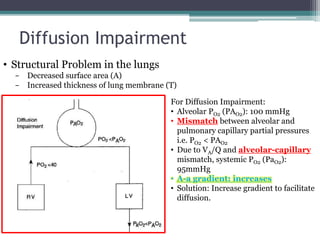
• Structural Problem in the lungs
− Decreased surface area (A)
− Increased thickness of lung membrane (T)
For Diffusion Impairment:
• Alveolar PO2 (PAO2): 100 mmHg
• Mismatch between alveolar and
pulmonary capillary partial pressures
i.e. PO2 < PAO2
• Due to VA/Q and alveolar-capillary
mismatch, systemic PO2 (PaO2):
95mmHg
• A-a gradient: increases
• Solution: Increase gradient to facilitate
diffusion.
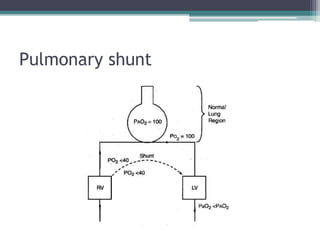
Pulmonary shunt
Respiratory Physiology
Recommendations
Respiratory Physiology
Thank you!!

Respiratory physiology

  • 1.
    Respiratory Physiology Presented by: Dr.Pravin Prasad Medical officer, ED Grande International Hospital Academic Session I Supervisor: Dr. Ajay Singh Thapa Head of Department, ED Grande International Hospital
  • 2.
    Discussion Topics • LungMechanics: 13 slides • Alveolar-Blood Gas Exchange: 5 slides • Transport of O2 and CO2: 4 slides • Regulation of Respiration: 4 slides • Hypoxemia and its types: 8 slides
  • 3.
  • 4.
    Volumes and Capacitiesof Lung 4 volumes: Tidal volume Inspiratory reserve volume Expiratory Reserve Volume Residual Volume 4 capacities: Functional residual capacity Vital capacity Total Lung Capacity Inspiratory Reserve Volume Lung mechanic
  • 5.
    Ventilation • Total Ventilation ▫Total volume of air moved in or out of the lungs per minute • Alveolar ventilation ▫ Represents room air delivered to the respiratory zone per minute • Why the gap?? ▫ Anatomic Dead space is the space in the respiratory system prior to the respiratory zone *Physiological Dead Space= Anatomic dead space + Alveolar dead space
  • 6.
    Lung Mechanics • Musclesof Respiration ▫ Inspiration: diaphragm ▫ Expiration: primarily passive process; abdominal muscles • Forces acting on Lung System ▫ Intra-pleural pressure, Intra-alveolar pressure ▫ Lung Recoil (tissue collagen/elastins, surface tension: Laplace law)
  • 7.
    Mechanics Under RestingCondition During Inspiration Before During End Of Intra pleural Pressure (cm H2O) -5 More negative less than -5 -8 Lung Recoil Force (cm H2O) 5 More positive More than 5 8 Alveolar Pressure 0 slightly negative (-1) 0 Before Inspiration End Inspiration
  • 8.
    Expiration?? • Passive process •Relaxation of inspiratory muscles returns intra- pleural pressure to -5 cm H2O • Followed by lung deflation, driven by lung recoil till it becomes equal to intra-pleural pressure • Smaller alveoli containing larger amount of gases: intra-alveolar pressure increases • Air flows outside and the intra-alveolar pressure becomes zero.
  • 9.
  • 10.
    Intra-pleural and Intra-alveolar pressures:Applied Part • Pneumo-thorax • Positive Pressure Ventilation ▫ Assisted Control Mode Ventilation ▫ Positive End Expiration Pressure
  • 11.
    Lung Recoil • TissueElastins/ Collagens • Surface Tension: Laplace Law • Role of Surfactant?? ▫ Decrease surface tension ▫ Bias the surface tension ▫ Reduce the chance of pulmonary edema
  • 12.
    Surfactant: Applied Aspects •Respiratory Distress Syndrome • Atelectasis • Pulmonary Edema
  • 13.
    Lung Compliance • Isthe unit change in lung volume for unit change in pressure. • Has 2 components: ▫ steeper part (higher compliance) ▫ flatter part (lower compliance)
  • 14.
    Forced Vital Capacity,Forced Expiratory Volume in 1st second, and their applied aspects
  • 15.
    Pulmonary Function Tests:Comparison Obstructive pattern Restrictive Pattern Total Lung Capacity   Forced Expiratory Volume in 1st second (FEV1)   Forced Vital Capacity (FVC)   FEV1/FVC   Or Normal Peak Flow  Functional Residual Capacity (FRC)   Residual Volume  
  • 16.
  • 17.
    Alveolar Blood GasExchange • Partial Pressure of a gas in ambient air: ▫ Pgas= Fgas x Patm • Partial Pressure of a gas in inspired air: ▫ PIgas = Fgas (Patm-PH2O) • Partial Pressure of a gas in alveoli: ▫ PAgas = Fgas(Patm – PH2O)-PAother gases
  • 18.
  • 19.
    Factors Affecting AlveolarCO2 Concentration • CO2 ▫ PACO2  ▫ Increases with increasing CO2 production (increased metabolism) ▫ Inverse relation with alveolar ventilation  Hyperventilation: doubled ventilation, PACO2 decreases by half  Hypoventilation: halved ventilation, PACO2 doubled metabolic CO2 production alveolar ventilation
  • 20.
    Factors Affecting AlveolarO2 Concentration • PAO2 = FO2 (Patm –PH2O)-(PACO2/RR) ▫ RR: respiratory ratio =CO2 produced ml/min O2 consumed ml/min
  • 21.
    ALVEOLAR-BLOOD GAS TRANSFER: FICKLAW OF DIFFUSION • Vgas = A/T x D x (P1-P2) • Factors affecting rate of diffusion: ▫ Structural factors: a. Surface area for exchange:  in emphysema,  in exercise b. Thickness of membranes between alveolar gas and capillary blood. ▫ Factors specific to each gas present: a. Diffusion constant: solubility clinically significant b. Gradient across the membrane
  • 22.
  • 23.
    Transport of Gases: Introduction •Down hill flow ▫ O2: From the alveoli to the tissues, ▫ CO2: From the tissues to the alveoli • Transportation made feasible by: ▫ Combined with the gas- carrying protein: O2 with hemoglobin (Hb)(99%), increase transportation by 70 fold ▫ Series of reversible chemical reactions that convert gases into other compounds: CO2, increase transportation by 17 fold
  • 24.
    TRANSPORT OF OXYGEN •Transported as: ▫ Dissolved form ▫ Combined with Hb  • 1 gm Hb combines with 1.34 mL of O2 • Normal Hb concentration: 15 mg /dL • Total O2 carried with Hb: 1.34 x 15=20 mL O2/100 mL of blood
  • 25.
    Shifts of Oxygen-DissociationCurve • Bohr Effect: • Decreased affinity of Hb for O2 with acidic pH
  • 26.
    Transport of CarbonDioxide Plasma RBC In Dissolved form (0.3mL%) •As dissolved solution (0.1mL%) •As carbonic acid ((0.2mL%) •As Carbonic Acid (0.1mL%) As carbamino compounds (0.7mL%) •As carbamino-proteins (0.1mL%) •As carbamino- haemoglobin (0.6mL%) As bicarbonates (3mL%) •As NaHCO3 (2.1mL%) •By phosphate buffer •By protein reduction •As KHCO3 (0.9mL%)
  • 27.
    Transport of Carbondioxide • Haldane Effect: ▫ Increased capacity of deoxygenated Hb to bind and carry CO2 resulting in facilitated CO2  binding at tissue level  transport in venous blood  release in alveoli • Chloride Shift
  • 28.
    Respiratory Acidosis andAlkalosis • Respiratory acidosis: ▫ pH decreases ▫ Increased arterial PCO2 ▫ Compensation: excretion of H+ ion and retention of HCO3 - ions by kidneys • Respiratory alkalosis: ▫ pH increases ▫ Decreased arterial PCO2 ▫ Compensation: retention of H+ ion and excretion of HCO3 - ions by kidneys
  • 29.
    Metabolic Acidosis andAlkalosis • Metabolic Acidosis: ▫ Decrease in pH ▫ Strong acids added to blood, H+ ions fixed by generation of H2CO3, dissociates in to H2O and CO2, CO2 removed by lungs: rapid process ▫ No change in PCO2 ▫ Compensation: increased ventilation to remove PCO2, returning pH to normal • Metabolic Alkalosis: ??
  • 30.
  • 31.
    Control Systems • NeuralControl: ▫ Medullary Control:  Pre-Botzinger complex (pre-BOTC)  Rhythmic discharges passed through phrenic nerves  NK1 receptors and μ-opioid receptors on these neurons: substance P stimulates and opioids inhibit respiration  Dorsal and Ventral groups of respiratory neurons  Efferents to pre-BOTC ▫ Pontine Control:  Puenmotaxic center (Nucleus parabrachialis, NPBL)  Inspiratory areas and Expiratory areas  Afferents from lungs and airways: via vagus nerve.  Efferents: Medulla
  • 32.
    Neural Centers forRespiratory control
  • 33.
    Receptors • Central Chemo-receptors ▫Stimulated by CSF [H+] and CO2 ▫ Adaptation occurs ▫ Insensitive to PO2 and arterial H+ • Peripheral Chemo-receptors ▫ Carotid bodies:  near carotid sinus, afferents to CN IX ▫ Aortic bodies:  Aortic arch, afferents to CN X ▫ Contains:  H+/CO2 receptors: less sensitive, but maintains the normal drive.  Po2 receptors: responds to PO2 (dissolved O2) and not to total oxygen content(bound to Hb).  Do not contribute to normal drive.  Activated if PaO2 <50-60 mmHg ▫ Do not adapt.
  • 34.
  • 35.
  • 36.
    Hypoxia • Hypoxic Hypoxia(Hypoxemia): reduced arterial PO2 • Anaemic Hypoxia: normal arterial PO2, decreased carriers (Hb) • Ischaemic/stagnant Hypoxia: normal arterial Po2 and Hb, decreased blood flow to tissues • Histotoxic Hypoxia: normal arterial Po2 and Hb, normal flow to the tissues, tissues can’t utilize the delivered O2
  • 37.
    Hypoxemia: Four PrimeCauses • Ventilation-Perfusion (VA/Q) mismatch • Hypoventilation • Diffusion impairment • Pulmonary shunt
  • 38.
    Ventilation-Perfusion Mismatch • RegionalDifferences in Ventilation ▫ Due to effects of gravity over intra-plueral fluid column. • Regional differences in Perfusion ▫ Gravity ▫ Pulmonary artery diameter
  • 39.
    Regional Differences inVentilation A t the Apex At the Base At rest Lower Pressure (More negative) Alveoli relatively distended Higher Pressure (Less negative) Alveoli relatively small During Inspiration Alveoli receives less air (poor ventilation) Alveoli receives more air (better ventilation)
  • 40.
    Regional Differences inPerfusion At Apex At Base Pulmonary arterial pressure (mainly due to gravity) Decreases Increases Vessels diameter (relative hypoxia) And Resistance Relatively constricted High resistance Relatively dilated Low resistance Blood Flow Low High
  • 41.
    Ventilation-Perfusion Relationships At ApexAt Base Ventilation Low High Perfusion Low High Relatively VA/Q ratio Over ventilated Under ventilated
  • 42.
    Hypoventilation In normal condition: •Alveolar PCO2(PACO2): 40 mmHg and Alveolar PO2 (PAO2): 100 mmHg • Equilibrium between alveolar and pulmonary capillary partial pressures • Due to VA/Q mismatch, systemic PO2 (PaO2): 95mmHg • A-a gradient: 5-10 mmHg During Hypoventilation(for example): • Alveolar PCO2(PACO2): 80 mmHg and Alveolar PO2 (PAO2): 60 mmHg • Equilibrium between alveolar and pulmonary capillary partial pressures • Due to VA/Q mismatch, systemic PO2 (PaO2): 55mmHg • A-a gradient: 5-10 mmHg (i.e. NORMAL)
  • 43.
    Diffusion Impairment • StructuralProblem in the lungs − Decreased surface area (A) − Increased thickness of lung membrane (T) For Diffusion Impairment: • Alveolar PO2 (PAO2): 100 mmHg • Mismatch between alveolar and pulmonary capillary partial pressures i.e. PO2 < PAO2 • Due to VA/Q and alveolar-capillary mismatch, systemic PO2 (PaO2): 95mmHg • A-a gradient: increases • Solution: Increase gradient to facilitate diffusion.
  • 44.
  • 45.
  • 46.