Physiology of ventilation &
work of breathing

Puneet Malhotra
Dept. of Pulmonary Med, PGIMER
20.03.04
Goals of respiration
1.Ventilation
2.Diffusion of O2 & CO2
3.Transport of O2 & CO2
4.Regulation of respiration
Ventilation
• Movement of air in & out of lungs
the airways
respiratory muscles
dead space ventilation
• Measurement of ventilation
• The work of breathing
• Importance in the ICU
Movement of air in & out of lungs
The airways

Anatomic dead space
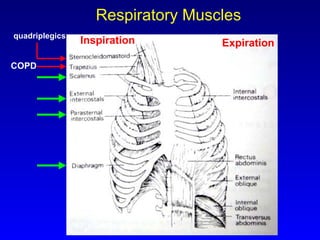
Respiratory Muscles
quadriplegics

COPD

Inspiration

Expiration
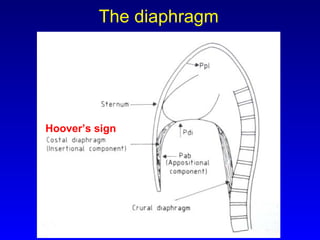
The diaphragm

Hoover’s sign
Effect of posture on respiratory muscles
Upright: FRC

Supine: FRC

Lateral:
The pressures
• Pressure differences > airflow
• Ppl precede Palv
• Palv and air flow in phase
• At points of no flow Palv = 0
Dead space ventilation
• 3 types
• Anatomic dead space
1ml/lb ideal body wt., 150 ml/500ml VT
VT- anat dead space/VT ratio
e.g.150/500=30%, 150/300=50%

can gas exchange occur if pt. is
ventilated with VT< anat dead space?
Yes:
high freq
ventilation

VA = f x [VT - VD]
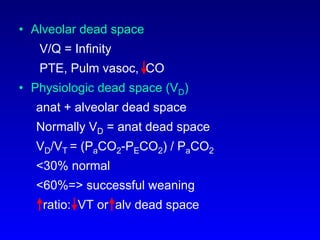
• Alveolar dead space
V/Q = Infinity
PTE, Pulm vasoc, CO
• Physiologic dead space (VD)
anat + alveolar dead space
Normally VD = anat dead space
VD/VT = (PaCO2-PECO2) / PaCO2
<30% normal
<60%=> successful weaning
ratio: VT or alv dead space
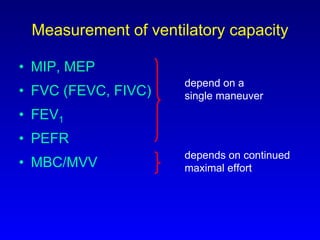
Measurement of ventilatory capacity
• MIP, MEP
• FVC (FEVC, FIVC)

depend on a
single maneuver

• FEV1
• PEFR
• MBC/MVV

depends on continued
maximal effort
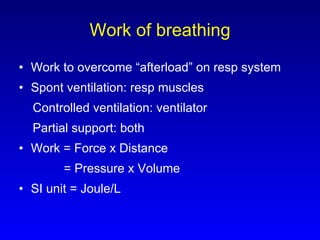
Work of breathing
• Work to overcome “afterload” on resp system
• Spont ventilation: resp muscles
Controlled ventilation: ventilator
Partial support: both
• Work = Force x Distance
= Pressure x Volume
• SI unit = Joule/L
Normally work is performed only for inspiration
Divided into 2 fractions

0.5L

E

Rel

v

I

5

TranspulmP

Raw

10cm H2O
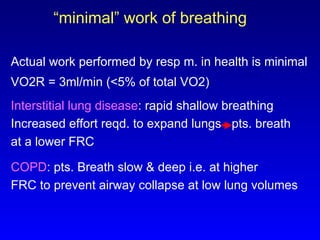
“minimal” work of breathing
Actual work performed by resp m. in health is minimal
VO2R = 3ml/min (<5% of total VO2)
Interstitial lung disease: rapid shallow breathing
Increased effort reqd. to expand lungs pts. breath
at a lower FRC
COPD: pts. Breath slow & deep i.e. at higher
FRC to prevent airway collapse at low lung volumes
Importance in the ICU
• Measurement of WOB in ICU not routine
• Until recently performed by physiologists>clinicians
• Most ICU pts. are extubated < 96 hrs using standard
weaning criteria
• “advantages” of measuring WOB
ensure pt.-vent synchrony
aid to weaning
comparison of diff. modes of MV
Measurement of WOB in ICU
2 ways:
a) Determination of O2 cost of breathing
b) Measurement of mechanical WOB
a) O2 cost of breathing
Total VO2 – VO2 during spont breathing
[ VO2 = CO X (CaO2-CVO2) ]
drawbacks:
in ICU O2 COB may represent small % of VO2
VO2 itself influenced by many other factors
b) Measurement of mechanical WOB
• 2 ways
a) Graphics
Paw tracings
P/V curves
b) Pressure time product
Paw tracings
P/V curves
Example 1
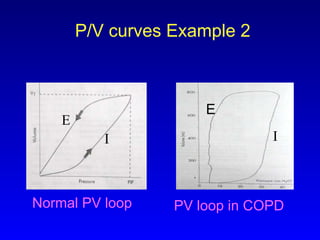
P/V curves Example 2

E

E
I

Normal PV loop

I

PV loop in COPD
P/V curves Example 3

E
Pt. effort to trigger
ventilator

Solution: increase
trigger sensitivity

I
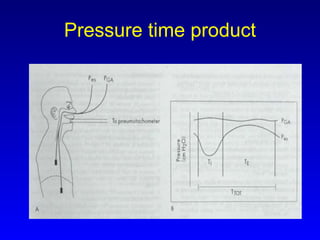
Pressure time product
Pressure time product (contd.)
• Work = P.dV
• Underestimates isometric work i.e. resp m. work
which consumes O2 but doesn’t result in dV e.g.
against PEEPi
• Under heavy loading conditions e.g. ARDS PTP
correlates better with fatigue potential
• Pressure time index = P/Pmax x Ti/Ttot
>0.15 => fatigue
WOB measurement at the bedside
• Bicore CP-100 Pulmonary Monitor
• Automated measurement of
VA, Pulm mechanics
WOBv and WOBp
Respiratory drive
• Oesophageal balloon, pnemotachograph

Pneumology - Ventilation physiology-and-work-of-breathing

  • 1.
    Physiology of ventilation& work of breathing Puneet Malhotra Dept. of Pulmonary Med, PGIMER 20.03.04
  • 2.
    Goals of respiration 1.Ventilation 2.Diffusionof O2 & CO2 3.Transport of O2 & CO2 4.Regulation of respiration
  • 3.
    Ventilation • Movement ofair in & out of lungs the airways respiratory muscles dead space ventilation • Measurement of ventilation • The work of breathing • Importance in the ICU
  • 4.
    Movement of airin & out of lungs The airways Anatomic dead space
  • 5.
  • 6.
  • 7.
    Effect of postureon respiratory muscles Upright: FRC Supine: FRC Lateral:
  • 8.
    The pressures • Pressuredifferences > airflow • Ppl precede Palv • Palv and air flow in phase • At points of no flow Palv = 0
  • 9.
    Dead space ventilation •3 types • Anatomic dead space 1ml/lb ideal body wt., 150 ml/500ml VT VT- anat dead space/VT ratio e.g.150/500=30%, 150/300=50% can gas exchange occur if pt. is ventilated with VT< anat dead space?
  • 10.
  • 11.
    • Alveolar deadspace V/Q = Infinity PTE, Pulm vasoc, CO • Physiologic dead space (VD) anat + alveolar dead space Normally VD = anat dead space VD/VT = (PaCO2-PECO2) / PaCO2 <30% normal <60%=> successful weaning ratio: VT or alv dead space
  • 12.
    Measurement of ventilatorycapacity • MIP, MEP • FVC (FEVC, FIVC) depend on a single maneuver • FEV1 • PEFR • MBC/MVV depends on continued maximal effort
  • 13.
    Work of breathing •Work to overcome “afterload” on resp system • Spont ventilation: resp muscles Controlled ventilation: ventilator Partial support: both • Work = Force x Distance = Pressure x Volume • SI unit = Joule/L
  • 14.
    Normally work isperformed only for inspiration Divided into 2 fractions 0.5L E Rel v I 5 TranspulmP Raw 10cm H2O
  • 15.
    “minimal” work ofbreathing Actual work performed by resp m. in health is minimal VO2R = 3ml/min (<5% of total VO2) Interstitial lung disease: rapid shallow breathing Increased effort reqd. to expand lungs pts. breath at a lower FRC COPD: pts. Breath slow & deep i.e. at higher FRC to prevent airway collapse at low lung volumes
  • 16.
    Importance in theICU • Measurement of WOB in ICU not routine • Until recently performed by physiologists>clinicians • Most ICU pts. are extubated < 96 hrs using standard weaning criteria • “advantages” of measuring WOB ensure pt.-vent synchrony aid to weaning comparison of diff. modes of MV
  • 17.
    Measurement of WOBin ICU 2 ways: a) Determination of O2 cost of breathing b) Measurement of mechanical WOB a) O2 cost of breathing Total VO2 – VO2 during spont breathing [ VO2 = CO X (CaO2-CVO2) ] drawbacks: in ICU O2 COB may represent small % of VO2 VO2 itself influenced by many other factors
  • 18.
    b) Measurement ofmechanical WOB • 2 ways a) Graphics Paw tracings P/V curves b) Pressure time product
  • 19.
  • 20.
  • 21.
    P/V curves Example2 E E I Normal PV loop I PV loop in COPD
  • 22.
    P/V curves Example3 E Pt. effort to trigger ventilator Solution: increase trigger sensitivity I
  • 23.
  • 24.
    Pressure time product(contd.) • Work = P.dV • Underestimates isometric work i.e. resp m. work which consumes O2 but doesn’t result in dV e.g. against PEEPi • Under heavy loading conditions e.g. ARDS PTP correlates better with fatigue potential • Pressure time index = P/Pmax x Ti/Ttot >0.15 => fatigue
  • 25.
    WOB measurement atthe bedside • Bicore CP-100 Pulmonary Monitor • Automated measurement of VA, Pulm mechanics WOBv and WOBp Respiratory drive • Oesophageal balloon, pnemotachograph