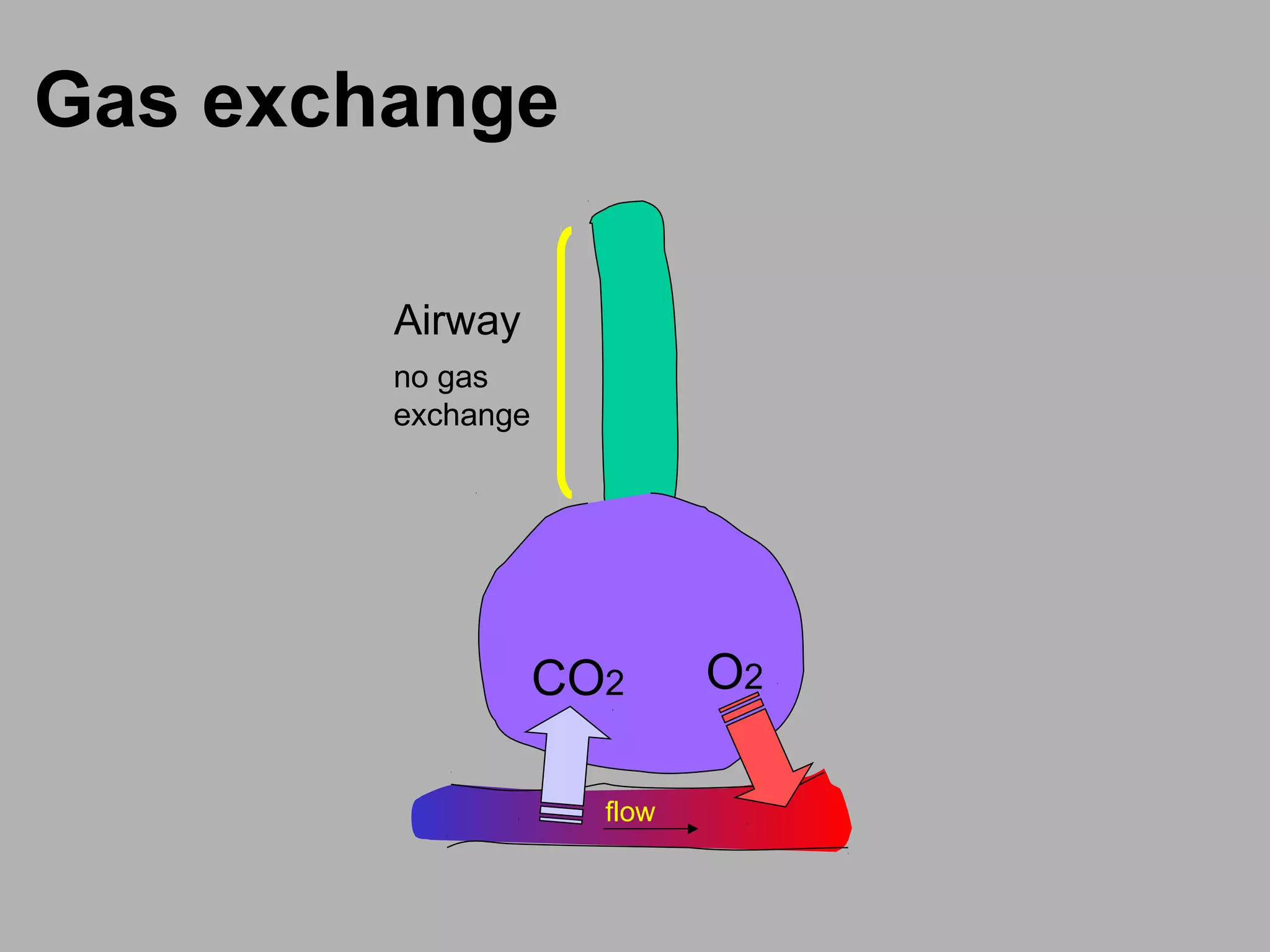
Gas exchange
Airway
flow
CO2 O2
no gas
exchange
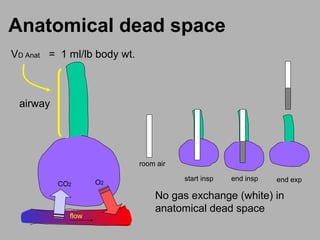
Anatomical dead space
VD Anat = 1 ml/lb body wt.
airway
start insp end insp end exp
room air
No gas exchange (white) in
anatomical dead space
flow
CO2 O2
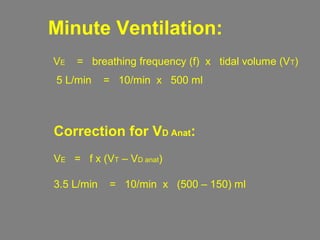
Minute Ventilation:
VE = breathing frequency (f) x tidal volume (VT)
5 L/min = 10/min x 500 ml
Correction for VD Anat:
VE = f x (VT – VD anat)
3.5 L/min = 10/min x (500 – 150) ml
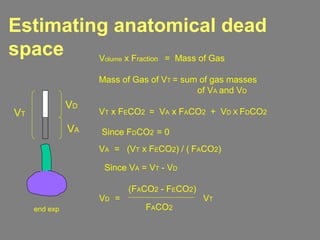
Estimating anatomical dead
space
VT x FECO2 = VA x FACO2 + VD X FDCO2
Volume x Fraction = Mass of Gas
Mass of Gas of VT = sum of gas masses
of VA and VD
end exp
VT
VD
VA Since FDCO2 = 0
VA = (VT x FECO2) / ( FACO2)
Since VA = VT - VD
VD =
(FACO2 - FECO2)
FACO2
VT
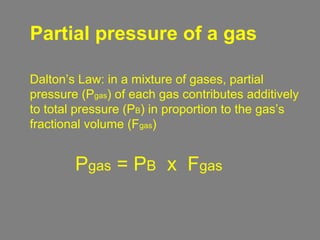
Partial pressure of a gas
Pgas = PB x Fgas
Dalton’s Law: in a mixture of gases, partial
pressure (Pgas) of each gas contributes additively
to total pressure (PB) in proportion to the gas’s
fractional volume (Fgas)
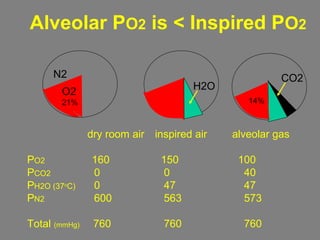
dry room air inspired air alveolar gas
PO2 160 150 100
PCO2 0 0 40
PH2O (37o
C) 0 47 47
PN2 600 563 573
Total (mmHg) 760 760 760
N2
O2
21%
H2O
14%
CO2
Alveolar PO2 is < Inspired PO2
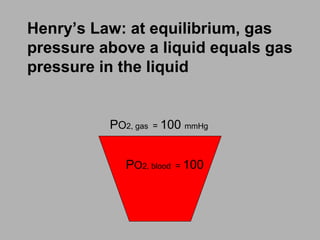
Henry’s Law: at equilibrium, gas
pressure above a liquid equals gas
pressure in the liquid
PO2, gas = 100 mmHg
PO2, blood = 100
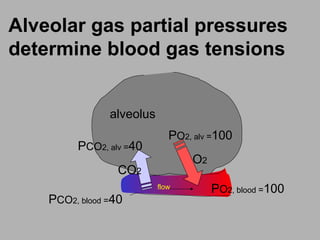
Alveolar gas partial pressures
determine blood gas tensions
flow
CO2
O2
PCO2, blood =40
PCO2, alv =40
PO2, alv =100
PO2, blood =100
alveolus
Blood gas tension determines
blood gas content
Concentration of gas dissolved per
liter of blood (C) depends on gas
solubility (α) and Pgas in blood
CO2 = α x PO2, blood
CO2 = 0.03 x 100
= 3 ml O2/liter of blood
= 0.3 ml O2/100ml of blood
α, Solubility coefficient
(ml O2/[liter.mmHg])
Dissolved gas
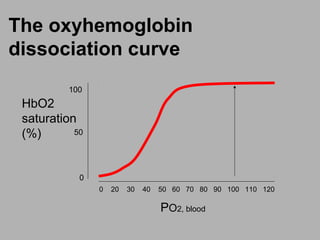
The oxyhemoglobin
dissociation curve
0 20 30 40 50 60 70 80 90 100 110 120
100
50
0
PO2, blood
HbO2
saturation
(%)
The O2 carrying capacity of blood
= Hgb-bound O2 + dissolved O2
PO2, alv
O2 content in 1 liter of blood at PO2, blood of 100 mmHg
= (HgbO2 sat [%] x 1.34 x [Hgb]) + (.03 x PO2, blood)
= (0.98 x 1.34 x 150 [g/l]) + 3
= 200 ml O2/liter of blood
HgbO2 saturation = 1.34 ml at 100%PO2, blood
dissolved O2 in blood
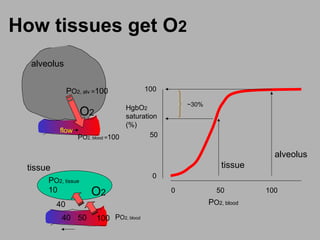
How tissues get O2
flow
O2
PO2, alv =100
alveolus
O2
PO2, tissue
10
PO2, blood =100
PO2, blood
40
10040 50
tissue
alveolus
tissue
0 50 100
100
50
0
~30%
PO2, blood
HgbO2
saturation
(%)
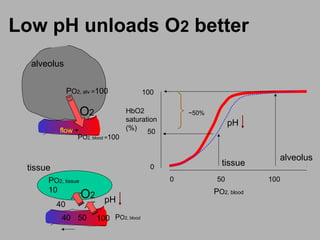
Low pH unloads O2 better
flow
O2
PO2, alv =100
alveolus
O2
PO2, tissue
10
PO2, blood =100
PO2, blood
40
10040 50
tissue
alveolus
0 50 100
100
50
0
~50%
tissue
PO2, blood
HbO2
saturation
(%)
pH
pH
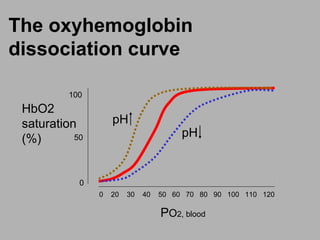
The oxyhemoglobin
dissociation curve
0 20 30 40 50 60 70 80 90 100 110 120
100
50
0
PO2, blood
HbO2
saturation
(%) pH
pH
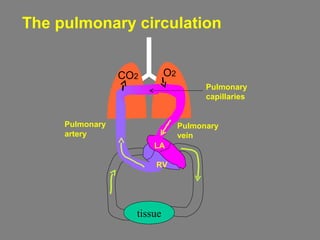
The pulmonary circulation
tissue
CO2 O2
Pulmonary
artery
RV
LA
Pulmonary
vein
Pulmonary
capillaries
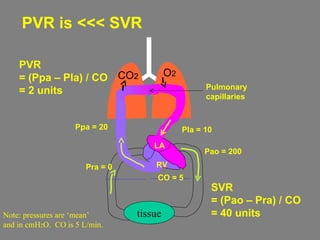
PVR
= (Ppa – Pla) / CO
= 2 units
tissue
CO2 O2
Ppa = 20
RV
LA
Pulmonary
capillaries
Note: pressures are ‘mean’
and in cmH2O. CO is 5 L/min.
Pla = 10
Pao = 200
SVR
= (Pao – Pra) / CO
= 40 units
Pra = 0
CO = 5
PVR is <<< SVR
The lung has low vascular resistance
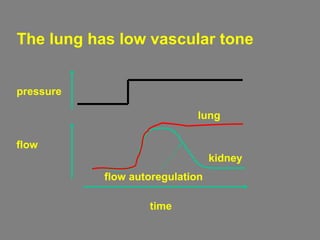
The lung has low vascular tone
pressure
flow
kidney
lung
flow autoregulation
time
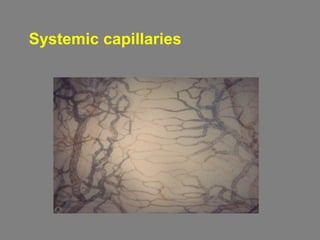
Systemic capillaries
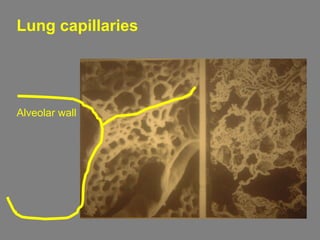
Alveolar wall
Lung capillaries
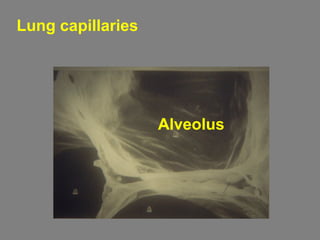
Lung capillaries
Alveolus
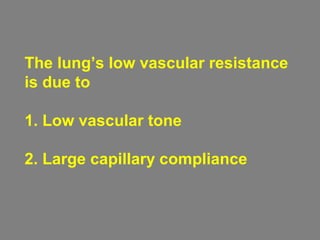
The lung’s low vascular resistance
is due to
1. Low vascular tone
2. Large capillary compliance
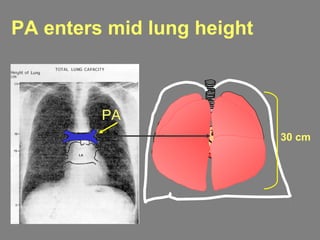
PA enters mid lung height
30 cm
PA
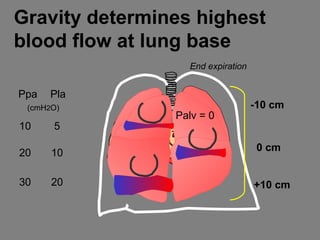
Gravity determines highest
blood flow at lung base
0 cm
End expiration
+10 cm
-10 cm
Ppa Pla
(cmH2O)
10 5
20 10
30 20
Palv = 0
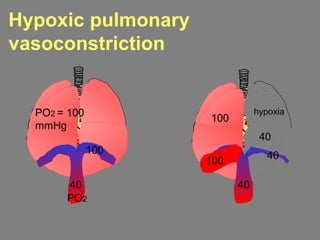
Hypoxic pulmonary
vasoconstriction
PO2 = 100
mmHg
100
40
40
100
100
40
40
PO2
hypoxia
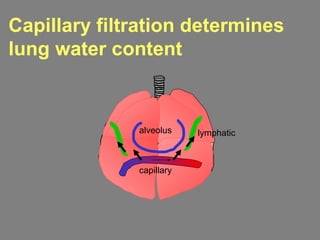
Capillary filtration determines
lung water content
alveolus lymphatic
capillary
The Starling equation
describes capillary filtration
FR = Lp x S [ (Pc – Pi) – σ (Πc – Πi) ]
FR filtration rate
S capillary surface area
Pc capillary pressure
Pi interstitial pressure
σ reflection coefficient
Πc plasma colloid osmotic pressure
Πi interstitial colloid osmotic pressure
alveolus
Pc
Pi
Πc
Πi
PA Capillary
bed
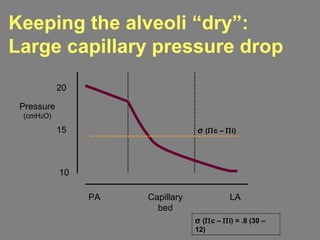
LA
20
10
15
σ (Πc – Πi) = .8 (30 –
12)
σ (Πc – Πi)
Pressure
(cmH2O)
Keeping the alveoli “dry”:
Large capillary pressure drop
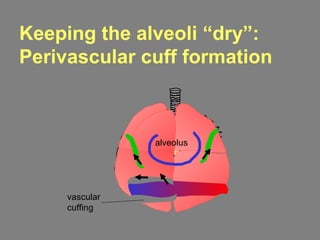
alveolus
vascular
cuffing
Keeping the alveoli “dry”:
Perivascular cuff formation
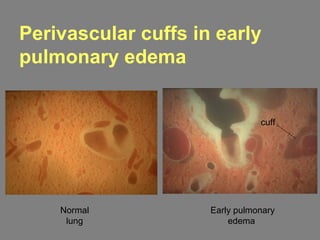
Normal
lung
Early pulmonary
edema
Perivascular cuffs in early
pulmonary edema
cuff
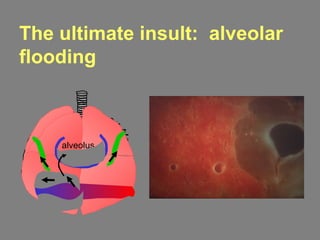
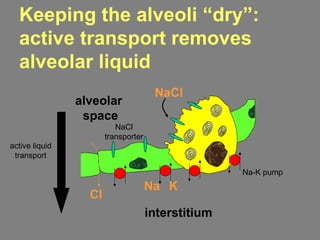
The ultimate insult: alveolar
flooding
alveolus
alveolar
space
interstitium
NaCl
Na K
Cl
Keeping the alveoli “dry”:
active transport removes
alveolar liquid
active liquid
transport
Na-K pump
NaCl
transporter
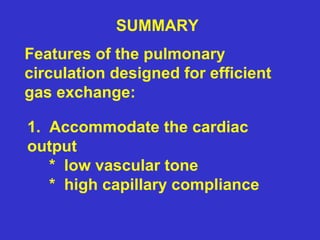
SUMMARY
Features of the pulmonary
circulation designed for efficient
gas exchange:
1. Accommodate the cardiac
output
* low vascular tone
* high capillary compliance
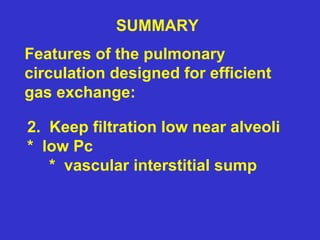
SUMMARY
Features of the pulmonary
circulation designed for efficient
gas exchange:
2. Keep filtration low near alveoli
* low Pc
* vascular interstitial sump
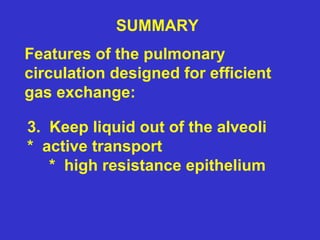
SUMMARY
Features of the pulmonary
circulation designed for efficient
gas exchange:
3. Keep liquid out of the alveoli
* active transport
* high resistance epithelium
Control of Breathing
Central neurons determine minute
ventilation (VE) by regulating tidal
volume (VT) and breathing
frequency (f).
VE = VT x f
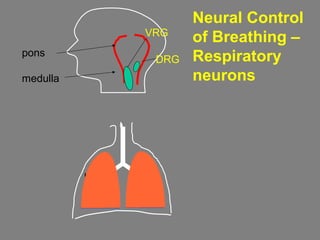
DRG
VRG
pons
medulla
Neural Control
of Breathing –
Respiratory
neurons
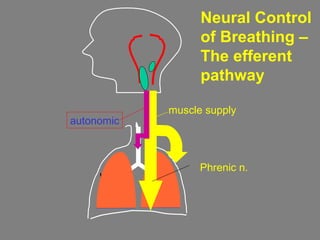
Neural Control
of Breathing –
The efferent
pathway
Phrenic n.
muscle supply
autonomic
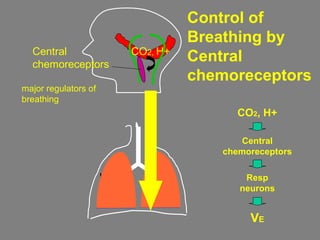
CO2, H+
Control of
Breathing by
Central
chemoreceptors
Central
chemoreceptors
major regulators of
breathing
CO2, H+
Central
chemoreceptors
Resp
neurons
VE
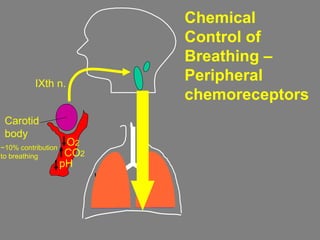
Carotid
body
O2
Chemical
Control of
Breathing –
Peripheral
chemoreceptors
IXth n.
CO2
pH
~10% contribution
to breathing
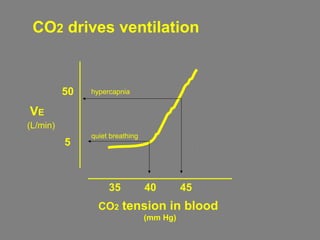
CO2 tension in blood
(mm Hg)
35 40 45
VE
5
50
(L/min)
quiet breathing
hypercapnia
CO2 drives ventilation
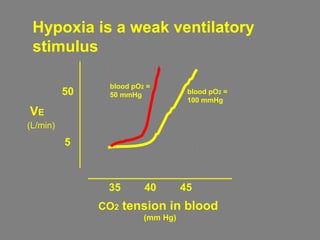
CO2 tension in blood
(mm Hg)
35 40 45
VE
5
50
(L/min)
Hypoxia is a weak ventilatory
stimulus
blood pO2 =
100 mmHg
blood pO2 =
50 mmHg
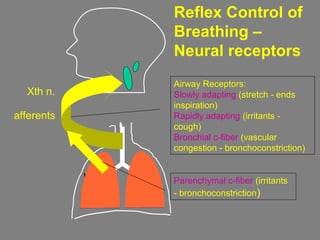
Airway Receptors:
Slowly adapting (stretch - ends
inspiration)
Rapidly adapting (irritants -
cough)
Bronchial c-fiber (vascular
congestion - bronchoconstriction)
Parenchymal c-fiber (irritants
- bronchoconstriction)
Xth n.
Reflex Control of
Breathing –
Neural receptors
afferents

Pul circulation

  • 1.
  • 2.
    Anatomical dead space VDAnat = 1 ml/lb body wt. airway start insp end insp end exp room air No gas exchange (white) in anatomical dead space flow CO2 O2
  • 3.
    Minute Ventilation: VE =breathing frequency (f) x tidal volume (VT) 5 L/min = 10/min x 500 ml Correction for VD Anat: VE = f x (VT – VD anat) 3.5 L/min = 10/min x (500 – 150) ml
  • 4.
    Estimating anatomical dead space VTx FECO2 = VA x FACO2 + VD X FDCO2 Volume x Fraction = Mass of Gas Mass of Gas of VT = sum of gas masses of VA and VD end exp VT VD VA Since FDCO2 = 0 VA = (VT x FECO2) / ( FACO2) Since VA = VT - VD VD = (FACO2 - FECO2) FACO2 VT
  • 5.
    Partial pressure ofa gas Pgas = PB x Fgas Dalton’s Law: in a mixture of gases, partial pressure (Pgas) of each gas contributes additively to total pressure (PB) in proportion to the gas’s fractional volume (Fgas)
  • 6.
    dry room airinspired air alveolar gas PO2 160 150 100 PCO2 0 0 40 PH2O (37o C) 0 47 47 PN2 600 563 573 Total (mmHg) 760 760 760 N2 O2 21% H2O 14% CO2 Alveolar PO2 is < Inspired PO2
  • 7.
    Henry’s Law: atequilibrium, gas pressure above a liquid equals gas pressure in the liquid PO2, gas = 100 mmHg PO2, blood = 100
  • 8.
    Alveolar gas partialpressures determine blood gas tensions flow CO2 O2 PCO2, blood =40 PCO2, alv =40 PO2, alv =100 PO2, blood =100 alveolus
  • 9.
    Blood gas tensiondetermines blood gas content Concentration of gas dissolved per liter of blood (C) depends on gas solubility (α) and Pgas in blood CO2 = α x PO2, blood CO2 = 0.03 x 100 = 3 ml O2/liter of blood = 0.3 ml O2/100ml of blood α, Solubility coefficient (ml O2/[liter.mmHg]) Dissolved gas
  • 10.
    The oxyhemoglobin dissociation curve 020 30 40 50 60 70 80 90 100 110 120 100 50 0 PO2, blood HbO2 saturation (%)
  • 11.
    The O2 carryingcapacity of blood = Hgb-bound O2 + dissolved O2 PO2, alv O2 content in 1 liter of blood at PO2, blood of 100 mmHg = (HgbO2 sat [%] x 1.34 x [Hgb]) + (.03 x PO2, blood) = (0.98 x 1.34 x 150 [g/l]) + 3 = 200 ml O2/liter of blood HgbO2 saturation = 1.34 ml at 100%PO2, blood dissolved O2 in blood
  • 12.
    How tissues getO2 flow O2 PO2, alv =100 alveolus O2 PO2, tissue 10 PO2, blood =100 PO2, blood 40 10040 50 tissue alveolus tissue 0 50 100 100 50 0 ~30% PO2, blood HgbO2 saturation (%)
  • 13.
    Low pH unloadsO2 better flow O2 PO2, alv =100 alveolus O2 PO2, tissue 10 PO2, blood =100 PO2, blood 40 10040 50 tissue alveolus 0 50 100 100 50 0 ~50% tissue PO2, blood HbO2 saturation (%) pH pH
  • 14.
    The oxyhemoglobin dissociation curve 020 30 40 50 60 70 80 90 100 110 120 100 50 0 PO2, blood HbO2 saturation (%) pH pH
  • 15.
    The pulmonary circulation tissue CO2O2 Pulmonary artery RV LA Pulmonary vein Pulmonary capillaries
  • 16.
    PVR = (Ppa –Pla) / CO = 2 units tissue CO2 O2 Ppa = 20 RV LA Pulmonary capillaries Note: pressures are ‘mean’ and in cmH2O. CO is 5 L/min. Pla = 10 Pao = 200 SVR = (Pao – Pra) / CO = 40 units Pra = 0 CO = 5 PVR is <<< SVR
  • 17.
    The lung haslow vascular resistance
  • 18.
    The lung haslow vascular tone pressure flow kidney lung flow autoregulation time
  • 19.
  • 20.
  • 21.
  • 22.
    The lung’s lowvascular resistance is due to 1. Low vascular tone 2. Large capillary compliance
  • 23.
    PA enters midlung height 30 cm PA
  • 24.
    Gravity determines highest bloodflow at lung base 0 cm End expiration +10 cm -10 cm Ppa Pla (cmH2O) 10 5 20 10 30 20 Palv = 0
  • 25.
    Hypoxic pulmonary vasoconstriction PO2 =100 mmHg 100 40 40 100 100 40 40 PO2 hypoxia
  • 26.
    Capillary filtration determines lungwater content alveolus lymphatic capillary
  • 27.
    The Starling equation describescapillary filtration FR = Lp x S [ (Pc – Pi) – σ (Πc – Πi) ] FR filtration rate S capillary surface area Pc capillary pressure Pi interstitial pressure σ reflection coefficient Πc plasma colloid osmotic pressure Πi interstitial colloid osmotic pressure alveolus Pc Pi Πc Πi
  • 28.
    PA Capillary bed LA 20 10 15 σ (Πc– Πi) = .8 (30 – 12) σ (Πc – Πi) Pressure (cmH2O) Keeping the alveoli “dry”: Large capillary pressure drop
  • 29.
    alveolus vascular cuffing Keeping the alveoli“dry”: Perivascular cuff formation
  • 30.
  • 31.
    The ultimate insult:alveolar flooding alveolus
  • 32.
    alveolar space interstitium NaCl Na K Cl Keeping thealveoli “dry”: active transport removes alveolar liquid active liquid transport Na-K pump NaCl transporter
  • 33.
    SUMMARY Features of thepulmonary circulation designed for efficient gas exchange: 1. Accommodate the cardiac output * low vascular tone * high capillary compliance
  • 34.
    SUMMARY Features of thepulmonary circulation designed for efficient gas exchange: 2. Keep filtration low near alveoli * low Pc * vascular interstitial sump
  • 35.
    SUMMARY Features of thepulmonary circulation designed for efficient gas exchange: 3. Keep liquid out of the alveoli * active transport * high resistance epithelium
  • 36.
    Control of Breathing Centralneurons determine minute ventilation (VE) by regulating tidal volume (VT) and breathing frequency (f). VE = VT x f
  • 37.
  • 38.
    Neural Control of Breathing– The efferent pathway Phrenic n. muscle supply autonomic
  • 39.
    CO2, H+ Control of Breathingby Central chemoreceptors Central chemoreceptors major regulators of breathing CO2, H+ Central chemoreceptors Resp neurons VE
  • 40.
  • 41.
    CO2 tension inblood (mm Hg) 35 40 45 VE 5 50 (L/min) quiet breathing hypercapnia CO2 drives ventilation
  • 42.
    CO2 tension inblood (mm Hg) 35 40 45 VE 5 50 (L/min) Hypoxia is a weak ventilatory stimulus blood pO2 = 100 mmHg blood pO2 = 50 mmHg
  • 43.
    Airway Receptors: Slowly adapting(stretch - ends inspiration) Rapidly adapting (irritants - cough) Bronchial c-fiber (vascular congestion - bronchoconstriction) Parenchymal c-fiber (irritants - bronchoconstriction) Xth n. Reflex Control of Breathing – Neural receptors afferents