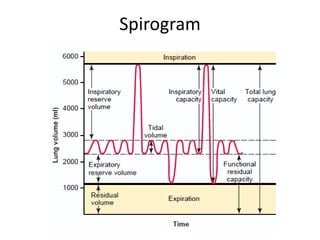
Spirogram
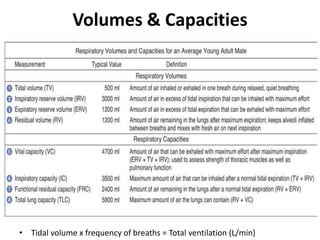
Volumes & CapacitiesTidal volume x frequency of breaths = Total ventilation (L/min)
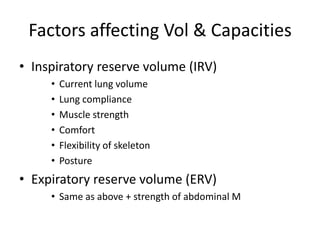
Factors affecting Vol & CapacitiesInspiratory reserve volume (IRV)Current lung volumeLung complianceMuscle strengthComfortFlexibility of skeletonPostureExpiratory reserve volume (ERV)Same as above + strength of abdominal M
Why have RV?Airways would collapseWould take an unusually high pressure to inflate them during inspirationModest RV minimizes airway collapse, thereby optimizing ventilation efficiency Would affect blood oxygenationBlood flow to the lungs and other parts of the body is continuousDuring collapse – Po2 will plummet
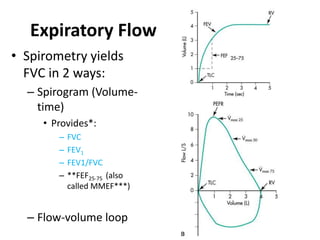
Expiratory FlowSpirometry yields FVC in 2 ways:Spirogram (Volume-time)Provides*: FVCFEV1FEV1/FVC**FEF25-75  (also called MMEF***)Flow-volume loop
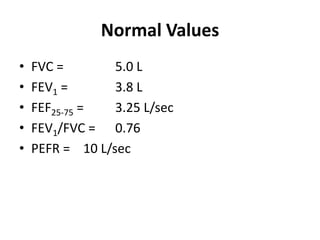
Normal ValuesFVC = 		5.0 LFEV1 = 		3.8 LFEF25-75 = 	3.25 L/secFEV1/FVC = 	0.76PEFR = 	10 L/sec
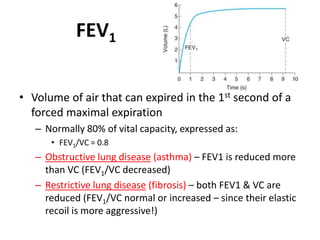
FEV1Volume of air that can expired in the 1st second of a forced maximal expirationNormally 80% of vital capacity, expressed as:FEV1/VC = 0.8Obstructive lung disease (asthma) – FEV1 is reduced more than VC (FEV1/VC decreased)Restrictive lung disease (fibrosis) – both FEV1 & VC are reduced (FEV1/VC normal or increased – since their elastic recoil is more aggressive!)
Helium Dilution Method(for TLC & FRC)*[He]initial = 10%VS(initial) = 2 L[He]final = 5% (assume)Final Vol = VS + VLC1xV1 = C2xV2[He]initial x VS= [He]final x (VS +VL)
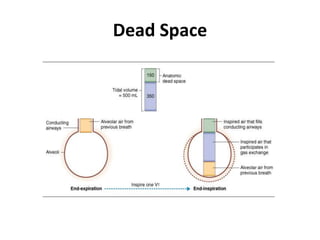
Dead SpaceVolume that does not participate in gas exchangeAnatomical & PhysiologicalAnatomical DSNose (and/or mouth), trachea, bronchi, and bronchiolesVolume = 150 ml Hence out of VT only 350 ml reaches gas exchange areasFirst air expired – DS air To sample alveolar air - sample end-expiratory air
Dead Space
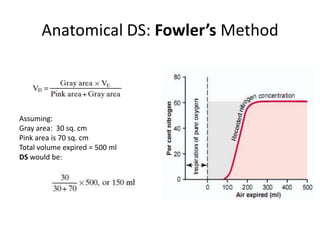
Anatomical DS: Fowler’s MethodAssuming:Gray area:  30 sq. cm Pink area is 70 sq. cmTotal volume expired = 500 mlDS would be:
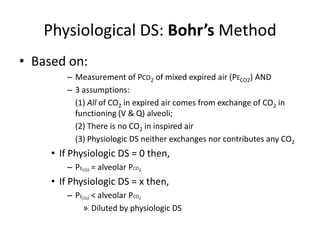
Physiological DS: Bohr’s MethodBased on:Measurement of Pco2 of mixed expired air (PeCO2) AND3 assumptions:	(1) All of CO2 in expired air comes from exchange of CO2 in functioning (V & Q) alveoli; 	(2) There is no CO2 in inspired air	(3) Physiologic DS neither exchanges nor contributes any CO2If Physiologic DS = 0 then,PeCO2 = alveolar Pco2If Physiologic DS = x then,PeCO2 < alveolar Pco2Diluted by physiologic DS
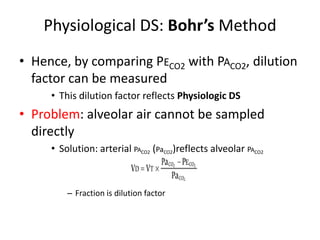
Physiological DS: Bohr’s MethodHence, by comparing PeCO2 with PaCO2, dilution factor can be measuredThis dilution factor reflects Physiologic DSProblem: alveolar air cannot be sampled directlySolution: arterial PaCO2 (PaCO2)reflects alveolar PaCO2Fraction is dilution factor
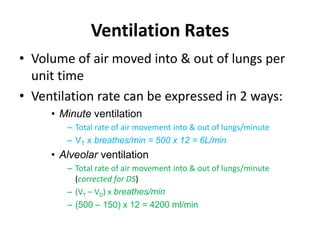
Ventilation RatesVolume of air moved into & out of lungs per unit timeVentilation rate can be expressed in 2 ways:Minute ventilationTotal rate of air movement into & out of lungs/minuteVTx breathes/min = 500 x 12 = 6L/minAlveolar ventilationTotal rate of air movement into & out of lungs/minute (corrected for DS)(VT – VD) x breathes/min (500 – 150) x 12 = 4200 ml/min
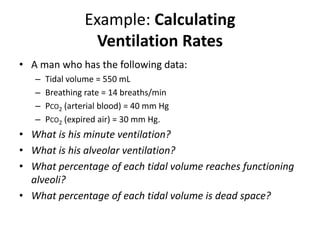
Example: Calculating Ventilation RatesA man who has the following data: Tidal volume = 550 mLBreathing rate = 14 breaths/minPco2 (arterial blood) = 40 mm HgPco2 (expired air) = 30 mm Hg. What is his minute ventilation? What is his alveolar ventilation? What percentage of each tidal volume reaches functioning alveoli? What percentage of each tidal volume is dead space?
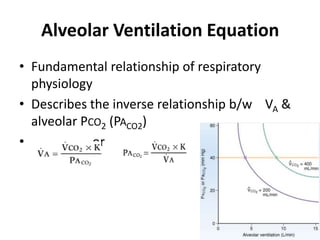
Alveolar Ventilation EquationFundamental relationship of respiratory physiologyDescribes the inverse relationship b/w    VA & alveolar Pco2 (PaCO2)                   or
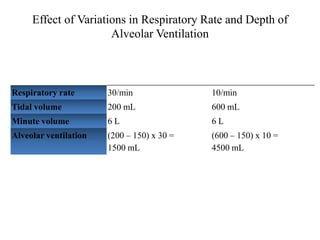
Effect of Variations in Respiratory Rate and Depth of Alveolar Ventilation
Pulmonary Circulation (Perfusion)
Pulmonary CirculationPulmonary artery (differences from systemic arteries)ThinnerLarger in diameterHighly distensibleLess no. of arteriolesOverall VERY COMPLIANT (7 ml/mm Hg = entire systemic arterial tree!)Accommodate 2/3 of SV of right ventriclePulmonary veinsAs distensible as systemic veinsBronchial vessels1-2 % of total C.O.Oxygenated bloodSupplies lung tissueBronchial veins empty into the left atriumBronchial (& coronary) vessels causing slight shunting of bloodPhysiological shunt (PO2 of arterial blood is 2 mm Hg < than pulmonary vein blood)
Pulmonary CirculationPressures in pulmonary systemRight ventricleSystolic 25 mm HgDiastolic 0-1 mm HgPulmonary arterySystolic 25 mm HgDiastolic 8 mm HgMean 15 mm HgPulmonary arteriolar P (mean) – 12 mm HgPulmonary capillary P (mean) – 10.5 mm HgPulmonary venous P (mean) – 9 mmHg
Pulmonary CirculationLeft atrial P & pulmonary venous PMean P in left atrium and major pulmonary veins – 2 mm Hg (recumbent)Pulmonary Wedge Pressure5 mm HgRole in estimating pulmonary capillary P & left atrial PBlood flow through the lungs and its distributionBlood flow through lungs = C.O.Poorly aerated areas – vasoconstrictionDiversion of blood to better aerated areasTime spent by RBC in navigating pulmonary capillary – 0.75 sec (total amount 75 ml)During exercise – 200 ml with time shortened
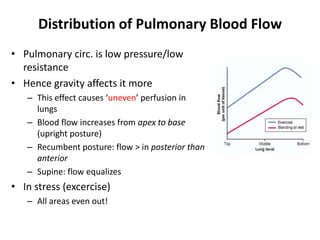
Distribution of Pulmonary Blood FlowPulmonary circ. is low pressure/low resistanceHence gravity affects it moreThis effect causes ‘uneven’ perfusion in lungsBlood flow increases from apex to base (upright posture)Recumbent posture: flow > in posterior than anteriorSupine: flow equalizesIn stress (excercise)All areas even out!
Distribution of Pulmonary Blood FlowHydrostatic Pressure (HP) difference in lungsDifference between highest & lowest point in lung – 30 cm apartThis causes a pressure gradient of 23 mmHg15 mmHg above heart level8 mmHg below heart levelAnother way to look at it:Every 1 cm that an artery has to ‘ascend’ the lungA change in HP of 0.74 mmHg (1 cm H2O) occursSo an ‘ascend’ of 10 cm above heart levelInduces HP change of 7.4 mmHg HP at heart level = 14 mmHgSo, 14 <minus> 7.4 = 6.6 mmHg (arterial P in upper areas)
Distribution of Pulmonary Blood FlowGravity affects arteries & veins alike throughout lung fieldsThis also affects ventilation (V/Q ratios)Meaning, perfusion affects ventilationConversely, alveolar pressure also influences perfusionMeaning, ventilation affects perfusion
Distribution of Pulmonary Blood FlowPA = pulmonary alveolar pressurePa = pulmonary arterial pressurePV = pulmonary venous pressure
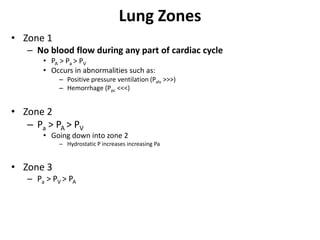
Lung ZonesZone 1No blood flow during any part of cardiac cyclePA > Pa > PVOccurs in abnormalities such as:Positive pressure ventilation (Palv >>>)Hemorrhage (Ppc <<<)Zone 2Pa > PA > PVGoing down into zone 2Hydrostatic P increases increasing PaZone 3Pa > PV > PA
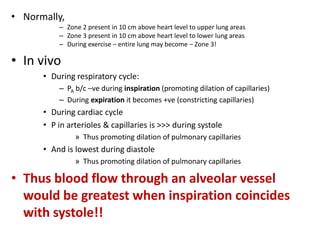
Normally,Zone 2 present in 10 cm above heart level to upper lung areasZone 3 present in 10 cm above heart level to lower lung areasDuring exercise – entire lung may become – Zone 3!In vivoDuring respiratory cycle:PA b/c –ve during inspiration (promoting dilation of capillaries)During expiration it becomes +ve (constricting capillaries)During cardiac cycleP in arterioles & capillaries is >>> during systoleThus promoting dilation of pulmonary capillariesAnd is lowest during diastoleThus promoting dilation of pulmonary capillariesThus blood flow through an alveolar vessel would be greatest when inspiration coincides with systole!!
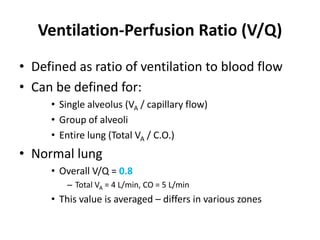
Ventilation-Perfusion Ratio (V/Q)Defined as ratio of ventilation to blood flowCan be defined for:Single alveolus (VA / capillary flow)Group of alveoliEntire lung (Total VA / C.O.)Normal lungOverall V/Q = 0.8Total VA = 4 L/min, CO = 5 L/minThis value is averaged – differs in various zones
Ventilation-Perfusion Ratio (V/Q)V/Q only describes the nature of relationship b/w V & QSo a normal V/Q only means the relation is normal*
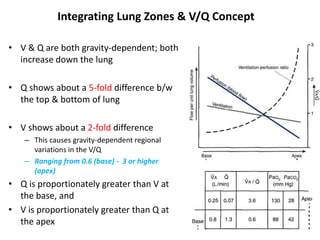
Integrating Lung Zones & V/Q ConceptV & Q are both gravity-dependent; both increase down the lungQ shows about a 5-fold difference b/w the top & bottom of lungV shows about a 2-fold differenceThis causes gravity-dependent regional variations in the V/Q Ranging from 0.6 (base) -  3 or higher (apex)Q is proportionately greater than V at the base, and V is proportionately greater than Q at the apex
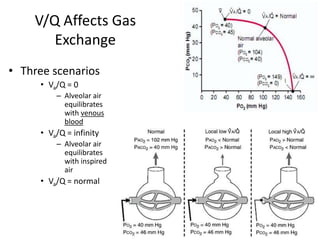
V/Q Affects Gas ExchangeThree scenariosVa/Q = 0Alveolar air equilibrates with venous bloodVa/Q = infinityAlveolar air equilibrates with inspired airVa/Q = normal
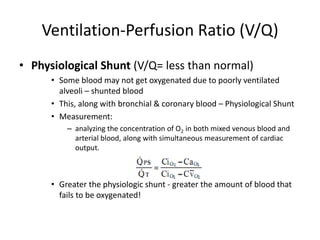
Ventilation-Perfusion Ratio (V/Q)Physiological Shunt (V/Q= less than normal)Some blood may not get oxygenated due to poorly ventilated alveoli – shunted bloodThis, along with bronchial & coronary blood – Physiological ShuntMeasurement: analyzing the concentration of O2 in both mixed venous blood and arterial blood, along with simultaneous measurement of cardiac output.Greater the physiologic shunt - greater the amount of blood that fails to be oxygenated!
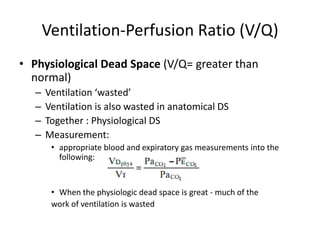
Ventilation-Perfusion Ratio (V/Q)Physiological Dead Space (V/Q= greater than normal)Ventilation ‘wasted’Ventilation is also wasted in anatomical DSTogether : Physiological DSMeasurement:appropriate blood and expiratory gas measurements into the following:When the physiologic dead space is great - much of thework of ventilation is wasted
Abnormalities of V/Q ratioAbnormal V/Q - Upper and Lower in Normal LungNormal person – upright positionLung upper regions: Va/Q higher (Physio. DS)Lung lower regions: Va/Q lower (Physio. Shunt)In both cases – lung’s effectiveness for gas exchange decreasesIn exercise – situation improves!
Abnormalities of V/Q ratioAbnormal V/Q in COPDvarious degrees of bronchial obstruction occursEmphysema occurs resulting in 2 scenarios:Small bronchioles obstructed – alveoli unventilated – V/Q=0Other areas – wall destruction causes loss of blood vessels – ventilation wasted – V/Q = infinity
Alveolar-Arterial Difference (AaDO2)Relationship b/w PAO2 and PaO2Even in normal people – there is a slight difference b/w the twoDifference is called AaDO2This slight difference is caused bu mixing of venous blood (thebesian + broncial veins) into oxygenated bloodIncreased AaDO2 is indicative of impaired gas exchange
GAS TRANSPORT
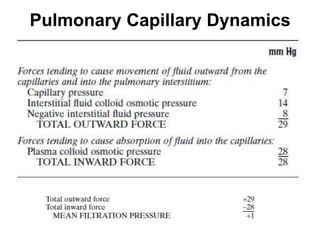
Pulmonary Capillary Dynamics
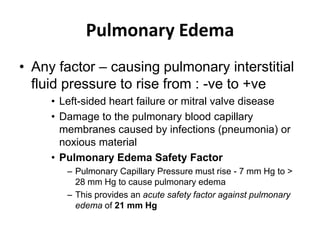
Pulmonary EdemaAny factor – causing pulmonary interstitial fluid pressure to rise from : -ve to +veLeft-sided heart failure or mitral valve diseaseDamage to the pulmonary blood capillary membranes caused by infections (pneumonia) or noxious materialPulmonary Edema Safety FactorPulmonary Capillary Pressure must rise - 7 mm Hg to > 28 mm Hg to cause pulmonary edema This provides an acute safety factor against pulmonary edema of 21 mm Hg
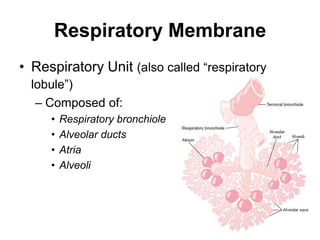
Respiratory MembraneRespiratory Unit(also called “respiratory lobule”)Composed of:Respiratory bronchiole Alveolar ducts AtriaAlveoli
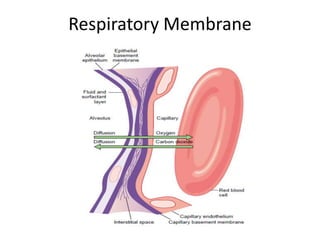
Respiratory Membrane
Forms of Gases in Solution In alveolar air:There is one form of gas (expressed as a partial pressure) In solutions (blood):Gases are carried in additional forms:Gas may be dissolvedIt may be bound to proteinsIt may be chemically modified.Hence total gas concentration in solution= dissolved gas + bound gas + chemically modified gasPartial pressure of gas in a solution is exerted only by dissolved form!!
Gas Transfer & TransportTwo types of gas movements in lungsBulk flow (trachea to alveoli)Diffusion (alveoli to blood)Henry law statesAt equilibrium, amount of gas dissolved in a liquid (at a given temperature) is directly proportional to parital P & solubility of a gasFick law statesVolume of gas diffusing per minute across a membrane is directly proportional to:membrane surface areadiffusion coefficient of the gas partial pressure difference of the gas And is inversely proportional to membrane thickness
Capillary blood flow & gas uptakePerfusion-limited vs Diffusion-limited gases*Difference b/w N2O, O2 and CO
O2 Transport in Blood O2 is carried in 2 forms in blood: DissolvedBound to HbDissolved formFree in solution Approx. 2% of total O2 content of bloodThe only form of O2 that produces a partial pressureAt normal PaO2 = 100 mm Hg, Concentration of dissolved O2 = 0.3 mL O2/100 mLInsufficient to meet tissue demands*
Bound with HbRemaining 98% of the total O2 content of blood is reversibly bound to HbHemoglobinGlobular protein consisting of four subunitsEach subunit can bind one molecule of O2 - total of four molecules of O2 per molecule of HbFor the subunits to bind O2, iron in the heme moieties must be in the ferrous state (i.e., Fe2+)
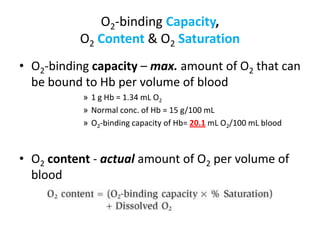
O2-binding Capacity, O2Content&O2SaturationO2-binding capacity – max. amount of O2 that can be bound to Hb per volume of blood1 g Hb = 1.34 mL O2Normal conc. of Hb = 15 g/100 mLO2-binding capacity of Hb= 20.1 mL O2/100 mL bloodO2content - actual amount of O2 per volume of blood
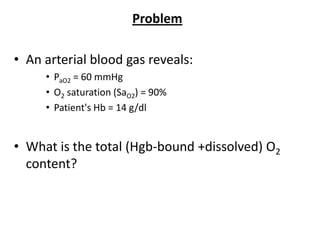
ProblemAn arterial blood gas reveals:PaO2 = 60 mmHg O2 saturation (SaO2) = 90%Patient's Hb = 14 g/dl What is the total (Hgb-bound +dissolved) O2 content?
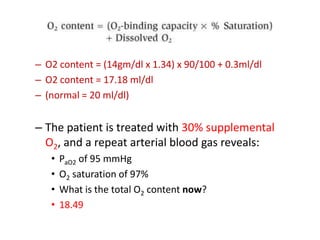
O2 content = (14gm/dl x 1.34) x 90/100 + 0.3ml/dlO2 content = 17.18 ml/dl(normal = 20 ml/dl)The patient is treated with 30% supplemental O2, and a repeat arterial blood gas reveals:PaO2 of 95 mmHg O2 saturation of 97% What is the total O2 content now? 18.49
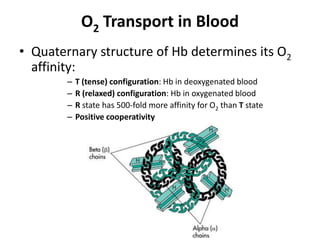
O2 Transport in Blood Quaternary structure of Hb determines its O2 affinity:T (tense) configuration: Hb in deoxygenated bloodR (relaxed) configuration: Hb in oxygenated bloodR statehas 500-fold more affinity for O2 than T statePositive cooperativity
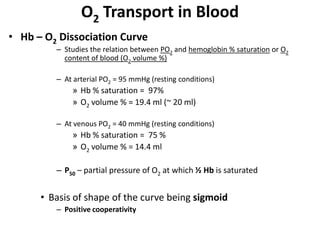
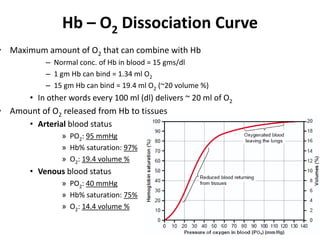
O2 Transport in BloodHb –O2 Dissociation CurveStudies the relation between PO2 and hemoglobin % saturation or O2 content of blood (O2 volume %)At arterial PO2 = 95 mmHg (resting conditions)Hb % saturation =  97%O2 volume % = 19.4 ml (~ 20 ml)At venous PO2 = 40 mmHg (resting conditions)Hb % saturation =  75 %O2 volume % = 14.4 mlP50 – partial pressure of O2 at which ½ Hb is saturatedBasis of shape of the curve being sigmoidPositive cooperativity
Hb –O2 Dissociation CurveMaximum amount of O2 that can combine with HbNormal conc. of Hb in blood = 15 gms/dl1 gm Hb can bind = 1.34 ml O215 gm Hb can bind = 19.4 ml O2 (~20 volume %)In other words every 100 ml (dl) delivers ~ 20 ml of O2Amount of O2 released from Hb to tissuesArterial blood statusPO2: 95 mmHgHb% saturation: 97%O2: 19.4 volume %Venous blood statusPO2: 40 mmHgHb% saturation: 75%O2: 14.4 volume %
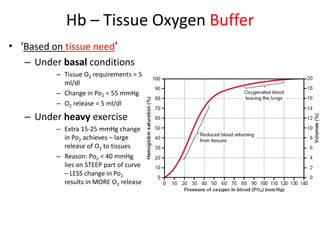
Hb – Tissue Oxygen Buffer‘Based on tissue need’Under basal conditionsTissue O2 requirements = 5 ml/dlChange in Po2 = 55 mmHgO2 release = 5 ml/dlUnder heavy exerciseExtra 15-25 mmHg change in Po2 achieves – large release of O2 to tissuesReason: Po2 < 40 mmHg lies on STEEP part of curve – LESS change in Po2 results in MORE O2 release
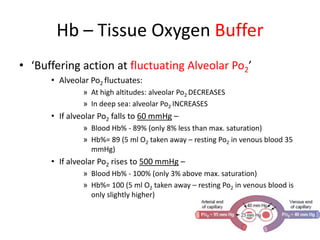
Hb – Tissue Oxygen Buffer‘Buffering action at fluctuating Alveolar Po2’Alveolar Po2 fluctuates:At high altitudes: alveolar Po2 DECREASESIn deep sea: alveolar Po2 INCREASESIf alveolar Po2 falls to 60 mmHg – Blood Hb% - 89% (only 8% less than max. saturation)Hb%= 89 (5 ml O2 taken away – resting Po2 in venous blood 35 mmHg)If alveolar Po2 rises to 500 mmHg – Blood Hb% - 100% (only 3% above max. saturation)Hb%= 100 (5 ml O2 taken away – resting Po2 in venous blood is only slightly higher)
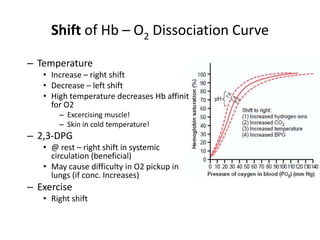
Shift of Hb – O2 Dissociation CurveTemperatureIncrease – right shiftDecrease – left shiftHigh temperature decreases Hb affinity for O2Excercising muscle!Skin in cold temperature!2,3-DPG@ rest – right shift in systemic circulation (beneficial)May cause difficulty in O2 pickup in lungs (if conc. Increases)ExerciseRight shift
Shift of Hb – O2 Dissociation CurveAcid (Bohr pH effect)Metabolically active tissues – H+ production – displaces O2 from incoming Hb – Right shiftLungs – increased Po2 – displaces H+ - left shiftCO2 (Bohr CO2 effect)Hypercapnia in tissues – right shiftCO poisoning, HB-FLeft shift
CO Poisoning Hb binding site for O2 and CO is the same!Binding capability of CO with Hb is 250 folds more than O2Alveolar pressure of 0.4 mmHg (1/250 of normal Po2) CO competes equally with O2 for hemoglobincauses 1/2 Hb to bind with CO instead of with O2Alveolar pressure of 0.6 mmHg – LethalClinical scenarioPatient comes in with nervous signs No obvious signs of hypoxemia (no cyanosis, bright red blood,)Po2 is normal – body does not detect hypoxia!TreatmentPure O2 with 5% CO2

Respiration2 upload

  • 2.
  • 3.
    Volumes & CapacitiesTidalvolume x frequency of breaths = Total ventilation (L/min)
  • 4.
    Factors affecting Vol& CapacitiesInspiratory reserve volume (IRV)Current lung volumeLung complianceMuscle strengthComfortFlexibility of skeletonPostureExpiratory reserve volume (ERV)Same as above + strength of abdominal M
  • 5.
    Why have RV?Airwayswould collapseWould take an unusually high pressure to inflate them during inspirationModest RV minimizes airway collapse, thereby optimizing ventilation efficiency Would affect blood oxygenationBlood flow to the lungs and other parts of the body is continuousDuring collapse – Po2 will plummet
  • 6.
    Expiratory FlowSpirometry yieldsFVC in 2 ways:Spirogram (Volume-time)Provides*: FVCFEV1FEV1/FVC**FEF25-75 (also called MMEF***)Flow-volume loop
  • 7.
    Normal ValuesFVC = 5.0 LFEV1 = 3.8 LFEF25-75 = 3.25 L/secFEV1/FVC = 0.76PEFR = 10 L/sec
  • 8.
    FEV1Volume of airthat can expired in the 1st second of a forced maximal expirationNormally 80% of vital capacity, expressed as:FEV1/VC = 0.8Obstructive lung disease (asthma) – FEV1 is reduced more than VC (FEV1/VC decreased)Restrictive lung disease (fibrosis) – both FEV1 & VC are reduced (FEV1/VC normal or increased – since their elastic recoil is more aggressive!)
  • 9.
    Helium Dilution Method(forTLC & FRC)*[He]initial = 10%VS(initial) = 2 L[He]final = 5% (assume)Final Vol = VS + VLC1xV1 = C2xV2[He]initial x VS= [He]final x (VS +VL)
  • 10.
    Dead SpaceVolume thatdoes not participate in gas exchangeAnatomical & PhysiologicalAnatomical DSNose (and/or mouth), trachea, bronchi, and bronchiolesVolume = 150 ml Hence out of VT only 350 ml reaches gas exchange areasFirst air expired – DS air To sample alveolar air - sample end-expiratory air
  • 11.
  • 12.
    Anatomical DS: Fowler’sMethodAssuming:Gray area: 30 sq. cm Pink area is 70 sq. cmTotal volume expired = 500 mlDS would be:
  • 13.
    Physiological DS: Bohr’sMethodBased on:Measurement of Pco2 of mixed expired air (PeCO2) AND3 assumptions: (1) All of CO2 in expired air comes from exchange of CO2 in functioning (V & Q) alveoli; (2) There is no CO2 in inspired air (3) Physiologic DS neither exchanges nor contributes any CO2If Physiologic DS = 0 then,PeCO2 = alveolar Pco2If Physiologic DS = x then,PeCO2 < alveolar Pco2Diluted by physiologic DS
  • 14.
    Physiological DS: Bohr’sMethodHence, by comparing PeCO2 with PaCO2, dilution factor can be measuredThis dilution factor reflects Physiologic DSProblem: alveolar air cannot be sampled directlySolution: arterial PaCO2 (PaCO2)reflects alveolar PaCO2Fraction is dilution factor
  • 15.
    Ventilation RatesVolume ofair moved into & out of lungs per unit timeVentilation rate can be expressed in 2 ways:Minute ventilationTotal rate of air movement into & out of lungs/minuteVTx breathes/min = 500 x 12 = 6L/minAlveolar ventilationTotal rate of air movement into & out of lungs/minute (corrected for DS)(VT – VD) x breathes/min (500 – 150) x 12 = 4200 ml/min
  • 16.
    Example: Calculating VentilationRatesA man who has the following data: Tidal volume = 550 mLBreathing rate = 14 breaths/minPco2 (arterial blood) = 40 mm HgPco2 (expired air) = 30 mm Hg. What is his minute ventilation? What is his alveolar ventilation? What percentage of each tidal volume reaches functioning alveoli? What percentage of each tidal volume is dead space?
  • 17.
    Alveolar Ventilation EquationFundamentalrelationship of respiratory physiologyDescribes the inverse relationship b/w VA & alveolar Pco2 (PaCO2) or
  • 18.
    Effect of Variationsin Respiratory Rate and Depth of Alveolar Ventilation
  • 19.
  • 20.
    Pulmonary CirculationPulmonary artery(differences from systemic arteries)ThinnerLarger in diameterHighly distensibleLess no. of arteriolesOverall VERY COMPLIANT (7 ml/mm Hg = entire systemic arterial tree!)Accommodate 2/3 of SV of right ventriclePulmonary veinsAs distensible as systemic veinsBronchial vessels1-2 % of total C.O.Oxygenated bloodSupplies lung tissueBronchial veins empty into the left atriumBronchial (& coronary) vessels causing slight shunting of bloodPhysiological shunt (PO2 of arterial blood is 2 mm Hg < than pulmonary vein blood)
  • 21.
    Pulmonary CirculationPressures inpulmonary systemRight ventricleSystolic 25 mm HgDiastolic 0-1 mm HgPulmonary arterySystolic 25 mm HgDiastolic 8 mm HgMean 15 mm HgPulmonary arteriolar P (mean) – 12 mm HgPulmonary capillary P (mean) – 10.5 mm HgPulmonary venous P (mean) – 9 mmHg
  • 22.
    Pulmonary CirculationLeft atrialP & pulmonary venous PMean P in left atrium and major pulmonary veins – 2 mm Hg (recumbent)Pulmonary Wedge Pressure5 mm HgRole in estimating pulmonary capillary P & left atrial PBlood flow through the lungs and its distributionBlood flow through lungs = C.O.Poorly aerated areas – vasoconstrictionDiversion of blood to better aerated areasTime spent by RBC in navigating pulmonary capillary – 0.75 sec (total amount 75 ml)During exercise – 200 ml with time shortened
  • 23.
    Distribution of PulmonaryBlood FlowPulmonary circ. is low pressure/low resistanceHence gravity affects it moreThis effect causes ‘uneven’ perfusion in lungsBlood flow increases from apex to base (upright posture)Recumbent posture: flow > in posterior than anteriorSupine: flow equalizesIn stress (excercise)All areas even out!
  • 24.
    Distribution of PulmonaryBlood FlowHydrostatic Pressure (HP) difference in lungsDifference between highest & lowest point in lung – 30 cm apartThis causes a pressure gradient of 23 mmHg15 mmHg above heart level8 mmHg below heart levelAnother way to look at it:Every 1 cm that an artery has to ‘ascend’ the lungA change in HP of 0.74 mmHg (1 cm H2O) occursSo an ‘ascend’ of 10 cm above heart levelInduces HP change of 7.4 mmHg HP at heart level = 14 mmHgSo, 14 <minus> 7.4 = 6.6 mmHg (arterial P in upper areas)
  • 25.
    Distribution of PulmonaryBlood FlowGravity affects arteries & veins alike throughout lung fieldsThis also affects ventilation (V/Q ratios)Meaning, perfusion affects ventilationConversely, alveolar pressure also influences perfusionMeaning, ventilation affects perfusion
  • 26.
    Distribution of PulmonaryBlood FlowPA = pulmonary alveolar pressurePa = pulmonary arterial pressurePV = pulmonary venous pressure
  • 27.
    Lung ZonesZone 1Noblood flow during any part of cardiac cyclePA > Pa > PVOccurs in abnormalities such as:Positive pressure ventilation (Palv >>>)Hemorrhage (Ppc <<<)Zone 2Pa > PA > PVGoing down into zone 2Hydrostatic P increases increasing PaZone 3Pa > PV > PA
  • 28.
    Normally,Zone 2 presentin 10 cm above heart level to upper lung areasZone 3 present in 10 cm above heart level to lower lung areasDuring exercise – entire lung may become – Zone 3!In vivoDuring respiratory cycle:PA b/c –ve during inspiration (promoting dilation of capillaries)During expiration it becomes +ve (constricting capillaries)During cardiac cycleP in arterioles & capillaries is >>> during systoleThus promoting dilation of pulmonary capillariesAnd is lowest during diastoleThus promoting dilation of pulmonary capillariesThus blood flow through an alveolar vessel would be greatest when inspiration coincides with systole!!
  • 29.
    Ventilation-Perfusion Ratio (V/Q)Definedas ratio of ventilation to blood flowCan be defined for:Single alveolus (VA / capillary flow)Group of alveoliEntire lung (Total VA / C.O.)Normal lungOverall V/Q = 0.8Total VA = 4 L/min, CO = 5 L/minThis value is averaged – differs in various zones
  • 30.
    Ventilation-Perfusion Ratio (V/Q)V/Qonly describes the nature of relationship b/w V & QSo a normal V/Q only means the relation is normal*
  • 31.
    Integrating Lung Zones& V/Q ConceptV & Q are both gravity-dependent; both increase down the lungQ shows about a 5-fold difference b/w the top & bottom of lungV shows about a 2-fold differenceThis causes gravity-dependent regional variations in the V/Q Ranging from 0.6 (base) - 3 or higher (apex)Q is proportionately greater than V at the base, and V is proportionately greater than Q at the apex
  • 32.
    V/Q Affects GasExchangeThree scenariosVa/Q = 0Alveolar air equilibrates with venous bloodVa/Q = infinityAlveolar air equilibrates with inspired airVa/Q = normal
  • 33.
    Ventilation-Perfusion Ratio (V/Q)PhysiologicalShunt (V/Q= less than normal)Some blood may not get oxygenated due to poorly ventilated alveoli – shunted bloodThis, along with bronchial & coronary blood – Physiological ShuntMeasurement: analyzing the concentration of O2 in both mixed venous blood and arterial blood, along with simultaneous measurement of cardiac output.Greater the physiologic shunt - greater the amount of blood that fails to be oxygenated!
  • 34.
    Ventilation-Perfusion Ratio (V/Q)PhysiologicalDead Space (V/Q= greater than normal)Ventilation ‘wasted’Ventilation is also wasted in anatomical DSTogether : Physiological DSMeasurement:appropriate blood and expiratory gas measurements into the following:When the physiologic dead space is great - much of thework of ventilation is wasted
  • 35.
    Abnormalities of V/QratioAbnormal V/Q - Upper and Lower in Normal LungNormal person – upright positionLung upper regions: Va/Q higher (Physio. DS)Lung lower regions: Va/Q lower (Physio. Shunt)In both cases – lung’s effectiveness for gas exchange decreasesIn exercise – situation improves!
  • 36.
    Abnormalities of V/QratioAbnormal V/Q in COPDvarious degrees of bronchial obstruction occursEmphysema occurs resulting in 2 scenarios:Small bronchioles obstructed – alveoli unventilated – V/Q=0Other areas – wall destruction causes loss of blood vessels – ventilation wasted – V/Q = infinity
  • 37.
    Alveolar-Arterial Difference (AaDO2)Relationshipb/w PAO2 and PaO2Even in normal people – there is a slight difference b/w the twoDifference is called AaDO2This slight difference is caused bu mixing of venous blood (thebesian + broncial veins) into oxygenated bloodIncreased AaDO2 is indicative of impaired gas exchange
  • 38.
  • 39.
  • 40.
    Pulmonary EdemaAny factor– causing pulmonary interstitial fluid pressure to rise from : -ve to +veLeft-sided heart failure or mitral valve diseaseDamage to the pulmonary blood capillary membranes caused by infections (pneumonia) or noxious materialPulmonary Edema Safety FactorPulmonary Capillary Pressure must rise - 7 mm Hg to > 28 mm Hg to cause pulmonary edema This provides an acute safety factor against pulmonary edema of 21 mm Hg
  • 41.
    Respiratory MembraneRespiratory Unit(alsocalled “respiratory lobule”)Composed of:Respiratory bronchiole Alveolar ducts AtriaAlveoli
  • 42.
  • 43.
    Forms of Gasesin Solution In alveolar air:There is one form of gas (expressed as a partial pressure) In solutions (blood):Gases are carried in additional forms:Gas may be dissolvedIt may be bound to proteinsIt may be chemically modified.Hence total gas concentration in solution= dissolved gas + bound gas + chemically modified gasPartial pressure of gas in a solution is exerted only by dissolved form!!
  • 44.
    Gas Transfer &TransportTwo types of gas movements in lungsBulk flow (trachea to alveoli)Diffusion (alveoli to blood)Henry law statesAt equilibrium, amount of gas dissolved in a liquid (at a given temperature) is directly proportional to parital P & solubility of a gasFick law statesVolume of gas diffusing per minute across a membrane is directly proportional to:membrane surface areadiffusion coefficient of the gas partial pressure difference of the gas And is inversely proportional to membrane thickness
  • 45.
    Capillary blood flow& gas uptakePerfusion-limited vs Diffusion-limited gases*Difference b/w N2O, O2 and CO
  • 46.
    O2 Transport inBlood O2 is carried in 2 forms in blood: DissolvedBound to HbDissolved formFree in solution Approx. 2% of total O2 content of bloodThe only form of O2 that produces a partial pressureAt normal PaO2 = 100 mm Hg, Concentration of dissolved O2 = 0.3 mL O2/100 mLInsufficient to meet tissue demands*
  • 47.
    Bound with HbRemaining98% of the total O2 content of blood is reversibly bound to HbHemoglobinGlobular protein consisting of four subunitsEach subunit can bind one molecule of O2 - total of four molecules of O2 per molecule of HbFor the subunits to bind O2, iron in the heme moieties must be in the ferrous state (i.e., Fe2+)
  • 48.
    O2-binding Capacity, O2Content&O2SaturationO2-bindingcapacity – max. amount of O2 that can be bound to Hb per volume of blood1 g Hb = 1.34 mL O2Normal conc. of Hb = 15 g/100 mLO2-binding capacity of Hb= 20.1 mL O2/100 mL bloodO2content - actual amount of O2 per volume of blood
  • 49.
    ProblemAn arterial bloodgas reveals:PaO2 = 60 mmHg O2 saturation (SaO2) = 90%Patient's Hb = 14 g/dl What is the total (Hgb-bound +dissolved) O2 content?
  • 50.
    O2 content =(14gm/dl x 1.34) x 90/100 + 0.3ml/dlO2 content = 17.18 ml/dl(normal = 20 ml/dl)The patient is treated with 30% supplemental O2, and a repeat arterial blood gas reveals:PaO2 of 95 mmHg O2 saturation of 97% What is the total O2 content now? 18.49
  • 51.
    O2 Transport inBlood Quaternary structure of Hb determines its O2 affinity:T (tense) configuration: Hb in deoxygenated bloodR (relaxed) configuration: Hb in oxygenated bloodR statehas 500-fold more affinity for O2 than T statePositive cooperativity
  • 52.
    O2 Transport inBloodHb –O2 Dissociation CurveStudies the relation between PO2 and hemoglobin % saturation or O2 content of blood (O2 volume %)At arterial PO2 = 95 mmHg (resting conditions)Hb % saturation = 97%O2 volume % = 19.4 ml (~ 20 ml)At venous PO2 = 40 mmHg (resting conditions)Hb % saturation = 75 %O2 volume % = 14.4 mlP50 – partial pressure of O2 at which ½ Hb is saturatedBasis of shape of the curve being sigmoidPositive cooperativity
  • 53.
    Hb –O2 DissociationCurveMaximum amount of O2 that can combine with HbNormal conc. of Hb in blood = 15 gms/dl1 gm Hb can bind = 1.34 ml O215 gm Hb can bind = 19.4 ml O2 (~20 volume %)In other words every 100 ml (dl) delivers ~ 20 ml of O2Amount of O2 released from Hb to tissuesArterial blood statusPO2: 95 mmHgHb% saturation: 97%O2: 19.4 volume %Venous blood statusPO2: 40 mmHgHb% saturation: 75%O2: 14.4 volume %
  • 54.
    Hb – TissueOxygen Buffer‘Based on tissue need’Under basal conditionsTissue O2 requirements = 5 ml/dlChange in Po2 = 55 mmHgO2 release = 5 ml/dlUnder heavy exerciseExtra 15-25 mmHg change in Po2 achieves – large release of O2 to tissuesReason: Po2 < 40 mmHg lies on STEEP part of curve – LESS change in Po2 results in MORE O2 release
  • 55.
    Hb – TissueOxygen Buffer‘Buffering action at fluctuating Alveolar Po2’Alveolar Po2 fluctuates:At high altitudes: alveolar Po2 DECREASESIn deep sea: alveolar Po2 INCREASESIf alveolar Po2 falls to 60 mmHg – Blood Hb% - 89% (only 8% less than max. saturation)Hb%= 89 (5 ml O2 taken away – resting Po2 in venous blood 35 mmHg)If alveolar Po2 rises to 500 mmHg – Blood Hb% - 100% (only 3% above max. saturation)Hb%= 100 (5 ml O2 taken away – resting Po2 in venous blood is only slightly higher)
  • 56.
    Shift of Hb– O2 Dissociation CurveTemperatureIncrease – right shiftDecrease – left shiftHigh temperature decreases Hb affinity for O2Excercising muscle!Skin in cold temperature!2,3-DPG@ rest – right shift in systemic circulation (beneficial)May cause difficulty in O2 pickup in lungs (if conc. Increases)ExerciseRight shift
  • 57.
    Shift of Hb– O2 Dissociation CurveAcid (Bohr pH effect)Metabolically active tissues – H+ production – displaces O2 from incoming Hb – Right shiftLungs – increased Po2 – displaces H+ - left shiftCO2 (Bohr CO2 effect)Hypercapnia in tissues – right shiftCO poisoning, HB-FLeft shift
  • 58.
    CO Poisoning Hbbinding site for O2 and CO is the same!Binding capability of CO with Hb is 250 folds more than O2Alveolar pressure of 0.4 mmHg (1/250 of normal Po2) CO competes equally with O2 for hemoglobincauses 1/2 Hb to bind with CO instead of with O2Alveolar pressure of 0.6 mmHg – LethalClinical scenarioPatient comes in with nervous signs No obvious signs of hypoxemia (no cyanosis, bright red blood,)Po2 is normal – body does not detect hypoxia!TreatmentPure O2 with 5% CO2

Editor's Notes

  • #7 *coloured blue parameters are already done**forced expiratory flow from 25-75% VC***mid-maximal expiratory flow: The third measure made by the spirogram is the average flow rate over the middle section of the vital capacity. This test has several names, including the MMEF (mid-maximal expiratory flow) and the FEF25-75 (forced expiratory flow from 25 to 75% of the vital capacity). It can be calculated from the spirogram by dividing the vital capacity into quarters, dropping a line from the first (25%) and third (75%) quartiles, and then connecting the lines and measuring the slope. Volume/time is a flow rate and thus the slope is a flow rate (the only real flow rate that can easily be obtained from the spirogram).
  • #10 *VL corresponds to the lung volume at the instant we open the mouth valve and allow the He to beginequilibrating. If we wish to measure FRC, we open the valve just after the subject has completed a quietexpiration. If the subject has just completed a maximal expiration, then the computed VL is RV.
  • #18 The constant, K, equals 863 mm Hg for conditions of BTPS and when Va and Vco2 are expressed in the same units (e.g., mL/min). BTPS means body temperature (310 K), ambient pressure (760 mm Hg), and gas saturated with water vapor. Using the rearranged form of the equation, alveolar Pco2 can be predicted if two variables are known: (1) the rate of CO2 production from aerobic metabolism of the tissues, and (2) alveolar ventilation, which excretes this CO2 in expired air.  A critical point to be understood from the alveolar ventilation equation is that if CO2production is constant, then PaCO2 is determined by alveolar ventilation. For a constant level of CO2 production, there is a hyperbolic relationship between PaCO2 and Va. Increases in alveolar ventilation cause a decrease in PaCO2; conversely, decreases in alveolar ventilation cause an increase in PaCO2. Another way to think about the alveolar ventilation equation is to consider how the relationship between PaCO2 and Va would be altered by changes in CO2 production. For example, if CO2 production, or Vco2, doubles (e.g., during strenuous exercise), the hyperbolic relationship between PaCO2 and Va shifts to the right. Under these conditions, the only way to maintain PaCO2 at its normal value (approximately 40 mm Hg) is for alveolar ventilation to double also. The graph shows that if CO2 production increases from 200 mL/min to 400 mL/min, PaCO2 is maintained at 40 mm Hg if, simultaneously, Va increases from 5L/min to 10L/min.
  • #31 * Doesn’t mean that ventilation and perfusion to the entire lung is normal ! E.g. in lobar pneumonia, V to the affected lobe is affected, and perfusion isnt….but since hypoxia causes vasoconstriction – eventually perfusion too is affected….so V/Q remains ‘normal’ though both V and Q are in fact abnormal
  • #32 The effect of regional V/Q on blood gases is shown in the above table. Because overventilation relative to blood flow occurs in the apex, the PaO2 is high and the PaCO2 is low at the apex of the lungs. Oxygen tension (PO2) in the blood leaving pulmonary capillaries at the base of the lungs is low because the blood is not fully oxygenated as a result of underventilation relative to blood flow. Regional differences in V/Q tend to localize some diseases to the top or bottom parts of the lungs. For example, tuberculosis tends to be localized in the apex because of a more favorable environment (i.e., higher oxygen levels for Mycobacterium tuberculosis).
  • #33 In continuation of the last table showing effects of V/Q in various lung zones on blood gases
  • #46 *transit time
  • #47 *For example, in a person at rest, O2 consumption is about 250 mL O2/min. If O2 delivery to the tissues were based strictly on the dissolved component, then 15 mL O2/min would be delivered to the tissues (O2 delivery = Cardiac output × dissolved O2 concentration, or 5 L/min × 0.3 mL O2/100 mL = 15 mL O2/min). Clearly, this amount is insufficient to meet the demand of 250 mL O2/min. An additional mechanism for transporting large quantities of O2 in blood is needed-that mechanism is O2 bound to hemoglobin.
  • #54 Volume% is ml/dl