值
日
生
黃
俊
穎
Pulmonary Embolism (肺栓塞)
The mortality rate of approximately 30% can be
reduced to 3% to 10%, with anticoagulation
therapy or inferior vena cava filter placement
Diagnosis
Classic Triad – rarely
• Dyspnea (喘)
• Pleuritic chest pain (肋膜性胸痛)
• Hemoptysis (咳血)
Lab - nonspecific
• D-dimer
Modified Wells Criteria
Clinical symptoms of DVT: 3
Other diagnosis less likely than PE: 3
Heart rate >100 beats/min: 1.5
Immobilization or surgery <4 weeks: 1.5
Previous DVT or PE: 1.5
Hemoptysis: 1
Malignancy: 1
CLINICAL PROBABILITY ASSESSMENT
High: >6 (41%)

Moderate: 2-6 (16%)
Low: <2 (0.5-2.7%)
Pulmonary arteriography
• Gold standard
• Sensitivity: 98%; Specificity: 97%

• Invasive, 0.5% risk for death
and 2% risk for other major
complication
Chest radiographs
• Can reveal other causes
• Normal radiographs are
common
• Pleural-based Hampton
hump
hemorrhage filling the
alveolar spaces
Nuclear medicine ventilation (V) /
perfusion (Q) scan
• The PIOPED trial found that the V/Q to be accurate
• But the interpretation criteria were complex
• Effective dose about 2 mSv or less
• Many sites utilize very low-dose techniques
involving perfusion only techniques

• Since then, a number of modifications to the
criteria have been suggested

PIOPED, the Prospective Investigation of Pulmonary Embolism Diagnosis
Computed tomography
arteriography, CTA
• Widely used as the primary method for PE
• In PIOPED II with MDCT:
Sensitivity

83%, 78% (if indeterminate scan included)

Specificity

96%

Positive predictive value

86%

Negative predictive value

95%

• Nondiagnostic CT scans average 6% but may be
higher in pregnancy, where it might reach as high
as 25%
Computed tomography
arteriography, CTA
• Patients with renal failure or allergy to iodinated
contrast – CTA (X)
• Effective dose of CT: 3 to 5 mSv
is associated with increased risk of cancer
Magnetic resonance angiography,
MRA
• Attempts to replace CTA with MRA have not yet
been successful.
• The PIOPED III trial reported a sensitivity of only
63% for pulmonary emboli
It should be noted that
• In PIOPED II trial, failed to prove the superiority of
CTA over V/Q
• Both CTA and V/Q lose value if the objective clinical
evaluation is discordant or does not match the
imaging results.
It should be noted that
• In PIOPED I, V/Q were performed on old equipment
• New, simplified interpretation criteria are being
considered in the United States and are already
recommended in Europe.
在網路上有人問
大家的回答…
其他專業的回答…
Ventilation / Perfusion
Normal V/Q
scan
Ventilation

Gravity affects
radiotracer distribution

Perfusion
Many Diseases Affect Ventilation
• Asthma
• Bronchitis
• Pneumonia
• Emphysema

The normal regional
response to acute hypoxia
is vasoconstriction, which
shunts blood flow away to
other aerated areas of
lung. This results in regions
of reduced perfusion and
reduced ventilation that are
“matched.”
In a pulmonary embolus
• Pulmonary arterial perfusion
is reduced
• The ventilation is unaffected
in such cases, so the alveolar
spaces remain aerated.
Ventilation and perfusion
are uncoupled or
“mismatched” in territories
affected by the pulmonary
embolus.
Radiopharmaceuticals

• Perfusion
• Ventilation
Perfusion Radiopharmaceuticals
Diameter
RBC

<8 µm

Capillaries

7-10µm

Precapillary
arterioles

35µm
Perfusion Radiopharmaceuticals
• Iodine-131 macroaggregated albumin
• Tc-99m labeled human albumin microspheres
• Tc-99m macroaggregated albumin – U.S.A

• Only Tc-99m MAA is available for clinical
use in the United States
Tc-99m MAA
• Size ranges from 5 to 100 µm
• Generally 60% to 80% between 10 and 30 µm
• Biological half-life in the lung: 4 to 6 hours
• Number of particles is important
Particles
Adult

200,000 to 500,000

Neonates

10,000

<5 y/o

50,000

Pulmonary hypertension

100,000 to 250,000

Right to left shunt

100,000 to 150,000

Pregnancy

Minimum 100,000
Tc-99m MAA
• Many sites advocate
performing a reduced-dose
perfusion-only scan with 1
to 2 mCi (37-74 MBq) of
Tc-9m MAA in pregnant
patients to reduce fetal
exposure
Tc-99m MAA
• Because there are an estimated 300 million
precapillary arterioles and more than 280 billion
pulmonary capillaries, this should result in no ill
effects with obstruction of only 0.1% to 0.3% of
vessels
Ventilation Radiopharmaceuticals
An ideal ventilation radiopharmaceutical
• Could be used after the perfusion examination
• Optimal radiolabel for gamma camera imaging
• Closely model respiration
• For SPECT, it should not clear too rapidly from the
lungs
Ventilation Radiopharmaceuticals
Radioactive Gases

Xe-133
Xe-127

T1/2:36.4 d
172 KeV, 375 KeV

Kr-81m

Radioaerosols

T1/2:13 sec
expensive, 190 KeV
Tc-99m DTPA
Tc-99m Technegas
Xenon-133
Several disadvantages
• Rapid washout limits the number of views and
projections obtainable
• Photopeak of 81-keV is not optimal for gamma
camera imaging
• Ventilation scan must be performed first
• Need special equipment
Tc-99m DTPA
• Tc-99m DTPA aerosol
particles are cleared by
crossing the airway
membrane and entering
the circulation, where
they are cleared by the
kidney. The biological
half-life is
approximately 80 ± 20
minutes in healthy
people and 24 ± 9
minutes in healthy
smokers.
Tc-99m DTPA
• The ideal particle size is
in the range of 0.1 to 0.5
μm. Particles larger than
1 to 2 μm tend to
settle out in the large
airways - possibly
“shining through” onto
the subsequent
perfusion examination
Tc-99m DTPA
• Particle clumping
may still occur in
patients unable to
cooperate with deep
breathing or who
have asthma or
COPD.
Tc-99m Technegas
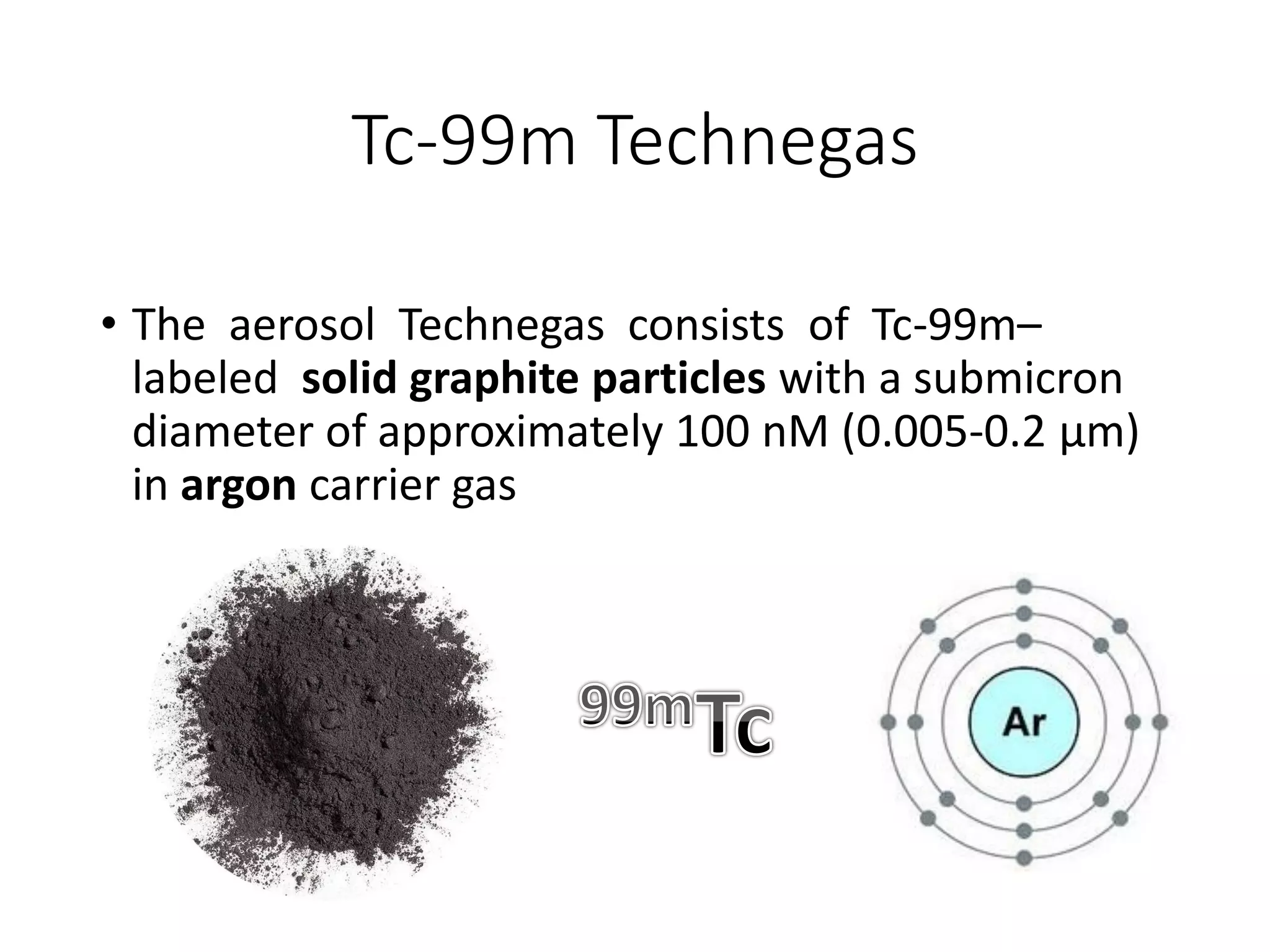
• The aerosol Technegas consists of Tc-99m–
labeled solid graphite particles with a submicron
diameter of approximately 100 nM (0.005-0.2 μm)
in argon carrier gas
Tc-99m Technegas
• Like a gas, the particles penetrate far into the lung
periphery without the central clumping often
seen in COPD with Tc-99m DTPA.
• In addition to having the advantages of a gas,
multiple views or SPECT imaging is possible, adding
appeal
Tc-99m Technegas
• Produced onsite by a generator. This generator
requires regular maintenance
• Tc-99m Technegas is widely used outside of the
United States, and the images appear superior to
those obtained with Tc-99m DTPA and Xe-133
Dosimetry
• Reports describe the effective whole-body dose
for a V/Q scan to be 1.4 to 2 mSv compared to
2.2 to 6.0 mSv from CTA
• In pregnant patients, fetal doses from V/Q are low,
reportedly 350 to 570 μGy using a reduced 1 to 2
mCi (37-74 MBq)-MBq Tc-99m MAA dose.
However, this is generally higher than with CT
V/Q scan

V/Q scan

  • 1.
  • 2.
  • 3.
    The mortality rateof approximately 30% can be reduced to 3% to 10%, with anticoagulation therapy or inferior vena cava filter placement
  • 4.
    Diagnosis Classic Triad –rarely • Dyspnea (喘) • Pleuritic chest pain (肋膜性胸痛) • Hemoptysis (咳血) Lab - nonspecific • D-dimer
  • 5.
    Modified Wells Criteria Clinicalsymptoms of DVT: 3 Other diagnosis less likely than PE: 3 Heart rate >100 beats/min: 1.5 Immobilization or surgery <4 weeks: 1.5 Previous DVT or PE: 1.5 Hemoptysis: 1 Malignancy: 1 CLINICAL PROBABILITY ASSESSMENT High: >6 (41%) Moderate: 2-6 (16%) Low: <2 (0.5-2.7%)
  • 7.
    Pulmonary arteriography • Goldstandard • Sensitivity: 98%; Specificity: 97% • Invasive, 0.5% risk for death and 2% risk for other major complication
  • 8.
    Chest radiographs • Canreveal other causes • Normal radiographs are common • Pleural-based Hampton hump hemorrhage filling the alveolar spaces
  • 9.
    Nuclear medicine ventilation(V) / perfusion (Q) scan • The PIOPED trial found that the V/Q to be accurate • But the interpretation criteria were complex • Effective dose about 2 mSv or less • Many sites utilize very low-dose techniques involving perfusion only techniques • Since then, a number of modifications to the criteria have been suggested PIOPED, the Prospective Investigation of Pulmonary Embolism Diagnosis
  • 10.
    Computed tomography arteriography, CTA •Widely used as the primary method for PE • In PIOPED II with MDCT: Sensitivity 83%, 78% (if indeterminate scan included) Specificity 96% Positive predictive value 86% Negative predictive value 95% • Nondiagnostic CT scans average 6% but may be higher in pregnancy, where it might reach as high as 25%
  • 11.
    Computed tomography arteriography, CTA •Patients with renal failure or allergy to iodinated contrast – CTA (X) • Effective dose of CT: 3 to 5 mSv is associated with increased risk of cancer
  • 12.
    Magnetic resonance angiography, MRA •Attempts to replace CTA with MRA have not yet been successful. • The PIOPED III trial reported a sensitivity of only 63% for pulmonary emboli
  • 13.
    It should benoted that • In PIOPED II trial, failed to prove the superiority of CTA over V/Q • Both CTA and V/Q lose value if the objective clinical evaluation is discordant or does not match the imaging results.
  • 14.
    It should benoted that • In PIOPED I, V/Q were performed on old equipment • New, simplified interpretation criteria are being considered in the United States and are already recommended in Europe.
  • 15.
  • 16.
  • 17.
  • 18.
  • 19.
  • 20.
    Many Diseases AffectVentilation • Asthma • Bronchitis • Pneumonia • Emphysema The normal regional response to acute hypoxia is vasoconstriction, which shunts blood flow away to other aerated areas of lung. This results in regions of reduced perfusion and reduced ventilation that are “matched.”
  • 21.
    In a pulmonaryembolus • Pulmonary arterial perfusion is reduced • The ventilation is unaffected in such cases, so the alveolar spaces remain aerated. Ventilation and perfusion are uncoupled or “mismatched” in territories affected by the pulmonary embolus.
  • 22.
  • 23.
  • 24.
    Perfusion Radiopharmaceuticals • Iodine-131macroaggregated albumin • Tc-99m labeled human albumin microspheres • Tc-99m macroaggregated albumin – U.S.A • Only Tc-99m MAA is available for clinical use in the United States
  • 25.
    Tc-99m MAA • Sizeranges from 5 to 100 µm • Generally 60% to 80% between 10 and 30 µm • Biological half-life in the lung: 4 to 6 hours • Number of particles is important Particles Adult 200,000 to 500,000 Neonates 10,000 <5 y/o 50,000 Pulmonary hypertension 100,000 to 250,000 Right to left shunt 100,000 to 150,000 Pregnancy Minimum 100,000
  • 26.
    Tc-99m MAA • Manysites advocate performing a reduced-dose perfusion-only scan with 1 to 2 mCi (37-74 MBq) of Tc-9m MAA in pregnant patients to reduce fetal exposure
  • 27.
    Tc-99m MAA • Becausethere are an estimated 300 million precapillary arterioles and more than 280 billion pulmonary capillaries, this should result in no ill effects with obstruction of only 0.1% to 0.3% of vessels
  • 28.
    Ventilation Radiopharmaceuticals An idealventilation radiopharmaceutical • Could be used after the perfusion examination • Optimal radiolabel for gamma camera imaging • Closely model respiration • For SPECT, it should not clear too rapidly from the lungs
  • 29.
    Ventilation Radiopharmaceuticals Radioactive Gases Xe-133 Xe-127 T1/2:36.4d 172 KeV, 375 KeV Kr-81m Radioaerosols T1/2:13 sec expensive, 190 KeV Tc-99m DTPA Tc-99m Technegas
  • 31.
    Xenon-133 Several disadvantages • Rapidwashout limits the number of views and projections obtainable • Photopeak of 81-keV is not optimal for gamma camera imaging • Ventilation scan must be performed first • Need special equipment
  • 32.
    Tc-99m DTPA • Tc-99mDTPA aerosol particles are cleared by crossing the airway membrane and entering the circulation, where they are cleared by the kidney. The biological half-life is approximately 80 ± 20 minutes in healthy people and 24 ± 9 minutes in healthy smokers.
  • 33.
    Tc-99m DTPA • Theideal particle size is in the range of 0.1 to 0.5 μm. Particles larger than 1 to 2 μm tend to settle out in the large airways - possibly “shining through” onto the subsequent perfusion examination
  • 34.
    Tc-99m DTPA • Particleclumping may still occur in patients unable to cooperate with deep breathing or who have asthma or COPD.
  • 35.
    Tc-99m Technegas • Theaerosol Technegas consists of Tc-99m– labeled solid graphite particles with a submicron diameter of approximately 100 nM (0.005-0.2 μm) in argon carrier gas
  • 36.
    Tc-99m Technegas • Likea gas, the particles penetrate far into the lung periphery without the central clumping often seen in COPD with Tc-99m DTPA. • In addition to having the advantages of a gas, multiple views or SPECT imaging is possible, adding appeal
  • 37.
    Tc-99m Technegas • Producedonsite by a generator. This generator requires regular maintenance • Tc-99m Technegas is widely used outside of the United States, and the images appear superior to those obtained with Tc-99m DTPA and Xe-133
  • 38.
    Dosimetry • Reports describethe effective whole-body dose for a V/Q scan to be 1.4 to 2 mSv compared to 2.2 to 6.0 mSv from CTA • In pregnant patients, fetal doses from V/Q are low, reportedly 350 to 570 μGy using a reduced 1 to 2 mCi (37-74 MBq)-MBq Tc-99m MAA dose. However, this is generally higher than with CT