Any use of this material without specific permission of Arrow Devices is strictly prohibited
May 2015
UVM	
  Methodology	
  
Topics	
  covered	
  
•  Introduc0on	
  
•  SV	
  Test-­‐bench	
  Architecture	
  
•  UVM	
  Test-­‐bench	
  Architecture	
  
•  UVM	
  Configura0on	
  
•  UVM	
  Messaging	
  
•  UVM	
  Sequences	
  
•  UVM	
  Test	
  
•  UVM	
  Phasing	
  
•  UVM	
  Overriding	
  
2
Arrow Devices Pvt Ltd


Introduc0on	


Arrow Devices Pvt Ltd
UVM Core Capabilities
l Universal Verification Methodology or UVM
Ø  A methodology and a class library for building advanced
reusable verification component
l Relies on strong, proven industry foundations
Ø  The core of its success is adherence to a standard (i.e.
architecture, stimulus creation, automation, factory usage
standards etc.)
Arrow Devices Pvt Ltd
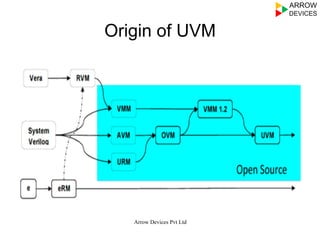
Origin of UVM
Arrow Devices Pvt Ltd
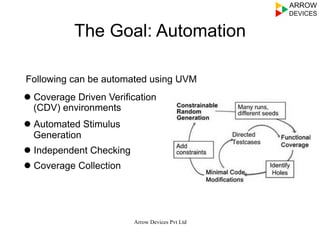
The Goal: Automation
l Coverage Driven Verification
(CDV) environments
l Automated Stimulus
Generation
l Independent Checking
l Coverage Collection
Arrow Devices Pvt Ltd
Following can be automated using UVM


SV	
  Test-­‐bench	
  Architecture	


Arrow Devices Pvt Ltd
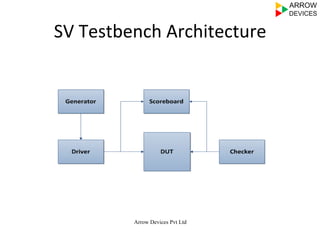
SV	
  Testbench	
  Architecture	
  
Arrow Devices Pvt Ltd
 	
  
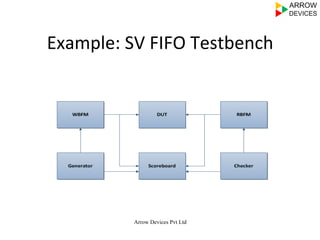
Example:	
  SV	
  FIFO	
  Testbench	
  
Arrow Devices Pvt Ltd


UVM	
  Test-­‐bench	
  Architecture	


Arrow Devices Pvt Ltd
UVM Test-bench Architecture
Arrow Devices Pvt Ltd
 
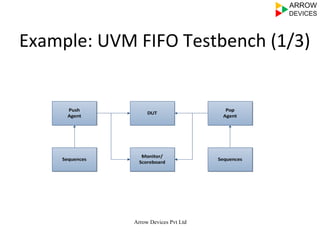
Example:	
  UVM	
  FIFO	
  Testbench	
  (1/3)	
  
Arrow Devices Pvt Ltd


Arrow Devices Pvt Ltd
	
  
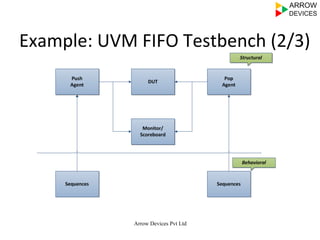
Example:	
  UVM	
  FIFO	
  Testbench	
  (2/3)	
  
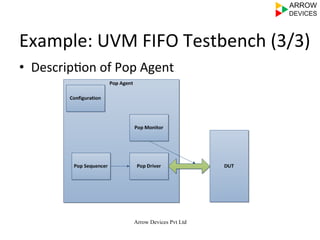
•  Descrip0on	
  of	
  Pop	
  Agent	
  
Arrow Devices Pvt Ltd
	
  
Example:	
  UVM	
  FIFO	
  Testbench	
  (3/3)	
  
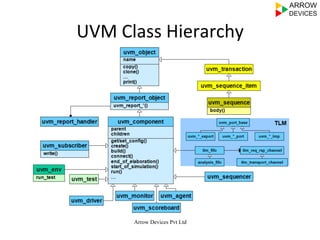
UVM	
  Class	
  Hierarchy	
  	
  
Arrow Devices Pvt Ltd
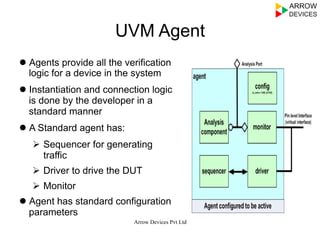
UVM Agent
l Agents provide all the verification
logic for a device in the system
l Instantiation and connection logic
is done by the developer in a
standard manner
l A Standard agent has:
Ø  Sequencer for generating
traffic
Ø  Driver to drive the DUT
Ø  Monitor
l Agent has standard configuration
parameters
Arrow Devices Pvt Ltd
UVM Agent: Standard Configuration
l  A standard agent is configured using an enumeration field:
“is_active”
Ø  UVM_ACTIVE:
Ø  Actively drive an interface or device
Ø  Driver, Sequencer and Monitor are allocated
Ø  UVM_PASSIVE:
Ø  Only the Monitor is allocated
l Still able to do checking and collect coverage
l Other user-defined configuration parameters can also be added
Ø  Example: address configuration for slave devices
Arrow Devices Pvt Ltd
Driver-Sequencer Model
Arrow Devices Pvt Ltd
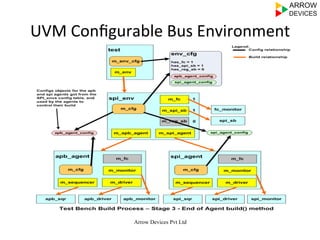
UVM	
  Configurable	
  Bus	
  Environment	
  
Arrow Devices Pvt Ltd


UVM	
  Configura0on	


Arrow Devices Pvt Ltd
UVM Configuration Mechanism
l  The configuration mechanism allows a powerful way for attribute
configuration
l  Configuration mechanism advantages:
Ø  Mechanism semantic allows an upper component to override
contained components values
-  No file changes are required
Ø  Can configure attributes at various hierarchy locations
Ø  Wild cards and regular expressions allow configuration of multiple
attributes with a single command
Ø  Debug capabilities
Ø  Support for user defined types (e.g. SV virtual interfaces)
Ø  Run-time configuration support
Ø  Type safe solution
Arrow Devices Pvt Ltd
UVM Database
l uvm_config_db
l uvm_resource_db
Arrow Devices Pvt Ltd
UVM supports the following database
Example:	
  UVM	
  Configura0on	
  Database	


l 	
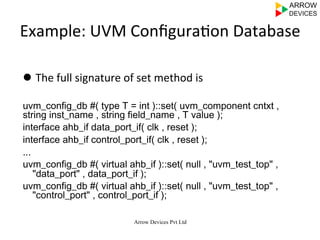
  The	
  full	
  signature	
  of	
  set	
  method	
  is	
  	
  
uvm_config_db #( type T = int )::set( uvm_component cntxt ,
string inst_name , string field_name , T value );
interface ahb_if data_port_if( clk , reset );
interface ahb_if control_port_if( clk , reset );
...
uvm_config_db #( virtual ahb_if )::set( null , "uvm_test_top" ,
"data_port" , data_port_if );
uvm_config_db #( virtual ahb_if )::set( null , "uvm_test_top" ,
"control_port" , control_port_if );
Arrow Devices Pvt Ltd
UVM Messaging Facility
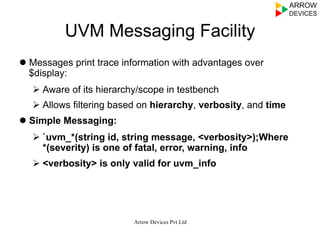
l Messages print trace information with advantages over
$display:
Ø Aware of its hierarchy/scope in testbench
Ø Allows filtering based on hierarchy, verbosity, and time
l Simple Messaging:
Ø `uvm_*(string id, string message, <verbosity>);Where
*(severity) is one of fatal, error, warning, info
Ø <verbosity> is only valid for uvm_info
Arrow Devices Pvt Ltd
UVM Sequences
Arrow Devices Pvt Ltd
Transaction : uvm_seq_item
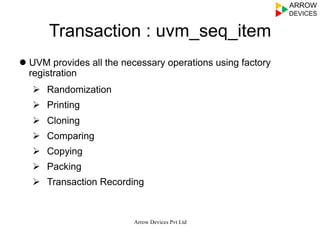
l UVM provides all the necessary operations using factory
registration
Ø  Randomization
Ø  Printing
Ø  Cloning
Ø  Comparing
Ø  Copying
Ø  Packing
Ø  Transaction Recording
Arrow Devices Pvt Ltd
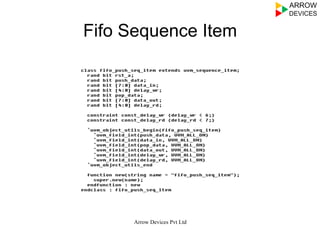
Fifo Sequence Item
Arrow Devices Pvt Ltd
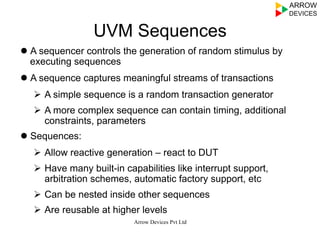
UVM Sequences
l A sequencer controls the generation of random stimulus by
executing sequences
l A sequence captures meaningful streams of transactions
Ø  A simple sequence is a random transaction generator
Ø  A more complex sequence can contain timing, additional
constraints, parameters
l Sequences:
Ø  Allow reactive generation – react to DUT
Ø  Have many built-in capabilities like interrupt support,
arbitration schemes, automatic factory support, etc
Ø  Can be nested inside other sequences
Ø  Are reusable at higher levels
Arrow Devices Pvt Ltd
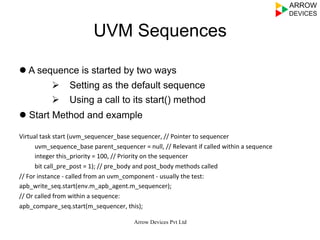
UVM Sequences
l A sequence is started by two ways
Ø  Setting as the default sequence
Ø  Using a call to its start() method
l Start Method and example
	
  
Virtual	
  task	
  start	
  (uvm_sequencer_base	
  sequencer,	
  //	
  Pointer	
  to	
  sequencer	


  uvm_sequence_base	
  parent_sequencer	
  =	
  null,	
  //	
  Relevant	
  if	
  called	
  within	
  a	
  sequence	


  integer	
  this_priority	
  =	
  100,	
  //	
  Priority	
  on	
  the	
  sequencer	


  bit	
  call_pre_post	
  =	
  1);	
  //	
  pre_body	
  and	
  post_body	
  methods	
  called	
  
//	
  For	
  instance	
  -­‐	
  called	
  from	
  an	
  uvm_component	
  -­‐	
  usually	
  the	
  test:	
  
apb_write_seq.start(env.m_apb_agent.m_sequencer);	
  
//	
  Or	
  called	
  from	
  within	
  a	
  sequence:	
  
apb_compare_seq.start(m_sequencer,	
  this);	
  
Arrow Devices Pvt Ltd
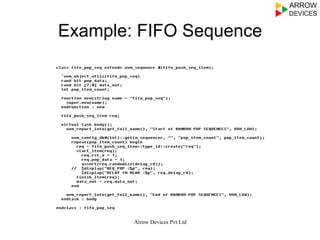
Example: FIFO Sequence
Arrow Devices Pvt Ltd
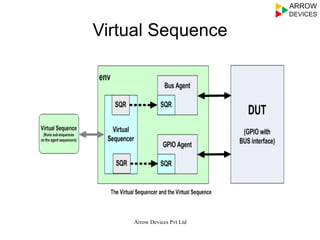
Virtual Sequence
Arrow Devices Pvt Ltd
UVM Test
Arrow Devices Pvt Ltd
UVM Test
l Placing all components in the test requires lot of duplication
l Separate the env configuration and the test
Ø  TB class instantiates and configures reusable components
l Tests instantiate a testbench
Ø  Specify the nature of generated traffic
Ø  Can modify configuration parameters as needed
l Benefits
Ø  Tests are shorter, and descriptive
Ø  Less knowledge to create a test
Ø  Easier to maintain - changes are done in a central location
Arrow Devices Pvt Ltd
UVM Phasing
Arrow Devices Pvt Ltd
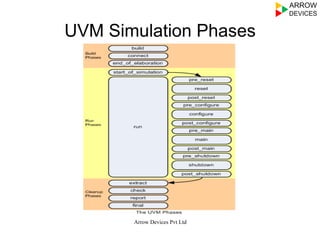
UVM Simulation Phases
l The Standard UVM phases
Ø  Build phases, Run-time phases and Clean up phases
l Unique tasks are performed in each simulation phase
Ø  Set-up activities are performed during “testbench
creation”while expected results may be addressed in “check”
Ø  Phases run in order –next phase does not begin until
previous phase is complete
l UVM provides set of standard phases enabling VIP plug&play
Ø  Allows orchestrating the activity of components that were
created by different resources
Arrow Devices Pvt Ltd
UVM Simulation Phases
Arrow Devices Pvt Ltd
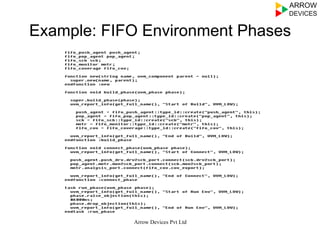
Example: FIFO Environment Phases
Arrow Devices Pvt Ltd
UVM Overriding
Arrow Devices Pvt Ltd
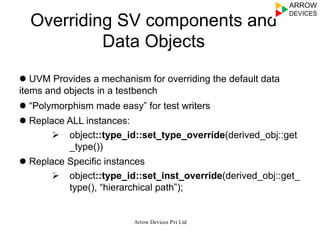
Overriding SV components and
Data Objects
l UVM Provides a mechanism for overriding the default data
items and objects in a testbench
l “Polymorphism made easy” for test writers
l Replace ALL instances:
Ø  object::type_id::set_type_override(derived_obj::get
_type())
l Replace Specific instances
Ø  object::type_id::set_inst_override(derived_obj::get_
type(), “hierarchical path”);
Arrow Devices Pvt Ltd
Extensions Using Callbacks
l Like the factory, callbacks are a way to affect an existing
component from outside
l The SystemVeriloglanguage includes built-in callbacks
Ø  e.g. post_randomize(), pre_body()
l Callbacks requires the developer to predict the extension
location and create a proper hook
l Callbacks advantages:
Ø  They do not require inheritance
Ø  Multiple callbacks can be combined
Arrow Devices Pvt Ltd
UVM	
  Advantages	
  (1/2)	
  	
  
•  Standard	
  communica0on	
  between	
  components	
  
•  End	
  of	
  test	
  is	
  well	
  defined	
  
•  All	
  the	
  tasks	
  in	
  the	
  component	
  are	
  pre-­‐defined	
  standard	
  
names	
  by	
  using	
  Phasing	
  
•  Standard	
  Sequencer	
  to	
  Driver	
  Communica0on	
  
•  Separa0ng	
  testbench	
  into	
  structural	
  and	
  behavioral	
  
•  Configura0on	
  database	
  ie	
  either	
  easy	
  to	
  use	
  or	
  to	
  change	


Arrow Devices Pvt Ltd
UVM	
  Advantages	
  (2/2)	
  
•  Using	
  Factory	
  registra0on	
  
•  You	
  can	
  override	
  the	
  type	
  or	
  instance	
  of	
  trasac0ons,	
  
components	
  etc.,	
  
Ø  Configura0on	
  can	
  be	
  changed	
  easily	
  
Ø  Overridden	
  components	
  can	
  be	
  used	
  with	
  less	
  efforts	
  
Ø  Provides	
  user	
  more	
  flexbility	
  in	
  wri0ng	
  tests	
  
•  Reusability	
  
•  Debugging	


Arrow Devices Pvt Ltd
Thank	
  you	
  
Arrow Devices Pvt Ltd

UVM Methodology Tutorial

  • 1.
    Any use ofthis material without specific permission of Arrow Devices is strictly prohibited May 2015 UVM  Methodology  
  • 2.
    Topics  covered   • Introduc0on   •  SV  Test-­‐bench  Architecture   •  UVM  Test-­‐bench  Architecture   •  UVM  Configura0on   •  UVM  Messaging   •  UVM  Sequences   •  UVM  Test   •  UVM  Phasing   •  UVM  Overriding   2 Arrow Devices Pvt Ltd
  • 3.
              Introduc0on       Arrow Devices Pvt Ltd
  • 4.
    UVM Core Capabilities l UniversalVerification Methodology or UVM Ø  A methodology and a class library for building advanced reusable verification component l Relies on strong, proven industry foundations Ø  The core of its success is adherence to a standard (i.e. architecture, stimulus creation, automation, factory usage standards etc.) Arrow Devices Pvt Ltd
  • 5.
    Origin of UVM ArrowDevices Pvt Ltd
  • 6.
    The Goal: Automation l CoverageDriven Verification (CDV) environments l Automated Stimulus Generation l Independent Checking l Coverage Collection Arrow Devices Pvt Ltd Following can be automated using UVM
  • 7.
            SV  Test-­‐bench  Architecture         Arrow Devices Pvt Ltd
  • 8.
    SV  Testbench  Architecture   Arrow Devices Pvt Ltd
  • 9.
        Example:  SV  FIFO  Testbench   Arrow Devices Pvt Ltd
  • 10.
            UVM  Test-­‐bench  Architecture         Arrow Devices Pvt Ltd
  • 11.
  • 12.
      Example:  UVM  FIFO  Testbench  (1/3)   Arrow Devices Pvt Ltd
  • 13.
          ArrowDevices Pvt Ltd   Example:  UVM  FIFO  Testbench  (2/3)  
  • 14.
    •  Descrip0on  of  Pop  Agent   Arrow Devices Pvt Ltd   Example:  UVM  FIFO  Testbench  (3/3)  
  • 15.
    UVM  Class  Hierarchy     Arrow Devices Pvt Ltd
  • 16.
    UVM Agent l Agents provideall the verification logic for a device in the system l Instantiation and connection logic is done by the developer in a standard manner l A Standard agent has: Ø  Sequencer for generating traffic Ø  Driver to drive the DUT Ø  Monitor l Agent has standard configuration parameters Arrow Devices Pvt Ltd
  • 17.
    UVM Agent: StandardConfiguration l  A standard agent is configured using an enumeration field: “is_active” Ø  UVM_ACTIVE: Ø  Actively drive an interface or device Ø  Driver, Sequencer and Monitor are allocated Ø  UVM_PASSIVE: Ø  Only the Monitor is allocated l Still able to do checking and collect coverage l Other user-defined configuration parameters can also be added Ø  Example: address configuration for slave devices Arrow Devices Pvt Ltd
  • 18.
  • 19.
    UVM  Configurable  Bus  Environment   Arrow Devices Pvt Ltd
  • 20.
            UVM  Configura0on       Arrow Devices Pvt Ltd
  • 21.
    UVM Configuration Mechanism l The configuration mechanism allows a powerful way for attribute configuration l  Configuration mechanism advantages: Ø  Mechanism semantic allows an upper component to override contained components values -  No file changes are required Ø  Can configure attributes at various hierarchy locations Ø  Wild cards and regular expressions allow configuration of multiple attributes with a single command Ø  Debug capabilities Ø  Support for user defined types (e.g. SV virtual interfaces) Ø  Run-time configuration support Ø  Type safe solution Arrow Devices Pvt Ltd
  • 22.
  • 23.
    Example:  UVM  Configura0on  Database     l   The  full  signature  of  set  method  is     uvm_config_db #( type T = int )::set( uvm_component cntxt , string inst_name , string field_name , T value ); interface ahb_if data_port_if( clk , reset ); interface ahb_if control_port_if( clk , reset ); ... uvm_config_db #( virtual ahb_if )::set( null , "uvm_test_top" , "data_port" , data_port_if ); uvm_config_db #( virtual ahb_if )::set( null , "uvm_test_top" , "control_port" , control_port_if ); Arrow Devices Pvt Ltd
  • 24.
    UVM Messaging Facility l Messagesprint trace information with advantages over $display: Ø Aware of its hierarchy/scope in testbench Ø Allows filtering based on hierarchy, verbosity, and time l Simple Messaging: Ø `uvm_*(string id, string message, <verbosity>);Where *(severity) is one of fatal, error, warning, info Ø <verbosity> is only valid for uvm_info Arrow Devices Pvt Ltd
  • 25.
  • 26.
    Transaction : uvm_seq_item l UVMprovides all the necessary operations using factory registration Ø  Randomization Ø  Printing Ø  Cloning Ø  Comparing Ø  Copying Ø  Packing Ø  Transaction Recording Arrow Devices Pvt Ltd
  • 27.
    Fifo Sequence Item ArrowDevices Pvt Ltd
  • 28.
    UVM Sequences l A sequencercontrols the generation of random stimulus by executing sequences l A sequence captures meaningful streams of transactions Ø  A simple sequence is a random transaction generator Ø  A more complex sequence can contain timing, additional constraints, parameters l Sequences: Ø  Allow reactive generation – react to DUT Ø  Have many built-in capabilities like interrupt support, arbitration schemes, automatic factory support, etc Ø  Can be nested inside other sequences Ø  Are reusable at higher levels Arrow Devices Pvt Ltd
  • 29.
    UVM Sequences l A sequenceis started by two ways Ø  Setting as the default sequence Ø  Using a call to its start() method l Start Method and example   Virtual  task  start  (uvm_sequencer_base  sequencer,  //  Pointer  to  sequencer                      uvm_sequence_base  parent_sequencer  =  null,  //  Relevant  if  called  within  a  sequence                      integer  this_priority  =  100,  //  Priority  on  the  sequencer                      bit  call_pre_post  =  1);  //  pre_body  and  post_body  methods  called   //  For  instance  -­‐  called  from  an  uvm_component  -­‐  usually  the  test:   apb_write_seq.start(env.m_apb_agent.m_sequencer);   //  Or  called  from  within  a  sequence:   apb_compare_seq.start(m_sequencer,  this);   Arrow Devices Pvt Ltd
  • 30.
  • 31.
  • 32.
  • 33.
    UVM Test l Placing allcomponents in the test requires lot of duplication l Separate the env configuration and the test Ø  TB class instantiates and configures reusable components l Tests instantiate a testbench Ø  Specify the nature of generated traffic Ø  Can modify configuration parameters as needed l Benefits Ø  Tests are shorter, and descriptive Ø  Less knowledge to create a test Ø  Easier to maintain - changes are done in a central location Arrow Devices Pvt Ltd
  • 34.
  • 35.
    UVM Simulation Phases l TheStandard UVM phases Ø  Build phases, Run-time phases and Clean up phases l Unique tasks are performed in each simulation phase Ø  Set-up activities are performed during “testbench creation”while expected results may be addressed in “check” Ø  Phases run in order –next phase does not begin until previous phase is complete l UVM provides set of standard phases enabling VIP plug&play Ø  Allows orchestrating the activity of components that were created by different resources Arrow Devices Pvt Ltd
  • 36.
  • 37.
    Example: FIFO EnvironmentPhases Arrow Devices Pvt Ltd
  • 38.
  • 39.
    Overriding SV componentsand Data Objects l UVM Provides a mechanism for overriding the default data items and objects in a testbench l “Polymorphism made easy” for test writers l Replace ALL instances: Ø  object::type_id::set_type_override(derived_obj::get _type()) l Replace Specific instances Ø  object::type_id::set_inst_override(derived_obj::get_ type(), “hierarchical path”); Arrow Devices Pvt Ltd
  • 40.
    Extensions Using Callbacks l Likethe factory, callbacks are a way to affect an existing component from outside l The SystemVeriloglanguage includes built-in callbacks Ø  e.g. post_randomize(), pre_body() l Callbacks requires the developer to predict the extension location and create a proper hook l Callbacks advantages: Ø  They do not require inheritance Ø  Multiple callbacks can be combined Arrow Devices Pvt Ltd
  • 41.
    UVM  Advantages  (1/2)     •  Standard  communica0on  between  components   •  End  of  test  is  well  defined   •  All  the  tasks  in  the  component  are  pre-­‐defined  standard   names  by  using  Phasing   •  Standard  Sequencer  to  Driver  Communica0on   •  Separa0ng  testbench  into  structural  and  behavioral   •  Configura0on  database  ie  either  easy  to  use  or  to  change     Arrow Devices Pvt Ltd
  • 42.
    UVM  Advantages  (2/2)   •  Using  Factory  registra0on   •  You  can  override  the  type  or  instance  of  trasac0ons,   components  etc.,   Ø  Configura0on  can  be  changed  easily   Ø  Overridden  components  can  be  used  with  less  efforts   Ø  Provides  user  more  flexbility  in  wri0ng  tests   •  Reusability   •  Debugging       Arrow Devices Pvt Ltd
  • 43.
    Thank  you   ArrowDevices Pvt Ltd