Introduction to Verification
Methodologies - OVM/UVM
Ramdas M
Expert Verification Engineer
1/4/2016
Intro to Verification Methodologies -
OVM/UVM Concepts
1
Agenda
• Standard Verification Methodologies
– Need for Methodologies
– Layered Testbench Architecture
– TLM concepts
– OVM/UVM concepts
• Testbench structure - Agent, Env, Factory, Callbacks
• Sequences
• For more Course Resources, Tutorials see
• http://verificationexcellence.in/
1/4/2016
Intro to Verification Methodologies -
OVM/UVM Concepts
2
Self Paced online courses
• New and engaging way to learn everything about
Functional Verification
• Sign up here: http://verificationexcellence.in/online-
courses/
• Structured online courses
– SOC Verification using System Verilog
– Learn SVA and Coverage Coding
– Learn to build OVM/UVM Testbenches from scratch
1/4/2016
Intro to Verification Methodologies -
OVM/UVM Concepts
3
Why do we need Standard Methodology?
• Traditional methods doesn’t scale up or enable re-use across
verification for complex design
• Verification is increasingly becoming critical and complex
– Building constrained random test benches is complex and time
consuming
– Projects demand verification engineers to divide and conquer
• Following needs to be addressed for efficiency
– Automation
– Abstraction
– Re-use
– Interoparability
– Quality
1/4/2016 Intro to Verification Methodologies - 4
What must a methodology Provide?
• Standard to enable re-use
– Abstraction/Project/Company/Industry wide re-use
• Layered approach to enable a division of skills and
development
– Developing verification IP
– Re-using and configuring existing verification IP
– Separation of Stimulus from Testbench Structure
– Writing of new code
• Assertions and/or coverage points
• Writing or re-using checkers
• Writing or re-using test cases
1/4/2016 Intro to Verification Methodologies - 5
What must a methodology Provide?
• A consistent approach
– Naming conventions
– Verification IP configuration
• Defining the number of agent
• How they connect to the DUT
• Whether an agent is ACTIVE or PASSIVE
– Well-defined generation and simulation phases
• Build, connect, pre-run, run, post-run
• The power to find bugs fast
– Faster development of Testbench
– Good control on stimulus, observability and debug ability
• Vendor/Tool independence
• Verification Management - Planning, progress and completion
1/4/2016 Intro to Verification Methodologies - 6
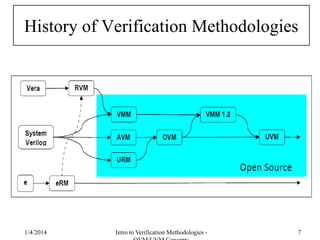
History of Verification Methodologies
1/4/2016 Intro to Verification Methodologies - 7
What is OVM/UVM ?
• OVM - Open Verification Methodology
– Backward compatible with AVM and URM
• UVM - Universal Verification Methodology
– Accellera standard
– SystemVerilog UVM Base Class Library (BCL)
– Near-backward compatible with OVM
• Both are Open source (Apache licence)
• Test benches for (System)Verilog / VHDL / SystemC
designs
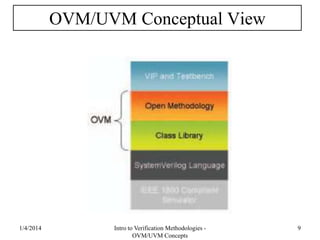
• SystemVerilog class library
1/4/2016 Intro to Verification Methodologies - 8
OVM/UVM Conceptual View
1/4/2016 Intro to Verification Methodologies -
OVM/UVM Concepts
9
Highlights of OVM and UVM
• Constrained random, coverage-driven verification
• Configurable, flexible, test benches
• Verification IP reuse
• Separation of tests/stimulus from test bench
• Transaction-level communication (TLM)
• Layered sequential stimulus
• Standardized messaging
• Register layer (Newly added in UVM)
– Enables programming and verifying registers in a consistent
and efficient manner
1/4/2016 Intro to Verification Methodologies - 10
UVM – OVM - Differences
• UVM is based on OVM 2.1.1
– The deprecated features from OVM were removed in UVM
(deprecated.txt file in the OVM install area).
– The URM and AVM compatibility layers were removed from
UVM.
• Updates in UVM
– Enhancements to the OVM callback facility, including a new
message catching facility.
– Enhancements to the OVM objection mechanism.
• These enhancements introduce some minor backward incompatibilities to
the OVM callback facility.
– Few capabiilties donated from VMM (not sure what?)
– Other than this – it is a blind change from ovm_* to uvm_* for
the whole library
1/4/2016 Intro to Verification Methodologies - 11
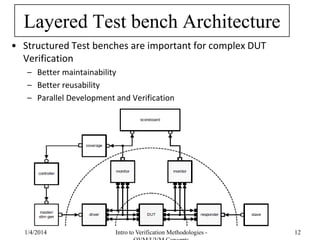
Layered Test bench Architecture
• Structured Test benches are important for complex DUT
Verification
– Better maintainability
– Better reusability
– Parallel Development and Verification
1/4/2016 Intro to Verification Methodologies - 12
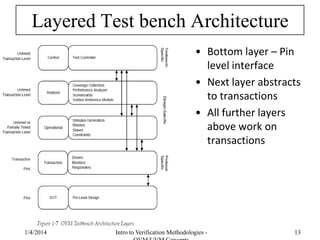
Layered Test bench Architecture
• Bottom layer – Pin
level interface
• Next layer abstracts
to transactions
• All further layers
above work on
transactions
1/4/2016 Intro to Verification Methodologies - 13
Transactors
• Components that converts stream of transaction to pin level
interface and vice versa
– Monitor
• Passive components that watches the pin toggles and converts them to a
stream of transactions
– Driver
• Converts a stream of transactions to pin level activity
– Respondent
• Similar to a driver but responds to an activity rather than initiating activity
1/4/2016 Intro to Verification Methodologies - 14
Operational Components
• Transactional components that provides everything needed
for DUT to operate
– Stimulus Generator
• Creates stream of transactions to stimulate the DUT. Can be random, directed
or pseudo-random
– Master
• Bi-directional component that can send requests and can receive responses
– Slave
• Bi-directional component that responds to requests by returning with
responses
1/4/2016 Intro to Verification Methodologies - 15
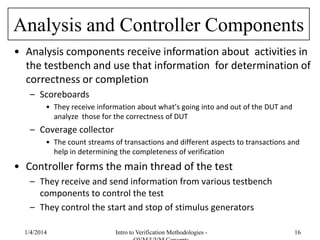
Analysis and Controller Components
• Analysis components receive information about activities in
the testbench and use that information for determination of
correctness or completion
– Scoreboards
• They receive information about what’s going into and out of the DUT and
analyze those for the correctness of DUT
– Coverage collector
• The count streams of transactions and different aspects to transactions and
help in determining the completeness of verification
• Controller forms the main thread of the test
– They receive and send information from various testbench
components to control the test
– They control the start and stop of stimulus generators
1/4/2016 Intro to Verification Methodologies - 16
Transaction Level Modelling
• Transaction-level models consist of multiple processes
communicating with each other by sending transactions
back and forth through channels.
– Abstracts time
• Reduces the number of activation of processes
• RTL evaluation of nets/signals vs evaluation of transactions
– Abstracts data
• Form transaction objects instead of bit by bit details
– Abstracts function
• Implement functionality with functions/processes rather than with real
registers or circuits
1/4/2016 Intro to Verification Methodologies - 17
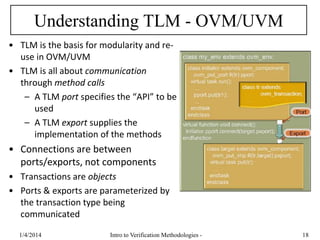
Understanding TLM - OVM/UVM
• TLM is the basis for modularity and re-
use in OVM/UVM
• TLM is all about communication
through method calls
– A TLM port specifies the “API” to be
used
– A TLM export supplies the
implementation of the methods
• Connections are between
ports/exports, not components
• Transactions are objects
• Ports & exports are parameterized by
the transaction type being
communicated
1/4/2016 Intro to Verification Methodologies - 18
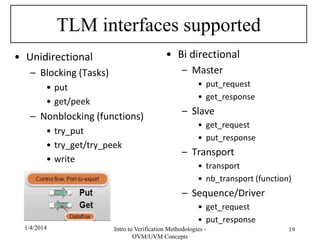
TLM interfaces supported
1/4/2016 Intro to Verification Methodologies -
OVM/UVM Concepts
19
• Unidirectional
– Blocking (Tasks)
• put
• get/peek
– Nonblocking (functions)
• try_put
• try_get/try_peek
• write
• Bi directional
– Master
• put_request
• get_response
– Slave
• get_request
• put_response
– Transport
• transport
• nb_transport (function)
– Sequence/Driver
• get_request
• put_response
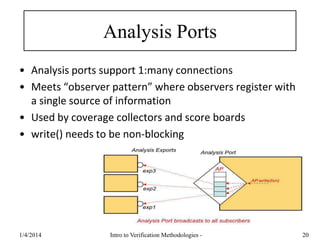
Analysis Ports
• Analysis ports support 1:many connections
• Meets “observer pattern” where observers register with
a single source of information
• Used by coverage collectors and score boards
• write() needs to be non-blocking
1/4/2016 Intro to Verification Methodologies - 20
UVM Testbench Hierarchy
• Testbenches are built from classes derived from
uvm_component class
• Top level class is a test class that instantiates “env” class
which instantiates a series of components
• Modular to facilitate the reuse of groups of verification
components
– Across projects (horizontal reuse)
– Across levels of integration (veritical reuse)
• Two main collective component types
– the env (short for environment)
– the agent
1/4/2016 Intro to Verification Methodologies - 21
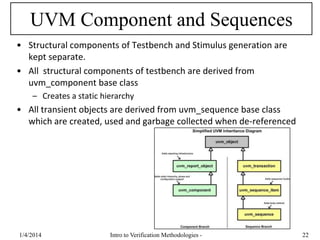
UVM Component and Sequences
• Structural components of Testbench and Stimulus generation are
kept separate.
• All structural components of testbench are derived from
uvm_component base class
– Creates a static hierarchy
• All transient objects are derived from uvm_sequence base class
which are created, used and garbage collected when de-referenced
1/4/2016 Intro to Verification Methodologies - 22
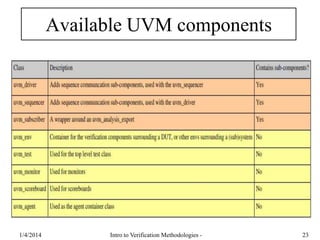
Available UVM components
1/4/2016 Intro to Verification Methodologies - 23
UVM Agent
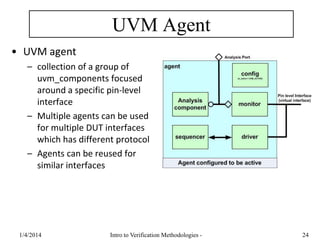
• UVM agent
– collection of a group of
uvm_components focused
around a specific pin-level
interface
– Multiple agents can be used
for multiple DUT interfaces
which has different protocol
– Agents can be reused for
similar interfaces
1/4/2016 Intro to Verification Methodologies - 24
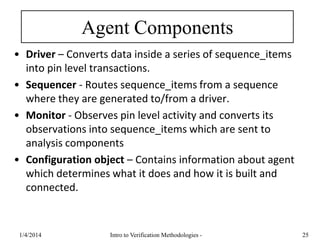
Agent Components
• Driver – Converts data inside a series of sequence_items
into pin level transactions.
• Sequencer - Routes sequence_items from a sequence
where they are generated to/from a driver.
• Monitor - Observes pin level activity and converts its
observations into sequence_items which are sent to
analysis components
• Configuration object – Contains information about agent
which determines what it does and how it is built and
connected.
1/4/2016 Intro to Verification Methodologies - 25
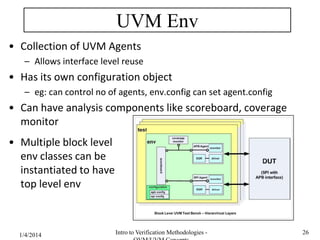
UVM Env
• Collection of UVM Agents
– Allows interface level reuse
• Has its own configuration object
– eg: can control no of agents, env.config can set agent.config
• Can have analysis components like scoreboard, coverage
monitor
• Multiple block level
env classes can be
instantiated to have
top level env
1/4/2016 Intro to Verification Methodologies - 26
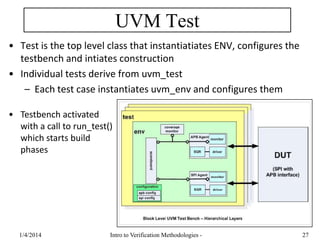
UVM Test
• Test is the top level class that instantiatiates ENV, configures the
testbench and intiates construction
• Individual tests derive from uvm_test
– Each test case instantiates uvm_env and configures them
• Testbench activated
with a call to run_test()
which starts build
phases
1/4/2016 Intro to Verification Methodologies - 27
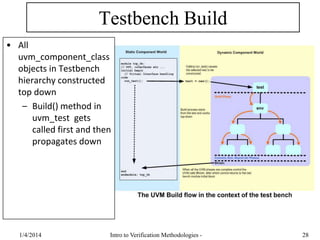
Testbench Build
• All
uvm_component_class
objects in Testbench
hierarchy constructed
top down
– Build() method in
uvm_test gets
called first and then
propagates down
1/4/2016 Intro to Verification Methodologies - 28
UVM/OVM Simulation Phases
• When using classes, you need to manage environment
creation at run-time
• Test execution is divided to phases
– Configuration, testbench creation, run-time, check, etc
• Unique tasks are performed in each simulation phase
– Set-up activities are performed during “testbench creation” while
expected results may be addressed in “check”
– Phases run in order – next phase does not begin until previous
phase is complete
• OVM/UVM provides set of standard phases enabling VIP
plug&play
1/4/2016 Intro to Verification Methodologies - 29
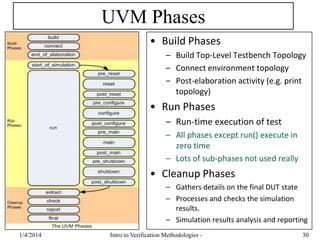
UVM Phases
• Build Phases
– Build Top-Level Testbench Topology
– Connect environment topology
– Post-elaboration activity (e.g. print
topology)
• Run Phases
– Run-time execution of test
– All phases except run() execute in
zero time
– Lots of sub-phases not used really
• Cleanup Phases
– Gathers details on the final DUT state
– Processes and checks the simulation
results.
– Simulation results analysis and reporting
1/4/2016 Intro to Verification Methodologies - 30
Run Phases
• start_of_simulation()
– occurs before the time consuming part of the testbench begins. Called in bottom
up order
• run()
– stimulus generation and checking activities
– all uvm_component run tasks are executed in parallel.
• pre_reset()
– Its purpose is to take care of any activity that should occur before reset eg:
waiting for a power good signal to go high
• reset()
- for DUT or interface specific reset behaviour.
• post_reset() -
– Intended for any activity required immediately following reset.
• pre_configure()
– Intended for anything that is required to prepare for the DUT's configuration process after
reset completion.
• configure()
– Used to program the DUT and any memories in the testbench so that it is ready for the start
of the test.
1/4/2016 Intro to Verification Methodologies - 31
Run Phases
• post_configure()
– Used to wait for the effects of configuration to propagate through the DUT.
• pre_main()
– Used to ensure that all required components are ready to start generating
stimulus.
• main()
– This is where the stimulus specified by the test case is generated and applied to
the DUT. It completes when either all stimulus is exhausted or a timeout occurs.
• post_main()
– Used to take care of any finalization of the main phase.
• pre_shutdown()
– This phase is a buffer for any DUT stimulus that needs to take place before the
shutdown phase.
• Shutdown()
– Used to ensure that the effects of the stimulus generated during the main phase
have propagated through the DUT and that any resultant data has drained away.
• post_shutdown()
– Perform any final activities before exiting the active simulation phases.
1/4/2016 Intro to Verification Methodologies - 32
UVM Factory
• UVM Factory
– Allows an object of one type to be substituted with an object of derived
type without testbench edits/re-compile
– Works on the concept of polymorphism which allows a derived class object
to be accessed using a base class type handle
• All objects should be registered with factory class
– `ovm_object_utils (for sequences) and `ovm_component_utils (for
components)
– Use ::create() method of factory instead of calling new()
• Two types of override possible
– Type overrides
• Every time a component class type is created in a testbench hierarchy, a
substitute type is created in its place. Applies to all instances of that component
type
– Instance override
• A specific component instance is overridden by specifying its position in the
uvm component hierarchy
1/4/2016 Intro to Verification Methodologies - 33
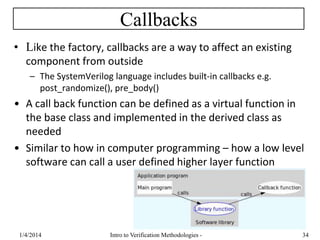
Callbacks
• Like the factory, callbacks are a way to affect an existing
component from outside
– The SystemVerilog language includes built-in callbacks e.g.
post_randomize(), pre_body()
• A call back function can be defined as a virtual function in
the base class and implemented in the derived class as
needed
• Similar to how in computer programming – how a low level
software can call a user defined higher layer function
1/4/2016 Intro to Verification Methodologies - 34
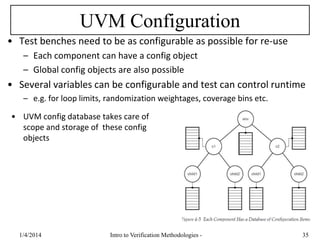
UVM Configuration
• Test benches need to be as configurable as possible for re-use
– Each component can have a config object
– Global config objects are also possible
• Several variables can be configurable and test can control runtime
– e.g. for loop limits, randomization weightages, coverage bins etc.
1/4/2016 Intro to Verification Methodologies - 35
• UVM config database takes care of
scope and storage of these config
objects
UVM Configuration
• uvm_config_db class is recommended way of accessing
config across components
– ::set* and ::get* methods available
• Two typical uses with uvm_config_db
– Passing virtual interfaces from DUT to test
• In module top() - add the physical interface into config
db using config_db::set() method
• In class uvm_test() – get the handle to interface using
config_db::get() and pass down to agents
– Passing configuration classes down through TB
1/4/2016 Intro to Verification Methodologies - 36
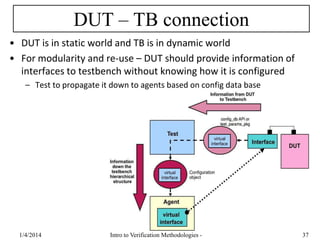
DUT – TB connection
• DUT is in static world and TB is in dynamic world
• For modularity and re-use – DUT should provide information of
interfaces to testbench without knowing how it is configured
– Test to propagate it down to agents based on config data base
1/4/2016 Intro to Verification Methodologies - 37
End of Test Mechanism - Objections
• End of Test
– Happens when all time consuming phases end
– A phase end happens when there are no pending objections to that phase
• uvm_objection class
– Provides a shared counter between all participating components
and sequences
– Each participant can “raise” (increase) or “drop” (decrease)
objection
– Used in run() phase of UVM to determine end of phase when an
“all dropped” (zero count) is reached
• Methods
– ::raise_objection()
– ::drop_objection()
1/4/2016 Intro to Verification Methodologies - 38
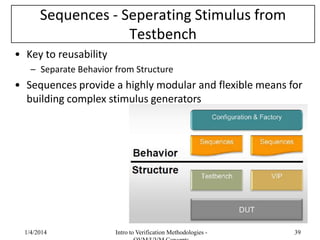
Sequences - Seperating Stimulus from
Testbench
• Key to reusability
– Separate Behavior from Structure
• Sequences provide a highly modular and flexible means for
building complex stimulus generators
1/4/2016 Intro to Verification Methodologies - 39
Layered Sequential Stimulus
1/4/2016 Intro to Verification Methodologies - 40
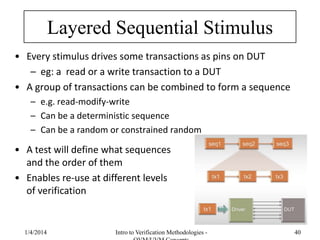
• Every stimulus drives some transactions as pins on DUT
– eg: a read or a write transaction to a DUT
• A group of transactions can be combined to form a sequence
– e.g. read-modify-write
– Can be a deterministic sequence
– Can be a random or constrained random
• A test will define what sequences
and the order of them
• Enables re-use at different levels
of verification
UVM Sequences - Overview
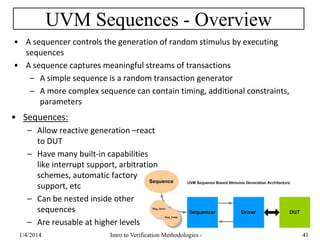
• A sequencer controls the generation of random stimulus by executing
sequences
• A sequence captures meaningful streams of transactions
– A simple sequence is a random transaction generator
– A more complex sequence can contain timing, additional constraints,
parameters
• Sequences:
– Allow reactive generation –react
to DUT
– Have many built-in capabilities
like interrupt support, arbitration
schemes, automatic factory
support, etc
– Can be nested inside other
sequences
– Are reusable at higher levels
1/4/2016 Intro to Verification Methodologies - 41
UVM Sequences
• Sequence is a transient object with limited life time unlike a
uvm_component
– Each sequence will have to implement a task called body()
– This can be implemented to create other sequences or to generate
sequence_item and send to driver
• Sequencer is an intermediate component that implements
communication channels and arbitration mechanisms between
sequence and driver
• Sequence item
– Data object that contains all the needs of a driver to driver on pin level
– Most randomization done on this object
– Should implement all of the virtual methods like
copy/clone/compare/print etc
1/4/2016 Intro to Verification Methodologies - 42
Sequence Execution Flow
• Call uvm_sequence::start() to start sequence execution
– Will internally call the body() method
– The body() can implement what all sequence_items to be send to
driver or whether to spawn other sequence etc..
• Controlling multiple sequences to a single driver
– Sequencer has 5 arbitration schemes that can be configured
– Sequence id field can be used for correlating response from
drivers to a sequence.
– Methods like grab or lock are available if a sequence need
exclusive access to driver
• Controlled stimulus generation on multiple drivers connected to
different interface
– Use a Virtual sequence which can start sub-sequences
1/4/2016 Intro to Verification Methodologies - 43
Virtual Sequences
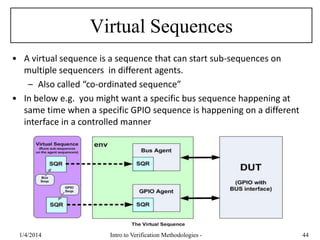
• A virtual sequence is a sequence that can start sub-sequences on
multiple sequencers in different agents.
– Also called “co-ordinated sequence”
• In below e.g. you might want a specific bus sequence happening at
same time when a specific GPIO sequence is happening on a different
interface in a controlled manner
1/4/2016 Intro to Verification Methodologies - 44
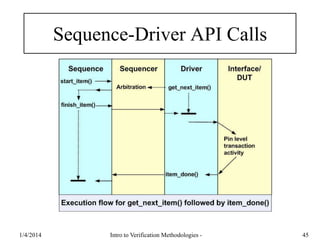
Sequence-Driver API Calls
1/4/2016 Intro to Verification Methodologies - 45
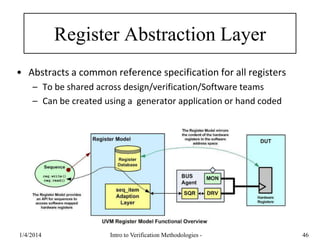
Register Abstraction Layer
• Abstracts a common reference specification for all registers
– To be shared across design/verification/Software teams
– Can be created using a generator application or hand coded
1/4/2016 Intro to Verification Methodologies - 46
Acknowledgements/Reference
• Thanks to following useful content
– Accellera SystemVerilog workshop foils at DAC2003
– Verification Academy Trainings and OVM/UVM cookbooks
– Several other Reference papers on DVCon etc
1/4/2016 Intro to Verification Methodologies -
OVM/UVM Concepts
47
Thank you
• For more video lectures on same follow
– http://verificationexcellence.in/online-courses/
• Follow on Facebook
– https://www.facebook.com/verificationexcellen
ce
• Follow on Twitter
– https://twitter.com/ramdas2m
1/4/2016 Intro to Verification Methodologies - 48
Thank You
• Sign up here
– http://verificationexcellence.in/online-courses/
• Follow on Face book – Click Here
– https://www.facebook.com/verificationexcellence
• Follow on Twitter - Click Here
– https://twitter.com/ramdas2m
1/4/2016 Intro to Verification Methodologies - 49

SystemVerilog based OVM and UVM Verification Methodologies

  • 1.
    Introduction to Verification Methodologies- OVM/UVM Ramdas M Expert Verification Engineer 1/4/2016 Intro to Verification Methodologies - OVM/UVM Concepts 1
  • 2.
    Agenda • Standard VerificationMethodologies – Need for Methodologies – Layered Testbench Architecture – TLM concepts – OVM/UVM concepts • Testbench structure - Agent, Env, Factory, Callbacks • Sequences • For more Course Resources, Tutorials see • http://verificationexcellence.in/ 1/4/2016 Intro to Verification Methodologies - OVM/UVM Concepts 2
  • 3.
    Self Paced onlinecourses • New and engaging way to learn everything about Functional Verification • Sign up here: http://verificationexcellence.in/online- courses/ • Structured online courses – SOC Verification using System Verilog – Learn SVA and Coverage Coding – Learn to build OVM/UVM Testbenches from scratch 1/4/2016 Intro to Verification Methodologies - OVM/UVM Concepts 3
  • 4.
    Why do weneed Standard Methodology? • Traditional methods doesn’t scale up or enable re-use across verification for complex design • Verification is increasingly becoming critical and complex – Building constrained random test benches is complex and time consuming – Projects demand verification engineers to divide and conquer • Following needs to be addressed for efficiency – Automation – Abstraction – Re-use – Interoparability – Quality 1/4/2016 Intro to Verification Methodologies - 4
  • 5.
    What must amethodology Provide? • Standard to enable re-use – Abstraction/Project/Company/Industry wide re-use • Layered approach to enable a division of skills and development – Developing verification IP – Re-using and configuring existing verification IP – Separation of Stimulus from Testbench Structure – Writing of new code • Assertions and/or coverage points • Writing or re-using checkers • Writing or re-using test cases 1/4/2016 Intro to Verification Methodologies - 5
  • 6.
    What must amethodology Provide? • A consistent approach – Naming conventions – Verification IP configuration • Defining the number of agent • How they connect to the DUT • Whether an agent is ACTIVE or PASSIVE – Well-defined generation and simulation phases • Build, connect, pre-run, run, post-run • The power to find bugs fast – Faster development of Testbench – Good control on stimulus, observability and debug ability • Vendor/Tool independence • Verification Management - Planning, progress and completion 1/4/2016 Intro to Verification Methodologies - 6
  • 7.
    History of VerificationMethodologies 1/4/2016 Intro to Verification Methodologies - 7
  • 8.
    What is OVM/UVM? • OVM - Open Verification Methodology – Backward compatible with AVM and URM • UVM - Universal Verification Methodology – Accellera standard – SystemVerilog UVM Base Class Library (BCL) – Near-backward compatible with OVM • Both are Open source (Apache licence) • Test benches for (System)Verilog / VHDL / SystemC designs • SystemVerilog class library 1/4/2016 Intro to Verification Methodologies - 8
  • 9.
    OVM/UVM Conceptual View 1/4/2016Intro to Verification Methodologies - OVM/UVM Concepts 9
  • 10.
    Highlights of OVMand UVM • Constrained random, coverage-driven verification • Configurable, flexible, test benches • Verification IP reuse • Separation of tests/stimulus from test bench • Transaction-level communication (TLM) • Layered sequential stimulus • Standardized messaging • Register layer (Newly added in UVM) – Enables programming and verifying registers in a consistent and efficient manner 1/4/2016 Intro to Verification Methodologies - 10
  • 11.
    UVM – OVM- Differences • UVM is based on OVM 2.1.1 – The deprecated features from OVM were removed in UVM (deprecated.txt file in the OVM install area). – The URM and AVM compatibility layers were removed from UVM. • Updates in UVM – Enhancements to the OVM callback facility, including a new message catching facility. – Enhancements to the OVM objection mechanism. • These enhancements introduce some minor backward incompatibilities to the OVM callback facility. – Few capabiilties donated from VMM (not sure what?) – Other than this – it is a blind change from ovm_* to uvm_* for the whole library 1/4/2016 Intro to Verification Methodologies - 11
  • 12.
    Layered Test benchArchitecture • Structured Test benches are important for complex DUT Verification – Better maintainability – Better reusability – Parallel Development and Verification 1/4/2016 Intro to Verification Methodologies - 12
  • 13.
    Layered Test benchArchitecture • Bottom layer – Pin level interface • Next layer abstracts to transactions • All further layers above work on transactions 1/4/2016 Intro to Verification Methodologies - 13
  • 14.
    Transactors • Components thatconverts stream of transaction to pin level interface and vice versa – Monitor • Passive components that watches the pin toggles and converts them to a stream of transactions – Driver • Converts a stream of transactions to pin level activity – Respondent • Similar to a driver but responds to an activity rather than initiating activity 1/4/2016 Intro to Verification Methodologies - 14
  • 15.
    Operational Components • Transactionalcomponents that provides everything needed for DUT to operate – Stimulus Generator • Creates stream of transactions to stimulate the DUT. Can be random, directed or pseudo-random – Master • Bi-directional component that can send requests and can receive responses – Slave • Bi-directional component that responds to requests by returning with responses 1/4/2016 Intro to Verification Methodologies - 15
  • 16.
    Analysis and ControllerComponents • Analysis components receive information about activities in the testbench and use that information for determination of correctness or completion – Scoreboards • They receive information about what’s going into and out of the DUT and analyze those for the correctness of DUT – Coverage collector • The count streams of transactions and different aspects to transactions and help in determining the completeness of verification • Controller forms the main thread of the test – They receive and send information from various testbench components to control the test – They control the start and stop of stimulus generators 1/4/2016 Intro to Verification Methodologies - 16
  • 17.
    Transaction Level Modelling •Transaction-level models consist of multiple processes communicating with each other by sending transactions back and forth through channels. – Abstracts time • Reduces the number of activation of processes • RTL evaluation of nets/signals vs evaluation of transactions – Abstracts data • Form transaction objects instead of bit by bit details – Abstracts function • Implement functionality with functions/processes rather than with real registers or circuits 1/4/2016 Intro to Verification Methodologies - 17
  • 18.
    Understanding TLM -OVM/UVM • TLM is the basis for modularity and re- use in OVM/UVM • TLM is all about communication through method calls – A TLM port specifies the “API” to be used – A TLM export supplies the implementation of the methods • Connections are between ports/exports, not components • Transactions are objects • Ports & exports are parameterized by the transaction type being communicated 1/4/2016 Intro to Verification Methodologies - 18
  • 19.
    TLM interfaces supported 1/4/2016Intro to Verification Methodologies - OVM/UVM Concepts 19 • Unidirectional – Blocking (Tasks) • put • get/peek – Nonblocking (functions) • try_put • try_get/try_peek • write • Bi directional – Master • put_request • get_response – Slave • get_request • put_response – Transport • transport • nb_transport (function) – Sequence/Driver • get_request • put_response
  • 20.
    Analysis Ports • Analysisports support 1:many connections • Meets “observer pattern” where observers register with a single source of information • Used by coverage collectors and score boards • write() needs to be non-blocking 1/4/2016 Intro to Verification Methodologies - 20
  • 21.
    UVM Testbench Hierarchy •Testbenches are built from classes derived from uvm_component class • Top level class is a test class that instantiates “env” class which instantiates a series of components • Modular to facilitate the reuse of groups of verification components – Across projects (horizontal reuse) – Across levels of integration (veritical reuse) • Two main collective component types – the env (short for environment) – the agent 1/4/2016 Intro to Verification Methodologies - 21
  • 22.
    UVM Component andSequences • Structural components of Testbench and Stimulus generation are kept separate. • All structural components of testbench are derived from uvm_component base class – Creates a static hierarchy • All transient objects are derived from uvm_sequence base class which are created, used and garbage collected when de-referenced 1/4/2016 Intro to Verification Methodologies - 22
  • 23.
    Available UVM components 1/4/2016Intro to Verification Methodologies - 23
  • 24.
    UVM Agent • UVMagent – collection of a group of uvm_components focused around a specific pin-level interface – Multiple agents can be used for multiple DUT interfaces which has different protocol – Agents can be reused for similar interfaces 1/4/2016 Intro to Verification Methodologies - 24
  • 25.
    Agent Components • Driver– Converts data inside a series of sequence_items into pin level transactions. • Sequencer - Routes sequence_items from a sequence where they are generated to/from a driver. • Monitor - Observes pin level activity and converts its observations into sequence_items which are sent to analysis components • Configuration object – Contains information about agent which determines what it does and how it is built and connected. 1/4/2016 Intro to Verification Methodologies - 25
  • 26.
    UVM Env • Collectionof UVM Agents – Allows interface level reuse • Has its own configuration object – eg: can control no of agents, env.config can set agent.config • Can have analysis components like scoreboard, coverage monitor • Multiple block level env classes can be instantiated to have top level env 1/4/2016 Intro to Verification Methodologies - 26
  • 27.
    UVM Test • Testis the top level class that instantiatiates ENV, configures the testbench and intiates construction • Individual tests derive from uvm_test – Each test case instantiates uvm_env and configures them • Testbench activated with a call to run_test() which starts build phases 1/4/2016 Intro to Verification Methodologies - 27
  • 28.
    Testbench Build • All uvm_component_class objectsin Testbench hierarchy constructed top down – Build() method in uvm_test gets called first and then propagates down 1/4/2016 Intro to Verification Methodologies - 28
  • 29.
    UVM/OVM Simulation Phases •When using classes, you need to manage environment creation at run-time • Test execution is divided to phases – Configuration, testbench creation, run-time, check, etc • Unique tasks are performed in each simulation phase – Set-up activities are performed during “testbench creation” while expected results may be addressed in “check” – Phases run in order – next phase does not begin until previous phase is complete • OVM/UVM provides set of standard phases enabling VIP plug&play 1/4/2016 Intro to Verification Methodologies - 29
  • 30.
    UVM Phases • BuildPhases – Build Top-Level Testbench Topology – Connect environment topology – Post-elaboration activity (e.g. print topology) • Run Phases – Run-time execution of test – All phases except run() execute in zero time – Lots of sub-phases not used really • Cleanup Phases – Gathers details on the final DUT state – Processes and checks the simulation results. – Simulation results analysis and reporting 1/4/2016 Intro to Verification Methodologies - 30
  • 31.
    Run Phases • start_of_simulation() –occurs before the time consuming part of the testbench begins. Called in bottom up order • run() – stimulus generation and checking activities – all uvm_component run tasks are executed in parallel. • pre_reset() – Its purpose is to take care of any activity that should occur before reset eg: waiting for a power good signal to go high • reset() - for DUT or interface specific reset behaviour. • post_reset() - – Intended for any activity required immediately following reset. • pre_configure() – Intended for anything that is required to prepare for the DUT's configuration process after reset completion. • configure() – Used to program the DUT and any memories in the testbench so that it is ready for the start of the test. 1/4/2016 Intro to Verification Methodologies - 31
  • 32.
    Run Phases • post_configure() –Used to wait for the effects of configuration to propagate through the DUT. • pre_main() – Used to ensure that all required components are ready to start generating stimulus. • main() – This is where the stimulus specified by the test case is generated and applied to the DUT. It completes when either all stimulus is exhausted or a timeout occurs. • post_main() – Used to take care of any finalization of the main phase. • pre_shutdown() – This phase is a buffer for any DUT stimulus that needs to take place before the shutdown phase. • Shutdown() – Used to ensure that the effects of the stimulus generated during the main phase have propagated through the DUT and that any resultant data has drained away. • post_shutdown() – Perform any final activities before exiting the active simulation phases. 1/4/2016 Intro to Verification Methodologies - 32
  • 33.
    UVM Factory • UVMFactory – Allows an object of one type to be substituted with an object of derived type without testbench edits/re-compile – Works on the concept of polymorphism which allows a derived class object to be accessed using a base class type handle • All objects should be registered with factory class – `ovm_object_utils (for sequences) and `ovm_component_utils (for components) – Use ::create() method of factory instead of calling new() • Two types of override possible – Type overrides • Every time a component class type is created in a testbench hierarchy, a substitute type is created in its place. Applies to all instances of that component type – Instance override • A specific component instance is overridden by specifying its position in the uvm component hierarchy 1/4/2016 Intro to Verification Methodologies - 33
  • 34.
    Callbacks • Like thefactory, callbacks are a way to affect an existing component from outside – The SystemVerilog language includes built-in callbacks e.g. post_randomize(), pre_body() • A call back function can be defined as a virtual function in the base class and implemented in the derived class as needed • Similar to how in computer programming – how a low level software can call a user defined higher layer function 1/4/2016 Intro to Verification Methodologies - 34
  • 35.
    UVM Configuration • Testbenches need to be as configurable as possible for re-use – Each component can have a config object – Global config objects are also possible • Several variables can be configurable and test can control runtime – e.g. for loop limits, randomization weightages, coverage bins etc. 1/4/2016 Intro to Verification Methodologies - 35 • UVM config database takes care of scope and storage of these config objects
  • 36.
    UVM Configuration • uvm_config_dbclass is recommended way of accessing config across components – ::set* and ::get* methods available • Two typical uses with uvm_config_db – Passing virtual interfaces from DUT to test • In module top() - add the physical interface into config db using config_db::set() method • In class uvm_test() – get the handle to interface using config_db::get() and pass down to agents – Passing configuration classes down through TB 1/4/2016 Intro to Verification Methodologies - 36
  • 37.
    DUT – TBconnection • DUT is in static world and TB is in dynamic world • For modularity and re-use – DUT should provide information of interfaces to testbench without knowing how it is configured – Test to propagate it down to agents based on config data base 1/4/2016 Intro to Verification Methodologies - 37
  • 38.
    End of TestMechanism - Objections • End of Test – Happens when all time consuming phases end – A phase end happens when there are no pending objections to that phase • uvm_objection class – Provides a shared counter between all participating components and sequences – Each participant can “raise” (increase) or “drop” (decrease) objection – Used in run() phase of UVM to determine end of phase when an “all dropped” (zero count) is reached • Methods – ::raise_objection() – ::drop_objection() 1/4/2016 Intro to Verification Methodologies - 38
  • 39.
    Sequences - SeperatingStimulus from Testbench • Key to reusability – Separate Behavior from Structure • Sequences provide a highly modular and flexible means for building complex stimulus generators 1/4/2016 Intro to Verification Methodologies - 39
  • 40.
    Layered Sequential Stimulus 1/4/2016Intro to Verification Methodologies - 40 • Every stimulus drives some transactions as pins on DUT – eg: a read or a write transaction to a DUT • A group of transactions can be combined to form a sequence – e.g. read-modify-write – Can be a deterministic sequence – Can be a random or constrained random • A test will define what sequences and the order of them • Enables re-use at different levels of verification
  • 41.
    UVM Sequences -Overview • A sequencer controls the generation of random stimulus by executing sequences • A sequence captures meaningful streams of transactions – A simple sequence is a random transaction generator – A more complex sequence can contain timing, additional constraints, parameters • Sequences: – Allow reactive generation –react to DUT – Have many built-in capabilities like interrupt support, arbitration schemes, automatic factory support, etc – Can be nested inside other sequences – Are reusable at higher levels 1/4/2016 Intro to Verification Methodologies - 41
  • 42.
    UVM Sequences • Sequenceis a transient object with limited life time unlike a uvm_component – Each sequence will have to implement a task called body() – This can be implemented to create other sequences or to generate sequence_item and send to driver • Sequencer is an intermediate component that implements communication channels and arbitration mechanisms between sequence and driver • Sequence item – Data object that contains all the needs of a driver to driver on pin level – Most randomization done on this object – Should implement all of the virtual methods like copy/clone/compare/print etc 1/4/2016 Intro to Verification Methodologies - 42
  • 43.
    Sequence Execution Flow •Call uvm_sequence::start() to start sequence execution – Will internally call the body() method – The body() can implement what all sequence_items to be send to driver or whether to spawn other sequence etc.. • Controlling multiple sequences to a single driver – Sequencer has 5 arbitration schemes that can be configured – Sequence id field can be used for correlating response from drivers to a sequence. – Methods like grab or lock are available if a sequence need exclusive access to driver • Controlled stimulus generation on multiple drivers connected to different interface – Use a Virtual sequence which can start sub-sequences 1/4/2016 Intro to Verification Methodologies - 43
  • 44.
    Virtual Sequences • Avirtual sequence is a sequence that can start sub-sequences on multiple sequencers in different agents. – Also called “co-ordinated sequence” • In below e.g. you might want a specific bus sequence happening at same time when a specific GPIO sequence is happening on a different interface in a controlled manner 1/4/2016 Intro to Verification Methodologies - 44
  • 45.
    Sequence-Driver API Calls 1/4/2016Intro to Verification Methodologies - 45
  • 46.
    Register Abstraction Layer •Abstracts a common reference specification for all registers – To be shared across design/verification/Software teams – Can be created using a generator application or hand coded 1/4/2016 Intro to Verification Methodologies - 46
  • 47.
    Acknowledgements/Reference • Thanks tofollowing useful content – Accellera SystemVerilog workshop foils at DAC2003 – Verification Academy Trainings and OVM/UVM cookbooks – Several other Reference papers on DVCon etc 1/4/2016 Intro to Verification Methodologies - OVM/UVM Concepts 47
  • 48.
    Thank you • Formore video lectures on same follow – http://verificationexcellence.in/online-courses/ • Follow on Facebook – https://www.facebook.com/verificationexcellen ce • Follow on Twitter – https://twitter.com/ramdas2m 1/4/2016 Intro to Verification Methodologies - 48
  • 49.
    Thank You • Signup here – http://verificationexcellence.in/online-courses/ • Follow on Face book – Click Here – https://www.facebook.com/verificationexcellence • Follow on Twitter - Click Here – https://twitter.com/ramdas2m 1/4/2016 Intro to Verification Methodologies - 49

Editor's Notes

  • #18 Abstracting time reduces the number of activation of processes. Event based vs cycle based simulations. RTL evaluation of nets/signals vs evaluation of transactions Abstracting data - forms transaction objects instead of bit by bit details Abstracting function – TLMs implement design functionality with functions rather than with real registers or actual circuit as in RTL
  • #19 Value of TLM - Modularity and re-use. For eg: in above diagram, the target can be easily replaced by another component that has same interface.
  • #21 Write method in analysis port gets actually implemented in all subscribers which need to implement write() Write() happens in zero time – non-blocking
  • #26 Standard UVM Agent configurations UVM_ACTIVE - Active agent which can have driver, sequencer and monitor UVM_PASSIVE - Passive agent which can have only a monitor – and still can do coverage/checking user defined configurations - eg: address configurations of slave
  • #31 All phases other than build are bottoms up. Only build is top down
  • #34 For objects or sequences - only type override is really used – as the hierarchy is not possible for them unlike components Eg : for component override – You may have default components with default behavior which you might want to override in specific tests with a more controlled behavior or so. Eg: for Sequence override - You want to have a normal transaction and an error transaction and pick one of them randomly
  • #38 Passing Interface information from DUT to Test and then propagating it down to all agents using config data base is for modularity and re-use even though it is a round about way (instead of passing it directly to agents in TB)
  • #39 End of test occurs when all of the time consuming phases have ended. Each phase ends when there are no longer any pending objections to that phase. So end-of-test in the UVM is controlled by managing phase objections
  • #41 Create a sequence library package – where all sequence are defined Test can then start any sequence by calling start() method on any sequencer
  • #43 When a sequence is used, it is created, then the body method is executed, and then the sequence can be discarded.
  • #44 Start() has an argument which is pointer to the sequencer m_sequencer is a handle inside the sequence (which is transient) that gets assigned when the start() is called with the pointer of the actual sequencer