Virtual platform with OpenRisc 2010/06/08 by Sean Chen
Agenda Physical platform Virtual platform How to Co-Work? Case for OpenRisc Requirements SystemC /TLM Toolchain Other tools Getting Start How to write your test program? UART sample case How to run and simulation ? References
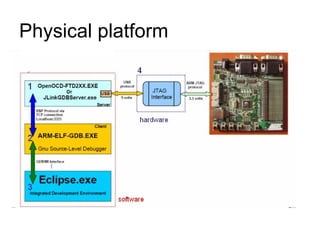
Physical platform
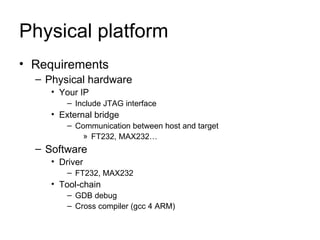
Physical platform Requirements Physical hardware Your IP Include JTAG interface External bridge Communication between host and target FT232, MAX232… Software Driver FT232, MAX232 Tool-chain GDB debug Cross compiler (gcc 4 ARM)
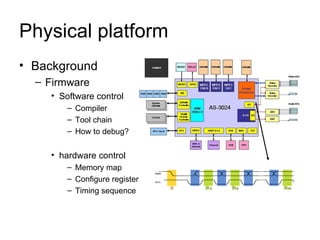
Physical platform Background Firmware Software control Compiler Tool chain How to debug? hardware control Memory map Configure register Timing sequence
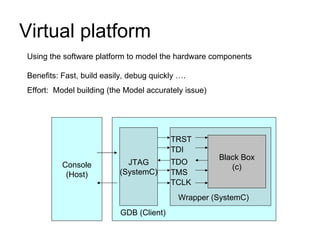
Virtual platform Using the software platform to model the hardware components Benefits: Fast, build easily, debug quickly …. Effort:  Model building (the Model accurately issue) Black Box (c) TDI TDO TMS TCLK TRST JTAG (SystemC) GDB (Client) Wrapper (SystemC) Console (Host)
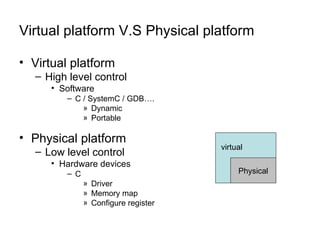
Virtual platform V.S Physical platform Virtual platform High level control Software  C / SystemC / GDB…. Dynamic Portable Physical platform Low level control Hardware devices C Driver Memory map Configure register Physical virtual
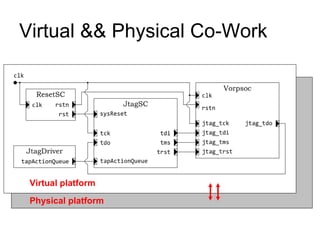
Virtual && Physical Co-Work Virtual platform Physical platform
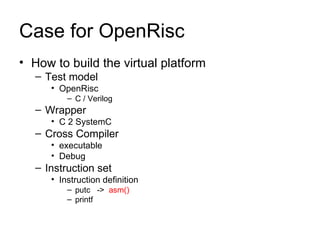
Case for OpenRisc How to build the virtual platform Test model OpenRisc C / Verilog Wrapper C 2 SystemC Cross Compiler executable Debug Instruction set Instruction definition putc  ->  asm() printf
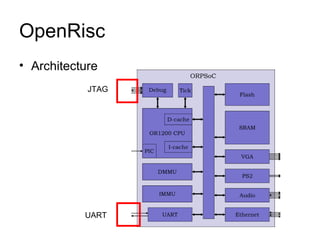
OpenRisc Architecture JTAG UART
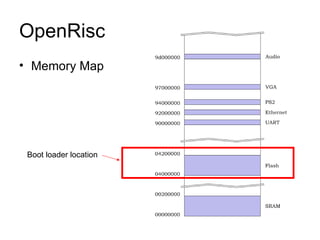
OpenRisc Memory Map Boot loader location
Requirements/SystemC/TLM What’s SystemC? SystemC processes can communicate in a  simulated  real-time environment, using signals of all the  datatypes  offered by C++, some additional ones offered by the SystemC library, as well as user defined. In certain respects, SystemC deliberately mimics the  hardware description languages   VHDL  and  Verilog , but is more aptly described as a  system-level modeling language   What’s TLM? Transaction-level modeling  (TLM) is a high-level approach to modeling digital systems where details of communication among modules are separated from the details of the implementation of functional units or of the communication architecture. Communication mechanisms such as busses or  FIFOs  are modeled as  channels ,
Requirements/Toolchain what’s Toolchain? a  toolchain  is the set of  programming tools  that are used to create a product (typically another computer program or system of programs). The tools may be used in a chain, so that the output of each tool becomes the input for the next, but the term is used widely to refer to any set of linked development tools.   Requirements GNU compiler (cross compiler) GCC GDB Lib … Patch
Requirements/other tools Verilog-Perl Verilog Parser Include Syntax Tree  SigParser  Netlist  … System-Perl SystemPerl is a version of the SystemC language. It is designed to expand text so that needless repetition in the language is minimized. By using  sp_preproc , SystemPerl files can be expanded into C++ files at compile time, or expanded in place to make them valid stand-alone SystemC files.
Requirements/other tools Verilator Verilator is the fastest free Verilog HDL simulator, and beats many commercial simulators. It compiles synthesizable Verilog (not test-bench code!), plus some PSL, SystemVerilog and Synthesis assertions into C++ or SystemC code
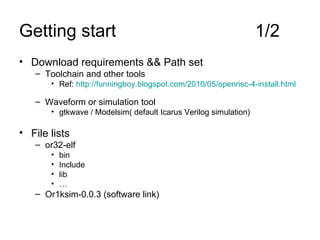
Getting start  1/2 Download requirements && Path set  Toolchain and other tools Ref:  http://funningboy.blogspot.com/2010/05/openrisc-4-install.html Waveform or simulation tool gtkwave / Modelsim( default Icarus Verilog simulation) File lists or32-elf bin Include lib … Or1ksim-0.0.3 (software link)
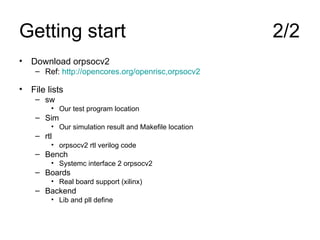
Getting start  2/2 Download orpsocv2 Ref:  http://opencores.org/openrisc,orpsocv2 File lists sw Our test program location Sim Our simulation result and Makefile location rtl orpsocv2 rtl verilog code Bench Systemc interface 2 orpsocv2 Boards Real board support (xilinx) Backend Lib and pll define
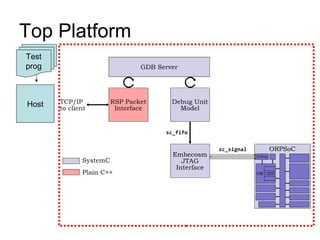
Top Platform Host Test prog
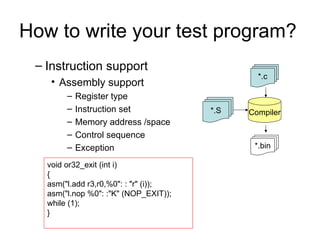
How to write your test program? Instruction support Assembly support Register type Instruction set Memory address /space Control sequence Exception  *.S Compiler *.c *.bin void or32_exit (int i) { asm("l.add r3,r0,%0": : "r" (i)); asm("l.nop %0": :"K" (NOP_EXIT)); while (1); }
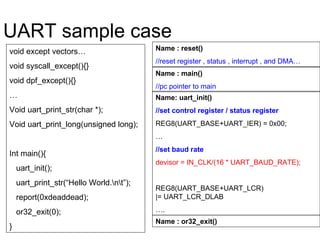
UART sample case void except vectors… void syscall_except(){} void dpf_except(){} … Void uart_print_str(char *); Void uart_print_long(unsigned long); Int main(){ uart_init(); uart_print_str(“Hello World.\n\t”); report(0xdeaddead); or32_exit(0); }  Name: uart_init() //set control register / status register REG8(UART_BASE+UART_IER) = 0x00; … //set baud rate devisor = IN_CLK/(16 * UART_BAUD_RATE); REG8(UART_BASE+UART_LCR)  |= UART_LCR_DLAB … . Name : reset() //reset register , status , interrupt , and DMA…  Name : main() //pc pointer to main Name : or32_exit()
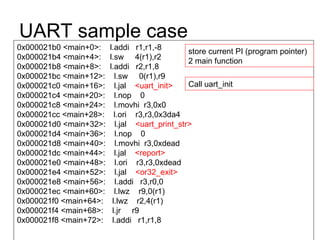
UART sample case 0x000021b0 <main+0>:  l.addi  r1,r1,-8 0x000021b4 <main+4>:  l.sw  4(r1),r2 0x000021b8 <main+8>:  l.addi  r2,r1,8 0x000021bc <main+12>:  l.sw  0(r1),r9 0x000021c0 <main+16>:  l.jal  <uart_init>  0x000021c4 <main+20>:  l.nop  0 0x000021c8 <main+24>:  l.movhi  r3,0x0 0x000021cc <main+28>:  l.ori  r3,r3,0x3da4 0x000021d0 <main+32>:  l.jal  <uart_print_str> 0x000021d4 <main+36>:  l.nop  0 0x000021d8 <main+40>:  l.movhi  r3,0xdead 0x000021dc <main+44>:  l.jal  <report> 0x000021e0 <main+48>:  l.ori  r3,r3,0xdead 0x000021e4 <main+52>:  l.jal  <or32_exit> 0x000021e8 <main+56>:  l.addi  r3,r0,0 0x000021ec <main+60>:  l.lwz  r9,0(r1) 0x000021f0 <main+64>:  l.lwz  r2,4(r1) 0x000021f4 <main+68>:  l.jr  r9 0x000021f8 <main+72>:  l.addi  r1,r1,8 store current PI (program pointer) 2 main function Call uart_init
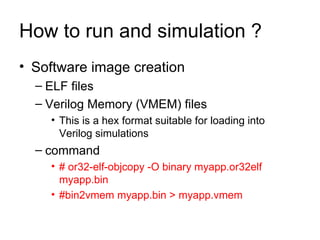
How to run and simulation ? Software image creation  ELF files Verilog Memory (VMEM) files  This is a hex format suitable for loading into Verilog simulations  command  # or32-elf-objcopy -O binary myapp.or32elf myapp.bin  #bin2vmem myapp.bin > myapp.vmem
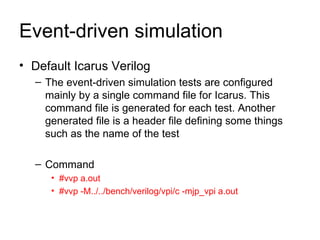
Event-driven simulation Default Icarus Verilog The event-driven simulation tests are configured mainly by a single command file for Icarus. This command file is generated for each test. Another generated file is a header file defining some things such as the name of the test  Command #vvp a.out #vvp -M../../bench/verilog/vpi/c -mjp_vpi a.out
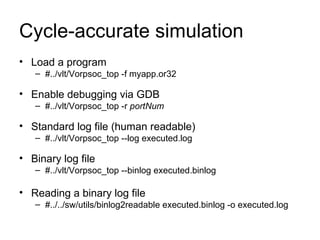
Cycle-accurate simulation Load a program  #../vlt/Vorpsoc_top -f myapp.or32 Enable debugging via GDB #../vlt/Vorpsoc_top -r  portNum   Standard log file (human readable)  #../vlt/Vorpsoc_top --log executed.log  Binary log file  #../vlt/Vorpsoc_top --binlog executed.binlog  Reading a binary log file  #../../sw/utils/binlog2readable executed.binlog -o executed.log
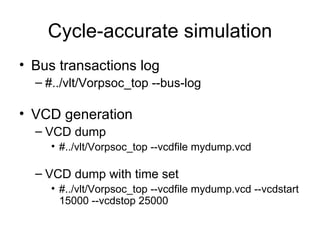
Cycle-accurate simulation Bus transactions log  #../vlt/Vorpsoc_top --bus-log  VCD generation  VCD dump #../vlt/Vorpsoc_top --vcdfile mydump.vcd  VCD dump with time set #../vlt/Vorpsoc_top --vcdfile mydump.vcd --vcdstart 15000 --vcdstop 25000
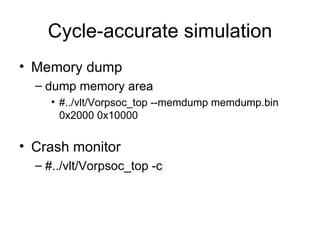
Cycle-accurate simulation Memory dump dump memory area  #../vlt/Vorpsoc_top --memdump memdump.bin 0x2000 0x10000 Crash monitor  #../vlt/Vorpsoc_top -c
References OpenRisc http://opencores.org/openrisc,orpsocv2#own_software embecosm http://www.embecosm.com/

Virtual platform

  • 1.
    Virtual platform withOpenRisc 2010/06/08 by Sean Chen
  • 2.
    Agenda Physical platformVirtual platform How to Co-Work? Case for OpenRisc Requirements SystemC /TLM Toolchain Other tools Getting Start How to write your test program? UART sample case How to run and simulation ? References
  • 3.
  • 4.
    Physical platform RequirementsPhysical hardware Your IP Include JTAG interface External bridge Communication between host and target FT232, MAX232… Software Driver FT232, MAX232 Tool-chain GDB debug Cross compiler (gcc 4 ARM)
  • 5.
    Physical platform BackgroundFirmware Software control Compiler Tool chain How to debug? hardware control Memory map Configure register Timing sequence
  • 6.
    Virtual platform Usingthe software platform to model the hardware components Benefits: Fast, build easily, debug quickly …. Effort: Model building (the Model accurately issue) Black Box (c) TDI TDO TMS TCLK TRST JTAG (SystemC) GDB (Client) Wrapper (SystemC) Console (Host)
  • 7.
    Virtual platform V.SPhysical platform Virtual platform High level control Software C / SystemC / GDB…. Dynamic Portable Physical platform Low level control Hardware devices C Driver Memory map Configure register Physical virtual
  • 8.
    Virtual && PhysicalCo-Work Virtual platform Physical platform
  • 9.
    Case for OpenRiscHow to build the virtual platform Test model OpenRisc C / Verilog Wrapper C 2 SystemC Cross Compiler executable Debug Instruction set Instruction definition putc -> asm() printf
  • 10.
  • 11.
    OpenRisc Memory MapBoot loader location
  • 12.
    Requirements/SystemC/TLM What’s SystemC?SystemC processes can communicate in a simulated real-time environment, using signals of all the datatypes offered by C++, some additional ones offered by the SystemC library, as well as user defined. In certain respects, SystemC deliberately mimics the hardware description languages VHDL and Verilog , but is more aptly described as a system-level modeling language What’s TLM? Transaction-level modeling (TLM) is a high-level approach to modeling digital systems where details of communication among modules are separated from the details of the implementation of functional units or of the communication architecture. Communication mechanisms such as busses or FIFOs are modeled as channels ,
  • 13.
    Requirements/Toolchain what’s Toolchain?a toolchain is the set of programming tools that are used to create a product (typically another computer program or system of programs). The tools may be used in a chain, so that the output of each tool becomes the input for the next, but the term is used widely to refer to any set of linked development tools. Requirements GNU compiler (cross compiler) GCC GDB Lib … Patch
  • 14.
    Requirements/other tools Verilog-PerlVerilog Parser Include Syntax Tree SigParser Netlist … System-Perl SystemPerl is a version of the SystemC language. It is designed to expand text so that needless repetition in the language is minimized. By using sp_preproc , SystemPerl files can be expanded into C++ files at compile time, or expanded in place to make them valid stand-alone SystemC files.
  • 15.
    Requirements/other tools VerilatorVerilator is the fastest free Verilog HDL simulator, and beats many commercial simulators. It compiles synthesizable Verilog (not test-bench code!), plus some PSL, SystemVerilog and Synthesis assertions into C++ or SystemC code
  • 16.
    Getting start 1/2 Download requirements && Path set Toolchain and other tools Ref: http://funningboy.blogspot.com/2010/05/openrisc-4-install.html Waveform or simulation tool gtkwave / Modelsim( default Icarus Verilog simulation) File lists or32-elf bin Include lib … Or1ksim-0.0.3 (software link)
  • 17.
    Getting start 2/2 Download orpsocv2 Ref: http://opencores.org/openrisc,orpsocv2 File lists sw Our test program location Sim Our simulation result and Makefile location rtl orpsocv2 rtl verilog code Bench Systemc interface 2 orpsocv2 Boards Real board support (xilinx) Backend Lib and pll define
  • 18.
  • 19.
    How to writeyour test program? Instruction support Assembly support Register type Instruction set Memory address /space Control sequence Exception *.S Compiler *.c *.bin void or32_exit (int i) { asm(&quot;l.add r3,r0,%0&quot;: : &quot;r&quot; (i)); asm(&quot;l.nop %0&quot;: :&quot;K&quot; (NOP_EXIT)); while (1); }
  • 20.
    UART sample casevoid except vectors… void syscall_except(){} void dpf_except(){} … Void uart_print_str(char *); Void uart_print_long(unsigned long); Int main(){ uart_init(); uart_print_str(“Hello World.\n\t”); report(0xdeaddead); or32_exit(0); } Name: uart_init() //set control register / status register REG8(UART_BASE+UART_IER) = 0x00; … //set baud rate devisor = IN_CLK/(16 * UART_BAUD_RATE); REG8(UART_BASE+UART_LCR) |= UART_LCR_DLAB … . Name : reset() //reset register , status , interrupt , and DMA… Name : main() //pc pointer to main Name : or32_exit()
  • 21.
    UART sample case0x000021b0 <main+0>: l.addi r1,r1,-8 0x000021b4 <main+4>: l.sw 4(r1),r2 0x000021b8 <main+8>: l.addi r2,r1,8 0x000021bc <main+12>: l.sw 0(r1),r9 0x000021c0 <main+16>: l.jal <uart_init> 0x000021c4 <main+20>: l.nop 0 0x000021c8 <main+24>: l.movhi r3,0x0 0x000021cc <main+28>: l.ori r3,r3,0x3da4 0x000021d0 <main+32>: l.jal <uart_print_str> 0x000021d4 <main+36>: l.nop 0 0x000021d8 <main+40>: l.movhi r3,0xdead 0x000021dc <main+44>: l.jal <report> 0x000021e0 <main+48>: l.ori r3,r3,0xdead 0x000021e4 <main+52>: l.jal <or32_exit> 0x000021e8 <main+56>: l.addi r3,r0,0 0x000021ec <main+60>: l.lwz r9,0(r1) 0x000021f0 <main+64>: l.lwz r2,4(r1) 0x000021f4 <main+68>: l.jr r9 0x000021f8 <main+72>: l.addi r1,r1,8 store current PI (program pointer) 2 main function Call uart_init
  • 22.
    How to runand simulation ? Software image creation ELF files Verilog Memory (VMEM) files This is a hex format suitable for loading into Verilog simulations command # or32-elf-objcopy -O binary myapp.or32elf myapp.bin #bin2vmem myapp.bin > myapp.vmem
  • 23.
    Event-driven simulation DefaultIcarus Verilog The event-driven simulation tests are configured mainly by a single command file for Icarus. This command file is generated for each test. Another generated file is a header file defining some things such as the name of the test Command #vvp a.out #vvp -M../../bench/verilog/vpi/c -mjp_vpi a.out
  • 24.
    Cycle-accurate simulation Loada program #../vlt/Vorpsoc_top -f myapp.or32 Enable debugging via GDB #../vlt/Vorpsoc_top -r portNum Standard log file (human readable) #../vlt/Vorpsoc_top --log executed.log Binary log file #../vlt/Vorpsoc_top --binlog executed.binlog Reading a binary log file #../../sw/utils/binlog2readable executed.binlog -o executed.log
  • 25.
    Cycle-accurate simulation Bustransactions log #../vlt/Vorpsoc_top --bus-log VCD generation VCD dump #../vlt/Vorpsoc_top --vcdfile mydump.vcd VCD dump with time set #../vlt/Vorpsoc_top --vcdfile mydump.vcd --vcdstart 15000 --vcdstop 25000
  • 26.
    Cycle-accurate simulation Memorydump dump memory area #../vlt/Vorpsoc_top --memdump memdump.bin 0x2000 0x10000 Crash monitor #../vlt/Vorpsoc_top -c
  • 27.