AMBA AHB 2.0

By-Akhil Srivastava
Ajay Sharma

1

Sicon Design Technologies

12/17/2013
AMBA AHB Bus 2.0
 AHB is a new generation of AMBA bus which is

intended to address the requirements of highperformance synthesizable designs.
 High-performance system bus that supports
multiple bus masters and provides highbandwidth operation.

2

Sicon Design Technologies

12/17/2013
Features
 Burst transfers
 Split transactions
 Single-cycle bus master handover
 Single-clock edge operation
 Non-tristate implementation

 Wider data bus configurations (64/128 bits).

3

Sicon Design Technologies

12/17/2013
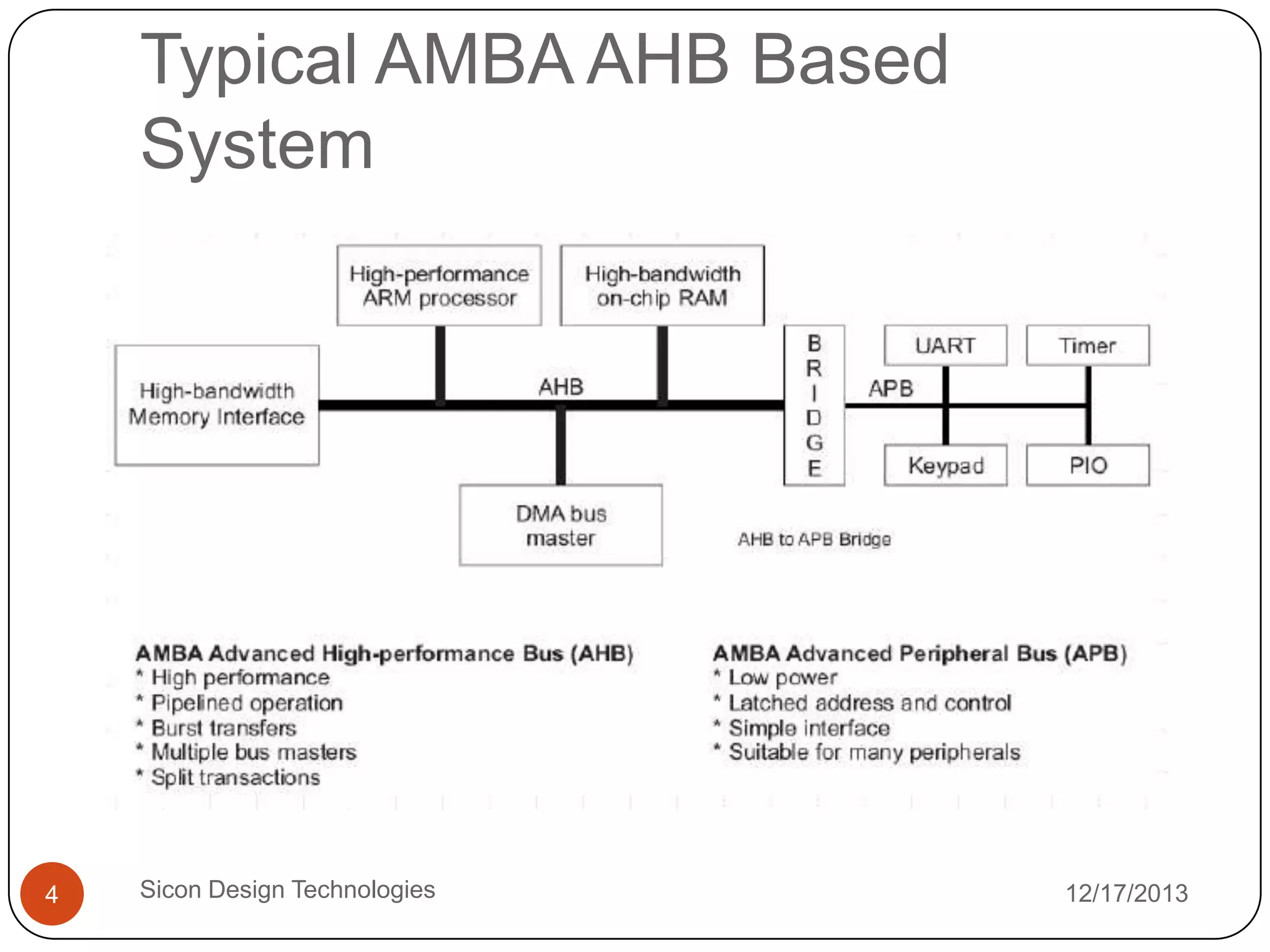
Typical AMBA AHB Based
System

4

Sicon Design Technologies

12/17/2013
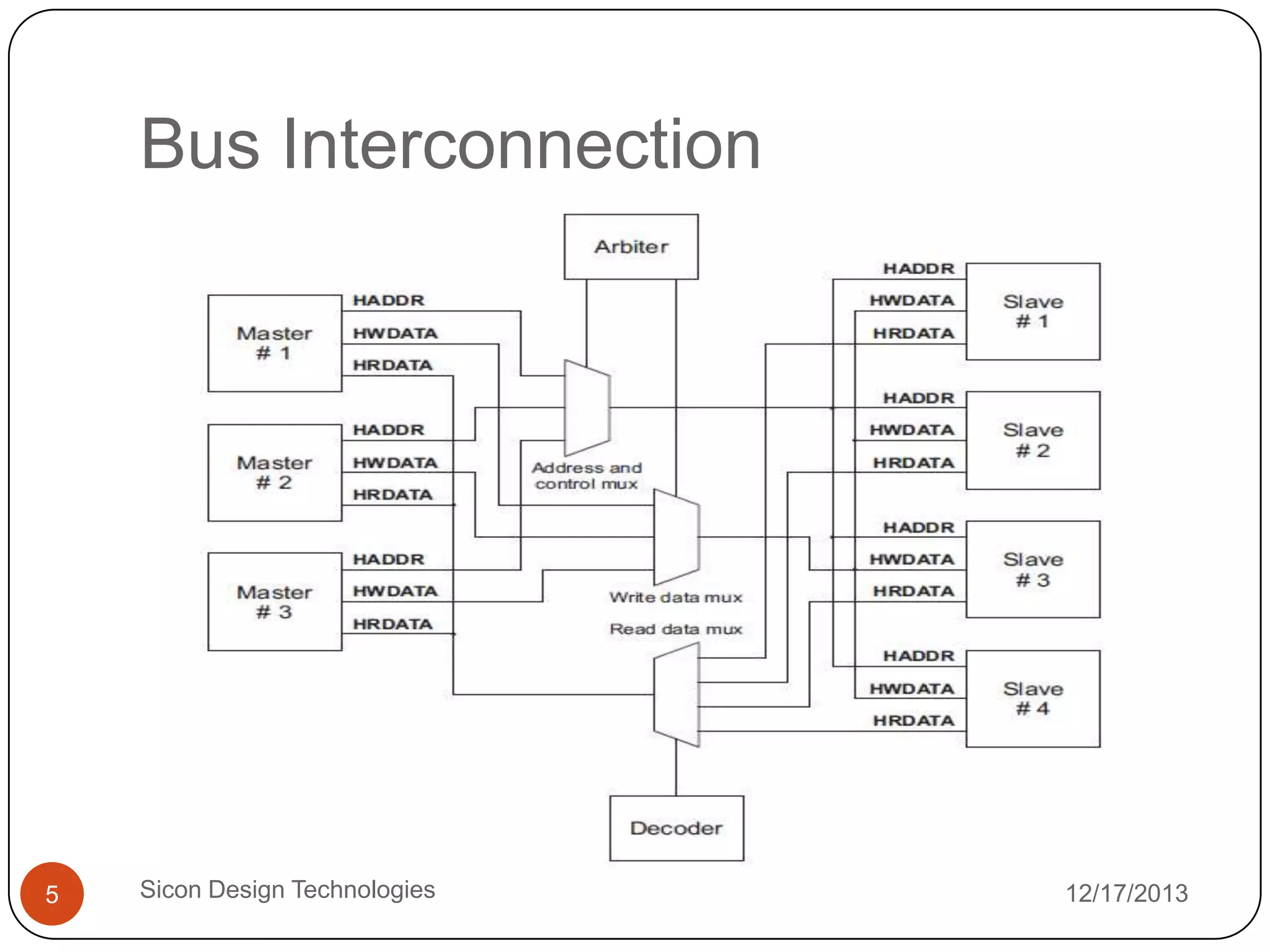
Bus Interconnection

5

Sicon Design Technologies

12/17/2013
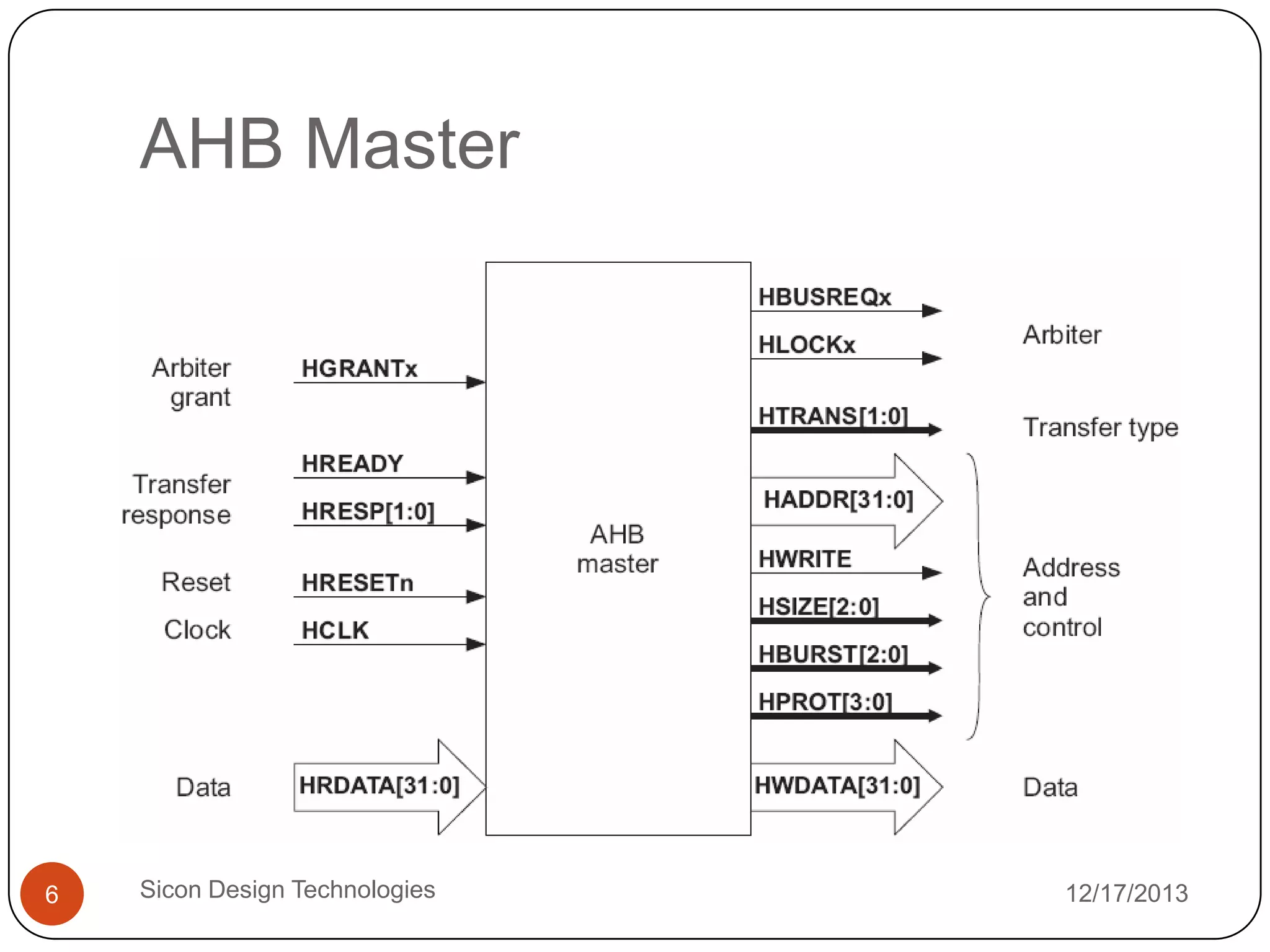
AHB Master

6

Sicon Design Technologies

12/17/2013
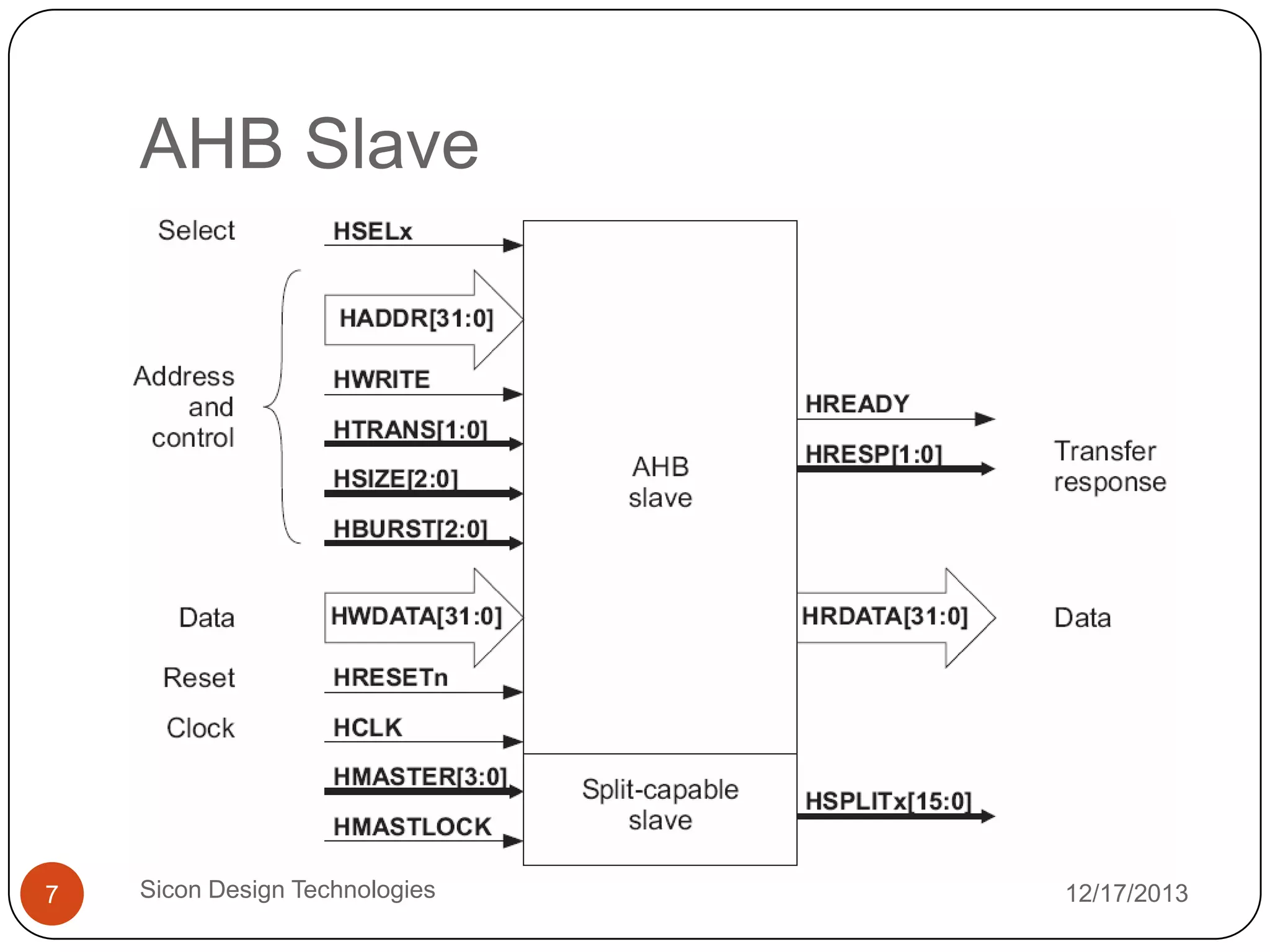
AHB Slave

7

Sicon Design Technologies

12/17/2013
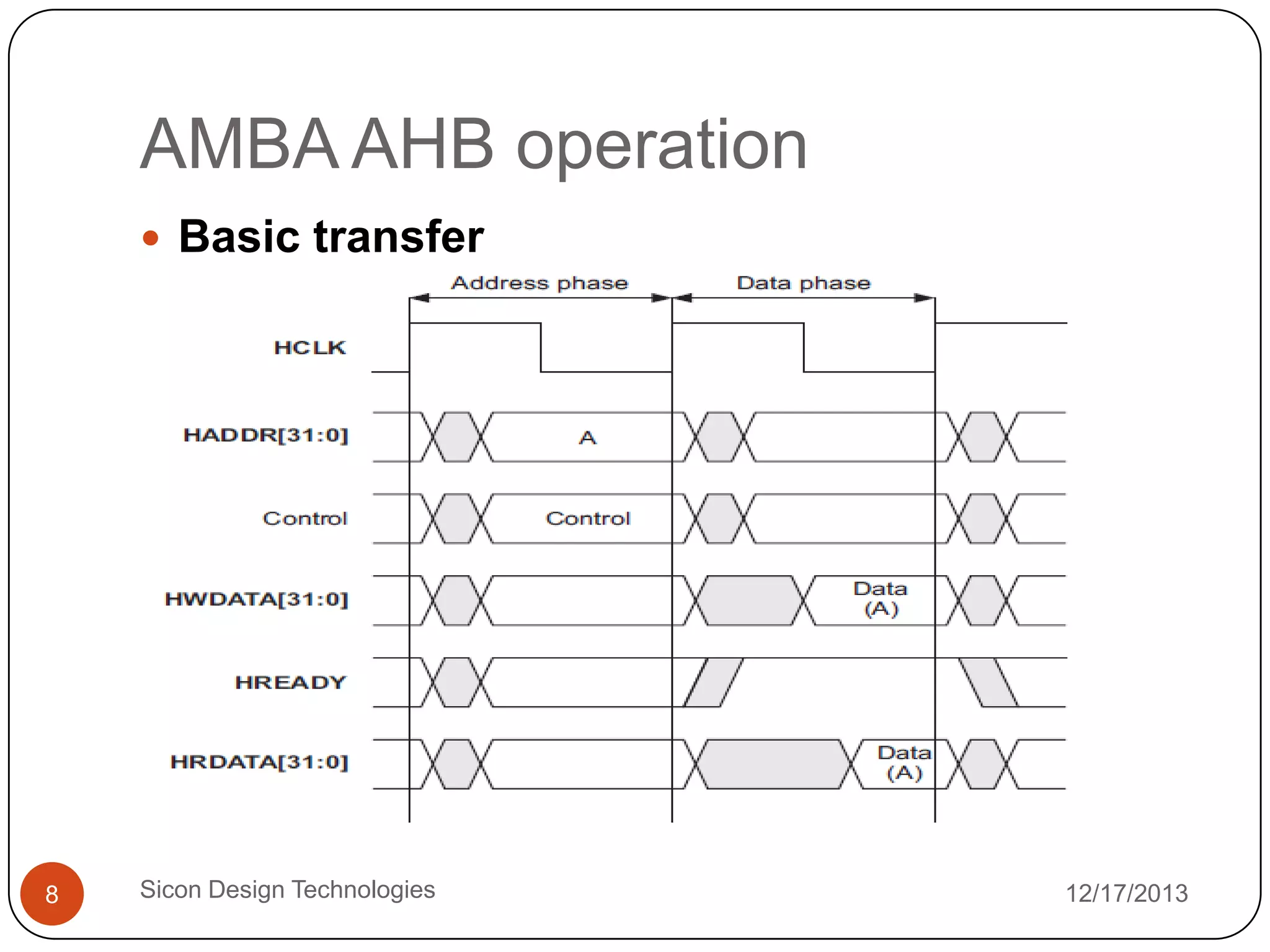
AMBA AHB operation
 Basic transfer

8

Sicon Design Technologies

12/17/2013
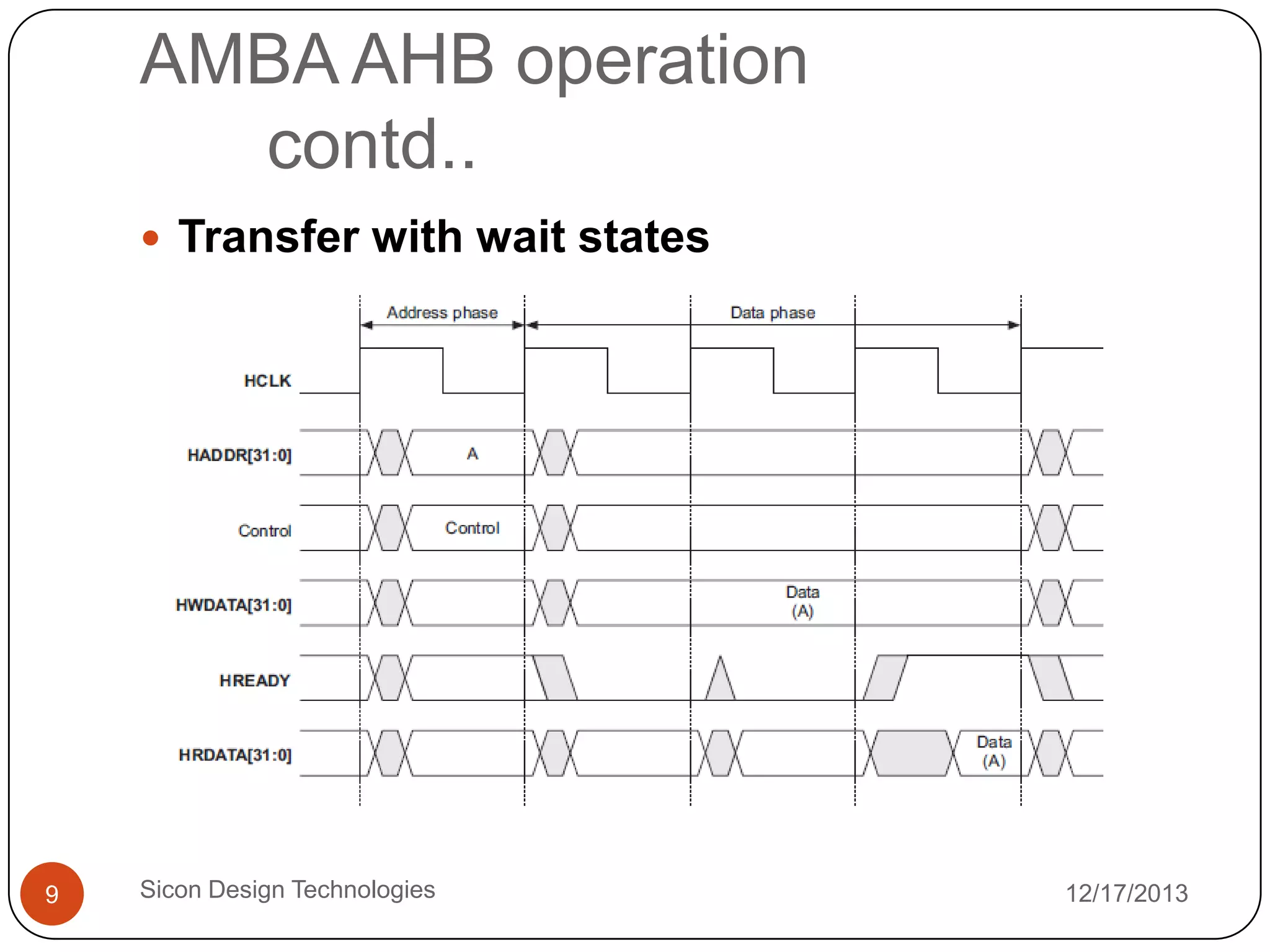
AMBA AHB operation
contd..
 Transfer with wait states

9

Sicon Design Technologies

12/17/2013
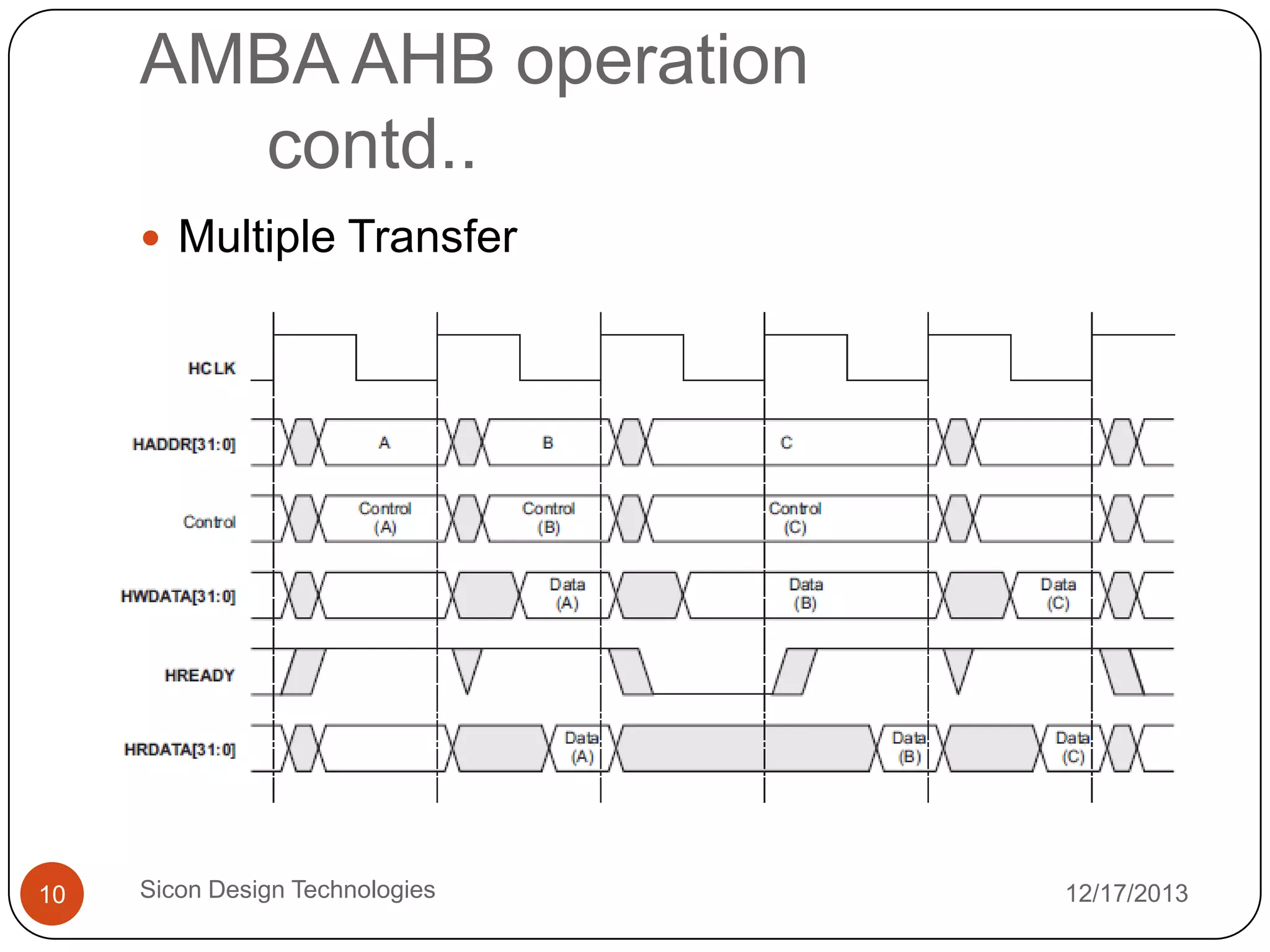
AMBA AHB operation
contd..
 Multiple Transfer

10

Sicon Design Technologies

12/17/2013
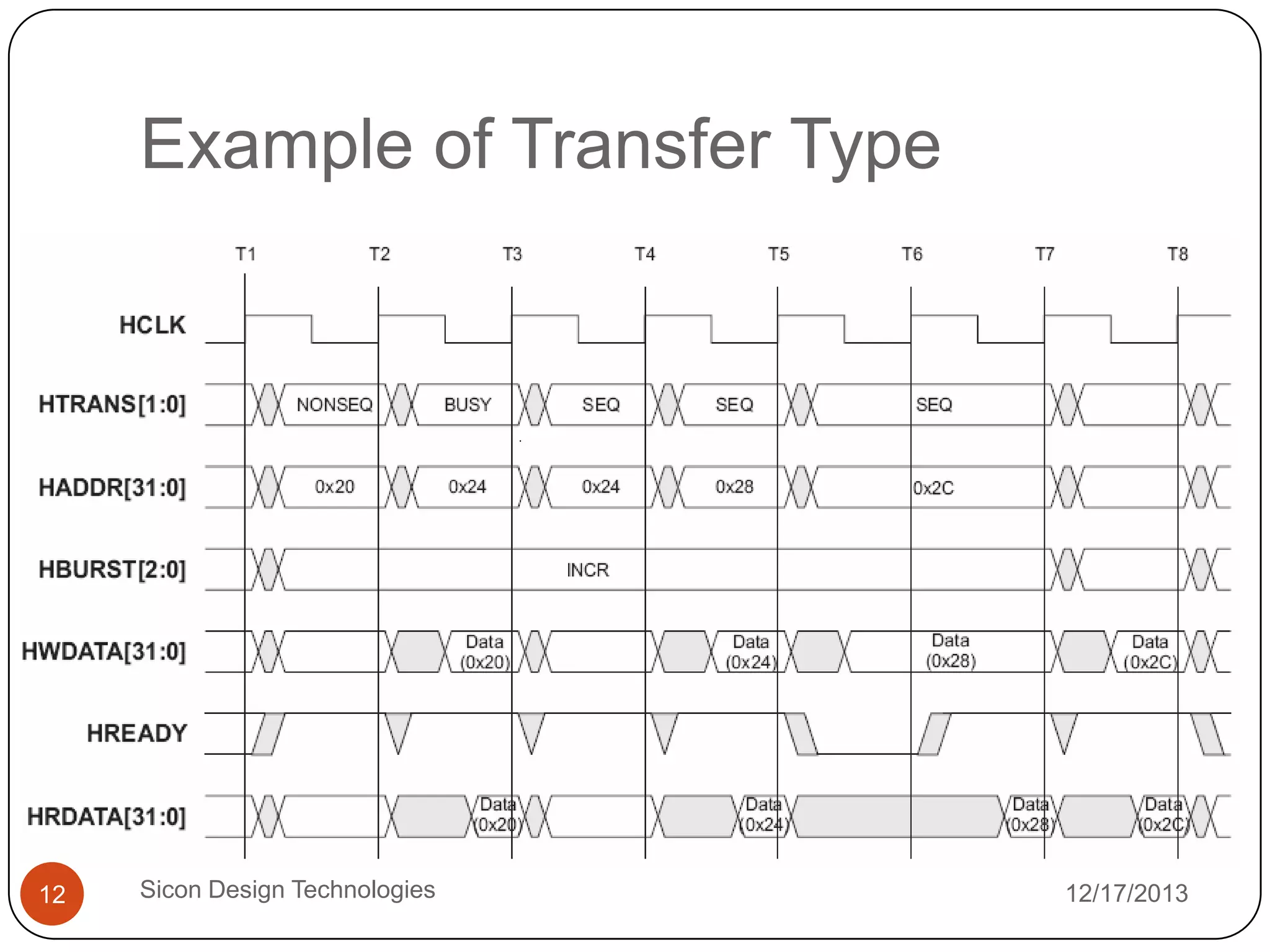
Transfer Type Encoding
HTRANS[1:0
]

Type

Description

00

IDLE

•No data transfer is required
• Used when the master is granted the bus without
performing transfer.
• The slave must provide a zero wait state OKAY
response

01

BUSY

•Allow master to insert IDLE cycle in the middle of
bursts of transfers
• Address and control signals must reflect the next
transfer in the burst
• The slave must provide a zero wait state OKAY
response.

10

NONSE
Q

•Indicate the first transfer of a burst or a single transfer
• Address and control signals are unrelated to previous
transfer

11 11

Sicon Design SEQ
Technologies

•Indicate a remaining transfer in a burst
12/17/2013
•Address = Address of previous transfer + size in
Example of Transfer Type

12

Sicon Design Technologies

12/17/2013
Burst Operation
 4/8/16-beat bursts, as well as undefined-length

bursts
 Burst size indicates the number of beats in the
burst
 Valid data transferred = (# of beats) x (data size
in each beat)
 Data size in each beat is indicated in HSIZE[2:0]

 Incrementing bursts
 Access sequential locations with the address of each

13

transfer in the burst being an increment of the previous
address
 An incremental burst can be of any length, but the upper
limit is set by
Sicon Design Technologies the fact that address must not cross a 1KB
12/17/2013
boundary
Burst Operation

contd..

 Wrapping bursts
 If the start address of the transfer is not aligned to the total

number of bytes in a burst (size x beats) then the address of
the transfers in the burst will wrap when the boundary is
reached
 A 4-beat wrapping burst of word (4-byte) access
 If start address is 0x38 -> 0x38, 0x3C, 0x30, 0x34

 Transfers within a burst must be aligned to the

address boundary equal to the size of the
transfer
 Word transfers must have A[1:0] = 00
 Halfword transfers must have A[0] = 0
14

Sicon Design Technologies

12/17/2013
Burst Operation

contd..

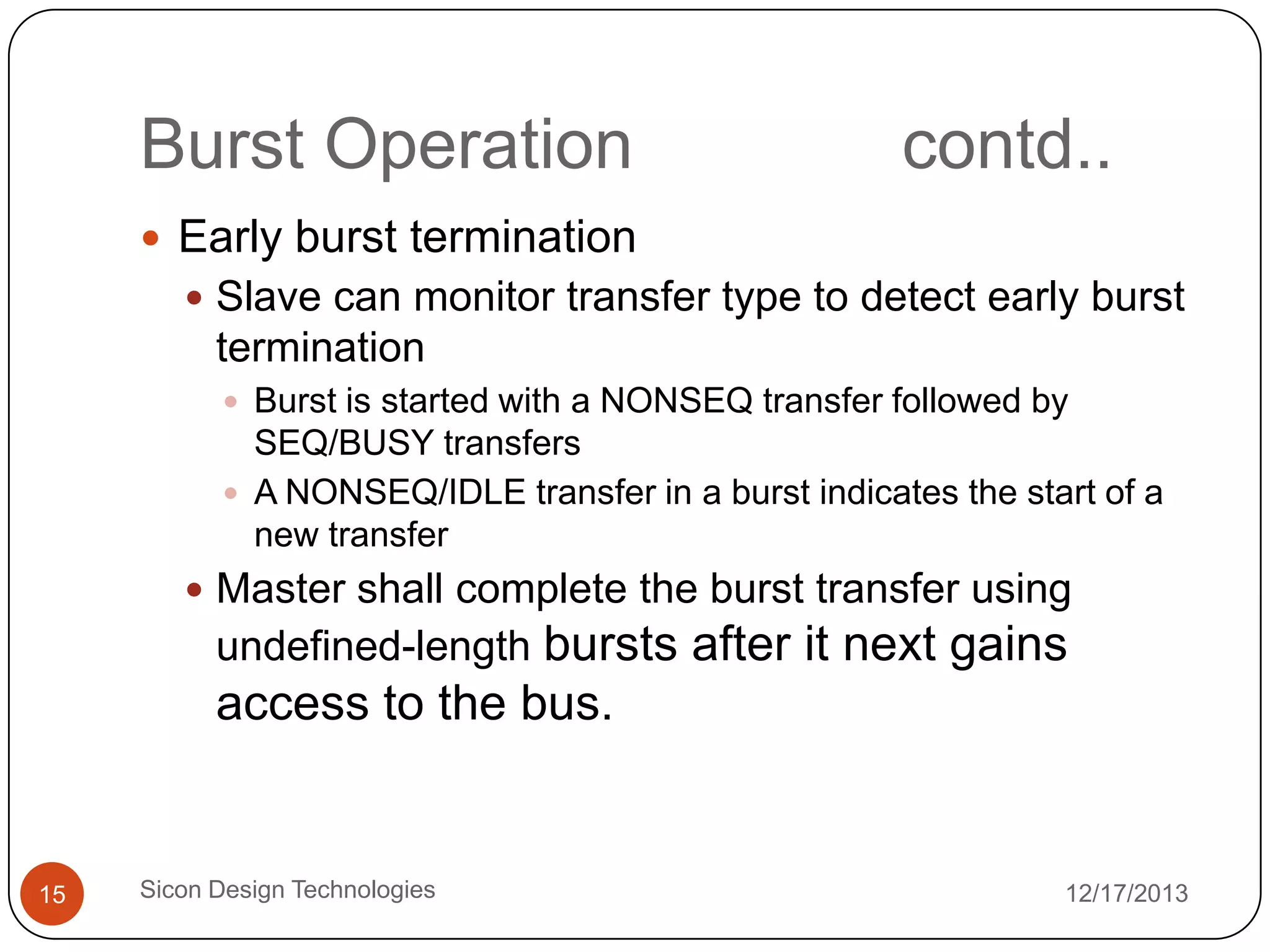
 Early burst termination
 Slave can monitor transfer type to detect early burst

termination
 Burst is started with a NONSEQ transfer followed by

SEQ/BUSY transfers
 A NONSEQ/IDLE transfer in a burst indicates the start of a
new transfer

 Master shall complete the burst transfer using

undefined-length bursts after it next gains

access to the bus.

15

Sicon Design Technologies

12/17/2013
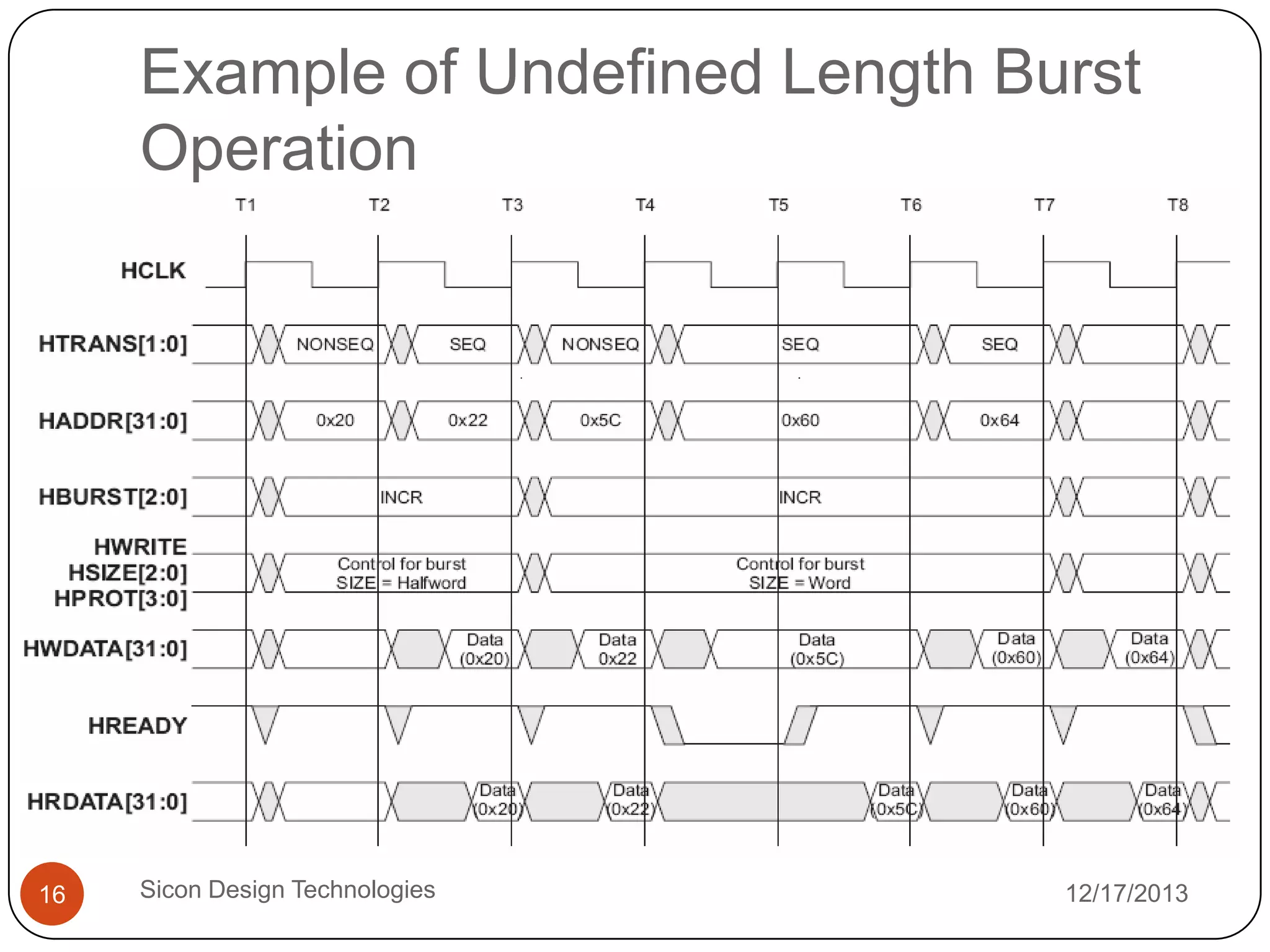
Example of Undefined Length Burst
Operation

16

Sicon Design Technologies

12/17/2013
HWDATA and HRDATA
 Separate read/write data buses in order not to use

tristate drivers
 Minimum width of read/write data buses is 32 bits
 HWDATA - driven by the bus master
 Hold the data valid until the transfer completes
 Drive the appropriate byte lanes
 Transfers that are narrower than the width of the bus
 Burst transfers will have different active byte lanes for

each beat
 A transfer size less than the width of the data bus

 HRDATA - driven by the bus slave
 Provide valid data only at the end of the final cycle
 Provide valid data only on the active byte lanes
17

 All masters and slaves on the bus shall have the
Sicon Design Technologies
12/17/2013

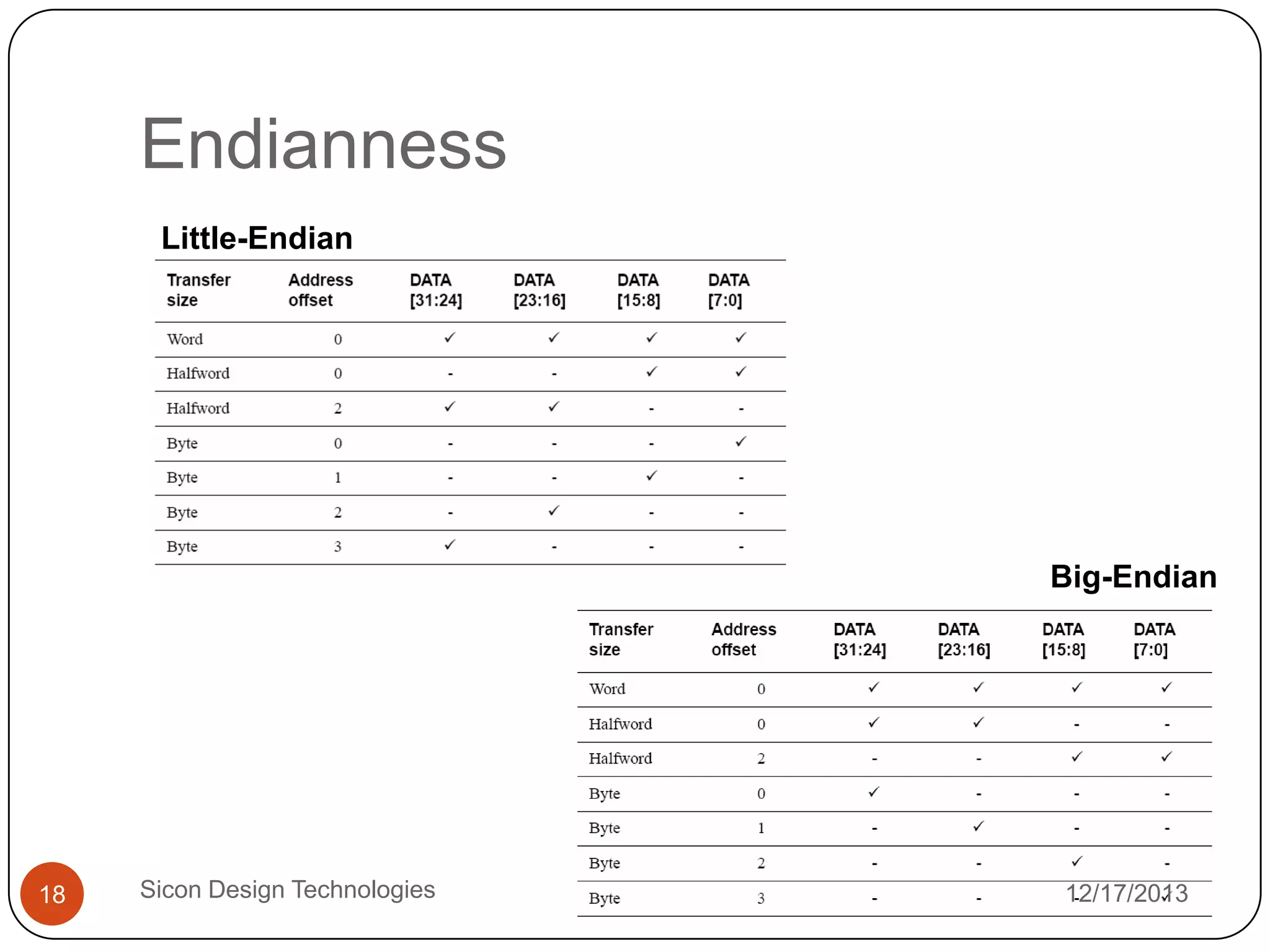
same endianness
Endianness
Little-Endian

Big-Endian

18

Sicon Design Technologies

12/17/2013
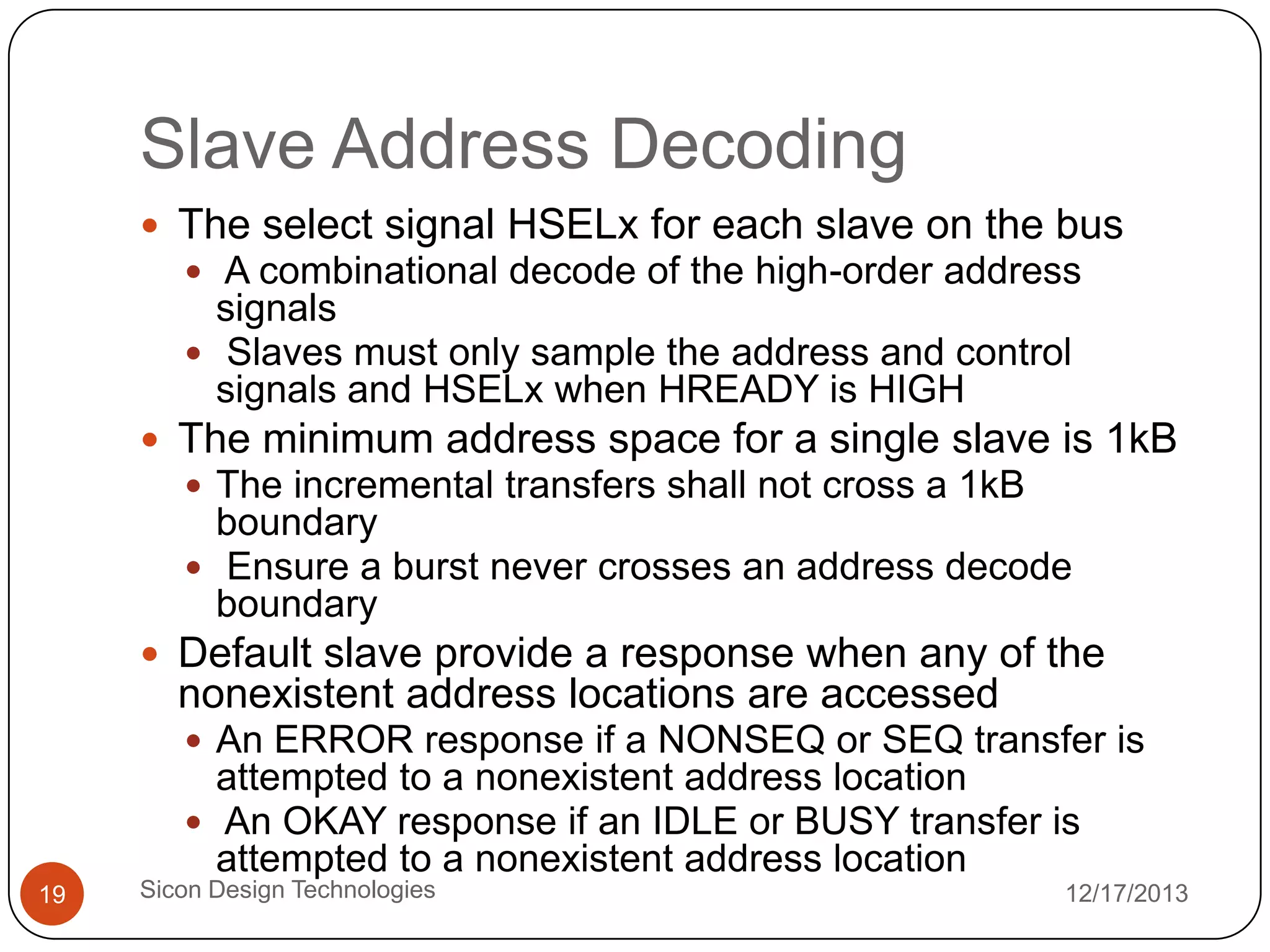
Slave Address Decoding
 The select signal HSELx for each slave on the bus
 A combinational decode of the high-order address

signals
 Slaves must only sample the address and control
signals and HSELx when HREADY is HIGH
 The minimum address space for a single slave is 1kB
 The incremental transfers shall not cross a 1kB

boundary
 Ensure a burst never crosses an address decode
boundary
 Default slave provide a response when any of the

nonexistent address locations are accessed
 An ERROR response if a NONSEQ or SEQ transfer is

attempted to a nonexistent address location
 An OKAY response if an IDLE or BUSY transfer is
attempted to a nonexistent address location
19

Sicon Design Technologies

12/17/2013
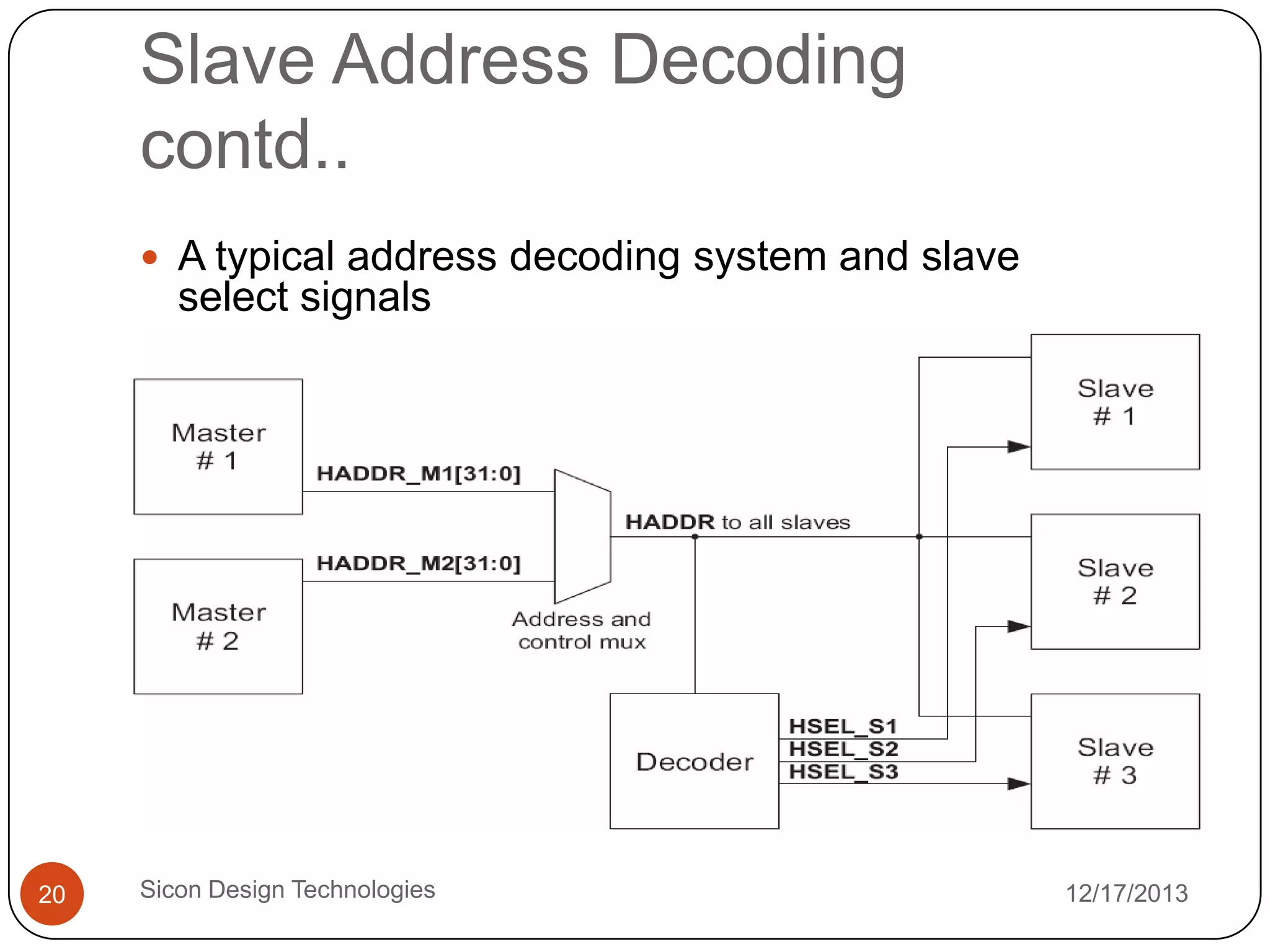
Slave Address Decoding
contd..
 A typical address decoding system and slave

select signals

20

Sicon Design Technologies

12/17/2013
Slave Response
 The slave must determine how the transfer

should progress after a master has started a
transfer
 Complete the transfer immediately
 Insert one or more wait states to allow time to

complete the transfer
 Signal an error message indicating that the transfer
has failed
 Delay the completion of the transfer, but allow the
master and slave back off the bus, leaving it
available for other transfers
 Whenever a slave is accessed it must provide a

response indicating the status of the transfer
21

HREADY

Sicon Design Technologies


12/17/2013
Slave Response
contd..
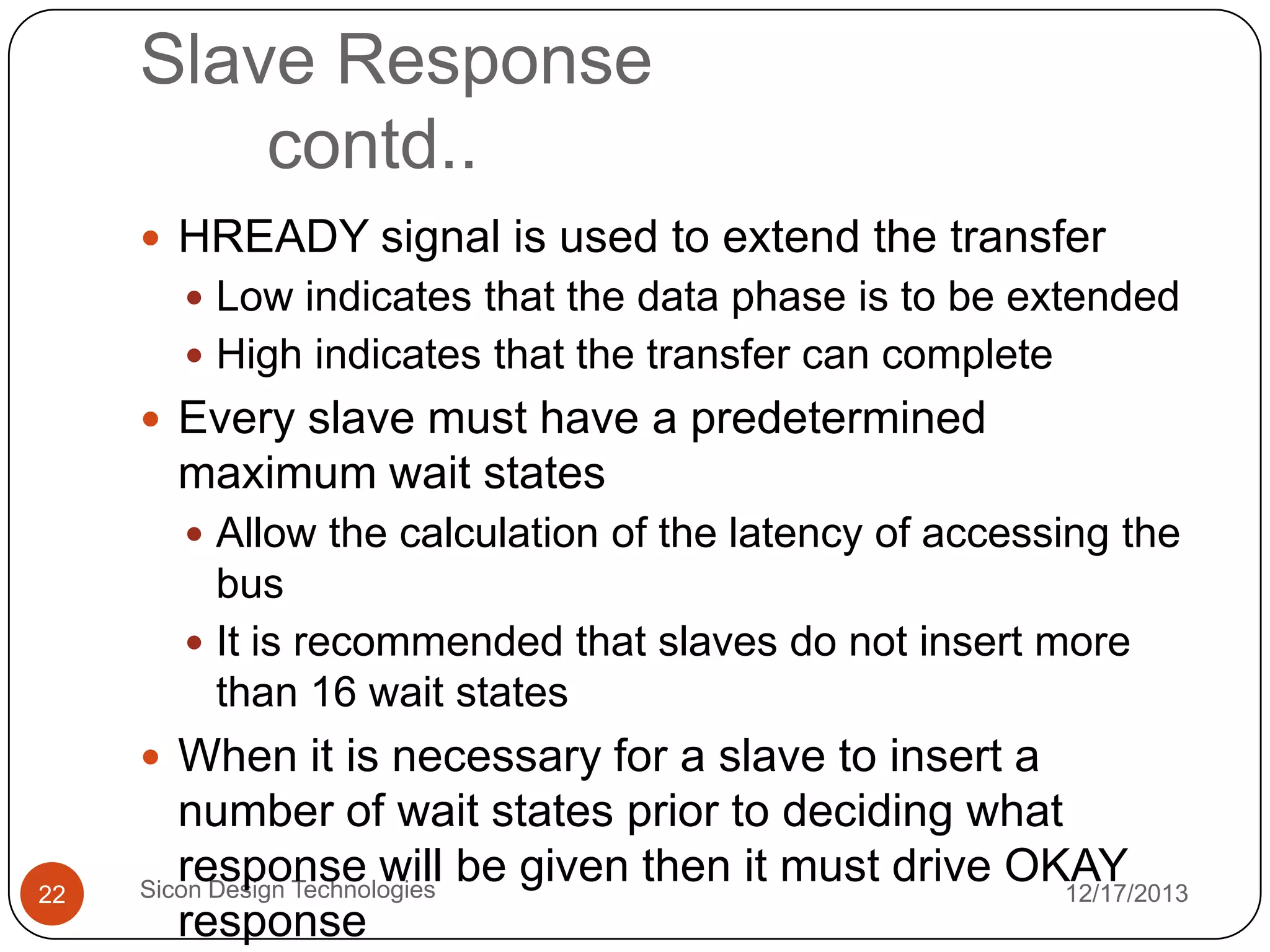
 HREADY signal is used to extend the transfer
 Low indicates that the data phase is to be extended
 High indicates that the transfer can complete

 Every slave must have a predetermined

maximum wait states
 Allow the calculation of the latency of accessing the

bus
 It is recommended that slaves do not insert more
than 16 wait states
 When it is necessary for a slave to insert a

22

number of wait states prior to deciding what
response will be given then it must drive OKAY
Sicon Design Technologies
12/17/2013
response
Slave Response
contd..
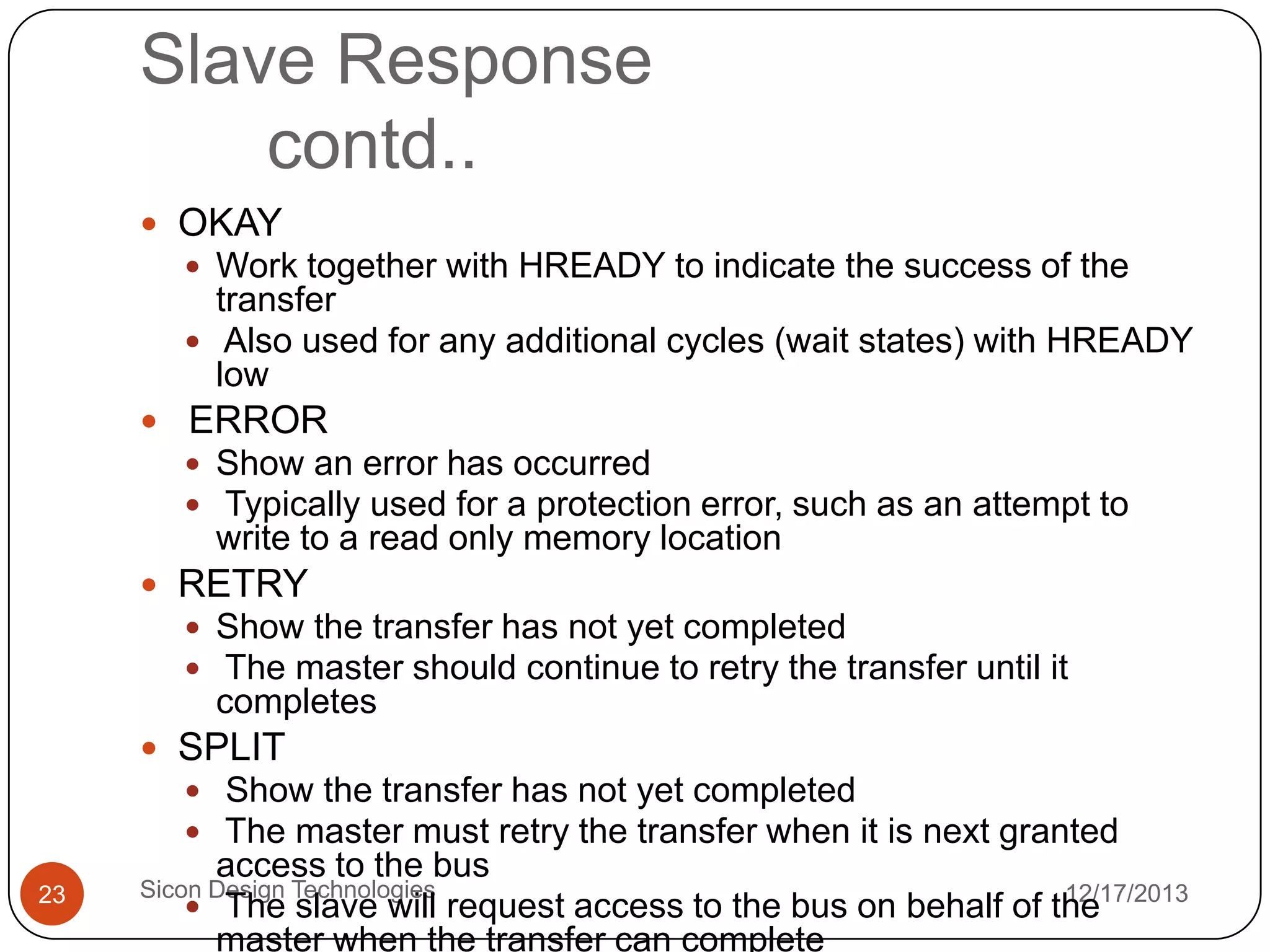
 OKAY
 Work together with HREADY to indicate the success of the

transfer
 Also used for any additional cycles (wait states) with HREADY
low
 ERROR
 Show an error has occurred
 Typically used for a protection error, such as an attempt to

write to a read only memory location
 RETRY
 Show the transfer has not yet completed
 The master should continue to retry the transfer until it

completes
 SPLIT
 Show the transfer has not yet completed
 The master must retry the transfer when it is next granted
23

access to the bus
12/17/2013
 The slave will request access to the bus on behalf of the
master when the transfer can complete

Sicon Design Technologies
Two-cycle Response
 OKAY response can be given in a single cycle
 ERROR, SPLIT and RETRY responses require at least

two cycles
 Additional cycles (wait states) at the start of the transfer
 HREADY will be LOW and the response must be set to OKAY
 In the penultimate cycle
 The slave drives HRESP[1:0] to indicate these responses
 The slave drives HREADY Low to extend the transfer
 In the final cycle
 HRESP[1:0] remains driven
 HREADY is driven High to end the transfer

 SPLIT and RETRY
 The following transfer must be canceled

 ERROR
 Optional to cancel the following transfer

24

Sicon Design Technologies

12/17/2013
Two-cycle Response
contd..
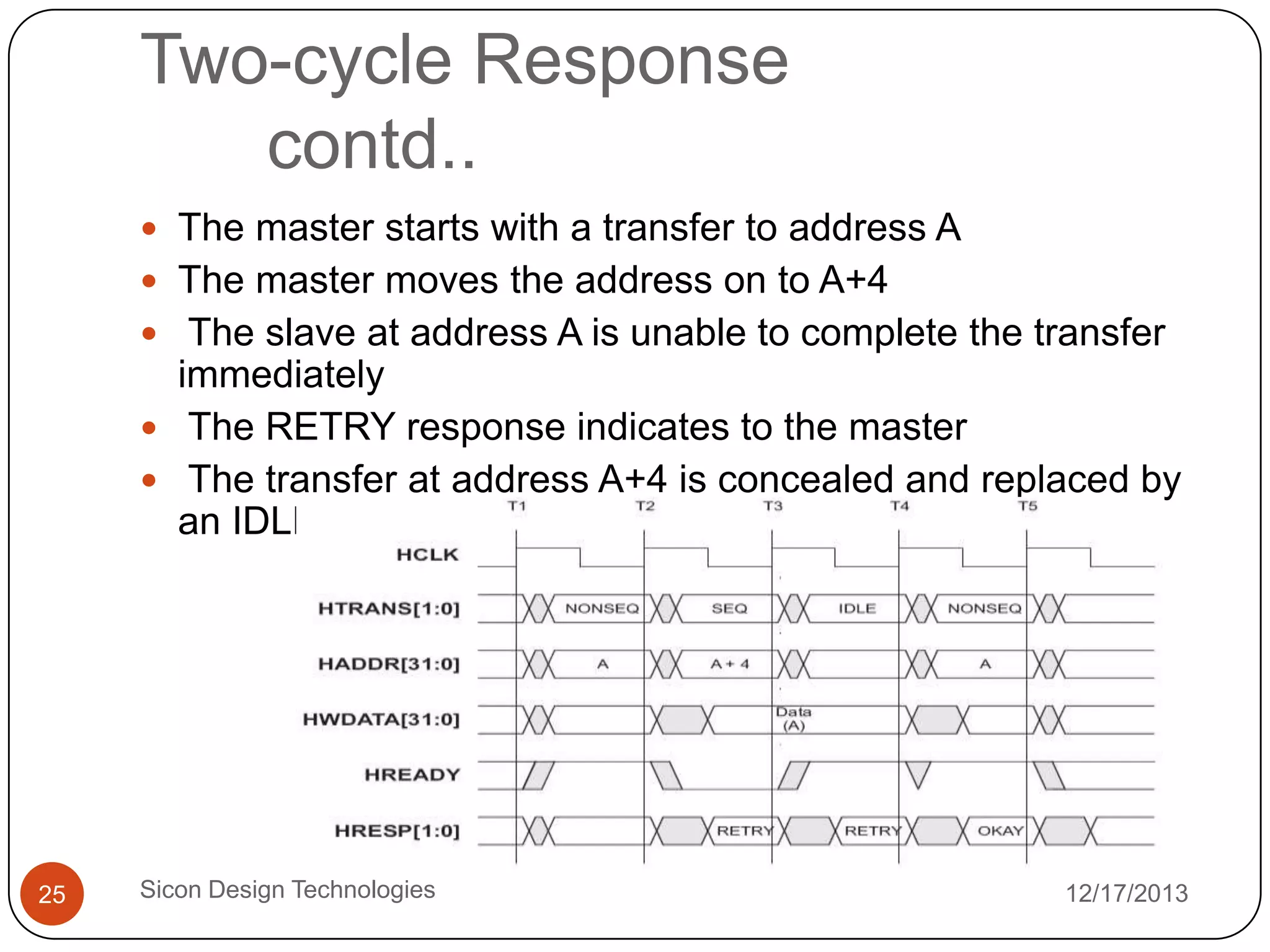
 The master starts with a transfer to address A
 The master moves the address on to A+4

 The slave at address A is unable to complete the transfer

immediately
 The RETRY response indicates to the master
 The transfer at address A+4 is concealed and replaced by
an IDLE transfer

25

Sicon Design Technologies

12/17/2013
SPLIT and RETRY
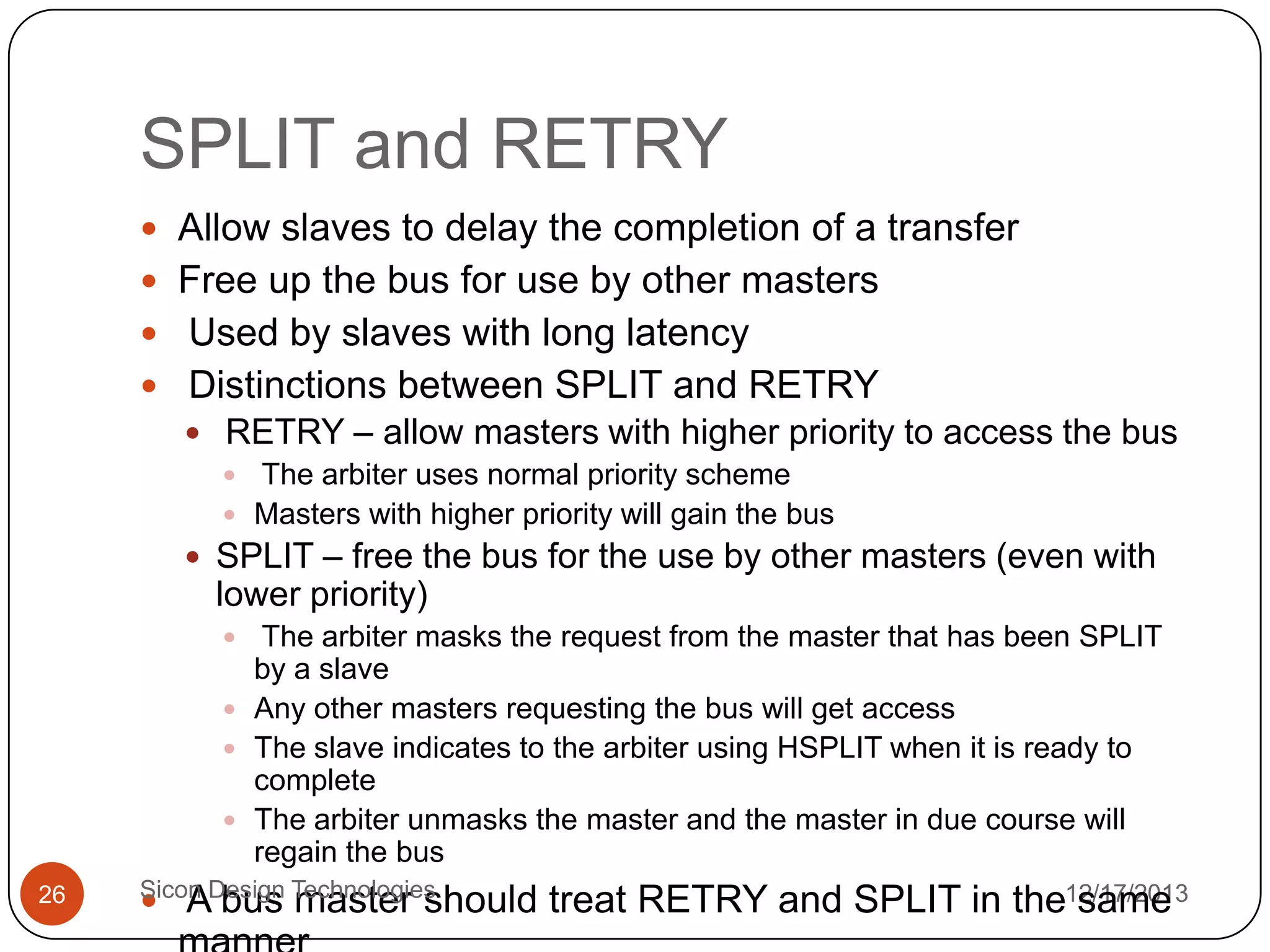
 Allow slaves to delay the completion of a transfer
 Free up the bus for use by other masters

 Used by slaves with long latency
 Distinctions between SPLIT and RETRY
 RETRY – allow masters with higher priority to access the bus
 The arbiter uses normal priority scheme
 Masters with higher priority will gain the bus
 SPLIT – free the bus for the use by other masters (even with

lower priority)
 The arbiter masks the request from the master that has been SPLIT

by a slave
 Any other masters requesting the bus will get access
 The slave indicates to the arbiter using HSPLIT when it is ready to
complete
 The arbiter unmasks the master and the master in due course will
regain the bus
26

Sicon Design Technologies

 A bus master should treat RETRY and SPLIT in the12/17/2013
same
Bus Arbitration and SPLIT/RETRY
Transfers
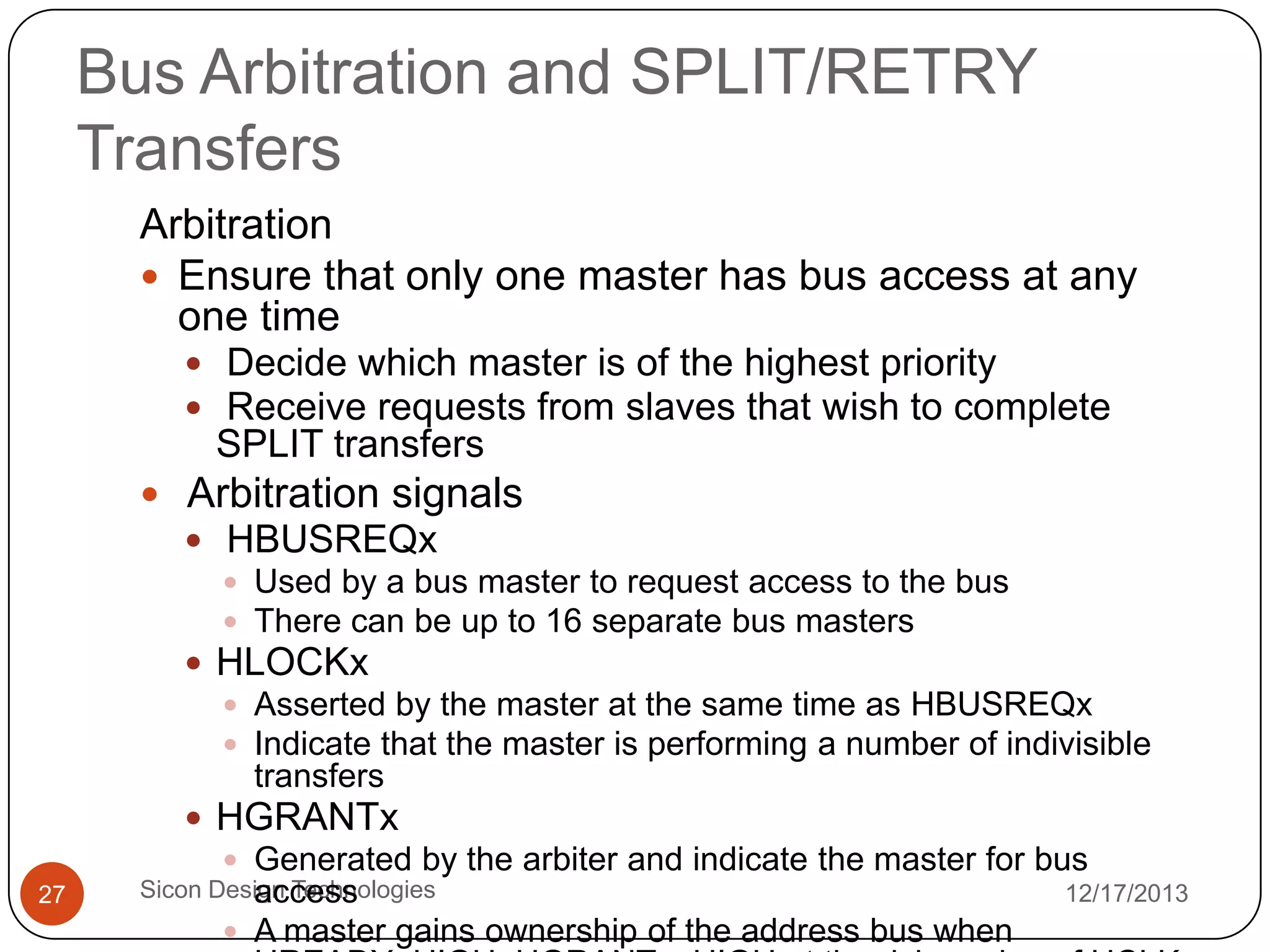
Arbitration
 Ensure that only one master has bus access at any
one time
 Decide which master is of the highest priority
 Receive requests from slaves that wish to complete

SPLIT transfers
 Arbitration signals

27

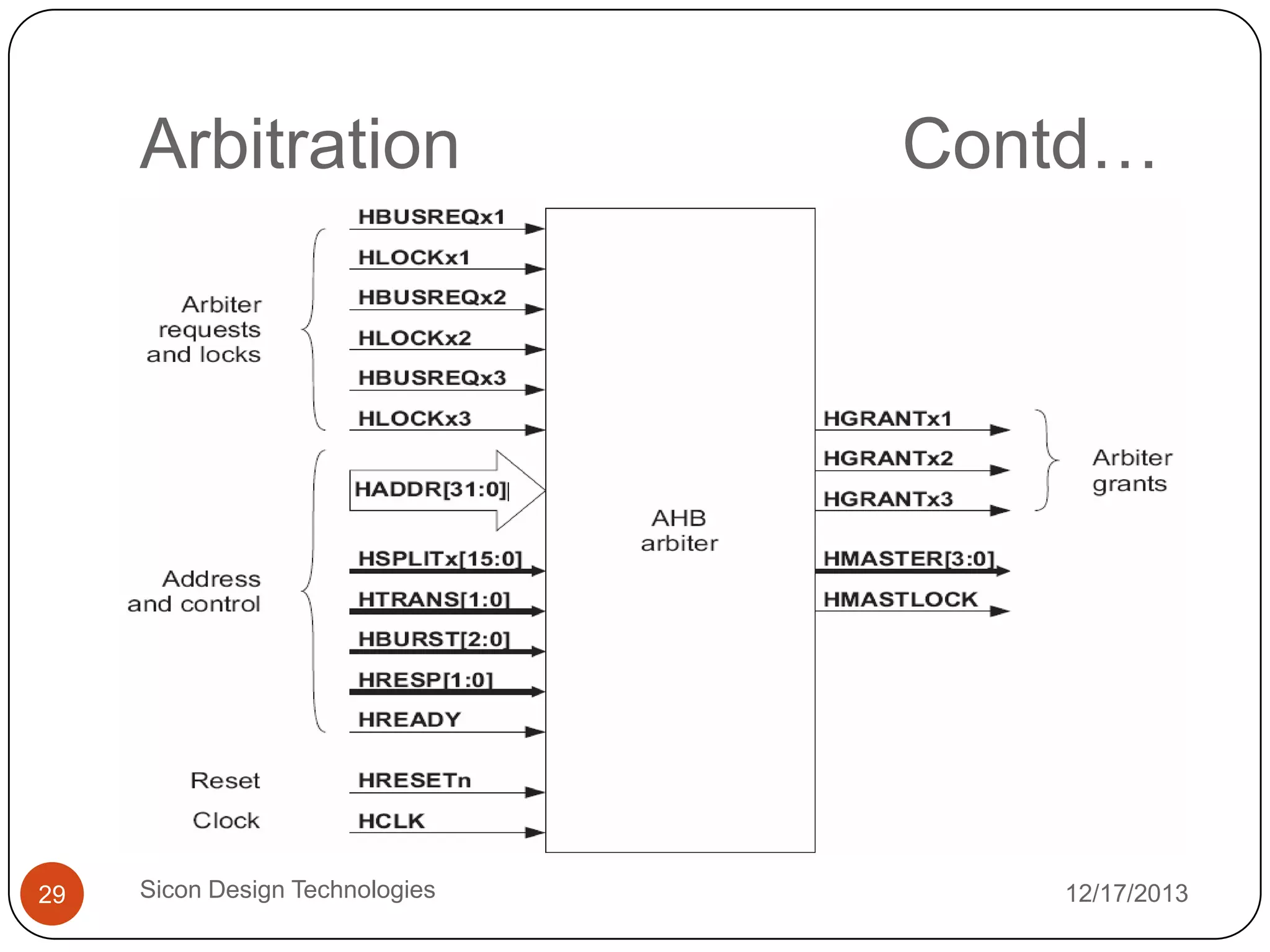
 HBUSREQx
 Used by a bus master to request access to the bus
 There can be up to 16 separate bus masters
 HLOCKx
 Asserted by the master at the same time as HBUSREQx
 Indicate that the master is performing a number of indivisible
transfers
 HGRANTx
 Generated by the arbiter and indicate the master for bus
Sicon Design Technologies
12/17/2013
access
 A master gains ownership of the address bus when
Arbitration

Contd…

 HMASTER[3:0]
 Arbiter indicates which master is currently granted the

bus
 Control the central address and control MUX
 Required by SPLIT-capable slaves so that they can
indicate to the arbiter which master is able to complete a
SPLIT transaction
 HMASTERLOCK
 The arbiter indicates that the current transfer is part of a

locked sequence by asserting the HMASTLOCK signal
 HSPLIT[15:0]
 The 16-bit bus is used by a SPLIT-capable slave to

28

indicate which bus master can complete a SPLIT
transaction
Sicon Design Technologies the arbiter
12/17/2013
 Required by
Arbitration

29

Sicon Design Technologies

Contd…

12/17/2013
Arbitration

Contd…

 The HGRANTx signal is used by the master to determine

when it owns the address bus
 Since a central multiplexor is used, each master can drive
out the address of the transfer immediately and it does not
need to wait until it is granted the bus
 A delayed version of the HMASTER bus is used to control
the write data multiplexor

30

Sicon Design Technologies

12/17/2013
Request Bus Access
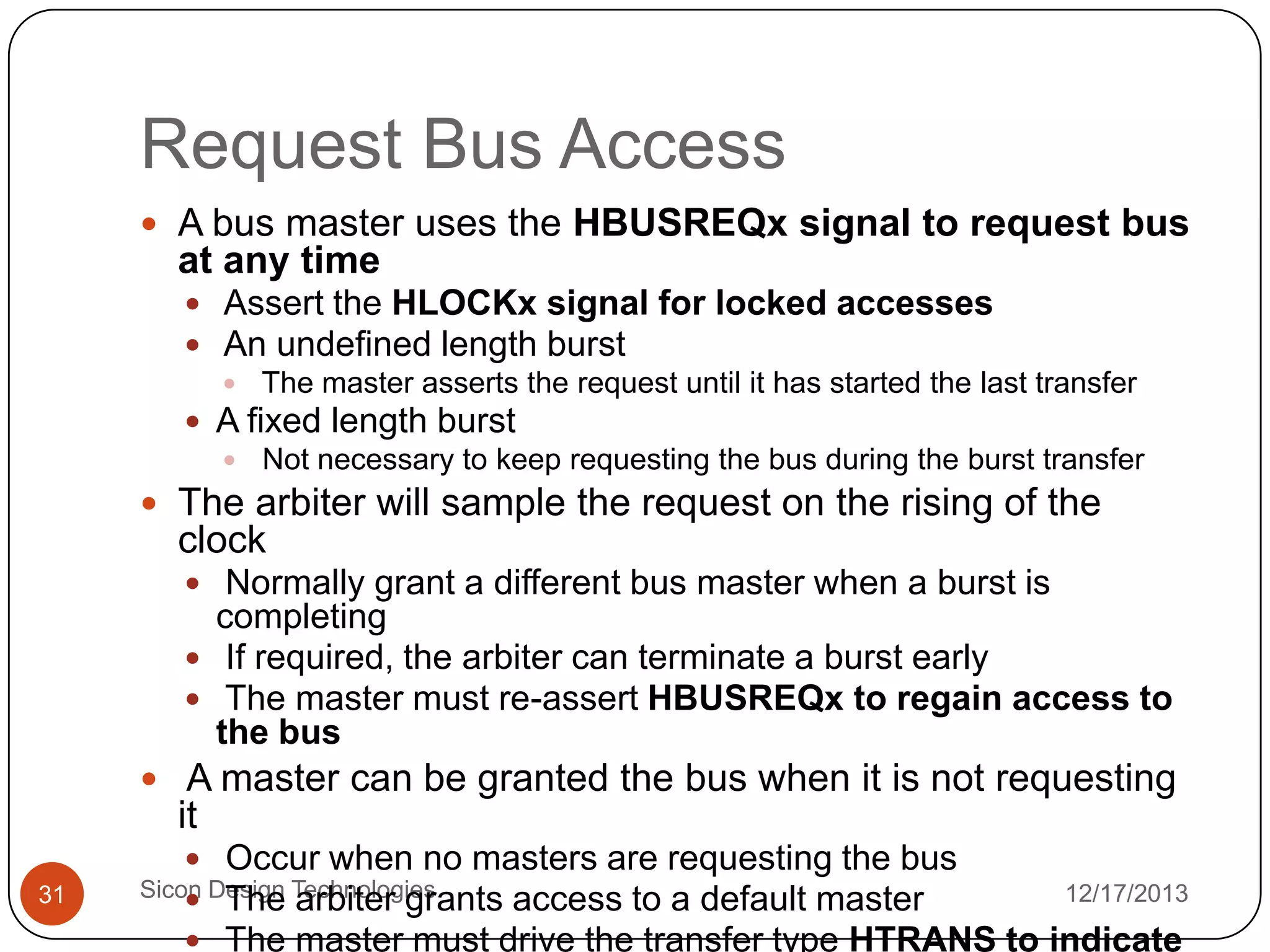
 A bus master uses the HBUSREQx signal to request bus

at any time
 Assert the HLOCKx signal for locked accesses
 An undefined length burst
 The master asserts the request until it has started the last transfer
 A fixed length burst
 Not necessary to keep requesting the bus during the burst transfer

 The arbiter will sample the request on the rising of the

clock
 Normally grant a different bus master when a burst is

completing
 If required, the arbiter can terminate a burst early
 The master must re-assert HBUSREQx to regain access to
the bus
 A master can be granted the bus when it is not requesting

it
31

 Occur when no masters are requesting the bus
Sicon Design Technologies
12/17/2013
 The arbiter grants access to a default master
 The master must drive the transfer type HTRANS to indicate
Data Bus Ownership
 Arbiter indicates the bus master for access by HGRANTx
 When the current transfer completes (HREADY=High)
 The master will become granted
 The arbiter will change the HMASTER[3:0] to indicate the

master
 The ownership of the data bus is delayed from that of the
address bus

32

Sicon Design Technologies

12/17/2013
Bus Handover after a BURST
Transfer
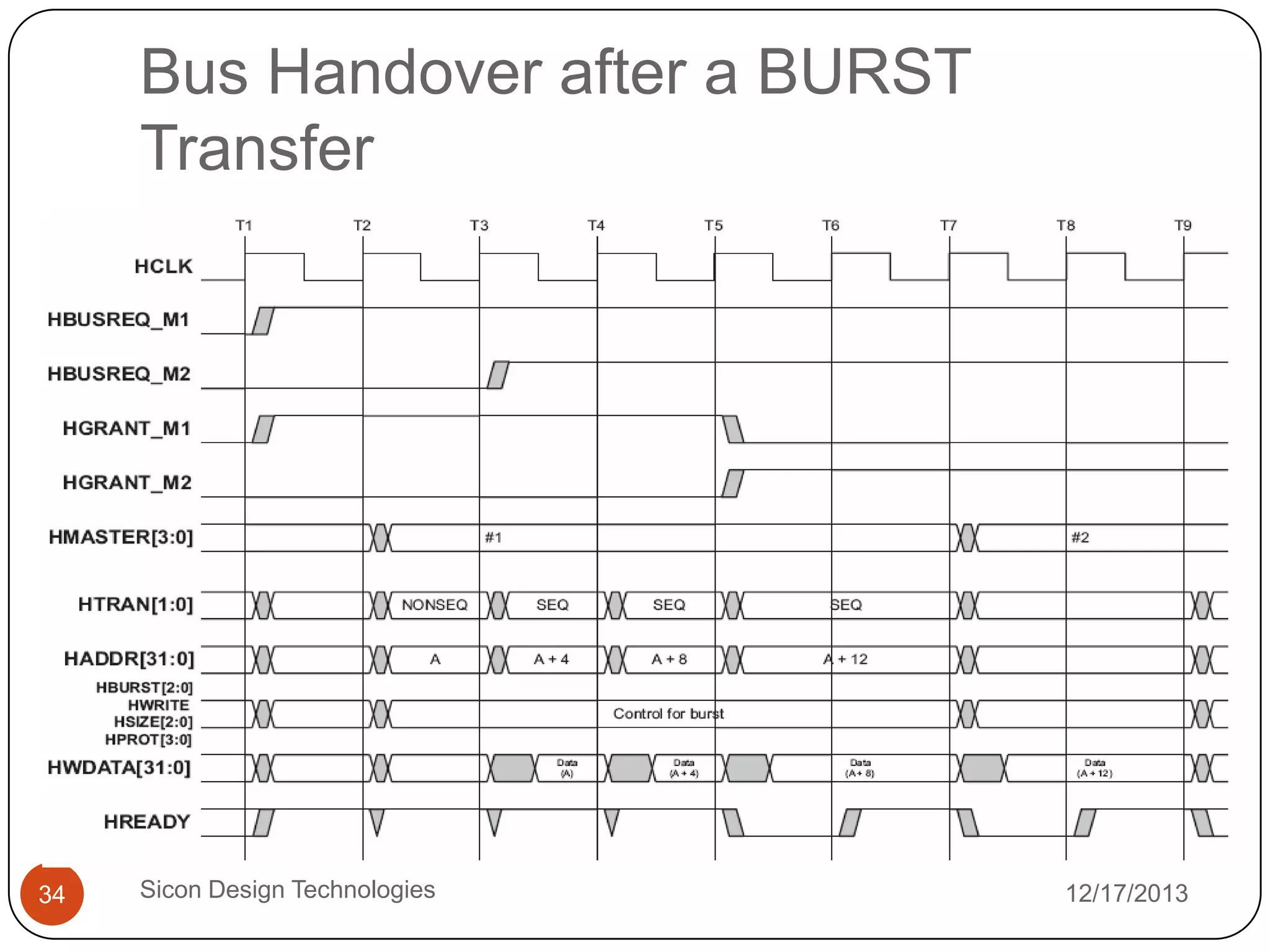
 Arbiter changes the HGRANTx signals when the

Last but one address has been sampled
 The new HGRANTx will then be sampled as the
last address of the burst is sampled

33

Sicon Design Technologies

12/17/2013
Bus Handover after a BURST
Transfer

34

Sicon Design Technologies

12/17/2013
SPLIT Transfer
 Improve the overall utilization of the bus by separating
 The master providing the address to a slave

 The slave responding with the appropriate data

 Concepts of operations
 The arbiter generates the master number on HMASTER[3:0]
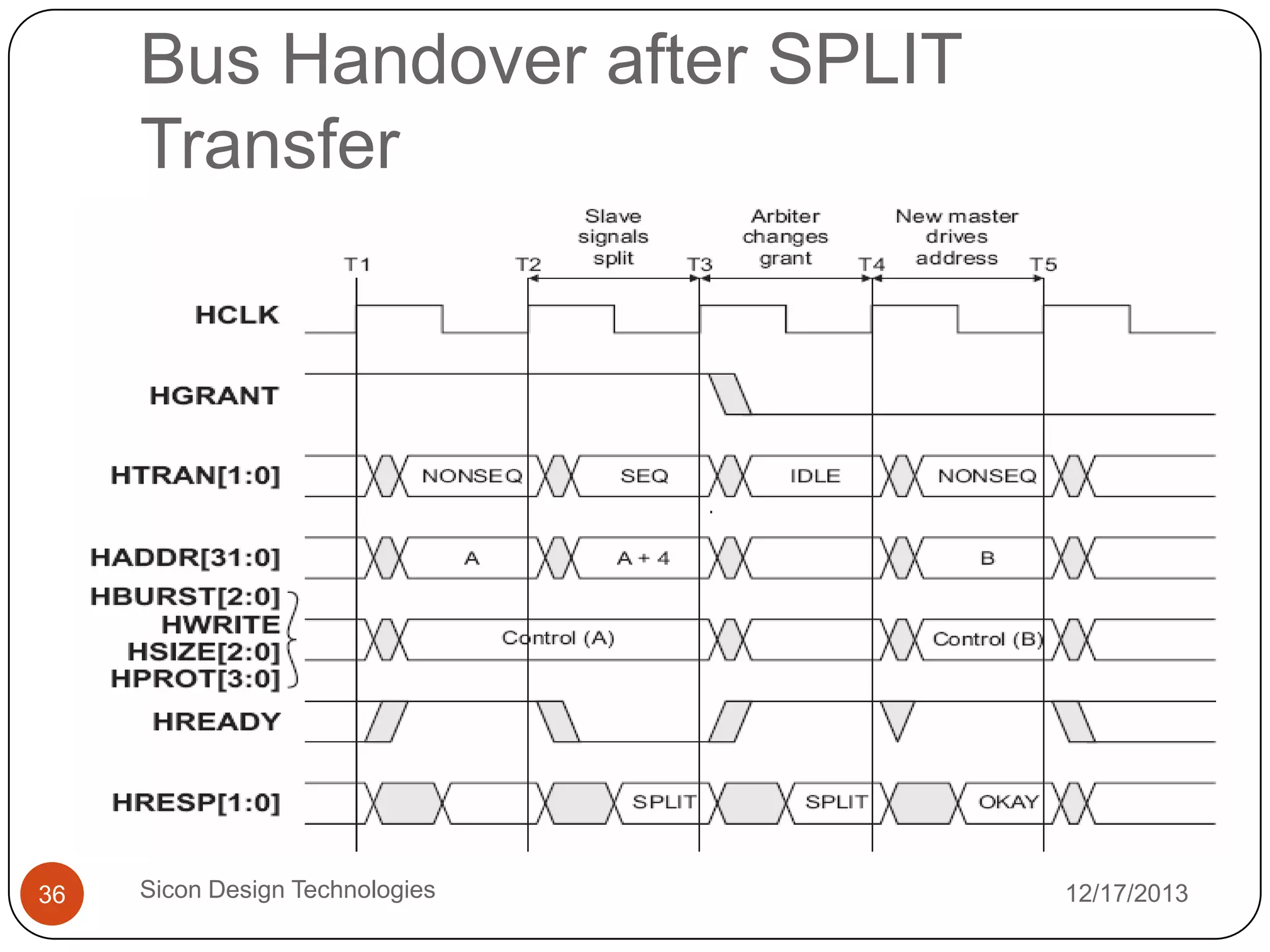
 The slave makes note of HMASTER[3:0] and signals to the

35

arbiter
 The arbiter masks any requests from masters which have
been SPLIT
 The arbiter grants other masters use of the bus
 The slave is ready to complete the transfer
 The slave asserts the appropriate bit on HSPLIT[15:0]
 The arbiter restores the priority of the appropriate master
 The master eventually will be granted the bus and re-attempt
the transfer
Sicon Design Technologies
 When the transfer takes place, the slave finishes with 12/17/2013
an
OKAY response
Bus Handover after SPLIT
Transfer

36

Sicon Design Technologies

12/17/2013
Multiple SPLIT Transfers
 AHB protocol only allows one outstanding transaction

per master
 However, a single module may appear as a number of

masters
 A SPLIT-capable slave could receive multiple

requests
 A number of masters attempt to access a SPLIT-

37

capable slave
 The slave issues a SPLIT for each attempt and records
the master number without latching the address/control
 The slave then works through the outstanding requests
in an orderly manner
 The slave asserts the appropriate HSPLITx to indicate
that it is ready to complete the transfer
 The arbiter in due course grants the associated master
 The master retries the transfer with the address and
Sicon Design Technologies
12/17/2013
control
 The slave latches the address/control and may issue
RETRY Transfer
 Slaves that issue RETRY are mostly peripherals and

must be accessed by just one master at a time
 Not enforced by the protocol of the bus
 Should be ensured by the system

 The slave can check every transfer attempt that is

made to ensure the master number is the same
 If the master number is different, then it can take an
alternative course of action, such as:





38

An ERROR response
A signal to the arbiter
A system level interrupt
A complete system reset

Sicon Design Technologies

12/17/2013
References
 AMBA AHB 2.0 Specification

39

Sicon Design Technologies

12/17/2013
Thank You
40

Sicon Design Technologies

12/17/2013

AMBA Ahb 2.0

  • 1.
    AMBA AHB 2.0 By-AkhilSrivastava Ajay Sharma 1 Sicon Design Technologies 12/17/2013
  • 2.
    AMBA AHB Bus2.0  AHB is a new generation of AMBA bus which is intended to address the requirements of highperformance synthesizable designs.  High-performance system bus that supports multiple bus masters and provides highbandwidth operation. 2 Sicon Design Technologies 12/17/2013
  • 3.
    Features  Burst transfers Split transactions  Single-cycle bus master handover  Single-clock edge operation  Non-tristate implementation  Wider data bus configurations (64/128 bits). 3 Sicon Design Technologies 12/17/2013
  • 4.
    Typical AMBA AHBBased System 4 Sicon Design Technologies 12/17/2013
  • 5.
    Bus Interconnection 5 Sicon DesignTechnologies 12/17/2013
  • 6.
    AHB Master 6 Sicon DesignTechnologies 12/17/2013
  • 7.
    AHB Slave 7 Sicon DesignTechnologies 12/17/2013
  • 8.
    AMBA AHB operation Basic transfer 8 Sicon Design Technologies 12/17/2013
  • 9.
    AMBA AHB operation contd.. Transfer with wait states 9 Sicon Design Technologies 12/17/2013
  • 10.
    AMBA AHB operation contd.. Multiple Transfer 10 Sicon Design Technologies 12/17/2013
  • 11.
    Transfer Type Encoding HTRANS[1:0 ] Type Description 00 IDLE •Nodata transfer is required • Used when the master is granted the bus without performing transfer. • The slave must provide a zero wait state OKAY response 01 BUSY •Allow master to insert IDLE cycle in the middle of bursts of transfers • Address and control signals must reflect the next transfer in the burst • The slave must provide a zero wait state OKAY response. 10 NONSE Q •Indicate the first transfer of a burst or a single transfer • Address and control signals are unrelated to previous transfer 11 11 Sicon Design SEQ Technologies •Indicate a remaining transfer in a burst 12/17/2013 •Address = Address of previous transfer + size in
  • 12.
    Example of TransferType 12 Sicon Design Technologies 12/17/2013
  • 13.
    Burst Operation  4/8/16-beatbursts, as well as undefined-length bursts  Burst size indicates the number of beats in the burst  Valid data transferred = (# of beats) x (data size in each beat)  Data size in each beat is indicated in HSIZE[2:0]  Incrementing bursts  Access sequential locations with the address of each 13 transfer in the burst being an increment of the previous address  An incremental burst can be of any length, but the upper limit is set by Sicon Design Technologies the fact that address must not cross a 1KB 12/17/2013 boundary
  • 14.
    Burst Operation contd..  Wrappingbursts  If the start address of the transfer is not aligned to the total number of bytes in a burst (size x beats) then the address of the transfers in the burst will wrap when the boundary is reached  A 4-beat wrapping burst of word (4-byte) access  If start address is 0x38 -> 0x38, 0x3C, 0x30, 0x34  Transfers within a burst must be aligned to the address boundary equal to the size of the transfer  Word transfers must have A[1:0] = 00  Halfword transfers must have A[0] = 0 14 Sicon Design Technologies 12/17/2013
  • 15.
    Burst Operation contd..  Earlyburst termination  Slave can monitor transfer type to detect early burst termination  Burst is started with a NONSEQ transfer followed by SEQ/BUSY transfers  A NONSEQ/IDLE transfer in a burst indicates the start of a new transfer  Master shall complete the burst transfer using undefined-length bursts after it next gains access to the bus. 15 Sicon Design Technologies 12/17/2013
  • 16.
    Example of UndefinedLength Burst Operation 16 Sicon Design Technologies 12/17/2013
  • 17.
    HWDATA and HRDATA Separate read/write data buses in order not to use tristate drivers  Minimum width of read/write data buses is 32 bits  HWDATA - driven by the bus master  Hold the data valid until the transfer completes  Drive the appropriate byte lanes  Transfers that are narrower than the width of the bus  Burst transfers will have different active byte lanes for each beat  A transfer size less than the width of the data bus  HRDATA - driven by the bus slave  Provide valid data only at the end of the final cycle  Provide valid data only on the active byte lanes 17  All masters and slaves on the bus shall have the Sicon Design Technologies 12/17/2013 same endianness
  • 18.
  • 19.
    Slave Address Decoding The select signal HSELx for each slave on the bus  A combinational decode of the high-order address signals  Slaves must only sample the address and control signals and HSELx when HREADY is HIGH  The minimum address space for a single slave is 1kB  The incremental transfers shall not cross a 1kB boundary  Ensure a burst never crosses an address decode boundary  Default slave provide a response when any of the nonexistent address locations are accessed  An ERROR response if a NONSEQ or SEQ transfer is attempted to a nonexistent address location  An OKAY response if an IDLE or BUSY transfer is attempted to a nonexistent address location 19 Sicon Design Technologies 12/17/2013
  • 20.
    Slave Address Decoding contd.. A typical address decoding system and slave select signals 20 Sicon Design Technologies 12/17/2013
  • 21.
    Slave Response  Theslave must determine how the transfer should progress after a master has started a transfer  Complete the transfer immediately  Insert one or more wait states to allow time to complete the transfer  Signal an error message indicating that the transfer has failed  Delay the completion of the transfer, but allow the master and slave back off the bus, leaving it available for other transfers  Whenever a slave is accessed it must provide a response indicating the status of the transfer 21 HREADY Sicon Design Technologies  12/17/2013
  • 22.
    Slave Response contd..  HREADYsignal is used to extend the transfer  Low indicates that the data phase is to be extended  High indicates that the transfer can complete  Every slave must have a predetermined maximum wait states  Allow the calculation of the latency of accessing the bus  It is recommended that slaves do not insert more than 16 wait states  When it is necessary for a slave to insert a 22 number of wait states prior to deciding what response will be given then it must drive OKAY Sicon Design Technologies 12/17/2013 response
  • 23.
    Slave Response contd..  OKAY Work together with HREADY to indicate the success of the transfer  Also used for any additional cycles (wait states) with HREADY low  ERROR  Show an error has occurred  Typically used for a protection error, such as an attempt to write to a read only memory location  RETRY  Show the transfer has not yet completed  The master should continue to retry the transfer until it completes  SPLIT  Show the transfer has not yet completed  The master must retry the transfer when it is next granted 23 access to the bus 12/17/2013  The slave will request access to the bus on behalf of the master when the transfer can complete Sicon Design Technologies
  • 24.
    Two-cycle Response  OKAYresponse can be given in a single cycle  ERROR, SPLIT and RETRY responses require at least two cycles  Additional cycles (wait states) at the start of the transfer  HREADY will be LOW and the response must be set to OKAY  In the penultimate cycle  The slave drives HRESP[1:0] to indicate these responses  The slave drives HREADY Low to extend the transfer  In the final cycle  HRESP[1:0] remains driven  HREADY is driven High to end the transfer  SPLIT and RETRY  The following transfer must be canceled  ERROR  Optional to cancel the following transfer 24 Sicon Design Technologies 12/17/2013
  • 25.
    Two-cycle Response contd..  Themaster starts with a transfer to address A  The master moves the address on to A+4  The slave at address A is unable to complete the transfer immediately  The RETRY response indicates to the master  The transfer at address A+4 is concealed and replaced by an IDLE transfer 25 Sicon Design Technologies 12/17/2013
  • 26.
    SPLIT and RETRY Allow slaves to delay the completion of a transfer  Free up the bus for use by other masters  Used by slaves with long latency  Distinctions between SPLIT and RETRY  RETRY – allow masters with higher priority to access the bus  The arbiter uses normal priority scheme  Masters with higher priority will gain the bus  SPLIT – free the bus for the use by other masters (even with lower priority)  The arbiter masks the request from the master that has been SPLIT by a slave  Any other masters requesting the bus will get access  The slave indicates to the arbiter using HSPLIT when it is ready to complete  The arbiter unmasks the master and the master in due course will regain the bus 26 Sicon Design Technologies  A bus master should treat RETRY and SPLIT in the12/17/2013 same
  • 27.
    Bus Arbitration andSPLIT/RETRY Transfers Arbitration  Ensure that only one master has bus access at any one time  Decide which master is of the highest priority  Receive requests from slaves that wish to complete SPLIT transfers  Arbitration signals 27  HBUSREQx  Used by a bus master to request access to the bus  There can be up to 16 separate bus masters  HLOCKx  Asserted by the master at the same time as HBUSREQx  Indicate that the master is performing a number of indivisible transfers  HGRANTx  Generated by the arbiter and indicate the master for bus Sicon Design Technologies 12/17/2013 access  A master gains ownership of the address bus when
  • 28.
    Arbitration Contd…  HMASTER[3:0]  Arbiterindicates which master is currently granted the bus  Control the central address and control MUX  Required by SPLIT-capable slaves so that they can indicate to the arbiter which master is able to complete a SPLIT transaction  HMASTERLOCK  The arbiter indicates that the current transfer is part of a locked sequence by asserting the HMASTLOCK signal  HSPLIT[15:0]  The 16-bit bus is used by a SPLIT-capable slave to 28 indicate which bus master can complete a SPLIT transaction Sicon Design Technologies the arbiter 12/17/2013  Required by
  • 29.
  • 30.
    Arbitration Contd…  The HGRANTxsignal is used by the master to determine when it owns the address bus  Since a central multiplexor is used, each master can drive out the address of the transfer immediately and it does not need to wait until it is granted the bus  A delayed version of the HMASTER bus is used to control the write data multiplexor 30 Sicon Design Technologies 12/17/2013
  • 31.
    Request Bus Access A bus master uses the HBUSREQx signal to request bus at any time  Assert the HLOCKx signal for locked accesses  An undefined length burst  The master asserts the request until it has started the last transfer  A fixed length burst  Not necessary to keep requesting the bus during the burst transfer  The arbiter will sample the request on the rising of the clock  Normally grant a different bus master when a burst is completing  If required, the arbiter can terminate a burst early  The master must re-assert HBUSREQx to regain access to the bus  A master can be granted the bus when it is not requesting it 31  Occur when no masters are requesting the bus Sicon Design Technologies 12/17/2013  The arbiter grants access to a default master  The master must drive the transfer type HTRANS to indicate
  • 32.
    Data Bus Ownership Arbiter indicates the bus master for access by HGRANTx  When the current transfer completes (HREADY=High)  The master will become granted  The arbiter will change the HMASTER[3:0] to indicate the master  The ownership of the data bus is delayed from that of the address bus 32 Sicon Design Technologies 12/17/2013
  • 33.
    Bus Handover aftera BURST Transfer  Arbiter changes the HGRANTx signals when the Last but one address has been sampled  The new HGRANTx will then be sampled as the last address of the burst is sampled 33 Sicon Design Technologies 12/17/2013
  • 34.
    Bus Handover aftera BURST Transfer 34 Sicon Design Technologies 12/17/2013
  • 35.
    SPLIT Transfer  Improvethe overall utilization of the bus by separating  The master providing the address to a slave  The slave responding with the appropriate data  Concepts of operations  The arbiter generates the master number on HMASTER[3:0]  The slave makes note of HMASTER[3:0] and signals to the 35 arbiter  The arbiter masks any requests from masters which have been SPLIT  The arbiter grants other masters use of the bus  The slave is ready to complete the transfer  The slave asserts the appropriate bit on HSPLIT[15:0]  The arbiter restores the priority of the appropriate master  The master eventually will be granted the bus and re-attempt the transfer Sicon Design Technologies  When the transfer takes place, the slave finishes with 12/17/2013 an OKAY response
  • 36.
    Bus Handover afterSPLIT Transfer 36 Sicon Design Technologies 12/17/2013
  • 37.
    Multiple SPLIT Transfers AHB protocol only allows one outstanding transaction per master  However, a single module may appear as a number of masters  A SPLIT-capable slave could receive multiple requests  A number of masters attempt to access a SPLIT- 37 capable slave  The slave issues a SPLIT for each attempt and records the master number without latching the address/control  The slave then works through the outstanding requests in an orderly manner  The slave asserts the appropriate HSPLITx to indicate that it is ready to complete the transfer  The arbiter in due course grants the associated master  The master retries the transfer with the address and Sicon Design Technologies 12/17/2013 control  The slave latches the address/control and may issue
  • 38.
    RETRY Transfer  Slavesthat issue RETRY are mostly peripherals and must be accessed by just one master at a time  Not enforced by the protocol of the bus  Should be ensured by the system  The slave can check every transfer attempt that is made to ensure the master number is the same  If the master number is different, then it can take an alternative course of action, such as:     38 An ERROR response A signal to the arbiter A system level interrupt A complete system reset Sicon Design Technologies 12/17/2013
  • 39.
    References  AMBA AHB2.0 Specification 39 Sicon Design Technologies 12/17/2013
  • 40.
    Thank You 40 Sicon DesignTechnologies 12/17/2013