1
UVM Basics
Nagesh Loke
ARM CPUVerification Lead/Manager
2
▪ This lecture aims to:
▪ demonstrate the need for a verification methodology
▪ provide an understanding of some of the key components of a UVM testbench
▪ cover some basic features of UVM
What to expect …
3
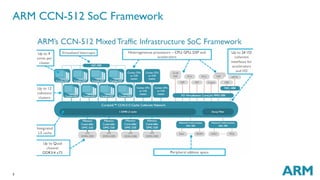
ARM CCN-512 SoC Framework
4
▪ Typical processor development from scratch could be 100s of engineering years
▪ Requires parallel developments across multiple sites, and it takes a large team to verify a
processor
▪ The typical method is to divide and conquer, partitioning the whole CPU into smaller
units and verify those units, then reuse the checkers and stimulus at a higher level
▪ The challenges are numerous
▪ Reuse of code becomes an absolute key to avoid duplication of work
▪ It is essential to have the ability to integrate an external IP
▪ This requires rigorous planning, code structure, & lockstep development
▪ Standardization becomes a key consideration
▪ UVM can help solve this!
What are the challenges of verifying complex systems?
5
▪ Stands for UniversalVerification Methodology
▪ Benefits:
▪ supports and provides framework for modular and layered verification components
▪ Enables:
◦ reuse
◦ clear functional definition for each component
◦ configuration of components to be used in a variety of contexts
▪ is maintained and released by Accellera committee
▪ source code is fully available
▪ is a mature product
▪ significant amount of training and support available
What is UVM and why use it?
6
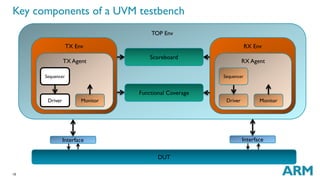
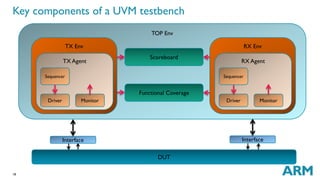
TOP Env
TX Env
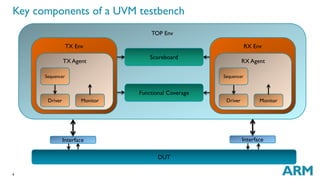
Key components of a UVM testbench
DUT
TX Agent
Sequencer
Driver Monitor
Functional Coverage
RX Env
RX Agent
Sequencer
Driver Monitor
Scoreboard
Interface Interface
7
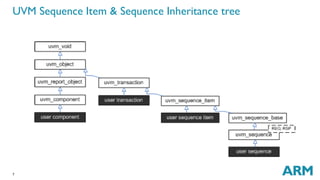
UVM Sequence Item & Sequence Inheritance tree
8
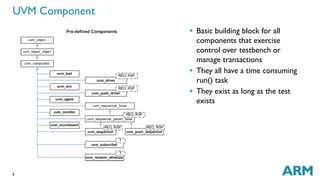
UVM Component
▪ Basic building block for all
components that exercise
control over testbench or
manage transactions
▪ They all have a time consuming
run() task
▪ They exist as long as the test
exists
9
UVM Sequence Item & Sequence
▪ Sequence Item is the same as a transaction
▪ It’s the basic building block for all types of data in
UVM
▪ Collection of logically related items that are
shared between testbench components
▪ Examples: packet,AXI transaction, pixel
▪ Common supported methods:
▪ create, copy, print, compare
▪ UVM Sequence is a collection/list of UVM
sequence items
▪ UVM sequence usually has smarts to populate
the sequence but sometimes this is separated
into a UVM generator
10
TOP Env
TX Env
Key components of a UVM testbench
DUT
TX Agent
Sequencer
Driver Monitor
Functional Coverage
RX Env
RX Agent
Sequencer
Driver Monitor
Scoreboard
Interface Interface
11
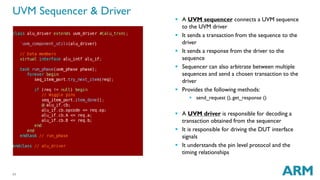
UVM Sequencer & Driver
▪ A UVM sequencer connects a UVM sequence
to the UVM driver
▪ It sends a transaction from the sequence to the
driver
▪ It sends a response from the driver to the
sequence
▪ Sequencer can also arbitrate between multiple
sequences and send a chosen transaction to the
driver
▪ Provides the following methods:
▪ send_request (), get_response ()
▪ A UVM driver is responsible for decoding a
transaction obtained from the sequencer
▪ It is responsible for driving the DUT interface
signals
▪ It understands the pin level protocol and the
timing relationships
12
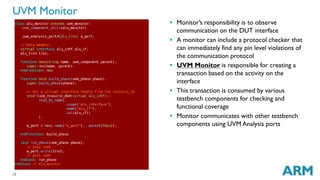
UVM Monitor
▪ Monitor’s responsibility is to observe
communication on the DUT interface
▪ A monitor can include a protocol checker that
can immediately find any pin level violations of
the communication protocol
▪ UVM Monitor is responsible for creating a
transaction based on the activity on the
interface
▪ This transaction is consumed by various
testbench components for checking and
functional coverage
▪ Monitor communicates with other testbench
components using UVM Analysis ports
13
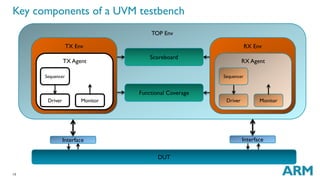
TOP Env
TX Env
Key components of a UVM testbench
DUT
TX Agent
Sequencer
Driver Monitor
Functional Coverage
RX Env
RX Agent
Sequencer
Driver Monitor
Scoreboard
Interface Interface
14
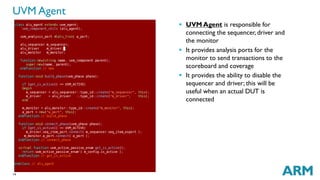
UVM Agent
▪ UVM Agent is responsible for
connecting the sequencer, driver and
the monitor
▪ It provides analysis ports for the
monitor to send transactions to the
scoreboard and coverage
▪ It provides the ability to disable the
sequencer and driver; this will be
useful when an actual DUT is
connected
15
UVM Scoreboard
▪ Scoreboard is one of the trickiest and most important verification components
▪ Scoreboard is an independent implementation of specification
▪ It takes in transactions from various monitors in the design, applies the inputs to the
independent model and generates an expected output
▪ It then compares the actual and the expected outputs
▪ A typical scoreboard is a queue implementation of the modeled outputs resulting in a
pop of the latest result when the actual DUT output is available
▪ A scoreboard also has to ensure that the timing of the inputs and outputs is well
managed to avoid false fails
16
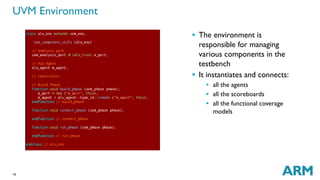
UVM Environment
▪ The environment is
responsible for managing
various components in the
testbench
▪ It instantiates and connects:
▪ all the agents
▪ all the scoreboards
▪ all the functional coverage
models
17
UVM Test
▪ uvm_test is responsible for
▪ creating the environment
▪ controlling the type of test you want to run
▪ providing configuration information to all the components through the environment
18
TOP Env
TX Env
Key components of a UVM testbench
DUT
TX Agent
Sequencer
Driver Monitor
Functional Coverage
RX Env
RX Agent
Sequencer
Driver Monitor
Scoreboard
Interface Interface
19
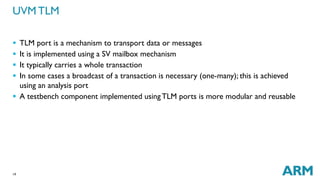
UVM TLM
▪ TLM port is a mechanism to transport data or messages
▪ It is implemented using a SV mailbox mechanism
▪ It typically carries a whole transaction
▪ In some cases a broadcast of a transaction is necessary (one-many); this is achieved
using an analysis port
▪ A testbench component implemented usingTLM ports is more modular and reusable
20
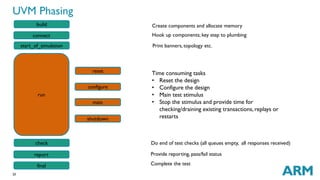
UVM Phasing
build
check
start_of_simulation
run
final
connect
report
reset
configure
shutdown
main
Create components and allocate memory
Hook up components; key step to plumbing
Time consuming tasks
• Reset the design
• Configure the design
• Main test stimulus
• Stop the stimulus and provide time for
checking/draining existing transactions, replays or
restarts
Do end of test checks (all queues empty, all responses received)
Provide reporting, pass/fail status
Complete the test
Print banners, topology etc.
21
▪ Discussed what a verification methodology is and the need for it
▪ Looked at block diagrams with key components in a UVM testbench
▪ Covered UVM and some of it’s basic features
What we learned today …
22
▪ https://verificationacademy.com/
▪ Accelera: http://accellera.org/downloads/standards/uvm
▪ Recommend watching short videos on UVM introduction onYouTube
Useful pointers

UVM Basics.pdf

  • 1.
    1 UVM Basics Nagesh Loke ARMCPUVerification Lead/Manager
  • 2.
    2 ▪ This lectureaims to: ▪ demonstrate the need for a verification methodology ▪ provide an understanding of some of the key components of a UVM testbench ▪ cover some basic features of UVM What to expect …
  • 3.
  • 4.
    4 ▪ Typical processordevelopment from scratch could be 100s of engineering years ▪ Requires parallel developments across multiple sites, and it takes a large team to verify a processor ▪ The typical method is to divide and conquer, partitioning the whole CPU into smaller units and verify those units, then reuse the checkers and stimulus at a higher level ▪ The challenges are numerous ▪ Reuse of code becomes an absolute key to avoid duplication of work ▪ It is essential to have the ability to integrate an external IP ▪ This requires rigorous planning, code structure, & lockstep development ▪ Standardization becomes a key consideration ▪ UVM can help solve this! What are the challenges of verifying complex systems?
  • 5.
    5 ▪ Stands forUniversalVerification Methodology ▪ Benefits: ▪ supports and provides framework for modular and layered verification components ▪ Enables: ◦ reuse ◦ clear functional definition for each component ◦ configuration of components to be used in a variety of contexts ▪ is maintained and released by Accellera committee ▪ source code is fully available ▪ is a mature product ▪ significant amount of training and support available What is UVM and why use it?
  • 6.
    6 TOP Env TX Env Keycomponents of a UVM testbench DUT TX Agent Sequencer Driver Monitor Functional Coverage RX Env RX Agent Sequencer Driver Monitor Scoreboard Interface Interface
  • 7.
    7 UVM Sequence Item& Sequence Inheritance tree
  • 8.
    8 UVM Component ▪ Basicbuilding block for all components that exercise control over testbench or manage transactions ▪ They all have a time consuming run() task ▪ They exist as long as the test exists
  • 9.
    9 UVM Sequence Item& Sequence ▪ Sequence Item is the same as a transaction ▪ It’s the basic building block for all types of data in UVM ▪ Collection of logically related items that are shared between testbench components ▪ Examples: packet,AXI transaction, pixel ▪ Common supported methods: ▪ create, copy, print, compare ▪ UVM Sequence is a collection/list of UVM sequence items ▪ UVM sequence usually has smarts to populate the sequence but sometimes this is separated into a UVM generator
  • 10.
    10 TOP Env TX Env Keycomponents of a UVM testbench DUT TX Agent Sequencer Driver Monitor Functional Coverage RX Env RX Agent Sequencer Driver Monitor Scoreboard Interface Interface
  • 11.
    11 UVM Sequencer &Driver ▪ A UVM sequencer connects a UVM sequence to the UVM driver ▪ It sends a transaction from the sequence to the driver ▪ It sends a response from the driver to the sequence ▪ Sequencer can also arbitrate between multiple sequences and send a chosen transaction to the driver ▪ Provides the following methods: ▪ send_request (), get_response () ▪ A UVM driver is responsible for decoding a transaction obtained from the sequencer ▪ It is responsible for driving the DUT interface signals ▪ It understands the pin level protocol and the timing relationships
  • 12.
    12 UVM Monitor ▪ Monitor’sresponsibility is to observe communication on the DUT interface ▪ A monitor can include a protocol checker that can immediately find any pin level violations of the communication protocol ▪ UVM Monitor is responsible for creating a transaction based on the activity on the interface ▪ This transaction is consumed by various testbench components for checking and functional coverage ▪ Monitor communicates with other testbench components using UVM Analysis ports
  • 13.
    13 TOP Env TX Env Keycomponents of a UVM testbench DUT TX Agent Sequencer Driver Monitor Functional Coverage RX Env RX Agent Sequencer Driver Monitor Scoreboard Interface Interface
  • 14.
    14 UVM Agent ▪ UVMAgent is responsible for connecting the sequencer, driver and the monitor ▪ It provides analysis ports for the monitor to send transactions to the scoreboard and coverage ▪ It provides the ability to disable the sequencer and driver; this will be useful when an actual DUT is connected
  • 15.
    15 UVM Scoreboard ▪ Scoreboardis one of the trickiest and most important verification components ▪ Scoreboard is an independent implementation of specification ▪ It takes in transactions from various monitors in the design, applies the inputs to the independent model and generates an expected output ▪ It then compares the actual and the expected outputs ▪ A typical scoreboard is a queue implementation of the modeled outputs resulting in a pop of the latest result when the actual DUT output is available ▪ A scoreboard also has to ensure that the timing of the inputs and outputs is well managed to avoid false fails
  • 16.
    16 UVM Environment ▪ Theenvironment is responsible for managing various components in the testbench ▪ It instantiates and connects: ▪ all the agents ▪ all the scoreboards ▪ all the functional coverage models
  • 17.
    17 UVM Test ▪ uvm_testis responsible for ▪ creating the environment ▪ controlling the type of test you want to run ▪ providing configuration information to all the components through the environment
  • 18.
    18 TOP Env TX Env Keycomponents of a UVM testbench DUT TX Agent Sequencer Driver Monitor Functional Coverage RX Env RX Agent Sequencer Driver Monitor Scoreboard Interface Interface
  • 19.
    19 UVM TLM ▪ TLMport is a mechanism to transport data or messages ▪ It is implemented using a SV mailbox mechanism ▪ It typically carries a whole transaction ▪ In some cases a broadcast of a transaction is necessary (one-many); this is achieved using an analysis port ▪ A testbench component implemented usingTLM ports is more modular and reusable
  • 20.
    20 UVM Phasing build check start_of_simulation run final connect report reset configure shutdown main Create componentsand allocate memory Hook up components; key step to plumbing Time consuming tasks • Reset the design • Configure the design • Main test stimulus • Stop the stimulus and provide time for checking/draining existing transactions, replays or restarts Do end of test checks (all queues empty, all responses received) Provide reporting, pass/fail status Complete the test Print banners, topology etc.
  • 21.
    21 ▪ Discussed whata verification methodology is and the need for it ▪ Looked at block diagrams with key components in a UVM testbench ▪ Covered UVM and some of it’s basic features What we learned today …
  • 22.
    22 ▪ https://verificationacademy.com/ ▪ Accelera:http://accellera.org/downloads/standards/uvm ▪ Recommend watching short videos on UVM introduction onYouTube Useful pointers