WEAPONIZING HYPERVISORS
TO FIGHT & BEAT
CAR & MEDICAL DEVICE
ATTACKS
Ali Islam – CEO Numen Inc
Dan Regalado – DanuX – CTO Numen Inc
AGENDA
Basic	Concepts	
Q&A	
Embedded	Environment	
Demo	–	Attacks	&	Use	cases
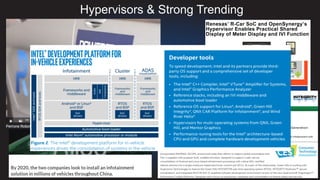
Hypervisors & Strong Trending
Confidential
Agent-less vs Agent (AV)
•  Sophisticated Invisibility (VMI) - Cat and mouse
game
•  No messing up the actual device functionality
•  Helps with regulations and certifications
Let’s start the Journey
Setting up the Environment on a
Zynq UltraScale+ MPSoC ZCU 102
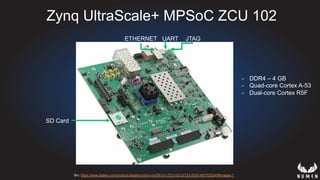
Src: https://www.digikey.com/product-detail/en/xilinx-inc/EK-U1-ZCU102-G/122-2035-ND/7035245#images-1
SD Card
UART JTAG
Zynq UltraScale+ MPSoC ZCU 102
ETHERNET
-  DDR4 – 4 GB
-  Quad-core Cortex A-53
-  Dual-core Cortex R5F
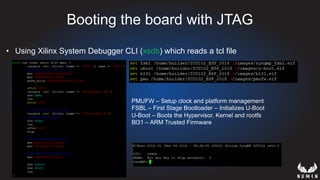
Booting the board with JTAG
•  Using Xilinx System Debugger CLI (xsdb) which reads a tcl file
PMUFW – Setup clock and platform management
FSBL – First Stage Bootloader – Initializes U-Boot
U-Boot – Boots the Hypervisor, Kernel and rootfs
Bl31 – ARM Trusted Firmware
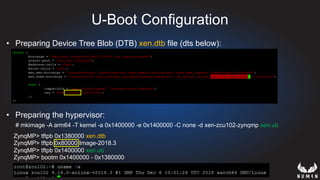
U-Boot Configuration
•  Preparing Device Tree Blob (DTB) xen.dtb file (dts below):
ZynqMP> tftpb 0x1380000 xen.dtb
ZynqMP> tftpb 0x80000 Image-2018.3
ZynqMP> tftpb 0x1400000 xen.ub
ZynqMP> bootm 0x1400000 - 0x1380000
# mkimage -A arm64 -T kernel -a 0x1400000 -e 0x1400000 -C none -d xen-zcu102-zynqmp xen.ub
•  Preparing the hypervisor:
Building the rootfs
•  PetaLinux: Xilinx-based and therefore not universal
•  Yocto: Universal but builds a Busybox limited rootfs
ü  Real pain to compile new libraries
•  Debootstrap: Way to go, Debian-based FileSystem J
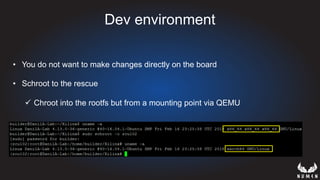
Dev environment
•  You do not want to make changes directly on the board
•  Schroot to the rescue
ü  Chroot into the rootfs but from a mounting point via QEMU
Let’s get the damn ARM Syscalls out!
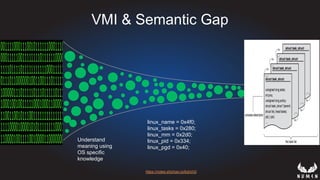
VMI & Semantic Gap
Understand
meaning using
OS specific
knowledge
https://notes.shichao.io/lkd/ch3/
linux_name = 0x4f0;
linux_tasks = 0x280;
linux_mm = 0x2d0;
linux_pid = 0x334;
linux_pgd = 0x40;
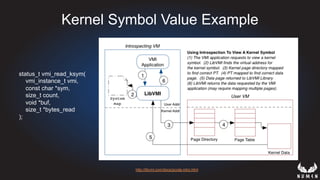
Kernel Symbol Value Example
http://libvmi.com/docs/gcode-intro.html
status_t vmi_read_ksym(
vmi_instance_t vmi,
const char *sym,
size_t count,
void *buf,
size_t *bytes_read
);
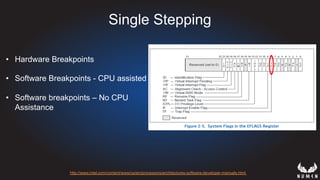
Single Stepping
•  Hardware Breakpoints
•  Software Breakpoints - CPU assisted
•  Software breakpoints – No CPU
Assistance
http://www.intel.com/content/www/us/en/processors/architectures-software-developer-manuals.html
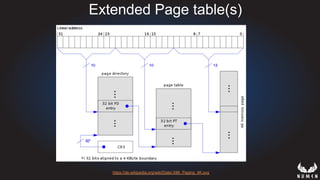
Extended Page table(s)
https://de.wikipedia.org/wiki/Datei:X86_Paging_4K.svg
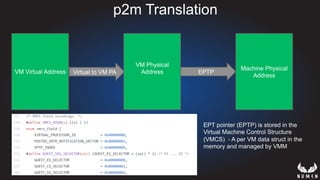
p2m Translation
Machine Physical
Address
VM Virtual Address
VM Physical
Address EPTPVirtual to VM PA
EPT pointer (EPTP) is stored in the
Virtual Machine Control Structure
(VMCS) - A per VM data struct in the
memory and managed by VMM
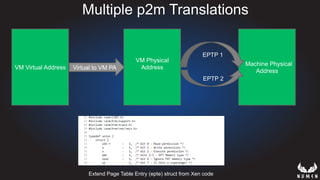
Multiple p2m Translations
Machine Physical
Address
VM Virtual Address
VM Physical
AddressVirtual to VM PA
EPTP 2
EPTP 1
Extend Page Table Entry (epte) struct from Xen code
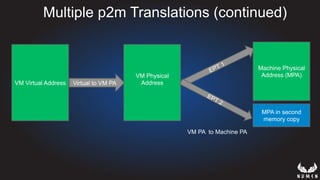
Multiple p2m Translations (continued)
Machine Physical
Address (MPA)
VM Virtual Address
VM Physical
AddressVirtual to VM PA
MPA in second
memory copy
VM PA to Machine PA
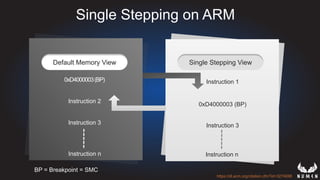
Single Stepping on ARM
0xD4000003(BP)
Instruction 2
Instruction 3
Default Memory View
Instruction 1
0xD4000003 (BP)
Instruction 3
Single Stepping View
https://dl.acm.org/citation.cfm?id=3274698
Instruction nInstruction n
BP = Breakpoint = SMC
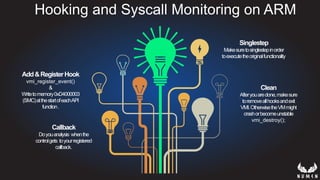
Hooking and Syscall Monitoring on ARM
Singlestep
Makesuretosinglestepinorder
toexecutetheoriginalfunctionality
Clean
Afteryouaredone,makesure
toremoveallhooksandexit
VMI.OtherwisetheVMmight
crashorbecomeunstable
vmi_destroy();
Add&RegisterHook
vmi_register_event()
&
Writetomemory0xD4000003
(SMC)atthestartofeachAPI
function.
Callback
Doyouanalysis whenthe
controlgets toyourregistered
callback.
Syscalls Monitoring in ARM
(ARM-Syscalls.mp4)
Attacks and Detection scenarios
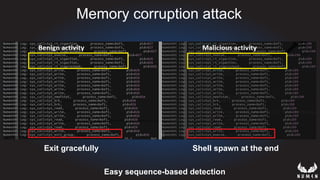
Memory corruption attack
Shell spawn at the endExit gracefully
Easy sequence-based detection
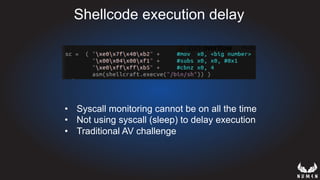
Shellcode execution delay
•  Syscall monitoring cannot be on all the time
•  Not using syscall (sleep) to delay execution
•  Traditional AV challenge
Solution approach
•  Create a “triggered memory view” hooking
only suspicious syscalls: execve, connect,
clone, etc all the time
•  As soon as the shellcode spawns, full hooking
on that process is enabled!
Malware hypervisor-aware
•  The malware is able to read kernel memory
and identify SMC hooks
ü  Stops running or wipes the system!
•  Even in some conditions is able to remove the
hooks!
ü  Worst scenario, detection bypass!
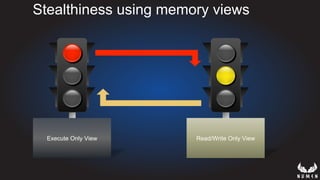
Stealthiness using memory views
Execute Only View Read/Write Only View
Policy Enforcement – Network Use Case
Once you have a good handle on Virtual Machine Introspection,
there are many possibilities.
1) Traverse a task list and see if there is any socket handle for a
particular task struct
1.1) A socket is a special type of file. So check if there is
any additional file handle
2) Hook the network related APIs (e.g. connect).
2.1) More active approach vs the passive one in step 1.
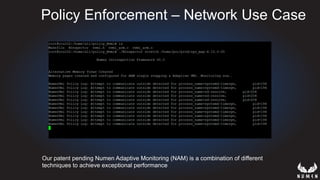
Policy Enforcement – Network Use Case
Our patent pending Numen Adaptive Monitoring (NAM) is a combination of different
techniques to achieve exceptional performance
Remediation
•  Its not easy to remediate from outside without putting
any agent inside. Lets say kill a process.
•  How about manipulating with one of the frequently called
APIs?
•  Maybe make one of the string parameter NULL?
•  Just a basic way. There can be other more mature ways.
PRACTICAL RECOMMENDATIONS FOR END TO END SYSTEM
•  Software Breakpoints
•  Efficient Single Stepping Mechanism
•  Event Mechanism
•  Efficient translations caching
•  Multiple mappings support for p2m (physical to machine)
•  Memory page permissions management
Releasing tool to the public
•  Tool to perform syscall monitoring for ARM & Intel J
•  All files needed to setup a working environment:
ü  Booting the board: zynqmp_fsbl.elf, u-boot.elf,
bl31.elf, pmufw.elf
ü  Environment: xen.dtb, Kernel-Image, Xen-Hypervisor
(version 11.0), DomU-Configuration files, xen startup
scripts.
ü  Test: ARM64-based malware and exploit samples.
•  Dropbox link: xxxxxxxxxxxxxxxxxxxxxx
Takeaways
•  “Smart” Hypervisors on ARM are needed, not only for
isolation
•  ARM Syscall Hooking is great achievement but just the
beginning, the detection strategies is what makes the
difference
•  Switching between memory views for detection strategies is a
new way to detect maliciousness from VMI
Special Thanks
•  Stefano Stabellini: For his great help on Xen troubleshooting
•  Matt Leinhos: For his great features on ARM/Intel VMI
•  For those 3 of you guys, you know who you are J
Without you, no way to complete this effort
Q & A
@Ali_Islam_Khan
@danuxx

DEF CON 27 - ALI ISLAM and DAN REGALADO WEAPONIZING HYPERVISORS

  • 1.
    WEAPONIZING HYPERVISORS TO FIGHT& BEAT CAR & MEDICAL DEVICE ATTACKS Ali Islam – CEO Numen Inc Dan Regalado – DanuX – CTO Numen Inc
  • 2.
  • 3.
    Hypervisors & StrongTrending Confidential
  • 4.
    Agent-less vs Agent(AV) •  Sophisticated Invisibility (VMI) - Cat and mouse game •  No messing up the actual device functionality •  Helps with regulations and certifications
  • 5.
    Let’s start theJourney Setting up the Environment on a Zynq UltraScale+ MPSoC ZCU 102
  • 6.
    Src: https://www.digikey.com/product-detail/en/xilinx-inc/EK-U1-ZCU102-G/122-2035-ND/7035245#images-1 SD Card UARTJTAG Zynq UltraScale+ MPSoC ZCU 102 ETHERNET -  DDR4 – 4 GB -  Quad-core Cortex A-53 -  Dual-core Cortex R5F
  • 7.
    Booting the boardwith JTAG •  Using Xilinx System Debugger CLI (xsdb) which reads a tcl file PMUFW – Setup clock and platform management FSBL – First Stage Bootloader – Initializes U-Boot U-Boot – Boots the Hypervisor, Kernel and rootfs Bl31 – ARM Trusted Firmware
  • 8.
    U-Boot Configuration •  PreparingDevice Tree Blob (DTB) xen.dtb file (dts below): ZynqMP> tftpb 0x1380000 xen.dtb ZynqMP> tftpb 0x80000 Image-2018.3 ZynqMP> tftpb 0x1400000 xen.ub ZynqMP> bootm 0x1400000 - 0x1380000 # mkimage -A arm64 -T kernel -a 0x1400000 -e 0x1400000 -C none -d xen-zcu102-zynqmp xen.ub •  Preparing the hypervisor:
  • 9.
    Building the rootfs • PetaLinux: Xilinx-based and therefore not universal •  Yocto: Universal but builds a Busybox limited rootfs ü  Real pain to compile new libraries •  Debootstrap: Way to go, Debian-based FileSystem J
  • 10.
    Dev environment •  Youdo not want to make changes directly on the board •  Schroot to the rescue ü  Chroot into the rootfs but from a mounting point via QEMU
  • 11.
    Let’s get thedamn ARM Syscalls out!
  • 12.
    VMI & SemanticGap Understand meaning using OS specific knowledge https://notes.shichao.io/lkd/ch3/ linux_name = 0x4f0; linux_tasks = 0x280; linux_mm = 0x2d0; linux_pid = 0x334; linux_pgd = 0x40;
  • 13.
    Kernel Symbol ValueExample http://libvmi.com/docs/gcode-intro.html status_t vmi_read_ksym( vmi_instance_t vmi, const char *sym, size_t count, void *buf, size_t *bytes_read );
  • 14.
    Single Stepping •  HardwareBreakpoints •  Software Breakpoints - CPU assisted •  Software breakpoints – No CPU Assistance http://www.intel.com/content/www/us/en/processors/architectures-software-developer-manuals.html
  • 15.
  • 16.
    p2m Translation Machine Physical Address VMVirtual Address VM Physical Address EPTPVirtual to VM PA EPT pointer (EPTP) is stored in the Virtual Machine Control Structure (VMCS) - A per VM data struct in the memory and managed by VMM
  • 17.
    Multiple p2m Translations MachinePhysical Address VM Virtual Address VM Physical AddressVirtual to VM PA EPTP 2 EPTP 1 Extend Page Table Entry (epte) struct from Xen code
  • 18.
    Multiple p2m Translations(continued) Machine Physical Address (MPA) VM Virtual Address VM Physical AddressVirtual to VM PA MPA in second memory copy VM PA to Machine PA
  • 19.
    Single Stepping onARM 0xD4000003(BP) Instruction 2 Instruction 3 Default Memory View Instruction 1 0xD4000003 (BP) Instruction 3 Single Stepping View https://dl.acm.org/citation.cfm?id=3274698 Instruction nInstruction n BP = Breakpoint = SMC
  • 20.
    Hooking and SyscallMonitoring on ARM Singlestep Makesuretosinglestepinorder toexecutetheoriginalfunctionality Clean Afteryouaredone,makesure toremoveallhooksandexit VMI.OtherwisetheVMmight crashorbecomeunstable vmi_destroy(); Add&RegisterHook vmi_register_event() & Writetomemory0xD4000003 (SMC)atthestartofeachAPI function. Callback Doyouanalysis whenthe controlgets toyourregistered callback.
  • 21.
    Syscalls Monitoring inARM (ARM-Syscalls.mp4)
  • 22.
  • 23.
    Memory corruption attack Shellspawn at the endExit gracefully Easy sequence-based detection
  • 24.
    Shellcode execution delay • Syscall monitoring cannot be on all the time •  Not using syscall (sleep) to delay execution •  Traditional AV challenge
  • 25.
    Solution approach •  Createa “triggered memory view” hooking only suspicious syscalls: execve, connect, clone, etc all the time •  As soon as the shellcode spawns, full hooking on that process is enabled!
  • 26.
    Malware hypervisor-aware •  Themalware is able to read kernel memory and identify SMC hooks ü  Stops running or wipes the system! •  Even in some conditions is able to remove the hooks! ü  Worst scenario, detection bypass!
  • 27.
    Stealthiness using memoryviews Execute Only View Read/Write Only View
  • 28.
    Policy Enforcement –Network Use Case Once you have a good handle on Virtual Machine Introspection, there are many possibilities. 1) Traverse a task list and see if there is any socket handle for a particular task struct 1.1) A socket is a special type of file. So check if there is any additional file handle 2) Hook the network related APIs (e.g. connect). 2.1) More active approach vs the passive one in step 1.
  • 29.
    Policy Enforcement –Network Use Case Our patent pending Numen Adaptive Monitoring (NAM) is a combination of different techniques to achieve exceptional performance
  • 30.
    Remediation •  Its noteasy to remediate from outside without putting any agent inside. Lets say kill a process. •  How about manipulating with one of the frequently called APIs? •  Maybe make one of the string parameter NULL? •  Just a basic way. There can be other more mature ways.
  • 31.
    PRACTICAL RECOMMENDATIONS FOREND TO END SYSTEM •  Software Breakpoints •  Efficient Single Stepping Mechanism •  Event Mechanism •  Efficient translations caching •  Multiple mappings support for p2m (physical to machine) •  Memory page permissions management
  • 32.
    Releasing tool tothe public •  Tool to perform syscall monitoring for ARM & Intel J •  All files needed to setup a working environment: ü  Booting the board: zynqmp_fsbl.elf, u-boot.elf, bl31.elf, pmufw.elf ü  Environment: xen.dtb, Kernel-Image, Xen-Hypervisor (version 11.0), DomU-Configuration files, xen startup scripts. ü  Test: ARM64-based malware and exploit samples. •  Dropbox link: xxxxxxxxxxxxxxxxxxxxxx
  • 33.
    Takeaways •  “Smart” Hypervisorson ARM are needed, not only for isolation •  ARM Syscall Hooking is great achievement but just the beginning, the detection strategies is what makes the difference •  Switching between memory views for detection strategies is a new way to detect maliciousness from VMI
  • 34.
    Special Thanks •  StefanoStabellini: For his great help on Xen troubleshooting •  Matt Leinhos: For his great features on ARM/Intel VMI •  For those 3 of you guys, you know who you are J Without you, no way to complete this effort
  • 35.