
June 2014
Basics of Functional Verification
Anand Shirahatti @ashirahatti
| 2
Contents
▪  Verification Philosophy
▪  Familiarity
▪  Scope of Verification
▪  Functional Verification as a Career
▪  Overview of Process
▪  Some Examples: The 3 Musketeers
▪  Do’s and Don’t’s
▪  State of the Art
| 3
The Verification Philosophy
KNOW EVOLUTION to understand why
things are the way they are!
GET THE DNA to evolve further
GO BEYOND basics to get productive
| 4
Contents
▪  Verification Philosophy
▪  Familiarity
▪  Scope of Verification
▪  Functional Verification as a Career
▪  Overview of Process
▪  Some Examples: The 3 Musketeers
▪  Do’s and Don’t’s
▪  State of the Art
| 5
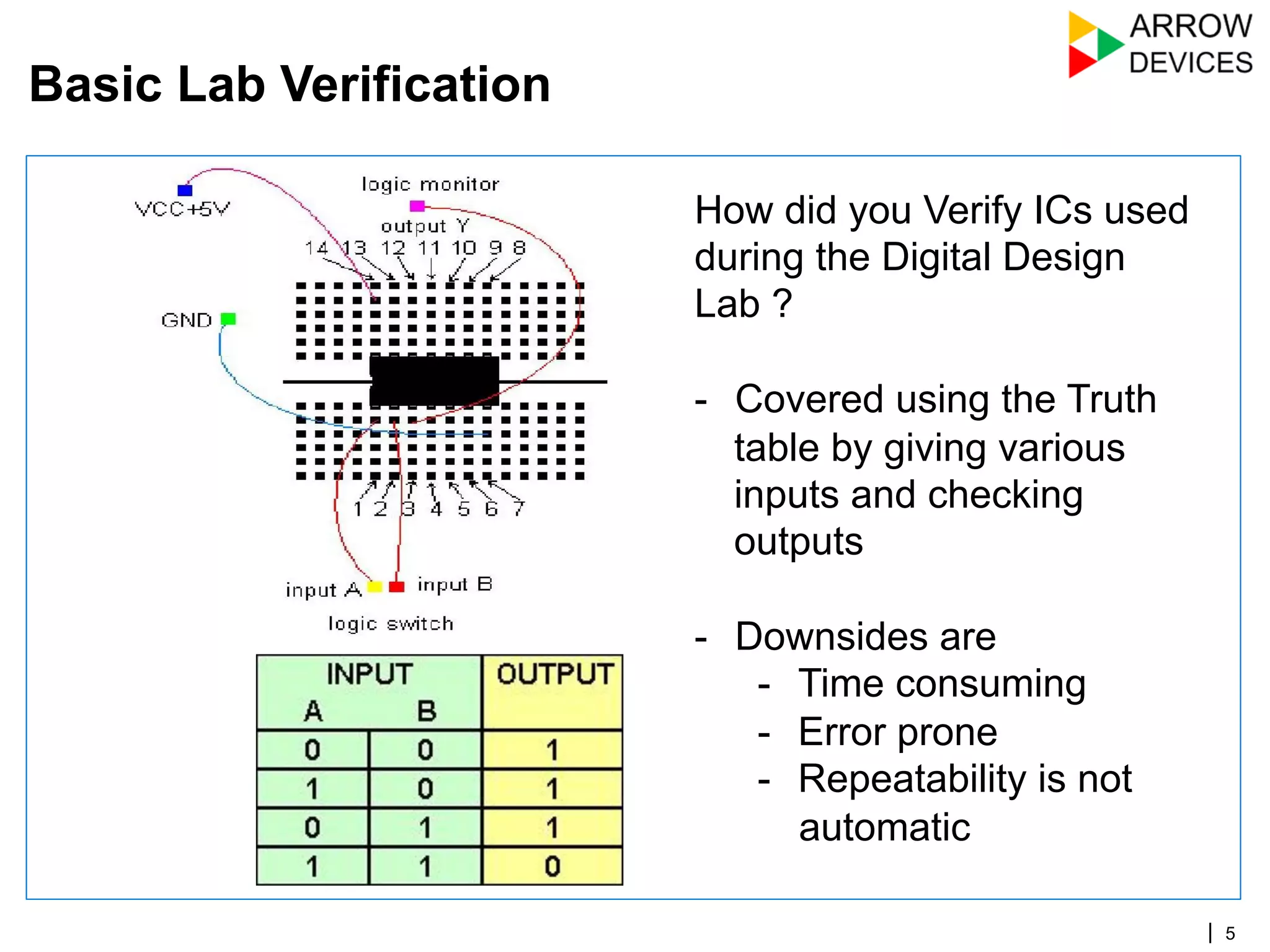
Basic Lab Verification
How did you Verify ICs used
during the Digital Design
Lab ?
-  Covered using the Truth
table by giving various
inputs and checking
outputs
-  Downsides are
-  Time consuming
-  Error prone
-  Repeatability is not
automatic
| 6
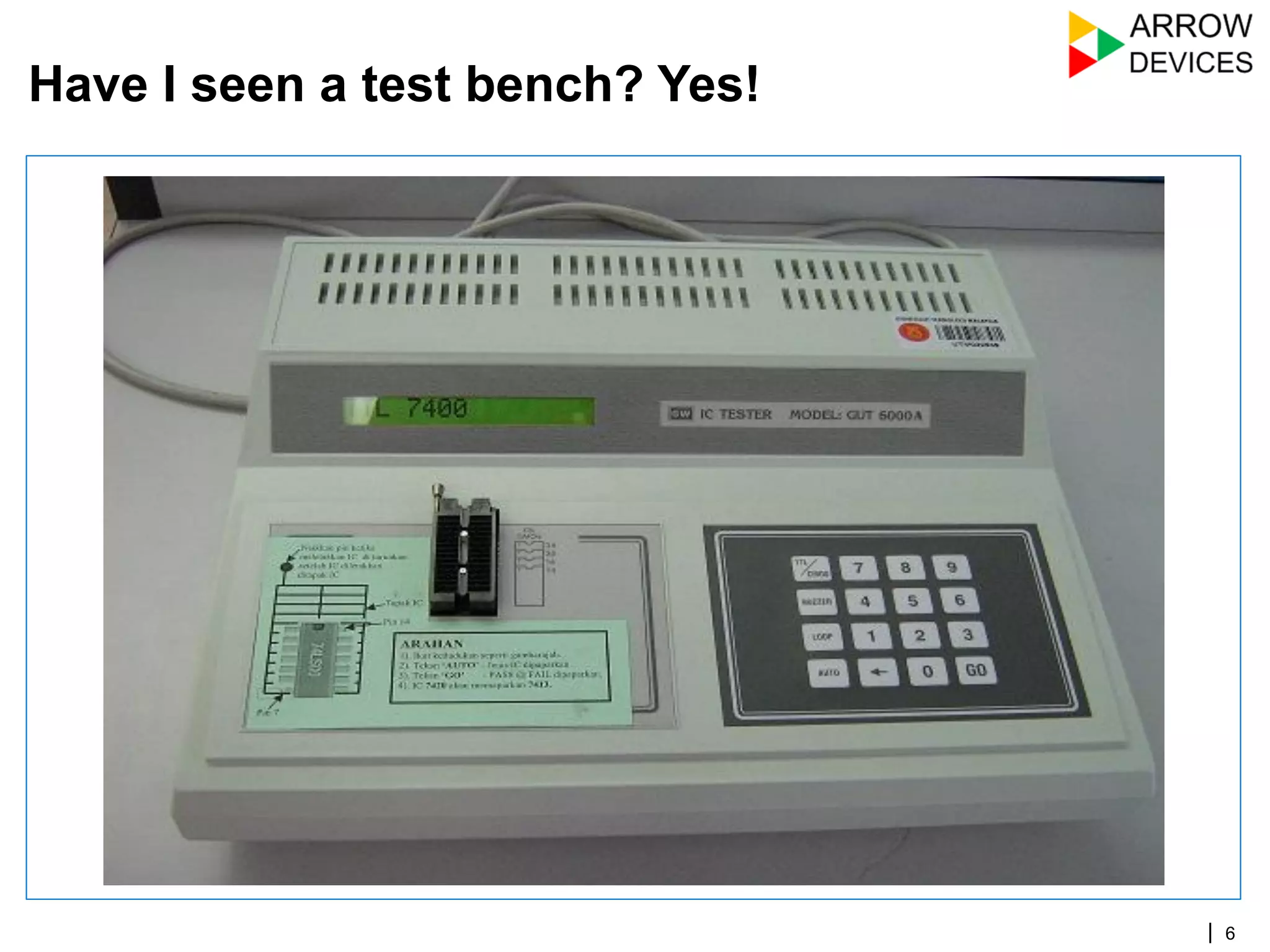
Have I seen a test bench? Yes!
| 7
Contents
▪  Verification Philosophy
▪  Familiarity
▪  Scope of Verification
▪  Functional Verification as a Career
▪  Overview of Process
▪  Some Examples: The 3 Musketeers
▪  Do’s and Don’t’s
▪  State of the Art
| 8
•  Four major types of verification :
1.  Functional
2.  Timing
3.  Test
4.  Equivalence
•  Functional verification ensures correct logic
performance - under all conditions
•  70 % of chip cycle is verification and more than 70 %
re-spins are functional bugs
•  Functional verification is very time consuming and thus
is always on the critical path
Scope of Verification (1/2)
| 9
•  Design technologies are evolving in Moore’s Law
friendly.
•  Functional verification technologies are yet to catch up
with the advancement happening in the are of Design
•  Functional Verification Tools and methodologies are
attempting to reduce the overall verification time by
enabling parallelism of effort, higher abstraction levels
and automation
•  There is no single formula of success
Scope of Verification (2/2)
| 10
Contents
▪  Verification Philosophy
▪  Familiarity
▪  Scope of Verification
▪  Functional Verification as a Career
▪  Overview of Process
▪  Some Examples: The 3 Musketeers
▪  Do’s and Don’t’s
▪  State of the Art
| 11
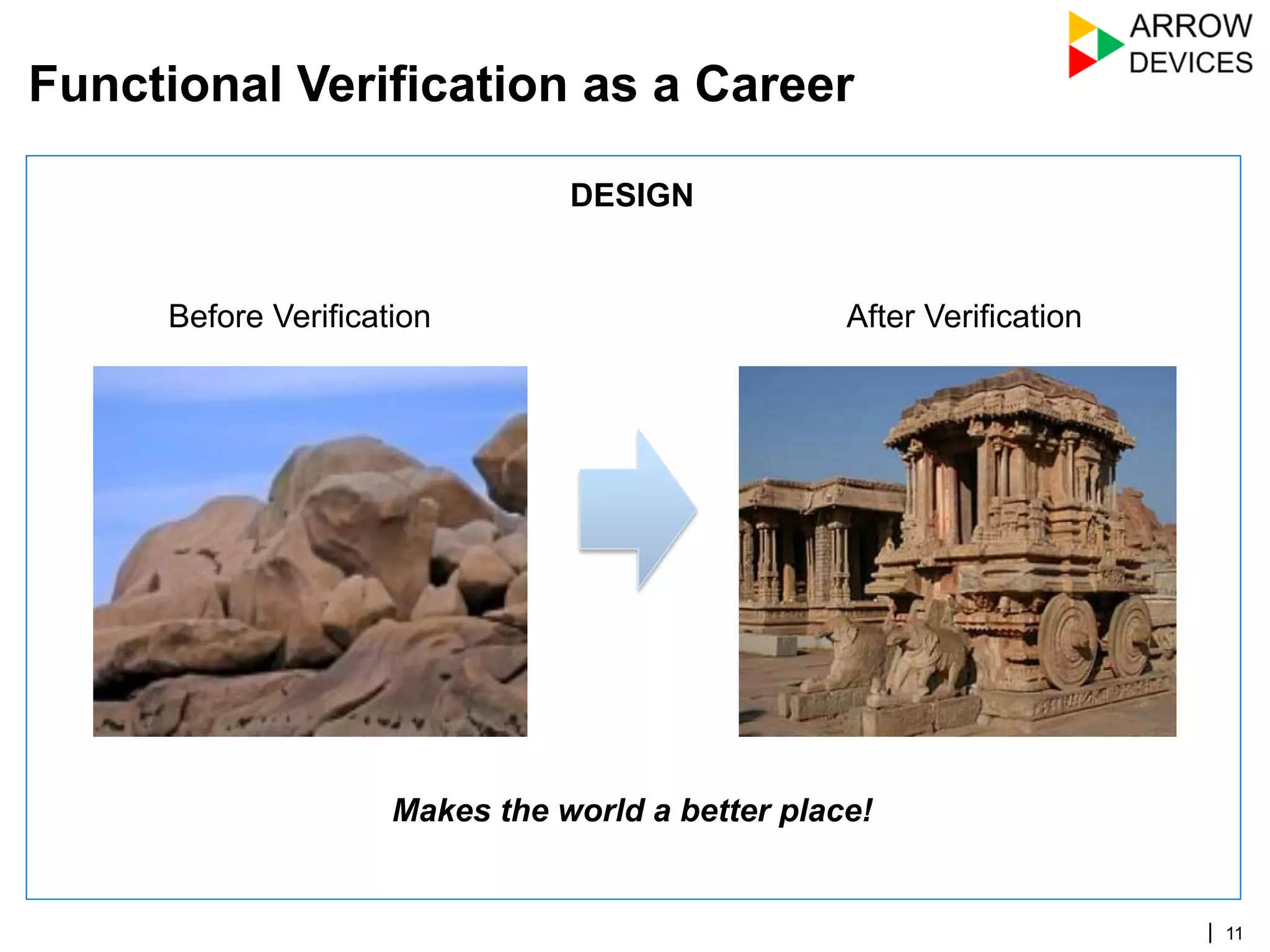
DESIGN
Functional Verification as a Career
Before Verification After Verification
Makes the world a better place!
| 12
•  Knows the design
•  Contributes to architecture
•  Gives feedback as first user
•  Is Creative, Logical and Lateral
•  Programmer
•  “Quality cop”
•  Bridges specification, architecture & design
Hats worn by a Verification Engineer
| 13
Contents
▪  Verification Philosophy
▪  Familiarity
▪  Scope of Verification
▪  Functional Verification as a Career
▪  Overview of Process
▪  Some Examples: The 3 Musketeers
▪  Do’s and Don’t’s
▪  State of the Art
| 14
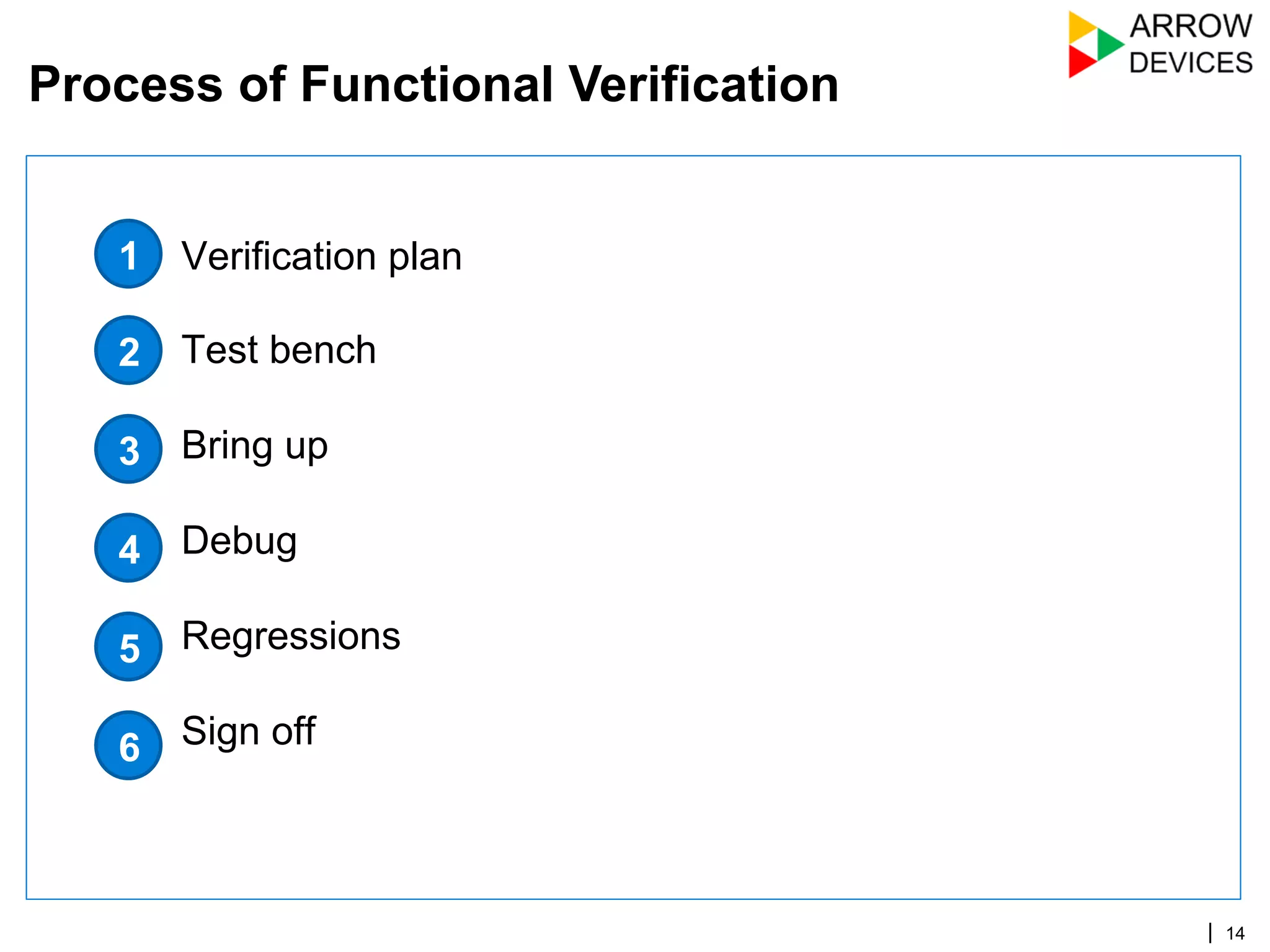
1.  Verification plan
2.  Test bench
3.  Bring up
4.  Debug
5.  Regressions
6.  Sign off
Process of Functional Verification
1
2
3
4
5
6
| 15
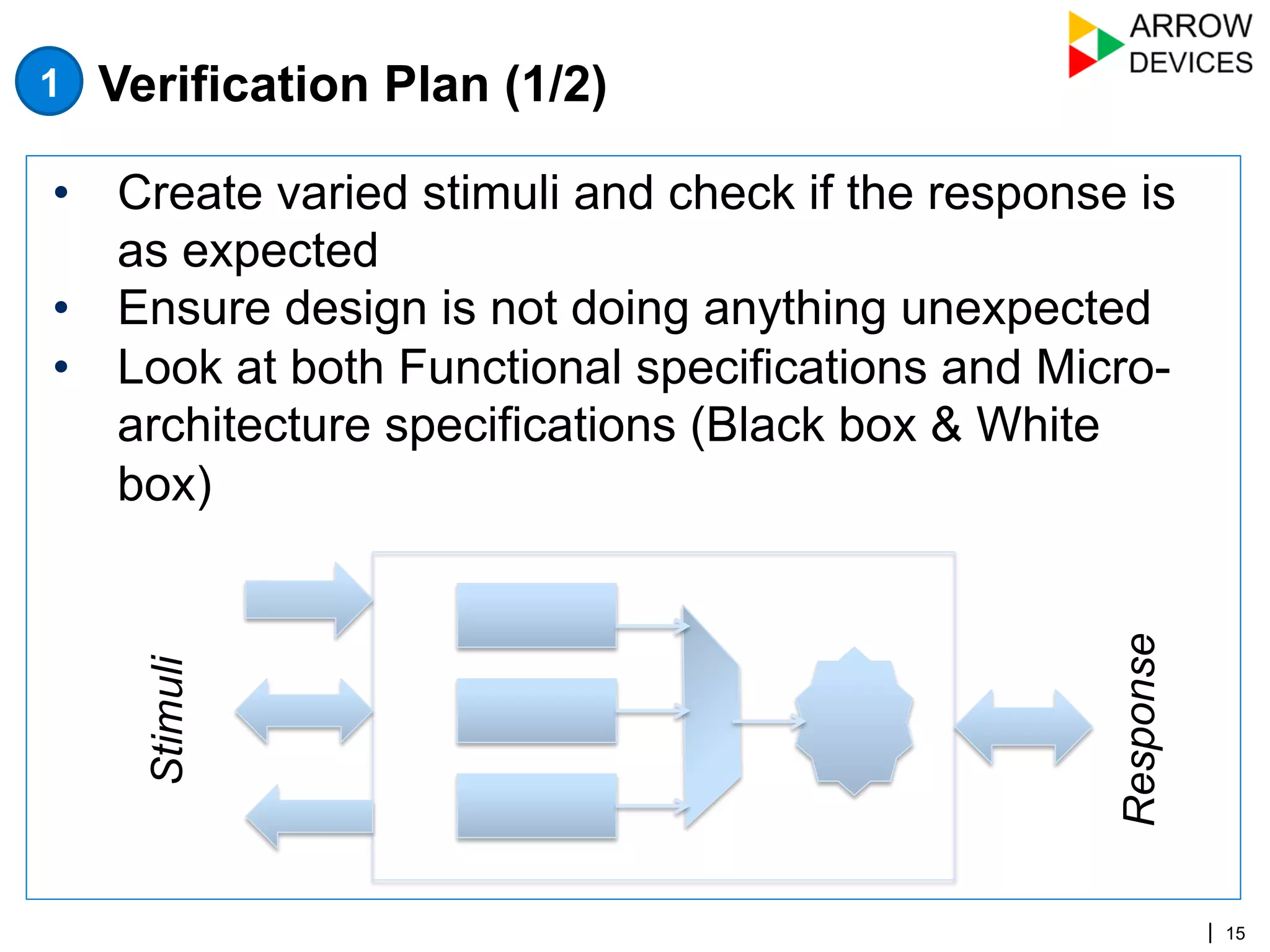
•  Create varied stimuli and check if the response is
as expected
•  Ensure design is not doing anything unexpected
•  Look at both Functional specifications and Micro-
architecture specifications (Black box & White
box)
Stimuli
Response
Verification Plan (1/2)1
| 16
•  Test plan: Create the list of programmable parameters
and features
1.  Normal operation : Basic & Concurrent
2.  Corner cases
3.  Error cases
4.  Negative cases
5.  Stress design cases
•  Functional coverage plan: Capture important features and
parameters
•  Strategy to execute the test plan
Verification Plan (2/2)1
| 17
Every Test Bench Should have the following characteristics
•  Ability to exercise all features and parameters
•  Ability achieve the desired coverage
•  Necessary abstraction
•  Scalability
•  Balance ease of verification vs. reality
•  Ease of understanding and maintenance
•  Ease of debugging – Developer vs User
•  Developer is interested in Internal architecture
•  User is interested in only black box view
•  Easily controllable and observable
Test Bench - Architecture2
| 18
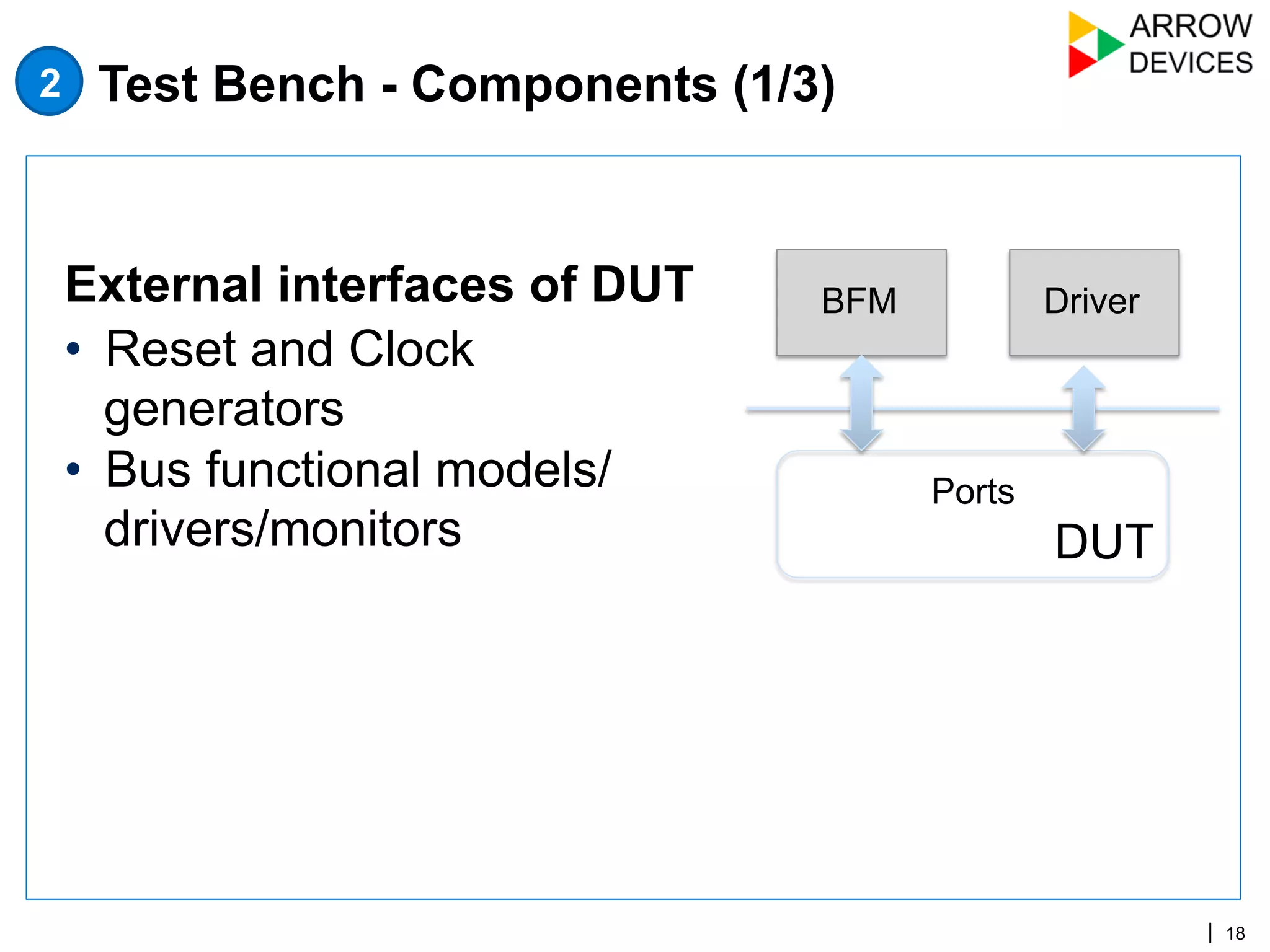
External interfaces of DUT
•  Reset and Clock
generators
•  Bus functional models/
drivers/monitors DUT
Ports
BFM Driver
Test Bench - Components (1/3)2
| 19
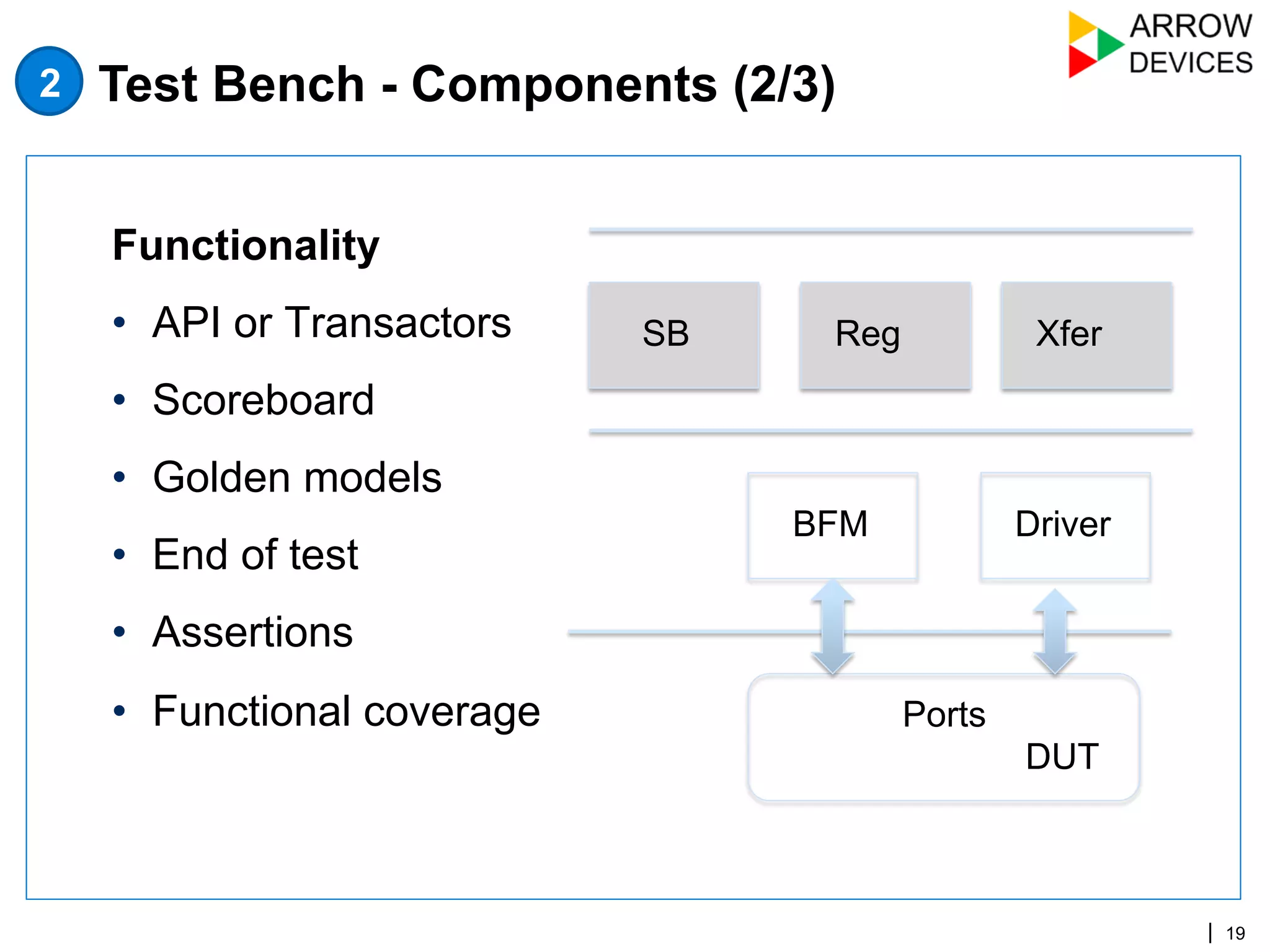
Functionality
•  API or Transactors
•  Scoreboard
•  Golden models
•  End of test
•  Assertions
•  Functional coverage
DUT
Ports
BFM Driver
SB Reg Xfer
Test Bench - Components (2/3)2
| 20
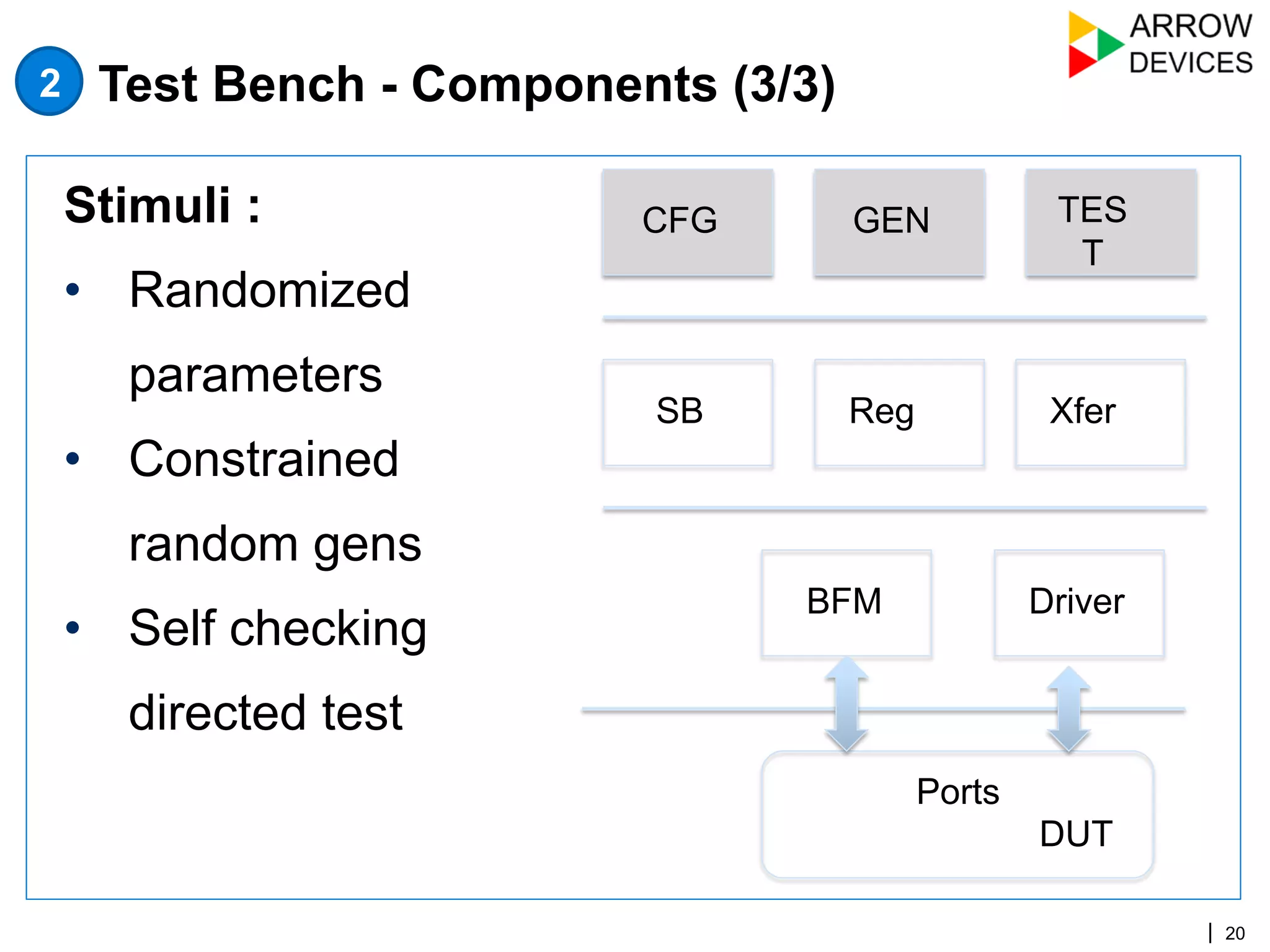
Stimuli :
•  Randomized
parameters
•  Constrained
random gens
•  Self checking
directed test
DUT
Ports
BFM Driver
SB Reg Xfer
CFG GEN TES
T
Test Bench - Components (3/3)2
| 21
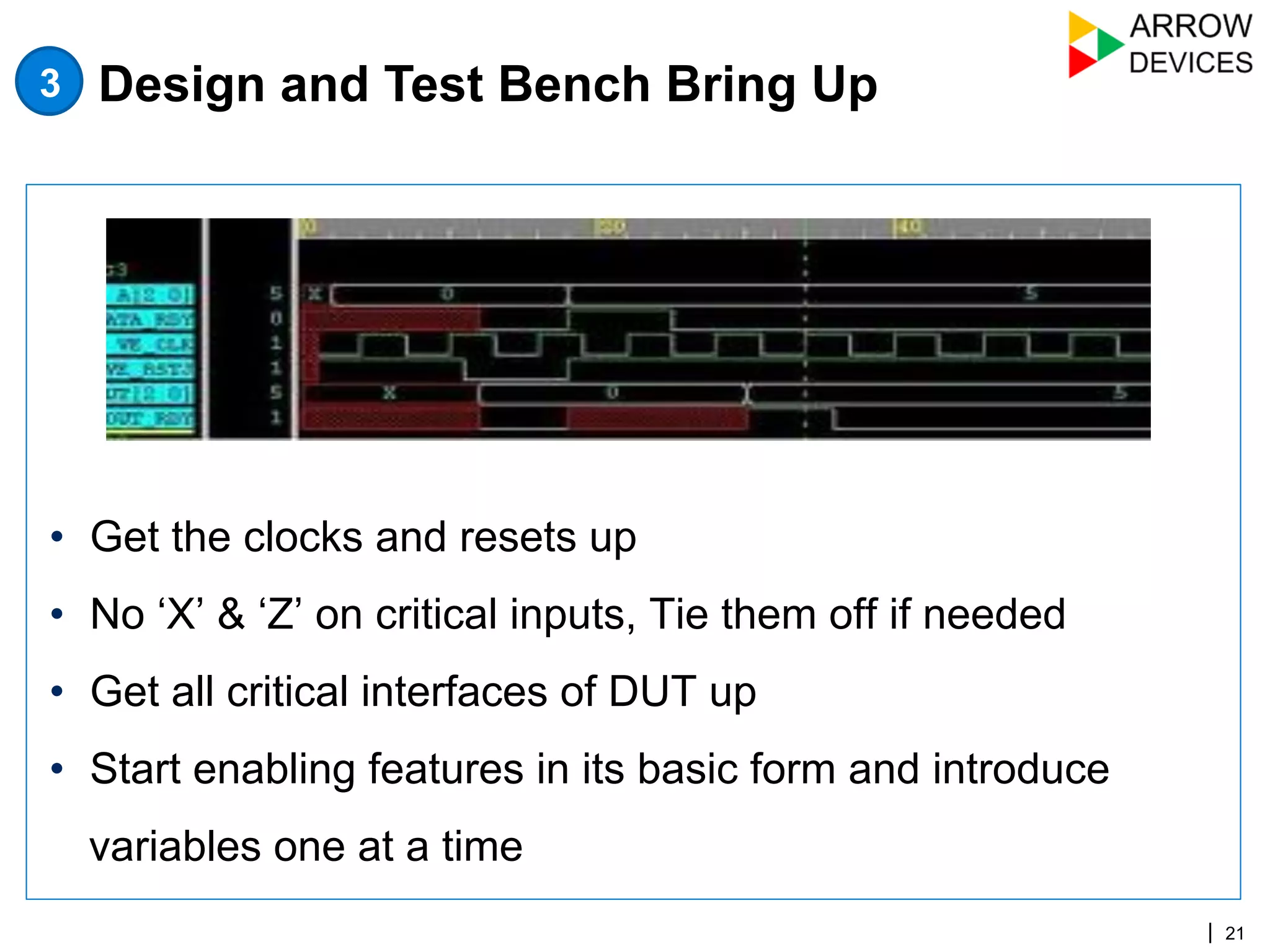
•  Get the clocks and resets up
•  No ‘X’ & ‘Z’ on critical inputs, Tie them off if needed
•  Get all critical interfaces of DUT up
•  Start enabling features in its basic form and introduce
variables one at a time
Design and Test Bench Bring Up3
| 22
•  Done when things not going as expected
•  Takes up 30% of functional verification activity
•  First step is to isolate between the DUT/TB
•  Isolation is done with help of logging
•  Use regular expression friendly logging
•  Extract stimuli and response from log
•  If its not isolatable from log look at waves
•  Benchmark debug is to be able to suggest the design fix
•  Verification engineer is owner of bug till it is fixed
Debug4
| 23
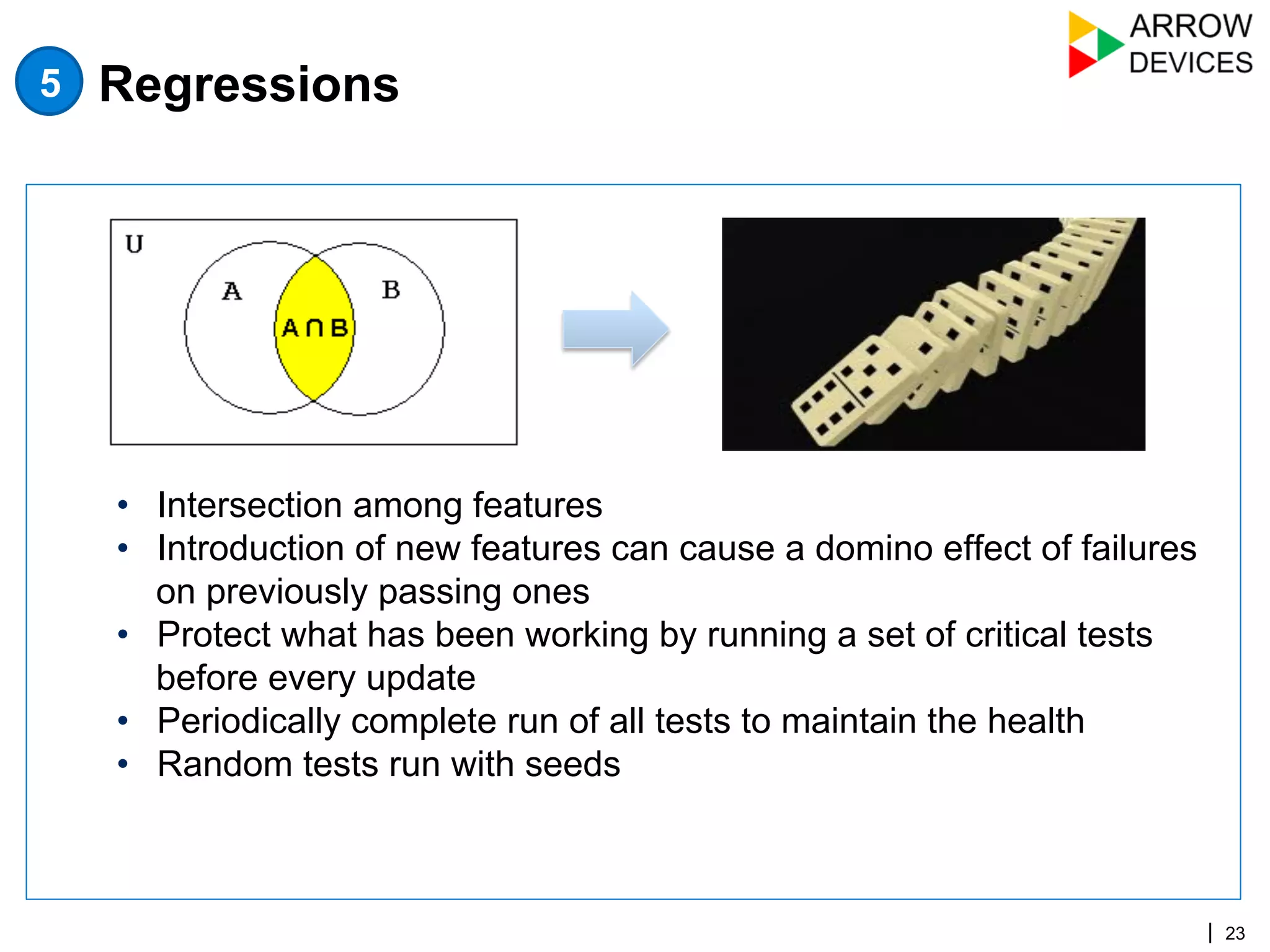
•  Intersection among features
•  Introduction of new features can cause a domino effect of failures
on previously passing ones
•  Protect what has been working by running a set of critical tests
before every update
•  Periodically complete run of all tests to maintain the health
•  Random tests run with seeds
Regressions5
| 24
•  Verification never really completes
•  Minimize risk using metrics
•  100 % code coverage
•  100 % functional coverage
•  All directed tests passing
•  Randoms having zero failures or acceptable failure rate
over few weeks
•  No critical bugs found over last few weeks
Sign Off6
| 25
Contents
▪  Verification Philosophy
▪  Familiarity
▪  Scope of Verification
▪  Functional Verification as a Career
▪  Overview of Process
▪  Some Examples: The 3 Musketeers
▪  Do’s and Don’t’s
▪  State of the Art
| 26
•  Action begins…
•  Lets demonstrate what we have learnt by attacking The
Three Musketeers described below
•  Each of these will take you through complete flow and
also focus on clarifying one aspect we have learnt in
previous slides
1.  Counters – 2-bit and 256-bit
•  Verification strategy
2.  FIFO Verification
•  Test cases and assertions
3.  UART Verification
•  Test bench architecture
The 3 Musketeers
| 27
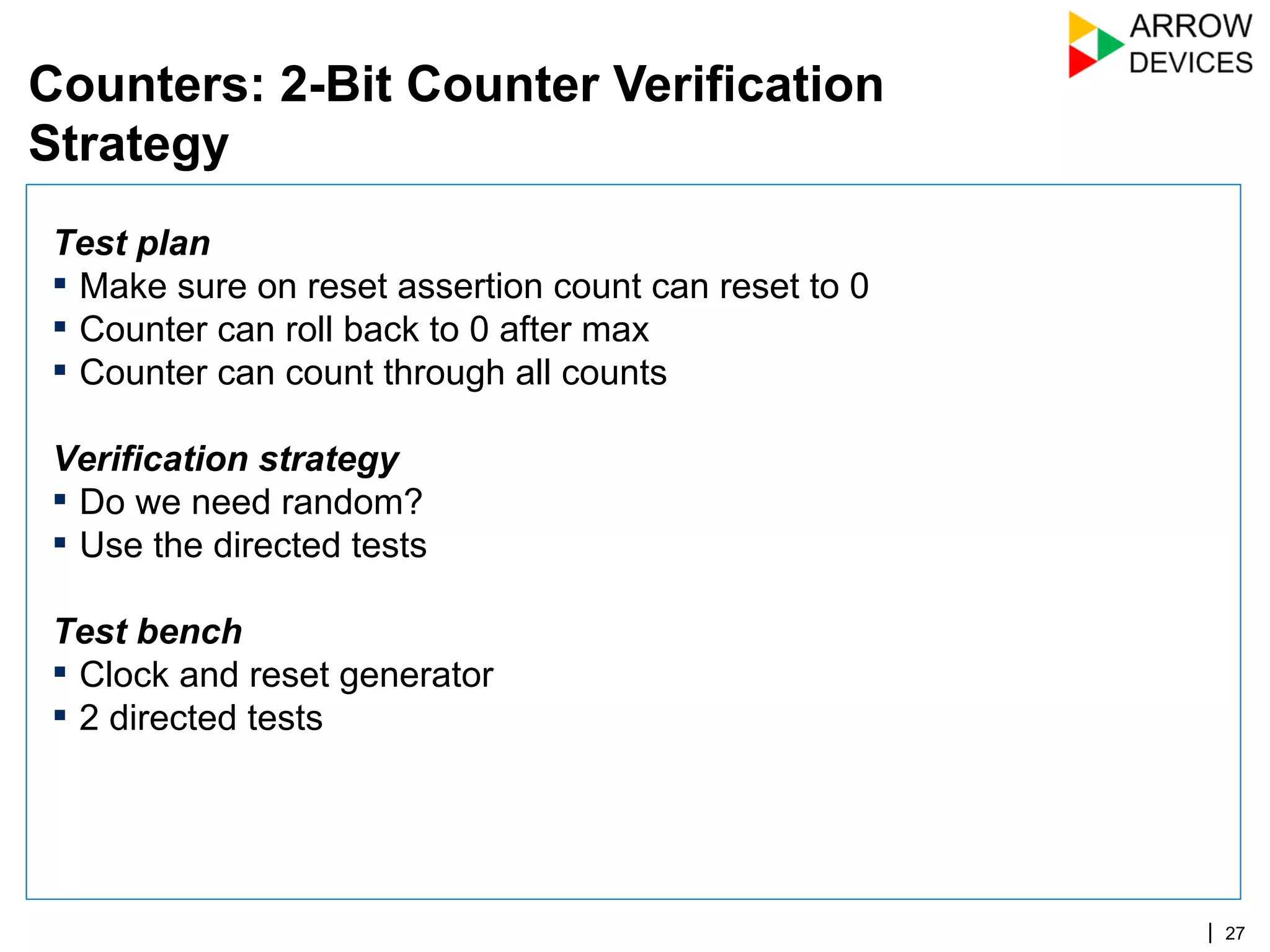
Test plan
▪ Make sure on reset assertion count can reset to 0
▪ Counter can roll back to 0 after max
▪ Counter can count through all counts
Verification strategy
▪ Do we need random?
▪ Use the directed tests
Test bench
▪ Clock and reset generator
▪ 2 directed tests
Counters: 2-Bit Counter Verification
Strategy
| 28
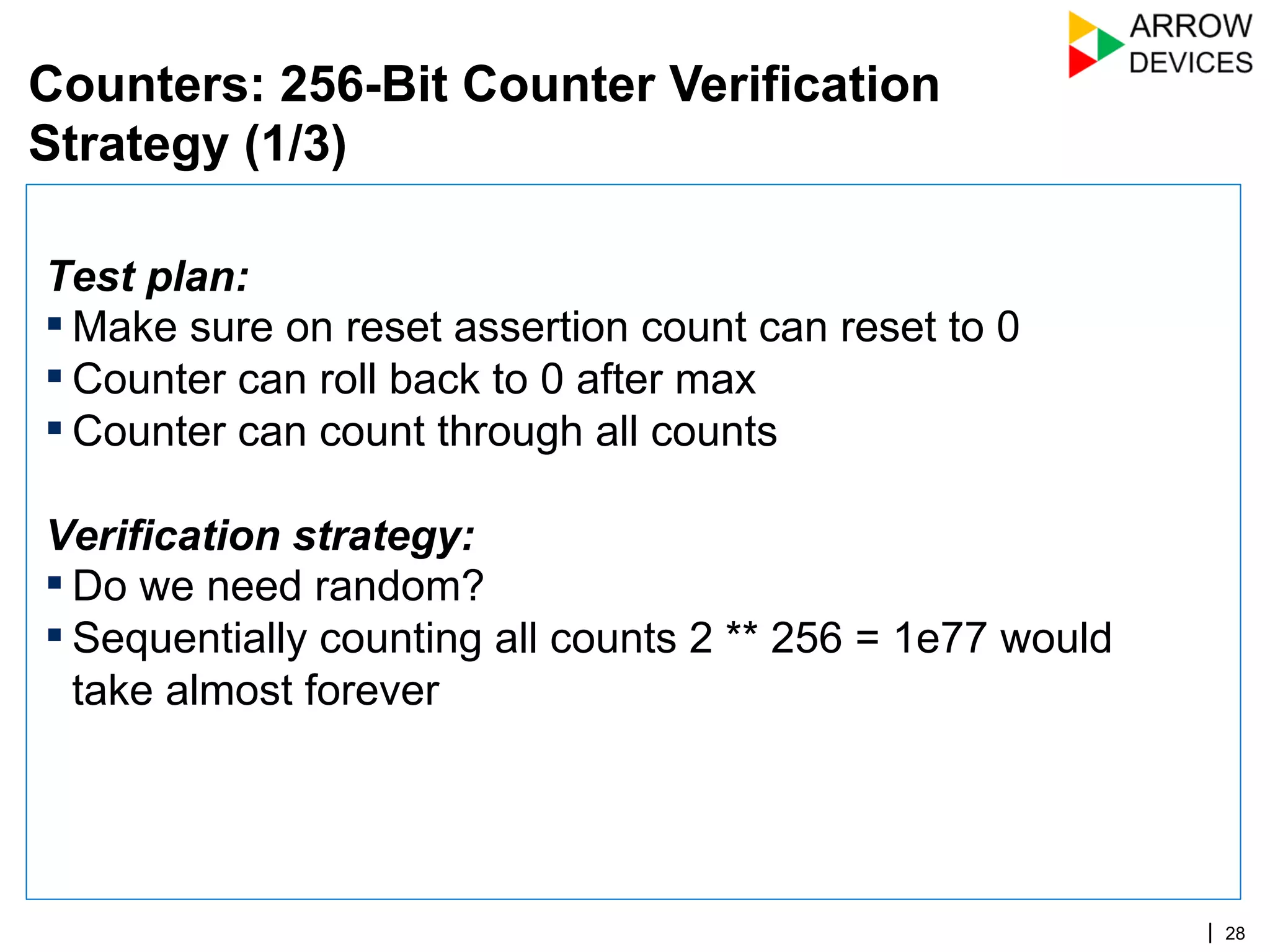
Test plan:
▪ Make sure on reset assertion count can reset to 0
▪ Counter can roll back to 0 after max
▪ Counter can count through all counts
Verification strategy:
▪ Do we need random?
▪ Sequentially counting all counts 2 ** 256 = 1e77 would
take almost forever
Counters: 256-Bit Counter Verification
Strategy (1/3)
| 29
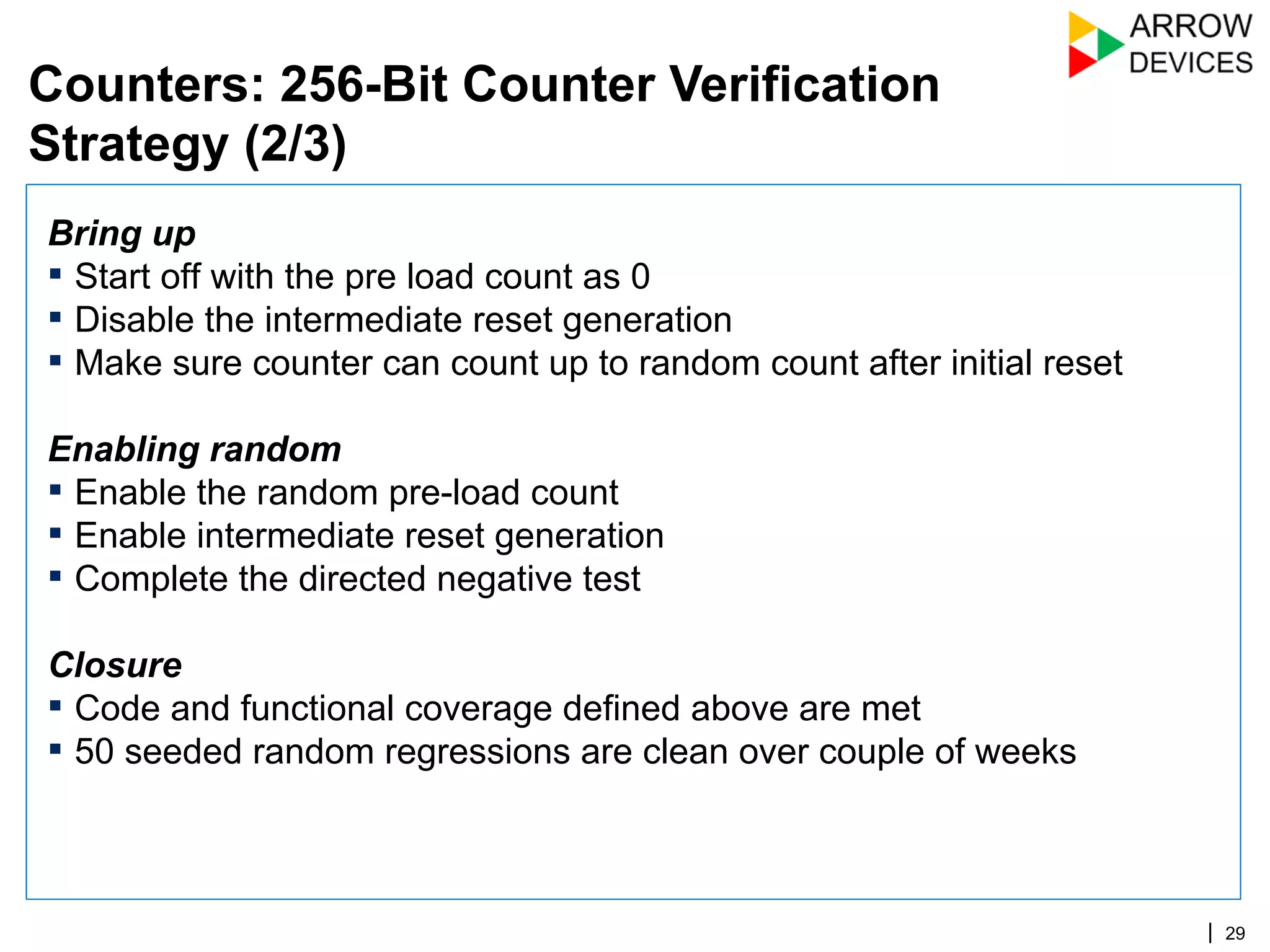
Bring up
▪ Start off with the pre load count as 0
▪ Disable the intermediate reset generation
▪ Make sure counter can count up to random count after initial reset
Enabling random
▪ Enable the random pre-load count
▪ Enable intermediate reset generation
▪ Complete the directed negative test
Closure
▪ Code and functional coverage defined above are met
▪ 50 seeded random regressions are clean over couple of weeks
Counters: 256-Bit Counter Verification
Strategy (2/3)
| 30
•  Start from random value and count up to another random
value
•  Divide count range into 4 and make sure each range
covers some counts
•  All the bits should be toggling
•  Count from Max to 0
•  Reset during random count
•  Bias the design change for pre load
•  How do you handle condition of reset and enable
asserted together ?
Counters: 256-Bit Counter Verification
Strategy (3/3)
| 31
•  Identify variables that need randomization
–  Random pre-load count
–  Random count up value to end the test
–  Control to enable/disable intermediate reset generation
–  Random count at which reset needs to be generated
▫  All random stimulus should have control to make it directed if
needed
•  Clock generator
•  Counter model with load and reset control - This will act as a score board.
•  The model’s output will be used for check - Comparing at every clock will
ensure that the bug’s can be caught immediately
Counters: 256-Bit Counter Test Bench
| 32
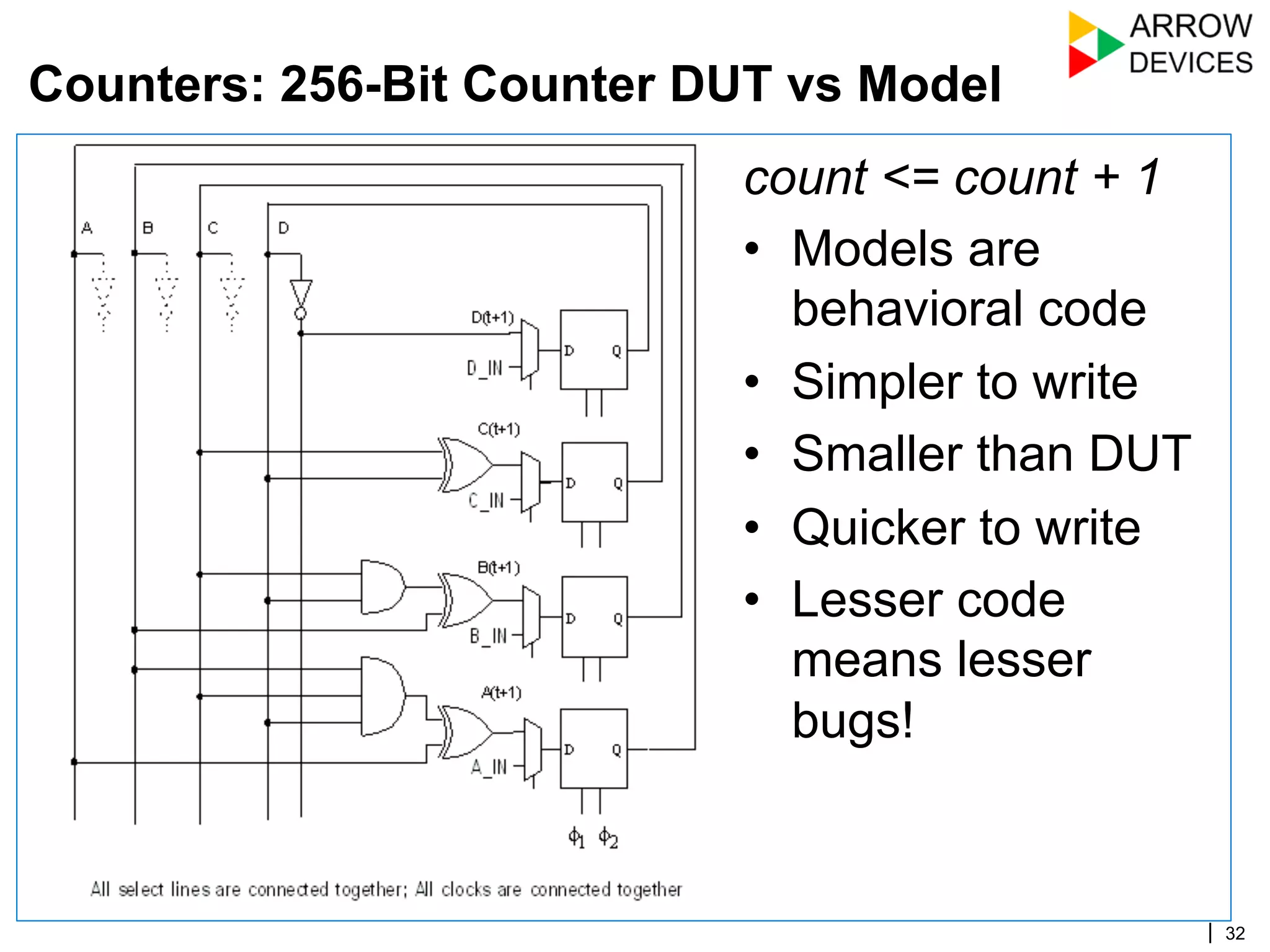
count <= count + 1
•  Models are
behavioral code
•  Simpler to write
•  Smaller than DUT
•  Quicker to write
•  Lesser code
means lesser
bugs!
Counters: 256-Bit Counter DUT vs Model
| 33
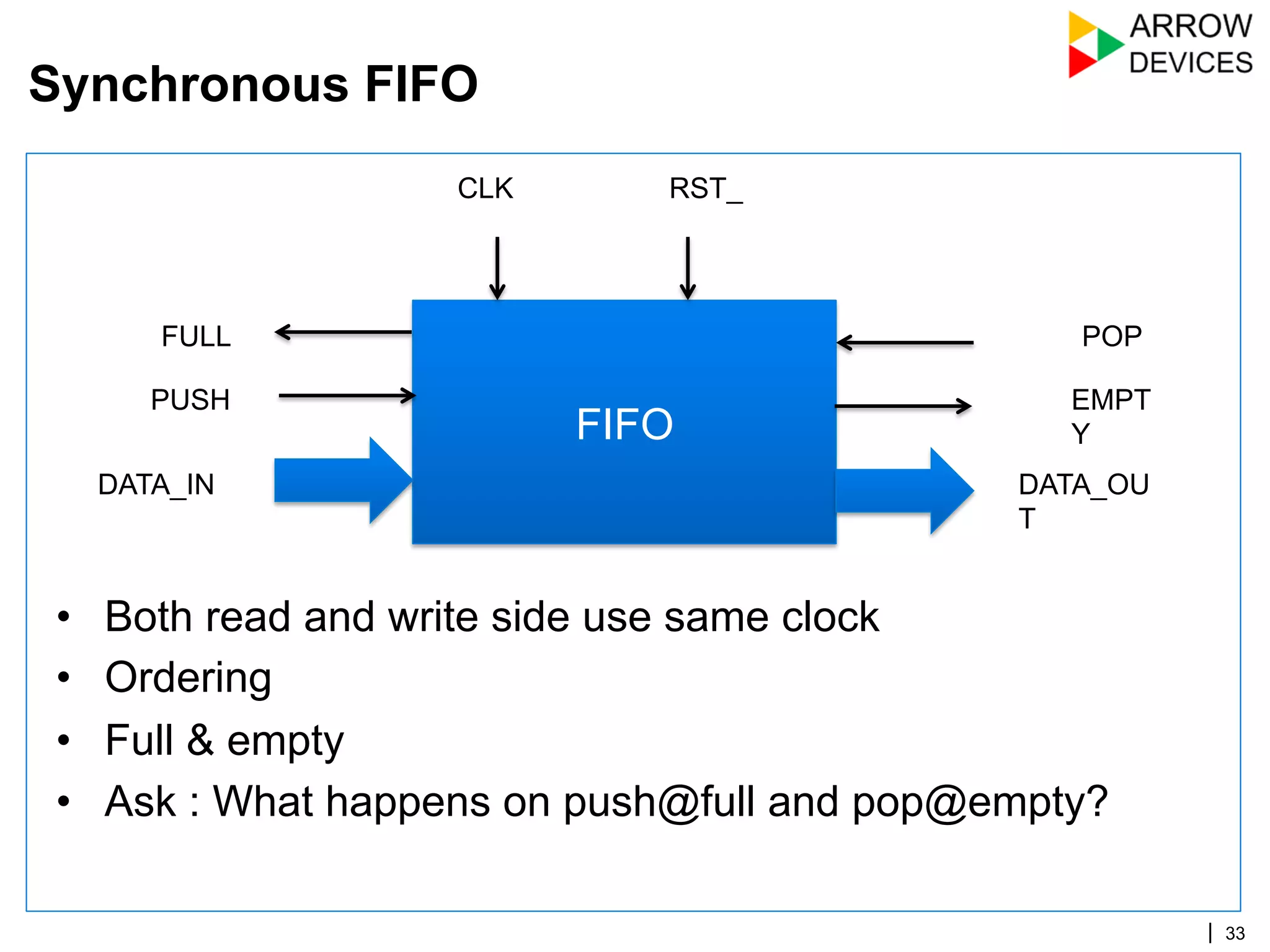
FIFO
FULL
PUSH
DATA_IN
POP
EMPT
Y
DATA_OU
T
CLK RST_
•  Both read and write side use same clock
•  Ordering
•  Full & empty
•  Ask : What happens on push@full and pop@empty?
Synchronous FIFO
| 34
Normal operation
▪  Order of data pushed should match POP
▪  After N PUSH and 0 POP, FIFO FULL assertion
▪  Num of PUSH == Num of POP EMPTY assertion
▪  Stress : PUSH and POP at same time
▪  Reset intermediately
Negative case
▪  PUSH on FULL and POP on EMPTY
Implementation specific
▪  Internal counter alignments for FULL/EMPTY generation
Always true conditions [Assertion]
▪  Both FULL and EMPTY should never get asserted together
▪  Number of clocks between the assertion of Write on input to de-assertion of
empty on output - This is also indicative of performance of the FIFO.
Synchronous FIFO - Test Plan
| 35
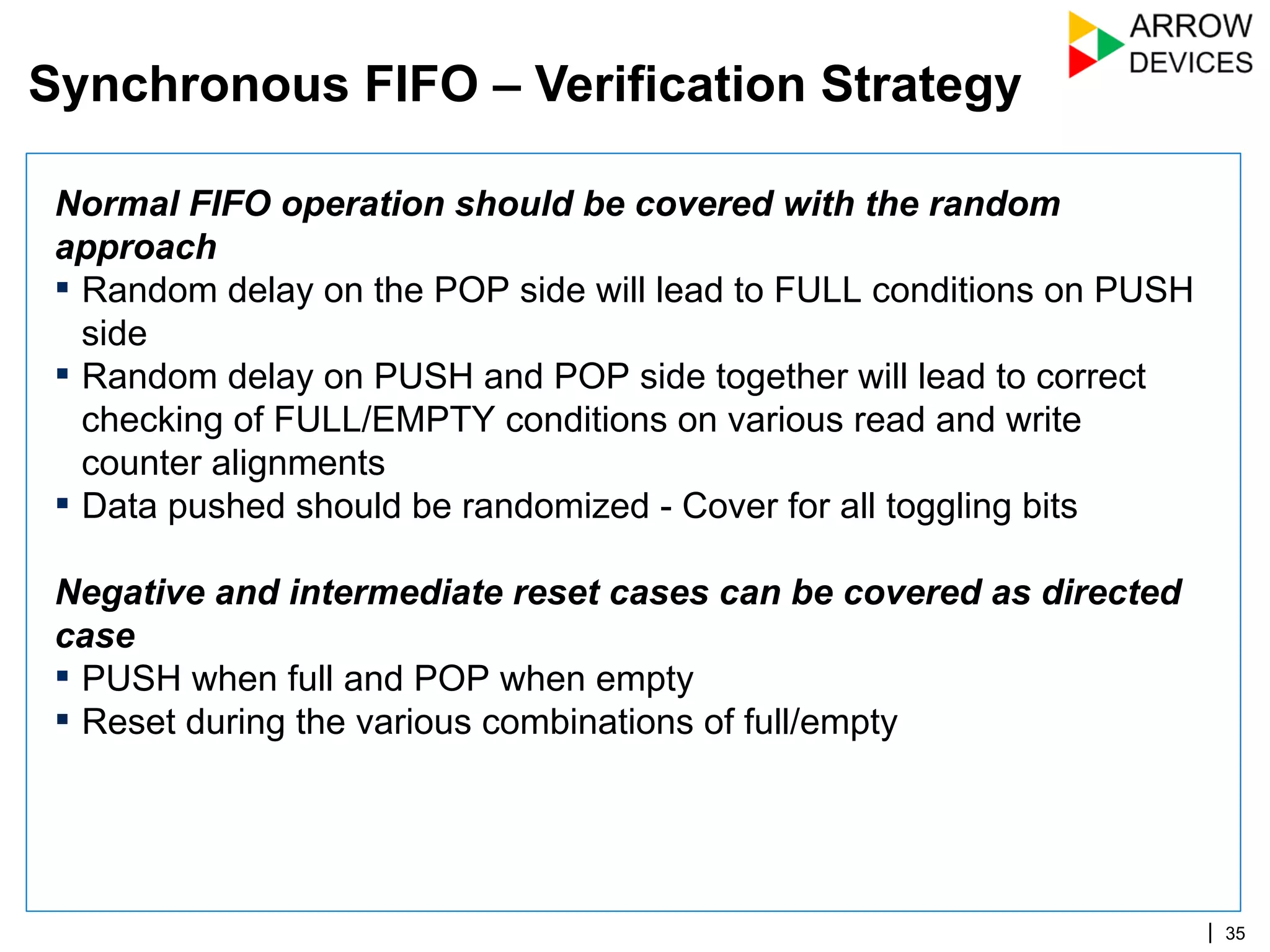
Normal FIFO operation should be covered with the random
approach
▪ Random delay on the POP side will lead to FULL conditions on PUSH
side
▪ Random delay on PUSH and POP side together will lead to correct
checking of FULL/EMPTY conditions on various read and write
counter alignments
▪ Data pushed should be randomized - Cover for all toggling bits
Negative and intermediate reset cases can be covered as directed
case
▪ PUSH when full and POP when empty
▪ Reset during the various combinations of full/empty
Synchronous FIFO – Verification Strategy
| 36
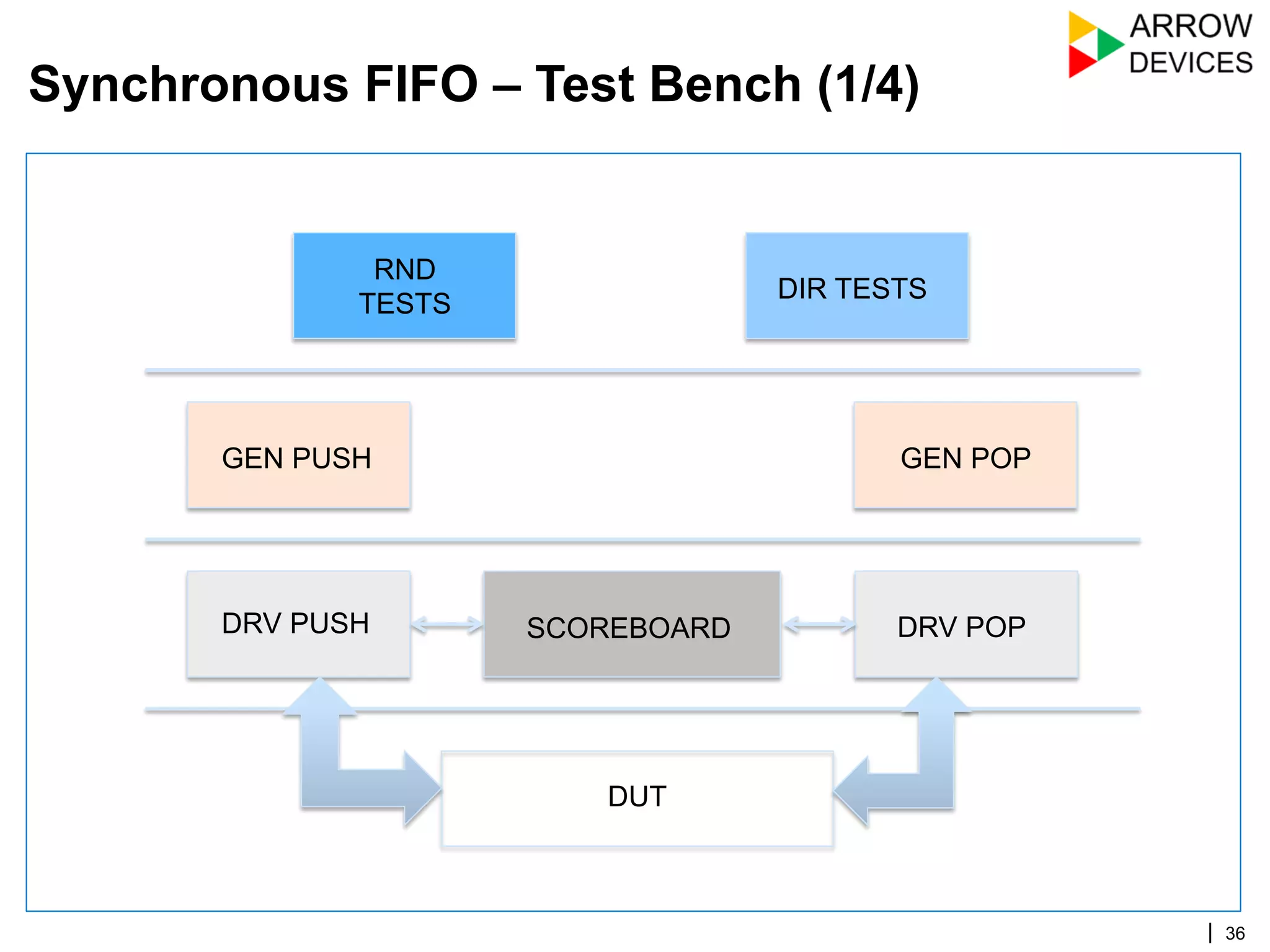
DUT
DRV PUSH DRV POPSCOREBOARD
GEN PUSH GEN POP
RND
TESTS
DIR TESTS
Synchronous FIFO – Test Bench (1/4)
| 37
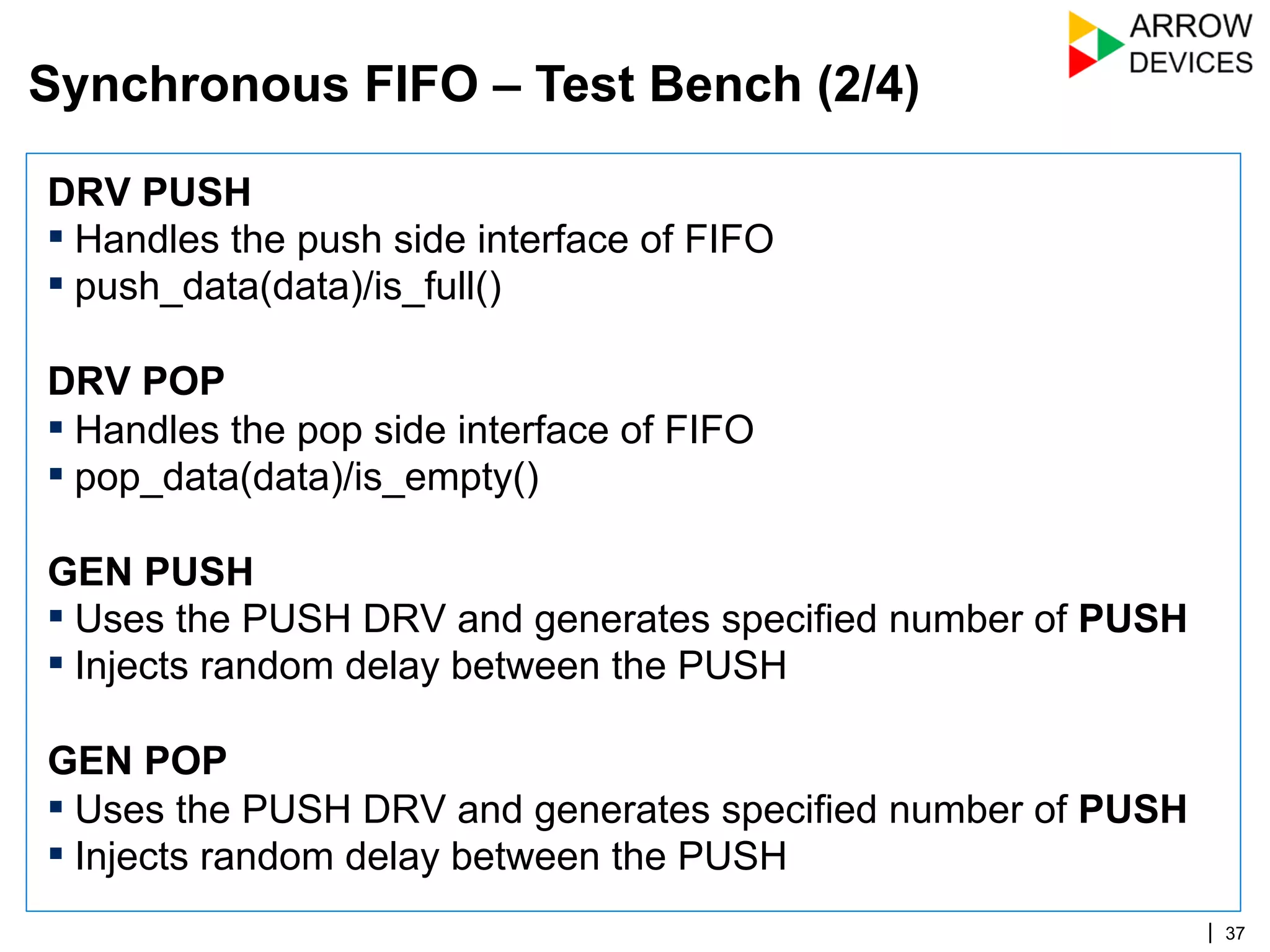
DRV PUSH
▪ Handles the push side interface of FIFO
▪ push_data(data)/is_full()
DRV POP
▪ Handles the pop side interface of FIFO
▪ pop_data(data)/is_empty()
GEN PUSH
▪ Uses the PUSH DRV and generates specified number of PUSH
▪ Injects random delay between the PUSH
GEN POP
▪ Uses the PUSH DRV and generates specified number of PUSH
▪ Injects random delay between the PUSH
Synchronous FIFO – Test Bench (2/4)
| 38
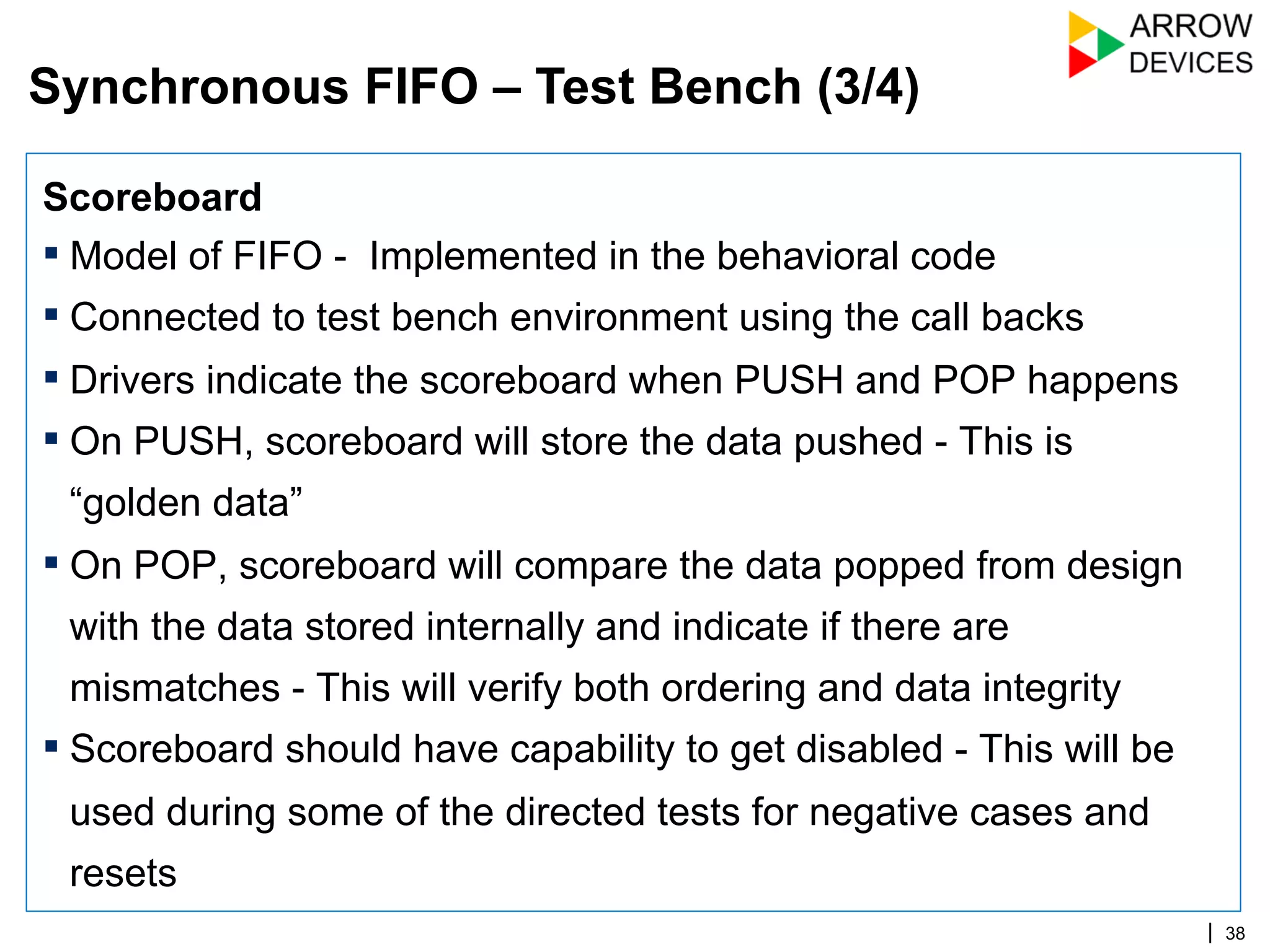
Scoreboard
▪ Model of FIFO - Implemented in the behavioral code
▪ Connected to test bench environment using the call backs
▪ Drivers indicate the scoreboard when PUSH and POP happens
▪ On PUSH, scoreboard will store the data pushed - This is
“golden data”
▪ On POP, scoreboard will compare the data popped from design
with the data stored internally and indicate if there are
mismatches - This will verify both ordering and data integrity
▪ Scoreboard should have capability to get disabled - This will be
used during some of the directed tests for negative cases and
resets
Synchronous FIFO – Test Bench (3/4)
| 39
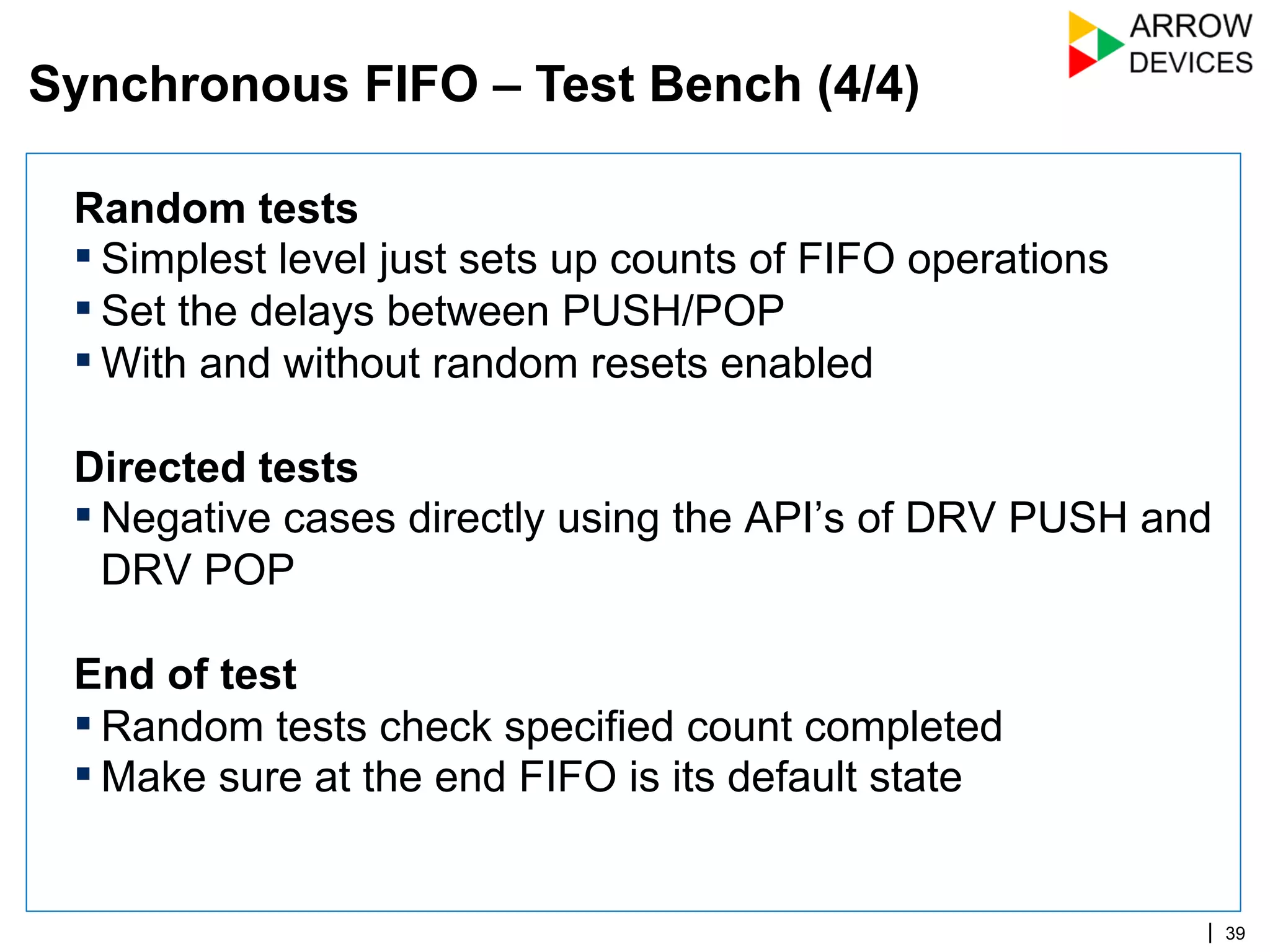
Random tests
▪ Simplest level just sets up counts of FIFO operations
▪ Set the delays between PUSH/POP
▪ With and without random resets enabled
Directed tests
▪ Negative cases directly using the API’s of DRV PUSH and
DRV POP
End of test
▪ Random tests check specified count completed
▪ Make sure at the end FIFO is its default state
Synchronous FIFO – Test Bench (4/4)
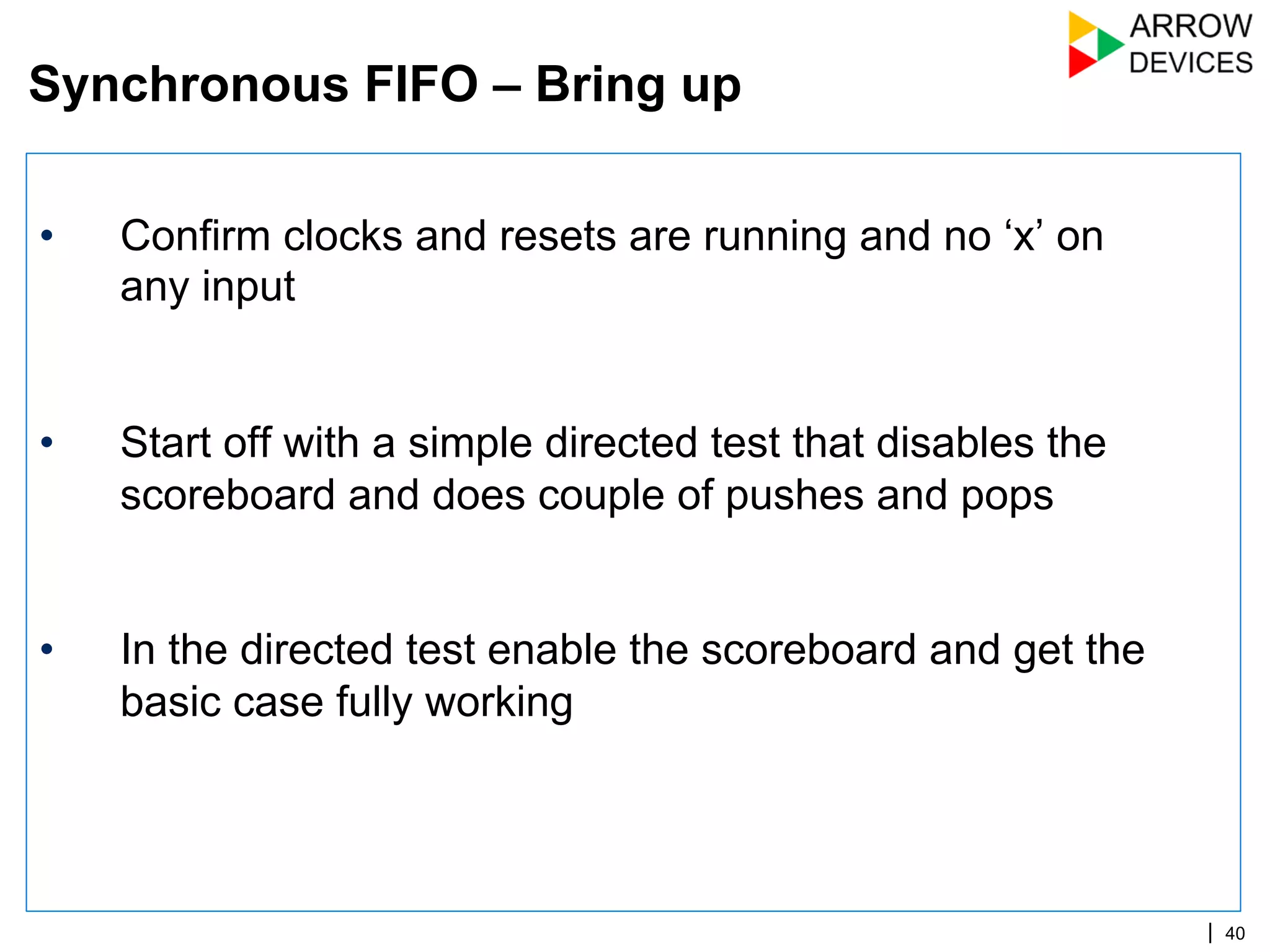
| 40
•  Confirm clocks and resets are running and no ‘x’ on
any input
•  Start off with a simple directed test that disables the
scoreboard and does couple of pushes and pops
•  In the directed test enable the scoreboard and get the
basic case fully working
Synchronous FIFO – Bring up
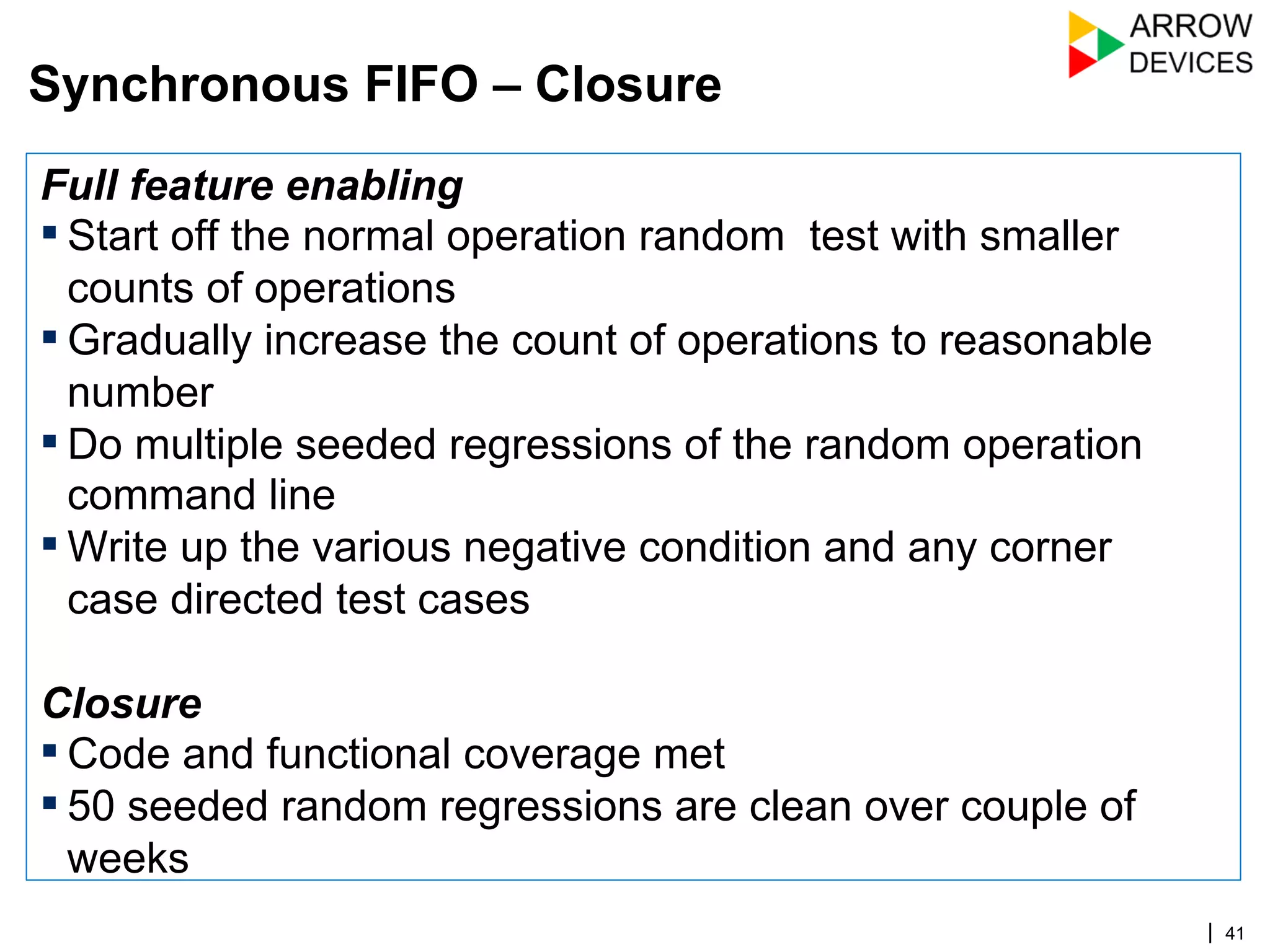
| 41
Full feature enabling
▪ Start off the normal operation random test with smaller
counts of operations
▪ Gradually increase the count of operations to reasonable
number
▪ Do multiple seeded regressions of the random operation
command line
▪ Write up the various negative condition and any corner
case directed test cases
Closure
▪ Code and functional coverage met
▪ 50 seeded random regressions are clean over couple of
weeks
Synchronous FIFO – Closure
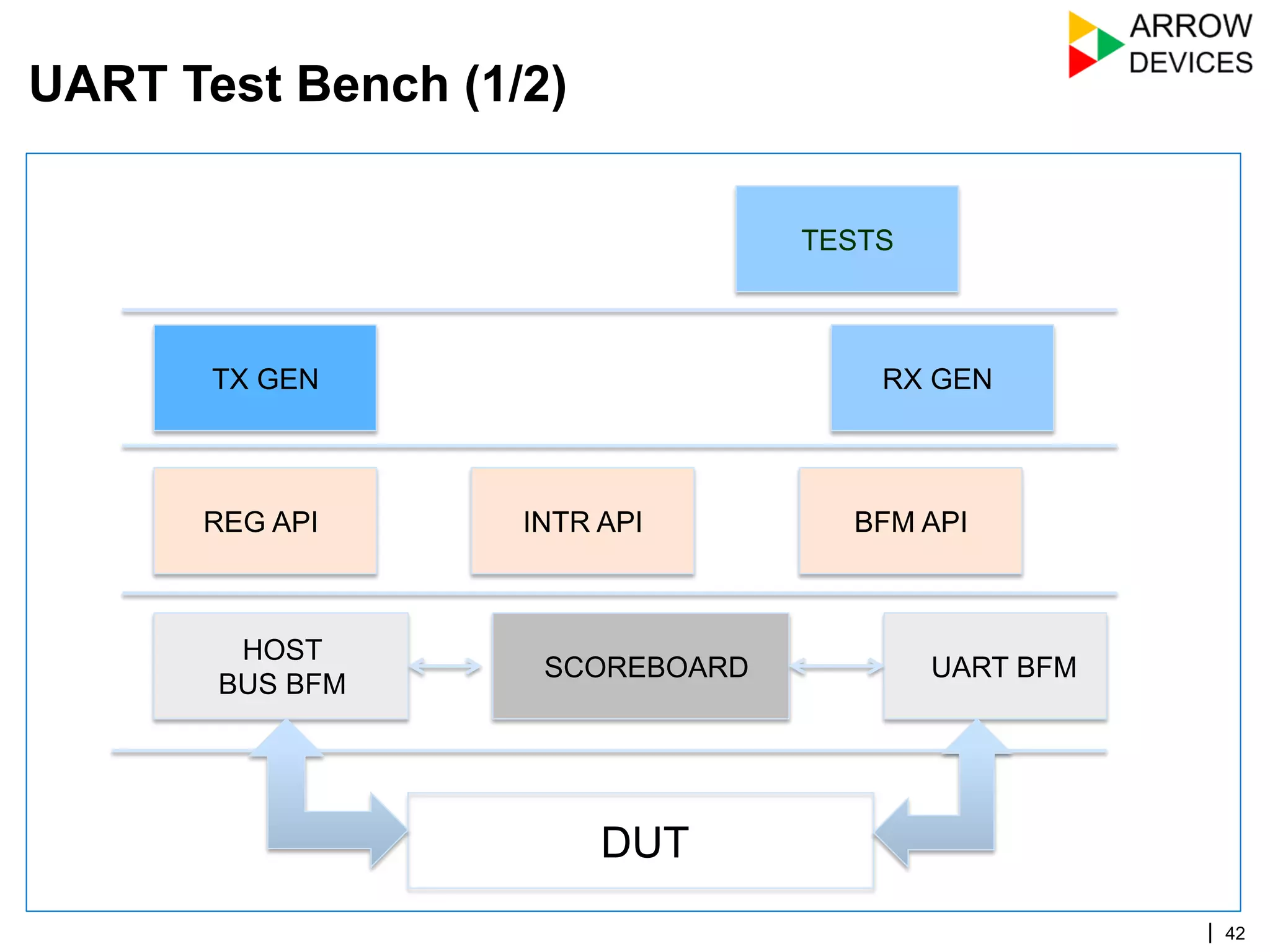
| 42
DUT
HOST
BUS BFM
UART BFMSCOREBOARD
REG API INTR API
TX GEN RX GEN
BFM API
TESTS
UART Test Bench (1/2)
| 43
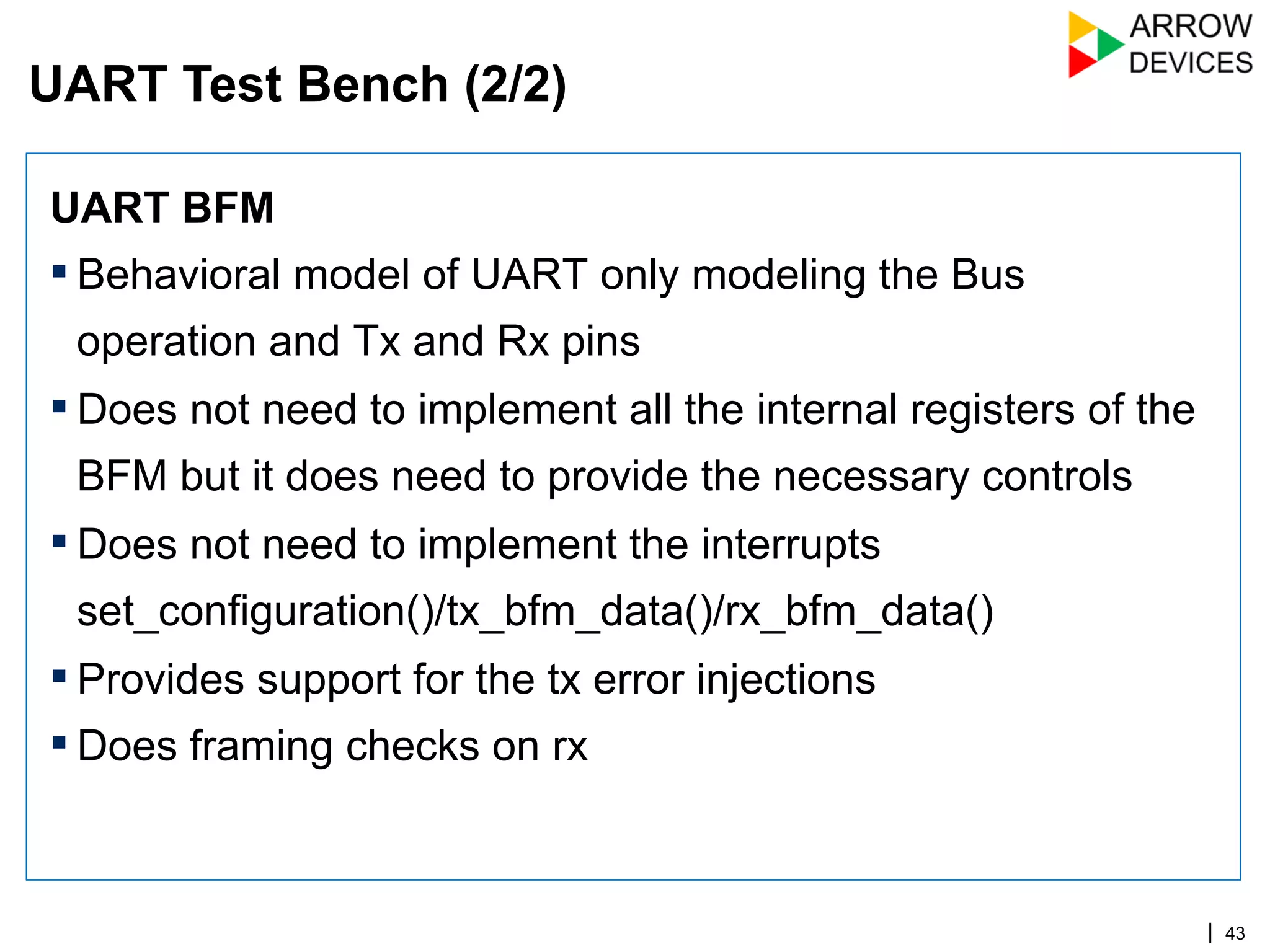
UART BFM
▪ Behavioral model of UART only modeling the Bus
operation and Tx and Rx pins
▪ Does not need to implement all the internal registers of the
BFM but it does need to provide the necessary controls
▪ Does not need to implement the interrupts
set_configuration()/tx_bfm_data()/rx_bfm_data()
▪ Provides support for the tx error injections
▪ Does framing checks on rx
UART Test Bench (2/2)
| 44
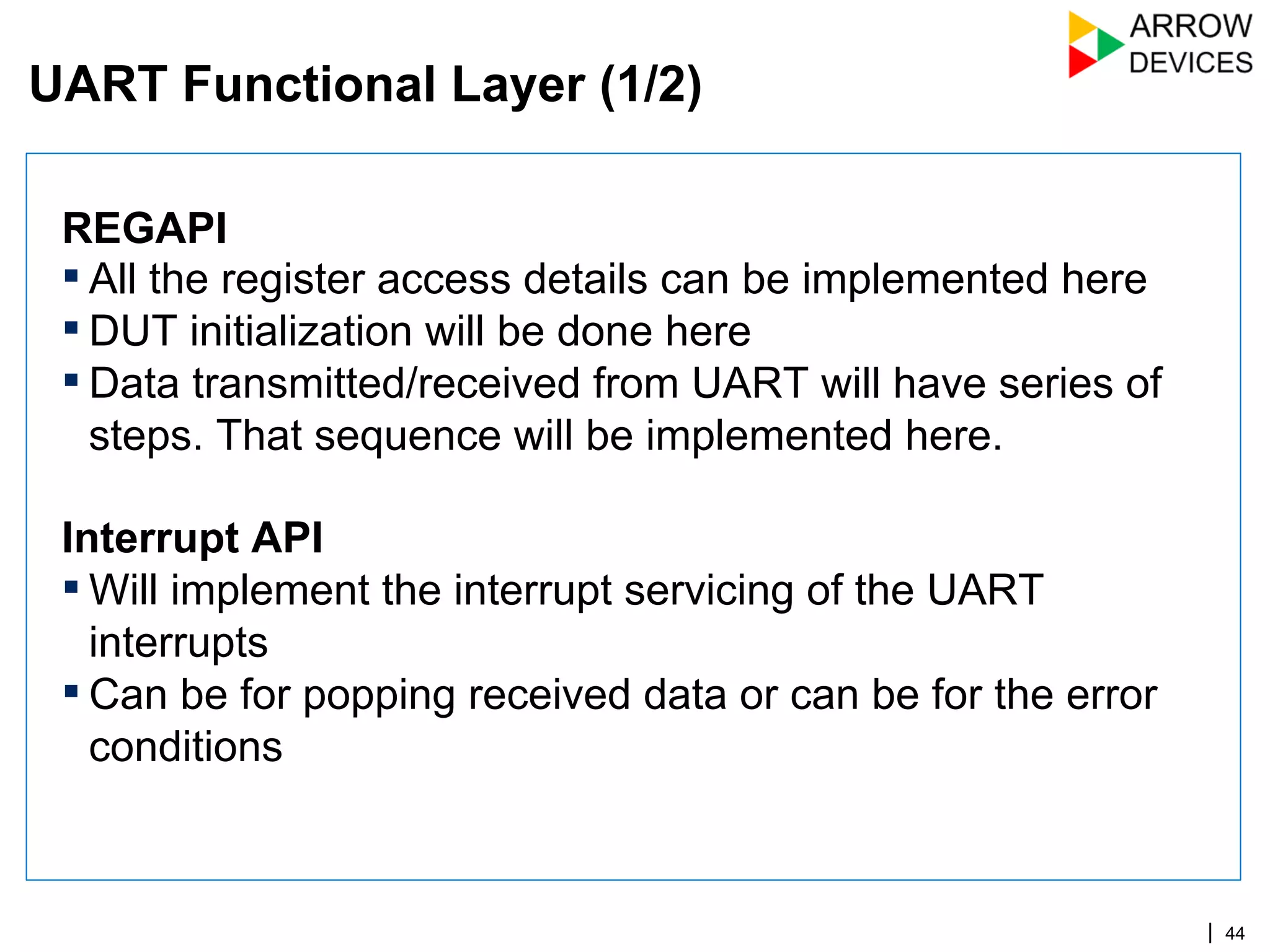
REGAPI
▪ All the register access details can be implemented here
▪ DUT initialization will be done here
▪ Data transmitted/received from UART will have series of
steps. That sequence will be implemented here.
Interrupt API
▪ Will implement the interrupt servicing of the UART
interrupts
▪ Can be for popping received data or can be for the error
conditions
UART Functional Layer (1/2)
| 45
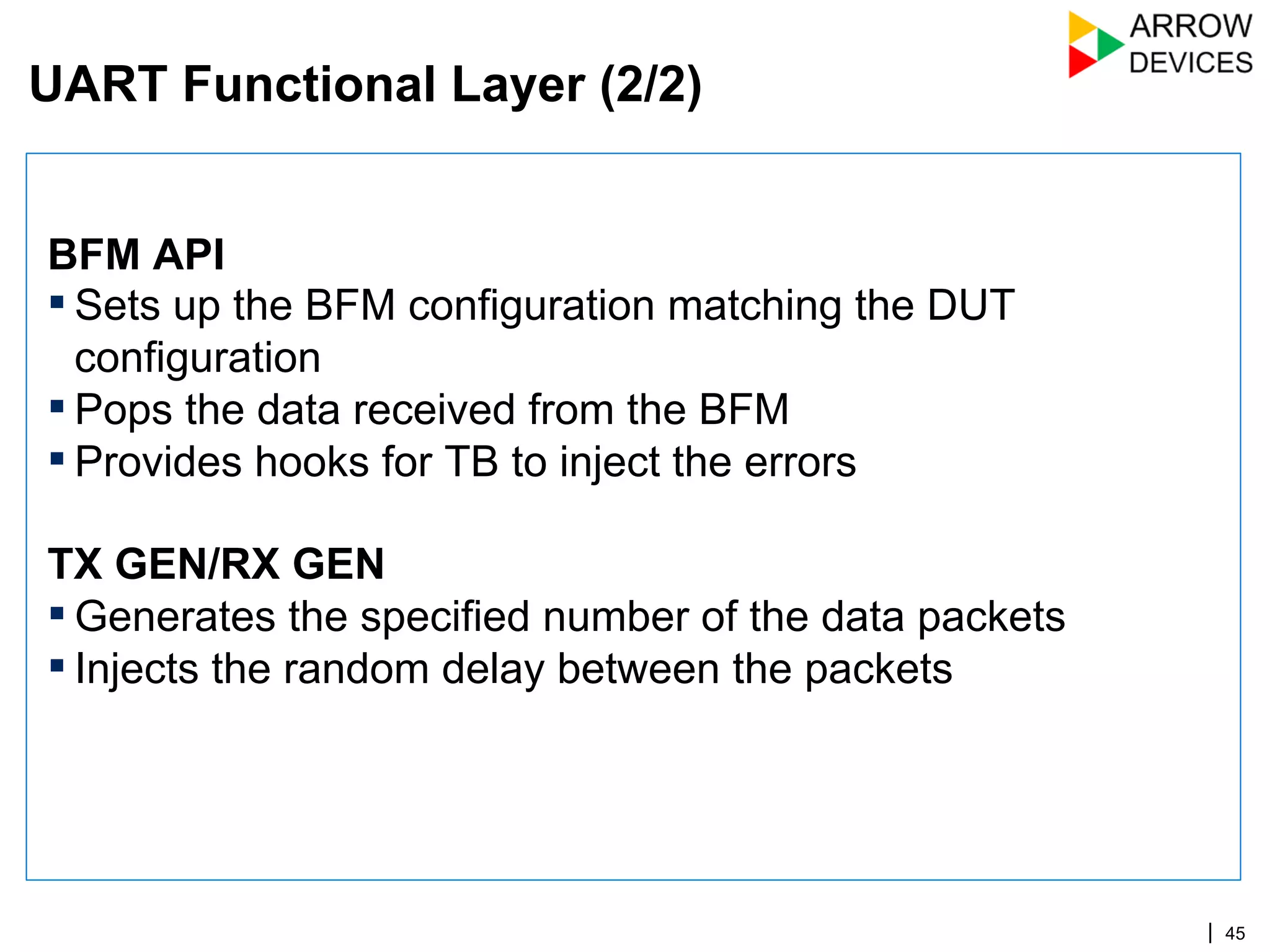
BFM API
▪ Sets up the BFM configuration matching the DUT
configuration
▪ Pops the data received from the BFM
▪ Provides hooks for TB to inject the errors
TX GEN/RX GEN
▪ Generates the specified number of the data packets
▪ Injects the random delay between the packets
UART Functional Layer (2/2)
| 46
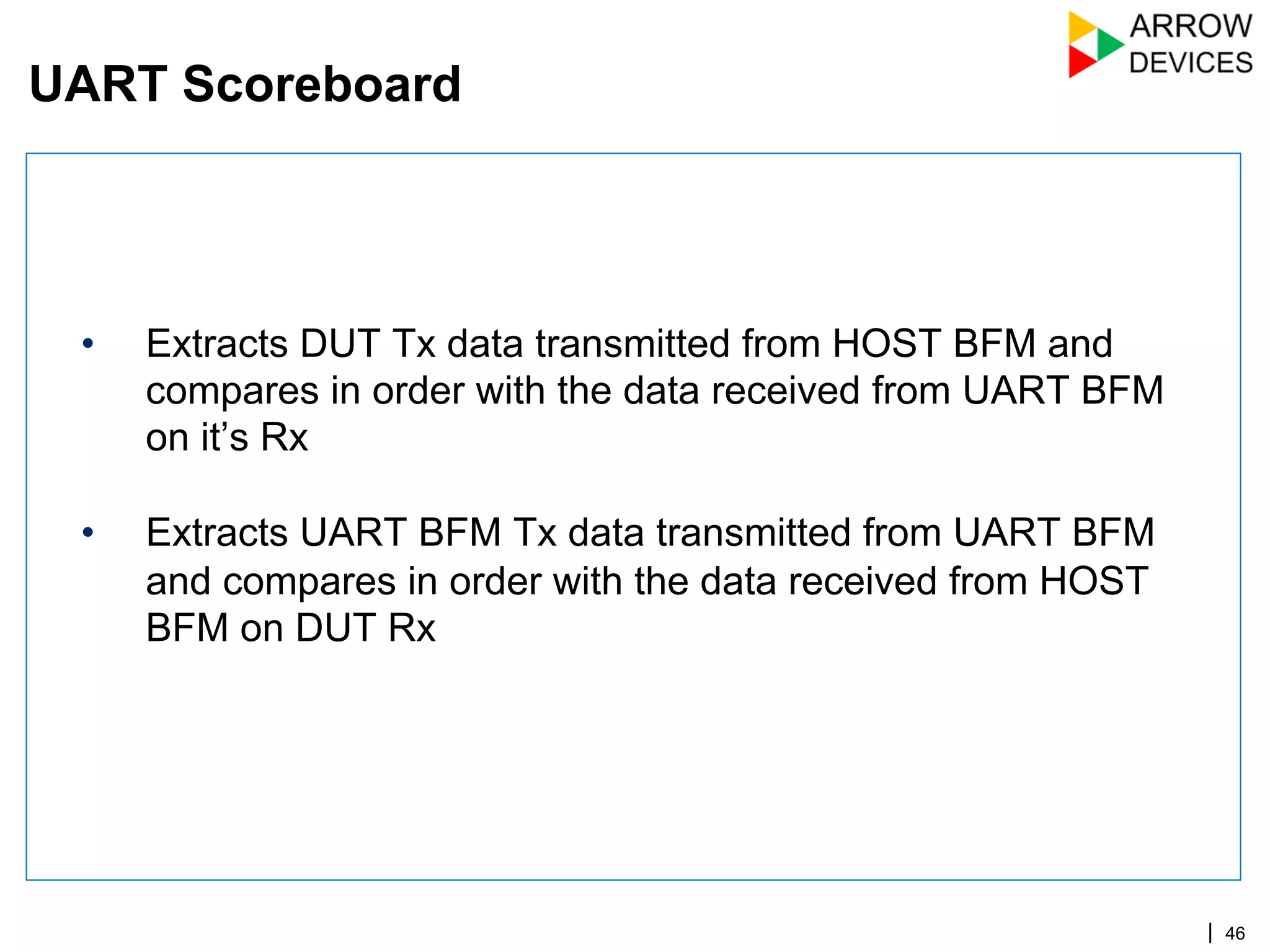
•  Extracts DUT Tx data transmitted from HOST BFM and
compares in order with the data received from UART BFM
on it’s Rx
•  Extracts UART BFM Tx data transmitted from UART BFM
and compares in order with the data received from HOST
BFM on DUT Rx
UART Scoreboard
| 47
Contents
▪  Verification Philosophy
▪  Familiarity
▪  Scope of Verification
▪  Functional Verification as a Career
▪  Overview of Process
▪  Some Examples: The 3 Musketeers
▪  Do’s and Don’t’s
▪  State of the Art
| 48
•  Focus on optimum verification to achieve quality
•  Design evolves - make sure verification plan evolves
around that
•  Get plugged into various sources of information to
track changes
•  Use emails or better bug reports
•  Document and archive important discussions
•  Avoid bypass and short cuts. If you really need to
take one always clearly comment/document
Do’s and Don’t’s
| 49
Contents
▪  Verification Philosophy
▪  Familiarity
▪  Scope of Verification
▪  Functional Verification as a Career
▪  Overview of Process
▪  Some Examples: The 3 Musketeers
▪  Do’s and Don’t’s
▪  State of the Art
| 50
•  Constrained random approach has been found to be very
effective in functional verification
•  System Verilog has OOPs support to enhance the re-
usability, special constructs for randomization and
coverage
State of the Art – SystemVerilog
| 51
•  Common good practices of constrained random verification
environment development have been standardized as
methodologies
•  There are multiple such industry level standard verification
methodologies such as VMM, OVM and UVM
•  These methodologies also provide set of base class libraries and
•  utilities that are very useful across the entire spectrum of
verification activities
State of the Art – Verification
Methodologies
| 52
End of Document
Visit us on:
http://www.arrowdevices.com

Basics of Functional Verification - Arrow Devices

  • 1.
    June 2014 Basics ofFunctional Verification Anand Shirahatti @ashirahatti
  • 2.
    | 2 Contents ▪  VerificationPhilosophy ▪  Familiarity ▪  Scope of Verification ▪  Functional Verification as a Career ▪  Overview of Process ▪  Some Examples: The 3 Musketeers ▪  Do’s and Don’t’s ▪  State of the Art
  • 3.
    | 3 The VerificationPhilosophy KNOW EVOLUTION to understand why things are the way they are! GET THE DNA to evolve further GO BEYOND basics to get productive
  • 4.
    | 4 Contents ▪  VerificationPhilosophy ▪  Familiarity ▪  Scope of Verification ▪  Functional Verification as a Career ▪  Overview of Process ▪  Some Examples: The 3 Musketeers ▪  Do’s and Don’t’s ▪  State of the Art
  • 5.
    | 5 Basic LabVerification How did you Verify ICs used during the Digital Design Lab ? -  Covered using the Truth table by giving various inputs and checking outputs -  Downsides are -  Time consuming -  Error prone -  Repeatability is not automatic
  • 6.
    | 6 Have Iseen a test bench? Yes!
  • 7.
    | 7 Contents ▪  VerificationPhilosophy ▪  Familiarity ▪  Scope of Verification ▪  Functional Verification as a Career ▪  Overview of Process ▪  Some Examples: The 3 Musketeers ▪  Do’s and Don’t’s ▪  State of the Art
  • 8.
    | 8 •  Fourmajor types of verification : 1.  Functional 2.  Timing 3.  Test 4.  Equivalence •  Functional verification ensures correct logic performance - under all conditions •  70 % of chip cycle is verification and more than 70 % re-spins are functional bugs •  Functional verification is very time consuming and thus is always on the critical path Scope of Verification (1/2)
  • 9.
    | 9 •  Designtechnologies are evolving in Moore’s Law friendly. •  Functional verification technologies are yet to catch up with the advancement happening in the are of Design •  Functional Verification Tools and methodologies are attempting to reduce the overall verification time by enabling parallelism of effort, higher abstraction levels and automation •  There is no single formula of success Scope of Verification (2/2)
  • 10.
    | 10 Contents ▪  VerificationPhilosophy ▪  Familiarity ▪  Scope of Verification ▪  Functional Verification as a Career ▪  Overview of Process ▪  Some Examples: The 3 Musketeers ▪  Do’s and Don’t’s ▪  State of the Art
  • 11.
    | 11 DESIGN Functional Verificationas a Career Before Verification After Verification Makes the world a better place!
  • 12.
    | 12 •  Knowsthe design •  Contributes to architecture •  Gives feedback as first user •  Is Creative, Logical and Lateral •  Programmer •  “Quality cop” •  Bridges specification, architecture & design Hats worn by a Verification Engineer
  • 13.
    | 13 Contents ▪  VerificationPhilosophy ▪  Familiarity ▪  Scope of Verification ▪  Functional Verification as a Career ▪  Overview of Process ▪  Some Examples: The 3 Musketeers ▪  Do’s and Don’t’s ▪  State of the Art
  • 14.
    | 14 1.  Verificationplan 2.  Test bench 3.  Bring up 4.  Debug 5.  Regressions 6.  Sign off Process of Functional Verification 1 2 3 4 5 6
  • 15.
    | 15 •  Createvaried stimuli and check if the response is as expected •  Ensure design is not doing anything unexpected •  Look at both Functional specifications and Micro- architecture specifications (Black box & White box) Stimuli Response Verification Plan (1/2)1
  • 16.
    | 16 •  Testplan: Create the list of programmable parameters and features 1.  Normal operation : Basic & Concurrent 2.  Corner cases 3.  Error cases 4.  Negative cases 5.  Stress design cases •  Functional coverage plan: Capture important features and parameters •  Strategy to execute the test plan Verification Plan (2/2)1
  • 17.
    | 17 Every TestBench Should have the following characteristics •  Ability to exercise all features and parameters •  Ability achieve the desired coverage •  Necessary abstraction •  Scalability •  Balance ease of verification vs. reality •  Ease of understanding and maintenance •  Ease of debugging – Developer vs User •  Developer is interested in Internal architecture •  User is interested in only black box view •  Easily controllable and observable Test Bench - Architecture2
  • 18.
    | 18 External interfacesof DUT •  Reset and Clock generators •  Bus functional models/ drivers/monitors DUT Ports BFM Driver Test Bench - Components (1/3)2
  • 19.
    | 19 Functionality •  APIor Transactors •  Scoreboard •  Golden models •  End of test •  Assertions •  Functional coverage DUT Ports BFM Driver SB Reg Xfer Test Bench - Components (2/3)2
  • 20.
    | 20 Stimuli : • Randomized parameters •  Constrained random gens •  Self checking directed test DUT Ports BFM Driver SB Reg Xfer CFG GEN TES T Test Bench - Components (3/3)2
  • 21.
    | 21 •  Getthe clocks and resets up •  No ‘X’ & ‘Z’ on critical inputs, Tie them off if needed •  Get all critical interfaces of DUT up •  Start enabling features in its basic form and introduce variables one at a time Design and Test Bench Bring Up3
  • 22.
    | 22 •  Donewhen things not going as expected •  Takes up 30% of functional verification activity •  First step is to isolate between the DUT/TB •  Isolation is done with help of logging •  Use regular expression friendly logging •  Extract stimuli and response from log •  If its not isolatable from log look at waves •  Benchmark debug is to be able to suggest the design fix •  Verification engineer is owner of bug till it is fixed Debug4
  • 23.
    | 23 •  Intersectionamong features •  Introduction of new features can cause a domino effect of failures on previously passing ones •  Protect what has been working by running a set of critical tests before every update •  Periodically complete run of all tests to maintain the health •  Random tests run with seeds Regressions5
  • 24.
    | 24 •  Verificationnever really completes •  Minimize risk using metrics •  100 % code coverage •  100 % functional coverage •  All directed tests passing •  Randoms having zero failures or acceptable failure rate over few weeks •  No critical bugs found over last few weeks Sign Off6
  • 25.
    | 25 Contents ▪  VerificationPhilosophy ▪  Familiarity ▪  Scope of Verification ▪  Functional Verification as a Career ▪  Overview of Process ▪  Some Examples: The 3 Musketeers ▪  Do’s and Don’t’s ▪  State of the Art
  • 26.
    | 26 •  Actionbegins… •  Lets demonstrate what we have learnt by attacking The Three Musketeers described below •  Each of these will take you through complete flow and also focus on clarifying one aspect we have learnt in previous slides 1.  Counters – 2-bit and 256-bit •  Verification strategy 2.  FIFO Verification •  Test cases and assertions 3.  UART Verification •  Test bench architecture The 3 Musketeers
  • 27.
    | 27 Test plan ▪ Makesure on reset assertion count can reset to 0 ▪ Counter can roll back to 0 after max ▪ Counter can count through all counts Verification strategy ▪ Do we need random? ▪ Use the directed tests Test bench ▪ Clock and reset generator ▪ 2 directed tests Counters: 2-Bit Counter Verification Strategy
  • 28.
    | 28 Test plan: ▪ Makesure on reset assertion count can reset to 0 ▪ Counter can roll back to 0 after max ▪ Counter can count through all counts Verification strategy: ▪ Do we need random? ▪ Sequentially counting all counts 2 ** 256 = 1e77 would take almost forever Counters: 256-Bit Counter Verification Strategy (1/3)
  • 29.
    | 29 Bring up ▪ Startoff with the pre load count as 0 ▪ Disable the intermediate reset generation ▪ Make sure counter can count up to random count after initial reset Enabling random ▪ Enable the random pre-load count ▪ Enable intermediate reset generation ▪ Complete the directed negative test Closure ▪ Code and functional coverage defined above are met ▪ 50 seeded random regressions are clean over couple of weeks Counters: 256-Bit Counter Verification Strategy (2/3)
  • 30.
    | 30 •  Startfrom random value and count up to another random value •  Divide count range into 4 and make sure each range covers some counts •  All the bits should be toggling •  Count from Max to 0 •  Reset during random count •  Bias the design change for pre load •  How do you handle condition of reset and enable asserted together ? Counters: 256-Bit Counter Verification Strategy (3/3)
  • 31.
    | 31 •  Identifyvariables that need randomization –  Random pre-load count –  Random count up value to end the test –  Control to enable/disable intermediate reset generation –  Random count at which reset needs to be generated ▫  All random stimulus should have control to make it directed if needed •  Clock generator •  Counter model with load and reset control - This will act as a score board. •  The model’s output will be used for check - Comparing at every clock will ensure that the bug’s can be caught immediately Counters: 256-Bit Counter Test Bench
  • 32.
    | 32 count <=count + 1 •  Models are behavioral code •  Simpler to write •  Smaller than DUT •  Quicker to write •  Lesser code means lesser bugs! Counters: 256-Bit Counter DUT vs Model
  • 33.
    | 33 FIFO FULL PUSH DATA_IN POP EMPT Y DATA_OU T CLK RST_ • Both read and write side use same clock •  Ordering •  Full & empty •  Ask : What happens on push@full and pop@empty? Synchronous FIFO
  • 34.
    | 34 Normal operation ▪ Order of data pushed should match POP ▪  After N PUSH and 0 POP, FIFO FULL assertion ▪  Num of PUSH == Num of POP EMPTY assertion ▪  Stress : PUSH and POP at same time ▪  Reset intermediately Negative case ▪  PUSH on FULL and POP on EMPTY Implementation specific ▪  Internal counter alignments for FULL/EMPTY generation Always true conditions [Assertion] ▪  Both FULL and EMPTY should never get asserted together ▪  Number of clocks between the assertion of Write on input to de-assertion of empty on output - This is also indicative of performance of the FIFO. Synchronous FIFO - Test Plan
  • 35.
    | 35 Normal FIFOoperation should be covered with the random approach ▪ Random delay on the POP side will lead to FULL conditions on PUSH side ▪ Random delay on PUSH and POP side together will lead to correct checking of FULL/EMPTY conditions on various read and write counter alignments ▪ Data pushed should be randomized - Cover for all toggling bits Negative and intermediate reset cases can be covered as directed case ▪ PUSH when full and POP when empty ▪ Reset during the various combinations of full/empty Synchronous FIFO – Verification Strategy
  • 36.
    | 36 DUT DRV PUSHDRV POPSCOREBOARD GEN PUSH GEN POP RND TESTS DIR TESTS Synchronous FIFO – Test Bench (1/4)
  • 37.
    | 37 DRV PUSH ▪ Handlesthe push side interface of FIFO ▪ push_data(data)/is_full() DRV POP ▪ Handles the pop side interface of FIFO ▪ pop_data(data)/is_empty() GEN PUSH ▪ Uses the PUSH DRV and generates specified number of PUSH ▪ Injects random delay between the PUSH GEN POP ▪ Uses the PUSH DRV and generates specified number of PUSH ▪ Injects random delay between the PUSH Synchronous FIFO – Test Bench (2/4)
  • 38.
    | 38 Scoreboard ▪ Model ofFIFO - Implemented in the behavioral code ▪ Connected to test bench environment using the call backs ▪ Drivers indicate the scoreboard when PUSH and POP happens ▪ On PUSH, scoreboard will store the data pushed - This is “golden data” ▪ On POP, scoreboard will compare the data popped from design with the data stored internally and indicate if there are mismatches - This will verify both ordering and data integrity ▪ Scoreboard should have capability to get disabled - This will be used during some of the directed tests for negative cases and resets Synchronous FIFO – Test Bench (3/4)
  • 39.
    | 39 Random tests ▪ Simplestlevel just sets up counts of FIFO operations ▪ Set the delays between PUSH/POP ▪ With and without random resets enabled Directed tests ▪ Negative cases directly using the API’s of DRV PUSH and DRV POP End of test ▪ Random tests check specified count completed ▪ Make sure at the end FIFO is its default state Synchronous FIFO – Test Bench (4/4)
  • 40.
    | 40 •  Confirmclocks and resets are running and no ‘x’ on any input •  Start off with a simple directed test that disables the scoreboard and does couple of pushes and pops •  In the directed test enable the scoreboard and get the basic case fully working Synchronous FIFO – Bring up
  • 41.
    | 41 Full featureenabling ▪ Start off the normal operation random test with smaller counts of operations ▪ Gradually increase the count of operations to reasonable number ▪ Do multiple seeded regressions of the random operation command line ▪ Write up the various negative condition and any corner case directed test cases Closure ▪ Code and functional coverage met ▪ 50 seeded random regressions are clean over couple of weeks Synchronous FIFO – Closure
  • 42.
    | 42 DUT HOST BUS BFM UARTBFMSCOREBOARD REG API INTR API TX GEN RX GEN BFM API TESTS UART Test Bench (1/2)
  • 43.
    | 43 UART BFM ▪ Behavioralmodel of UART only modeling the Bus operation and Tx and Rx pins ▪ Does not need to implement all the internal registers of the BFM but it does need to provide the necessary controls ▪ Does not need to implement the interrupts set_configuration()/tx_bfm_data()/rx_bfm_data() ▪ Provides support for the tx error injections ▪ Does framing checks on rx UART Test Bench (2/2)
  • 44.
    | 44 REGAPI ▪ All theregister access details can be implemented here ▪ DUT initialization will be done here ▪ Data transmitted/received from UART will have series of steps. That sequence will be implemented here. Interrupt API ▪ Will implement the interrupt servicing of the UART interrupts ▪ Can be for popping received data or can be for the error conditions UART Functional Layer (1/2)
  • 45.
    | 45 BFM API ▪ Setsup the BFM configuration matching the DUT configuration ▪ Pops the data received from the BFM ▪ Provides hooks for TB to inject the errors TX GEN/RX GEN ▪ Generates the specified number of the data packets ▪ Injects the random delay between the packets UART Functional Layer (2/2)
  • 46.
    | 46 •  ExtractsDUT Tx data transmitted from HOST BFM and compares in order with the data received from UART BFM on it’s Rx •  Extracts UART BFM Tx data transmitted from UART BFM and compares in order with the data received from HOST BFM on DUT Rx UART Scoreboard
  • 47.
    | 47 Contents ▪  VerificationPhilosophy ▪  Familiarity ▪  Scope of Verification ▪  Functional Verification as a Career ▪  Overview of Process ▪  Some Examples: The 3 Musketeers ▪  Do’s and Don’t’s ▪  State of the Art
  • 48.
    | 48 •  Focuson optimum verification to achieve quality •  Design evolves - make sure verification plan evolves around that •  Get plugged into various sources of information to track changes •  Use emails or better bug reports •  Document and archive important discussions •  Avoid bypass and short cuts. If you really need to take one always clearly comment/document Do’s and Don’t’s
  • 49.
    | 49 Contents ▪  VerificationPhilosophy ▪  Familiarity ▪  Scope of Verification ▪  Functional Verification as a Career ▪  Overview of Process ▪  Some Examples: The 3 Musketeers ▪  Do’s and Don’t’s ▪  State of the Art
  • 50.
    | 50 •  Constrainedrandom approach has been found to be very effective in functional verification •  System Verilog has OOPs support to enhance the re- usability, special constructs for randomization and coverage State of the Art – SystemVerilog
  • 51.
    | 51 •  Commongood practices of constrained random verification environment development have been standardized as methodologies •  There are multiple such industry level standard verification methodologies such as VMM, OVM and UVM •  These methodologies also provide set of base class libraries and •  utilities that are very useful across the entire spectrum of verification activities State of the Art – Verification Methodologies
  • 52.
    | 52 End ofDocument Visit us on: http://www.arrowdevices.com