BY
M.Vharshini
2ND YEAR
B.Sc. BMS
1. Waldhof fermenter
2. Acetators and cavitators
3. Tower fermenter
4. Cylindro-conical vessels
5. Air lift fermenter
6. Deep jet fermenter
7. The cyclone column
8. Rotating disc fermenter
 Yeast growth in sulphite waste liquor led to
the development of Waldhof fermenter.
 The fermenter was Carbon steel, clad in
stainless steel
 Diameter – 7.9m
 High-4.3m
 Central draught tube -1.2m in diameter
 Draught tube was held by tie rods attached
to the fermenter walls
 Operating volume—225,000dm3 of
emulsion(broth & air) and broth without air—
100,000dm3
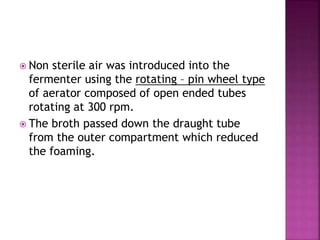
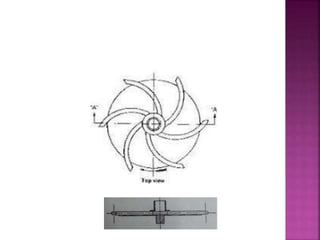
 Non sterile air was introduced into the
fermenter using the rotating – pin wheel type
of aerator composed of open ended tubes
rotating at 300 rpm.
 The broth passed down the draught tube
from the outer compartment which reduced
the foaming.
 Fundamental studies on vinegar production showed that:
 Acetobacter cells remain active in stirred aerated
fermenter , distribution of air had to be almost perfect
within the entire contents of the vessel
 The full-scale problem was solved by the use of self
aspirating rotor— the turning rotor sucked air and broth
and dispersed the mixture through out the rotating stator.
 The aerator also worked without a compressor and was
self-priming.
 In Vinegar fermentation—foam & chemical antifoams are
not feasible because they decrease aeration efficiency and
quality of vinegar.
 Therefore Mechanical defoamer was incorporated into
vessels and as foam builds up it is forced into a chamber in
which the rotor runs at 1,000 to 1,450 rpm.
 Centrifugal force breaks the foam & separates it
into gas & liquid.
 The liquid is pumped back into the fermenter &
gas escapes by a venting mechanism.
 Uniform distribution of air bubbles was obtained
by means of the circulation pattern created by
the centrally located draught tube.
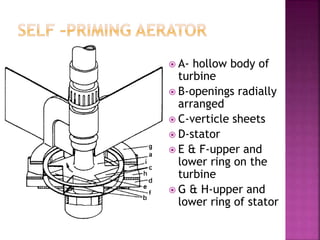
 A- hollow body of
turbine
 B-openings radially
arranged
 C-verticle sheets
 D-stator
 E & F-upper and
lower ring on the
turbine
 G & H-upper and
lower ring of stator
 An elongated non mechanically stirred
fermenter having the aspect ratio 6:1 for tubular
sections and 10:1 for overall, through which
there is a unidirectional flow of gases.
 Simple tower fermenter are those with air
sparger at the base ;used for citric acid
production
 This batch fermenter is in the form of glass
column having a ht:diameter ratio of 16:1 and
with a volume of 3dm3.
 Humid sterile air was supplied through the base.
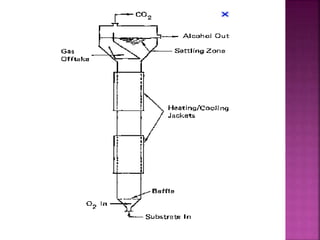
 Single staged: e.g. Hall and howard’s beer
fermentor: water jacketed tubes of various
dimensions inclined at an angles of 9ºto90º.
 Intermediate staged: settling zones of
various designs e.g. Shore et al’s beer
fermentor. It has sectioned perforated plates
for max. beer production
 Multi staged: number of perforated vessels
are used. e.g.Owen (1948) and
victorero(1948) et al for brewing beer.
 Used in Brewing of lager.
 First proposed by Nathan.
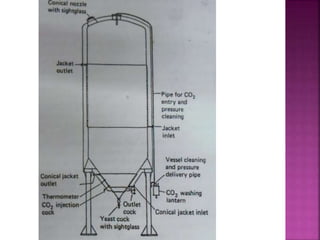
 The vessel consists of stainless steel vertical
tube with a hemispherical top & conical base
with an included angle of approx 70 degree.
 Aspect ratio—3:1
 Fermenter Height—10 to 20m
 Operating volumes—150,000to 200,000dm3
 Vessels are not normally agitated unless
particularly flocculant yeast is used
 Small impeller may be used to ensure the
homogeneity when filling with wort.
 In the vessel ,wort is inoculated with yeast
and fermentation proceeds for 40 to 48hrs.
 Mixing is achieved by the addition of carbon
dioxide bubbles—rise rapidly in the vessel.
 Temperature control is monitored by
probes positioned at suitable points within
the vessel.
 A no. of cooling jackets are fitted to the wall
to regulate & cause flocculation & settling of
yeast.
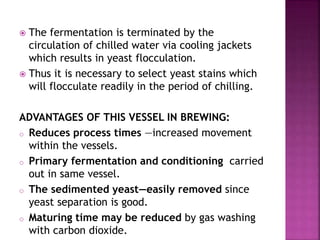
 The fermentation is terminated by the
circulation of chilled water via cooling jackets
which results in yeast flocculation.
 Thus it is necessary to select yeast stains which
will flocculate readily in the period of chilling.
ADVANTAGES OF THIS VESSEL IN BREWING:
o Reduces process times —increased movement
within the vessels.
o Primary fermentation and conditioning carried
out in same vessel.
o The sedimented yeast—easily removed since
yeast separation is good.
o Maturing time may be reduced by gas washing
with carbon dioxide.
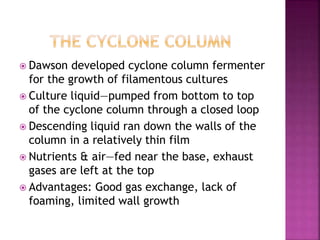
 Dawson developed cyclone column fermenter
for the growth of filamentous cultures
 Culture liquid—pumped from bottom to top
of the cyclone column through a closed loop
 Descending liquid ran down the walls of the
column in a relatively thin film
 Nutrients & air—fed near the base, exhaust
gases are left at the top
 Advantages: Good gas exchange, lack of
foaming, limited wall growth
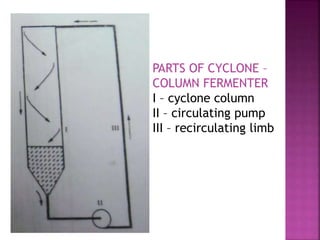
PARTS OF CYCLONE –
COLUMN FERMENTER
I – cyclone column
II – circulating pump
III – recirculating limb
 It is essentially a gas tight baffled riser tube
connected to the downcomer tube.
 Air or gas mixture—introduced into the base of the
riser by a sparger during normal operating
conditions.
 The driving force for circulation of medium in vessel
is produced by the differences in density between
the liquid column in the riser and in the down
comer.
 This type of vessel can be used for continuous
culture.
 It would be uneconomical to use a mechanically
stirred fermenter to produce SCP from methanol as a
carbon substrate ;as heat removal would be needed
in external cooling loops because of high rate of
aeration and agitation required to operate this
process.
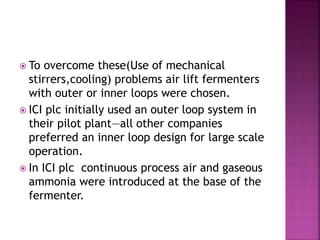
 To overcome these(Use of mechanical
stirrers,cooling) problems air lift fermenters
with outer or inner loops were chosen.
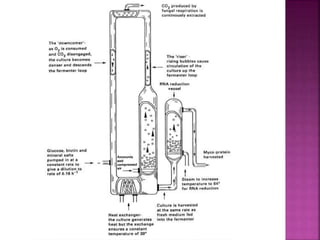
 ICI plc initially used an outer loop system in
their pilot plant—all other companies
preferred an inner loop design for large scale
operation.
 In ICI plc continuous process air and gaseous
ammonia were introduced at the base of the
fermenter.
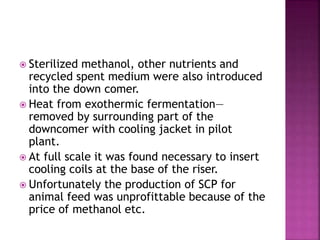
 Sterilized methanol, other nutrients and
recycled spent medium were also introduced
into the down comer.
 Heat from exothermic fermentation—
removed by surrounding part of the
downcomer with cooling jacket in pilot
plant.
 At full scale it was found necessary to insert
cooling coils at the base of the riser.
 Unfortunately the production of SCP for
animal feed was unprofittable because of the
price of methanol etc.
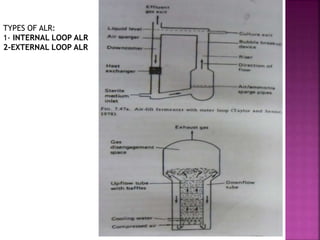
TYPES OF ALR:
1- INTERNAL LOOP ALR
2-EXTERNAL LOOP ALR
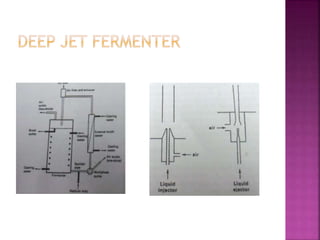
 Design of continuous culture fermenter—
necessary mechanical power input with a pump
to circulate the liquid medium –gas entrainer
 Two construction—gas entrainer nozzles
 Injector
 Ejector
 Injector—jet of medium—surrounded by a jet
compressed air
 Gas from outlet enters the large tube with the
nozzle velocity 5 to 100m/s
 Expands in tube—form large air bubbles—
dispersed by the shear of water jet
 Ejector—liquid jet enters into a large
converging-diverging nozzle—entrains the gas
around the jet
 Gas is sucked into the converging-diverging
jet is dispersed in that zone
 Aerated medium is pumped by a multiphase
pump through a broth cooler to an air
entrainer above the fermenter
 Air medium mixture falls down—conical shaft
at high velocity—creates a turbulence in the
fermenter
 2/3rd of the exhaust gas is vented from the
fermenter head space—reminder via
multiphase pump
 Oxygen transfer rate 4.5g/dm3 h with an
energy consumption of 1kW/hkg
 Application for the immobilized cells
 A vertical cylindrical column is packed with
pieces of some relatively inert
material(woodshavings, twigs, coke,
polythene)
 Both medium and cells are fed into the top
of the packed bed
 Once cells get adhersed to support(thin
film)—fresh medium added at the top of the
column—fermented medium removed from
the bottom of the column
 Vinegar generator—ethanol is oxidised to
acetic acid by strains of acetobacter
 Mainly used for sewage and effluent
treatment
 In treatment with gas liquor a column was
packed with the height—7.9m with Dowpac—
polystrene derivatives
 Effluent treatment
 Utilize a growing microbial film on slow
rotating discs to oxidizes the effluent
 ANDERSON and BLAIN—construct small
fermenter(40dm3)
 Range of filamentous fungi—Aspergillus,
Rhizopus, Mucor, Penicillium—grow on
polypropylene discs
 Obtain yield—80g/dm3—production of citric
acid using A.niger
 Principles of fermentation technology
Peter F. Stanbury, Allan Whitaker
Types of fermenter

Types of fermenter

  • 1.
  • 2.
    1. Waldhof fermenter 2.Acetators and cavitators 3. Tower fermenter 4. Cylindro-conical vessels 5. Air lift fermenter 6. Deep jet fermenter 7. The cyclone column 8. Rotating disc fermenter
  • 3.
     Yeast growthin sulphite waste liquor led to the development of Waldhof fermenter.  The fermenter was Carbon steel, clad in stainless steel  Diameter – 7.9m  High-4.3m  Central draught tube -1.2m in diameter  Draught tube was held by tie rods attached to the fermenter walls  Operating volume—225,000dm3 of emulsion(broth & air) and broth without air— 100,000dm3
  • 4.
     Non sterileair was introduced into the fermenter using the rotating – pin wheel type of aerator composed of open ended tubes rotating at 300 rpm.  The broth passed down the draught tube from the outer compartment which reduced the foaming.
  • 6.
     Fundamental studieson vinegar production showed that:  Acetobacter cells remain active in stirred aerated fermenter , distribution of air had to be almost perfect within the entire contents of the vessel  The full-scale problem was solved by the use of self aspirating rotor— the turning rotor sucked air and broth and dispersed the mixture through out the rotating stator.  The aerator also worked without a compressor and was self-priming.  In Vinegar fermentation—foam & chemical antifoams are not feasible because they decrease aeration efficiency and quality of vinegar.  Therefore Mechanical defoamer was incorporated into vessels and as foam builds up it is forced into a chamber in which the rotor runs at 1,000 to 1,450 rpm.
  • 7.
     Centrifugal forcebreaks the foam & separates it into gas & liquid.  The liquid is pumped back into the fermenter & gas escapes by a venting mechanism.  Uniform distribution of air bubbles was obtained by means of the circulation pattern created by the centrally located draught tube.
  • 8.
     A- hollowbody of turbine  B-openings radially arranged  C-verticle sheets  D-stator  E & F-upper and lower ring on the turbine  G & H-upper and lower ring of stator
  • 9.
     An elongatednon mechanically stirred fermenter having the aspect ratio 6:1 for tubular sections and 10:1 for overall, through which there is a unidirectional flow of gases.  Simple tower fermenter are those with air sparger at the base ;used for citric acid production  This batch fermenter is in the form of glass column having a ht:diameter ratio of 16:1 and with a volume of 3dm3.  Humid sterile air was supplied through the base.
  • 10.
     Single staged:e.g. Hall and howard’s beer fermentor: water jacketed tubes of various dimensions inclined at an angles of 9ºto90º.  Intermediate staged: settling zones of various designs e.g. Shore et al’s beer fermentor. It has sectioned perforated plates for max. beer production  Multi staged: number of perforated vessels are used. e.g.Owen (1948) and victorero(1948) et al for brewing beer.
  • 12.
     Used inBrewing of lager.  First proposed by Nathan.  The vessel consists of stainless steel vertical tube with a hemispherical top & conical base with an included angle of approx 70 degree.  Aspect ratio—3:1  Fermenter Height—10 to 20m  Operating volumes—150,000to 200,000dm3  Vessels are not normally agitated unless particularly flocculant yeast is used
  • 13.
     Small impellermay be used to ensure the homogeneity when filling with wort.  In the vessel ,wort is inoculated with yeast and fermentation proceeds for 40 to 48hrs.  Mixing is achieved by the addition of carbon dioxide bubbles—rise rapidly in the vessel.  Temperature control is monitored by probes positioned at suitable points within the vessel.  A no. of cooling jackets are fitted to the wall to regulate & cause flocculation & settling of yeast.
  • 14.
     The fermentationis terminated by the circulation of chilled water via cooling jackets which results in yeast flocculation.  Thus it is necessary to select yeast stains which will flocculate readily in the period of chilling. ADVANTAGES OF THIS VESSEL IN BREWING: o Reduces process times —increased movement within the vessels. o Primary fermentation and conditioning carried out in same vessel. o The sedimented yeast—easily removed since yeast separation is good. o Maturing time may be reduced by gas washing with carbon dioxide.
  • 16.
     Dawson developedcyclone column fermenter for the growth of filamentous cultures  Culture liquid—pumped from bottom to top of the cyclone column through a closed loop  Descending liquid ran down the walls of the column in a relatively thin film  Nutrients & air—fed near the base, exhaust gases are left at the top  Advantages: Good gas exchange, lack of foaming, limited wall growth
  • 17.
    PARTS OF CYCLONE– COLUMN FERMENTER I – cyclone column II – circulating pump III – recirculating limb
  • 18.
     It isessentially a gas tight baffled riser tube connected to the downcomer tube.  Air or gas mixture—introduced into the base of the riser by a sparger during normal operating conditions.  The driving force for circulation of medium in vessel is produced by the differences in density between the liquid column in the riser and in the down comer.  This type of vessel can be used for continuous culture.  It would be uneconomical to use a mechanically stirred fermenter to produce SCP from methanol as a carbon substrate ;as heat removal would be needed in external cooling loops because of high rate of aeration and agitation required to operate this process.
  • 19.
     To overcomethese(Use of mechanical stirrers,cooling) problems air lift fermenters with outer or inner loops were chosen.  ICI plc initially used an outer loop system in their pilot plant—all other companies preferred an inner loop design for large scale operation.  In ICI plc continuous process air and gaseous ammonia were introduced at the base of the fermenter.
  • 20.
     Sterilized methanol,other nutrients and recycled spent medium were also introduced into the down comer.  Heat from exothermic fermentation— removed by surrounding part of the downcomer with cooling jacket in pilot plant.  At full scale it was found necessary to insert cooling coils at the base of the riser.  Unfortunately the production of SCP for animal feed was unprofittable because of the price of methanol etc.
  • 22.
    TYPES OF ALR: 1-INTERNAL LOOP ALR 2-EXTERNAL LOOP ALR
  • 23.
     Design ofcontinuous culture fermenter— necessary mechanical power input with a pump to circulate the liquid medium –gas entrainer  Two construction—gas entrainer nozzles  Injector  Ejector  Injector—jet of medium—surrounded by a jet compressed air  Gas from outlet enters the large tube with the nozzle velocity 5 to 100m/s  Expands in tube—form large air bubbles— dispersed by the shear of water jet
  • 24.
     Ejector—liquid jetenters into a large converging-diverging nozzle—entrains the gas around the jet  Gas is sucked into the converging-diverging jet is dispersed in that zone  Aerated medium is pumped by a multiphase pump through a broth cooler to an air entrainer above the fermenter
  • 25.
     Air mediummixture falls down—conical shaft at high velocity—creates a turbulence in the fermenter  2/3rd of the exhaust gas is vented from the fermenter head space—reminder via multiphase pump  Oxygen transfer rate 4.5g/dm3 h with an energy consumption of 1kW/hkg
  • 27.
     Application forthe immobilized cells  A vertical cylindrical column is packed with pieces of some relatively inert material(woodshavings, twigs, coke, polythene)  Both medium and cells are fed into the top of the packed bed  Once cells get adhersed to support(thin film)—fresh medium added at the top of the column—fermented medium removed from the bottom of the column
  • 28.
     Vinegar generator—ethanolis oxidised to acetic acid by strains of acetobacter  Mainly used for sewage and effluent treatment  In treatment with gas liquor a column was packed with the height—7.9m with Dowpac— polystrene derivatives
  • 29.
     Effluent treatment Utilize a growing microbial film on slow rotating discs to oxidizes the effluent  ANDERSON and BLAIN—construct small fermenter(40dm3)  Range of filamentous fungi—Aspergillus, Rhizopus, Mucor, Penicillium—grow on polypropylene discs  Obtain yield—80g/dm3—production of citric acid using A.niger
  • 30.
     Principles offermentation technology Peter F. Stanbury, Allan Whitaker