Introduction toIntroduction to
FermentationFermentation
Aspergillus nigerAspergillus niger andand
LactobacillusLactobacillus
Introduction to FermentationIntroduction to Fermentation
• Aspergillus nigerAspergillus niger andand Lactobacillus DelbruckiiLactobacillus Delbruckii are theare the
microbes used to commercially produce citric acid andmicrobes used to commercially produce citric acid and
lactic acid, respectively. The production takes place in alactic acid, respectively. The production takes place in a
batch fermenter. This tutorial will introduce you to thebatch fermenter. This tutorial will introduce you to the
following areas regarding batch fermentationfollowing areas regarding batch fermentation
– Microbial Growth KineticsMicrobial Growth Kinetics
– Media for Industrial FermentationsMedia for Industrial Fermentations
– SterilizationSterilization
– The Development of Inocula for Industrial FermentationsThe Development of Inocula for Industrial Fermentations
– Design of a FermenterDesign of a Fermenter
– Instrumentation and ControlInstrumentation and Control
– Aeration and AgitationAeration and Agitation
Microbial Growth KineticsMicrobial Growth Kinetics
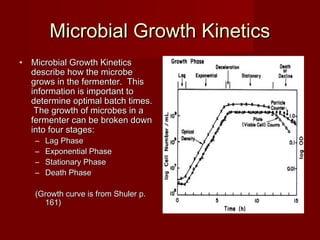
• Microbial Growth KineticsMicrobial Growth Kinetics
describe how the microbedescribe how the microbe
grows in the fermenter. Thisgrows in the fermenter. This
information is important toinformation is important to
determine optimal batch times.determine optimal batch times.
The growth of microbes in aThe growth of microbes in a
fermenter can be broken downfermenter can be broken down
into four stages:into four stages:
– Lag PhaseLag Phase
– Exponential PhaseExponential Phase
– Stationary PhaseStationary Phase
– Death PhaseDeath Phase
(Growth curve is from Shuler p.(Growth curve is from Shuler p.
161)161)
Microbial Growth KineticsMicrobial Growth Kinetics
• Lag PhaseLag Phase
– This is the first phase in the fermentationThis is the first phase in the fermentation
processprocess
– The cells have just been injected into a newThe cells have just been injected into a new
environment and they need time to adjustenvironment and they need time to adjust
accordinglyaccordingly
– Cell growth is minimal in this phase.Cell growth is minimal in this phase.
Microbial Growth KineticsMicrobial Growth Kinetics
• Exponential PhaseExponential Phase
– The second phase in the fermentationThe second phase in the fermentation
processprocess
– The cells have adjusted to their environmentThe cells have adjusted to their environment
and rapid growth takes placeand rapid growth takes place
– Cell growth rate is highest in this phaseCell growth rate is highest in this phase
Microbial Growth KineticsMicrobial Growth Kinetics
• Exponential Phase (Continued)Exponential Phase (Continued)
– At some point the cell growth rate will level offAt some point the cell growth rate will level off
and become constantand become constant
– The most likely cause of this leveling off isThe most likely cause of this leveling off is
substrate limited inhibitionsubstrate limited inhibition
• Substrate limited inhibition means that theSubstrate limited inhibition means that the
microbes do not have enough nutrients in themicrobes do not have enough nutrients in the
medium to continue multiplying.medium to continue multiplying.
Microbial Growth KineticsMicrobial Growth Kinetics
• Stationary phaseStationary phase
– This is the third phase in the fermentationThis is the third phase in the fermentation
processprocess
– The cell growth rate has leveled off andThe cell growth rate has leveled off and
become constantbecome constant
– The number of cells multiplying equals theThe number of cells multiplying equals the
number of cells dyingnumber of cells dying
Microbial Growth KineticsMicrobial Growth Kinetics
• Death phaseDeath phase
– The fourth phase in the fermentation processThe fourth phase in the fermentation process
– The number of cells dying is greater than theThe number of cells dying is greater than the
number of cells multiplyingnumber of cells multiplying
• The cause of the death phase is usually that theThe cause of the death phase is usually that the
cells have consumed most of the nutrients in thecells have consumed most of the nutrients in the
medium and there is not enough left formedium and there is not enough left for
sustainabilitysustainability
Media for Industrial FermentationsMedia for Industrial Fermentations
• The media is the feed solutionThe media is the feed solution
– It must contain the essential nutrients needed for theIt must contain the essential nutrients needed for the
microbe to growmicrobe to grow
• Factors of consideration when choosing mediaFactors of consideration when choosing media
-Quality consistence and availability-Quality consistence and availability
-Ensure there are no problems with Media Prep or-Ensure there are no problems with Media Prep or
other aspects of production processother aspects of production process
Ex. Cane molasses, beet molasses, cereal grainsEx. Cane molasses, beet molasses, cereal grains
SterilizationSterilization
• Sterilizing the feed solution is essentialSterilizing the feed solution is essential
because the media cannot contain foreignbecause the media cannot contain foreign
microbes because this could severelymicrobes because this could severely
hinder the growth of the productionhinder the growth of the production
microbemicrobe
– Most popular method is heat sterilization ofMost popular method is heat sterilization of
the feed solutionthe feed solution
The Development of Inocula forThe Development of Inocula for
Industrial FermentationsIndustrial Fermentations
• The inoculum is the starter culture that isThe inoculum is the starter culture that is
injected into the fermenterinjected into the fermenter
– It must be of sufficient size for optimal growth kineticsIt must be of sufficient size for optimal growth kinetics
• Since the production fermenter in industrialSince the production fermenter in industrial
fermentations is so large, the inoculum volumefermentations is so large, the inoculum volume
has to be quite largehas to be quite large
- A seed fermenter is usually required to produce the- A seed fermenter is usually required to produce the
inoculum volumeinoculum volume
-The seed fermenter’s purpose is not to produce-The seed fermenter’s purpose is not to produce
product but to prepare inoculumproduct but to prepare inoculum
Design of a FermenterDesign of a Fermenter
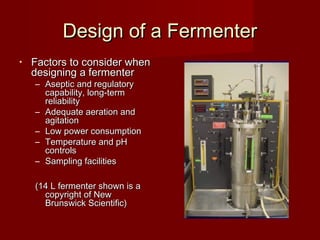
• Factors to consider whenFactors to consider when
designing a fermenterdesigning a fermenter
– Aseptic and regulatoryAseptic and regulatory
capability, long-termcapability, long-term
reliabilityreliability
– Adequate aeration andAdequate aeration and
agitationagitation
– Low power consumptionLow power consumption
– Temperature and pHTemperature and pH
controlscontrols
– Sampling facilitiesSampling facilities
(14 L fermenter shown is a(14 L fermenter shown is a
copyright of Newcopyright of New
Brunswick Scientific)Brunswick Scientific)
Instrumentation and ControlInstrumentation and Control
• The success of a fermentation process isThe success of a fermentation process is
highly dependent on environmental factorshighly dependent on environmental factors
– The fermenter needs to be able to controlThe fermenter needs to be able to control
such factors as temperature, pH, andsuch factors as temperature, pH, and
dissolved oxygen levelsdissolved oxygen levels
Aeration and AgitationAeration and Agitation
• Most industrial fermentations are aerobicMost industrial fermentations are aerobic
processes meaning that the productionprocesses meaning that the production
microbe requires oxygen to growmicrobe requires oxygen to grow
– The oxygen demand is met by sparging airThe oxygen demand is met by sparging air
through the fermentation vessel and using anthrough the fermentation vessel and using an
agitator increase the amount of dissolvedagitator increase the amount of dissolved
oxygenoxygen
ReferencesReferences
• Stanbury, P.F., A. Whitaker, and S. J. Hall,Stanbury, P.F., A. Whitaker, and S. J. Hall,
Principles of Fermentation TechnologyPrinciples of Fermentation Technology, 2, 2ndnd
ed., Butterworth Heinemann, Oxford,ed., Butterworth Heinemann, Oxford,
2000.2000.
• Shuler, M. L. and F. Kargi.Shuler, M. L. and F. Kargi. BioprocessBioprocess
Engineering Basic ConceptsEngineering Basic Concepts, 2, 2ndnd
ed.,ed.,
Prentice Hall, Upper Saddle River, NJ,Prentice Hall, Upper Saddle River, NJ,
2002.2002.

Introduction to Fermentation

  • 1.
    Introduction toIntroduction to FermentationFermentation AspergillusnigerAspergillus niger andand LactobacillusLactobacillus
  • 2.
    Introduction to FermentationIntroductionto Fermentation • Aspergillus nigerAspergillus niger andand Lactobacillus DelbruckiiLactobacillus Delbruckii are theare the microbes used to commercially produce citric acid andmicrobes used to commercially produce citric acid and lactic acid, respectively. The production takes place in alactic acid, respectively. The production takes place in a batch fermenter. This tutorial will introduce you to thebatch fermenter. This tutorial will introduce you to the following areas regarding batch fermentationfollowing areas regarding batch fermentation – Microbial Growth KineticsMicrobial Growth Kinetics – Media for Industrial FermentationsMedia for Industrial Fermentations – SterilizationSterilization – The Development of Inocula for Industrial FermentationsThe Development of Inocula for Industrial Fermentations – Design of a FermenterDesign of a Fermenter – Instrumentation and ControlInstrumentation and Control – Aeration and AgitationAeration and Agitation
  • 3.
    Microbial Growth KineticsMicrobialGrowth Kinetics • Microbial Growth KineticsMicrobial Growth Kinetics describe how the microbedescribe how the microbe grows in the fermenter. Thisgrows in the fermenter. This information is important toinformation is important to determine optimal batch times.determine optimal batch times. The growth of microbes in aThe growth of microbes in a fermenter can be broken downfermenter can be broken down into four stages:into four stages: – Lag PhaseLag Phase – Exponential PhaseExponential Phase – Stationary PhaseStationary Phase – Death PhaseDeath Phase (Growth curve is from Shuler p.(Growth curve is from Shuler p. 161)161)
  • 4.
    Microbial Growth KineticsMicrobialGrowth Kinetics • Lag PhaseLag Phase – This is the first phase in the fermentationThis is the first phase in the fermentation processprocess – The cells have just been injected into a newThe cells have just been injected into a new environment and they need time to adjustenvironment and they need time to adjust accordinglyaccordingly – Cell growth is minimal in this phase.Cell growth is minimal in this phase.
  • 5.
    Microbial Growth KineticsMicrobialGrowth Kinetics • Exponential PhaseExponential Phase – The second phase in the fermentationThe second phase in the fermentation processprocess – The cells have adjusted to their environmentThe cells have adjusted to their environment and rapid growth takes placeand rapid growth takes place – Cell growth rate is highest in this phaseCell growth rate is highest in this phase
  • 6.
    Microbial Growth KineticsMicrobialGrowth Kinetics • Exponential Phase (Continued)Exponential Phase (Continued) – At some point the cell growth rate will level offAt some point the cell growth rate will level off and become constantand become constant – The most likely cause of this leveling off isThe most likely cause of this leveling off is substrate limited inhibitionsubstrate limited inhibition • Substrate limited inhibition means that theSubstrate limited inhibition means that the microbes do not have enough nutrients in themicrobes do not have enough nutrients in the medium to continue multiplying.medium to continue multiplying.
  • 7.
    Microbial Growth KineticsMicrobialGrowth Kinetics • Stationary phaseStationary phase – This is the third phase in the fermentationThis is the third phase in the fermentation processprocess – The cell growth rate has leveled off andThe cell growth rate has leveled off and become constantbecome constant – The number of cells multiplying equals theThe number of cells multiplying equals the number of cells dyingnumber of cells dying
  • 8.
    Microbial Growth KineticsMicrobialGrowth Kinetics • Death phaseDeath phase – The fourth phase in the fermentation processThe fourth phase in the fermentation process – The number of cells dying is greater than theThe number of cells dying is greater than the number of cells multiplyingnumber of cells multiplying • The cause of the death phase is usually that theThe cause of the death phase is usually that the cells have consumed most of the nutrients in thecells have consumed most of the nutrients in the medium and there is not enough left formedium and there is not enough left for sustainabilitysustainability
  • 9.
    Media for IndustrialFermentationsMedia for Industrial Fermentations • The media is the feed solutionThe media is the feed solution – It must contain the essential nutrients needed for theIt must contain the essential nutrients needed for the microbe to growmicrobe to grow • Factors of consideration when choosing mediaFactors of consideration when choosing media -Quality consistence and availability-Quality consistence and availability -Ensure there are no problems with Media Prep or-Ensure there are no problems with Media Prep or other aspects of production processother aspects of production process Ex. Cane molasses, beet molasses, cereal grainsEx. Cane molasses, beet molasses, cereal grains
  • 10.
    SterilizationSterilization • Sterilizing thefeed solution is essentialSterilizing the feed solution is essential because the media cannot contain foreignbecause the media cannot contain foreign microbes because this could severelymicrobes because this could severely hinder the growth of the productionhinder the growth of the production microbemicrobe – Most popular method is heat sterilization ofMost popular method is heat sterilization of the feed solutionthe feed solution
  • 11.
    The Development ofInocula forThe Development of Inocula for Industrial FermentationsIndustrial Fermentations • The inoculum is the starter culture that isThe inoculum is the starter culture that is injected into the fermenterinjected into the fermenter – It must be of sufficient size for optimal growth kineticsIt must be of sufficient size for optimal growth kinetics • Since the production fermenter in industrialSince the production fermenter in industrial fermentations is so large, the inoculum volumefermentations is so large, the inoculum volume has to be quite largehas to be quite large - A seed fermenter is usually required to produce the- A seed fermenter is usually required to produce the inoculum volumeinoculum volume -The seed fermenter’s purpose is not to produce-The seed fermenter’s purpose is not to produce product but to prepare inoculumproduct but to prepare inoculum
  • 12.
    Design of aFermenterDesign of a Fermenter • Factors to consider whenFactors to consider when designing a fermenterdesigning a fermenter – Aseptic and regulatoryAseptic and regulatory capability, long-termcapability, long-term reliabilityreliability – Adequate aeration andAdequate aeration and agitationagitation – Low power consumptionLow power consumption – Temperature and pHTemperature and pH controlscontrols – Sampling facilitiesSampling facilities (14 L fermenter shown is a(14 L fermenter shown is a copyright of Newcopyright of New Brunswick Scientific)Brunswick Scientific)
  • 13.
    Instrumentation and ControlInstrumentationand Control • The success of a fermentation process isThe success of a fermentation process is highly dependent on environmental factorshighly dependent on environmental factors – The fermenter needs to be able to controlThe fermenter needs to be able to control such factors as temperature, pH, andsuch factors as temperature, pH, and dissolved oxygen levelsdissolved oxygen levels
  • 14.
    Aeration and AgitationAerationand Agitation • Most industrial fermentations are aerobicMost industrial fermentations are aerobic processes meaning that the productionprocesses meaning that the production microbe requires oxygen to growmicrobe requires oxygen to grow – The oxygen demand is met by sparging airThe oxygen demand is met by sparging air through the fermentation vessel and using anthrough the fermentation vessel and using an agitator increase the amount of dissolvedagitator increase the amount of dissolved oxygenoxygen
  • 15.
    ReferencesReferences • Stanbury, P.F.,A. Whitaker, and S. J. Hall,Stanbury, P.F., A. Whitaker, and S. J. Hall, Principles of Fermentation TechnologyPrinciples of Fermentation Technology, 2, 2ndnd ed., Butterworth Heinemann, Oxford,ed., Butterworth Heinemann, Oxford, 2000.2000. • Shuler, M. L. and F. Kargi.Shuler, M. L. and F. Kargi. BioprocessBioprocess Engineering Basic ConceptsEngineering Basic Concepts, 2, 2ndnd ed.,ed., Prentice Hall, Upper Saddle River, NJ,Prentice Hall, Upper Saddle River, NJ, 2002.2002.