MODES OF FERMENTATION
Submitted to: Ramsaran sir
Submitted by: Muskan arora
Monika
Shalini
Megha
kanica
•Fermentation is a metabolic process that
converts sugar to acids, gases or alcohol.
• It occurs in yeast and bacteria, and also in
oxygen-starved ( Deficient ) muscle cells, as
in the case of lactic acid fermentation.
• Fermentation, chemical process by which
molecules such as glucose are broken down
anaerobically.
Fermentation:
Modes of
fermentation:
• Batch fermentation
• Continuous fermentation
• Fed batch fermentation
•Batch culture technique is also called as closed system
of cultivation.
•In this technique at first nutrient solution is prepared
and it is inoculated with inoculum and then nothing is
added in the fermentation tank except aeration.
•In batch culture, neither fresh medium is added nor
used up media is removed from the cultivation vessel.
Therefore volume of culture remains same.
•Since fresh media is not added during the course of
incubation, concentration of nutrition decreases
continuously. Furthermore various toxic metabolites
also accumulates in the culture vessel. Therefore batch
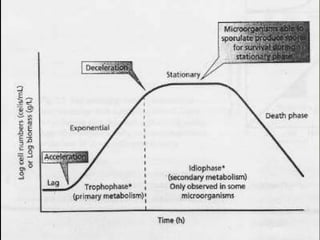
culture technique gives characteristics growth curve
with lag phase, log phase, stationary phase and decline
phase.
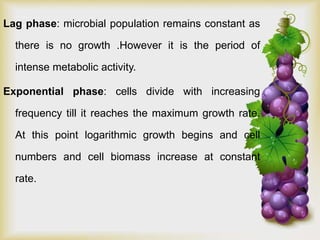
Lag phase: microbial population remains constant as
there is no growth .However it is the period of
intense metabolic activity.
Exponential phase: cells divide with increasing
frequency till it reaches the maximum growth rate.
At this point logarithmic growth begins and cell
numbers and cell biomass increase at constant
rate.
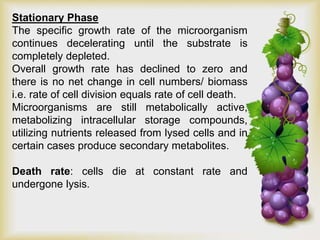
Stationary Phase
The specific growth rate of the microorganism
continues decelerating until the substrate is
completely depleted.
Overall growth rate has declined to zero and
there is no net change in cell numbers/ biomass
i.e. rate of cell division equals rate of cell death.
Microorganisms are still metabolically active,
metabolizing intracellular storage compounds,
utilizing nutrients released from lysed cells and in
certain cases produce secondary metabolites.
Death rate: cells die at constant rate and
undergone lysis.
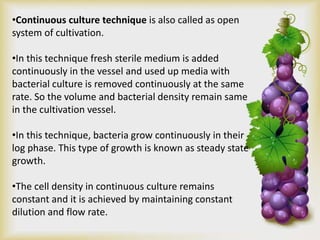
•Continuous culture technique is also called as open
system of cultivation.
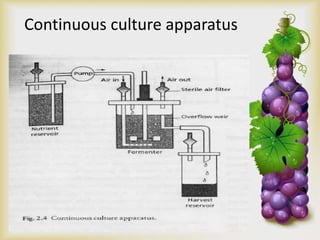
•In this technique fresh sterile medium is added
continuously in the vessel and used up media with
bacterial culture is removed continuously at the same
rate. So the volume and bacterial density remain same
in the cultivation vessel.
•In this technique, bacteria grow continuously in their
log phase. This type of growth is known as steady state
growth.
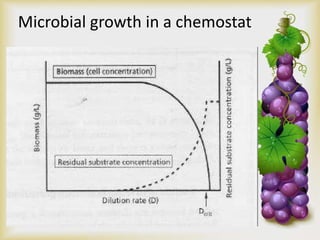
•The cell density in continuous culture remains
constant and it is achieved by maintaining constant
dilution and flow rate.
Continuous culture apparatus
Microbial growth in a chemostat
•Fed-batch culture is also called as semi-closed system of
cultivation.
•In this technique, at first nutrient media is prepared and
it is inoculated with culture organism and then incubated
for particulate time.
•During the course of incubation a particular nutrient is
added at intervals without removing the used up media
so the volume of culture increases continuously.
•Fed batch culture technique is applied in many types of
fermentation process.
•In fermentation some nutrient is very essential for the
process but when these nutrients are provided in higher
concentration in the culture they inhibit the growth of
bacteria ultimately ceasing the fermentation.
•Therefore such nutrients are kept in lower
concentration initially and it is added slowly and
continuously during the course of fermentation.
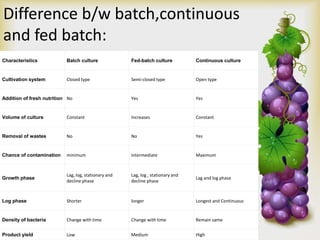
Difference b/w batch,continuous
and fed batch:
Characteristics Batch culture Fed-batch culture Continuous culture
Cultivation system Closed type Semi-closed type Open type
Addition of fresh nutrition No Yes Yes
Volume of culture Constant Increases Constant
Removal of wastes No No Yes
Chance of contamination minimum Intermediate Maximum
Growth phase
Lag, log, stationary and
decline phase
Lag, log , stationary and
decline phase
Lag and log phase
Log phase Shorter longer Longest and Continuous
Density of bacteria Change with time Change with time Remain same
Product yield Low Medium High
Thank you

Modes of fermentation

  • 1.
    MODES OF FERMENTATION Submittedto: Ramsaran sir Submitted by: Muskan arora Monika Shalini Megha kanica
  • 2.
    •Fermentation is ametabolic process that converts sugar to acids, gases or alcohol. • It occurs in yeast and bacteria, and also in oxygen-starved ( Deficient ) muscle cells, as in the case of lactic acid fermentation. • Fermentation, chemical process by which molecules such as glucose are broken down anaerobically. Fermentation:
  • 3.
    Modes of fermentation: • Batchfermentation • Continuous fermentation • Fed batch fermentation
  • 4.
    •Batch culture techniqueis also called as closed system of cultivation. •In this technique at first nutrient solution is prepared and it is inoculated with inoculum and then nothing is added in the fermentation tank except aeration. •In batch culture, neither fresh medium is added nor used up media is removed from the cultivation vessel. Therefore volume of culture remains same. •Since fresh media is not added during the course of incubation, concentration of nutrition decreases continuously. Furthermore various toxic metabolites also accumulates in the culture vessel. Therefore batch culture technique gives characteristics growth curve with lag phase, log phase, stationary phase and decline phase.
  • 6.
    Lag phase: microbialpopulation remains constant as there is no growth .However it is the period of intense metabolic activity. Exponential phase: cells divide with increasing frequency till it reaches the maximum growth rate. At this point logarithmic growth begins and cell numbers and cell biomass increase at constant rate.
  • 7.
    Stationary Phase The specificgrowth rate of the microorganism continues decelerating until the substrate is completely depleted. Overall growth rate has declined to zero and there is no net change in cell numbers/ biomass i.e. rate of cell division equals rate of cell death. Microorganisms are still metabolically active, metabolizing intracellular storage compounds, utilizing nutrients released from lysed cells and in certain cases produce secondary metabolites. Death rate: cells die at constant rate and undergone lysis.
  • 8.
    •Continuous culture techniqueis also called as open system of cultivation. •In this technique fresh sterile medium is added continuously in the vessel and used up media with bacterial culture is removed continuously at the same rate. So the volume and bacterial density remain same in the cultivation vessel. •In this technique, bacteria grow continuously in their log phase. This type of growth is known as steady state growth. •The cell density in continuous culture remains constant and it is achieved by maintaining constant dilution and flow rate.
  • 9.
  • 10.
  • 11.
    •Fed-batch culture isalso called as semi-closed system of cultivation. •In this technique, at first nutrient media is prepared and it is inoculated with culture organism and then incubated for particulate time. •During the course of incubation a particular nutrient is added at intervals without removing the used up media so the volume of culture increases continuously. •Fed batch culture technique is applied in many types of fermentation process. •In fermentation some nutrient is very essential for the process but when these nutrients are provided in higher concentration in the culture they inhibit the growth of bacteria ultimately ceasing the fermentation. •Therefore such nutrients are kept in lower concentration initially and it is added slowly and continuously during the course of fermentation.
  • 12.
    Difference b/w batch,continuous andfed batch: Characteristics Batch culture Fed-batch culture Continuous culture Cultivation system Closed type Semi-closed type Open type Addition of fresh nutrition No Yes Yes Volume of culture Constant Increases Constant Removal of wastes No No Yes Chance of contamination minimum Intermediate Maximum Growth phase Lag, log, stationary and decline phase Lag, log , stationary and decline phase Lag and log phase Log phase Shorter longer Longest and Continuous Density of bacteria Change with time Change with time Remain same Product yield Low Medium High
  • 13.