By
Asmita P. Sagar
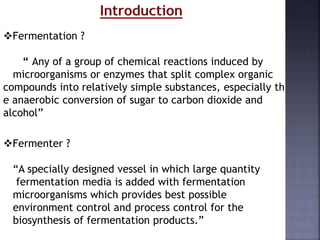
Fermentation ?
“ Any of a group of chemical reactions induced by
microorganisms or enzymes that split complex organic
compounds into relatively simple substances, especially th
e anaerobic conversion of sugar to carbon dioxide and
alcohol”
Fermenter ?
“A specially designed vessel in which large quantity
fermentation media is added with fermentation
microorganisms which provides best possible
environment control and process control for the
biosynthesis of fermentation products.”
1. Vessel
Function of a fermenter is to carryout process under appropriate
aseptic and pre-defined environmental conditions.
A fermentation vessel is designed in such a way that it requires
minimal labour operation and maintenance.
There are mainly two types of vessels base on the type
fermentation process :
1. Small scale fermenter (Laboratory scale fermenter) These
are made up of glass
2.Large scale fermenter (Industrial scale fermenter)
a. As, stainless steel is the most satisfactory material, it is used
to manufacture vessels of high volume
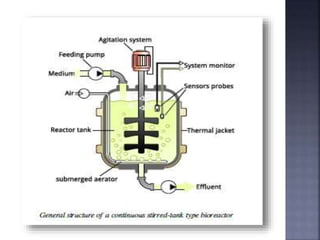
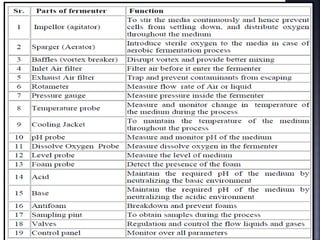
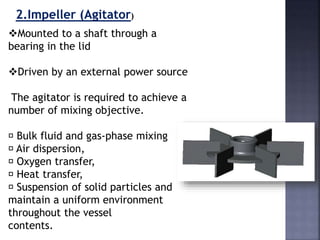
2.Impeller (Agitator)
Mounted to a shaft through a
bearing in the lid
Driven by an external power source
The agitator is required to achieve a
number of mixing objective.
􀂾 Bulk fluid and gas-phase mixing
􀂾 Air dispersion,
􀂾 Oxygen transfer,
􀂾 Heat transfer,
􀂾 Suspension of solid particles and
maintain a uniform environment
throughout the vessel
contents.
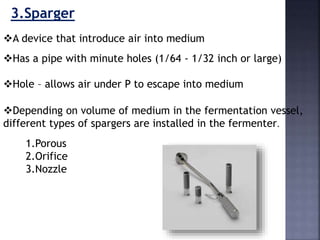
A device that introduce air into medium
3.Sparger
Has a pipe with minute holes (1/64 - 1/32 inch or large)
Hole – allows air under P to escape into medium
Depending on volume of medium in the fermentation vessel,
different types of spargers are installed in the fermenter.
1.Porous
2.Orifice
3.Nozzle
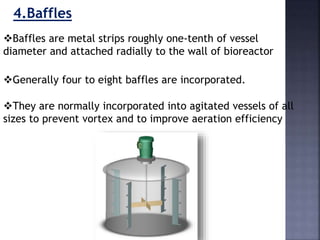
Baffles are metal strips roughly one-tenth of vessel
diameter and attached radially to the wall of bioreactor
4.Baffles
Generally four to eight baffles are incorporated.
They are normally incorporated into agitated vessels of all
sizes to prevent vortex and to improve aeration efficiency
5.Temperature controlling (heating and
cooling) devices
Mechanical agitation and exothermic microbial metabolic
activity generates heat during the fermentation process.
Endothermic microbial metabolic activity lower down the
temperature of the fermentation medium
To maintain this temperature, heat is to be either added
to or removed from the system
The cooling system is used to remove excess heat from
the system
Internal heating coils are used for providing heat (Note:
In case of lab scale process, the fermenter is placed in
thermostatically controlled bath)
6.pH control: -
Certain microorganisms grow in particular pH only. In
fermentation it is very essential to control
pH in order to grow the desired microorganisms for
product formation.
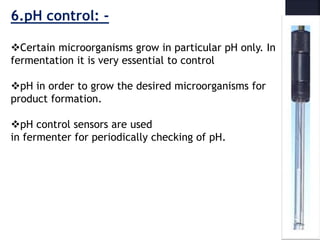
pH control sensors are used
in fermenter for periodically checking of pH.
7.Feed ports
Feed ports are the tubes ( for Lab scale fermenter)
and pipelines (for large scale fermenter) connected to
the nutrient reservoir
These tubes or pipelines are used to add nutrients and
acid/alkali in the fermenter before and during the
fermentation process
They are heat sterilized in situ and /or ex situ with
stem
It is advisable to sterilize after connection has been
done and before any additions are made
THANK
YOU…

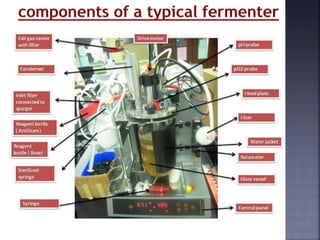
Components of a typical fermenter

  • 1.
  • 2.
    Fermentation ? “ Anyof a group of chemical reactions induced by microorganisms or enzymes that split complex organic compounds into relatively simple substances, especially th e anaerobic conversion of sugar to carbon dioxide and alcohol” Fermenter ? “A specially designed vessel in which large quantity fermentation media is added with fermentation microorganisms which provides best possible environment control and process control for the biosynthesis of fermentation products.”
  • 6.
    1. Vessel Function ofa fermenter is to carryout process under appropriate aseptic and pre-defined environmental conditions. A fermentation vessel is designed in such a way that it requires minimal labour operation and maintenance. There are mainly two types of vessels base on the type fermentation process : 1. Small scale fermenter (Laboratory scale fermenter) These are made up of glass 2.Large scale fermenter (Industrial scale fermenter) a. As, stainless steel is the most satisfactory material, it is used to manufacture vessels of high volume
  • 7.
    2.Impeller (Agitator) Mounted toa shaft through a bearing in the lid Driven by an external power source The agitator is required to achieve a number of mixing objective. 􀂾 Bulk fluid and gas-phase mixing 􀂾 Air dispersion, 􀂾 Oxygen transfer, 􀂾 Heat transfer, 􀂾 Suspension of solid particles and maintain a uniform environment throughout the vessel contents.
  • 8.
    A device thatintroduce air into medium 3.Sparger Has a pipe with minute holes (1/64 - 1/32 inch or large) Hole – allows air under P to escape into medium Depending on volume of medium in the fermentation vessel, different types of spargers are installed in the fermenter. 1.Porous 2.Orifice 3.Nozzle
  • 9.
    Baffles are metalstrips roughly one-tenth of vessel diameter and attached radially to the wall of bioreactor 4.Baffles Generally four to eight baffles are incorporated. They are normally incorporated into agitated vessels of all sizes to prevent vortex and to improve aeration efficiency
  • 10.
    5.Temperature controlling (heatingand cooling) devices Mechanical agitation and exothermic microbial metabolic activity generates heat during the fermentation process. Endothermic microbial metabolic activity lower down the temperature of the fermentation medium To maintain this temperature, heat is to be either added to or removed from the system The cooling system is used to remove excess heat from the system Internal heating coils are used for providing heat (Note: In case of lab scale process, the fermenter is placed in thermostatically controlled bath)
  • 11.
    6.pH control: - Certainmicroorganisms grow in particular pH only. In fermentation it is very essential to control pH in order to grow the desired microorganisms for product formation. pH control sensors are used in fermenter for periodically checking of pH.
  • 12.
    7.Feed ports Feed portsare the tubes ( for Lab scale fermenter) and pipelines (for large scale fermenter) connected to the nutrient reservoir These tubes or pipelines are used to add nutrients and acid/alkali in the fermenter before and during the fermentation process They are heat sterilized in situ and /or ex situ with stem It is advisable to sterilize after connection has been done and before any additions are made
  • 13.