FERMENTERS
PREPARED BY:
Bhargavi Mistry
[M. Pharm (Pharmaceutics)]
01 Introduction
LIST OF CONTENT
Prepared by: Bhargavi Mistry 2
02 Functions Fermenter
03 Design of fermenter 04 Types of fermenter
INTRODUCTION
Fermentation:
Fermentation:
➢ Fermentation is defined as growing culture of microorganisms in a nutrient media
and converting feed into the desired end product.
➢ It is described as a biochemical reaction in which microorganisms serve as biocatalysts.
Prepared by: Bhargavi Mistry 3
Fermentors/Bioreactors:
➢ The most articulate, manipulative and progressive industrial (commercial) usage of
microorganisms invariably needs that they be allowed to grow in large vessels
essentially loaded with considerable quantum of highly nutritive culture media. These
specially designed vessels are universally and commonly termed as fermentors or
bioreactors.
FUNCTIONS OF FERMENTERS
Prepared by: Bhargavi Mistry 4
1) It should provide a controlled environment for optimum biomass/product yield.
2) It should permit aseptic fermentation for a number of days reliably.
3) It should provide adequate mixing and aeration for optimum growth and
production, without damaging the microorganisms/cells.
4) The power consumption should be minimized.
5) It should provide easy and adaptable temperature control.
6) Facility of sampling should be provided.
7) It should have a system for monitoring and regulating pH of fermentation broth.
8) Evaporation losses should be minimum.
9) Minimum labour maintenance.
10) Construct using the cheapest material.
Prepared by: Bhargavi Mistry 5
Figure: Diagram of the fermenter
DESIGN OF FERMENTERS
Prepared by: Bhargavi Mistry 6
1) Fermenter Vessel 7) Sealing Assembly
2) Heating and Cooling Apparatus 8) Feed Ports
3) Aeration System 9) Foam-Control
4) Agitator (impeller) 10) Valves
5) Sparger 11) Controlling Devices for
Environmental Factors
6) Baffles 12) Use of Computer in Fermenter
➢ The fermenter contains the following components:
Component of fermenter:
Prepared by: Bhargavi Mistry 7
1) Fermenter Vessel
➢ A fermenter is a large cylinder closed at the top and bottom connected with
various pipes and valves.
➢ The vessel is designed in such a way that it allows it to work under controlled
conditions.
➢ Glass and stainless steels are two types of fermenter vessels used.
➢ The glass vessel is usually used in small-scale industries. It is non-toxic and
corrosion-proof.
➢ Stainless steel vessel is used in large-scale industries. It can resist pressure and
corrosion.
Prepared by: Bhargavi Mistry 8
2) Heating and Cooling Apparatus
➢ The fermenter vessel’s exterior is fitted with a cooling jacket that seals the vessel
and provides cooling water.
➢ Thermostatically controlled baths or internal coils are generally used to provide
heat while silicone jackets are used to remove excess heat.
➢ A cooling jacket is necessary to sterilize the nutrient medium and remove the
heat generated during fermentation in the fermentor.
Prepared by: Bhargavi Mistry 9
3) Aeration System
➢ An aeration system is one of the very important parts of a fermenter.
➢ It is important to choose a good aeration system to ensure proper aeration and
oxygen availability throughout the culture.
➢ It contains two separate aeration devices (sparger and impeller) to ensure proper
aeration in a fermenter.
➢ The stirring accomplishes two things:
➢ It helps to mix the gas bubbles through the liquid culture medium and
➢ It helps to mix the microbial cells through the liquid culture medium, ensuring
the uniform access of microbial cells to the nutrients.
Prepared by: Bhargavi Mistry 10
4) Agitator (Impeller)
Agitators achieve the following objectives:
➢ Bulk fluid and gas phase mixing
➢ Air dispersion
➢ Oxygen transfer
➢ Heat transfer
➢ Suspension of solid particle
➢ Maintenance of uniform environment throughout the vessel.
Prepared by: Bhargavi Mistry 11
1) Disc turbine:
Disc turbine consists of a disc with a series of rectangular vanes set in a vertical
the plane around its peripheri.
2) Vaned discs turbine:
The vaned discs turbine has a series of rectangular vanes attached vertically to
the underside of the disc.
3) Open turbines of variable pitch
In this type of turbine, the vanes are attached directly to a boss on the agitator
shaft.
Prepared by: Bhargavi Mistry 12
5) Sparger
➢ A sparger is a system used for introducing sterile air to a fermentation vessel. It
helps in providing proper aeration to the vessel.
➢ The sparger pipes contain small holes of about 5-10 mm, through which
pressurized air is released.
➢ Three types of sparger are used
1) Porous sparger
2) Nozzle sparger
3) Combined sparger–agitator
Prepared by: Bhargavi Mistry 13
6) Baffles
➢ There are four baffles that are present inside of an agitated vessel to prevent a
vortex and improve aeration efficiency.
➢ Baffles are made up of metal strips roughly one-tenth of the vessel diameter and
attached to the wall.
➢ The agitation effect is slightly increased with wider baffles but drops sharply
with narrower baffles.
Prepared by: Bhargavi Mistry 14
7) Sealing Assembly
➢ The sealing assembly is used for the sealing of the stirrer shaft to offer proper
agitation.
➢ There are three types of sealing assembly in the fermenter:
1) Packed gland seal
2) Mechanical seal
3) Magnetic drives
Prepared by: Bhargavi Mistry 15
8) Feed Ports
➢ They are used to add nutrients and acid/alkali to the fermentor.
➢ Feed ports are tubes made up of silicone.
➢ In-situ sterilization is performed before the removal or addition of the products.
9) Foam control
➢ The level of foam in the vessel must be minimized to avoid contamination, this is
an important aspect of the fermentor.
➢ Foam is controlled by two units, foam sensing, and a control unit.
➢ A foam-controlling device is mounted on top of the fermentor, with an inlet into
the fermentor.
Prepared by: Bhargavi Mistry 16
10) Valves
➢ Valves are used in the fermenter to control the movement of liquid in the vessel.
➢ There are around five types of valves are used, that is,
1) globe valve,
2) butterfly valve,
3) a ball valve, and
4) diaphragm valve.
5) A safety valve
Prepared by: Bhargavi Mistry 17
11) Controlling Devices for Environmental Factors
➢ A variety of devices are utilized to control environmental elements like
temperature, oxygen concentration, pH, cell mass, essential nutrient levels, and
product concentration.
12) Use of Computer in Fermenter
➢ For an efficient process, monitoring, and data collecting, fermentors are generally
coupled with modern automated and semi-automated computers and databases.
Prepared by: Bhargavi Mistry 18
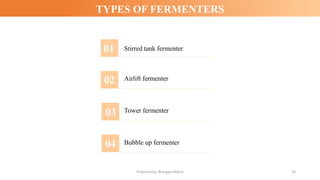
TYPES OF FERMENTERS
Stirred tank fermenter
Airlift fermenter
Tower fermenter
Bubble up fermenter
01
02
03
04
Prepared by: Bhargavi Mistry 19
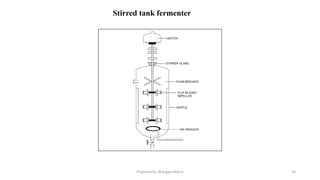
Stirred tank fermenter
➢ These are usually made of ‘glass’(smaller vessels) or ‘stainless steel’ (larger
volumes) vessels.
➢ These are closed systems having rather definite fixed volumes and are normally
agitated with motor-driven stirrers with lots of variation in design
specifications,
• Curved-bottom for more efficient mixing at low speeds
• Water-circulated jacket in place of heater-type (electrical) temperature control
• Mirrored internal finishes to minimize cell-damage
Prepared by: Bhargavi Mistry 20
Stirred tank fermenter
Prepared by: Bhargavi Mistry 21
➢ Several heteroploid cell lines may be grown successfully in such vessels.
➢ Small-scale reactors (cap. 2-50 L) fulfill the need for research biochemicals from
cells.
➢ Large-scale reactors (cap. 100-5000 L) are largely employed for growing
hybridoma cells for the production of monoclonal antibodies (MABs)
Advantages:
Prepared by: Bhargavi Mistry 22
➢ The cultures in air-lift type fermentors are subjected to ‘aeration’ and ‘agitation’ by
passing sterilized compressed air bubbles introduced strategically at the bottom of the
vessel.
➢ The fermentors have an inner draft tube via which the air bubbles as well as the
aerated medium rise because this effectively gives rise to the thorough mixing of the
culture and aeration simultaneously.
➢ The air bubbles being lighter lift to the top of the medium and the air subsequently gets
released through on outlet.
➢ Air-lift type fermentors with a capacity of 2-90L are invariably available for large-
scale production. However, 2000L fermentors are being employed specifically for the
production of monoclonal antibodies (MABs).
Air lift fermenter
Prepared by: Bhargavi Mistry 23
Figure: Diagram of the air lift fermenter
Prepared by: Bhargavi Mistry 24
➢ A tower fermenter has been defined by Greenshields and co-workers
➢ It is an elongated non mechanically stirred fermenter.
➢ This fermenter is designed to provide the best feasible and possible growth and
biosynthesis conditions for industrially vital microbial cultures.
➢ It should be strong enough to hold a large volume of the aqueous medium.
➢ It should not be either corroded by the fermentation product or even contribute
severe toxic ions to the prevailing growth medium.
Tower fermenter
Prepared by: Bhargavi Mistry 25
➢ The oxygen is readily and adequately available to the microorganism, and the
resulting CO2 obtained from the ‘microbial metabolism’ is mostly flushed out from
the medium accordingly through a vent provided at the top-end of the tower
bioreactor.
➢ The sample is introduced into the tower bioreactor from the bottom, and the
finished fermented product is removed from the top-end outlet as and when
required.
Prepared by: Bhargavi Mistry 26
Figure: Diagram of the tower fermenter
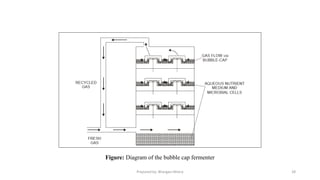
➢ It essentially comprises a tank provided with a series of horizontal plates.
➢ Each plate supports a nutrient medium devoid of a carbon source, and subsequently,
the medium is duly inoculated with the ‘required microorganism’.
➢ Each plate is provided with several short vertical pipes that are strategically
connected to its upper surface, and duly projecting just above the surface of the
liquid culture medium.
➢ Each short vertical pipe has two important provisions, namely :
(a) A hole in the bottom of this pipe allows legitimate contact with the
atmosphere above the medium in the next immediate lower plate; and
(b) The top of the lower rim of the inverted cap extends beneath the surface of
the nutrient medium.
Bubble cap fermenter
Prepared by: Bhargavi Mistry 27
Prepared by: Bhargavi Mistry 28
Figure: Diagram of the bubble cap fermenter
Prepared by: Bhargavi Mistry 29
REFERENCES
1) B. D. Singh, Biotechnology expanding horizons, Fourth revised edition 2012,
Kalyani publishers, Page no. 522-533
2) Ashutosh kar, Pharmaceutical biotechnology, reprint 2008, New age international
limited publishers, Page no. 186, 192-194, 198-201
Prepared by: Bhargavi Mistry 30
THANK YOU

Fermenters.pdf

  • 1.
  • 2.
    01 Introduction LIST OFCONTENT Prepared by: Bhargavi Mistry 2 02 Functions Fermenter 03 Design of fermenter 04 Types of fermenter
  • 3.
    INTRODUCTION Fermentation: Fermentation: ➢ Fermentation isdefined as growing culture of microorganisms in a nutrient media and converting feed into the desired end product. ➢ It is described as a biochemical reaction in which microorganisms serve as biocatalysts. Prepared by: Bhargavi Mistry 3 Fermentors/Bioreactors: Fermentors/Bioreactors: ➢ The most articulate, manipulative and progressive industrial (commercial) usage of microorganisms invariably needs that they be allowed to grow in large vessels essentially loaded with considerable quantum of highly nutritive culture media. These specially designed vessels are universally and commonly termed as fermentors or bioreactors.
  • 4.
    FUNCTIONS OF FERMENTERS Preparedby: Bhargavi Mistry 4 1) It should provide a controlled environment for optimum biomass/product yield. 2) It should permit aseptic fermentation for a number of days reliably. 3) It should provide adequate mixing and aeration for optimum growth and production, without damaging the microorganisms/cells. 4) The power consumption should be minimized. 5) It should provide easy and adaptable temperature control. 6) Facility of sampling should be provided. 7) It should have a system for monitoring and regulating pH of fermentation broth. 8) Evaporation losses should be minimum. 9) Minimum labour maintenance. 10) Construct using the cheapest material.
  • 5.
    Prepared by: BhargaviMistry 5 Figure: Diagram of the fermenter DESIGN OF FERMENTERS
  • 6.
    Prepared by: BhargaviMistry 6 1) Fermenter Vessel 7) Sealing Assembly 2) Heating and Cooling Apparatus 8) Feed Ports 3) Aeration System 9) Foam-Control 4) Agitator (impeller) 10) Valves 5) Sparger 11) Controlling Devices for Environmental Factors 6) Baffles 12) Use of Computer in Fermenter ➢ The fermenter contains the following components: Component of fermenter: Component of fermenter:
  • 7.
    Prepared by: BhargaviMistry 7 1) Fermenter Vessel ➢ A fermenter is a large cylinder closed at the top and bottom connected with various pipes and valves. ➢ The vessel is designed in such a way that it allows it to work under controlled conditions. ➢ Glass and stainless steels are two types of fermenter vessels used. ➢ The glass vessel is usually used in small-scale industries. It is non-toxic and corrosion-proof. ➢ Stainless steel vessel is used in large-scale industries. It can resist pressure and corrosion.
  • 8.
    Prepared by: BhargaviMistry 8 2) Heating and Cooling Apparatus ➢ The fermenter vessel’s exterior is fitted with a cooling jacket that seals the vessel and provides cooling water. ➢ Thermostatically controlled baths or internal coils are generally used to provide heat while silicone jackets are used to remove excess heat. ➢ A cooling jacket is necessary to sterilize the nutrient medium and remove the heat generated during fermentation in the fermentor.
  • 9.
    Prepared by: BhargaviMistry 9 3) Aeration System ➢ An aeration system is one of the very important parts of a fermenter. ➢ It is important to choose a good aeration system to ensure proper aeration and oxygen availability throughout the culture. ➢ It contains two separate aeration devices (sparger and impeller) to ensure proper aeration in a fermenter. ➢ The stirring accomplishes two things: ➢ It helps to mix the gas bubbles through the liquid culture medium and ➢ It helps to mix the microbial cells through the liquid culture medium, ensuring the uniform access of microbial cells to the nutrients.
  • 10.
    Prepared by: BhargaviMistry 10 4) Agitator (Impeller) Agitators achieve the following objectives: ➢ Bulk fluid and gas phase mixing ➢ Air dispersion ➢ Oxygen transfer ➢ Heat transfer ➢ Suspension of solid particle ➢ Maintenance of uniform environment throughout the vessel.
  • 11.
    Prepared by: BhargaviMistry 11 1) Disc turbine: Disc turbine consists of a disc with a series of rectangular vanes set in a vertical the plane around its peripheri. 2) Vaned discs turbine: The vaned discs turbine has a series of rectangular vanes attached vertically to the underside of the disc. 3) Open turbines of variable pitch In this type of turbine, the vanes are attached directly to a boss on the agitator shaft.
  • 12.
    Prepared by: BhargaviMistry 12 5) Sparger ➢ A sparger is a system used for introducing sterile air to a fermentation vessel. It helps in providing proper aeration to the vessel. ➢ The sparger pipes contain small holes of about 5-10 mm, through which pressurized air is released. ➢ Three types of sparger are used 1) Porous sparger 2) Nozzle sparger 3) Combined sparger–agitator
  • 13.
    Prepared by: BhargaviMistry 13 6) Baffles ➢ There are four baffles that are present inside of an agitated vessel to prevent a vortex and improve aeration efficiency. ➢ Baffles are made up of metal strips roughly one-tenth of the vessel diameter and attached to the wall. ➢ The agitation effect is slightly increased with wider baffles but drops sharply with narrower baffles.
  • 14.
    Prepared by: BhargaviMistry 14 7) Sealing Assembly ➢ The sealing assembly is used for the sealing of the stirrer shaft to offer proper agitation. ➢ There are three types of sealing assembly in the fermenter: 1) Packed gland seal 2) Mechanical seal 3) Magnetic drives
  • 15.
    Prepared by: BhargaviMistry 15 8) Feed Ports ➢ They are used to add nutrients and acid/alkali to the fermentor. ➢ Feed ports are tubes made up of silicone. ➢ In-situ sterilization is performed before the removal or addition of the products. 9) Foam control ➢ The level of foam in the vessel must be minimized to avoid contamination, this is an important aspect of the fermentor. ➢ Foam is controlled by two units, foam sensing, and a control unit. ➢ A foam-controlling device is mounted on top of the fermentor, with an inlet into the fermentor.
  • 16.
    Prepared by: BhargaviMistry 16 10) Valves ➢ Valves are used in the fermenter to control the movement of liquid in the vessel. ➢ There are around five types of valves are used, that is, 1) globe valve, 2) butterfly valve, 3) a ball valve, and 4) diaphragm valve. 5) A safety valve
  • 17.
    Prepared by: BhargaviMistry 17 11) Controlling Devices for Environmental Factors ➢ A variety of devices are utilized to control environmental elements like temperature, oxygen concentration, pH, cell mass, essential nutrient levels, and product concentration. 12) Use of Computer in Fermenter ➢ For an efficient process, monitoring, and data collecting, fermentors are generally coupled with modern automated and semi-automated computers and databases.
  • 18.
    Prepared by: BhargaviMistry 18 TYPES OF FERMENTERS Stirred tank fermenter Airlift fermenter Tower fermenter Bubble up fermenter 01 02 03 04
  • 19.
    Prepared by: BhargaviMistry 19 Stirred tank fermenter ➢ These are usually made of ‘glass’(smaller vessels) or ‘stainless steel’ (larger volumes) vessels. ➢ These are closed systems having rather definite fixed volumes and are normally agitated with motor-driven stirrers with lots of variation in design specifications, • Curved-bottom for more efficient mixing at low speeds • Water-circulated jacket in place of heater-type (electrical) temperature control • Mirrored internal finishes to minimize cell-damage
  • 20.
    Prepared by: BhargaviMistry 20 Stirred tank fermenter
  • 21.
    Prepared by: BhargaviMistry 21 ➢ Several heteroploid cell lines may be grown successfully in such vessels. ➢ Small-scale reactors (cap. 2-50 L) fulfill the need for research biochemicals from cells. ➢ Large-scale reactors (cap. 100-5000 L) are largely employed for growing hybridoma cells for the production of monoclonal antibodies (MABs) Advantages:
  • 22.
    Prepared by: BhargaviMistry 22 ➢ The cultures in air-lift type fermentors are subjected to ‘aeration’ and ‘agitation’ by passing sterilized compressed air bubbles introduced strategically at the bottom of the vessel. ➢ The fermentors have an inner draft tube via which the air bubbles as well as the aerated medium rise because this effectively gives rise to the thorough mixing of the culture and aeration simultaneously. ➢ The air bubbles being lighter lift to the top of the medium and the air subsequently gets released through on outlet. ➢ Air-lift type fermentors with a capacity of 2-90L are invariably available for large- scale production. However, 2000L fermentors are being employed specifically for the production of monoclonal antibodies (MABs). Air lift fermenter
  • 23.
    Prepared by: BhargaviMistry 23 Figure: Diagram of the air lift fermenter
  • 24.
    Prepared by: BhargaviMistry 24 ➢ A tower fermenter has been defined by Greenshields and co-workers ➢ It is an elongated non mechanically stirred fermenter. ➢ This fermenter is designed to provide the best feasible and possible growth and biosynthesis conditions for industrially vital microbial cultures. ➢ It should be strong enough to hold a large volume of the aqueous medium. ➢ It should not be either corroded by the fermentation product or even contribute severe toxic ions to the prevailing growth medium. Tower fermenter
  • 25.
    Prepared by: BhargaviMistry 25 ➢ The oxygen is readily and adequately available to the microorganism, and the resulting CO2 obtained from the ‘microbial metabolism’ is mostly flushed out from the medium accordingly through a vent provided at the top-end of the tower bioreactor. ➢ The sample is introduced into the tower bioreactor from the bottom, and the finished fermented product is removed from the top-end outlet as and when required.
  • 26.
    Prepared by: BhargaviMistry 26 Figure: Diagram of the tower fermenter
  • 27.
    ➢ It essentiallycomprises a tank provided with a series of horizontal plates. ➢ Each plate supports a nutrient medium devoid of a carbon source, and subsequently, the medium is duly inoculated with the ‘required microorganism’. ➢ Each plate is provided with several short vertical pipes that are strategically connected to its upper surface, and duly projecting just above the surface of the liquid culture medium. ➢ Each short vertical pipe has two important provisions, namely : (a) A hole in the bottom of this pipe allows legitimate contact with the atmosphere above the medium in the next immediate lower plate; and (b) The top of the lower rim of the inverted cap extends beneath the surface of the nutrient medium. Bubble cap fermenter Prepared by: Bhargavi Mistry 27
  • 28.
    Prepared by: BhargaviMistry 28 Figure: Diagram of the bubble cap fermenter
  • 29.
    Prepared by: BhargaviMistry 29 REFERENCES 1) B. D. Singh, Biotechnology expanding horizons, Fourth revised edition 2012, Kalyani publishers, Page no. 522-533 2) Ashutosh kar, Pharmaceutical biotechnology, reprint 2008, New age international limited publishers, Page no. 186, 192-194, 198-201
  • 30.
    Prepared by: BhargaviMistry 30 THANK YOU