
Diseases caused by DNA
damage
By
M.Vharshini
B.Sc. Biomedical sciences
Sri Ramachandra University
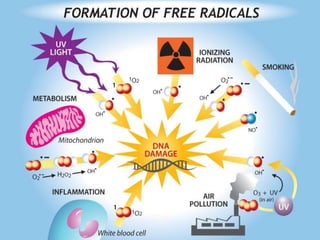
• DNA damage is an alteration in the chemical structure
of DNA, such as a break in a strand of DNA, a base
missing from the backbone of DNA, or a chemically
changed base such as 8-OHdG.
• Damage to DNA that occurs naturally can result
from metabolic or hydrolytic processes.
• DNA damage induces sequential responses to either
repair the damage or activate apoptosis.
Introduction
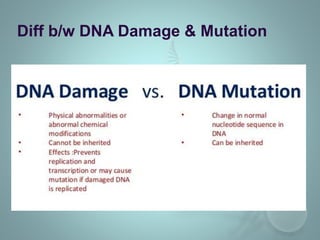
Diff b/w DNA Damage & Mutation
Defects in this critical response to DNA damage leads
to wide array of human pathologies that include :
 Cancer predisposition,
 Inflammation responses,
 Cell Ageing and
Neurodegeneration.
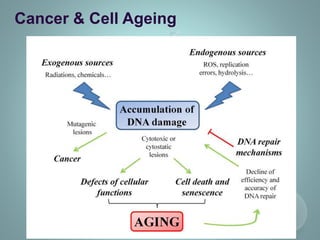
Cancer & Cell Ageing
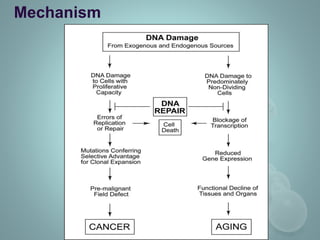
Mechanism
Neurodegeneration is the common feature of
many nervous system and aging diseases, such
as
• Huntington Disease (HD),
• Parkinson’s disease (PD) and
• Alzheimer’s disease (AD)
Neurodegeneration and DNA damage
After completing the normal development processes,
neurons enter a post-mitotic state and stay in a
resting status.
A numerous endogenous and exogenous agents can
cause DNA damage.
Activation of DNA damage sensing protein which
trigger the cascade reactivation of repair system.
If the damaged DNA was not completely repaired or
the ability of repair was deficiency, the unrepaired DNA
would be accumulated in the neuron which will be
provoked to re-enter into cell cycle *
Reactivation of the cell cycle in neurons can induce
apoptosis , lead to neuronal degeneration.
• Infections and chronic inflammations have been
recognized as important risk factors for carcinogenesis
and malignancies.
• Inflammation can be induced not only by chronic infection
but also endogenous and exogenous factors.
• Chronic inflammation accounts for approximately 25% of
human cancers.
• Under inflammatory conditions, reactive oxygen
species(ROS) & reactive nitrogen species(RNS) are
generated from inflammatory & epithelial cells.
• ROS can induce the formation of oxidative DNA lesion
products which is considered to be mutagenic
DNA damage in chronic inflammation
• Deletion of DNA segments is the predominant form of
radiation damage in cells that survive irradiation.
• It may be caused by any of two reasons:
1)Mispair of two separate double strand breaks in
DNA molecule with join of the two outer ends and
loss of the fragment between the breaks.
2)The process of cleaning (enzyme digestion of
nucleotides- the component molecules of DNA)
of the broken ends before rejoining to repair one
double strand break.
DNA damage caused my Ionising
radiation
Reference
• http://www.archivesofmedicine.com/medicine/dna-damage-
and-repair-neurodegeneration-and-the-roleof-pur-in-dna-
repair.php?aid=6739
• https://en.wikipedia.org/wiki/Free_radical_damage_to_DNA
• http://www.ncbi.nlm.nih.gov/pubmed/26255941
• http://www.asianscientist.com/2014/11/in-the-lab/dna-
damage-leads-cancer/
• http://www.sciencedirect.com/science/article/pii/S009286740
7011415
THANK YOU

Diseases caused by dna damage

  • 1.
    Diseases caused byDNA damage By M.Vharshini B.Sc. Biomedical sciences Sri Ramachandra University
  • 2.
    • DNA damageis an alteration in the chemical structure of DNA, such as a break in a strand of DNA, a base missing from the backbone of DNA, or a chemically changed base such as 8-OHdG. • Damage to DNA that occurs naturally can result from metabolic or hydrolytic processes. • DNA damage induces sequential responses to either repair the damage or activate apoptosis. Introduction
  • 3.
    Diff b/w DNADamage & Mutation
  • 5.
    Defects in thiscritical response to DNA damage leads to wide array of human pathologies that include :  Cancer predisposition,  Inflammation responses,  Cell Ageing and Neurodegeneration.
  • 6.
  • 7.
  • 8.
    Neurodegeneration is thecommon feature of many nervous system and aging diseases, such as • Huntington Disease (HD), • Parkinson’s disease (PD) and • Alzheimer’s disease (AD) Neurodegeneration and DNA damage
  • 9.
    After completing thenormal development processes, neurons enter a post-mitotic state and stay in a resting status. A numerous endogenous and exogenous agents can cause DNA damage. Activation of DNA damage sensing protein which trigger the cascade reactivation of repair system. If the damaged DNA was not completely repaired or the ability of repair was deficiency, the unrepaired DNA would be accumulated in the neuron which will be provoked to re-enter into cell cycle * Reactivation of the cell cycle in neurons can induce apoptosis , lead to neuronal degeneration.
  • 10.
    • Infections andchronic inflammations have been recognized as important risk factors for carcinogenesis and malignancies. • Inflammation can be induced not only by chronic infection but also endogenous and exogenous factors. • Chronic inflammation accounts for approximately 25% of human cancers. • Under inflammatory conditions, reactive oxygen species(ROS) & reactive nitrogen species(RNS) are generated from inflammatory & epithelial cells. • ROS can induce the formation of oxidative DNA lesion products which is considered to be mutagenic DNA damage in chronic inflammation
  • 11.
    • Deletion ofDNA segments is the predominant form of radiation damage in cells that survive irradiation. • It may be caused by any of two reasons: 1)Mispair of two separate double strand breaks in DNA molecule with join of the two outer ends and loss of the fragment between the breaks. 2)The process of cleaning (enzyme digestion of nucleotides- the component molecules of DNA) of the broken ends before rejoining to repair one double strand break. DNA damage caused my Ionising radiation
  • 12.
    Reference • http://www.archivesofmedicine.com/medicine/dna-damage- and-repair-neurodegeneration-and-the-roleof-pur-in-dna- repair.php?aid=6739 • https://en.wikipedia.org/wiki/Free_radical_damage_to_DNA •http://www.ncbi.nlm.nih.gov/pubmed/26255941 • http://www.asianscientist.com/2014/11/in-the-lab/dna- damage-leads-cancer/ • http://www.sciencedirect.com/science/article/pii/S009286740 7011415
  • 13.