PRESENTED BY
SIVARAMAKRISHNAN.T
II M.SC. MICROBIOLOGY
Reg.no.20201232516121
Ferrmentor or bioreactor
Iv – semester
PRESENTED TO
Dr.S.Viswanathan
DEPARTMENT OF MICROBIOLOGY
SRI PARAMAKALYANI COLLEGE
ALWARKURICHI
Contents
 Introduction
 History
 Function
 Design
 Classifications
Introduction
 It is a device or system that used to support biologically active
environment.
 It is a system within which substrate of very low value is employ by living
cells or enzymes to produce a product of greater value.
 A fermenter is a closed system vessel which have an adequate provision
for temperature, agitation, aeration, pH control, and drain or overflow vent
to remove waste biomass of culture microorganism with their products.
History
 In 1944 De becze and Liebmann used the primary
large-scale fermenter for the growth of yeast.
 But, during the time of world war there’s is a British
scientist whose name is Chain Weizmann who
desigined a fermenter for the production of
acetone.
Functions
 It should have a provision to control environment for optimum biomass or
product yield.
 It should provide an aseptic fermentation condition for more reliablity.
 It should provide the adequate or proper mixing and aeration for the
growth and production without damaging of the microorganisms or cells
Continue…..
 It should have a system temperature control
 It should have a system to monitor and regulate pH of the fermentation
broth.
 Facility for sampling should be provided.
 It should have required minimum of labour in maintenance, cleaning,
operating and harvesting operation.
Design
 Fermenter or bioreactor refers to a device that provides all the basic necessities
important for biological product extraction.
 A fermenter contains different devices that help to maintain the
environmental factor inside it which in turn leads to the production of
biological products.
 Therefore the main objective of a fermenter is to maintain a controlled
environment that supports the growth of the bacteria or any other organism.
 There are several important factors that need to be accurate to design a
fermenter. Those factors are following
Continue…..
 A bioreactor should consist of the followings:
1. Agitation- for mixing of cells and medium.
2. Aeration – aerobic fermentation used for oxygen supply.
3. Temperature
4. pH, pressure, nutrients feeding, etc.
5. Sterilization and maintenance of sterility.
6. Withdrawal of cells or media.
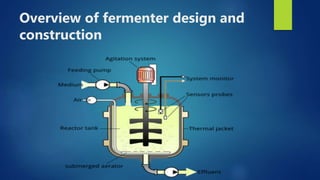
Overview of fermenter design and
construction
Agitation and Aeration
 Agitations are aims to ensure similar
distribution of microorganisms and the
nutrients in the broth.
 Aeration to provide microorganisms growing
in submerged culture with adequate oxygen
supply.
The following components of the fermenter
which is required for aeration and agitation:
1. Agitator (impellers)
2. Stirrer glands and bearings
3. Baffles
4. Sparger (the Aeration system)
Agitator (Impellers)
 Air bubbles often cause problems inside the
fermenter.
 Impellers involved in breaking the air bubbles
produced in a liquid medium.
 There are mainly three types of agitators used in
industrial-scale bioreactors
It is of several different type:
1. Disc turbine
2. Vaned disc turbine
3. Open turbine
4. Propeller
Disc Turbine:
It consists of a disc with a series of
rectangular vanes connected in a
vertical plane around the disc.
Vaned disc:
 In this case, the rectangular vanes
are attached vertically to the
underside of a disc.
Variable Pitch open turbine:
This type of agitator lacks disc and
the vanes are directly connected to a
center shaft.
Stirrer glands and bearings
 he most important factor of designing a fermenter is to maintain aseptic
conditions inside the vessel.
 It is highly challenging in the case of pilot-scale fermenters.
 Therefore stirrer shafts are required.
 These stirrer shafts play an important role to seal the openings of a
bioreactor.
There are several types of seals used for this
purpose, which are following
 he Stuffing Box
 The Mechanical Seal
 Magnetic Drives
The Stuffing Box:
 The shafted is sealed by several layers of packing
rings of asbestos or cotton yarn which is pressed
against the shaft by gland follower.
 At high stirrer speeds, the packing wears quickly and
excessive pressure may need to ensure the tightness
of fit.
The Mechanical Seal:
 t is used in both small scale and large scale fermenters.
 The seal is divided into two parts, first is the stationary bearing housing
and the second rotates on the shaft.
 These two parts are pressed together by springs.
 Steam condensate is used to lubricate and cool the seals during operation
and provides protection against the contamination.
Magnetic Drives:
 This type of seals helps to counter the problem
originated by the impeller shaft which is going
through the top or bottom of the fermenter plate.
 The magnetic drive is made up of two magnets one
is driving and one driven.
Baffles
Baffles
 It is metal strips.
 One tenth of the vessels diameter.
 Attached radially to fermenters wall.
 It provided to prevent vortex formation and improve efficiency.
Aeration system (Sparger)
 A sparger is a device that introduces air into
the liquid medium in a fermenter. There are
three main types of fermenter used in
industrial-scale bioreactors such as
It is of three types:
1. Porous Sparger
2. Orifice Sparger
3. Nozzle Sparger
Porous Sparger
 It is made up of sintered glass, ceramics or metals’ and are
mostly used in laboratory-scale bioreactors.
 As it introduces air inside a liquid medium, bubbles are
formed.
 These bubbles are always 10 to 100 times larger than the pore
size of the aerator.
Orifice Sparger
 These are used in small stirred fermenters
where perforated pipes are used and attached
below the impeller in the form of a ring.
 The air holes are mostly drilled under the
surface of the tubes.
Nozzle Sparger
 This is used in industrial-scale fermenters.
 The main characteristic of this kind of sparger
is that it contains a single open or partially
closed pipe as an air outlet.
 Temperature control: adequate provision for control of
Temperature.
 Pressure gauge: It measures pressure inside the fermenters.
 pH probe: It provides to measure and monitor pH of the
medium.
 Inlet air filter: Provision to supply air in the fermenters.
 Exhaust air filter: Provision to drain out the air from the
fermenters.
 Cooling jacket: Provided to maintain the
temperature of the fermenters throughout the
process.
 Control panel: it monitors all the parameters.
 Foam control: it is produced during most microbial
fermentation. Antifoams are used to removes foam
from the surface of media e.g., silicone, soybean oil,
cotton seed oil, sulphonate etc.
Classifications
 On the basis of agent used, bioreactors are of two types:
1. On the basis of living cells
2. On the basis of enzymes employed
In the terms of process fermenters, is
of following types:
1. Aerobic
2. Anaerobic
3. Solid state
4. Immobilized cell disruption
Types of fermenters
 Continuous Stirred Tank Bioreactor
 Airlift Bioreactor
 Packed Bed Bioreactor
 Fluidized Bed Bioreactor
 Photobioreactor
 Membrane Bioreactor
 Bubble Column Bioreactors
Continuous Stirred Tank Bioreactor
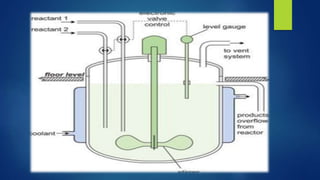
 The continuous stirred-tank bioreactor consists of a vessel, pipes, valves,
pumps, agitator, shaft, impeller, and motor.
 The motor power the bioreactor which helps in mixing cultures and also
there are sensors that can detect temperature, PH, dissolved oxygen,
glucose, lactic acid, ammonia, ammonium ion, and other parameters in
the culture medium.
 The main target of desired products enlists the cells or primary
metabolite which mostly acquire microorganisms like yeast or bacteria.
Advantages of continuous stirred tank
reactor
 It is a continuous operation
 It has a good capture over temperature
 It provides a homogeneous environment for cell growth and proliferation
 Easily adapts to two-phase runs
 It is quite cost-efficient in both investment and operation
Disadvantages of continuous stirred
tank reactor
 Their mechanic agitation produces shear stress
which may harm the cultured cells. but this can be
overcome by changing the shape and diameter of
the impeller blade or adding bovine serum albumin
or dextran
 Foaming can also cause a problem but again can be
solved by antifoaming agents.
Airlift Bioreactor
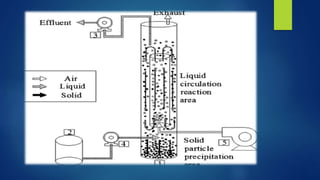
 he medium of the vessel consists of a baffle or a draft tube through
which air is pumped. This might create a bubble in the medium which
ultimately helps in rising up through the baffle tube and drags the
surrounding fluid as well.
 This, in the process, stirs up the contents by air.
 There are two types of airlift bioreactors –Internal loop type, External loop
type
 Internal-loop airlift bioreactor has a single container with a draft carrying
out the fermentation process.
 External loop airlift bioreactor has an external loop to separate samples
or liquids in different channels carrying out fermentation
Airlift Bioreactor Advantages
 It produces very little shear stress, less friction
 It requires fewer efforts to construct the bioreactor.
 It is cost-efficient
 Less energy is required
Airlift Bioreactor Disadvantages
High Pressure is required in this system
No shaft is present which helps as a
foam breaker which creates a major
drawback.
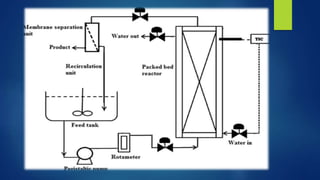
Packed Bed Bioreactor
 Packed-bed bioreactors are tubular reactors which are
stuffed with an immobilized enzyme or microbial cells as
biocatalysts as immobilization enhances the stability of the
enzyme and these enzymes can be utilized multiple times
 The substrate is then allowed to flow through the packed-
bed bioreactor and it is generally operated in a single pass.
Advantages of Packed Bed Bioreactor
 It’s quite easy to operate
 It provides better quality
 The products can be controlled.
Disadvantages of Packed Bed
Bioreactor
 As the substrate and product molecules are
carried out both in and out of the carrier
matrix during the reaction there is a problem
of external mass transfer resistance.
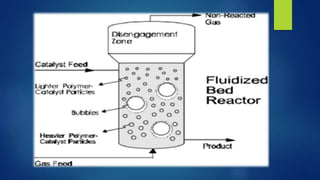
Fluidized Bed Bioreactor
 A fluidized bed bioreactor is an immobilized cell reactor which is a
combination of stirred tank and packed bed continuous flow reactors.
 It can be explained as beds of regular molecules that are suspended in a
flowing liquid stream.
 This can be used for particles such as immobilized enzymes, immobilized
cells, and microbial flocs.
 Immobilized-cell particles are retained in the bed by gravity critical
parameter here
 is the settling velocity
 It involves cell as biocatalysts including 3 phases – gas-liquid-solid.
Advantages of Fluidized Bed
Bioreactor
 It is used for wastewater treatment and hydrogen production.
Disadvantages of Fluidized-
Bed Bioreactor
 It requires more energy in order to achieve fluidization in the
bioreactor.
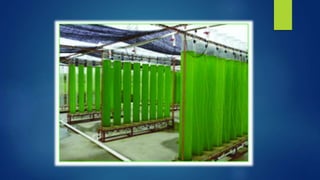
Photobioreactor
 These are carried out either by exposing to sunlight
or artificial illumination.
 These are majorly used for the cultivation of algae.
 The temperature range used is between 25-
40degreeC
Photobioreactor Advantages
 Contamination is lower.
 It can be space-saving as it can be placed vertically, horizontally or at an angle,
indoors or outdoors
Photobioreactor Disadvantages
 The control of PH and temperature is quite difficult
 It is somewhere susceptible to contamination.
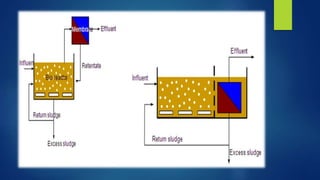
Membrane Bioreactor
 It consists of a biological reactor with suspended biomass and solids
removal by ultra- and microfiltration membranes.
 It is used for alcoholic fermentation, solvents, organic acid production,
wastewater treatment.
 It involves high-quality effluent through the membranes and eliminates
the sedimentation and filtration processes.
 The membrane materials mostly used are polysulfonte, polyamide and
cellulose acetate.
Advantages of Membrane Bioreactor
 The loss of the enzyme is minimized.
 Effluent quality is high
 The effluent is properly disinfected from all the pathogenic microbes
Disadvantages of Membrane
Bioreactor
 Quite costly and energy-consuming
 The aeration is limited
 Membrane pollution is also a drawback
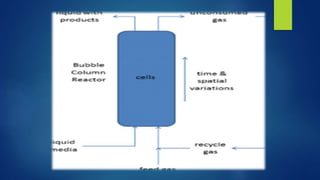
Bubble Column Bioreactors
 The bioreactor involves agitation by density-driven
fluid motions and sparger is used to provide air into
the continuous liquid phase at the bottom of the
reactors
 The fluid mixed intensively at high gas flow rates
when convective flows become turbulent.
Advantages of Bubble Column
Bioreactors
 It acquires good heat and mass transfer
 Easy to operate
 Low maintenance
Disadvantages of Bubble Column
Bioreactors
Back mixing is a major drawback
that adversely affects product
conversion.
References
 https://biologyease.com/types-of-fermentors/
 https://microbiologynotes.org/overview-of-bioreactor-or-
fermenters/#:~:text=Classifications-
,Introduction,a%20product%20of%20greater%20value.
 https://wiki2.org/en/Bioreactor
 https://samacheerkalvi.guru/author/bhagya/page/9/
 https://www.slideshare.net/shmpanwar92/bioreactors-fermenters-
56475754
 https://senthilarivan.wordpress.com/2015/11/26/fermenter-and-its-
features/
 https://www.dedot.info/airlift-fermenters-17/
bioreactor AND fermentor 1.pptx

bioreactor AND fermentor 1.pptx

  • 1.
    PRESENTED BY SIVARAMAKRISHNAN.T II M.SC.MICROBIOLOGY Reg.no.20201232516121 Ferrmentor or bioreactor Iv – semester PRESENTED TO Dr.S.Viswanathan DEPARTMENT OF MICROBIOLOGY SRI PARAMAKALYANI COLLEGE ALWARKURICHI
  • 2.
    Contents  Introduction  History Function  Design  Classifications
  • 3.
    Introduction  It isa device or system that used to support biologically active environment.  It is a system within which substrate of very low value is employ by living cells or enzymes to produce a product of greater value.  A fermenter is a closed system vessel which have an adequate provision for temperature, agitation, aeration, pH control, and drain or overflow vent to remove waste biomass of culture microorganism with their products.
  • 4.
    History  In 1944De becze and Liebmann used the primary large-scale fermenter for the growth of yeast.  But, during the time of world war there’s is a British scientist whose name is Chain Weizmann who desigined a fermenter for the production of acetone.
  • 5.
    Functions  It shouldhave a provision to control environment for optimum biomass or product yield.  It should provide an aseptic fermentation condition for more reliablity.  It should provide the adequate or proper mixing and aeration for the growth and production without damaging of the microorganisms or cells
  • 6.
    Continue…..  It shouldhave a system temperature control  It should have a system to monitor and regulate pH of the fermentation broth.  Facility for sampling should be provided.  It should have required minimum of labour in maintenance, cleaning, operating and harvesting operation.
  • 7.
    Design  Fermenter orbioreactor refers to a device that provides all the basic necessities important for biological product extraction.  A fermenter contains different devices that help to maintain the environmental factor inside it which in turn leads to the production of biological products.  Therefore the main objective of a fermenter is to maintain a controlled environment that supports the growth of the bacteria or any other organism.  There are several important factors that need to be accurate to design a fermenter. Those factors are following
  • 8.
    Continue…..  A bioreactorshould consist of the followings: 1. Agitation- for mixing of cells and medium. 2. Aeration – aerobic fermentation used for oxygen supply. 3. Temperature 4. pH, pressure, nutrients feeding, etc. 5. Sterilization and maintenance of sterility. 6. Withdrawal of cells or media.
  • 9.
    Overview of fermenterdesign and construction
  • 10.
    Agitation and Aeration Agitations are aims to ensure similar distribution of microorganisms and the nutrients in the broth.  Aeration to provide microorganisms growing in submerged culture with adequate oxygen supply.
  • 11.
    The following componentsof the fermenter which is required for aeration and agitation: 1. Agitator (impellers) 2. Stirrer glands and bearings 3. Baffles 4. Sparger (the Aeration system)
  • 12.
    Agitator (Impellers)  Airbubbles often cause problems inside the fermenter.  Impellers involved in breaking the air bubbles produced in a liquid medium.  There are mainly three types of agitators used in industrial-scale bioreactors
  • 13.
    It is ofseveral different type: 1. Disc turbine 2. Vaned disc turbine 3. Open turbine 4. Propeller
  • 14.
    Disc Turbine: It consistsof a disc with a series of rectangular vanes connected in a vertical plane around the disc.
  • 15.
    Vaned disc:  Inthis case, the rectangular vanes are attached vertically to the underside of a disc.
  • 16.
    Variable Pitch openturbine: This type of agitator lacks disc and the vanes are directly connected to a center shaft.
  • 17.
    Stirrer glands andbearings  he most important factor of designing a fermenter is to maintain aseptic conditions inside the vessel.  It is highly challenging in the case of pilot-scale fermenters.  Therefore stirrer shafts are required.  These stirrer shafts play an important role to seal the openings of a bioreactor.
  • 18.
    There are severaltypes of seals used for this purpose, which are following  he Stuffing Box  The Mechanical Seal  Magnetic Drives
  • 19.
    The Stuffing Box: The shafted is sealed by several layers of packing rings of asbestos or cotton yarn which is pressed against the shaft by gland follower.  At high stirrer speeds, the packing wears quickly and excessive pressure may need to ensure the tightness of fit.
  • 20.
    The Mechanical Seal: t is used in both small scale and large scale fermenters.  The seal is divided into two parts, first is the stationary bearing housing and the second rotates on the shaft.  These two parts are pressed together by springs.  Steam condensate is used to lubricate and cool the seals during operation and provides protection against the contamination.
  • 21.
    Magnetic Drives:  Thistype of seals helps to counter the problem originated by the impeller shaft which is going through the top or bottom of the fermenter plate.  The magnetic drive is made up of two magnets one is driving and one driven. Baffles
  • 22.
    Baffles  It ismetal strips.  One tenth of the vessels diameter.  Attached radially to fermenters wall.  It provided to prevent vortex formation and improve efficiency.
  • 23.
    Aeration system (Sparger) A sparger is a device that introduces air into the liquid medium in a fermenter. There are three main types of fermenter used in industrial-scale bioreactors such as
  • 24.
    It is ofthree types: 1. Porous Sparger 2. Orifice Sparger 3. Nozzle Sparger
  • 25.
    Porous Sparger  Itis made up of sintered glass, ceramics or metals’ and are mostly used in laboratory-scale bioreactors.  As it introduces air inside a liquid medium, bubbles are formed.  These bubbles are always 10 to 100 times larger than the pore size of the aerator.
  • 26.
    Orifice Sparger  Theseare used in small stirred fermenters where perforated pipes are used and attached below the impeller in the form of a ring.  The air holes are mostly drilled under the surface of the tubes.
  • 27.
    Nozzle Sparger  Thisis used in industrial-scale fermenters.  The main characteristic of this kind of sparger is that it contains a single open or partially closed pipe as an air outlet.
  • 28.
     Temperature control:adequate provision for control of Temperature.  Pressure gauge: It measures pressure inside the fermenters.  pH probe: It provides to measure and monitor pH of the medium.  Inlet air filter: Provision to supply air in the fermenters.  Exhaust air filter: Provision to drain out the air from the fermenters.
  • 29.
     Cooling jacket:Provided to maintain the temperature of the fermenters throughout the process.  Control panel: it monitors all the parameters.  Foam control: it is produced during most microbial fermentation. Antifoams are used to removes foam from the surface of media e.g., silicone, soybean oil, cotton seed oil, sulphonate etc.
  • 30.
    Classifications  On thebasis of agent used, bioreactors are of two types: 1. On the basis of living cells 2. On the basis of enzymes employed
  • 31.
    In the termsof process fermenters, is of following types: 1. Aerobic 2. Anaerobic 3. Solid state 4. Immobilized cell disruption
  • 32.
    Types of fermenters Continuous Stirred Tank Bioreactor  Airlift Bioreactor  Packed Bed Bioreactor  Fluidized Bed Bioreactor  Photobioreactor  Membrane Bioreactor  Bubble Column Bioreactors
  • 33.
    Continuous Stirred TankBioreactor  The continuous stirred-tank bioreactor consists of a vessel, pipes, valves, pumps, agitator, shaft, impeller, and motor.  The motor power the bioreactor which helps in mixing cultures and also there are sensors that can detect temperature, PH, dissolved oxygen, glucose, lactic acid, ammonia, ammonium ion, and other parameters in the culture medium.  The main target of desired products enlists the cells or primary metabolite which mostly acquire microorganisms like yeast or bacteria.
  • 35.
    Advantages of continuousstirred tank reactor  It is a continuous operation  It has a good capture over temperature  It provides a homogeneous environment for cell growth and proliferation  Easily adapts to two-phase runs  It is quite cost-efficient in both investment and operation
  • 36.
    Disadvantages of continuousstirred tank reactor  Their mechanic agitation produces shear stress which may harm the cultured cells. but this can be overcome by changing the shape and diameter of the impeller blade or adding bovine serum albumin or dextran  Foaming can also cause a problem but again can be solved by antifoaming agents.
  • 37.
    Airlift Bioreactor  hemedium of the vessel consists of a baffle or a draft tube through which air is pumped. This might create a bubble in the medium which ultimately helps in rising up through the baffle tube and drags the surrounding fluid as well.  This, in the process, stirs up the contents by air.  There are two types of airlift bioreactors –Internal loop type, External loop type  Internal-loop airlift bioreactor has a single container with a draft carrying out the fermentation process.  External loop airlift bioreactor has an external loop to separate samples or liquids in different channels carrying out fermentation
  • 39.
    Airlift Bioreactor Advantages It produces very little shear stress, less friction  It requires fewer efforts to construct the bioreactor.  It is cost-efficient  Less energy is required
  • 40.
    Airlift Bioreactor Disadvantages HighPressure is required in this system No shaft is present which helps as a foam breaker which creates a major drawback.
  • 41.
    Packed Bed Bioreactor Packed-bed bioreactors are tubular reactors which are stuffed with an immobilized enzyme or microbial cells as biocatalysts as immobilization enhances the stability of the enzyme and these enzymes can be utilized multiple times  The substrate is then allowed to flow through the packed- bed bioreactor and it is generally operated in a single pass.
  • 43.
    Advantages of PackedBed Bioreactor  It’s quite easy to operate  It provides better quality  The products can be controlled.
  • 44.
    Disadvantages of PackedBed Bioreactor  As the substrate and product molecules are carried out both in and out of the carrier matrix during the reaction there is a problem of external mass transfer resistance.
  • 45.
    Fluidized Bed Bioreactor A fluidized bed bioreactor is an immobilized cell reactor which is a combination of stirred tank and packed bed continuous flow reactors.  It can be explained as beds of regular molecules that are suspended in a flowing liquid stream.  This can be used for particles such as immobilized enzymes, immobilized cells, and microbial flocs.  Immobilized-cell particles are retained in the bed by gravity critical parameter here  is the settling velocity  It involves cell as biocatalysts including 3 phases – gas-liquid-solid.
  • 47.
    Advantages of FluidizedBed Bioreactor  It is used for wastewater treatment and hydrogen production. Disadvantages of Fluidized- Bed Bioreactor  It requires more energy in order to achieve fluidization in the bioreactor.
  • 48.
    Photobioreactor  These arecarried out either by exposing to sunlight or artificial illumination.  These are majorly used for the cultivation of algae.  The temperature range used is between 25- 40degreeC
  • 50.
    Photobioreactor Advantages  Contaminationis lower.  It can be space-saving as it can be placed vertically, horizontally or at an angle, indoors or outdoors Photobioreactor Disadvantages  The control of PH and temperature is quite difficult  It is somewhere susceptible to contamination.
  • 51.
    Membrane Bioreactor  Itconsists of a biological reactor with suspended biomass and solids removal by ultra- and microfiltration membranes.  It is used for alcoholic fermentation, solvents, organic acid production, wastewater treatment.  It involves high-quality effluent through the membranes and eliminates the sedimentation and filtration processes.  The membrane materials mostly used are polysulfonte, polyamide and cellulose acetate.
  • 53.
    Advantages of MembraneBioreactor  The loss of the enzyme is minimized.  Effluent quality is high  The effluent is properly disinfected from all the pathogenic microbes
  • 54.
    Disadvantages of Membrane Bioreactor Quite costly and energy-consuming  The aeration is limited  Membrane pollution is also a drawback
  • 55.
    Bubble Column Bioreactors The bioreactor involves agitation by density-driven fluid motions and sparger is used to provide air into the continuous liquid phase at the bottom of the reactors  The fluid mixed intensively at high gas flow rates when convective flows become turbulent.
  • 57.
    Advantages of BubbleColumn Bioreactors  It acquires good heat and mass transfer  Easy to operate  Low maintenance
  • 58.
    Disadvantages of BubbleColumn Bioreactors Back mixing is a major drawback that adversely affects product conversion.
  • 59.
    References  https://biologyease.com/types-of-fermentors/  https://microbiologynotes.org/overview-of-bioreactor-or- fermenters/#:~:text=Classifications- ,Introduction,a%20product%20of%20greater%20value. https://wiki2.org/en/Bioreactor  https://samacheerkalvi.guru/author/bhagya/page/9/  https://www.slideshare.net/shmpanwar92/bioreactors-fermenters- 56475754  https://senthilarivan.wordpress.com/2015/11/26/fermenter-and-its- features/  https://www.dedot.info/airlift-fermenters-17/