GENE
MUTATION
AND DNA REPAIR
By
M.Vharshini
Sri Ramachandra University
1
GENETIC MATERIAL
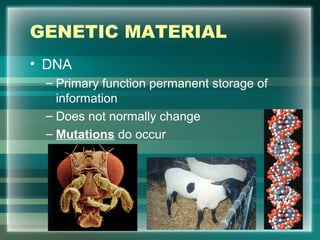
• DNA
– Primary function permanent storage of
information
– Does not normally change
– Mutations do occur
2
MUTATIONS
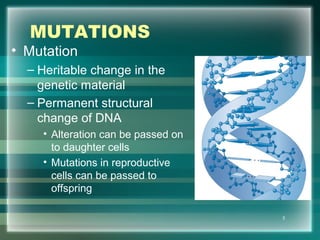
• Mutation
– Heritable change in the
genetic material
– Permanent structural
change of DNA
• Alteration can be passed on
to daughter cells
• Mutations in reproductive
cells can be passed to
offspring
3
MUTATIONS
• Mutations
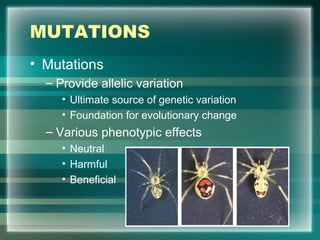
– Provide allelic variation
• Ultimate source of genetic variation
• Foundation for evolutionary change
– Various phenotypic effects
• Neutral
• Harmful
• Beneficial
4
MUTATIONS
• Mutations
– Most mutations are neutral
– More likely to be harmful than beneficial
to the individual
• More likely to disrupt function than improve
function
5
MUTATIONS
• Mutations
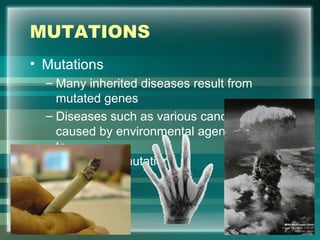
– Many inherited diseases result from
mutated genes
– Diseases such as various cancers can be
caused by environmental agents known
to
cause DNA mutations
• “Mutagens”
6
MODEL ORGANISMS
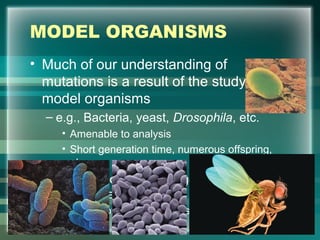
• Much of our understanding of
mutations is a result of the study of
model organisms
– e.g., Bacteria, yeast, Drosophila, etc.
• Amenable to analysis
• Short generation time, numerous offspring,
etc.
– Often exposed to mutagenic
environmental agents
• Effects of mutations are studied 7
TYPES OF MUTATIONS
• Types of mutations
– Chromosome mutations
• Changes in chromosome structure
– Genome mutations
• Changes in chromosome number
– Single-gene mutations
• Relatively small changes in DNA
structure
• Occur within a particular gene
• Focus of study in this chapter
8
TYPES OF MUTATIONS
• Mutations involve the permanent
alteration of a DNA sequence
– Alteration of base sequence
– Removal or addition of one or more
nucleotides
9
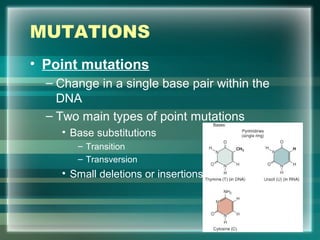
MUTATIONS
• Point mutations
– Change in a single base pair within the
DNA
– Two main types of point mutations
• Base substitutions
– Transition
– Transversion
• Small deletions or insertions
10
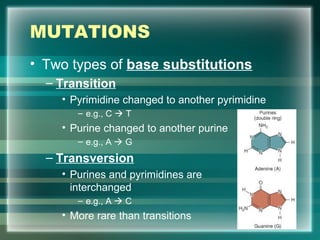
MUTATIONS
• Two types of base substitutions
– Transition
• Pyrimidine changed to another pyrimidine
– e.g., C  T
• Purine changed to another purine
– e.g., A  G
– Transversion
• Purines and pyrimidines are
interchanged
– e.g., A  C
• More rare than transitions 11
EFFECTS OF MUTATIONS
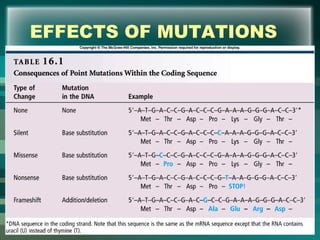
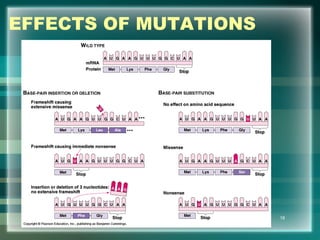
• Mutations within the coding sequence
of a gene can have various effects on
the encoded polypeptide’s amino acid
sequence
– Silent mutations
– Missense mutations
• Included neutral mutations
– Nonsense mutations
– Frameshift mutations
12
EFFECTS OF MUTATIONS
• Silent mutations
– Amino acid sequence is not altered
• e.g., CCC  CCG (pro  pro)
– Genetic code is degenerate
– Alterations of the third base of a codon often do not alter
the encoded amino acid
– Phenotype is not affected
13
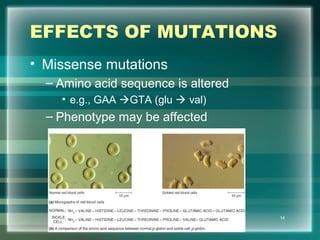
EFFECTS OF MUTATIONS
• Missense mutations
– Amino acid sequence is altered
• e.g., GAA GTA (glu  val)
– Phenotype may be affected
14
EFFECTS OF MUTATIONS
• Neutral mutations
– Type of missense mutation
– Amino acid sequence is altered
• e.g., CTT ATT (leu  ile)
• e.g., GAA GAC (glu  asp)
– No detectable effect on protein function
• Missense mutations substituting an amino acid with
a similar chemistry to the original is likely to be
neutral
15
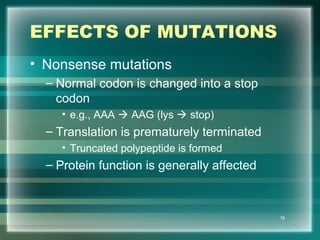
EFFECTS OF MUTATIONS
• Nonsense mutations
– Normal codon is changed into a stop
codon
• e.g., AAA  AAG (lys  stop)
– Translation is prematurely terminated
• Truncated polypeptide is formed
– Protein function is generally affected
16
EFFECTS OF MUTATIONS
17
EFFECTS OF MUTATIONS
18
EFFECTS OF MUTATIONS
• Mutations occasionally produce a
polypeptide with an enhanced ability to
function
– Relatively rare
– May result in an organism with a greater
likelihood to survive and reproduce
– Natural selection may increase the
frequency of this mutation in the
population
19
MUTATION TYPES
• Genetic terms to describe mutations
– Wild-type
• Relatively common genotype
• Generally the most common allele
– Variant
• Mutant allele altering an organism’s
phenotype
– Forward mutation
• Changes wild-type allele into something else
– Reverse mutation
• “Reversion”
• Restores wild-type allele
20
MUTATION TYPES
• Genetic terms to describe mutations
– Deleterious mutation
• Decreases an organism’s chance of
survival
– Lethal mutation
• Results in the death of an organism
• Extreme example of a deleterious
mutation
– Conditional mutants
• Affect the phenotype only under a
defined set of conditions
• e.g., Temperature-sensitive (ts) mutants
21
MUTATION TYPES
• Genetic terms to describe mutations
– Suppressor mutation
• Second mutation that restores the wild-type
phenotype
• Intragenic suppressor
– Secondary mutation in the same gene as
the first mutation
– Differs from a reversion
» Second mutation is at a different site
than the first
• Intergenic suppressor
– Secondary mutation in a different gene than the first
mutation
22
MUTATION TYPES
• Two general types of intergenic
suppressors
– Those involving an ability to defy the
genetic code
– Those involving a mutant structural gene
23
MUTATION TYPES
• Intergenic suppressor mutations involving
an ability to defy the genetic code
– e.g., tRNA mutations
• Altered anticodon region
• e.g., Recognize a stop codon
– May suppress a nonsense mutation in a gene.
– May also suppress stop codons in normal genes.
24
MUTATION TYPES
• Intergenic suppressors involving a mutant structural gene
– Usually involve altered expression of one gene that
compensates for a loss-of-function mutation affecting
another gene
• Second gene may take over the functional role of the
first
• May involve proteins participating in a common
cellular function
– Sometimes involve mutations in genetic regulatory
proteins
• e.g., Transcription factors activating other genes that
can compensate for the mutation in the first gene
25
MUTATION TYPES
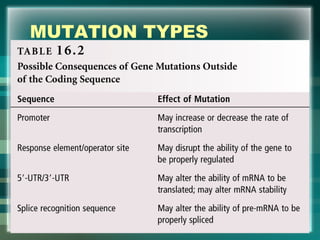
• Mutations occurring outside of coding sequences
can influence gene expression
– Mutations may alter the core promoter sequence
• Up promoter mutations
– Mutant promoter becomes more like the
consensus sequence
– Rate of transcription may be increased
• Down promoter mutations
– Mutant promoter becomes less like the
consensus sequence
– Affinity for regulatory factors is decreased
– Rate of transcription may be decreased
26
MUTATION TYPES
• Mutations occurring outside of coding
sequences can influence gene
expression
– Mutations may alter other regulatory
sequences
• lacOC
mutations prevent binding of
the lac repressor
– Lac operon is constituently expressed,
even in the absence of lactose
» Such expression is wasteful
» Such mutants are at a selective
disadvantage
27
MUTATION TYPES
• Mutations occurring outside of coding
sequences can influence gene
expression
– Mutations may alter splice junctions
• Altered order and/or number of exons in the
mRNA
28
MUTATION TYPES
• Mutations occurring outside of coding
sequences can influence gene
expression
– Mutations may affect an
untranslated region of mRNA
• 5’- or 3’-UTR
• May affect mRNA stability
• May affect the ability of the
mRNA to be translated
29
MUTATION TYPES
30
TRINUCLEOTIDE
REPEATS
• DNA trinucleotide repeats
– Three nucleotide sequences repeated in
tandem
• e.g., …CAGCAGCAGCAGCAGCAG…
• Generally transmitted normally from parent to
offspring without mutation
31
TRINUCLEOTIDE
REPEATS
• Trinucleotide repeat expansion
(TNRE)
– Number of repeats can readily increase
from one generation to the next
– Cause of several human genetic
diseases
• Length of a repeat has increased above a
certain critical size
• Becomes prone to frequent expansion
32
TRINUCLEOTIDE
REPEATS
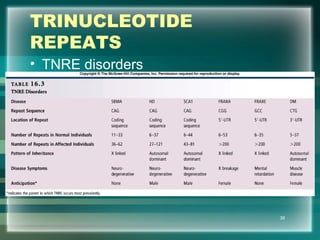
• TNRE disorders
– Fragile X syndrome (FRAXA)
– FRAXE mental retardation
– Myotonic muscular dystrophy (DM)
– Spinal and bulbar muscular atrophy
(SBMA)
– Huntington disease (HD)
– Spinocerebellar ataxia (SCA1)
33
TRINUCLEOTIDE
REPEATS
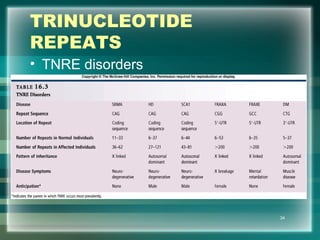
• TNRE disorders
34
TRINUCLEOTIDE
REPEATS
• TNRE disorders
– Expansion may be within a coding
sequence of a gene
• Most expansions are of a CAG repeat
• Encoded proteins possess long tracts of
glutamine
– CAG encodes a glutamine codon
• Presence of glutamine tracts causes
aggregation of the proteins
• Aggregation is correlated with the progression
of the disease 35
TRINUCLEOTIDE
REPEATS
• TNRE disorders
– Expansion may be in a noncoding region
of a gene
• Two fragile X syndromes
– Repeat produces CpG islands that become
methylated
– Methylation can lead to chromosome compaction
– Can silence gene transcription
• Myotonic muscular dystrophy
– Expansions may cause abnormal changes in RNA
structure
36
TRINUCLEOTIDE
REPEATS
• TNRE disorders
– Severity of the disease tends to worsen in
future generations
• “Anticipation”
– Severity of the disease depends on the
parent from whom it was inherited
• e.g., In Huntingdon disease, TNRE likely to occur
if mutation gene is inherited from the father
• e.g., In myotonic muscular dystrophy, TNRE
likely to occur if mutation gene is inherited from
the mother 37
TRINUCLEOTIDE
REPEATS
• TNRE disorders
38
TRINUCLEOTIDE
REPEATS
• TNRE disorders
– Cause of TNRE is not well understood
– Trinucleotide repeat may produce
alterations in DNA structure
• e.g., Stem-loop formation
• May lead to errors in DNA replication
– TNRE within certain genes alters gene
expression
• Disease symptoms are produced
39
CHROMOSOME STRUCTURE
• Altered chromosome structure can
alter gene expression
– Inversions and translocations commonly
have no obvious phenotypic effects
– Phenotypic effects sometimes occur
• “Position effect”
40
CHROMOSOME STRUCTURE
• Altered chromosome structure can alter gene
expression and phenotype
– Breakpoint may occur within a gene
• Expression of the gene is altered
– Breakpoint may occur near a gene
• Expression is altered when moved to a new location
• May be moved next to regulatory elements influencing
the expression of the relocated gene
– i.e., Silencers or enhancers
• May reposition a gene from a euchromatic region to a
highly condensed (heterochromatic) region
– Expression may be turned off 41
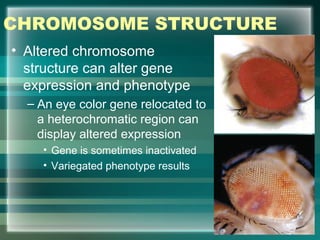
CHROMOSOME STRUCTURE
• Altered chromosome
structure can alter gene
expression and phenotype
– An eye color gene relocated to
a heterochromatic region can
display altered expression
• Gene is sometimes inactivated
• Variegated phenotype results
42
SOMATIC VS. GERM-LINE
• The timing of mutations in multicellular
organisms plays an important role
– Mutations may occur in gametes or a
fertilized egg
– Mutations may occur later in life
• Embryonic or adult stages
• Timing can affect
– The severity of the genetic effect
– The ability to be passed from parent to
offspring 43
SOMATIC VS. GERM-LINE
• Animals possess germ-line and
somatic cells
– Germ-line cells
• Cells giving rise to gametes
– Somatic cells
• All cells of the body
excluding the germ-line cells
– e.g., Muscle cells, nerve cells,
etc.
44
SOMATIC VS. GERM-LINE
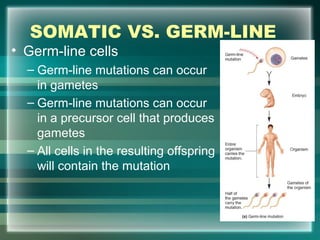
• Germ-line cells
– Germ-line mutations can occur
in gametes
– Germ-line mutations can occur
in a precursor cell that produces
gametes
– All cells in the resulting offspring
will contain the mutation
45
SOMATIC VS. GERM-LINE
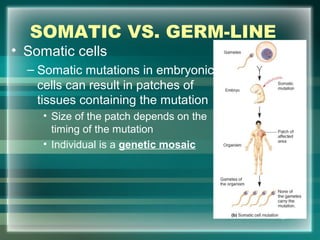
• Somatic cells
– Somatic mutations in embryonic
cells can result in patches of
tissues containing the mutation
• Size of the patch depends on the
timing of the mutation
• Individual is a genetic mosaic
46
CAUSES OF MUTATIONS
• Two causes of mutations
– Spontaneous mutations
• Result from abnormalities in biological
processes
• Underlying cause lies within the cell
– Induced mutations
• Caused by environmental agents
• Cause originates outside of the cell
47
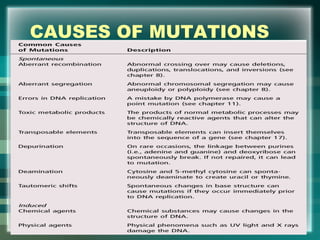
CAUSES OF MUTATIONS
• Causes of spontaneous mutations
– Abnormalities in crossing over
– Aberrant segregation of chromosomes during
meiosis
– Mistakes by DNA polymerase during
replication
– Alteration of DNA by chemical products of
normal metabolic processes
– Integration of transposable elements
– Spontaneous changes in nucleotide structure48
CAUSES OF MUTATIONS
• Induced mutations are caused by
mutagens
– Chemical substances or physical agents
originating outside of the cell
– Enter the cell and then alter the DNA
structure
49
CAUSES OF MUTATIONS
•
50
CAUSES OF MUTATIONS
• Spontaneous mutations are random
events
– Not purposeful
– Mutations occur as a matter of chance
• Some individuals possess beneficial
mutations
– Better adapted to their environment
– Increased chance of surviving and reproducing
• Natural selection results in differential
reproductive success
– The frequency of such alleles increases in the
population
51
CAUSES OF MUTATIONS
• Joshua and Ester Lederberg (1950s)
– Interested in the relationship between mutation
and the environmental conditions shat select
for mutations
• Scientists were unsure of the relationship
• Two competing hypotheses
– Directed mutation hypothesis
» Some scientists still believed that selective conditions
could promote specific mutations
– Random mutation theory
» Mutations occur at random
» Environmental factors affecting survival select for
those possessing beneficial mutations
52
CAUSES OF MUTATIONS
• Mutation rate
– Likelihood that a gene will be altered by a new
mutation
– Expressed as the number of new mutations in
a given gene per generation
• Generally 1/100,000 – 1/billion
– 10-5
– 10-9
53
CAUSES OF MUTATIONS
• Mutation rate
– Mutation rate is not a constant number
• Can be increased by environmental
mutagens
– Induced mutations can increase beyond
frequency of spontaneous mutations
• Mutation rates vary extensively
between species
– Even vary between strains of the
same species
54
CAUSES OF MUTATIONS
• Mutation rate
– Some genes mutate at a much higher
rate than other genes
• Some genes are longer than others
• Some locations are more susceptible to
mutation
– Even single genes possess mutation
hot spots
» More likely to mutate than other
regions
55
CAUSES OF MUTATIONS
• Mutation frequency
– Number of mutant alleles of a given gene divided
by the number of alleles within a population
– Timing of mutations influences mutation
frequency
• Timing does not influence mutation rate
– Mutation frequency depends both on mutation
rate and timing of mutations
– Natural selection and genetic drift can further
increase mutation frequencies 56
CAUSES OF MUTATIONS
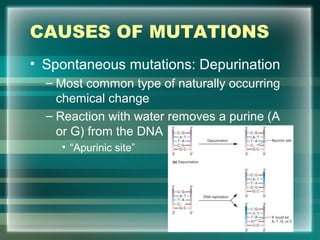
• Spontaneous mutations: Depurination
– Most common type of naturally occurring
chemical change
– Reaction with water removes a purine (A
or G) from the DNA
• “Apurinic site”
57
CAUSES OF MUTATIONS
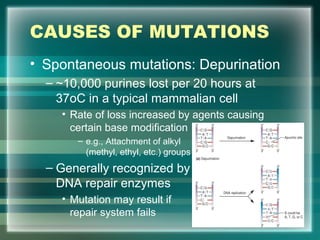
• Spontaneous mutations: Depurination
– ~10,000 purines lost per 20 hours at
37oC in a typical mammalian cell
• Rate of loss increased by agents causing
certain base modification
– e.g., Attachment of alkyl
(methyl, ethyl, etc.) groups
– Generally recognized by
DNA repair enzymes
• Mutation may result if
repair system fails 58
CAUSES OF MUTATIONS
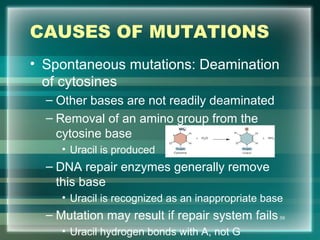
• Spontaneous mutations: Deamination
of cytosines
– Other bases are not readily deaminated
– Removal of an amino group from the
cytosine base
• Uracil is produced
– DNA repair enzymes generally remove
this base
• Uracil is recognized as an inappropriate base
– Mutation may result if repair system fails
• Uracil hydrogen bonds with A, not G
59
CAUSES OF MUTATIONS
• Spontaneous mutations: Deamination
of cytosines
– Methylation of cytosine occurs in many
eukaryotic species as well as prokaryotes
– Removal of an amino group from the 5-
methyl cytosine produces thymine
– DNA repair enzymes cannot determine
which is the incorrect base
• Hot spots for mutations are produced
60
CAUSES OF MUTATIONS
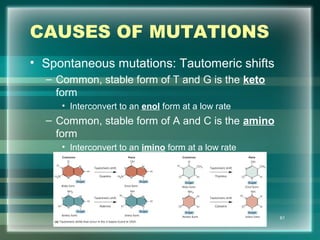
• Spontaneous mutations: Tautomeric shifts
– Common, stable form of T and G is the keto
form
• Interconvert to an enol form at a low rate
– Common, stable form of A and C is the amino
form
• Interconvert to an imino form at a low rate
61
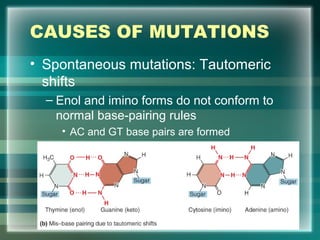
CAUSES OF MUTATIONS
• Spontaneous mutations: Tautomeric
shifts
– Enol and imino forms do not conform to
normal base-pairing rules
• AC and GT base pairs are formed
62
CAUSES OF MUTATIONS
• Spontaneous mutations: Tautomeric
shifts
– Tautomeric shifts immediately prior to
DNA replication can cause mutations
• Resulting mismatch could be repaired
• Mutation may result if repair system fails
63
CAUSES OF MUTATIONS
• Hermann Muller (1927)
– Showed that X rays can cause induced
mutations
• Reasoned that a mutagenic agent might form
defective alleles
• Experimental approach focused on formation
and detection of X-linked genes in Drosophila
melanogaster
64
CAUSES OF MUTATIONS
• The public is concerned about
mutagens for two important reasons
– Mutagenic agents are often involved in
the development of human cancers
– Avoiding mutations that may have
harmful effects on future offspring is
desirable
65
CAUSES OF MUTATIONS
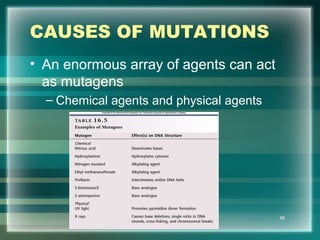
• An enormous array of agents can act
as mutagens
– Chemical agents and physical agents
66
CAUSES OF MUTATIONS
• Certain non-mutagenic chemicals can
be altered to a mutagenically active
form after ingestion
– Cellular enzymes such as oxidases can
activate some mutagens
• Certain foods contain chemicals acting
as antioxidants
– Antioxidants may be able to counteract
the effects of mutagens and lower cancer
rates 67
CAUSES OF MUTATIONS
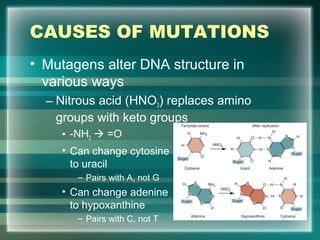
• Mutagens alter DNA structure in
various ways
– Nitrous acid (HNO3) replaces amino
groups with keto groups
• -NH2  =O
• Can change cytosine
to uracil
– Pairs with A, not G
• Can change adenine
to hypoxanthine
– Pairs with C, not T 68
CAUSES OF MUTATIONS
• Mutagens alter DNA structure in
various ways
– Alkylating agents covalently attach methyl
or ethyl groups to bases
• e.g., Nitrogen mustards, ethyl
methanesulfonate (EMS)
– Appropriate base pairing is disrupted
69
CAUSES OF MUTATIONS
• Mutagens alter DNA structure in
various ways
– Some mutagens directly interfere with the
DNA replication process
– e.g., Acridine dyes such as proflavin
• Flat, planar structures interchelate into the
double helix
– Sandwich between adjacent base pairs
• Helical structure is distorted
• Single-nucleotide additions and deletions can
result 70
CAUSES OF MUTATIONS
• Mutagens alter DNA structure in
various ways
– Some mutagens are base analogs
• e.g., 2-aminopurine
• e.g., 5-bromouracil (5BU)
• Become incorporated into daughter strands
during DNA replication
71
CAUSES OF MUTATIONS
• Mutagens alter DNA structure in
various ways
– Some mutagens are base analogs
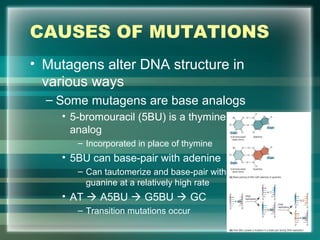
• 5-bromouracil (5BU) is a thymine
analog
– Incorporated in place of thymine
• 5BU can base-pair with adenine
– Can tautomerize and base-pair with
guanine at a relatively high rate
• AT  A5BU  G5BU  GC
– Transition mutations occur
72
CAUSES OF MUTATIONS
• Mutagens alter DNA structure in various
ways
– DNA molecules are sensitive to physical agents
such as radiation
• e.g., Ionizing radiation such as X rays and gamma
rays
– Short wavelength and high energy
– Can penetrate deeply into biological materials
– Creates “free radicals”
» Chemically reactive molecules
– Free radicals alter DNA structure in a variety of ways
» Deletions, single nicks, cross-linking, chromosomal
breaks
73
CAUSES OF MUTATIONS
• Mutagens alter DNA structure in various ways
– DNA molecules are sensitive to physical agents
such as radiation
• e.g., Nonionizing radiation such as
UV light
– Contains less energy
– Penetrates only the surface of material
such as the skin
– Causes the formation of thymine dimers
– May be repaired through one of numerous
repair systems
– May cause a mutation when that DNA
strand is replicated 74
CAUSES OF MUTATIONS
• Many different kinds of testes can
determine if an agent is mutagenic
– Ames test is commonly used
• Developed by Bruce Ames
– Uses his-
strains of Salmonella
typhimurium
• Mutation is due to a point mutation rendering
an enzyme inactive
– Reversions can restore his+
phenotype
• Ames test monitors rate of reversion
mutations
75
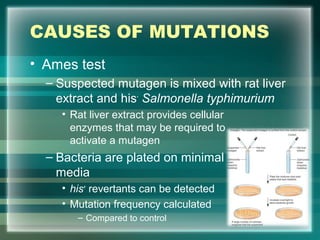
CAUSES OF MUTATIONS
• Ames test
– Suspected mutagen is mixed with rat liver
extract and his-
Salmonella typhimurium
• Rat liver extract provides cellular
enzymes that may be required to
activate a mutagen
– Bacteria are plated on minimal
media
• his+
revertants can be detected
• Mutation frequency calculated
– Compared to control 76
DNA REPAIR
• Most mutations are deleterious
– DNA repair systems are vital to the survival
– Bacteria possess several different DNA repair
systems
• Absence of a single system greatly
increases mutation rate
– “Mutator strains”
– Humans defective in a single DNA
repair system may manifest various
disease symptoms
• e.g., Higher risk of skin cancer
77
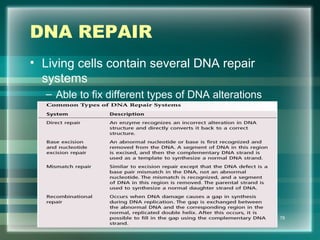
DNA REPAIR
• Living cells contain several DNA repair
systems
– Able to fix different types of DNA alterations
78

Gene Mutation

  • 1.
  • 2.
    GENETIC MATERIAL • DNA –Primary function permanent storage of information – Does not normally change – Mutations do occur 2
  • 3.
    MUTATIONS • Mutation – Heritablechange in the genetic material – Permanent structural change of DNA • Alteration can be passed on to daughter cells • Mutations in reproductive cells can be passed to offspring 3
  • 4.
    MUTATIONS • Mutations – Provideallelic variation • Ultimate source of genetic variation • Foundation for evolutionary change – Various phenotypic effects • Neutral • Harmful • Beneficial 4
  • 5.
    MUTATIONS • Mutations – Mostmutations are neutral – More likely to be harmful than beneficial to the individual • More likely to disrupt function than improve function 5
  • 6.
    MUTATIONS • Mutations – Manyinherited diseases result from mutated genes – Diseases such as various cancers can be caused by environmental agents known to cause DNA mutations • “Mutagens” 6
  • 7.
    MODEL ORGANISMS • Muchof our understanding of mutations is a result of the study of model organisms – e.g., Bacteria, yeast, Drosophila, etc. • Amenable to analysis • Short generation time, numerous offspring, etc. – Often exposed to mutagenic environmental agents • Effects of mutations are studied 7
  • 8.
    TYPES OF MUTATIONS •Types of mutations – Chromosome mutations • Changes in chromosome structure – Genome mutations • Changes in chromosome number – Single-gene mutations • Relatively small changes in DNA structure • Occur within a particular gene • Focus of study in this chapter 8
  • 9.
    TYPES OF MUTATIONS •Mutations involve the permanent alteration of a DNA sequence – Alteration of base sequence – Removal or addition of one or more nucleotides 9
  • 10.
    MUTATIONS • Point mutations –Change in a single base pair within the DNA – Two main types of point mutations • Base substitutions – Transition – Transversion • Small deletions or insertions 10
  • 11.
    MUTATIONS • Two typesof base substitutions – Transition • Pyrimidine changed to another pyrimidine – e.g., C  T • Purine changed to another purine – e.g., A  G – Transversion • Purines and pyrimidines are interchanged – e.g., A  C • More rare than transitions 11
  • 12.
    EFFECTS OF MUTATIONS •Mutations within the coding sequence of a gene can have various effects on the encoded polypeptide’s amino acid sequence – Silent mutations – Missense mutations • Included neutral mutations – Nonsense mutations – Frameshift mutations 12
  • 13.
    EFFECTS OF MUTATIONS •Silent mutations – Amino acid sequence is not altered • e.g., CCC  CCG (pro  pro) – Genetic code is degenerate – Alterations of the third base of a codon often do not alter the encoded amino acid – Phenotype is not affected 13
  • 14.
    EFFECTS OF MUTATIONS •Missense mutations – Amino acid sequence is altered • e.g., GAA GTA (glu  val) – Phenotype may be affected 14
  • 15.
    EFFECTS OF MUTATIONS •Neutral mutations – Type of missense mutation – Amino acid sequence is altered • e.g., CTT ATT (leu  ile) • e.g., GAA GAC (glu  asp) – No detectable effect on protein function • Missense mutations substituting an amino acid with a similar chemistry to the original is likely to be neutral 15
  • 16.
    EFFECTS OF MUTATIONS •Nonsense mutations – Normal codon is changed into a stop codon • e.g., AAA  AAG (lys  stop) – Translation is prematurely terminated • Truncated polypeptide is formed – Protein function is generally affected 16
  • 17.
  • 18.
  • 19.
    EFFECTS OF MUTATIONS •Mutations occasionally produce a polypeptide with an enhanced ability to function – Relatively rare – May result in an organism with a greater likelihood to survive and reproduce – Natural selection may increase the frequency of this mutation in the population 19
  • 20.
    MUTATION TYPES • Geneticterms to describe mutations – Wild-type • Relatively common genotype • Generally the most common allele – Variant • Mutant allele altering an organism’s phenotype – Forward mutation • Changes wild-type allele into something else – Reverse mutation • “Reversion” • Restores wild-type allele 20
  • 21.
    MUTATION TYPES • Geneticterms to describe mutations – Deleterious mutation • Decreases an organism’s chance of survival – Lethal mutation • Results in the death of an organism • Extreme example of a deleterious mutation – Conditional mutants • Affect the phenotype only under a defined set of conditions • e.g., Temperature-sensitive (ts) mutants 21
  • 22.
    MUTATION TYPES • Geneticterms to describe mutations – Suppressor mutation • Second mutation that restores the wild-type phenotype • Intragenic suppressor – Secondary mutation in the same gene as the first mutation – Differs from a reversion » Second mutation is at a different site than the first • Intergenic suppressor – Secondary mutation in a different gene than the first mutation 22
  • 23.
    MUTATION TYPES • Twogeneral types of intergenic suppressors – Those involving an ability to defy the genetic code – Those involving a mutant structural gene 23
  • 24.
    MUTATION TYPES • Intergenicsuppressor mutations involving an ability to defy the genetic code – e.g., tRNA mutations • Altered anticodon region • e.g., Recognize a stop codon – May suppress a nonsense mutation in a gene. – May also suppress stop codons in normal genes. 24
  • 25.
    MUTATION TYPES • Intergenicsuppressors involving a mutant structural gene – Usually involve altered expression of one gene that compensates for a loss-of-function mutation affecting another gene • Second gene may take over the functional role of the first • May involve proteins participating in a common cellular function – Sometimes involve mutations in genetic regulatory proteins • e.g., Transcription factors activating other genes that can compensate for the mutation in the first gene 25
  • 26.
    MUTATION TYPES • Mutationsoccurring outside of coding sequences can influence gene expression – Mutations may alter the core promoter sequence • Up promoter mutations – Mutant promoter becomes more like the consensus sequence – Rate of transcription may be increased • Down promoter mutations – Mutant promoter becomes less like the consensus sequence – Affinity for regulatory factors is decreased – Rate of transcription may be decreased 26
  • 27.
    MUTATION TYPES • Mutationsoccurring outside of coding sequences can influence gene expression – Mutations may alter other regulatory sequences • lacOC mutations prevent binding of the lac repressor – Lac operon is constituently expressed, even in the absence of lactose » Such expression is wasteful » Such mutants are at a selective disadvantage 27
  • 28.
    MUTATION TYPES • Mutationsoccurring outside of coding sequences can influence gene expression – Mutations may alter splice junctions • Altered order and/or number of exons in the mRNA 28
  • 29.
    MUTATION TYPES • Mutationsoccurring outside of coding sequences can influence gene expression – Mutations may affect an untranslated region of mRNA • 5’- or 3’-UTR • May affect mRNA stability • May affect the ability of the mRNA to be translated 29
  • 30.
  • 31.
    TRINUCLEOTIDE REPEATS • DNA trinucleotiderepeats – Three nucleotide sequences repeated in tandem • e.g., …CAGCAGCAGCAGCAGCAG… • Generally transmitted normally from parent to offspring without mutation 31
  • 32.
    TRINUCLEOTIDE REPEATS • Trinucleotide repeatexpansion (TNRE) – Number of repeats can readily increase from one generation to the next – Cause of several human genetic diseases • Length of a repeat has increased above a certain critical size • Becomes prone to frequent expansion 32
  • 33.
    TRINUCLEOTIDE REPEATS • TNRE disorders –Fragile X syndrome (FRAXA) – FRAXE mental retardation – Myotonic muscular dystrophy (DM) – Spinal and bulbar muscular atrophy (SBMA) – Huntington disease (HD) – Spinocerebellar ataxia (SCA1) 33
  • 34.
  • 35.
    TRINUCLEOTIDE REPEATS • TNRE disorders –Expansion may be within a coding sequence of a gene • Most expansions are of a CAG repeat • Encoded proteins possess long tracts of glutamine – CAG encodes a glutamine codon • Presence of glutamine tracts causes aggregation of the proteins • Aggregation is correlated with the progression of the disease 35
  • 36.
    TRINUCLEOTIDE REPEATS • TNRE disorders –Expansion may be in a noncoding region of a gene • Two fragile X syndromes – Repeat produces CpG islands that become methylated – Methylation can lead to chromosome compaction – Can silence gene transcription • Myotonic muscular dystrophy – Expansions may cause abnormal changes in RNA structure 36
  • 37.
    TRINUCLEOTIDE REPEATS • TNRE disorders –Severity of the disease tends to worsen in future generations • “Anticipation” – Severity of the disease depends on the parent from whom it was inherited • e.g., In Huntingdon disease, TNRE likely to occur if mutation gene is inherited from the father • e.g., In myotonic muscular dystrophy, TNRE likely to occur if mutation gene is inherited from the mother 37
  • 38.
  • 39.
    TRINUCLEOTIDE REPEATS • TNRE disorders –Cause of TNRE is not well understood – Trinucleotide repeat may produce alterations in DNA structure • e.g., Stem-loop formation • May lead to errors in DNA replication – TNRE within certain genes alters gene expression • Disease symptoms are produced 39
  • 40.
    CHROMOSOME STRUCTURE • Alteredchromosome structure can alter gene expression – Inversions and translocations commonly have no obvious phenotypic effects – Phenotypic effects sometimes occur • “Position effect” 40
  • 41.
    CHROMOSOME STRUCTURE • Alteredchromosome structure can alter gene expression and phenotype – Breakpoint may occur within a gene • Expression of the gene is altered – Breakpoint may occur near a gene • Expression is altered when moved to a new location • May be moved next to regulatory elements influencing the expression of the relocated gene – i.e., Silencers or enhancers • May reposition a gene from a euchromatic region to a highly condensed (heterochromatic) region – Expression may be turned off 41
  • 42.
    CHROMOSOME STRUCTURE • Alteredchromosome structure can alter gene expression and phenotype – An eye color gene relocated to a heterochromatic region can display altered expression • Gene is sometimes inactivated • Variegated phenotype results 42
  • 43.
    SOMATIC VS. GERM-LINE •The timing of mutations in multicellular organisms plays an important role – Mutations may occur in gametes or a fertilized egg – Mutations may occur later in life • Embryonic or adult stages • Timing can affect – The severity of the genetic effect – The ability to be passed from parent to offspring 43
  • 44.
    SOMATIC VS. GERM-LINE •Animals possess germ-line and somatic cells – Germ-line cells • Cells giving rise to gametes – Somatic cells • All cells of the body excluding the germ-line cells – e.g., Muscle cells, nerve cells, etc. 44
  • 45.
    SOMATIC VS. GERM-LINE •Germ-line cells – Germ-line mutations can occur in gametes – Germ-line mutations can occur in a precursor cell that produces gametes – All cells in the resulting offspring will contain the mutation 45
  • 46.
    SOMATIC VS. GERM-LINE •Somatic cells – Somatic mutations in embryonic cells can result in patches of tissues containing the mutation • Size of the patch depends on the timing of the mutation • Individual is a genetic mosaic 46
  • 47.
    CAUSES OF MUTATIONS •Two causes of mutations – Spontaneous mutations • Result from abnormalities in biological processes • Underlying cause lies within the cell – Induced mutations • Caused by environmental agents • Cause originates outside of the cell 47
  • 48.
    CAUSES OF MUTATIONS •Causes of spontaneous mutations – Abnormalities in crossing over – Aberrant segregation of chromosomes during meiosis – Mistakes by DNA polymerase during replication – Alteration of DNA by chemical products of normal metabolic processes – Integration of transposable elements – Spontaneous changes in nucleotide structure48
  • 49.
    CAUSES OF MUTATIONS •Induced mutations are caused by mutagens – Chemical substances or physical agents originating outside of the cell – Enter the cell and then alter the DNA structure 49
  • 50.
  • 51.
    CAUSES OF MUTATIONS •Spontaneous mutations are random events – Not purposeful – Mutations occur as a matter of chance • Some individuals possess beneficial mutations – Better adapted to their environment – Increased chance of surviving and reproducing • Natural selection results in differential reproductive success – The frequency of such alleles increases in the population 51
  • 52.
    CAUSES OF MUTATIONS •Joshua and Ester Lederberg (1950s) – Interested in the relationship between mutation and the environmental conditions shat select for mutations • Scientists were unsure of the relationship • Two competing hypotheses – Directed mutation hypothesis » Some scientists still believed that selective conditions could promote specific mutations – Random mutation theory » Mutations occur at random » Environmental factors affecting survival select for those possessing beneficial mutations 52
  • 53.
    CAUSES OF MUTATIONS •Mutation rate – Likelihood that a gene will be altered by a new mutation – Expressed as the number of new mutations in a given gene per generation • Generally 1/100,000 – 1/billion – 10-5 – 10-9 53
  • 54.
    CAUSES OF MUTATIONS •Mutation rate – Mutation rate is not a constant number • Can be increased by environmental mutagens – Induced mutations can increase beyond frequency of spontaneous mutations • Mutation rates vary extensively between species – Even vary between strains of the same species 54
  • 55.
    CAUSES OF MUTATIONS •Mutation rate – Some genes mutate at a much higher rate than other genes • Some genes are longer than others • Some locations are more susceptible to mutation – Even single genes possess mutation hot spots » More likely to mutate than other regions 55
  • 56.
    CAUSES OF MUTATIONS •Mutation frequency – Number of mutant alleles of a given gene divided by the number of alleles within a population – Timing of mutations influences mutation frequency • Timing does not influence mutation rate – Mutation frequency depends both on mutation rate and timing of mutations – Natural selection and genetic drift can further increase mutation frequencies 56
  • 57.
    CAUSES OF MUTATIONS •Spontaneous mutations: Depurination – Most common type of naturally occurring chemical change – Reaction with water removes a purine (A or G) from the DNA • “Apurinic site” 57
  • 58.
    CAUSES OF MUTATIONS •Spontaneous mutations: Depurination – ~10,000 purines lost per 20 hours at 37oC in a typical mammalian cell • Rate of loss increased by agents causing certain base modification – e.g., Attachment of alkyl (methyl, ethyl, etc.) groups – Generally recognized by DNA repair enzymes • Mutation may result if repair system fails 58
  • 59.
    CAUSES OF MUTATIONS •Spontaneous mutations: Deamination of cytosines – Other bases are not readily deaminated – Removal of an amino group from the cytosine base • Uracil is produced – DNA repair enzymes generally remove this base • Uracil is recognized as an inappropriate base – Mutation may result if repair system fails • Uracil hydrogen bonds with A, not G 59
  • 60.
    CAUSES OF MUTATIONS •Spontaneous mutations: Deamination of cytosines – Methylation of cytosine occurs in many eukaryotic species as well as prokaryotes – Removal of an amino group from the 5- methyl cytosine produces thymine – DNA repair enzymes cannot determine which is the incorrect base • Hot spots for mutations are produced 60
  • 61.
    CAUSES OF MUTATIONS •Spontaneous mutations: Tautomeric shifts – Common, stable form of T and G is the keto form • Interconvert to an enol form at a low rate – Common, stable form of A and C is the amino form • Interconvert to an imino form at a low rate 61
  • 62.
    CAUSES OF MUTATIONS •Spontaneous mutations: Tautomeric shifts – Enol and imino forms do not conform to normal base-pairing rules • AC and GT base pairs are formed 62
  • 63.
    CAUSES OF MUTATIONS •Spontaneous mutations: Tautomeric shifts – Tautomeric shifts immediately prior to DNA replication can cause mutations • Resulting mismatch could be repaired • Mutation may result if repair system fails 63
  • 64.
    CAUSES OF MUTATIONS •Hermann Muller (1927) – Showed that X rays can cause induced mutations • Reasoned that a mutagenic agent might form defective alleles • Experimental approach focused on formation and detection of X-linked genes in Drosophila melanogaster 64
  • 65.
    CAUSES OF MUTATIONS •The public is concerned about mutagens for two important reasons – Mutagenic agents are often involved in the development of human cancers – Avoiding mutations that may have harmful effects on future offspring is desirable 65
  • 66.
    CAUSES OF MUTATIONS •An enormous array of agents can act as mutagens – Chemical agents and physical agents 66
  • 67.
    CAUSES OF MUTATIONS •Certain non-mutagenic chemicals can be altered to a mutagenically active form after ingestion – Cellular enzymes such as oxidases can activate some mutagens • Certain foods contain chemicals acting as antioxidants – Antioxidants may be able to counteract the effects of mutagens and lower cancer rates 67
  • 68.
    CAUSES OF MUTATIONS •Mutagens alter DNA structure in various ways – Nitrous acid (HNO3) replaces amino groups with keto groups • -NH2  =O • Can change cytosine to uracil – Pairs with A, not G • Can change adenine to hypoxanthine – Pairs with C, not T 68
  • 69.
    CAUSES OF MUTATIONS •Mutagens alter DNA structure in various ways – Alkylating agents covalently attach methyl or ethyl groups to bases • e.g., Nitrogen mustards, ethyl methanesulfonate (EMS) – Appropriate base pairing is disrupted 69
  • 70.
    CAUSES OF MUTATIONS •Mutagens alter DNA structure in various ways – Some mutagens directly interfere with the DNA replication process – e.g., Acridine dyes such as proflavin • Flat, planar structures interchelate into the double helix – Sandwich between adjacent base pairs • Helical structure is distorted • Single-nucleotide additions and deletions can result 70
  • 71.
    CAUSES OF MUTATIONS •Mutagens alter DNA structure in various ways – Some mutagens are base analogs • e.g., 2-aminopurine • e.g., 5-bromouracil (5BU) • Become incorporated into daughter strands during DNA replication 71
  • 72.
    CAUSES OF MUTATIONS •Mutagens alter DNA structure in various ways – Some mutagens are base analogs • 5-bromouracil (5BU) is a thymine analog – Incorporated in place of thymine • 5BU can base-pair with adenine – Can tautomerize and base-pair with guanine at a relatively high rate • AT  A5BU  G5BU  GC – Transition mutations occur 72
  • 73.
    CAUSES OF MUTATIONS •Mutagens alter DNA structure in various ways – DNA molecules are sensitive to physical agents such as radiation • e.g., Ionizing radiation such as X rays and gamma rays – Short wavelength and high energy – Can penetrate deeply into biological materials – Creates “free radicals” » Chemically reactive molecules – Free radicals alter DNA structure in a variety of ways » Deletions, single nicks, cross-linking, chromosomal breaks 73
  • 74.
    CAUSES OF MUTATIONS •Mutagens alter DNA structure in various ways – DNA molecules are sensitive to physical agents such as radiation • e.g., Nonionizing radiation such as UV light – Contains less energy – Penetrates only the surface of material such as the skin – Causes the formation of thymine dimers – May be repaired through one of numerous repair systems – May cause a mutation when that DNA strand is replicated 74
  • 75.
    CAUSES OF MUTATIONS •Many different kinds of testes can determine if an agent is mutagenic – Ames test is commonly used • Developed by Bruce Ames – Uses his- strains of Salmonella typhimurium • Mutation is due to a point mutation rendering an enzyme inactive – Reversions can restore his+ phenotype • Ames test monitors rate of reversion mutations 75
  • 76.
    CAUSES OF MUTATIONS •Ames test – Suspected mutagen is mixed with rat liver extract and his- Salmonella typhimurium • Rat liver extract provides cellular enzymes that may be required to activate a mutagen – Bacteria are plated on minimal media • his+ revertants can be detected • Mutation frequency calculated – Compared to control 76
  • 77.
    DNA REPAIR • Mostmutations are deleterious – DNA repair systems are vital to the survival – Bacteria possess several different DNA repair systems • Absence of a single system greatly increases mutation rate – “Mutator strains” – Humans defective in a single DNA repair system may manifest various disease symptoms • e.g., Higher risk of skin cancer 77
  • 78.
    DNA REPAIR • Livingcells contain several DNA repair systems – Able to fix different types of DNA alterations 78