DIFFERENT TYPES OF
BIOREACTORS
Done by
T. Blessy
E. Brasilda
D. Dhanuprabha
TYPES OF BIOREACTORS
• Stirred tank bioreactor
• Pneumatically Agitated bioreactors:
• Airlift bioreactor
• Bubble Column
• Immobilized microorganism reactors
• Membrane Reactors
• Photobioreactors
STRATEGIES FOR CHOOSING THE
BIOREACTOR
• Microorganism species
• Growth and oxygen requirements
• Shear and rheology effects
• Cleaning and Sterility
• Light
• Foam
• Heating and cooling
• Materials of construction
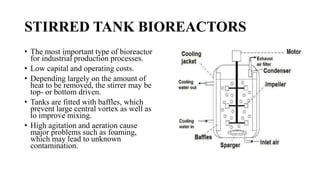
STIRRED TANK BIOREACTORS
• The most important type of bioreactor
for industrial production processes.
• Low capital and operating costs.
• Depending largely on the amount of
heat to be removed, the stirrer may be
top- or bottom driven.
• Tanks are fitted with baffles, which
prevent large central vortex as well as
to improve mixing.
• High agitation and aeration cause
major problems such as foaming,
which may lead to unknown
contamination.
PNEUMATICALLYAGITATED BIOREACTORS
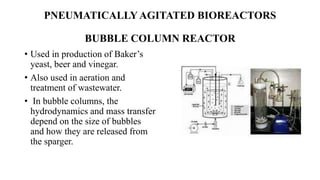
BUBBLE COLUMN REACTOR
• Used in production of Baker’s
yeast, beer and vinegar.
• Also used in aeration and
treatment of wastewater.
• In bubble columns, the
hydrodynamics and mass transfer
depend on the size of bubbles
and how they are released from
the sparger.
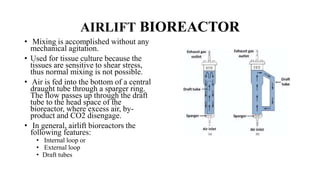
AIRLIFT BIOREACTOR
• Mixing is accomplished without any
mechanical agitation.
• Used for tissue culture because the
tissues are sensitive to shear stress,
thus normal mixing is not possible.
• Air is fed into the bottom of a central
draught tube through a sparger ring.
The flow passes up through the draft
tube to the head space of the
bioreactor, where excess air, by-
product and CO2 disengage.
• In general, airlift bioreactors the
following features:
• Internal loop or
• External loop
• Draft tubes
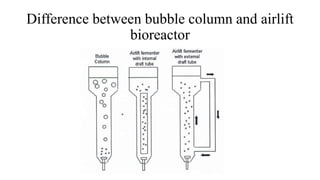
Difference between bubble column and airlift
bioreactor
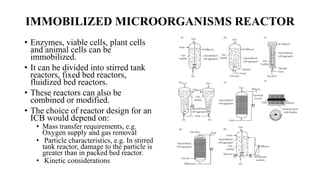
IMMOBILIZED MICROORGANISMS REACTOR
• Enzymes, viable cells, plant cells
and animal cells can be
immobilized.
• It can be divided into stirred tank
reactors, fixed bed reactors,
fluidized bed reactors.
• These reactors can also be
combined or modified.
• The choice of reactor design for an
ICB would depend on:
• Mass transfer requirements, e.g.
Oxygen supply and gas removal
• Particle characteristics, e.g. In stirred
tank reactor, damage to the particle is
greater than in packed bed reactor.
• Kinetic considerations
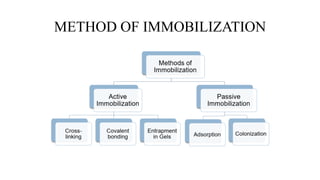
METHOD OF IMMOBILIZATION
Advantages
• Application to multi-step enzyme reaction
may be possible.
• The enzyme activity yield on
immobilization is high.
• Operational stability is generally high.
• Operations for enzyme extraction and/or
purification are unnecessary.
• High cell densities can be employed.
• Cell densities and enzyme activities can
be expected to be maintained over a long
period of operation.
• Products can be easily removed from
immobilized cells
• Immobilized cells appear to be less
susceptible to microbial contamination.
Disadvantages
• The cells may contain numerous
catalytically active enzymes, which may
catalyze unwanted side reactions.
• The cell membrane itself may serve as a
diffusion barrier, thus reducing
productivity.
• Contamination by cells leaking out from
carriers may occur.
• The physiological state of the
microorganism cannot be controlled
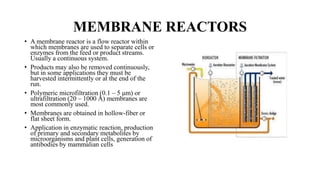
MEMBRANE REACTORS
• A membrane reactor is a flow reactor within
which membranes are used to separate cells or
enzymes from the feed or product streams.
Usually a continuous system.
• Products may also be removed continuously,
but in some applications they must be
harvested intermittently or at the end of the
run.
• Polymeric microfiltration (0.1 – 5 μm) or
ultrafiltration (20 – 1000 Å) membranes are
most commonly used.
• Membranes are obtained in hollow-fiber or
flat sheet form.
• Application in enzymatic reaction, production
of primary and secondary metabolites by
microorganisms and plant cells, generation of
antibodies by mammalian cells
Advantages
• A consequence of the retention of
cells or enzymes within the reactors.
This allows the reactors to be
continuously perfused without
worrying about washout.
• Membrane also provide an in-situ
separation of the cells or enzymes
from the product.
• Compared to immobilization
technique, no chemical agents or harsh
conditions are employed.
Disadvantages
• Cells and enzymes entrapped within
membrane reactors are subject to
diffusion and convection that can
render their distribution
heterogeneous.
• An uneven flow distribution among
the various channels in a membrane
reactor can have significant effect
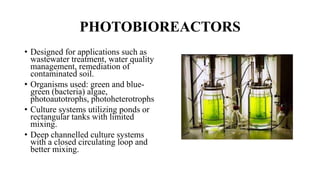
PHOTOBIOREACTORS
• Designed for applications such as
wastewater treatment, water quality
management, remediation of
contaminated soil.
• Organisms used: green and blue-
green (bacteria) algae,
photoautotrophs, photoheterotrophs
• Culture systems utilizing ponds or
rectangular tanks with limited
mixing.
• Deep channelled culture systems
with a closed circulating loop and
better mixing.
DIFFERENT TYPES OF BIOREACTORS

DIFFERENT TYPES OF BIOREACTORS

  • 1.
    DIFFERENT TYPES OF BIOREACTORS Doneby T. Blessy E. Brasilda D. Dhanuprabha
  • 2.
    TYPES OF BIOREACTORS •Stirred tank bioreactor • Pneumatically Agitated bioreactors: • Airlift bioreactor • Bubble Column • Immobilized microorganism reactors • Membrane Reactors • Photobioreactors
  • 3.
    STRATEGIES FOR CHOOSINGTHE BIOREACTOR • Microorganism species • Growth and oxygen requirements • Shear and rheology effects • Cleaning and Sterility • Light • Foam • Heating and cooling • Materials of construction
  • 4.
    STIRRED TANK BIOREACTORS •The most important type of bioreactor for industrial production processes. • Low capital and operating costs. • Depending largely on the amount of heat to be removed, the stirrer may be top- or bottom driven. • Tanks are fitted with baffles, which prevent large central vortex as well as to improve mixing. • High agitation and aeration cause major problems such as foaming, which may lead to unknown contamination.
  • 5.
    PNEUMATICALLYAGITATED BIOREACTORS BUBBLE COLUMNREACTOR • Used in production of Baker’s yeast, beer and vinegar. • Also used in aeration and treatment of wastewater. • In bubble columns, the hydrodynamics and mass transfer depend on the size of bubbles and how they are released from the sparger.
  • 6.
    AIRLIFT BIOREACTOR • Mixingis accomplished without any mechanical agitation. • Used for tissue culture because the tissues are sensitive to shear stress, thus normal mixing is not possible. • Air is fed into the bottom of a central draught tube through a sparger ring. The flow passes up through the draft tube to the head space of the bioreactor, where excess air, by- product and CO2 disengage. • In general, airlift bioreactors the following features: • Internal loop or • External loop • Draft tubes
  • 7.
    Difference between bubblecolumn and airlift bioreactor
  • 8.
    IMMOBILIZED MICROORGANISMS REACTOR •Enzymes, viable cells, plant cells and animal cells can be immobilized. • It can be divided into stirred tank reactors, fixed bed reactors, fluidized bed reactors. • These reactors can also be combined or modified. • The choice of reactor design for an ICB would depend on: • Mass transfer requirements, e.g. Oxygen supply and gas removal • Particle characteristics, e.g. In stirred tank reactor, damage to the particle is greater than in packed bed reactor. • Kinetic considerations
  • 9.
  • 10.
    Advantages • Application tomulti-step enzyme reaction may be possible. • The enzyme activity yield on immobilization is high. • Operational stability is generally high. • Operations for enzyme extraction and/or purification are unnecessary. • High cell densities can be employed. • Cell densities and enzyme activities can be expected to be maintained over a long period of operation. • Products can be easily removed from immobilized cells • Immobilized cells appear to be less susceptible to microbial contamination. Disadvantages • The cells may contain numerous catalytically active enzymes, which may catalyze unwanted side reactions. • The cell membrane itself may serve as a diffusion barrier, thus reducing productivity. • Contamination by cells leaking out from carriers may occur. • The physiological state of the microorganism cannot be controlled
  • 11.
    MEMBRANE REACTORS • Amembrane reactor is a flow reactor within which membranes are used to separate cells or enzymes from the feed or product streams. Usually a continuous system. • Products may also be removed continuously, but in some applications they must be harvested intermittently or at the end of the run. • Polymeric microfiltration (0.1 – 5 μm) or ultrafiltration (20 – 1000 Å) membranes are most commonly used. • Membranes are obtained in hollow-fiber or flat sheet form. • Application in enzymatic reaction, production of primary and secondary metabolites by microorganisms and plant cells, generation of antibodies by mammalian cells
  • 12.
    Advantages • A consequenceof the retention of cells or enzymes within the reactors. This allows the reactors to be continuously perfused without worrying about washout. • Membrane also provide an in-situ separation of the cells or enzymes from the product. • Compared to immobilization technique, no chemical agents or harsh conditions are employed. Disadvantages • Cells and enzymes entrapped within membrane reactors are subject to diffusion and convection that can render their distribution heterogeneous. • An uneven flow distribution among the various channels in a membrane reactor can have significant effect
  • 13.
    PHOTOBIOREACTORS • Designed forapplications such as wastewater treatment, water quality management, remediation of contaminated soil. • Organisms used: green and blue- green (bacteria) algae, photoautotrophs, photoheterotrophs • Culture systems utilizing ponds or rectangular tanks with limited mixing. • Deep channelled culture systems with a closed circulating loop and better mixing.