By
M.Vharshini
Sri Ramachandra University
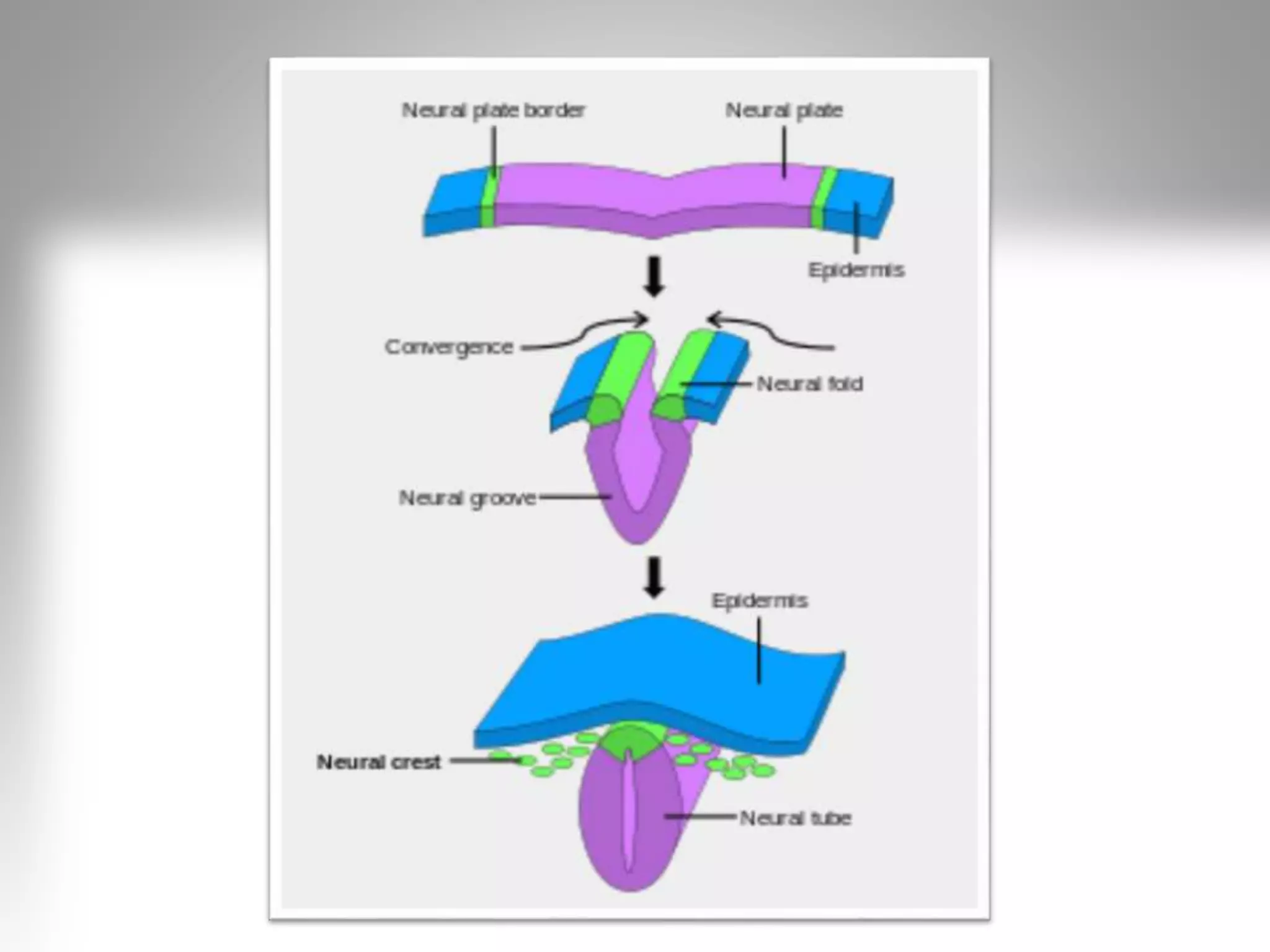
•Neural crest cells are a temporary
group of cells unique to vertebrates
that arise from the ectoderm cell
layer.
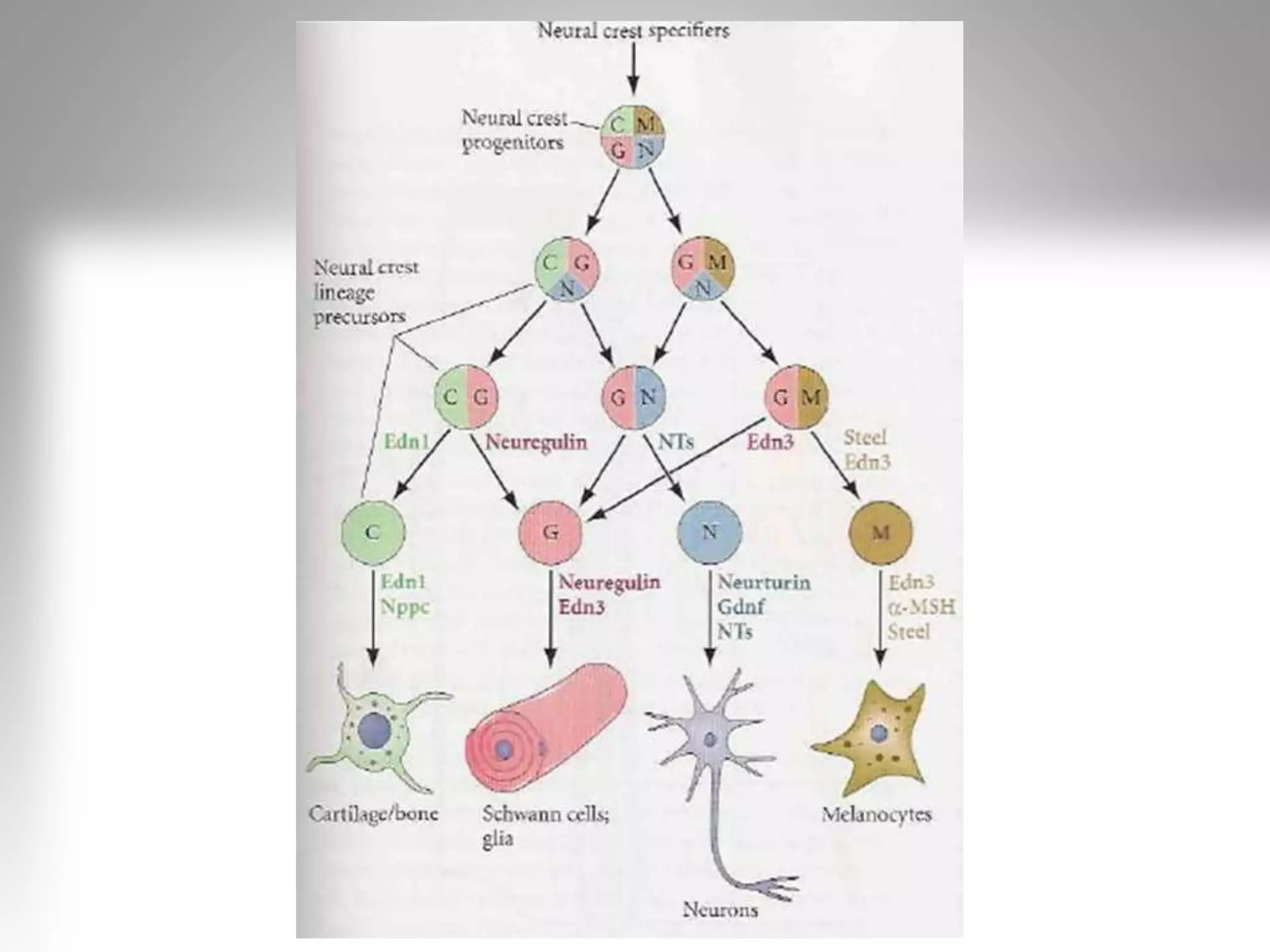
•They give rise to a diverse cell
lineage - including melanocytes,
craniofacial cartilage and bone, smooth
muscle, peripheral and enteric neurons
and ganglia.
1. Multipotent capability: Ability to
give rise to several precursor
cells.
2. Migratory property: Neural crest
cells break free from neural folds.
3. Regulation: It’s the ability of the
embryo to control the loss of cells
by increasing the proliferation of
the remaining neural crest cells.
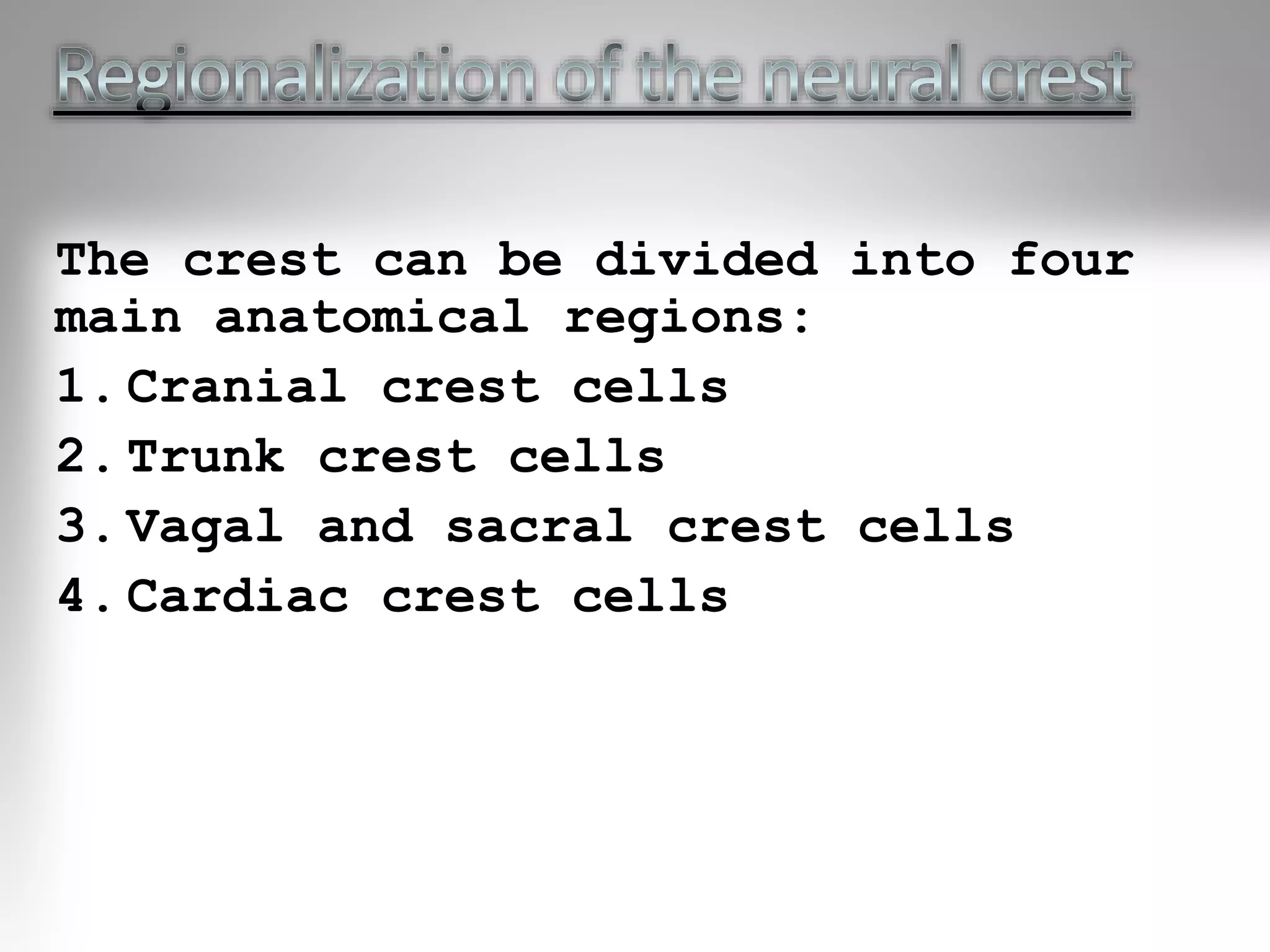
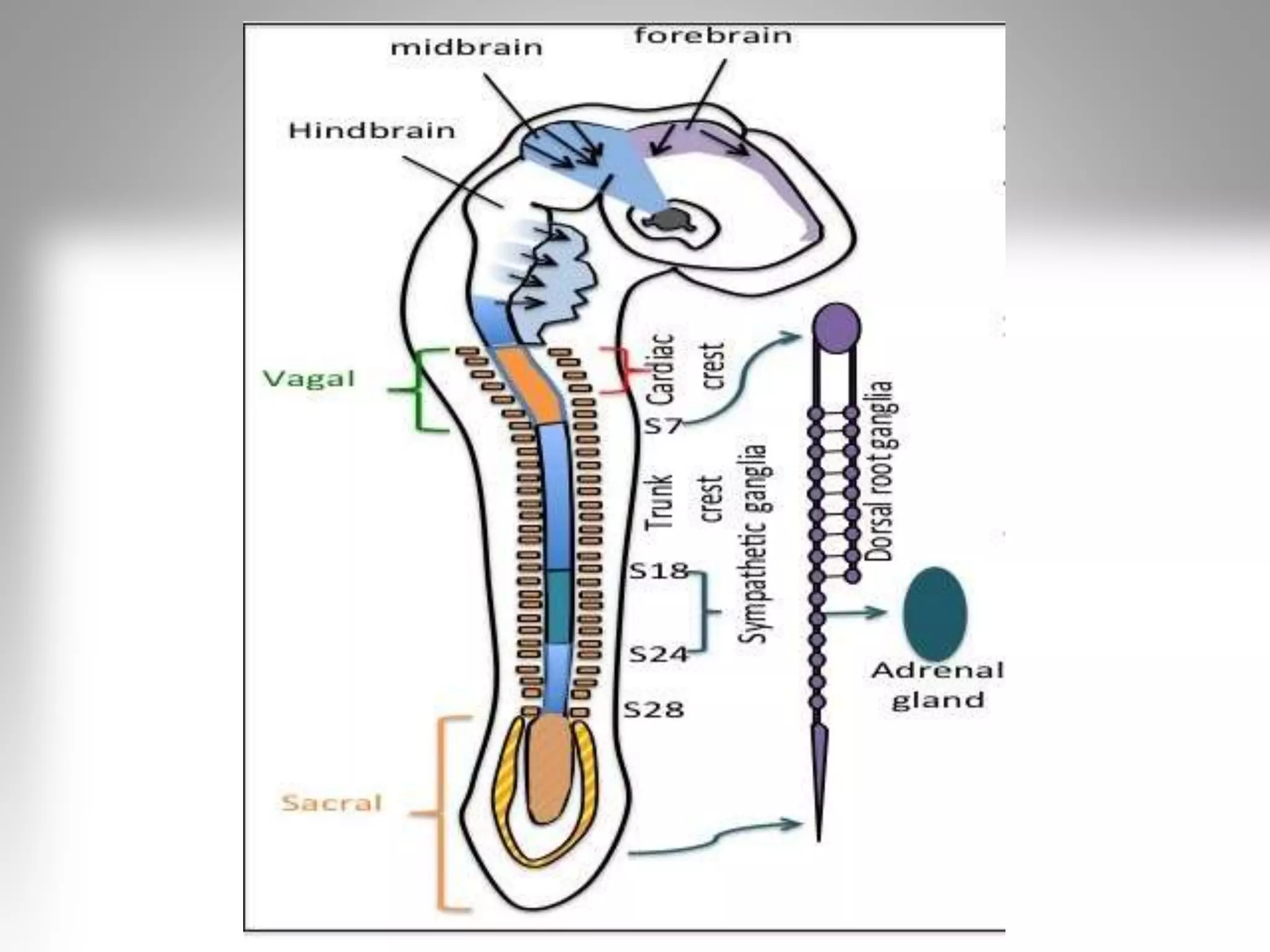
The crest can be divided into four
main anatomical regions:
1. Cranial crest cells
2. Trunk crest cells
3. Vagal and sacral crest cells
4. Cardiac crest cells
1. Cranial crest cells:
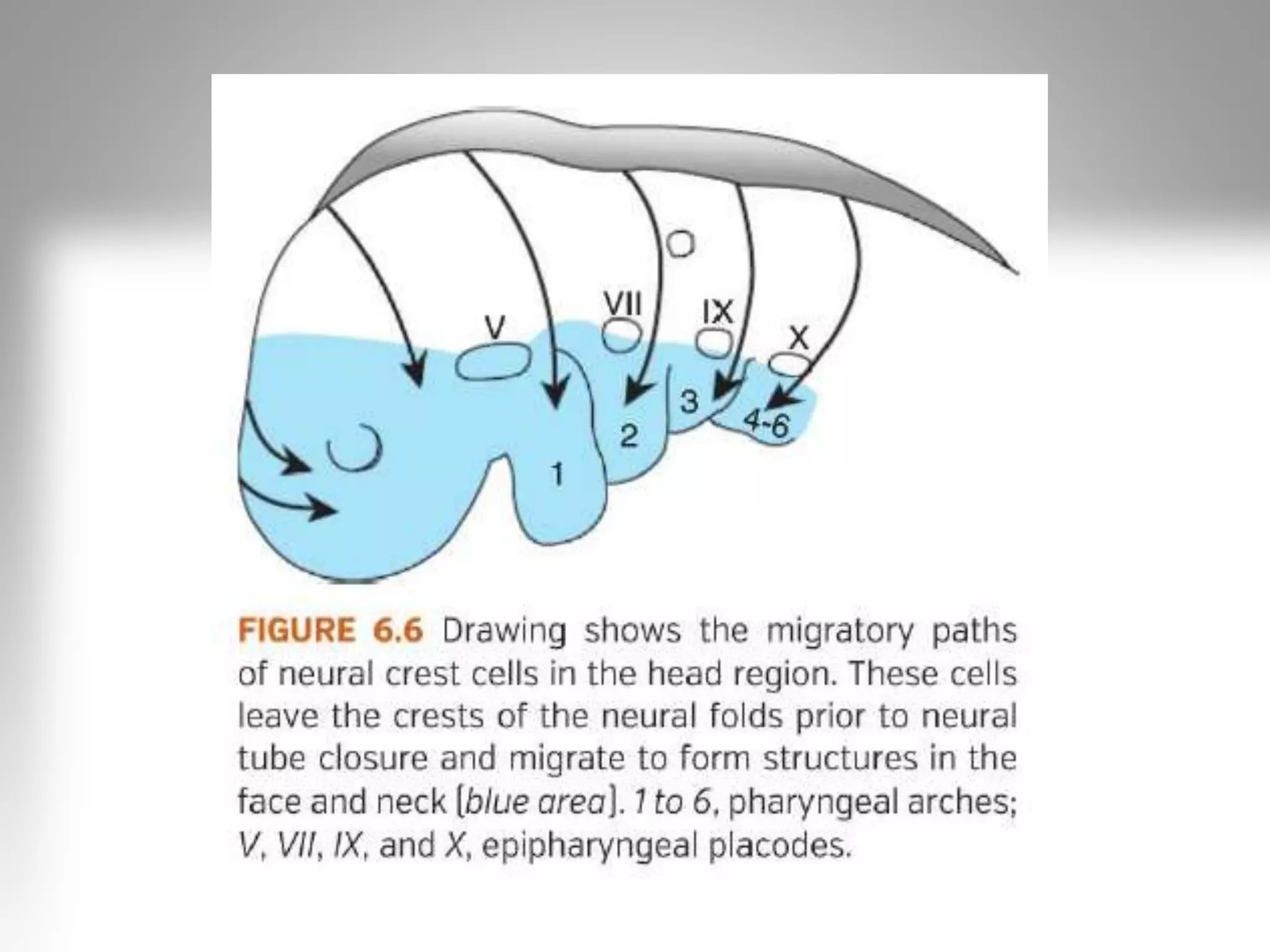
•Cranial neural crest cells migrate
to produce the craniofacial
mesenchyme, which differentiates
into the cartilage, bone, cranial
neurons, glia, and connective
tissues of the face.
•These cells also enter the
pharyngeal arches and pouches where
they contribute to the thymus, bones
of the middle ear and jaw.
2. Trunk neural crest:
•Trunk neural crest gives rise to two
populations of cells. One group of
cells fated to
become melanocytes migrates
dorsolaterally into the ectoderm.
•A second group of cells migrates
ventrolaterally to form the
sympathetic ganglia, adrenal
medulla, and the nerves surrounding
the aorta.
3. Vagal and sacral neural crest:
•The vagal and sacral neural crest
cells develop into the ganglia of
the enteric nervous system and the
parasympathetic ganglia.
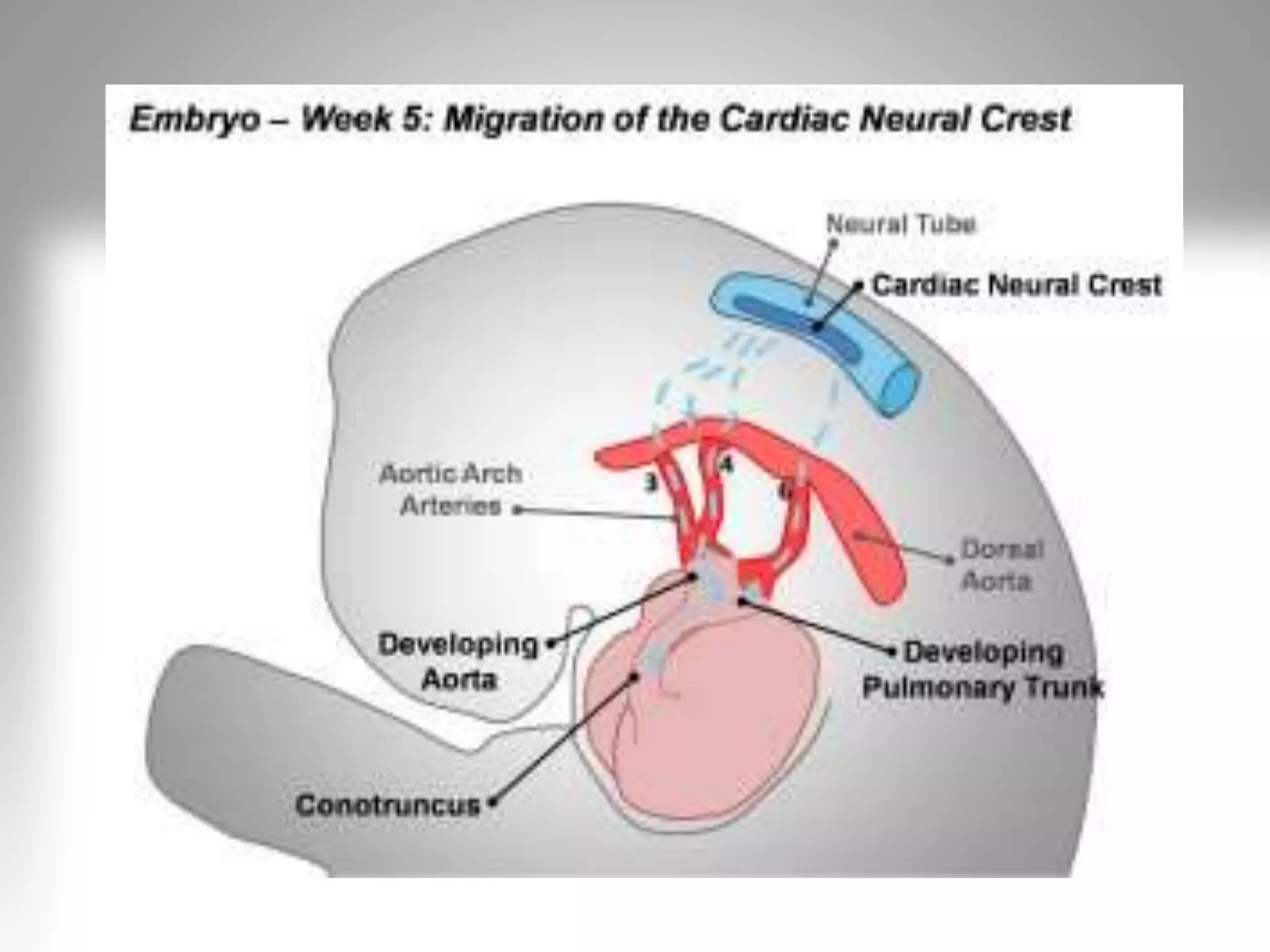
4. Cardiac neural crest:
•It develops into melanocytes,
cartilage, connective tissue and
neurons of some pharyngeal arches.
•It also gives rise to regions of the
heart such as the musculo-connective
tissue of the large arteries, and part
of the septum.
• The mesoderm forms at the same time as the
other two germ layers, the endoderm and
ectoderm.
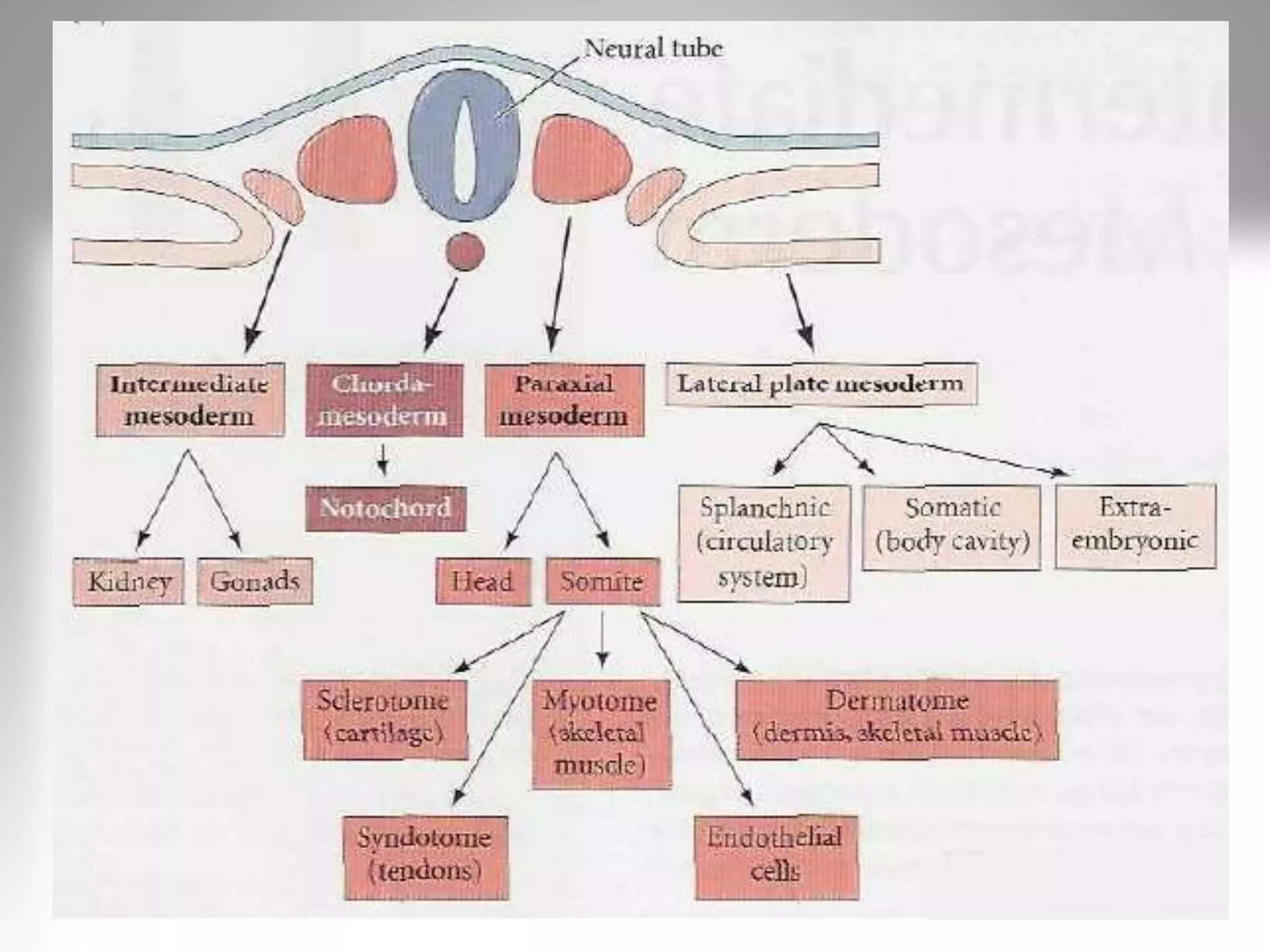
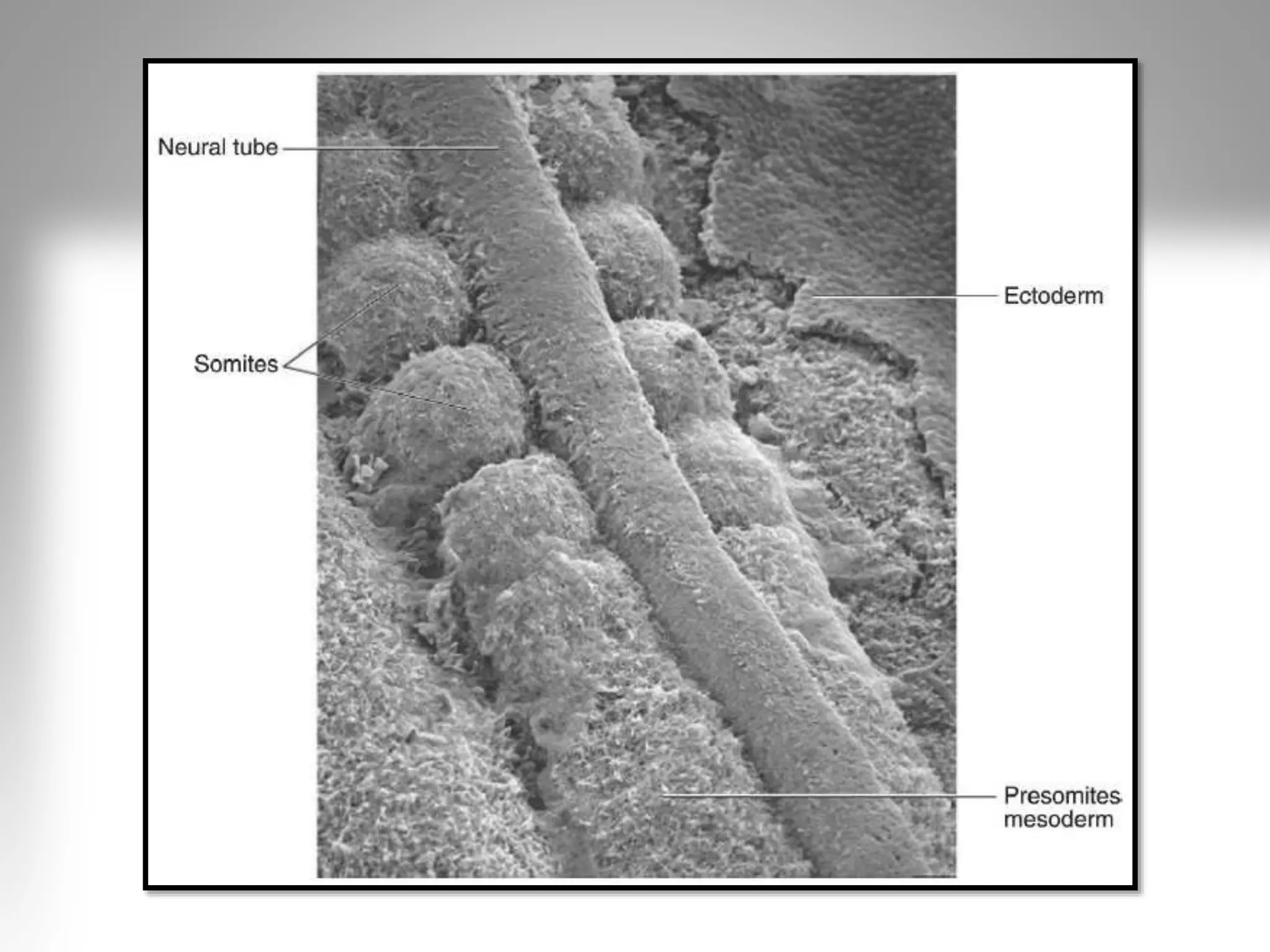
• The mesoderm at either side of the neural tube is
called paraxial mesoderm.
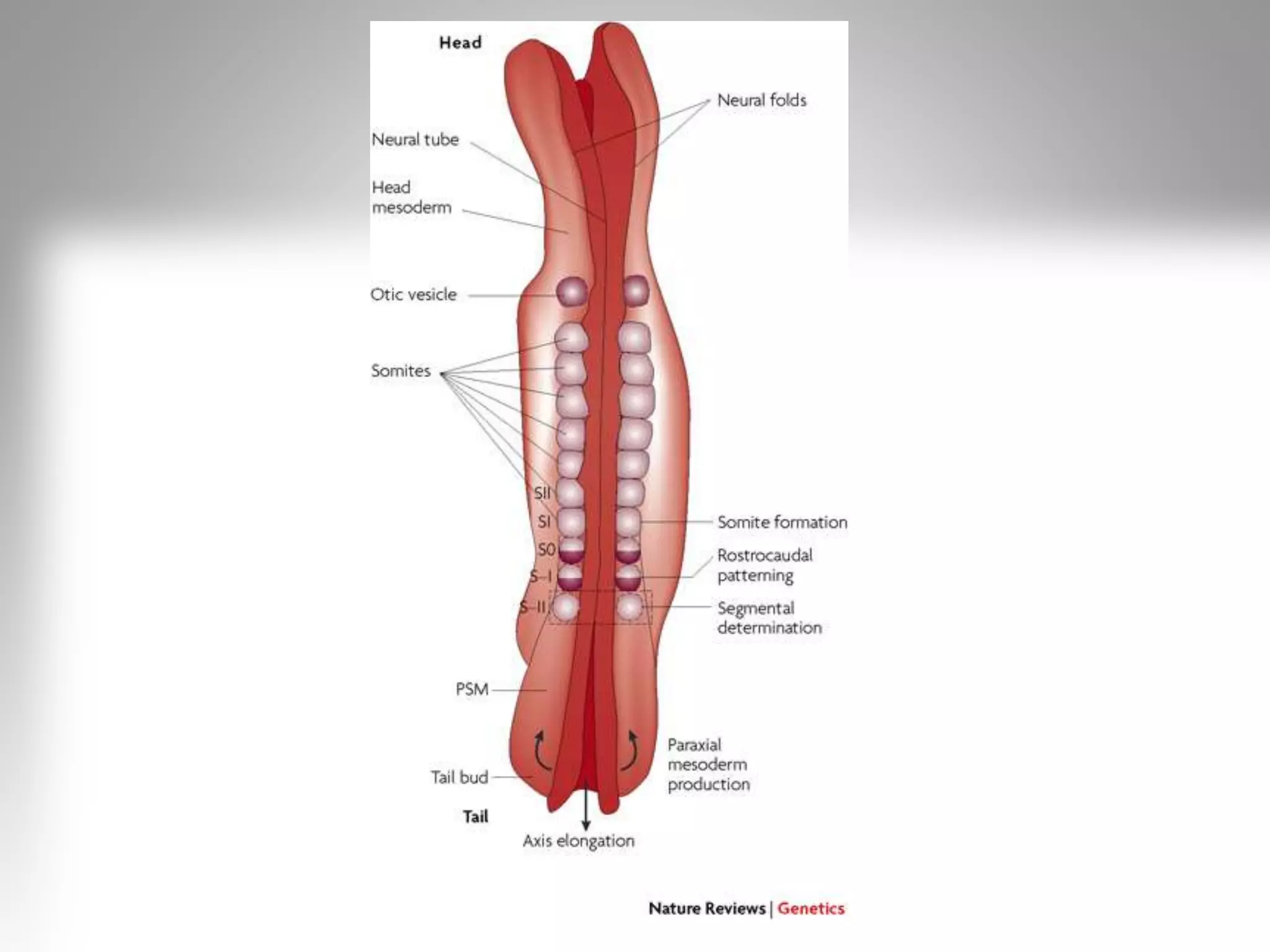
• As the primitive streak regresses and neural folds
gather (to eventually become the neural tube),
the paraxial mesoderm separates into blocks
called somites.
•Somites are blocks of mesoderm that
are located on either side of the
neural tube in the developing
vertebrate embryo.
•Somites are precursor populations of
cells that give rise to important
structures associated with the
vertebrate body plan and will
eventually differentiate into
dermis, skeletal muscle, cartilage,
tendons, and vertebrae.
•Formation of segmented somites from
un- segmented presomitic (paraxial)
mesoderm depends on a segmentation
dock established by cyclic
expression of a number of genes.
•The cyclic genes include members of
the NOTCH and WNT signaling pathways
that are expressed in an oscillating
pattern in presomitic mesoderm.
•Thus, Notch protein accumulates in
to form somite and then decreases as
the somite is established.
•The increase in Notch protein
activates other segment patterning
genes that establish the somite.
Boundaries of each somite are
regulated by RA and a combination of
FGF8 and WNT3a.
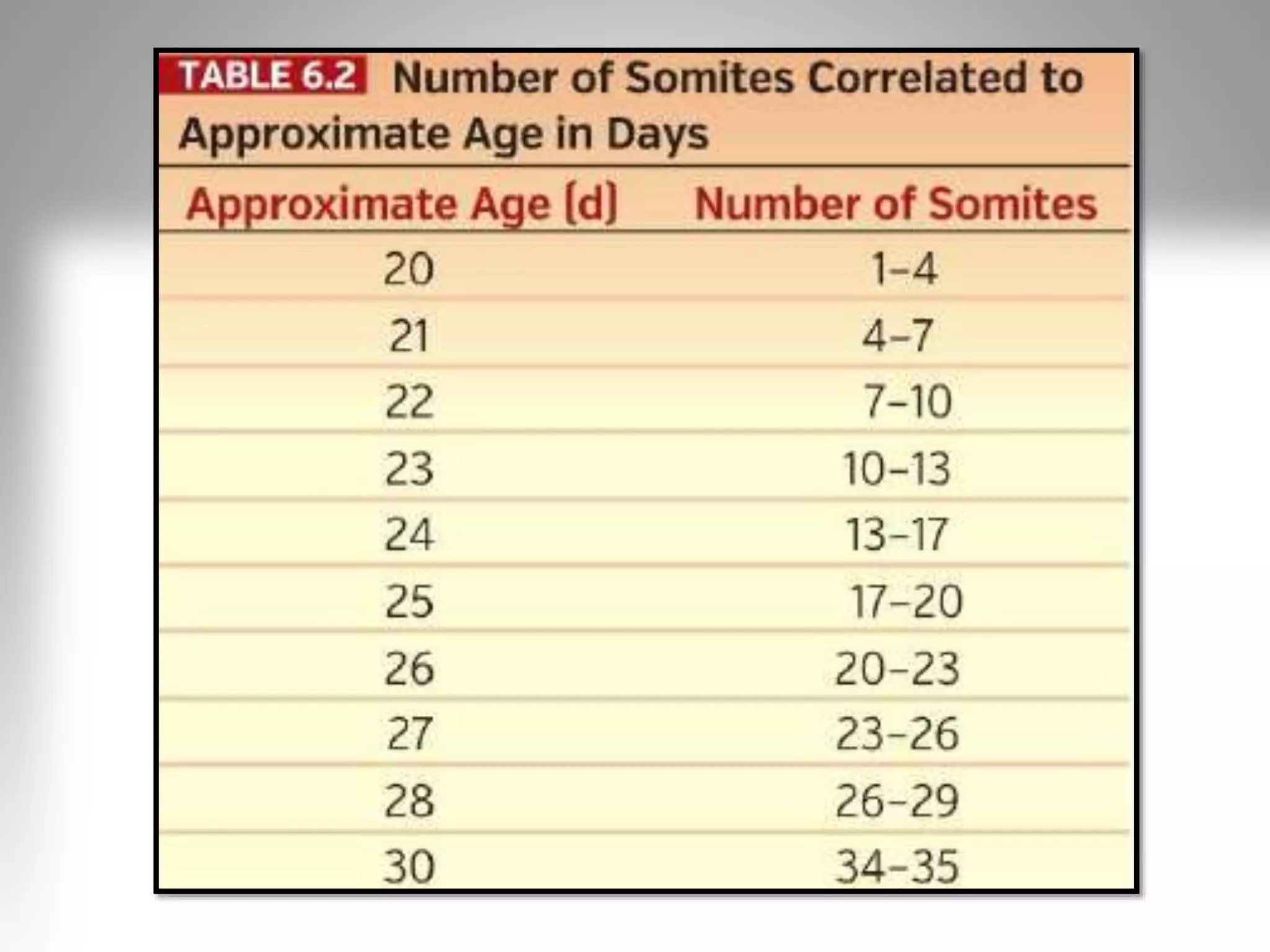
• In humans 42-44 somite pairs are formed along
the neural tube. These range from the cranial
region up to the embryo’s tail.
• Several caudal somites disappear again, which is
why only 35-37 somite pairs can be counted in the
end.
• The number of the somites that are found is used
to determine the embryo's age.
In the developing vertebrate embryo,
somites split to form:
1. Dermatomes
2. Skeletal muscle (myotomes)
3. Tendons and cartilage
(syndetomes)
4. Bone (sclerotomes)
•The dermatome is the dorsal portion
of the paraxial mesoderm somite
which gives rise to the skin.
•In the human embryo it arises in the
third week of embryogenesis.
•The dermatomes contribute to the
skin, fat and connective tissue of
the neck and of the trunk.
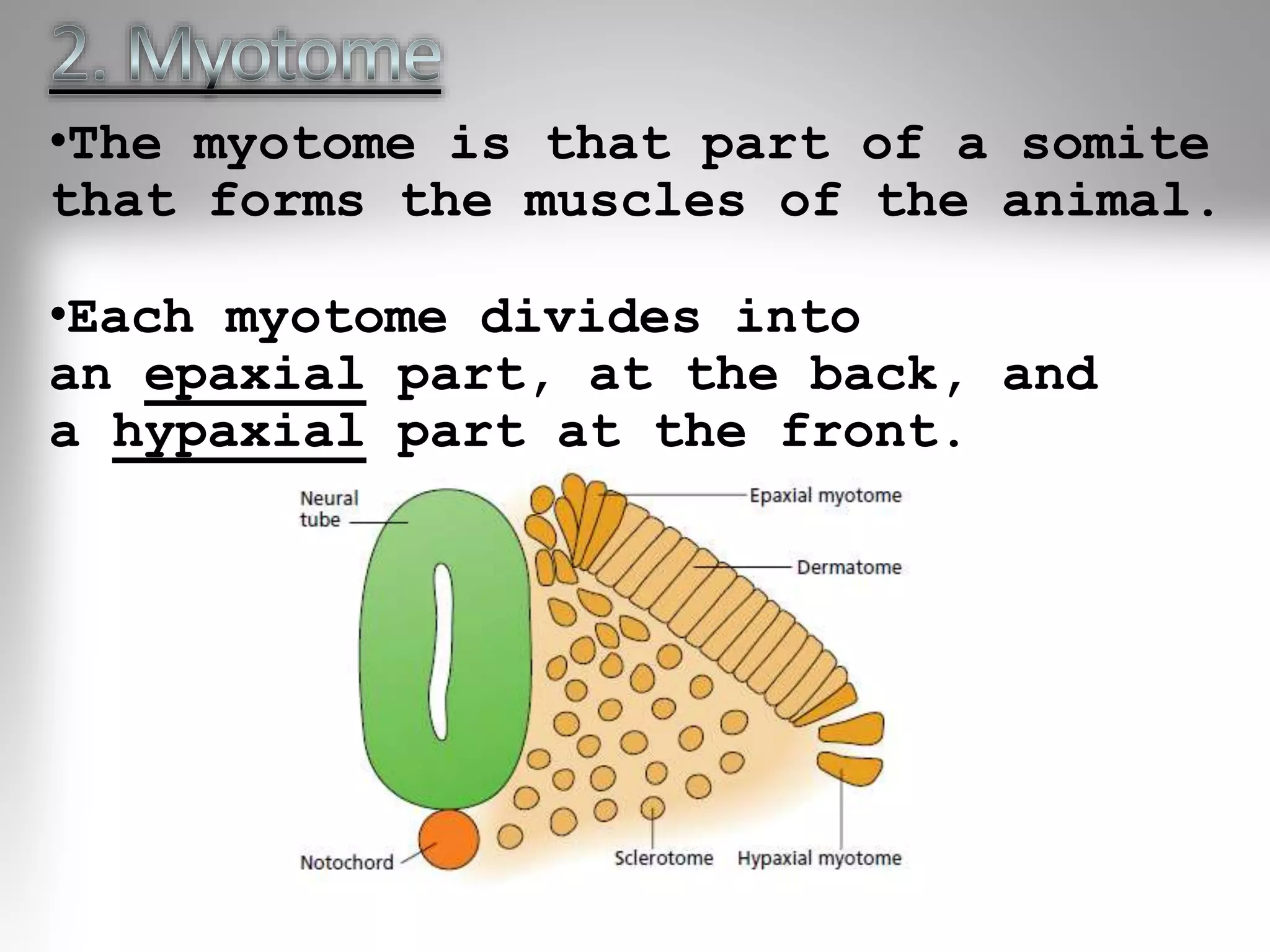
•The myotome is that part of a somite
that forms the muscles of the animal.
•Each myotome divides into
an epaxial part, at the back, and
a hypaxial part at the front.
•The myoblasts from the hypaxial
division form the muscles of the
thoracic and anterior abdominal
walls.
•The epaxial muscle mass loses its
segmental character to form
the extensor muscles of the neck and
trunk of mammals.
•The sclerotome forms
the vertebrae and the rib cartilage
and part of the occipital bone.
Somite differentiation and neural crest

Somite differentiation and neural crest

  • 1.
  • 2.
    •Neural crest cellsare a temporary group of cells unique to vertebrates that arise from the ectoderm cell layer. •They give rise to a diverse cell lineage - including melanocytes, craniofacial cartilage and bone, smooth muscle, peripheral and enteric neurons and ganglia.
  • 4.
    1. Multipotent capability:Ability to give rise to several precursor cells. 2. Migratory property: Neural crest cells break free from neural folds. 3. Regulation: It’s the ability of the embryo to control the loss of cells by increasing the proliferation of the remaining neural crest cells.
  • 7.
    The crest canbe divided into four main anatomical regions: 1. Cranial crest cells 2. Trunk crest cells 3. Vagal and sacral crest cells 4. Cardiac crest cells
  • 9.
    1. Cranial crestcells: •Cranial neural crest cells migrate to produce the craniofacial mesenchyme, which differentiates into the cartilage, bone, cranial neurons, glia, and connective tissues of the face. •These cells also enter the pharyngeal arches and pouches where they contribute to the thymus, bones of the middle ear and jaw.
  • 10.
    2. Trunk neuralcrest: •Trunk neural crest gives rise to two populations of cells. One group of cells fated to become melanocytes migrates dorsolaterally into the ectoderm. •A second group of cells migrates ventrolaterally to form the sympathetic ganglia, adrenal medulla, and the nerves surrounding the aorta.
  • 11.
    3. Vagal andsacral neural crest: •The vagal and sacral neural crest cells develop into the ganglia of the enteric nervous system and the parasympathetic ganglia. 4. Cardiac neural crest: •It develops into melanocytes, cartilage, connective tissue and neurons of some pharyngeal arches. •It also gives rise to regions of the heart such as the musculo-connective tissue of the large arteries, and part of the septum.
  • 14.
    • The mesodermforms at the same time as the other two germ layers, the endoderm and ectoderm. • The mesoderm at either side of the neural tube is called paraxial mesoderm. • As the primitive streak regresses and neural folds gather (to eventually become the neural tube), the paraxial mesoderm separates into blocks called somites.
  • 16.
    •Somites are blocksof mesoderm that are located on either side of the neural tube in the developing vertebrate embryo. •Somites are precursor populations of cells that give rise to important structures associated with the vertebrate body plan and will eventually differentiate into dermis, skeletal muscle, cartilage, tendons, and vertebrae.
  • 19.
    •Formation of segmentedsomites from un- segmented presomitic (paraxial) mesoderm depends on a segmentation dock established by cyclic expression of a number of genes. •The cyclic genes include members of the NOTCH and WNT signaling pathways that are expressed in an oscillating pattern in presomitic mesoderm.
  • 20.
    •Thus, Notch proteinaccumulates in to form somite and then decreases as the somite is established. •The increase in Notch protein activates other segment patterning genes that establish the somite. Boundaries of each somite are regulated by RA and a combination of FGF8 and WNT3a.
  • 21.
    • In humans42-44 somite pairs are formed along the neural tube. These range from the cranial region up to the embryo’s tail. • Several caudal somites disappear again, which is why only 35-37 somite pairs can be counted in the end. • The number of the somites that are found is used to determine the embryo's age.
  • 23.
    In the developingvertebrate embryo, somites split to form: 1. Dermatomes 2. Skeletal muscle (myotomes) 3. Tendons and cartilage (syndetomes) 4. Bone (sclerotomes)
  • 24.
    •The dermatome isthe dorsal portion of the paraxial mesoderm somite which gives rise to the skin. •In the human embryo it arises in the third week of embryogenesis. •The dermatomes contribute to the skin, fat and connective tissue of the neck and of the trunk.
  • 25.
    •The myotome isthat part of a somite that forms the muscles of the animal. •Each myotome divides into an epaxial part, at the back, and a hypaxial part at the front.
  • 26.
    •The myoblasts fromthe hypaxial division form the muscles of the thoracic and anterior abdominal walls. •The epaxial muscle mass loses its segmental character to form the extensor muscles of the neck and trunk of mammals.
  • 27.
    •The sclerotome forms thevertebrae and the rib cartilage and part of the occipital bone.