AIR AND MEDIA STERILIZATION
1
Dr Arunima Karkun
AIR AND MEDIA STERILIZATION
INTRODUCTION
HISTORY
PRINCIPLE
MEDIA STERILIZATION
•BATCH WISE IN FERMENTER
•COTINUOUS STERILIZATION
AIR STERILIZATION
CONCLUSION
SUMMARY
REFERENCE
S
Y
N
O
P
S
I
S
2
AIR AND MEDIA STERILIZATION
Sterilization is a term referring to any process
that eliminates (removes) or kills all forms of
life, including transmissible agents such as
fungi, bacteria, viruses, spore forms, etc.
There are many sterilizing agents e. g. steam,
U.V. light, chemical agents, etc.
Steam is preferred to other agents, because it is
cheaper for mass sterilization.
I
N
T
R
O
D
U
C
T
I
O
N
3
AIR AND MEDIA STERILIZATION
Terjesen & cherry 1902 First studied the
sterilization of large
volume of air.
Bourdillon et al. 1917 Developed the air
sterility technique.
H
I
S
T
O
R
Y
4
AIR AND MEDIA STERILIZATION
Sterilization removes infecting micro-organisms
it can also remove pathogenic micro-organisms
or spoiling agents.
Sterilization is accomplished either by chemical or
physical means.
Moist heat is a most common physical agent.
It allows for satisfactory industrial sterilization.
P
R
I
N
C
I
P
L
E
5
AIR AND MEDIA STERILIZATION
The other method of sterilization is the removal
of infecting micro-organisms.
This is done by filtration. Numerous type of filter
papers are available for this purpose.
It depends on the-
(i)- The size of micro-organisms and
(ii)-The retention efficiency of the filter.
Usually sterilization of gases and biostatic fluids
is done by filtration.
P
R
I
N
C
I
P
L
E
6
AIR AND MEDIA STERILIZATION
Usually media are sterilized before they are
inoculated.
Sterilization of media is decided by the chemical
composition.
Sterilization of media may be done by one of the
following three methods-
(i)-by boiling
(ii)-by passing live steam
(iii)-by subjecting the medium to steam under
pressure(i.e. autoclaving)
S
T
E
R
I
L
I
Z
A
T
I
O
N
O
F
M
E
D
I
A 7
AIR AND MEDIA STERILIZATION
The classical technique of making the medium
sterile by the use of steam may be carried out
in two ways-
(i)-batch wise in fermentor and
(ii)-continuous sterilization
BATCH WISE IN FERMENTOR
This is the simplest method of sterilizing
production media.
S
T
E
R
I
L
I
Z
A
T
I
O
N
O
F
M
E
D
I
A 8
AIR AND MEDIA STERILIZATION
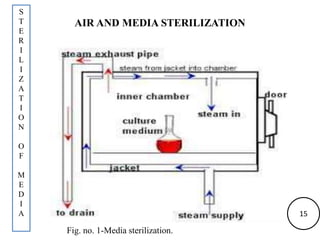
The vessel is equipped with a coil or jacket for
heating and cooling.
Also the agitator may be fitted to aid heat-
exchange.
It is needed to raise the temperature of the
medium to 1200C with steam to maintain this
for a period of 20 minutes before cooling the
system.
S
T
E
R
I
L
I
Z
A
T
I
O
N
O
F
M
E
D
I
A 9
AIR AND MEDIA STERILIZATION
There is an interconnecting pipeline between the
batch the batch cooker and the fermentor for
transferring the sterile medium from the cooker
to steam sterilized fermentor.
ADVANTAGE
The batch cooker method saves the production
time, since the fermentor is unoccupied between
two fermentor runs.
S
T
E
R
I
L
I
Z
A
T
I
O
N
O
F
M
E
D
I
A 10
AIR AND MEDIA STERILIZATION
LIMITATION
It occupies increased plant space.
It involve higher cost of the additional equipment
required, and
It involves increased steam usages.
S
T
E
R
I
L
I
Z
A
T
I
O
N
O
F
M
E
D
I
A 11
AIR AND MEDIA STERILIZATION
CONTINUOUS STERILIZATION
This methods involves passing of production
medium through a heat exchanger, a holding
coil and a cooler.
The temperature of medium undergoing
sterilization is raised to the desired level in the
heat exchanger.
The medium is then passes on to a holding coil.
S
T
E
R
I
L
I
Z
A
T
I
O
N
O
F
M
E
D
I
A 12
AIR AND MEDIA STERILIZATION
Where it is maintained at the sterilizing
temperature for a predetermined time period.
Finally the medium is rapidly cooled by
counter circulating it in the exchanger against
the cool input medium, and then against cold
water.
In continuous sterilization the temperature is
higher than 1200C.
S
T
E
R
I
L
I
Z
A
T
I
O
N
O
F
M
E
D
I
A 13
AIR AND MEDIA STERILIZATION
ADVANTAGES
It saves both production time and plant space.
It gives improved quality of the medium.
It involves some economy in steam cost.
It allows the use of lower sterilizing temperature
or shorter holding period.
S
T
E
R
I
L
I
Z
A
T
I
O
N
O
F
M
E
D
I
A 14
AIR AND MEDIA STERILIZATION
Fig. no. 1-Media sterilization.
S
T
E
R
I
L
I
Z
A
T
I
O
N
O
F
M
E
D
I
A 15
AIR AND MEDIA STERILIZATION
With aerobic fermentation continuous supply
of sterile air is vital for successful fermentation.
Air can be sterilized by many methods namely-
(i)-filtration
(ii)-heat
(iii)-electrostatic repulsion
(iv)-U.V. light
(iv)-chemical agents
A
I
R
S
T
E
R
I
L
I
Z
A
T
I
O
N
16
AIR AND MEDIA STERILIZATION
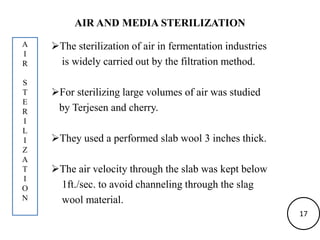
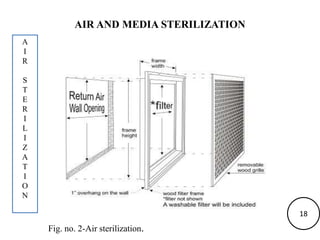
The sterilization of air in fermentation industries
is widely carried out by the filtration method.
For sterilizing large volumes of air was studied
by Terjesen and cherry.
They used a performed slab wool 3 inches thick.
The air velocity through the slab was kept below
1ft./sec. to avoid channeling through the slag
wool material.
A
I
R
S
T
E
R
I
L
I
Z
A
T
I
O
N
17
AIR AND MEDIA STERILIZATION
Fig. no. 2-Air sterilization.
A
I
R
S
T
E
R
I
L
I
Z
A
T
I
O
N
18
AIR AND MEDIA STERILIZATION
Sterilization is a term referring to any process
that eliminates (removes) or kills all forms of
life, including transmissible agents such as
fungi, bacteria, viruses, spore forms, etc.
Sterilization removes infecting micro-organisms
it can also remove pathogenic micro-organisms
or spoiling agents.
Sterilization is accomplished either by chemical
or physical means.
C
O
N
C
L
U
S
I
O
N
19
AIR AND MEDIA STERILIZATION
Sterilization of media may be done by one of the
following three methods-
(i)-by boiling
(ii)-by passing live steam
(iii)-by subjecting the medium to steam under
pressure(i.e. autoclaving)
Air can be sterilized by many methods namely-
(i)-filtration
(ii)-heat
(iii)-electrostatic repulsion
(iv)-U.V. light
(iv)-chemical agents
S
U
M
M
A
R
Y
20
AIR AND MEDIA STERILIZATION
A. H. Patel 2010 industrial microbiology
Some contents from net-
http://www.sigmaaldrich.com
http://www.air-zone.com/hepa.html
R
E
F
E
R
E
N
C
E
21
AIR AND MEDIA STERILIZATION
T
H
A
N
K
Y
O
U

Air and media sterilisation

  • 1.
    AIR AND MEDIASTERILIZATION 1 Dr Arunima Karkun
  • 2.
    AIR AND MEDIASTERILIZATION INTRODUCTION HISTORY PRINCIPLE MEDIA STERILIZATION •BATCH WISE IN FERMENTER •COTINUOUS STERILIZATION AIR STERILIZATION CONCLUSION SUMMARY REFERENCE S Y N O P S I S 2
  • 3.
    AIR AND MEDIASTERILIZATION Sterilization is a term referring to any process that eliminates (removes) or kills all forms of life, including transmissible agents such as fungi, bacteria, viruses, spore forms, etc. There are many sterilizing agents e. g. steam, U.V. light, chemical agents, etc. Steam is preferred to other agents, because it is cheaper for mass sterilization. I N T R O D U C T I O N 3
  • 4.
    AIR AND MEDIASTERILIZATION Terjesen & cherry 1902 First studied the sterilization of large volume of air. Bourdillon et al. 1917 Developed the air sterility technique. H I S T O R Y 4
  • 5.
    AIR AND MEDIASTERILIZATION Sterilization removes infecting micro-organisms it can also remove pathogenic micro-organisms or spoiling agents. Sterilization is accomplished either by chemical or physical means. Moist heat is a most common physical agent. It allows for satisfactory industrial sterilization. P R I N C I P L E 5
  • 6.
    AIR AND MEDIASTERILIZATION The other method of sterilization is the removal of infecting micro-organisms. This is done by filtration. Numerous type of filter papers are available for this purpose. It depends on the- (i)- The size of micro-organisms and (ii)-The retention efficiency of the filter. Usually sterilization of gases and biostatic fluids is done by filtration. P R I N C I P L E 6
  • 7.
    AIR AND MEDIASTERILIZATION Usually media are sterilized before they are inoculated. Sterilization of media is decided by the chemical composition. Sterilization of media may be done by one of the following three methods- (i)-by boiling (ii)-by passing live steam (iii)-by subjecting the medium to steam under pressure(i.e. autoclaving) S T E R I L I Z A T I O N O F M E D I A 7
  • 8.
    AIR AND MEDIASTERILIZATION The classical technique of making the medium sterile by the use of steam may be carried out in two ways- (i)-batch wise in fermentor and (ii)-continuous sterilization BATCH WISE IN FERMENTOR This is the simplest method of sterilizing production media. S T E R I L I Z A T I O N O F M E D I A 8
  • 9.
    AIR AND MEDIASTERILIZATION The vessel is equipped with a coil or jacket for heating and cooling. Also the agitator may be fitted to aid heat- exchange. It is needed to raise the temperature of the medium to 1200C with steam to maintain this for a period of 20 minutes before cooling the system. S T E R I L I Z A T I O N O F M E D I A 9
  • 10.
    AIR AND MEDIASTERILIZATION There is an interconnecting pipeline between the batch the batch cooker and the fermentor for transferring the sterile medium from the cooker to steam sterilized fermentor. ADVANTAGE The batch cooker method saves the production time, since the fermentor is unoccupied between two fermentor runs. S T E R I L I Z A T I O N O F M E D I A 10
  • 11.
    AIR AND MEDIASTERILIZATION LIMITATION It occupies increased plant space. It involve higher cost of the additional equipment required, and It involves increased steam usages. S T E R I L I Z A T I O N O F M E D I A 11
  • 12.
    AIR AND MEDIASTERILIZATION CONTINUOUS STERILIZATION This methods involves passing of production medium through a heat exchanger, a holding coil and a cooler. The temperature of medium undergoing sterilization is raised to the desired level in the heat exchanger. The medium is then passes on to a holding coil. S T E R I L I Z A T I O N O F M E D I A 12
  • 13.
    AIR AND MEDIASTERILIZATION Where it is maintained at the sterilizing temperature for a predetermined time period. Finally the medium is rapidly cooled by counter circulating it in the exchanger against the cool input medium, and then against cold water. In continuous sterilization the temperature is higher than 1200C. S T E R I L I Z A T I O N O F M E D I A 13
  • 14.
    AIR AND MEDIASTERILIZATION ADVANTAGES It saves both production time and plant space. It gives improved quality of the medium. It involves some economy in steam cost. It allows the use of lower sterilizing temperature or shorter holding period. S T E R I L I Z A T I O N O F M E D I A 14
  • 15.
    AIR AND MEDIASTERILIZATION Fig. no. 1-Media sterilization. S T E R I L I Z A T I O N O F M E D I A 15
  • 16.
    AIR AND MEDIASTERILIZATION With aerobic fermentation continuous supply of sterile air is vital for successful fermentation. Air can be sterilized by many methods namely- (i)-filtration (ii)-heat (iii)-electrostatic repulsion (iv)-U.V. light (iv)-chemical agents A I R S T E R I L I Z A T I O N 16
  • 17.
    AIR AND MEDIASTERILIZATION The sterilization of air in fermentation industries is widely carried out by the filtration method. For sterilizing large volumes of air was studied by Terjesen and cherry. They used a performed slab wool 3 inches thick. The air velocity through the slab was kept below 1ft./sec. to avoid channeling through the slag wool material. A I R S T E R I L I Z A T I O N 17
  • 18.
    AIR AND MEDIASTERILIZATION Fig. no. 2-Air sterilization. A I R S T E R I L I Z A T I O N 18
  • 19.
    AIR AND MEDIASTERILIZATION Sterilization is a term referring to any process that eliminates (removes) or kills all forms of life, including transmissible agents such as fungi, bacteria, viruses, spore forms, etc. Sterilization removes infecting micro-organisms it can also remove pathogenic micro-organisms or spoiling agents. Sterilization is accomplished either by chemical or physical means. C O N C L U S I O N 19
  • 20.
    AIR AND MEDIASTERILIZATION Sterilization of media may be done by one of the following three methods- (i)-by boiling (ii)-by passing live steam (iii)-by subjecting the medium to steam under pressure(i.e. autoclaving) Air can be sterilized by many methods namely- (i)-filtration (ii)-heat (iii)-electrostatic repulsion (iv)-U.V. light (iv)-chemical agents S U M M A R Y 20
  • 21.
    AIR AND MEDIASTERILIZATION A. H. Patel 2010 industrial microbiology Some contents from net- http://www.sigmaaldrich.com http://www.air-zone.com/hepa.html R E F E R E N C E 21
  • 22.
    AIR AND MEDIASTERILIZATION T H A N K Y O U