

Criteria for good medium
• It will produce the maximum yield of product or
biomass per gram of substrate used
• It will produce the maximum concentration of biomass
or product
• It will permit the maximum rate of product formation
• There will be minimum yield of undesired products
• It will be of consistent quality and available
throughout the year
• It will cause minimal problems during medium
sterilization
• Other aspects of production process such as aeration,
agitation, downstream processing, waste treatment
 Medium designed will affect the design of
fermenter ex oxidation of hydrocarbons highly
aerobic process –air lift reactor
 Problems will be encountered in scaling up.
Since large reactors will have low mass transfer
rate
 High viscous medium will consume more power.
 Besides growth and product formation medium
will influence the pH variation, foam formation,
morphological form of organism etc.,
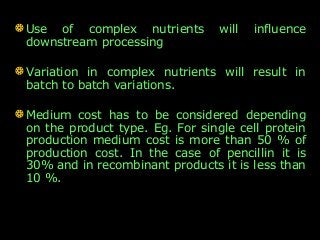
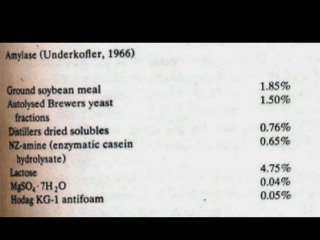
Use of complex nutrients will influence
downstream processing
Variation in complex nutrients will result in
batch to batch variations.
Medium cost has to be considered depending
on the product type. Eg. For single cell protein
production medium cost is more than 50 % of
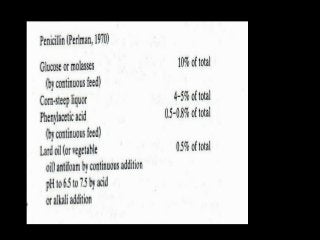
production cost. In the case of pencillin it is
30% and in recombinant products it is less than
10 %.
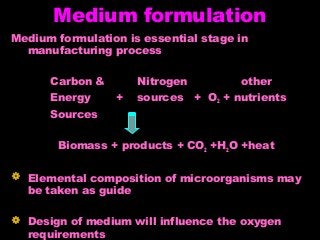
Medium formulation
Medium formulation is essential stage in
manufacturing process
Carbon & Nitrogen other
Energy + sources + O2 + nutrients
Sources
Biomass + products + CO2 +H2O +heat
 Elemental composition of microorganisms may
be taken as guide
 Design of medium will influence the oxygen
requirements
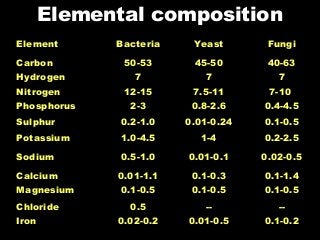
Elemental composition
Element Bacteria Yeast Fungi
Carbon 50-53 45-50 40-63
Hydrogen 7 7 7
Nitrogen 12-15 7.5-11 7-10
Phosphorus 2-3 0.8-2.6 0.4-4.5
Sulphur 0.2-1.0 0.01-0.24 0.1-0.5
Potassium 1.0-4.5 1-4 0.2-2.5
Sodium 0.5-1.0 0.01-0.1 0.02-0.5
Calcium 0.01-1.1 0.1-0.3 0.1-1.4
Magnesium 0.1-0.5 0.1-0.5 0.1-0.5
Chloride 0.5 -- --
Iron 0.02-0.2 0.01-0.5 0.1-0.2
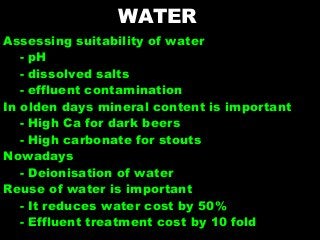
WATER
Assessing suitability of water
- pH
- dissolved salts
- effluent contamination
In olden days mineral content is important
- High Ca for dark beers
- High carbonate for stouts
Nowadays
- Deionisation of water
Reuse of water is important
- It reduces water cost by 50%
- Effluent treatment cost by 10 fold
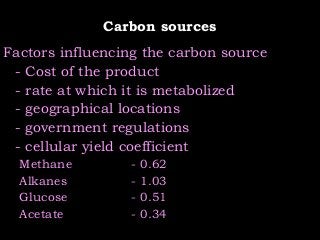
Carbon sources
Factors influencing the carbon source
- Cost of the product
- rate at which it is metabolized
- geographical locations
- government regulations
- cellular yield coefficient
Methane - 0.62
Alkanes - 1.03
Glucose - 0.51
Acetate - 0.34
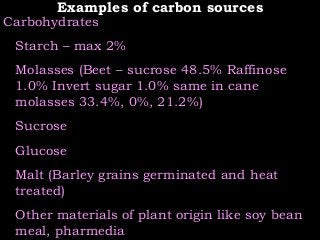
Examples of carbon sourcesExamples of carbon sources
Carbohydrates
Starch – max 2%
Molasses (Beet – sucrose 48.5% Raffinose
1.0% Invert sugar 1.0% same in cane
molasses 33.4%, 0%, 21.2%)
Sucrose
Glucose
Malt (Barley grains germinated and heat
treated)
Other materials of plant origin like soy bean
meal, pharmedia
Oils and fats
Oils are first used as antifoams and later
used as carbon sources (soya oil, olive oil,
maize oil, linseed oil etc.,)
Factors favouring oil
2.4 times energy than glucose
Hence volume advantage of 4 times.
some organisms can use only oils for
efficient production Eg. antibiotics (Methyl
oleate is used in cephalosporin)
Hydrocarbons and their derivatives
Now it is expensive
two times carbon and three times
energy than that of carbohydrates
Nitrogen sourcesNitrogen sources
Inorganic
Ammonia gas, ammonium chloride,
ammonium sulphate, ammonium nitrates,
sodium nitrates
Ammonia gas used for pH control
Ammonium salts produces acid conditions
when ammonia is utilised. pH drift
Sodium nitrate produces alkaline drift
Organic
Organic nitrogen may be supplied by
amino acids, protein, urea
Growth will be faster. These are commonly
added as complex nitrogen sources such
as soy bean meal, corn steep liquor etc.,
(During storage these sources are affected
by moisture, temperature and ageing)
Factors influencing choice of nitrogenFactors influencing choice of nitrogen
sourcesource
- Nitrate reductase enzyme is repressed by
ammonium ion. Hence ammonia or
ammonium salts are preferred
- Ammonium ions represses amino acid
uptake in fungal cultivations
- also ammonia regulates acid and alkaline
protease production
- antibiotic production by many fungi is
influenced by the nitrogen source.
- soy bean meal is preferred in polyene
antibiotics production due to slow hydrolysis
which prevents ammonia accumulation and
in turn aminoacid repression by it
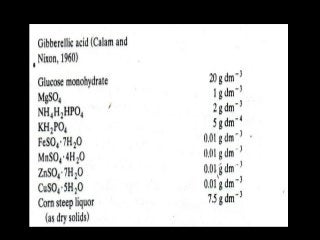
- in gibberellin production, nitrogen source
influence production of gibberellins
- some complex nitrogen sources may not be
utilised by some microorganisms which may
cause problem in downstream processing
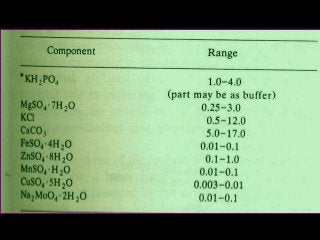
MineralsMinerals
All microorganisms require minerals for
growth and product formation
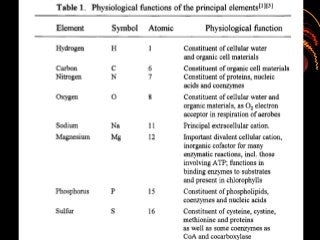
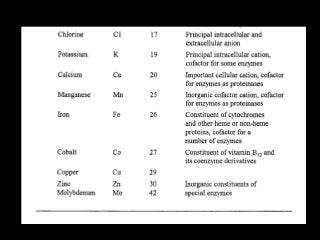
Magnesium, phosphorus, potassium,
sulphur, calcium, chlorine are essential
components
Cobalt, copper, manganese, iron,
molybdenum, zinc are also essential but in
traces.
Also depending on product analysis apart
from biomass minerals will be decided. E.g
sulphur in pencillins, cephalosporins,
chlorine in chlortetracyclin etc.,
Concentration of phosphate in medium is normally
required in excess for buffering the medium.
Phosphate concentration in the medium are
critical in antibiotic production since some
enzymes of biosynthesis are influenced by
phosphate
Other metal ions influence the production of
secondary metabolites
The functions of each vary from serving in
coenzyme functions to catalyze many reactions,
vitamin synthesis, and cell wall transport.
Citric acid & Penicillin production – Fe, Zn, Cu
Protease production – Mn
ChelatorsChelators
Many media cannot be prepared without
precipitation during autoclaving. Hence some
chelating agents are added to form complexes
with metal ions which are gradually utilised by
microorganism
Examples of chelators: EDTA, citric acid,
polyphosphates etc.,
It is important to check the concentration of
chelators otherwise it may inhibit the growth.
In many media these are added separately after
autoclaving Or yeast extract, peptone complex
with these metal ions
Mandel and Weber, 1969 (g l-1
)
Urea = 0.3 g
(NH4)2 SO4 = 1.4 g
K2HPO4 = 2 g
MnSO4. 7H2O = 1.6 mg
CoCl2.6H2O = 2 mg
CaCl2. 2H2O = 0.4 g
Mg SO4.7H2O = 0.3 g
FeSO4. 7H2O = 5 mg
ZnSO4. 7H2O = 1.4 mg
Peptone = 1 g
Yeast extract = 0.25 g
Maize / steep liquor= 10 g
Growth FactorsGrowth Factors
• Some microorganisms cannot synthesize a
full complement of cell components and
therefore require preformed compounds
called growth factors
• Eg.: vitamins, aminoacids, fatty acids or
sterols
• Complex media sources contain most of these
compounds. Careful blending of these will
give the required growth factors.
• For vinegar production – Calcium
Pantothenate
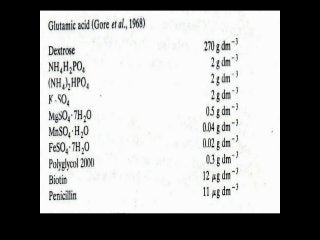
• For Glutamic acid – Biotin
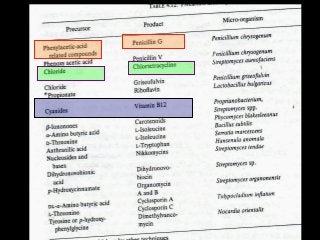
PrecursorsPrecursors
• Some chemicals when added to certain
fermentations are directly incorporated
into the desired product.
• Eg: Improving the yields of Pencillin
production
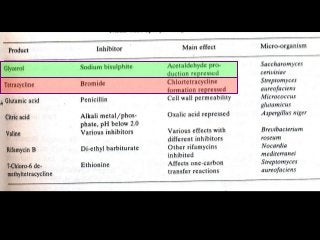
InhibitorsInhibitors
• When certain inhibitors are added to
fermentation more of a specific product
may be produced
• Eg : Glycerol fermentation
• Glycerol production depends on modifying
ethanol fermentation by removing
acetaldehyde
• Addition of sodium bisulphite forms
acetaldehyde bi sulphite. Acetaldehyde is
no longer available and dihydroxy acetone
is formed.
InducersInducers
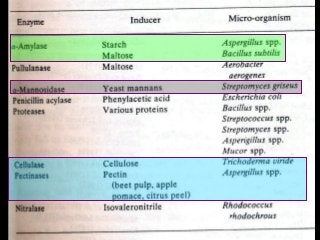
• Majority of the enzymes are inducible
• Substrates or substrates analogues are
used as inducers.
• Enzymes are produced in response to the
presence of these compounds in the
environment.
• Heterologous protein production in E.coli,
yeast etc.,
AntifoamsAntifoams
• Most fermentations foaming is major
problem.
• It may be due to component in the
medium or some factor produced by
the microorganism.
• Foaming can be controlled by
• Modification of medium
• Mechanical foam breakers
• Chemical agents antifoams are added
Eg: Fatty acids, silicones, PPG 2000
• Antifoams are surface active agents
reducing the surface tension in the
foam and destabilising the protein
films
• An ideal antifoam should have the
following properties
• Disperse readily and have fast action
• Active at low concentrations
• Long acting in preventing new foam
• Should not be metabolized
• Should not be toxic to m.o, humans etc
• Cheap, should not cause problem in
fermentation
Medium OptimizationMedium Optimization
When considering the biomass growth
phase in isolation, it must be recognized
that efficiently grown biomass produced by
an ‘optimized’ high productivity growth
phase is not necessarily best suited for its
ultimate purpose, such as synthesizing the
desired product.
 Classical designClassical design
Changing one variable at timeChanging one variable at time
Total no of experiments will be xTotal no of experiments will be xnn
x – no of levelx – no of level
n - no of variables or factorsn - no of variables or factors
For ex 3 levels and 6 variables have toFor ex 3 levels and 6 variables have to
be tested then the number ofbe tested then the number of
experiments will be 3experiments will be 366
=729=729
 Statistical optimization techniqueStatistical optimization technique
Plackett Burman designPlackett Burman design
Response surface methodologyResponse surface methodology
 Optimization through modellingOptimization through modelling
Design of Experiments (DOE)
oHelp you improve your processes. You
can screen the factors to determine which
are important for explaining process
variation.
oAfter you screen the factors, Minitab /
Design expert software helps you
understand how those factors interact and
drive your process.
Plackett Burman designPlackett Burman design
 More than five variables it is usefulMore than five variables it is useful
 It will be useful in screening theIt will be useful in screening the
most important variablemost important variable
 Here n no of experiments will beHere n no of experiments will be
conducted for n-1 variablesconducted for n-1 variables
 Where n is the multiples of 4 likeWhere n is the multiples of 4 like
8,12,16,20…1008,12,16,20…100
 Authors give a series ofAuthors give a series of
experimental design known asexperimental design known as
balanced incomplete blocksbalanced incomplete blocks
 Variables which is not having influenceVariables which is not having influence
in the process is designated as dummyin the process is designated as dummy
variablesvariables
 Dummy variables are required toDummy variables are required to
estimate the error in theestimate the error in the
experimentationexperimentation
 Minimum one or two dummy variablesMinimum one or two dummy variables
should be included in the experimentalshould be included in the experimental
setset
 More can be included if the realMore can be included if the real
variables are lessvariables are less
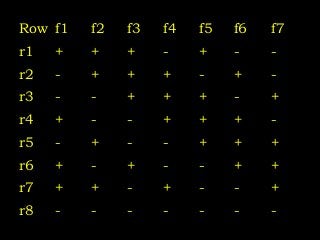
RowRow f1f1 f2f2 f3f3 f4f4 f5f5 f6f6 f7f7
r1r1 ++ ++ ++ -- ++ -- --
r2r2 -- ++ ++ ++ -- ++ --
r3r3 -- -- ++ ++ ++ -- ++
r4r4 ++ -- -- ++ ++ ++ --
r5r5 -- ++ -- -- ++ ++ ++
r6r6 ++ -- ++ -- -- ++ ++
r7r7 ++ ++ -- ++ -- -- ++
r8r8 -- -- -- -- -- -- --
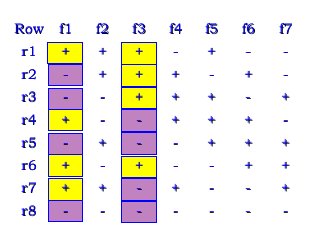
RowRow f1f1 f2f2 f3f3 f4f4 f5f5 f6f6 f7f7
r1r1 ++ ++ ++ -- ++ -- --
r2r2 -- ++ ++ ++ -- ++ --
r3r3 -- -- ++ ++ ++ -- ++
r4r4 ++ -- -- ++ ++ ++ --
r5r5 -- ++ -- -- ++ ++ ++
r6r6 ++ -- ++ -- -- ++ ++
r7r7 ++ ++ -- ++ -- -- ++
r8r8 -- -- -- -- -- -- --
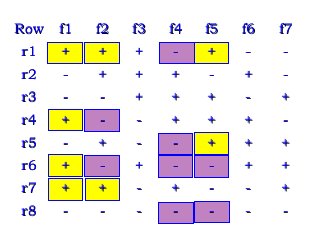
RowRow f1f1 f2f2 f3f3 f4f4 f5f5 f6f6 f7f7
r1r1 ++ ++ ++ -- ++ -- --
r2r2 -- ++ ++ ++ -- ++ --
r3r3 -- -- ++ ++ ++ -- ++
r4r4 ++ -- -- ++ ++ ++ --
r5r5 -- ++ -- -- ++ ++ ++
r6r6 ++ -- ++ -- -- ++ ++
r7r7 ++ ++ -- ++ -- -- ++
r8r8 -- -- -- -- -- -- --
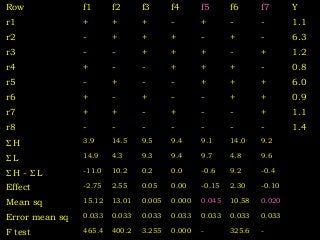
Row f1 f2 f3 f4 f5 f6 f7 Y
r1 + + + - + - - 1.1
r2 - + + + - + - 6.3
r3 - - + + + - + 1.2
r4 + - - + + + - 0.8
r5 - + - - + + + 6.0
r6 + - + - - + + 0.9
r7 + + - + - - + 1.1
r8 - - - - - - - 1.4
Σ H 3.9 14.5 9.5 9.4 9.1 14.0 9.2
Σ L 14.9 4.3 9.3 9.4 9.7 4.8 9.6
Σ H - Σ L -11.0 10.2 0.2 0.0 -0.6 9.2 -0.4
Effect -2.75 2.55 0.05 0.00 -0.15 2.30 -0.10
Mean sq 15.12 13.01 0.005 0.000 0.045 10.58 0.020
Error mean sq 0.033 0.033 0.033 0.033 0.033 0.033 0.033
F test 465.4 400.2 3.255 0.000 - 325.6 -
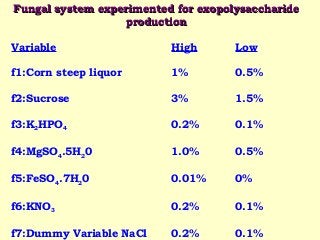
Fungal system experimented for exopolysaccharideFungal system experimented for exopolysaccharide
productionproduction
Variable High Low
f1:Corn steep liquor 1% 0.5%
f2:Sucrose 3% 1.5%
f3:K2HPO4 0.2% 0.1%
f4:MgSO4.5H20 1.0% 0.5%
f5:FeSO4.7H20 0.01% 0%
f6:KNO3 0.2% 0.1%
f7:Dummy Variable NaCl 0.2% 0.1%
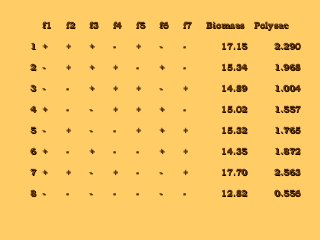
   f1f1 f2f2 f3f3 f4f4 f5f5 f6f6 f7f7 BiomassBiomass PolysacPolysac
11 ++ ++ ++ -- ++ -- -- 17.1517.15 2.2902.290
22 -- ++ ++ ++ -- ++ -- 15.3415.34 1.9681.968
33 -- -- ++ ++ ++ -- ++ 14.8914.89 1.0041.004
44 ++ -- -- ++ ++ ++ -- 15.0215.02 1.5571.557
55 -- ++ -- -- ++ ++ ++ 15.3215.32 1.7651.765
66 ++ -- ++ -- -- ++ ++ 14.3514.35 1.8721.872
77 ++ ++ -- ++ -- -- ++ 17.7017.70 2.5632.563
88 -- -- -- -- -- -- -- 12.8212.82 0.5560.556
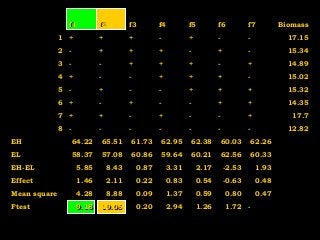
   f1f1 f2f2 f3f3 f4f4 f5f5 f6f6 f7f7 BiomassBiomass
11 ++ ++ ++ -- ++ -- -- 17.1517.15
22 -- ++ ++ ++ -- ++ -- 15.3415.34
33 -- -- ++ ++ ++ -- ++ 14.8914.89
44 ++ -- -- ++ ++ ++ -- 15.0215.02
55 -- ++ -- -- ++ ++ ++ 15.3215.32
66 ++ -- ++ -- -- ++ ++ 14.3514.35
77 ++ ++ -- ++ -- -- ++ 17.717.7
88 -- -- -- -- -- -- -- 12.8212.82
EHEH 64.2264.22 65.5165.51 61.7361.73 62.9562.95 62.3862.38 60.0360.03 62.2662.26   
ELEL 58.3758.37 57.0857.08 60.8660.86 59.6459.64 60.2160.21 62.5662.56 60.3360.33   
EH-ELEH-EL 5.855.85 8.438.43 0.870.87 3.313.31 2.172.17 -2.53-2.53 1.931.93   
EffectEffect 1.461.46 2.112.11 0.220.22 0.830.83 0.540.54 -0.63-0.63 0.480.48   
Mean squareMean square 4.284.28 8.888.88 0.090.09 1.371.37 0.590.59 0.800.80 0.470.47   
FtestFtest 9.189.18 19.0619.06 0.200.20 2.942.94 1.261.26 1.721.72 --   
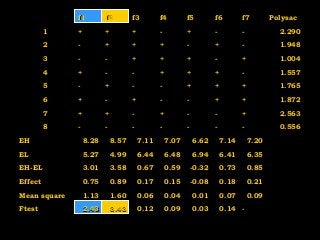
   f1f1 f2f2 f3f3 f4f4 f5f5 f6f6 f7f7 PolysacPolysac
11 ++ ++ ++ -- ++ -- -- 2.2902.290
22 -- ++ ++ ++ -- ++ -- 1.9481.948
33 -- -- ++ ++ ++ -- ++ 1.0041.004
44 ++ -- -- ++ ++ ++ -- 1.5571.557
55 -- ++ -- -- ++ ++ ++ 1.7651.765
66 ++ -- ++ -- -- ++ ++ 1.8721.872
77 ++ ++ -- ++ -- -- ++ 2.5632.563
88 -- -- -- -- -- -- -- 0.5560.556
EHEH 8.288.28 8.578.57 7.117.11 7.077.07 6.626.62 7.147.14 7.207.20   
ELEL 5.275.27 4.994.99 6.446.44 6.486.48 6.946.94 6.416.41 6.356.35   
EH-ELEH-EL 3.013.01 3.583.58 0.670.67 0.590.59 -0.32-0.32 0.730.73 0.850.85   
EffectEffect 0.750.75 0.890.89 0.170.17 0.150.15 -0.08-0.08 0.180.18 0.210.21   
Mean squareMean square 1.131.13 1.601.60 0.060.06 0.040.04 0.010.01 0.070.07 0.090.09   
FtestFtest 2.432.43 3.433.43 0.120.12 0.090.09 0.030.03 0.140.14 --   
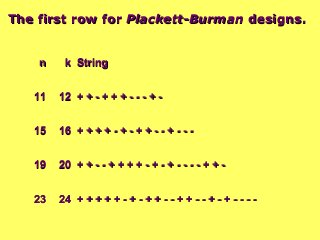
The first row forThe first row for Plackett-BurmanPlackett-Burman designs.designs.
nn kk StringString
1111 1212 + + - + + + - - - + -+ + - + + + - - - + -
1515 1616 + + + + - + - + + - - + - - -+ + + + - + - + + - - + - - -
1919 2020 + + - - + + + + - + - + - - - - + + -+ + - - + + + + - + - + - - - - + + -
2323 2424 + + + + + - + - + + - - + + - - + - + - - - -+ + + + + - + - + + - - + + - - + - + - - - -
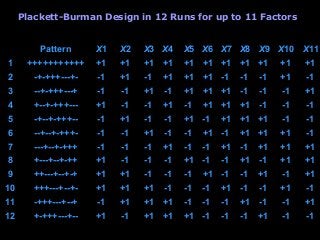
Plackett-Burman Design in 12 Runs for up to 11 FactorsPlackett-Burman Design in 12 Runs for up to 11 Factors
Pattern X1 X2 X3 X4 X5 X6 X7 X8 X9 X10 X11
1 +++++++++++ +1 +1 +1 +1 +1 +1 +1 +1 +1 +1 +1
2 -+-+++---+- -1 +1 -1 +1 +1 +1 -1 -1 -1 +1 -1
3 --+-+++---+ -1 -1 +1 -1 +1 +1 +1 -1 -1 -1 +1
4 +--+-+++--- +1 -1 -1 +1 -1 +1 +1 +1 -1 -1 -1
5 -+--+-+++-- -1 +1 -1 -1 +1 -1 +1 +1 +1 -1 -1
6 --+--+-+++- -1 -1 +1 -1 -1 +1 -1 +1 +1 +1 -1
7 ---+--+-+++ -1 -1 -1 +1 -1 -1 +1 -1 +1 +1 +1
8 +---+--+-++ +1 -1 -1 -1 +1 -1 -1 +1 -1 +1 +1
9 ++---+--+-+ +1 +1 -1 -1 -1 +1 -1 -1 +1 -1 +1
10 +++---+--+- +1 +1 +1 -1 -1 -1 +1 -1 -1 +1 -1
11 -+++---+--+ -1 +1 +1 +1 -1 -1 -1 +1 -1 -1 +1
12 +-+++---+-- +1 -1 +1 +1 +1 -1 -1 -1 +1 -1 -1
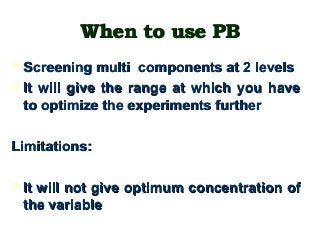
When to use PBWhen to use PB
 Screening multi components at 2 levelsScreening multi components at 2 levels
 It will give the range at which you haveIt will give the range at which you have
to optimize the experiments furtherto optimize the experiments further
Limitations:Limitations:
 It will not give optimum concentration ofIt will not give optimum concentration of
the variablethe variable
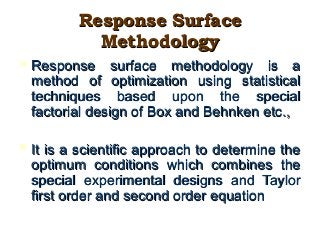
Response SurfaceResponse Surface
MethodologyMethodology
 Response surface methodology is aResponse surface methodology is a
method of optimization using statisticalmethod of optimization using statistical
techniques based upon the specialtechniques based upon the special
factorial design of Box and Behnken etc.,factorial design of Box and Behnken etc.,
 It is a scientific approach to determine theIt is a scientific approach to determine the
optimum conditions which combines theoptimum conditions which combines the
special experimental designs and Taylorspecial experimental designs and Taylor
first order and second order equationfirst order and second order equation
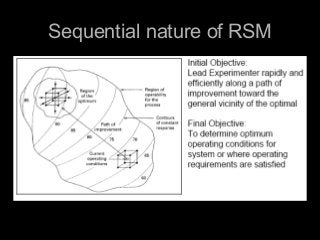
Sequential nature of RSMSequential nature of RSM
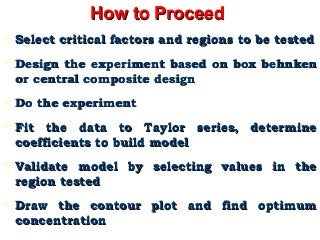
How to ProceedHow to Proceed
 Select critical factors and regions to be testedSelect critical factors and regions to be tested
 Design the experiment based on box behnkenDesign the experiment based on box behnken
or central composite designor central composite design
 Do the experimentDo the experiment
 Fit the data to Taylor series, determineFit the data to Taylor series, determine
coefficients to build modelcoefficients to build model
 Validate model by selecting values in theValidate model by selecting values in the
region testedregion tested
 Draw the contour plot and find optimumDraw the contour plot and find optimum
concentrationconcentration
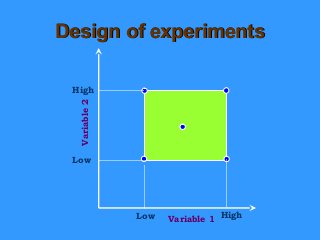
Design of experimentsDesign of experiments
Variable 1
Variable2
Low High
High
Low
Coding the variablesCoding the variables
Value of the variable - Middle pointValue of the variable - Middle point
Coding =Coding =
Difference/2Difference/2
Glucose = 10 – 30 g/lGlucose = 10 – 30 g/l
Coding 10 g/l glucose = [10-20]/(20/2) = -1Coding 10 g/l glucose = [10-20]/(20/2) = -1
Coding 30 g/l = ?Coding 30 g/l = ?
Coding 20 g/l ??Coding 20 g/l ??
Taylor seriesTaylor series
Yield Y =Yield Y = ββ00 ++ ββ11 XX11 ++ ββ1111 XX11
22
Constant term + Linear term + Quadratic termConstant term + Linear term + Quadratic term
Y=Y= ββ00 ++ ββ11 XX11 ++ ββ22 XX22 ++ ββ1111 XX11
22
++ ββ2222 XX22
22
++ ββ1212 XX11 XX22
αα = [2= [2nn
]]1/41/4
Design of experimentsDesign of experiments
[0,0]
[-1,-1]
[+1,+1]
[+1,_1]
[-1,+1]
[-1.414,0] [+1.414,0]
[0,+1.414]
[0,-1.414,0]
Variable 1
Variable2
Design the experiments for theDesign the experiments for the
following variable concentrationsfollowing variable concentrations
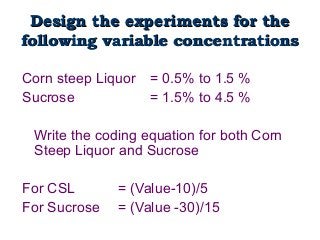
Corn steep Liquor = 0.5% to 1.5 %
Sucrose = 1.5% to 4.5 %
Write the coding equation for both Corn
Steep Liquor and Sucrose
For CSL = (Value-10)/5
For Sucrose = (Value -30)/15
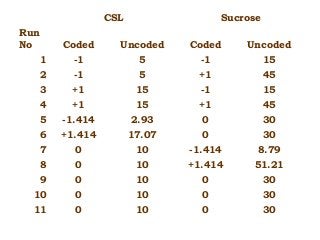
Run
No
CSL Sucrose
Coded Uncoded Coded Uncoded
1 -1 5 -1 15
2 -1 5 +1 45
3 +1 15 -1 15
4 +1 15 +1 45
5 -1.414 2.93 0 30
6 +1.414 17.07 0 30
7 0 10 -1.414 8.79
8 0 10 +1.414 51.21
9 0 10 0 30
10 0 10 0 30
11 0 10 0 30
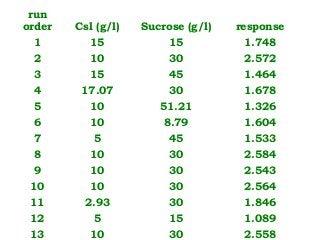
run
order Csl (g/l) Sucrose (g/l) response
1 15 15 1.748
2 10 30 2.572
3 15 45 1.464
4 17.07 30 1.678
5 10 51.21 1.326
6 10 8.79 1.604
7 5 45 1.533
8 10 30 2.584
9 10 30 2.543
10 10 30 2.564
11 2.93 30 1.846
12 5 15 1.089
13 10 30 2.558
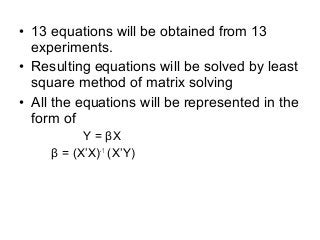
• 13 equations will be obtained from 13
experiments.
• Resulting equations will be solved by least
square method of matrix solving
• All the equations will be represented in the
form of
Y = βX
β = (X’X)-1
(X’Y)
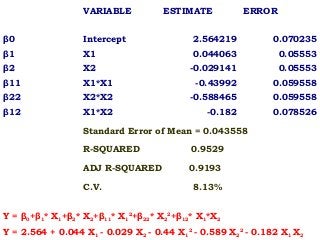
  VARIABLE ESTIMATE ERROR
       
β0 Intercept 2.564219 0.070235
β1 X1 0.044063 0.05553
β2 X2 -0.029141 0.05553
β11 X1*X1 -0.43992 0.059558
β22 X2*X2 -0.588465 0.059558
β12 X1*X2 -0.182 0.078526
Standard Error of Mean = 0.043558
R-SQUARED 0.9529
ADJ R-SQUARED 0.9193
C.V. 8.13%
Y = β0
+β1
* X1
+β2
* X2
+β11
* X1
2
+β22
* X2
2
+β12
* X1
*X2
Y = 2.564 + 0.044 X1
- 0.029 X2
- 0.44 X1
2
- 0.589 X2
2
- 0.182 X1
X2
http://www.itl.nist.gov/
div898/handbook/index.htm
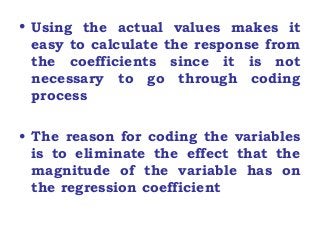
• Using the actual values makes it
easy to calculate the response from
the coefficients since it is not
necessary to go through coding
process
• The reason for coding the variables
is to eliminate the effect that the
magnitude of the variable has on
the regression coefficient
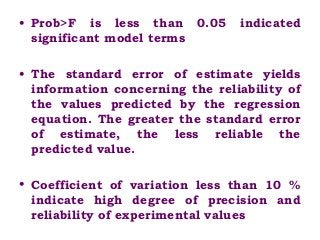
• Prob>F is less than 0.05 indicated
significant model terms
• The standard error of estimate yields
information concerning the reliability of
the values predicted by the regression
equation. The greater the standard error
of estimate, the less reliable the
predicted value.
• Coefficient of variation less than 10 %
indicate high degree of precision and
reliability of experimental values
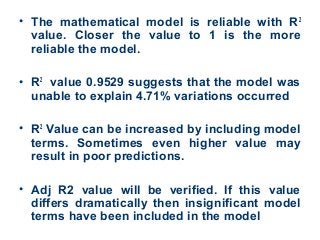
• The mathematical model is reliable with R2
value. Closer the value to 1 is the more
reliable the model.
• R2
value 0.9529 suggests that the model was
unable to explain 4.71% variations occurred
• R2
Value can be increased by including model
terms. Sometimes even higher value may
result in poor predictions.
• Adj R2 value will be verified. If this value
differs dramatically then insignificant model
terms have been included in the model
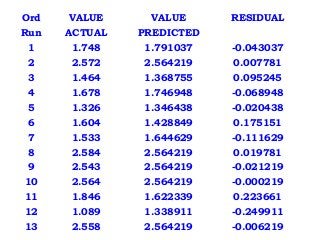
Ord VALUE VALUE RESIDUAL
Run ACTUAL PREDICTED  
1 1.748 1.791037 -0.043037
2 2.572 2.564219 0.007781
3 1.464 1.368755 0.095245
4 1.678 1.746948 -0.068948
5 1.326 1.346438 -0.020438
6 1.604 1.428849 0.175151
7 1.533 1.644629 -0.111629
8 2.584 2.564219 0.019781
9 2.543 2.564219 -0.021219
10 2.564 2.564219 -0.000219
11 1.846 1.622339 0.223661
12 1.089 1.338911 -0.249911
13 2.558 2.564219 -0.006219
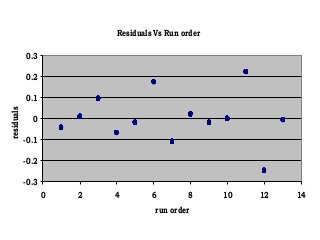
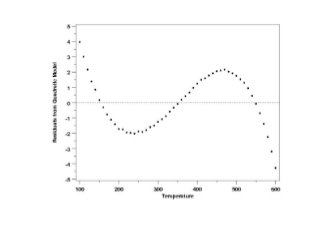
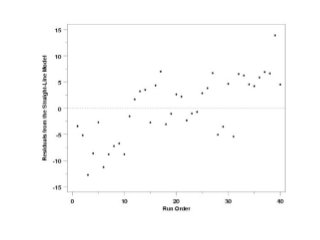
Residuals Vs Run order
-0.3
-0.2
-0.1
0
0.1
0.2
0.3
0 2 4 6 8 10 12 14
run order
residuals
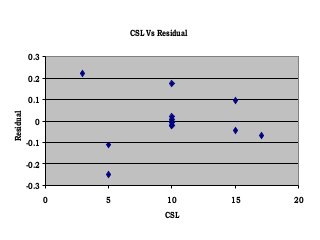
CSL Vs Residual
-0.3
-0.2
-0.1
0
0.1
0.2
0.3
0 5 10 15 20
CSL
Residual
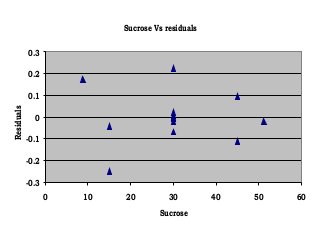
Sucrose Vs residuals
-0.3
-0.2
-0.1
0
0.1
0.2
0.3
0 10 20 30 40 50 60
Sucrose
Residuals
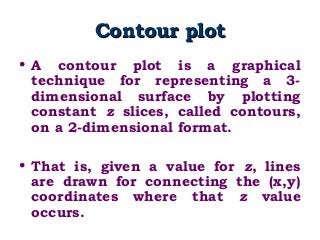
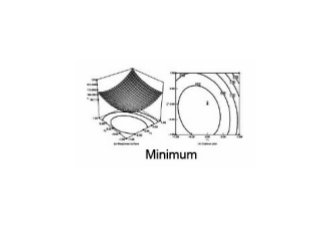
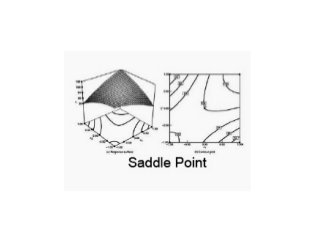
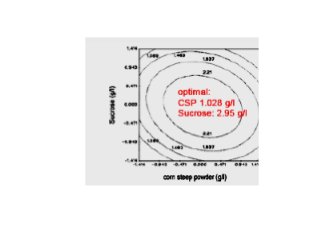
Contour plotContour plot
• A contour plot is a graphical
technique for representing a 3-
dimensional surface by plotting
constant z slices, called contours,
on a 2-dimensional format.
• That is, given a value for z, lines
are drawn for connecting the (x,y)
coordinates where that z value
occurs.
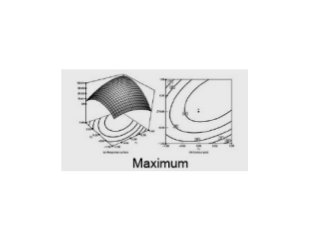
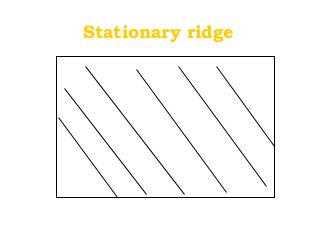
Stationary ridge
RISING RIDGERISING RIDGE
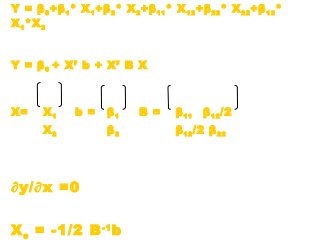
Y = β0+β1* X1+β2* X2+β11* X12+β22* X22+β12*
X1*X2
Y = β0 + X’ b + X’ B X
X= X1 b = β1 B = β11 β12/2
X2 β2 β12/2 β22
∂y/∂x =0
Xs = -1/2 B-1
b
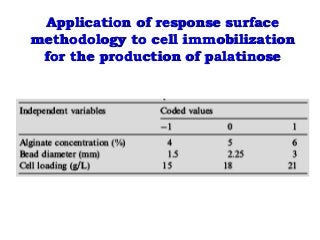
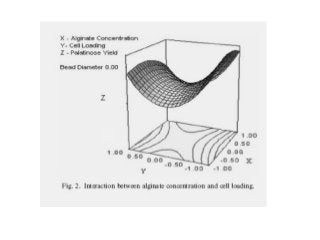
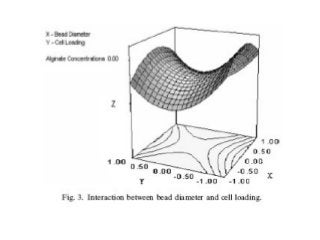
Application of response surfaceApplication of response surface
methodology to cell immobilizationmethodology to cell immobilization
for the production of palatinosefor the production of palatinose
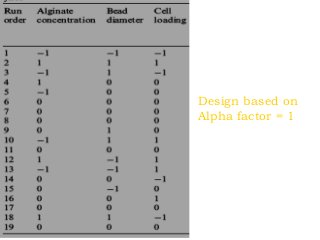
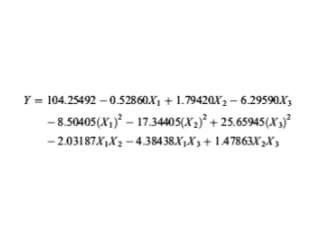
Design based on
Alpha factor = 1
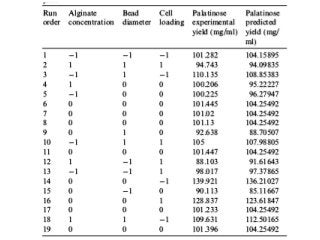
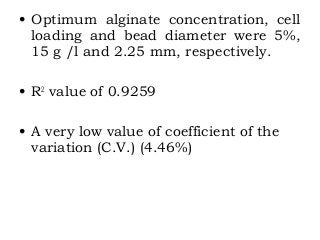
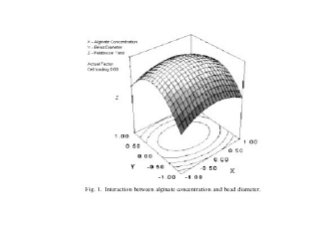
• Optimum alginate concentration, cell
loading and bead diameter were 5%,
15 g /l and 2.25 mm, respectively.
• R2
value of 0.9259
• A very low value of coefficient of the
variation (C.V.) (4.46%)
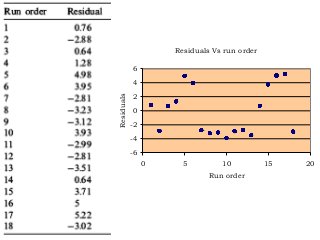
Residuals Vs run order
-6
-4
-2
0
2
4
6
0 5 10 15 20
Run order
Residuals
Media Formulation, Media Optimisation,

Media Formulation, Media Optimisation,

  • 1.
    Criteria for goodmedium • It will produce the maximum yield of product or biomass per gram of substrate used • It will produce the maximum concentration of biomass or product • It will permit the maximum rate of product formation • There will be minimum yield of undesired products • It will be of consistent quality and available throughout the year • It will cause minimal problems during medium sterilization • Other aspects of production process such as aeration, agitation, downstream processing, waste treatment
  • 2.
     Medium designedwill affect the design of fermenter ex oxidation of hydrocarbons highly aerobic process –air lift reactor  Problems will be encountered in scaling up. Since large reactors will have low mass transfer rate  High viscous medium will consume more power.  Besides growth and product formation medium will influence the pH variation, foam formation, morphological form of organism etc.,
  • 3.
    Use of complexnutrients will influence downstream processing Variation in complex nutrients will result in batch to batch variations. Medium cost has to be considered depending on the product type. Eg. For single cell protein production medium cost is more than 50 % of production cost. In the case of pencillin it is 30% and in recombinant products it is less than 10 %.
  • 10.
    Medium formulation Medium formulationis essential stage in manufacturing process Carbon & Nitrogen other Energy + sources + O2 + nutrients Sources Biomass + products + CO2 +H2O +heat  Elemental composition of microorganisms may be taken as guide  Design of medium will influence the oxygen requirements
  • 11.
    Elemental composition Element BacteriaYeast Fungi Carbon 50-53 45-50 40-63 Hydrogen 7 7 7 Nitrogen 12-15 7.5-11 7-10 Phosphorus 2-3 0.8-2.6 0.4-4.5 Sulphur 0.2-1.0 0.01-0.24 0.1-0.5 Potassium 1.0-4.5 1-4 0.2-2.5 Sodium 0.5-1.0 0.01-0.1 0.02-0.5 Calcium 0.01-1.1 0.1-0.3 0.1-1.4 Magnesium 0.1-0.5 0.1-0.5 0.1-0.5 Chloride 0.5 -- -- Iron 0.02-0.2 0.01-0.5 0.1-0.2
  • 12.
    WATER Assessing suitability ofwater - pH - dissolved salts - effluent contamination In olden days mineral content is important - High Ca for dark beers - High carbonate for stouts Nowadays - Deionisation of water Reuse of water is important - It reduces water cost by 50% - Effluent treatment cost by 10 fold
  • 13.
    Carbon sources Factors influencingthe carbon source - Cost of the product - rate at which it is metabolized - geographical locations - government regulations - cellular yield coefficient Methane - 0.62 Alkanes - 1.03 Glucose - 0.51 Acetate - 0.34
  • 14.
    Examples of carbonsourcesExamples of carbon sources Carbohydrates Starch – max 2% Molasses (Beet – sucrose 48.5% Raffinose 1.0% Invert sugar 1.0% same in cane molasses 33.4%, 0%, 21.2%) Sucrose Glucose Malt (Barley grains germinated and heat treated) Other materials of plant origin like soy bean meal, pharmedia
  • 15.
    Oils and fats Oilsare first used as antifoams and later used as carbon sources (soya oil, olive oil, maize oil, linseed oil etc.,) Factors favouring oil 2.4 times energy than glucose Hence volume advantage of 4 times. some organisms can use only oils for efficient production Eg. antibiotics (Methyl oleate is used in cephalosporin)
  • 16.
    Hydrocarbons and theirderivatives Now it is expensive two times carbon and three times energy than that of carbohydrates
  • 17.
    Nitrogen sourcesNitrogen sources Inorganic Ammoniagas, ammonium chloride, ammonium sulphate, ammonium nitrates, sodium nitrates Ammonia gas used for pH control Ammonium salts produces acid conditions when ammonia is utilised. pH drift Sodium nitrate produces alkaline drift
  • 18.
    Organic Organic nitrogen maybe supplied by amino acids, protein, urea Growth will be faster. These are commonly added as complex nitrogen sources such as soy bean meal, corn steep liquor etc., (During storage these sources are affected by moisture, temperature and ageing)
  • 19.
    Factors influencing choiceof nitrogenFactors influencing choice of nitrogen sourcesource - Nitrate reductase enzyme is repressed by ammonium ion. Hence ammonia or ammonium salts are preferred - Ammonium ions represses amino acid uptake in fungal cultivations - also ammonia regulates acid and alkaline protease production - antibiotic production by many fungi is influenced by the nitrogen source.
  • 20.
    - soy beanmeal is preferred in polyene antibiotics production due to slow hydrolysis which prevents ammonia accumulation and in turn aminoacid repression by it - in gibberellin production, nitrogen source influence production of gibberellins - some complex nitrogen sources may not be utilised by some microorganisms which may cause problem in downstream processing
  • 21.
    MineralsMinerals All microorganisms requireminerals for growth and product formation Magnesium, phosphorus, potassium, sulphur, calcium, chlorine are essential components Cobalt, copper, manganese, iron, molybdenum, zinc are also essential but in traces. Also depending on product analysis apart from biomass minerals will be decided. E.g sulphur in pencillins, cephalosporins, chlorine in chlortetracyclin etc.,
  • 23.
    Concentration of phosphatein medium is normally required in excess for buffering the medium. Phosphate concentration in the medium are critical in antibiotic production since some enzymes of biosynthesis are influenced by phosphate Other metal ions influence the production of secondary metabolites The functions of each vary from serving in coenzyme functions to catalyze many reactions, vitamin synthesis, and cell wall transport. Citric acid & Penicillin production – Fe, Zn, Cu Protease production – Mn
  • 24.
    ChelatorsChelators Many media cannotbe prepared without precipitation during autoclaving. Hence some chelating agents are added to form complexes with metal ions which are gradually utilised by microorganism Examples of chelators: EDTA, citric acid, polyphosphates etc., It is important to check the concentration of chelators otherwise it may inhibit the growth. In many media these are added separately after autoclaving Or yeast extract, peptone complex with these metal ions
  • 25.
    Mandel and Weber,1969 (g l-1 ) Urea = 0.3 g (NH4)2 SO4 = 1.4 g K2HPO4 = 2 g MnSO4. 7H2O = 1.6 mg CoCl2.6H2O = 2 mg CaCl2. 2H2O = 0.4 g Mg SO4.7H2O = 0.3 g FeSO4. 7H2O = 5 mg ZnSO4. 7H2O = 1.4 mg Peptone = 1 g Yeast extract = 0.25 g Maize / steep liquor= 10 g
  • 26.
    Growth FactorsGrowth Factors •Some microorganisms cannot synthesize a full complement of cell components and therefore require preformed compounds called growth factors • Eg.: vitamins, aminoacids, fatty acids or sterols • Complex media sources contain most of these compounds. Careful blending of these will give the required growth factors. • For vinegar production – Calcium Pantothenate • For Glutamic acid – Biotin
  • 27.
    PrecursorsPrecursors • Some chemicalswhen added to certain fermentations are directly incorporated into the desired product. • Eg: Improving the yields of Pencillin production
  • 29.
    InhibitorsInhibitors • When certaininhibitors are added to fermentation more of a specific product may be produced • Eg : Glycerol fermentation • Glycerol production depends on modifying ethanol fermentation by removing acetaldehyde • Addition of sodium bisulphite forms acetaldehyde bi sulphite. Acetaldehyde is no longer available and dihydroxy acetone is formed.
  • 31.
    InducersInducers • Majority ofthe enzymes are inducible • Substrates or substrates analogues are used as inducers. • Enzymes are produced in response to the presence of these compounds in the environment. • Heterologous protein production in E.coli, yeast etc.,
  • 33.
    AntifoamsAntifoams • Most fermentationsfoaming is major problem. • It may be due to component in the medium or some factor produced by the microorganism. • Foaming can be controlled by • Modification of medium • Mechanical foam breakers • Chemical agents antifoams are added Eg: Fatty acids, silicones, PPG 2000
  • 34.
    • Antifoams aresurface active agents reducing the surface tension in the foam and destabilising the protein films • An ideal antifoam should have the following properties • Disperse readily and have fast action • Active at low concentrations • Long acting in preventing new foam • Should not be metabolized • Should not be toxic to m.o, humans etc • Cheap, should not cause problem in fermentation
  • 35.
  • 36.
    When considering thebiomass growth phase in isolation, it must be recognized that efficiently grown biomass produced by an ‘optimized’ high productivity growth phase is not necessarily best suited for its ultimate purpose, such as synthesizing the desired product.
  • 37.
     Classical designClassicaldesign Changing one variable at timeChanging one variable at time Total no of experiments will be xTotal no of experiments will be xnn x – no of levelx – no of level n - no of variables or factorsn - no of variables or factors For ex 3 levels and 6 variables have toFor ex 3 levels and 6 variables have to be tested then the number ofbe tested then the number of experiments will be 3experiments will be 366 =729=729  Statistical optimization techniqueStatistical optimization technique Plackett Burman designPlackett Burman design Response surface methodologyResponse surface methodology  Optimization through modellingOptimization through modelling
  • 38.
    Design of Experiments(DOE) oHelp you improve your processes. You can screen the factors to determine which are important for explaining process variation. oAfter you screen the factors, Minitab / Design expert software helps you understand how those factors interact and drive your process.
  • 39.
    Plackett Burman designPlackettBurman design  More than five variables it is usefulMore than five variables it is useful  It will be useful in screening theIt will be useful in screening the most important variablemost important variable  Here n no of experiments will beHere n no of experiments will be conducted for n-1 variablesconducted for n-1 variables  Where n is the multiples of 4 likeWhere n is the multiples of 4 like 8,12,16,20…1008,12,16,20…100  Authors give a series ofAuthors give a series of experimental design known asexperimental design known as balanced incomplete blocksbalanced incomplete blocks
  • 40.
     Variables whichis not having influenceVariables which is not having influence in the process is designated as dummyin the process is designated as dummy variablesvariables  Dummy variables are required toDummy variables are required to estimate the error in theestimate the error in the experimentationexperimentation  Minimum one or two dummy variablesMinimum one or two dummy variables should be included in the experimentalshould be included in the experimental setset  More can be included if the realMore can be included if the real variables are lessvariables are less
  • 41.
    RowRow f1f1 f2f2f3f3 f4f4 f5f5 f6f6 f7f7 r1r1 ++ ++ ++ -- ++ -- -- r2r2 -- ++ ++ ++ -- ++ -- r3r3 -- -- ++ ++ ++ -- ++ r4r4 ++ -- -- ++ ++ ++ -- r5r5 -- ++ -- -- ++ ++ ++ r6r6 ++ -- ++ -- -- ++ ++ r7r7 ++ ++ -- ++ -- -- ++ r8r8 -- -- -- -- -- -- --
  • 42.
    RowRow f1f1 f2f2f3f3 f4f4 f5f5 f6f6 f7f7 r1r1 ++ ++ ++ -- ++ -- -- r2r2 -- ++ ++ ++ -- ++ -- r3r3 -- -- ++ ++ ++ -- ++ r4r4 ++ -- -- ++ ++ ++ -- r5r5 -- ++ -- -- ++ ++ ++ r6r6 ++ -- ++ -- -- ++ ++ r7r7 ++ ++ -- ++ -- -- ++ r8r8 -- -- -- -- -- -- --
  • 43.
    RowRow f1f1 f2f2f3f3 f4f4 f5f5 f6f6 f7f7 r1r1 ++ ++ ++ -- ++ -- -- r2r2 -- ++ ++ ++ -- ++ -- r3r3 -- -- ++ ++ ++ -- ++ r4r4 ++ -- -- ++ ++ ++ -- r5r5 -- ++ -- -- ++ ++ ++ r6r6 ++ -- ++ -- -- ++ ++ r7r7 ++ ++ -- ++ -- -- ++ r8r8 -- -- -- -- -- -- --
  • 44.
    Row f1 f2f3 f4 f5 f6 f7 Y r1 + + + - + - - 1.1 r2 - + + + - + - 6.3 r3 - - + + + - + 1.2 r4 + - - + + + - 0.8 r5 - + - - + + + 6.0 r6 + - + - - + + 0.9 r7 + + - + - - + 1.1 r8 - - - - - - - 1.4 Σ H 3.9 14.5 9.5 9.4 9.1 14.0 9.2 Σ L 14.9 4.3 9.3 9.4 9.7 4.8 9.6 Σ H - Σ L -11.0 10.2 0.2 0.0 -0.6 9.2 -0.4 Effect -2.75 2.55 0.05 0.00 -0.15 2.30 -0.10 Mean sq 15.12 13.01 0.005 0.000 0.045 10.58 0.020 Error mean sq 0.033 0.033 0.033 0.033 0.033 0.033 0.033 F test 465.4 400.2 3.255 0.000 - 325.6 -
  • 45.
    Fungal system experimentedfor exopolysaccharideFungal system experimented for exopolysaccharide productionproduction Variable High Low f1:Corn steep liquor 1% 0.5% f2:Sucrose 3% 1.5% f3:K2HPO4 0.2% 0.1% f4:MgSO4.5H20 1.0% 0.5% f5:FeSO4.7H20 0.01% 0% f6:KNO3 0.2% 0.1% f7:Dummy Variable NaCl 0.2% 0.1%
  • 46.
       f1f1 f2f2f3f3 f4f4 f5f5 f6f6 f7f7 BiomassBiomass PolysacPolysac 11 ++ ++ ++ -- ++ -- -- 17.1517.15 2.2902.290 22 -- ++ ++ ++ -- ++ -- 15.3415.34 1.9681.968 33 -- -- ++ ++ ++ -- ++ 14.8914.89 1.0041.004 44 ++ -- -- ++ ++ ++ -- 15.0215.02 1.5571.557 55 -- ++ -- -- ++ ++ ++ 15.3215.32 1.7651.765 66 ++ -- ++ -- -- ++ ++ 14.3514.35 1.8721.872 77 ++ ++ -- ++ -- -- ++ 17.7017.70 2.5632.563 88 -- -- -- -- -- -- -- 12.8212.82 0.5560.556
  • 47.
       f1f1 f2f2f3f3 f4f4 f5f5 f6f6 f7f7 BiomassBiomass 11 ++ ++ ++ -- ++ -- -- 17.1517.15 22 -- ++ ++ ++ -- ++ -- 15.3415.34 33 -- -- ++ ++ ++ -- ++ 14.8914.89 44 ++ -- -- ++ ++ ++ -- 15.0215.02 55 -- ++ -- -- ++ ++ ++ 15.3215.32 66 ++ -- ++ -- -- ++ ++ 14.3514.35 77 ++ ++ -- ++ -- -- ++ 17.717.7 88 -- -- -- -- -- -- -- 12.8212.82 EHEH 64.2264.22 65.5165.51 61.7361.73 62.9562.95 62.3862.38 60.0360.03 62.2662.26    ELEL 58.3758.37 57.0857.08 60.8660.86 59.6459.64 60.2160.21 62.5662.56 60.3360.33    EH-ELEH-EL 5.855.85 8.438.43 0.870.87 3.313.31 2.172.17 -2.53-2.53 1.931.93    EffectEffect 1.461.46 2.112.11 0.220.22 0.830.83 0.540.54 -0.63-0.63 0.480.48    Mean squareMean square 4.284.28 8.888.88 0.090.09 1.371.37 0.590.59 0.800.80 0.470.47    FtestFtest 9.189.18 19.0619.06 0.200.20 2.942.94 1.261.26 1.721.72 --   
  • 48.
       f1f1 f2f2f3f3 f4f4 f5f5 f6f6 f7f7 PolysacPolysac 11 ++ ++ ++ -- ++ -- -- 2.2902.290 22 -- ++ ++ ++ -- ++ -- 1.9481.948 33 -- -- ++ ++ ++ -- ++ 1.0041.004 44 ++ -- -- ++ ++ ++ -- 1.5571.557 55 -- ++ -- -- ++ ++ ++ 1.7651.765 66 ++ -- ++ -- -- ++ ++ 1.8721.872 77 ++ ++ -- ++ -- -- ++ 2.5632.563 88 -- -- -- -- -- -- -- 0.5560.556 EHEH 8.288.28 8.578.57 7.117.11 7.077.07 6.626.62 7.147.14 7.207.20    ELEL 5.275.27 4.994.99 6.446.44 6.486.48 6.946.94 6.416.41 6.356.35    EH-ELEH-EL 3.013.01 3.583.58 0.670.67 0.590.59 -0.32-0.32 0.730.73 0.850.85    EffectEffect 0.750.75 0.890.89 0.170.17 0.150.15 -0.08-0.08 0.180.18 0.210.21    Mean squareMean square 1.131.13 1.601.60 0.060.06 0.040.04 0.010.01 0.070.07 0.090.09    FtestFtest 2.432.43 3.433.43 0.120.12 0.090.09 0.030.03 0.140.14 --   
  • 49.
    The first rowforThe first row for Plackett-BurmanPlackett-Burman designs.designs. nn kk StringString 1111 1212 + + - + + + - - - + -+ + - + + + - - - + - 1515 1616 + + + + - + - + + - - + - - -+ + + + - + - + + - - + - - - 1919 2020 + + - - + + + + - + - + - - - - + + -+ + - - + + + + - + - + - - - - + + - 2323 2424 + + + + + - + - + + - - + + - - + - + - - - -+ + + + + - + - + + - - + + - - + - + - - - -
  • 50.
    Plackett-Burman Design in12 Runs for up to 11 FactorsPlackett-Burman Design in 12 Runs for up to 11 Factors Pattern X1 X2 X3 X4 X5 X6 X7 X8 X9 X10 X11 1 +++++++++++ +1 +1 +1 +1 +1 +1 +1 +1 +1 +1 +1 2 -+-+++---+- -1 +1 -1 +1 +1 +1 -1 -1 -1 +1 -1 3 --+-+++---+ -1 -1 +1 -1 +1 +1 +1 -1 -1 -1 +1 4 +--+-+++--- +1 -1 -1 +1 -1 +1 +1 +1 -1 -1 -1 5 -+--+-+++-- -1 +1 -1 -1 +1 -1 +1 +1 +1 -1 -1 6 --+--+-+++- -1 -1 +1 -1 -1 +1 -1 +1 +1 +1 -1 7 ---+--+-+++ -1 -1 -1 +1 -1 -1 +1 -1 +1 +1 +1 8 +---+--+-++ +1 -1 -1 -1 +1 -1 -1 +1 -1 +1 +1 9 ++---+--+-+ +1 +1 -1 -1 -1 +1 -1 -1 +1 -1 +1 10 +++---+--+- +1 +1 +1 -1 -1 -1 +1 -1 -1 +1 -1 11 -+++---+--+ -1 +1 +1 +1 -1 -1 -1 +1 -1 -1 +1 12 +-+++---+-- +1 -1 +1 +1 +1 -1 -1 -1 +1 -1 -1
  • 51.
    When to usePBWhen to use PB  Screening multi components at 2 levelsScreening multi components at 2 levels  It will give the range at which you haveIt will give the range at which you have to optimize the experiments furtherto optimize the experiments further Limitations:Limitations:  It will not give optimum concentration ofIt will not give optimum concentration of the variablethe variable
  • 52.
    Response SurfaceResponse Surface MethodologyMethodology Response surface methodology is aResponse surface methodology is a method of optimization using statisticalmethod of optimization using statistical techniques based upon the specialtechniques based upon the special factorial design of Box and Behnken etc.,factorial design of Box and Behnken etc.,  It is a scientific approach to determine theIt is a scientific approach to determine the optimum conditions which combines theoptimum conditions which combines the special experimental designs and Taylorspecial experimental designs and Taylor first order and second order equationfirst order and second order equation
  • 53.
    Sequential nature ofRSMSequential nature of RSM
  • 54.
    How to ProceedHowto Proceed  Select critical factors and regions to be testedSelect critical factors and regions to be tested  Design the experiment based on box behnkenDesign the experiment based on box behnken or central composite designor central composite design  Do the experimentDo the experiment  Fit the data to Taylor series, determineFit the data to Taylor series, determine coefficients to build modelcoefficients to build model  Validate model by selecting values in theValidate model by selecting values in the region testedregion tested  Draw the contour plot and find optimumDraw the contour plot and find optimum concentrationconcentration
  • 55.
    Design of experimentsDesignof experiments Variable 1 Variable2 Low High High Low
  • 56.
    Coding the variablesCodingthe variables Value of the variable - Middle pointValue of the variable - Middle point Coding =Coding = Difference/2Difference/2 Glucose = 10 – 30 g/lGlucose = 10 – 30 g/l Coding 10 g/l glucose = [10-20]/(20/2) = -1Coding 10 g/l glucose = [10-20]/(20/2) = -1 Coding 30 g/l = ?Coding 30 g/l = ? Coding 20 g/l ??Coding 20 g/l ??
  • 57.
    Taylor seriesTaylor series YieldY =Yield Y = ββ00 ++ ββ11 XX11 ++ ββ1111 XX11 22 Constant term + Linear term + Quadratic termConstant term + Linear term + Quadratic term Y=Y= ββ00 ++ ββ11 XX11 ++ ββ22 XX22 ++ ββ1111 XX11 22 ++ ββ2222 XX22 22 ++ ββ1212 XX11 XX22 αα = [2= [2nn ]]1/41/4
  • 58.
    Design of experimentsDesignof experiments [0,0] [-1,-1] [+1,+1] [+1,_1] [-1,+1] [-1.414,0] [+1.414,0] [0,+1.414] [0,-1.414,0] Variable 1 Variable2
  • 59.
    Design the experimentsfor theDesign the experiments for the following variable concentrationsfollowing variable concentrations Corn steep Liquor = 0.5% to 1.5 % Sucrose = 1.5% to 4.5 % Write the coding equation for both Corn Steep Liquor and Sucrose For CSL = (Value-10)/5 For Sucrose = (Value -30)/15
  • 60.
    Run No CSL Sucrose Coded UncodedCoded Uncoded 1 -1 5 -1 15 2 -1 5 +1 45 3 +1 15 -1 15 4 +1 15 +1 45 5 -1.414 2.93 0 30 6 +1.414 17.07 0 30 7 0 10 -1.414 8.79 8 0 10 +1.414 51.21 9 0 10 0 30 10 0 10 0 30 11 0 10 0 30
  • 61.
    run order Csl (g/l)Sucrose (g/l) response 1 15 15 1.748 2 10 30 2.572 3 15 45 1.464 4 17.07 30 1.678 5 10 51.21 1.326 6 10 8.79 1.604 7 5 45 1.533 8 10 30 2.584 9 10 30 2.543 10 10 30 2.564 11 2.93 30 1.846 12 5 15 1.089 13 10 30 2.558
  • 62.
    • 13 equationswill be obtained from 13 experiments. • Resulting equations will be solved by least square method of matrix solving • All the equations will be represented in the form of Y = βX β = (X’X)-1 (X’Y)
  • 63.
      VARIABLE ESTIMATEERROR         β0 Intercept 2.564219 0.070235 β1 X1 0.044063 0.05553 β2 X2 -0.029141 0.05553 β11 X1*X1 -0.43992 0.059558 β22 X2*X2 -0.588465 0.059558 β12 X1*X2 -0.182 0.078526 Standard Error of Mean = 0.043558 R-SQUARED 0.9529 ADJ R-SQUARED 0.9193 C.V. 8.13% Y = β0 +β1 * X1 +β2 * X2 +β11 * X1 2 +β22 * X2 2 +β12 * X1 *X2 Y = 2.564 + 0.044 X1 - 0.029 X2 - 0.44 X1 2 - 0.589 X2 2 - 0.182 X1 X2
  • 64.
  • 65.
    • Using theactual values makes it easy to calculate the response from the coefficients since it is not necessary to go through coding process • The reason for coding the variables is to eliminate the effect that the magnitude of the variable has on the regression coefficient
  • 66.
    • Prob>F isless than 0.05 indicated significant model terms • The standard error of estimate yields information concerning the reliability of the values predicted by the regression equation. The greater the standard error of estimate, the less reliable the predicted value. • Coefficient of variation less than 10 % indicate high degree of precision and reliability of experimental values
  • 67.
    • The mathematicalmodel is reliable with R2 value. Closer the value to 1 is the more reliable the model. • R2 value 0.9529 suggests that the model was unable to explain 4.71% variations occurred • R2 Value can be increased by including model terms. Sometimes even higher value may result in poor predictions. • Adj R2 value will be verified. If this value differs dramatically then insignificant model terms have been included in the model
  • 68.
    Ord VALUE VALUERESIDUAL Run ACTUAL PREDICTED   1 1.748 1.791037 -0.043037 2 2.572 2.564219 0.007781 3 1.464 1.368755 0.095245 4 1.678 1.746948 -0.068948 5 1.326 1.346438 -0.020438 6 1.604 1.428849 0.175151 7 1.533 1.644629 -0.111629 8 2.584 2.564219 0.019781 9 2.543 2.564219 -0.021219 10 2.564 2.564219 -0.000219 11 1.846 1.622339 0.223661 12 1.089 1.338911 -0.249911 13 2.558 2.564219 -0.006219
  • 69.
    Residuals Vs Runorder -0.3 -0.2 -0.1 0 0.1 0.2 0.3 0 2 4 6 8 10 12 14 run order residuals
  • 70.
  • 71.
    Sucrose Vs residuals -0.3 -0.2 -0.1 0 0.1 0.2 0.3 010 20 30 40 50 60 Sucrose Residuals
  • 74.
    Contour plotContour plot •A contour plot is a graphical technique for representing a 3- dimensional surface by plotting constant z slices, called contours, on a 2-dimensional format. • That is, given a value for z, lines are drawn for connecting the (x,y) coordinates where that z value occurs.
  • 78.
  • 79.
  • 81.
    Y = β0+β1*X1+β2* X2+β11* X12+β22* X22+β12* X1*X2 Y = β0 + X’ b + X’ B X X= X1 b = β1 B = β11 β12/2 X2 β2 β12/2 β22 ∂y/∂x =0 Xs = -1/2 B-1 b
  • 82.
    Application of responsesurfaceApplication of response surface methodology to cell immobilizationmethodology to cell immobilization for the production of palatinosefor the production of palatinose
  • 83.
  • 86.
    • Optimum alginateconcentration, cell loading and bead diameter were 5%, 15 g /l and 2.25 mm, respectively. • R2 value of 0.9259 • A very low value of coefficient of the variation (C.V.) (4.46%)
  • 87.
    Residuals Vs runorder -6 -4 -2 0 2 4 6 0 5 10 15 20 Run order Residuals